Feedback on work performance has long been recognized for its instructional and motivational functions in enhancing the effectiveness of organizational members (Ilgen, Fisher, & Taylor, Reference Ilgen, Fisher and Taylor1979; Kluger & DeNisi, Reference Kluger and DeNisi1996). As organizations increasingly acknowledge the importance of self-initiated proactive learning and development of employees, research on how to promote their feedback-seeking behavior has drawn much attention from researchers and practitioners in the field of human resource management (Reference Anseel, Beatty, Shen, Lievens and SackettAnseel, Beatty, Shen, Lievens, & Sackett, in press; Ashford, Blatt, & VandeWalle, Reference Ashford, Blatt and VandeWalle2003; De Stobbeleir, Ashford, & Buyens, Reference De Stobbeleir, Ashford and Buyens2011). Failure to seek diagnostic feedback is often adversely associated with self-regulatory process (Morrison & Weldon, Reference Morrison and Weldon1990) and the accuracy and fairness of performance appraisal (Morrison & Bies, Reference Morrison and Bies1991). Thus, it is important to identify ways to encourage employees to proactively seek performance feedback in light of intervention possibilities for developing human resources.
The supervisor-subordinate relationship is one of the most common yet vital components in any organization. Supervisors can instruct and motivate subordinates to actualize their potential by providing subordinates with feedback on work performance (Ilgen, Fisher, & Taylor, Reference Ilgen, Fisher and Taylor1979). Subordinates can also proactively seek performance feedback, which helps them gain control over their own performance through self-managed learning and development (Ashford & Cummings, Reference Ashford and Cummings1983; Ashford, Blatt, & VandeWalle, Reference Ashford, Blatt and VandeWalle2003). As such, the feedback exchange operates on both sides in the supervisory relationships. For a complete understanding of the phenomenon of subordinates’ feedback-seeking, it is essential to simultaneously consider subordinates’ individuality (e.g., learning goal orientation) and motives for feedback-seeking (e.g., performance enhancement), supervisors’ characteristics (e.g., source credibility), and dyadic attributes (e.g., leader-member relationship quality) from an integrative perspective (Anseel, Lievens, & Levy, Reference Anseel, Lievens and Levy2007).
Surprisingly, however, the way supervisor, subordinate, and dyadic characteristics simultaneously interplay to predict a subordinate's feedback-seeking behavior has been subject to little empirical scrutiny, with a couple of exceptions (e.g., VandeWalle, Ganesan, Challagalla, & Brown, Reference VandeWalle, Ganesan, Challagalla and Brown2000; Lam, Huang, & Snape, Reference Lam, Huang and Snape2007). Specifically, these individual and relational characteristics in the supervisory relationships can activate subordinates’ conflicting feedback-seeking motives and in turn lead to their perception of both cost and value of the feedback-seeking behavior (Ashford, Blatt, & VandeWalle, Reference Ashford, Blatt and VandeWalle2003). For example, subordinates with high learning goal orientation in a poor supervisory relationship should hold both an instrumental motive for self-improvement and an image-concern motive for obtaining a favorable image in the eyes of their supervisor, which in turn induce the perception of both information value and image cost of feedback-seeking attempt (VandeWalle et al., Reference VandeWalle, Ganesan, Challagalla and Brown2000). Nonetheless, most prior studies have examined the direct effects of supervisor, subordinate, and dyadic characteristics on feedback-seeking behavior in isolation, ignoring the possible interactions among them (Reference Anseel, Beatty, Shen, Lievens and SackettAnseel et al., in press). Accordingly, the mechanism of how subordinates manage competing motives for feedback-seeking and subsequent cost-value comparison in a feedback-seeking decision remains unclear (Reference Anseel, Beatty, Shen, Lievens and SackettAnseel et al., in press).
The purpose of this study is to fill this research gap by exploring dynamic relationships among supervisor (i.e., leader credibility), subordinate (i.e., self-monitoring, referring to the extent of an individual's willingness and ability to monitor and control self-expression in social settings (Snyder, Reference Snyder1974)), and dyadic (i.e., leader-member exchange quality: LMX quality [Graen & Uhl-Bien, Reference Graen and Uhl-Bien1995]) characteristics as antecedents of feedback-seeking behavior. We first examined the mediating role of subordinates’ perception of feedback-seeking cost to specify the process through which LMX quality promotes their feedback-seeking. We then examined the moderating effects of subordinates’ self-monitoring and leader credibility on the relationship between cost perception and feedback-seeking behavior. Finally, we investigated whether the cost-minimizing indirect effect of LMX quality on feedback-seeking behavior was contingent on the levels of subordinates’ self-monitoring and leader credibility. That is, we explored an integrative moderated mediation model, as presented in Figure 1. Accordingly, this study aims to highlight a way to reduce the perceived cost of feedback-seeking and identify contingency factors that buffer against the negative effect of such cost on feedback-seeking attempt.
A moderated mediation model of the relationship between LMX quality and feedback-seeking behavior

We chose to examine the research model in large banking institutions in Korea. The frequency and mode of feedback-seeking behavior may vary across different types of work (Ashford, Blatt, & VandeWalle, Reference Ashford, Blatt and VandeWalle2003) and by national culture (Sully de Luque & Sommer, Reference Sully de Luque and Sommer2000). Most types of work in the banking industry tend to be highly formalized; thus work-related feedback may be less likely to be sought in this work setting where task uncertainty may not be a salient concern (Ashford & Cummings, Reference Ashford and Cummings1983; Ashford, Blatt, & VandeWalle, Reference Ashford, Blatt and VandeWalle2003). In addition, Morrison, Chen, and Salgado (Reference Morrison, Chen and Salgado2004) found that newcomers to an organization in high power distance and high collectivism societies such as Korea (Triandis, Reference Triandis1995) reported less feedback inquiry from their supervisors. In high power distance cultures where seniority rule system prevails, performance feedback is typically given rather than sought by subordinates (Sully de Luque & Sommer, Reference Sully de Luque and Sommer2000). Furthermore, feedback-seeking behavior can be viewed as a sign of incompetence (Ashford & Cummings, Reference Ashford and Cummings1983) and thus may be less frequently found in collectivistic cultures that emphasize maintaining a favorable public image and building good relationships with others (Morrison, Chen, & Salgado, Reference Morrison, Chen and Salgado2004).
On the other hand, in the process of overcoming the 1997 Korean financial crisis, the majority of Korean banks had to carry out rigorous job cuts and salary reductions while changing their seniority-based promotion and pay systems to performance-based ones (Lee, Reference Lee2003). As Korean banking institutions have increasingly emphasized proactive learning and development of employees, self-improvement through active seeking of performance feedback appears critical for career success and employment security in the banking industry in Korea.
Accordingly, it is readily presumed that subordinates in Korean banks have to deal with an increasing feedback-seeking demand for performance enhancement while also considering the potential cost of negative public image elicited by such behavior. However, this proposition has been rarely examined in the literature on feedback-seeking behavior. We attempt to address this gap, and the findings of this study may have implications for feedback-seeking literature and human resource practices in other Asian contexts as well. In the next section, we specify how this study contributes to the existing feedback-seeking literature by providing the underlying theoretical rationale for our research model.
THEORETICAL BACKGROUND AND HYPOTHESES
The research model of this study is based on the conceptual process model of feedback-seeking (Ashford, Blatt, & VandeWalle, Reference Ashford, Blatt and VandeWalle2003; Anseel, Lievens, & Levy, Reference Anseel, Lievens and Levy2007). Building on Ashford and Cummings’ (Reference Ashford and Cummings1983) seminal work, most studies of feedback-seeking behavior have identified three motives for such actions (i.e., instrumental, ego-based, and image-based) and primarily used the motivational perspective as a theoretical underpinning to explain various patterns of feedback-seeking behavior (Reference Anseel, Beatty, Shen, Lievens and SackettAnseel et al., in press; Ashford, Blatt, & VandeWalle, Reference Ashford, Blatt and VandeWalle2003; Anseel, Lievens, & Levy, Reference Anseel, Lievens and Levy2007).
First, employees can be instrumentally motivated to seek feedback, because it has information value that helps them reduce uncertainty, diagnose problems, develop competence, and enhance work performance (Ashford & Tsui, Reference Ashford and Tsui1991). Second, individuals are motivated to protect their ego (Baumeister, Reference Baumeister1999). Because feedback contains evaluative information, individuals are likely to refrain from seeking feedback when they expect the feedback to potentially hurt their self-esteem (Ashford & Cummings, Reference Ashford and Cummings1983; Ashford, Blatt, & VandeWalle, Reference Ashford, Blatt and VandeWalle2003). Finally, one's feedback-seeking behavior may be viewed negatively by others as a sign of incompetence, or it may be interpreted positively as a sign of willingness for self-improvement (Ashford & Cummings, Reference Ashford and Cummings1983). As individuals desire a positive image in the eyes of others (Baumeister, Reference Baumeister1999), their feedback-seeking decisions may depend on whether they perceive that the elicited feedback enhances or harms their public image (Morrison & Bies, Reference Morrison and Bies1991).
An important tenet of the process model of feedback-seeking is that the three motives do not directly lead to feedback-seeking behavior (Ashford, Blatt, & VandeWalle, Reference Ashford, Blatt and VandeWalle2003; Anseel, Lievens, & Levy, Reference Anseel, Lievens and Levy2007). Rather, depending on what motives are activated, individuals consciously evaluate the potential costs and values their feedback-seeking behavior entails. The result of such cost-value analysis is then the primary determinant of actual feedback-seeking behavior (Anseel, Lievens, & Levy, Reference Anseel, Lievens and Levy2007). Researchers of feedback-seeking have attempted to identify various individual and situational factors that influence the activation of feedback-seeking motives (Ashford, Blatt, & VandeWalle, Reference Ashford, Blatt and VandeWalle2003), because the activation of underlying motives and subsequent cost-value analyses are readily inferred by examining the effects of those factors on feedback-seeking behavior (Reference Anseel, Beatty, Shen, Lievens and SackettAnseel et al., in press). For example, the positive relationship between source credibility (i.e., expertise) and feedback- seeking behavior implies an activation of the instrumental motive that enhances the perceived value of feedback-seeking behavior (Fedor, Rensvold, & Adams, Reference Fedor, Rensvold and Adams1992; Vancouver & Morrison, Reference Vancouver and Morrison1995). Therefore, in most studies of feedback-seeking, the intermediate process linking the individual and situational variables to feedback-seeking behavior has been theoretically taken for granted rather than directly tested, unless a specific intermediate process is the primary focus of study (cf. Reference Anseel, Beatty, Shen, Lievens and SackettAnseel et al., in press).
Another important premise of the feedback-seeking process is that competing feedback-seeking motives are activated simultaneously and lead to both cost and value perception, given the various individual and situational variables in a feedback-seeking setting (Ashford, Blatt, & VandeWalle, Reference Ashford, Blatt and VandeWalle2003; Anseel, Lievens, & Levy, Reference Anseel, Lievens and Levy2007). For example, a newcomer in an organization may be motivated to seek feedback to reduce uncertainty (i.e., instrumental motive), yet he or she may be also concerned about conveying a negative image (e.g., incompetence) to coworkers by feedback-seeking (i.e., ego- and image-based motives) (Morrison, Reference Morrison1993). Therefore, to understand whether the value associated with a feedback-seeking attempt overrides the cost of such action and vice versa, it is essential to examine the pattern of interaction among individual and situational factors relevant to the activation of certain feedback-seeking motives (Anseel, Lievens, & Levy, Reference Anseel, Lievens and Levy2007; Hays & Williams, Reference Hays and Williams2011).
Consistent with most prior studies of feedback-seeking, this study does not directly test the intermediate feedback-seeking process in which each of the supervisor, subordinate, and dyadic characteristics makes a particular feedback-seeking motive more salient than the others, leading to the corresponding cost-value comparison. Instead, we theoretically infer the intermediate process in developing research hypotheses that represent a moderated mediation relationship among supervisor (i.e., leader credibility), subordinate (i.e., self-monitoring), and dyadic (i.e., LMX quality) variables in predicting subordinates’ feedback-seeking behavior. However, as this study attempts to emphasize the ways to reduce the perceived cost of feedback-seeking, we directly incorporated the perceived cost of feedback-seeking in the research model. In the model, the cost-value comparison is indirectly examined by testing the moderating effects of value-related contingency factors (i.e., self-monitoring and leader credibility) on the relationship between the perceived cost of feedback-seeking and actual seeking behavior.
This study contributes to the existing feedback-seeking literature and practice in two ways. First, there has been accumulated evidence that shows the positive effects of relationship quality (i.e., LMX quality) and source credibility (i.e., leader credibility) on feedback-seeking behavior, via cost-reduction and value-enhancement, respectively (Reference Anseel, Beatty, Shen, Lievens and SackettAnseel et al., in press). However, most research has examined the direct or indirect effects of the individual and situational factors on feedback-seeking behavior in isolation (Reference Anseel, Beatty, Shen, Lievens and SackettAnseel et al., in press; Hays & Williams, Reference Hays and Williams2011). Although activation of conflicting feedback-seeking motives leads to both cost and value perception of feedback-seeking behavior in the workplace (Ashford, Blatt, & VandeWalle, Reference Ashford, Blatt and VandeWalle2003), little is known about how employees deal with the competing motives and perceptions (Reference Anseel, Beatty, Shen, Lievens and SackettAnseel et al., in press). A simple mosaic from the piecemeal evidence found in prior studies may not provide an integrated understanding of the feedback-seeking phenomenon. Thus, we explored a moderated mediation model to determine whether the cost-minimizing effect of LMX quality on the frequency of feedback-seeking behavior is important depending on the level of value-enhancing leader credibility.
Second, to date, there has been no empirical examination of the relationship between feedback-seekers’ self-monitoring level and the frequency of their feedback-seeking behavior (cf. Reference Anseel, Beatty, Shen, Lievens and SackettAnseel et al., in press). We consider this omission as a critical gap in the feedback-seeking literature. Employees high in self-monitoring are very sensitive to their public image (Turnley & Bolino, Reference Turnley and Bolino2001) and also outperform others in a variety of work outcomes (Day, Schleicher, Unckless, & Hiller, Reference Day, Schleicher, Unckless and Hiller2002). This implies that such employees have to resolve competing motives (i.e., concern for image and performance enhancement) that induce the perception of both image cost and information value of a feedback-seeking attempt. Therefore, it appears important to examine whether subordinates high in self-monitoring consistently seek feedback despite perceiving the potential cost of the feedback-seeking.
Taken together, findings of the moderating effects of subordinates’ self-monitoring and leader credibility on the mediated relationship between LMX quality and subordinates’ feedback-seeking through perceived cost of such behavior would provide supervisors with a guideline for when building a high-quality LMX is more (or less) important to promote subordinates’ feedback-seeking. We now discuss in the hypothesis development below how the supervisor, subordinate, and dyadic characteristics independently and interactively influence the frequency of a subordinate's feedback-seeking behavior.
LMX quality and the perceived cost of feedback-seeking
While feedback is an organizational resource conveyed to employees, it is also a valuable individual resource for those who proactively seek it because these employees may be able to obtain more control over their performance and relationships with others (Ashford & Cummings, Reference Ashford and Cummings1983). In line with this view, an active and direct form of feedback-seeking behavior is an explicit verbal request for feedback, which is differentiated from the traditional passive and downward perspective on feedback (Ashford & Cummings, Reference Ashford and Cummings1983; Ashford, Blatt, & VandeWalle, Reference Ashford, Blatt and VandeWalle2003). Prior research suggests that this type of feedback-seeking behavior inherently involves a perceived cost, such as the risk of embarrassment and loss of face. Employees may feel that directly asking others (e.g., supervisors) for feedback may elicit the inference that they are incompetent and unable to work autonomously (Fedor, Rensvold, & Adams, Reference Fedor, Rensvold and Adams1992; VandeWalle et al., Reference VandeWalle, Ganesan, Challagalla and Brown2000). We posit that high quality of LMX alleviates the perceived cost of seeking feedback.
Graen and Uhl-Bien (Reference Graen and Uhl-Bien1995: 237) theorize that high quality of LMX is characterized by a mutual respect for the capabilities of each other, the anticipation of heightening reciprocal trust, and the expectation that mutual obligation will become more pronounced over time as the work-related social exchanges develop into a working partnership. They also note that high-quality LMX is built upon a supervisor and his or her subordinates who are willing to accommodate their differences in interests and needs, thereby eliciting a working partnership in which substantial diversity and stability can coexist (Graen & Uhl-Bien, Reference Graen and Uhl-Bien1995). In contrast, a low-quality LMX is typified by an economic leader-member relationship based on formally agreed-upon, quid pro quo and contractual exchange of tangible assets (Graen & Uhl-Bien, Reference Graen and Uhl-Bien1995).
Accordingly, the high quality of LMX may encourage subordinates to frequently seek feedback from their supervisors, because an explicit verbal request for feedback may not be perceived as costly in a working partnership of mutual respect and trust, and the subordinates correspondingly feel comfortable with feedback-seeking. More specifically, LMX quality is more likely to activate the ego- and image-based motives related to the cost perception than the instrumental motive associated with the perceived value of feedback-seeking (Reference Anseel, Beatty, Shen, Lievens and SackettAnseel et al., in press; Ashford, Blatt, & VandeWalle, Reference Ashford, Blatt and VandeWalle2003). Indeed, VandeWalle et al. (Reference VandeWalle, Ganesan, Challagalla and Brown2000) found that leader consideration, characterized by mutual trust and respect and consideration of other's feelings, was negatively associated with the perceived cost, while it had no relationship with the perceived value of feedback-seeking.
Consistent with the cost-minimizing role of high-quality LMX, Vancouver and Morrison (Reference Vancouver and Morrison1995) also found that participants in a high-quality relationship setting reported a higher likelihood of feedback-seeking than those in a low-quality relationship setting. Likewise, Williams, Miller, Steelman, and Levy (Reference Williams, Miller, Steelman and Levy1999) found that when a supportive feedback source was willing to accept feedback requests and provide prompt feedback in an enthusiastic manner, study participants more frequently sought feedback than those with an unsupportive feedback source. Taken together, we predict that as subordinates become more comfortable with their supervisors in the high quality of LMX, the perceived cost of feedback-seeking decreases, thereby increasing the likelihood of their feedback-seeking behavior. Thus:
Hypothesis 1: The quality of LMX is negatively related to subordinates’ perceived cost of feedback-seeking from their supervisors.
THE MODERATING ROLES OF SUBORDINATES’ SELF-MONITORING AND LEADER CREDIBILITY
Feedback-seeking behavior is instrumentally driven to obtain useful information for self-regulation (Ashford & Cummings, Reference Ashford and Cummings1983) and/or to enhance positive public-image (Morrison & Bies, Reference Morrison and Bies1991; Ashford & Northcraft, Reference Ashford and Northcraft1992; De Stobbeleir, Ashford, & De Luque, Reference De Stobbeleir, Ashford and De Luque2010). It is avoided when such behavior seems to threaten one's ego or cause loss of face (Ashford, Blatt, & VandeWalle, Reference Ashford, Blatt and VandeWalle2003). Hays and Williams (Reference Hays and Williams2011) found a compensatory interaction between the value and cost of feedback-seeking behavior, such that individuals continuously sought feedback despite the perceived cost associated with such behavior when they perceived feedback-seeking as particularly valuable. Therefore, although the subordinates’ perceived cost of feedback-seeking seems to be negatively associated with their feedback-seeking behavior (Fedor, Rensvold, & Adams, Reference Fedor, Rensvold and Adams1992; VandeWalle et al., Reference VandeWalle, Ganesan, Challagalla and Brown2000), the magnitude of the relationship may vary according to subordinate and supervisor characteristics that influence the value of feedback-seeking (Anseel, Lievens, & Levy, Reference Anseel, Lievens and Levy2007; Hays & Williams, Reference Hays and Williams2011). Specifically, the subordinates’ self-monitoring level and their supervisors’ credibility may attenuate the negative relationship because these characteristics may help the subordinates perceive the value of feedback-seeking, which compensates for the negative effect of the perceived cost of feedback-seeking behavior.
Self-monitoring is the extent to which an individual is willing and able to monitor and control his or her self-expression in social settings (Snyder, Reference Snyder1974). According to Snyder and Gangestad (Reference Snyder and Gangestad1986: 125), individuals high in self-monitoring are likely to regulate their expressive self-presentation to create a desired public appearance, because they are highly responsive to the social and interpersonal cues of situationally appropriate performance. In contrast, individuals low in self-monitoring lack either the ability or the motivation to regulate their self-presentation, and thus their expressive behavior tends to consistently reflect their inner feelings, attitudes, and beliefs.
This notion of self-monitoring suggests that employees high in self-monitoring more effectively manage impressions to achieve a favorable image than those low in self-monitoring. Indeed, Turnley and Bolino (Reference Turnley and Bolino2001) found that business students high in self-monitoring more frequently and effectively utilized various impression management tactics such as ingratiation, self-promotion, and exemplification. In this regard, the subordinates’ feedback-seeking behavior is conceived as a form of impression management (Ashford & Cummings, Reference Ashford and Cummings1983; Morrison & Bies, Reference Morrison and Bies1991), which is more frequently observed from subordinates high in self-monitoring (Turnley & Bolino, Reference Turnley and Bolino2001). Thus, it appears that subordinates high in self-monitoring are more likely than those low in self-monitoring to seek feedback to enhance their image. However, Morrison and Bies (Reference Morrison and Bies1991) developed a series of propositions highlighting when, from whom, and how to seek feedback, suggesting that an individual's image can be not only enhanced but also damaged by feedback-seeking behavior, depending on the feedback-seeking context. This is an important issue, in that subordinates high in self-monitoring need to determine whether they engage in feedback-seeking for the purpose of impression management, perceiving the potential cost of seeking feedback and anticipating negative feedback which may hurt their image.
We expect, nonetheless, that as the perceived cost of feedback-seeking increases, subordinates high in self-monitoring may not substantially reduce the frequency of feedback-seeking behavior as much as others low in self-monitoring do. Unlike individuals low in self-monitoring, those high in self-monitoring have a propensity to actively seek additional information about their behavior and work performance, because the information is essential to better regulate their expressive self-presentation and adapt it to situational demands (Snyder & Gangestad, Reference Snyder and Gangestad1986). In other words, despite the perceived cost of feedback-seeking, subordinates high in self-monitoring may continue to look for relevant information through feedback-seeking. They utilize the feedback to carefully monitor their current situation and accurately anticipate future scenarios, both of which are prerequisites for properly regulating their expressive behavior to effectively manage the cost-related issues. In contrast, subordinates low in self-monitoring are less likely to seek feedback as they perceive a higher cost of feedback-seeking.
Furthermore, the self-monitoring literature provides accumulated evidence demonstrating the positive association of self-monitoring with a variety of job outcomes, such as work performance, leader emergence, conflict management, communication, and boundary spanning (see a meta-analytic review by Day et al., Reference Day, Schleicher, Unckless and Hiller2002). These findings indicate that the feedback-seeking behavior of individuals high in self-monitoring may be instrumentally driven not only to promote a positive impression but also to obtain useful information for proper self-regulation and performance enhancement in the workplace (Ashford, Blatt, & VandeWalle, Reference Ashford, Blatt and VandeWalle2003). This line of reasoning supports the notion that the frequency of feedback-seeking behavior by subordinates high in self-monitoring may not be overwhelmingly influenced by the perceived cost of feedback-seeking. In contrast, the negative relationship between the perceived cost of feedback-seeking and feedback-seeking behavior may still remain for subordinates low in self-monitoring whose expressive behavior tends to reflect their attitudes and feelings of the perceived cost. Therefore:
Hypothesis 2a: The negative relationship between subordinates’ perceived cost of feedback-seeking and their feedback-seeking behavior is stronger for subordinates low in self-monitoring than for subordinates high in self-monitoring.
Leader credibility may also moderate the negative relationship between the perceived cost of feedback-seeking and feedback-seeking behavior. Prior research on feedback views source credibility as a multidimensional construct that includes both the ability to provide accurate and useful information (i.e., expertise) and the motivation for such feedback-providing behavior (i.e., trustworthiness) (Ilgen, Fisher, & Taylor, Reference Ilgen, Fisher and Taylor1979). Research on feedback-seeking behavior in particular, however, has considered the source credibility as the source's expertise by which the source is able to provide accurate and reliable information for improving work performance (e.g., Ashford & Tsui, Reference Ashford and Tsui1991; Fedor, Rensvold, & Adams, Reference Fedor, Rensvold and Adams1992; Vancouver & Morrison, Reference Vancouver and Morrison1995). Consistent with the conceptualization of source credibility in feedback-seeking literature, leader credibility in this study refers to the extent to which a supervisor embodies expertise relevant to the task under consideration and the ability to provide the subordinates with accurate and useful feedback. The trustworthiness component of source credibility, however, is set aside in the present study.
Feedback has instrumental value for subordinates, because feedback can reduce uncertainty regarding whether they are performing well or poorly, and it can provide accurate and adequate information to improve their work performance (Ashford, Blatt, & VandeWalle, Reference Ashford, Blatt and VandeWalle2003). Thus, the perceived value of feedback-seeking depends on whether their supervisors are credible sources of feedback who exemplify relevant expertise and are good sources of accurate information (Reference Anseel, Beatty, Shen, Lievens and SackettAnseel et al., in press). Ilgen, Fisher, and Taylor (Reference Ilgen, Fisher and Taylor1979) proposed that the source's credibility affects both the accuracy of how the recipient interprets the feedback and his or her likelihood of accepting the feedback. This suggests that individuals are more likely to seek feedback from a credible source. As such, prior studies have demonstrated evidence that feedback source credibility is positively related to feedback-seeking behavior (Reference Anseel, Beatty, Shen, Lievens and SackettAnseel et al., in press; Fedor, Rensvold, & Adams, Reference Fedor, Rensvold and Adams1992; Vancouver & Morrison, Reference Vancouver and Morrison1995).
According to the conceptual process model of feedback-seeking (Ashford, Blatt, & VandeWalle, Reference Ashford, Blatt and VandeWalle2003; Anseel, Lievens, & Levy, Reference Anseel, Lievens and Levy2007), the positive relationship found between source credibility and feedback-seeking behavior implies an intermediate process that involves the activation of feedback-seekers’ instrumental motive and the perceived value of such action. Because the actual feedback-seeking behavior results from a conscious assessment of the costs and values for the seeking behavior (Reference Anseel, Beatty, Shen, Lievens and SackettAnseel et al., in press), prior findings of the positive relationship also suggest that the perceived value resulting from seekers’ instrumental motive based on source credibility may overweigh or at least may not be overwhelmed by the perceived cost of such behavior. This reasoning proposes a compensatory moderating effect of source credibility on the negative influence of the cost perception (Hays & Williams, Reference Hays and Williams2011).
Therefore, the magnitude of the negative relationship between the subordinates’ perceived cost of feedback-seeking and their feedback-seeking behavior may be attenuated when their supervisors are credible enough to provide useful and accurate information in the issues relevant to their job. In contrast, the negative relationship between the subordinates’ perceived cost and their feedback-seeking behavior may remain significant when the supervisors’ credibility is not adequate enough to give valuable information for improving work performance. Hence, we hypothesize:
Hypothesis 2b: The negative relationship between subordinates’ perceived cost of feedback-seeking and their feedback-seeking behavior is stronger when leader credibility is low than when it is high.
An integrative moderated mediation model
A final set of hypotheses is drawn by integrating the relationships proposed above: (a) LMX quality is negatively associated with subordinates’ perceived cost of seeking feedback from their supervisors (Hypothesis 1) and (b) the perceived cost has a stronger negative relationship with feedback-seeking behavior for lower levels of subordinates’ self-monitoring (Hypothesis 2a) and leader credibility (Hypothesis 2b). The conceptual process model of feedback-seeking (Ashford, Blatt, & VandeWalle, Reference Ashford, Blatt and VandeWalle2003; Anseel, Lievens, & Levy, Reference Anseel, Lievens and Levy2007) behind the above hypotheses provides the theoretical rationales for an integrative moderated mediation model. The process model describes how various individual and situational characteristics affect the actual frequency of feedback-seeking behavior through the intermediate process involving activation of specific feedback-seeking motives leading to cost and value perception. In addition, the result of a cost-value comparison can be inferred by examining the pattern of their interaction effect on feedback-seeking behavior (Anseel, Lievens, & Levy, Reference Anseel, Lievens and Levy2007). This process model of feedback-seeking suggests that a particular variable's cost-minimizing effect on feedback-seeking behavior (i.e., indirect effect) is moderated by another's value-enhancing function and vice versa, yielding a moderated mediation model.
Several studies found that the quality of the source-seeker relationship was positively related to feedback-seeking behavior (e.g., Vancouver & Morrison, Reference Vancouver and Morrison1995; Williams et al., Reference Williams, Miller, Steelman and Levy1999; VandeWalle et al., Reference VandeWalle, Ganesan, Challagalla and Brown2000). The underlying intermediate process linking these two is more likely to involve the activation of ego- and image-based motives associated with the cost perception than the arousal of instrumental motive related to the value perception (VandeWalle et al., Reference VandeWalle, Ganesan, Challagalla and Brown2000). However, given the compensatory nature of the cost-value relationship (Hays & Williams, Reference Hays and Williams2011), the degree of indirect effect of LMX quality on feedback-seeking behavior via cost-minimization will decrease as subordinates perceive the instrumental value of such behavior. Specifically, the effectiveness of the cost-minimizing function of LMX quality may be minimal for high self-monitoring subordinates, because they have a propensity for placing weight on the instrumental value to maintain or enhance their positive public image (Turnley & Bolino, Reference Turnley and Bolino2001) as well as work performance (Day et al., Reference Day, Schleicher, Unckless and Hiller2002).
Likewise, the indirect effect of LMX quality on feedback-seeking via cost-minimization may be also limited, when the supervisors have high leader credibility which helps the subordinates perceive the informational value of the elicited feedback (Fedor, Rensvold, & Adams, Reference Fedor, Rensvold and Adams1992; Vancouver & Morrison, Reference Vancouver and Morrison1995). In contrast, the cost-minimizing role of LMX quality in predicting feedback-seeking appears important for low self-monitoring subordinates whose displayed behavior corresponds to their attitude toward the costly feedback inquiry (Snyder & Gangestad, Reference Snyder and Gangestad1986) or when leader credibility is not adequate enough to derive the perceived value of feedback-seeking (Vancouver & Morrison, Reference Vancouver and Morrison1995). Therefore, as presented in Figure 1, we propose an integrative moderated mediation model as follows:
Hypothesis 3a: The mediated relationship between LMX quality and subordinates’ feedback-seeking behavior via the perceived cost of feedback-seeking is moderated by the subordinates’ self-monitoring level, such that the indirect (i.e., mediated) effect of LMX quality on subordinates’ feedback-seeking behavior is greater for subordinates low in self-monitoring than for subordinates high in self-monitoring.
Hypothesis 3b: The mediated relationship between LMX quality and subordinates’ feedback-seeking behavior via the perceived cost of feedback-seeking is moderated by leader credibility, such that the indirect (i.e., mediated) effect of LMX quality on subordinates’ feedback-seeking behavior is greater when the leader credibility is low than when it is high.
METHOD
Sample and procedure
The hypotheses were tested using survey data collected from employees working at the headquarters of five large banking institutions in Korea. Survey questionnaires were provided to each bank's key contact managers, who randomly distributed them to the employees. Potential respondents were informed that they were voluntarily participating in a study on performance feedback and were permitted to complete the survey during working hours. To ensure confidentiality, enclosed with each questionnaire was a sealable return envelope and a joint researcher-company cover letter that underscored anonymity.
Of 270 questionnaires administered, a total of 217 questionnaires were returned and used for hypothesis testing (80% response rate). Analysis of variance was conducted to examine whether there are mean differences of our study variables among five banking institutions. The results showed that there were no significant differences for LMX quality (F = 0.668, ns), perceived cost (F = 0.551, ns), self-monitoring (F = 0.707, ns), leader credibility (F = 0.455, ns), and feedback-seeking behavior (F = 0.916, ns). Thus, all final data were pooled for analyses. Briefly describing the characteristics of the final sample, 77% of the respondents were male, and 68% had a college education or above. The average age and organizational tenure of the respondents were 35.20 (SD = 6.71) and 11.17 (SD = 6.94) years, respectively.
Measures
The Korean versions of all measures were created by following Brislin's (Reference Brislin1980) translation-back-translation procedure. Unless otherwise indicated, every item was measured on a 7-point scale ranging from 1 (strongly disagree) to 7 (strongly agree). All measures were reported by the subordinates in the supervisor-subordinate relationships.
LMX quality
A 7-item LMX scale adapted from Scandura, Graen, and Novak (Reference Scandura, Graen and Novak1986) was employed to measure the quality of the exchange between supervisors and subordinates. A sample item reads ‘I feel that my immediate supervisor understands my problems and needs.’ The Cronbach's α reliability coefficient was 0.87.
Perceived cost of feedback-seeking behavior
The subordinates’ perceived cost of feedback seeking behavior was assessed using three items adapted from Fedor, Rensvold, and Adams (Reference Fedor, Rensvold and Adams1992) after excluding reverse-coded items that may produce artificial response variance (Podsakoff, MacKenzie, Lee, & Podsakoff, Reference Podsakoff, MacKenzie, Lee and Podsakoff2003). The three items used are as follows: ‘If I asked my immediate supervisor how I'm doing, s/he would become more critical of me;’ ‘I would look incompetent if I asked my immediate supervisor for additional information about my performance;’ and ‘I get embarrassed asking my immediate supervisor for performance information.’ The Cronbach's α was 0.81.
Self-monitoring
The subordinates’ self-monitoring, including the ability to modify self-presentation and the sensitivity to the expressive behavior of others, was measured using 11 of 13 items developed by Lennox and Wolfe (Reference Lennox and Wolfe1984), excluding two reverse-coded items (e.g., ‘I have trouble changing my behavior to suit different people and different situations’ and ‘Even when it might be to my advantage, I have difficulty putting up a good front’). A sample item assessing the ability to modify self-presentation was ‘I have the ability to control the way I come across to people, depending on the impression I wish to give them.’ A sample item measuring the sensitivity to the expressive behavior of others was ‘I am often able to read people's true emotions correctly through their eyes.’ Consistent with the treatment of Lennox and Wolfe (Reference Lennox and Wolfe1984), we used an overall measure of self-monitoring, and the Cronbach's α coefficient was 0.90.
Leader credibility
A 5-item scale adapted from Fedor, Rensvold, and Adams (Reference Fedor, Rensvold and Adams1992) was used to assess the extent to which supervisors embody expertise relevant to the task under consideration and are able to provide subordinates with accurate and useful information. A sample items reads ‘My immediate supervisor is very good at providing useful information.’ The Cronbach's α was 0.94.
Feedback-seeking behavior
Adapting a 4-item scale from Fedor, Rensvold, and Adams (Reference Fedor, Rensvold and Adams1992) to the study context, we asked the respondents how frequently they had sought proactive feedback from their direct supervisors during the last 3 months. We used a 7-point response scale anchored by objective units of time (1 = never, 2 = once a month, 3 = a few times a month, 4 = once a week, 5 = a few times a week, 6 = once a day, 7 = a few times a day). This method standardized ratings across respondents and might provide a more accurate estimate about the actual frequency of feedback-seeking behavior than using scales ranging from ‘very infrequently’ to ‘very frequently’ (Morrison, Reference Morrison1993). A sample item states ‘During the last 3 months, how frequently did you: Ask for more information concerning my performance from my immediate supervisor.’ The Cronbach's α was 0.91.
Control variables
Based on prior research on feedback-seeking behavior (e.g., Ashford, Blatt, & VandeWalle, Reference Ashford, Blatt and VandeWalle2003; Anseel, Lievens, & Levy, Reference Anseel, Lievens and Levy2007; Lam, Huang, & Snape, Reference Lam, Huang and Snape2007), variables theoretically associated with the perceived cost of feedback-seeking and feedback-seeking behavior were controlled in the data analysis. The demographic variables included age, gender, education level, and organizational tenure. Age and organizational tenure were rated in years. Education levels of the respondents (0 = below college, 1 = college or above) and gender (0 = female, 1 = male) were dummy-coded.
Results
Preliminary analyses
Because the data in this study were based on self-report questionnaires where the measures of all study variables were rated by subordinates, tests for the hypothesized relationships may be subject to a common method variance and have the potential to be inflated (Podsakoff et al., Reference Podsakoff, MacKenzie, Lee and Podsakoff2003). However, we attempted to minimize the method artifacts by ensuring respondent anonymity, counterbalancing item order, and improving the response scale for measuring the frequency of feedback-seeking behavior as a dependent variable, as noted above. Nonetheless, a series of confirmatory factor analyses were conducted to empirically verify the presence of common method variance and construct validity.
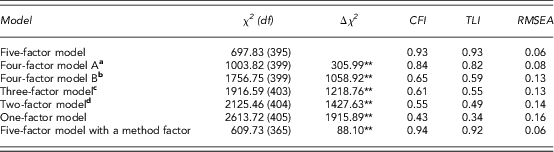
First, the confirmatory factor analyses estimated the fit indices of the five-factor model where the measures of all five study variables (i.e., LMX quality, perceived cost of feedback-seeking, self-monitoring, leader credibility, and feedback-seeking behavior) were set to load on their respective factors. Fit indices of the five-factor model were then compared with those of more constrained alternative models in which the measures of certain factors (e.g., LMX quality and leader credibility) were set to load on a single factor. The results showed that the five-factor model (χ2(df) = 697.83 (395), CFI = 0.93, TLI = 0.93, RMSEA = 0.06) fit the data significantly better than the one-factor model (χ2(df) = 2613.72 (405), CFI = 0.43, TLI = 0.34, RMSEA = 0.16) and all other alternative models, as presented in Table 1.
Results of confirmatory factor analysis
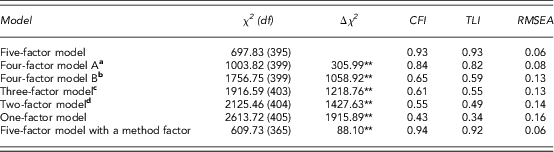
Note. Δχ2 denotes the deviation of each alternative model compared to the five-factor model.
aCombining leader-member exchange (LMX) quality and leader credibility in the five-factor model.
bCombining leader credibility and subordinate self-monitoring in the five-factor model.
cCombining LMX quality, leader credibility, and subordinate self-monitoring in the five-factor model.
dCombining perceived cost and feedback-seeking behavior in the three-factor model.
CFI=comparative fit index; RMSEA=root mean square error of approximation; TLI=Tucker–Lewis index.
n = 217, **p < .01.
Second, a single-common-method-factor approach suggested by Podsakoff et al. (Reference Podsakoff, MacKenzie, Lee and Podsakoff2003) was also conducted. It partitioned the variance of the response to a focal measure into trait, method, and random error components by adding an unmeasured method factor on which all measures of the five study variables were set to load. A χ2 difference test indicated that inclusion of the method factor in the five-factor model significantly improved the model fit (Δχ2(Δdf) = 88.10 (30), p < .01; CFI = 0.94, TLI = 0.92, RMSEA = 0.06), as shown in Table 1. However, the comparison of the squared-multiple correlations for the measures revealed that the original five-factor model cumulatively accounted for 57% of the total item variance, while the method-factor model accounted for additional 2% of the total variance, which is far below the usual method variance (25%) found by Williams, Cote, and Buckley (Reference Williams, Cote and Buckley1989). Furthermore, even after controlling for the method factor, all factor loadings of measures on their respective study variables remained above 0.70. Taken together, there was a common method effect present in our data, but the method artifact appears minimal and might not significantly bias the results of the hypothesis testing. Therefore, these results of the confirmatory factor analyses provide evidence of the construct validity and independence of the measures and help minimize the concern for common method variance.
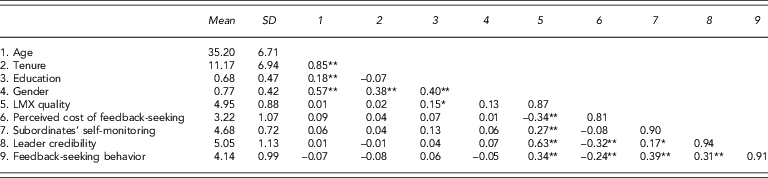
Means, standard deviations, Cronbach's αs, and zero-order correlations for all the variables are presented in Table 2. A review of Table 2 indicates that the subordinates’ perceived cost of feedback-seeking is negatively associated with their feedback-seeking behavior (r = –0.34, p < .01) and LMX quality (r = –0.24, p < .01), while the feedback-seeking behavior is positively related to their self-monitoring level (r = 0.39, p < .01) and leader credibility (r = 0.31, p < .01).
Means, standard deviations, correlations, and reliabilities
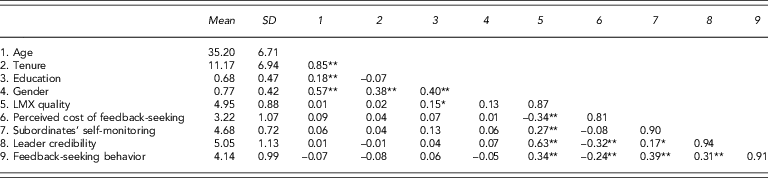
Note. Values in parentheses along the diagonal are Cronbach's α reliability coefficients.
LMX=leader-member exchange.
n = 217, *p < .05, **p < .01.
Hypothesis testing
To test the hypotheses in the moderated mediation model, we followed the steps suggested by Muller, Judd, and Yzerbyt (Reference Muller, Judd and Yzerbyt2005) and Preacher, Rucker, and Hayes (Reference Preacher, Rucker and Hayes2007). This statistical procedure was used to evaluate the significance of the conditional indirect effect of LMX quality on the subordinates’ feedback-seeking behavior through their perceived cost of feedback-seeking at different levels of their self-monitoring and leader credibility. We also applied a bootstrap method with 5,000 subsamples to confirm the study findings of the conditional indirect effect. Bootstrapping does not make assumptions regarding the sampling distribution of the indirect effect, which is typically non-normal and produces more confident estimates with a relatively small sample as in the present study (Preacher, Rucker, & Hayes, Reference Preacher, Rucker and Hayes2007). Finally, following the recommendations of Aiken and West (Reference Aiken and West1991), we mean-centered all the variables used as a component of the interaction term to avoid a multicollinearity issue.
According to Muller, Judd, and Yzerbyt (Reference Muller, Judd and Yzerbyt2005, three multiple regression equations are estimated to assess moderated mediation. In Model 1, an outcome (Y) is regressed on a predictor (X), a moderator (Mo), and their interaction (e.g., Y = b 10+b 11X+b 12Mo+b 13X·Mo+e 1). In Model 2, the mediator (Me) is regressed on the predictor, moderator, and their interaction (e.g., Me = b 20+b 21X+b 22Mo+b 23X·Mo+e 2). Lastly, both the mediator's effect on the outcome and the residual effect of the predictor on the outcome after controlling for the mediator are allowed to be moderated in Model 3 (e.g., Y = b 30+b 31X+b 32Mo+b 33X·Mo+b 34Me+b 35Me·Mo+e 3).
To demonstrate the moderated mediation, the following three conditions (a, b, and c) should be considered. For the first condition (a), in Model 1, the effect of the predictor on the outcome (b 11) is significant, while the effect of the interaction (b 13) is not, because an overall effect of the predictor on the outcome does not depend on the moderator. In Models 2 and 3, at least one of the following second and third conditions should be met: (b) both the interaction effect between the predictor and the moderator on the mediator (b 23) in Model 2 and the effect of the mediator on the outcome (b 34) in Model 3 are significant and/or (c) both the effect of the predictor on the mediator (b 21) in Model 2 and the interaction effect between the mediator and the moderator on the outcome (b 35) in Model 3 are significant. When the second condition (b) is met, it indicates that the moderator operates in the predictor–mediator linkage. When the third condition (c) is the case, this indicates that the moderator functions in the mediator–outcome relationship. If both the second and third conditions (b and c) are met, it indicates that the moderator operates not only in the predictor–mediator linkage but also in the mediator–outcome relationship. Therefore, the hypothesized moderated mediation in this study is demonstrated when the first and third conditions (a and c) are fulfilled but the second condition (b) is not.
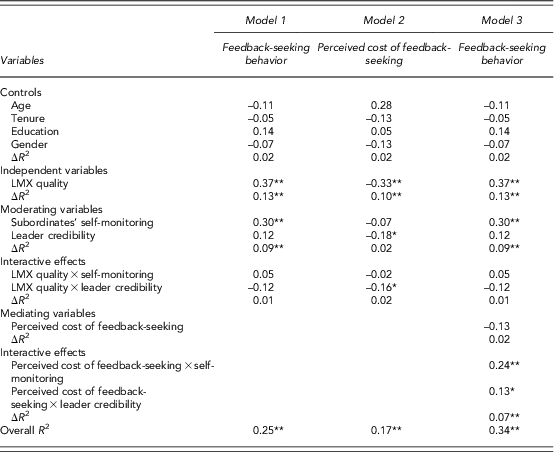
Table 3 shows the results of hierarchical multiple regressions for the moderated mediation model. The results of the regression Model 1 show that the quality of LMX was positively related to the subordinates’ feedback-seeking behavior (β = 0.37, p < .01, ΔR 2 = 0.13, p < .01), while the interactions between the LMX quality and the subordinates’ self-monitoring and leader credibility were not significantly associated with the feedback-seeking behavior (β = 0.05, ns and β = –0.12, ns, respectively, ΔR 2 = 0.01, ns); these findings meet the first condition for moderated mediation. The results imply that the overall positive relationship between the quality of LMX and the subordinates’ feedback-seeking behavior is not moderated by the levels of their self-monitoring and leader credibility.
Results of hierarchical multiple regression for the moderated mediation model
Note. Values are standardized regression coefficients.
LMX=leader-member exchange.
n = 217, *p < .05, **p < .01.
However, as shown in the regression Models 2 and 3, when the subordinates’ perceived cost of feedback-seeking was entered in the regressions as a mediator, it functioned contingently upon their self-monitoring level and leader credibility. In other words, the second condition for moderated mediation was not met, but the third condition was fulfilled, indicating that the moderators operated in the relationship between the perceived cost of feedback-seeking and the subordinates’ feedback-seeking behavior. Specifically, although the interaction between LMX quality and leader credibility had a significant effect on the perceived cost of feedback-seeking behavior (β = –0.16, p < .05), the interaction between LMX quality and the subordinates’ self-monitoring (β = –0.02, ns) had no effect on the perceived cost in Model 2, and the perceived cost of feedback-seeking did not relate to the subordinates’ feedback-seeking behavior (β = –0.13, ns; ΔR 2 = 0.02, ns) in Model 3. Thus, the second condition for moderated mediation was not confirmed.
In contrast, the third condition for moderated mediation was met. Specifically, the quality of LMX was negatively related to the subordinates’ perceived cost of feedback-seeking (β = –0.33, p < .01; ΔR 2 = 0.10, p < .01) in Model 2, as predicted by Hypothesis 1. And the interactions between the perceived cost of feedback-seeking and subordinates’ self-monitoring level (β = 0.24, p < .01) and leader credibility (β = 0.13, p < .05) had significant effects on their feedback-seeking behavior (ΔR 2 = 0.07, p < .01) in Model 3.
We probed the significant interactions by following the suggestion of Aiken and West (Reference Aiken and West1991). Plots of the interactive effects were drawn for subordinates with high (1 SD above mean) and low (1 SD below mean) levels of self-monitoring (Figure 2a) and leader credibility (Figure 2b). To determine whether the form of interactions matched those predicted in Hypotheses 2a and 2b, we conducted simple slope tests. In support of Hypothesis 2a, subordinates’ perceived cost of feedback-seeking was negatively related to their feedback-seeking behavior for subordinates low in self-monitoring (b = –0.37, p < .01), and not for subordinates high in self-monitoring (b = –0.04, ns). In addition, as Hypothesis 2b predicted, subordinates’ perception of feedback-seeking cost was negatively associated with their feedback-seeking when the leader credibility was low (b = –0.44, p < .01), and not when it was high (b = 0.04, ns).
Moderating effects of the subordinates’ self-monitoring and leader credibility
Together, the first and third conditions for moderated mediation were met, thus supporting Hypotheses 3a and 3b. These results indicate that for subordinates with low self-monitoring and with leaders low in credibility, LMX quality was indirectly related to their feedback-seeking behavior through the perceived cost of feedback-seeking. These findings suggest that the cost-minimizing effect of LMX quality is greater for low self-monitoring subordinates and when leader credibility is low. Finally, these moderating effects functioned in the relationship between the perceived cost of feedback-seeking and feedback-seeking behavior, as depicted in Figure 2.
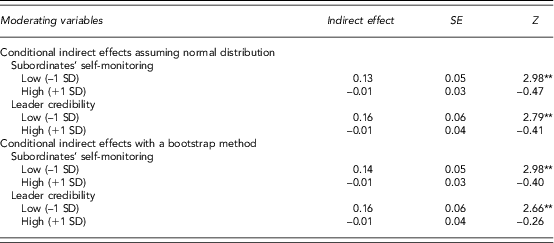
To further validate these moderated mediation relationships, we followed the procedure recommended by Preacher, Rucker, and Hayes (Reference Preacher, Rucker and Hayes2007) and examined the indirect effects depending on the varying levels of self-monitoring and leader credibility. We set high and low levels of the subordinates’ self-monitoring and leader credibility as 1 SD above and below the mean values of the respective variables. Table 4 presents the results for testing conditional indirect effects across high and low self-monitoring and leader credibility. As shown in the upper half of Table 4, normal-theory tests (Sobel tests) revealed that the indirect effect of LMX quality on the subordinates’ feedback-seeking behavior through their perceived cost of feedback-seeking was significant only for those with low levels of self-monitoring (indirect effect = 0.13, p < .01) and leader credibility (indirect effect = 0.16, p < .01). These findings were corroborated by bootstrap analyses with 5,000 subsamples yielding identical results of the indirect effects for subordinates with low levels of self-monitoring (boot indirect effect = 0.14, boot p < .01) and leader credibility (boot indirect effect = 0.16, boot p < .01). In sum, these findings for conditional indirect effects strongly support Hypotheses 3a and 3b, which state that the indirect effect of LMX quality on feedback-seeking behavior via the perceived cost of such action is greater when the levels of subordinates’ self-monitoring and leader credibility are low.
Results of conditional indirect effect analysis for the moderated mediation model
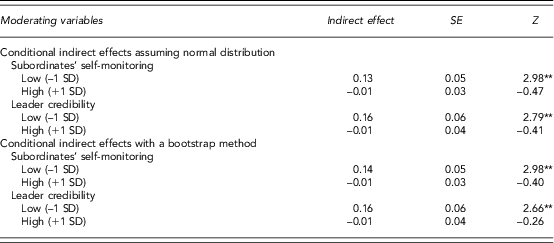
Note. Bootstrap n = 5,000. All values were estimated with control variables.
n = 217, **p < .01.
Auxiliary interview
To help strengthen the validity of the results from the hypothesis tests, we conducted interviews with five subordinates, each of whom responded to the survey in the five banking institutions. We first asked them to provide any episodes from an observer's perspective regarding their coworkers who frequently seek feedback from their supervisors even when negative comments are anticipated. This question was intended to validate the moderating effect of subordinates’ self-monitoring level on the relationship between perceived cost and feedback-seeking behavior. Additionally, we asked them to tell us if there were any managers who consistently receive many feedback requests even where the managers are well-known for critical comments. This question was asked to confirm the moderating role of leader credibility. In the interviews, we never provided any hints about the feedback-seeking motives for impression-management and performance-enhancement.
For the first question, the interviewees commonly listed the subordinates’ self-monitoring propensity as a factor that outweighs or at least buffers against the negative effect of the perceived cost of feedback-seeking. One of the interviewees responded as follows:
I heard that A, an employee in my company, prefers to ask his boss for directions on what work should be done both currently and moving forward, discuss issues pertaining to uncompleted tasks that A is in charge of, and ask his boss for advice regarding his shortcomings. Although employees are usually reluctant to go straight to their boss and discuss such things due to fear of receiving negative feedback such as ‘Don't you even know what you are supposed to do next?,’ ‘Can't you complete simple tasks on your own?,’ and so on, A frequently seeks feedback from his boss. I believe A's personality traits are largely responsible for this type of behavior. A's coworkers describe him as a type of person wanting to know how he is perceived by others, and desires to be known as a ‘proactive worker.’ By actively seeking feedback from his boss, A could receive clues on how that supervisor thinks of him while also giving a positive impression that ‘I am a very active and hard-working employee.’
For the second question, the managers’ expertise and ability to provide useful information was commonly mentioned across the five interviewees. One interviewee said the following:
There are two leaders in my company that have quite contrasting reputations. Leader A's seat is often surrounded by his subordinates seeking advice related to work problems or looking for tips on how to improve their work performance. This is understandable as A's skill, knowledge, and achievements are well-recognized throughout my company. In contrast, few people seek advice from leader B. Although B is a very nice person in my personal opinion, his performance and work-related skills are lacking in comparison to A. It might be embarrassing for some people to approach a leader and ask for advice in public, but if doing so is beneficial for improving work performance, employees will be willing to do so.
Taken together, the findings of these interviews may attenuate the concern for potential common rater bias and corroborate the empirical results of the current study.
Discussion
Considering the potential costs and values of feedback-seeking behavior is essential for employees in deciding whether to seek performance feedback (Ashford, Blatt, & VandeWalle, Reference Ashford, Blatt and VandeWalle2003). Exploring the compensatory interaction between the costs and values may provide useful insights on how to promote feedback-seeking behavior in the workplace (Hays & Williams, Reference Hays and Williams2011). As such, it is important to identify the factors associated with the perception of feedback-seeking costs and values. This study focuses on the dyadic factor (LMX quality) that minimizes the perceived cost of feedback-seeking behavior and the subordinate (self-monitoring) and supervisor (leader credibility) characteristics that may positively relate to the perceived values of such behavior and buffer against the negative effect of the perceived cost of feedback-seeking. Study findings from examining this moderated mediation model, therefore, extend the current feedback-seeking literature by providing a deeper and more integrated understanding of how the supervisor, subordinate, and dyadic characteristics simultaneously interact in subordinates’ feedback-seeking decision.
First, we found an overall positive relationship between LMX quality and the subordinates’ feedback-seeking behavior, which was mediated through their perceived cost of feedback-seeking. In the leadership context, these findings echo the established notion that relationship quality and the support of a feedback source are negatively related to the perceived cost of feedback-seeking, alleviation of which leads to frequent feedback-seeking behavior (e.g., Vancouver & Morrison, Reference Vancouver and Morrison1995; Williams et al., Reference Williams, Miller, Steelman and Levy1999; VandeWalle et al., Reference VandeWalle, Ganesan, Challagalla and Brown2000).
Second, the study results indicated that the perceived cost of feedback-seeking was negatively associated with feedback-seeking behavior only for subordinates with low self-monitoring level and not for subordinates with high self-monitoring. In addition, the relationship was negative only when leader credibility was low and not when it was high. These findings suggest that despite the perceived cost of feedback-seeking, subordinates high in self-monitoring continue to seek feedback to better monitor current issues and to accurately anticipate future possibilities, because the information from feedback serves as a prerequisite for proper regulation of their expressive behavior to effectively manage the cost-related issues. Likewise, when supervisors are credible sources of information, it acts as a buffer against the negative effect of the perceived cost of feedback-seeking. Overall, these findings regarding the moderating roles of self-monitoring and leader credibility integrate prior studies regarding source credibility (Fedor, Rensvold, & Adams, Reference Fedor, Rensvold and Adams1992), impression management (Morrison & Bies, Reference Morrison and Bies1991), perceived cost of feedback-seeking (VandeWalle et al., Reference VandeWalle, Ganesan, Challagalla and Brown2000), and their interactive relationships with feedback-seeking behavior.
Lastly, the first and second results suggest a pattern of moderated mediation effect (Muller, Judd, & Yzerbyt, Reference Muller, Judd and Yzerbyt2005; Preacher, Rucker, & Hayes, Reference Preacher, Rucker and Hayes2007). The positive relationship between LMX quality and feedback-seeking behavior was mediated through the subordinates’ perceived cost of feedback-seeking only for subordinates low in self-monitoring and when their supervisors are credible sources of feedback. These findings help increase our understanding of when and for whom the cost-minimizing role of LMX quality is particularly important. Thus, this study extends the feedback-seeking literature by simultaneously incorporating supervisor, subordinate, and dyadic attributes as antecedents of feedback-seeking behavior into an overall moderated mediation model using a robust data analytic technique.
Managerial implications
The study findings also provide several recommendations for managers and organizations. First, the overall positive relationship between LMX quality and the subordinates’ feedback-seeking behavior highlights the importance of a supervisor's role in facilitating the subordinates’ feedback-seeking behavior. This is critical because organizations are increasingly relying on employees who are adept at self-initiated, proactive learning and development (Ashford, Blatt, & VandeWalle, Reference Ashford, Blatt and VandeWalle2003). Managers should focus on developing a working partnership where substantial diversity can coincide with stability, building on mutual respect and trust with their subordinates. This effort would help the managers create a comfortable working climate where their subordinates will not be afraid to seek feedback on their behavior and work performance.
Second, the moderating effect of self-monitoring suggests that the cost-minimizing role of high-quality LMX is particularly important for subordinates with low self-monitoring, because they are not interested in presenting their strengths or a favorable image of themselves, react sensitively to the perceived cost of feedback-seeking, and thus are reluctant to engage in proactive feedback-seeking. One of the possible courses of action that managers can take is to establish informal mentoring relationships or regular private meetings (Ashford & Northcraft, Reference Ashford and Northcraft1992) with subordinates low in self-monitoring to institutionalize opportunities for active work-related feedback exchanges. Organizationally established formal mentoring programs may be another viable option for this purpose.
Third, it is a fundamental notion in the performance feedback literature that feedback improves work performance by promoting developmental opportunities (Ilgen, Fisher, & Taylor, Reference Ilgen, Fisher and Taylor1979). Thus, performance feedback should be sought from credible persons who can provide appropriate and relevant information, because ‘feedback is valuable only to the extent that its nature and content fit the task at hand’ (Ang, Cummings, Straub, & Earley, Reference Ang, Cummings, Straub and Earley1993: 256). In this study, leader credibility was found to act as a buffer against the negative effect of the perceived cost of feedback-seeking. Thus, this finding suggests that managers need to make a continuous effort to develop their own expertise in the issues relevant to subordinates’ tasks and to be perceived as a credible source of feedback.
Finally, to minimize the subordinates’ perceived cost of feedback-seeking, managerial training interventions can easily be expanded to improve the way managers convey their feedback to focal subordinates upon requests for feedback (Madzar, Reference Madzar1995). For example, by developing and utilizing the measures of various aspects of subordinate performance, managers may be able to simultaneously provide both positive and negative feedback (Robinson & Weldon, Reference Robinson and Weldon1993). This would be a useful tactic to provide feedback to poor performers who are reluctant to seek feedback on their work performance because of their perceived cost of feedback inquiry (Madzar, Reference Madzar1995).
LIMITATIONS AND FUTURE RESEARCH
There are several limitations that must be considered in interpreting the study findings and we suggest future directions for research. The first limitation of this study rests in its cross-sectional nature. Although our theoretical framework provides justification for the temporal ordering of the variables in our model, the cross-sectional design does not allow a firm causal inference to be drawn. Relatedly, there are potential biases that occur when subjective measures are rated by a common source in a cross-sectional study (Podsakoff et al., Reference Podsakoff, MacKenzie, Lee and Podsakoff2003). In our study, for example, LMX quality was highly correlated with leader credibility (r = 0.63, p < .01). Although it seems unlikely that high-quality LMX leads to increased leader's expertise per se in a theoretical sense, a subordinate's perception of high-quality LMX is likely to increase his or her perception of leader credibility. Results of confirmatory factor analyses may support this speculation. The two-factor model where items of LMX quality and leader credibility were set to load on their respective factors (χ2(df) = 132.25 (53), CFI = 0.96, TLI = 0.94, RMSEA = 0.08), fit the data significantly better than did the one-factor model (Δχ2(Δdf) = 292.47 (1), p < .01; χ2(df) = 424.72 (54), CFI = 0.80, TLI = 0.70, RMSEA = 0.18). However, when an unmeasured method factor was added to the two-factor model, the fit indices significantly increased (Δχ2 (Δdf) = 48.71 (12), p < .01; CFI = 0.98, TLI = 0.96, RMSEA = 0.07), explaining an additional 5.0% of the total response variance. Thus, although LMX quality and leader credibility are two distinct variables in a statistical sense and theoretical causality between the two appears unlikely, their correlations might be partly inflated by the common method variance. Nonetheless, it is worthy to note that the measurement model in this study demonstrated sound psychometric properties and a clear five-factor structure without cross-loadings. And this clear structural pattern remained even after we controlled for the common method factor. Although these results indicate a low probability of any seriously biased findings from the common source issue, employing different methods and a longitudinal research design are required to draw a firm causal inference and rule out the common method concerns.
Second, despite the primary focus on the cost-minimizing role of LMX quality contingent on the levels of subordinates’ self-monitoring and leader credibility, this study should have been better elaborated and balanced by directly measuring the perceived value of feedback-seeking and testing its interaction effect with the perceived cost. Although the conceptual process model of feedback-seeking involves the cost-value comparison as an intermediate phase (Anseel, Lievens, & Levy, Reference Anseel, Lievens and Levy2007), there are only a handful of studies where both the perceived cost and value were directly measured and tested (e.g., VandeWalle & Cummings, Reference VandeWalle and Cummings1997; VandeWalle et al., Reference VandeWalle, Ganesan, Challagalla and Brown2000; Park, Schmidt, Scheu, & DeShon, Reference Park, Schmidt, Scheu and DeShon2007; Hays & Williams, Reference Hays and Williams2011). Thus, future studies incorporating both the cost and value perception are warranted to verify which individual and situational characteristics differentially influence one's feedback-seeking behavior through cost-minimization or value-enhancement. This attempt would help determine whether the perceived cost derived by some of those variables overrides the perceived value from others and vice versa.
Third, the current study did not examine the differentiated effects of the expected feedback topic (i.e., positive or negative) on feedback-seeking behavior. It is plausible that subordinates high in self-monitoring are more likely to engage in explicit verbal requests for feedback in order to create a favorable image, particularly when positive feedback is expected (Morrison & Bies, Reference Morrison and Bies1991; Ashford, Blatt, & VandeWalle, Reference Ashford, Blatt and VandeWalle2003). However, it is unclear whether subordinates high in self-monitoring actively seek feedback when negative feedback is anticipated. Although the perceived cost of feedback-seeking in our study might tap the expectation of negative feedback, using separate measures for various feedback-seeking costs is recommended in future studies.
Fourth, given the image-based motive for feedback-seeking, high performers are likely to seek (positive) feedback for impression-enhancement, while low performers are unlikely to engage in feedback inquiry for impression-defense (Ashford & Northcraft, Reference Ashford and Northcraft1992; Moss, Valenzi, & Taggart, Reference Moss, Valenzi and Taggart2003; De Stobbeleir et al., Reference De Stobbeleir, Ashford and De Luque2010). Because individuals high in self-monitoring more effectively manage their public impression than do those low in self-monitoring (Turnley & Bolino, Reference Turnley and Bolino2001), it seems likely that the feedback-seeking decision is significantly affected by their prior performance level. This line of reasoning suggests the necessity of considering the seekers’ prior performance as a study variable (or at least as a control), particularly when the effect of self-monitoring of the seekers on feedback-seeking behavior is examined, as in the present study. Although this study is the first exploration of the effect of feedback-seekers’ self-monitoring on their seeking behavior, its failure to incorporate prior performance in hypothesis testing is a study limitation. Future research would benefit by examining the interaction effect of self-monitoring with prior performance on feedback-seeking behavior.
Fifth, considering that our data were collected from employees in banking institutions in Korea, we cannot assure the generalizability of our results. Generally, most types of work in the banking industry tend to be highly formalized and task uncertainty appears low; thus employees are expected to seek feedback less frequently in the work setting (Ashford & Cummings, Reference Ashford and Cummings1983; Ashford, Blatt, & VandeWalle, Reference Ashford, Blatt and VandeWalle2003). In addition, given that organizational tenure and hierarchical status are important considerations in supervisory relationships in Korean banking institutions (Lee, Reference Lee2003), performance feedback is typically given downward to subordinates and their feedback-seeking attempts may be infrequent in the absence of a close working partnership. Hence, it is possible that the cost-minimizing effect of LMX quality on subordinates’ feedback-seeking behavior might be inflated in our study. Relatedly, MacDonald, Sulsky, and Brown (Reference MacDonald, Sulsky, Spence and Brown2013) found that concern for losing face in a feedback-seeking attempt was more greatly pronounced among Chinese employees than Canadian employees, while information value of such behavior was perceived more strongly by Canadian employees than by Chinese employees. Thus, in the cultural context where seniority rule system and interpersonal relationships have significant control over one's behavior (e.g., Korea), other types of feedback-seeking behavior, such as monitoring and observation, appear more likely than explicit verbal inquiry (Sully de Luque & Sommer, Reference Sully de Luque and Sommer2000). Although our findings provide an initial understanding of feedback-seeking behavior in an Asian context, future research employing cross-cultural comparisons with samples from different work settings and national cultures is warranted.
Lastly, since Ashford and Cummings’ (Reference Ashford and Cummings1983) seminal work, research on feedback-seeking has attempted to identify various individual and situational variables that promote or impede one's proactive seeking of feedback, with a presumption that the outcomes of such behavior are motivationally and instructionally functional (Ashford, Blatt, & VandeWalle, Reference Ashford, Blatt and VandeWalle2003). Likewise, our research model is limited to the process before feedback is provided. However, the presumption about the positive outcomes of feedback-seeking behavior has been subject to little empirical examination (Reference Anseel, Beatty, Shen, Lievens and SackettAnseel et al., in press). The question of whether feedback-seeking positively influences work performance depends on the types of feedback actually provided in response to feedback-seeking and how the feedback-seeking intention is subsequently attributed (Reference Anseel, Beatty, Shen, Lievens and SackettAnseel et al., in press). Therefore, for a complete understanding of the feedback-seeking phenomenon, the processes immediately preceding and following feedback-seeking behavior should be examined. To this end, longitudinal or experimental examination of a feedback-seeking phenomenon is warranted as an area of future research, to capture the processes before and after the feedback-seeking behavior.
Despite these study limitations, this study also yields several interesting results and has valuable theoretical and managerial implications. Study findings from examining the moderated mediation model help gain a more integrated understanding of the dynamic relationships among the supervisor, subordinate, and dyadic characteristics as antecedents of feedback-seeking behavior. This insight could not be gained from prior studies based on the piecemeal approaches that examined the direct effects of those variables on feedback-seeking behavior. In an attempt to open this front, the current study further confirms, integrates, and extends the prior findings in the feedback-seeking literature.
Acknowledgement
This work was supported by the National Research Foundation of Korea Grant funded by the Korean Government (NRF-2012S1A5A8024523), awarded to the first author.