

Published online by Cambridge University Press: 13 February 2006
Within polling places, does the scarcity of voting machines causelonger lines and thereby dissuade some people from voting? Arevoting machines scarce in some areas because turnout would be low,irrespective of the availability of voting machines? In Ohio in theaftermath of the 2004 presidential election, the answers to thesequestions carried very real and significant political stakes.Consider the following from Franklin County, the second mostpopulous county in the state. In precincts where voting machineswere plentiful (i.e., where there were fewer registrants peravailable voting machine), turnout was especially high and JohnKerry's share of the presidential vote was low. In contrast, inareas of machine scarcity (i.e., precincts with many registrants peravailable voting machine), turnout was lower and Kerry's vote sharewas higher. These relationships are shown in Figures 1A and 1B.Given the strong association between machine availability and theKerry vote, if machine (un)availability was a cause of (low)turnout, then Kerry may very well have received fewer votes than hewould have had more machines been available or had the distributionof available machines been less skewed toward precincts that weremore supportive of George W. Bush.Iappreciate input from SSRC Commission members Henry Brady,Martha Kropf, Walter R. Mebane, Jr., and Michael Traugott withwhom I collaborated on the SSRC's “Interim Report on AllegedIrregularities in the United States Presidential Election of 2November 2004” (Brady et al. 2004). Ialso thank Benjamin Bishin for comments on the paper. The SocialScience Research Council and its staff, including JasonMcNichol, Dashiell Flynn, and Sarah Alexander, provided generoussupport for this work. The views expressed in this paper are notnecessarily shared by other SSRC Commission members or theSocial Science Research Council.
Perhaps the most visible of Ohio's problems were its long lines. Christopher McQuoid reached his polling place in Columbus at 4:30 p.m…. By 7:30, he was getting impatient. And when he finally voted at 9:30, there were 150 people in line behind him. “I was lucky…. I had the day off” [he said]. But how many people decided not to vote because of long lines, and was it enough to make a difference? No one has been able to say with authority (Dao, Fessenden, and Zeller 2004, 1).
Within polling places, does the scarcity of voting machines cause longer lines and thereby dissuade some people from voting? Are voting machines scarce in some areas because turnout would be low, irrespective of the availability of voting machines? In Ohio in the aftermath of the 2004 presidential election, the answers to these questions carried very real and significant political stakes. Consider the following from Franklin County, the second most populous county in the state.1
All the data analyzed in this paper are from the Franklin County Board of Elections, some of which was made available through Knapp (2004). All turnout rates are calculated as the percentage of registrants that voted.

Turnout by Registrants per Voting Machine

Kerry Vote Share by Registrants per Voting Machine
While voting in a single county in a single election rarely draws national attention, what happened in Franklin County in 2004 did. The final vote in the Electoral College favored George W. Bush over John Kerry by 286 to 251. Had Kerry won Ohio, which he lost 49 to 51%, its 20 electoral votes would have given him a bare majority of the electoral vote and victory in the presidential election. None of these observations has gone unrecognized in the media and among interested observers, party leaders, and elected officials. Although no one has contended that a turnout reduction caused by the scarcity of voting machines in Franklin County alone cost Kerry enough votes to give Bush the win and the presidential election, it was a primary point of contention in the election's aftermath. For example, the problems in Franklin County received substantial attention in front page articles in both the Washington Post (Powell and Slevin 2004) and the New York Times (Dao, Fessenden, and Zeller 2004).
Most notable are the events of early January 2005. On January 5, the Democratic staff of the House Judiciary Committee issued a report on “Preserving Democracy: What Went Wrong in Ohio.” The report includes an analysis of voting machine allocations in Franklin County and contends that it “appears to be [one] of the pivotal factors concerning the vote and outcome in the entire election in Ohio” (29). On January 6, when Congress was scheduled to officially ratify Bush's reelection, there was a formal challenge to the counting of electoral votes for only the second time since 1877. Stephanie Tubbs Jones, a Democratic House member from Ohio, and Barbara Boxer, a Democratic Senator from California, objected to awarding Ohio's electoral votes to Bush, in part based on concerns about machine allocations, long lines, and turnout. As Senator Boxer said in the subsequent debate, “Why in the Columbus area alone did an estimated 5,000 to 10,000 voters leave polling places out of frustration without having voted? How many more never bothered to vote after they heard this because they had to take care of their families or they had a job or they were sick or their legs ached after waiting for hours” (Congressional Record 2005, S41).2
Perhaps needless to point out, Columbus is the heart of Franklin County.
The purpose of this paper is to answer these questions: (1) What was the effect of voting machine allocations on turnout in Franklin County in the 2004 presidential election? (2) How many more people would have voted had there been no machine shortages? (3) What were the partisan implications of the distribution of voting machines?
With Ohio's Republican Secretary of State J. Kenneth Blackwell serving as co-chair of the Bush/Cheney campaign in Ohio, concerns about election administration in Ohio were often cast in partisan terms. Indeed, some of the controversy in Ohio could be linked to decisions and actions made by the secretary of state. But, in Ohio the county election boards, which make the decisions about voting machine allocations, are each composed of two Democrats and two Republicans. As a result, even though there may have been partisan effects of machine scarcity, partisan motivations to cause them seem unlikely.3
Consider the report written by the Democratic staff of the House Judiciary (House Judiciary Staff 2005). While it does not shy away from blaming Blackwell for a host of problems (“there were massive and unprecedented voter irregularities and anomalies in Ohio …. caused by intentional misconduct and illegal behavior … involving [the] Secretary of State” (4)), when discussing the problem of long lines and machine availability in Franklin County, though, no blame is attributed to Blackwell.
In Franklin County, the county election board allocates voting machines to precincts based on the number of “active voters,” which is determined by turnout in previous elections. As a consequence, if some precincts experience disproportionate registration increases in advance of a particular election or greater turnout surges, then it is likely that wait times will be longer on Election Day as the ratio of voters per machine increases. In addition, heading into the 2004 election there was a surge in registration statewide and an especially high turnout was expected as the national vote appeared very close and Ohio was identified by both presidential candidates as a key battleground state. These factors likely added to the problems. Writers for the Washington Post reported that while Franklin county used less then 3,000 voting machines on Election Day, it needed 5,000 (Powell and Slevin 2004).
Presumably, machine scarcity causes longer lines, which in turn lowers turnout, especially in a hotly contested election where the total number of voting machines is less than 60% of what is needed, as it was in Franklin County.4
The effects are likely greater for potential voters who have less free time, like the employed, and smaller for those with more free time, like the retired. Because I use precinct-level data, analyzing the differential effects of scarcity based on individual characteristics like employment status are beyond the bounds of this paper.
What would be the likely outcome if an analyst could control for other plausible factors related to turnout? Just as it is implausible to attribute all of the differences in turnout associated with varying registrant to machine ratios to machine availability, it seems equally implausible to argue that machine availability (and hence wait times) has no effect on turnout. Consequently … we believe it reasonable to argue that long wait times in more Democratic districts suppressed turnout to some degree. (17)
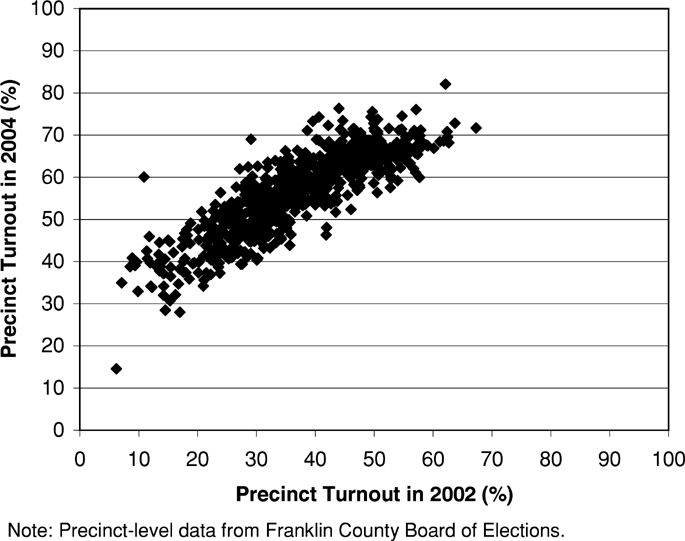
Distinguishing the two phenomena requires the use of a measure or measures that take into account differences across precincts that are related to turnout, but that are causally independent of machine scarcity in 2004. The measure I use is precinct-level turnout in the 2002 Ohio gubernatorial election. Several considerations make this variable especially attractive. First, because the election was only two years before the presidential election, there was unlikely to be much compositional change in the precincts between the two elections. Second, because it took place in a midterm election year, turnout was much lower, thereby making it less likely that machine allocations would matter much. Indeed, a check of local newspapers reveals no reports of long lines, machine scarcity, and other incidents like those present in 2004.5
To the extent that the composition of precincts changed between 2002 and 2004, turnout in 2002 will be an imperfect control variable and lead to overestimating the causal effect of machine availability on turnout. Thus the results reported in Table 1 should be viewed as upper-bound estimates of the effects of machine availability on turnout.

Precinct Level Turnout in 2002 and Turnout in 2004
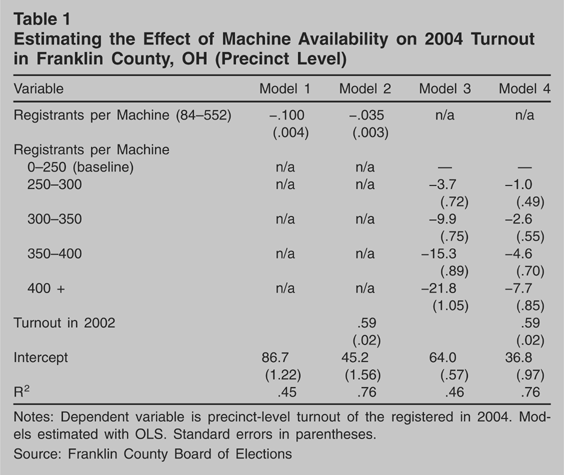
Estimating the Effect of Machine Availability on 2004 Turnout in Franklin County, OH (Precinct Level)

Reporting the results of a series of OLS regressions, Table 1 helps answer the question of whether there was a causal relationship between the number of registrants per available voting machine (RPM) and turnout in 2004. The first two columns are based on using a single variable, the number of registrants per voting machine, to measure the relationship between RPM and turnout. The first column (Model 1) reports the apparent effect of RPM on turnout without taking into account turnout in 2002. The results indicate an increase in RPM by 100 registrants is associated with substantially lower turnout of 10 percentage points. Model 2 adds turnout in 2002 as a control. Compared to its effect in Model 1, the apparent effect of RPM is reduced by more than half (65%). In Model 2, an increase of 100 in RPM is associated with lower turnout of 3.5 percentage points, a nontrivial effect to be sure, but significantly smaller than the estimate obtained without controlling for turnout in 2002.
Models 3 and 4 allow for the possibility that the rate at which turnout declines with increasing RPM is not constant. These models relax the linearity assumption by distinguishing five types of precincts based on RPM values (less then 250, 250–300, 300–350, 350–400, and 400+). The results for Model 3, which do not include the control for turnout in 2002, show that compared to precincts with less than 250 RPM, turnout was about 10 percentage points (9.9) lower in precincts with 300–350 RPM and 22 points lower in precincts with over 400 RPM. But, after taking into account turnout in 2002, Model 4 shows that the 9.9 point gap drops 74% to 2.6, and the 21.8 percentage point difference drops 65% to 7.7.
Simply put, the results indicate that the simple relationship between RPM (whether measured in a linear fashion or otherwise) and turnout significantly overestimates the causal effect of RPM on turnout. More modest effects are apparent when an appropriate control variable is taken into account.
Nonetheless, there are effects, and therefore the question of whether machine scarcity cost Kerry votes remains open. One way to answer this question is to use the coefficients in Table 1 to estimate how much higher turnout would have been (on a precinct-by-precinct basis) if there were no scarcity and to assume that the turnout gains would have translated into votes for Kerry and Bush in proportions equal to those based on the votes that were actually cast in the respective precincts.
Take a concrete example. If a precinct with over 400 RPM had more machines to bring the RPM down to less than 250, then turnout in the precinct would have been an estimated 7.7 percentage points higher (according to Model 4 in Table 1). If that precinct had 1,000 registered voters, then the 7.7 point increase translates into 77 additional voters. If those who actually voted in the precinct split their votes 60% or Kerry and 38% for Bush (with 2% voting for other candidates), then the increase of 77 voters would be expected to include 46 for Kerry and 29 for Bush, with a net advantage of 17 for Kerry.
Conducting the analysis across all 788 precincts in Franklin County and then aggregating the results produces a predicted turnout increase (based on Model 4 in Table 1) of 21,786 voters if all precincts had RPMs of 250 or less. Of these additional voters, an estimated 13,691 would have voted for Kerry while 7,912 would have voted for Bush. Thus the estimated net benefit for Kerry would have been 5,779 votes. With a final statewide margin of about 120,000 votes for Bush, a net increase of 5,779 votes for Kerry would have diminished the margin, but would not have altered the election outcome.
The strong association between the availability of voting machines and turnout in Franklin County, Ohio in the 2004 presidential election was largely the result of factors unrelated to the causal effect of the availability of voting machines on turnout. That said, after controlling for other causes of turnout, the relationship does not disappear, suggesting that machine scarcity was a cause of lower turnout. The magnitude of the effect in terms of votes was about 22,000, which would have diminished George W. Bush's statewide margin by about 6,000 had there been no scarcity of voting machines on Election Day. Thus long lines at polling places in Franklin County do not appear to have cost John Kerry the presidential election, but they do appear to have cost him votes.
Given that the Franklin County Board of Elections, like all Ohio county election boards, has four members, two Democrats and two Republicans, attributing the scarcity of voting machines and its consequent effects to partisan maneuvering is probably not warranted. Instead, the unusually close national election where the stakes were perceived to be especially high combined with Ohio's status as a key—perhaps the key—battleground state produced a much larger than usual number of citizens who would have liked to vote. This was apparent in advance of the election as registration rates surged in Franklin County and elsewhere. But, fully accommodating this desire would have required many more voting machines than the county had on hand. Michael R. Hackett, the deputy director of the Franklin County Board of Elections, explained the decision not to acquire more machines this way: “Does it make sense to purchase more machines just for one election? … I'll give you the answer: no” (quoted in Powell and Slevin 2004). While many would disagree with Hackett, his question and answer touch on two important points. Administering elections requires ample resources. Administering them well requires even more.
Benjamin Highton is associate professor of political science at UC Davis. During the 2004 election season he served as a member of the Social Science Research Council's National Commission on Elections and Voting.

Precinct Level Turnout in 2002 and Turnout in 2004

Estimating the Effect of Machine Availability on 2004 Turnout in Franklin County, OH (Precinct Level)