Introduction
One of the most challenging puzzles in the search for the origin of life is to understand how cellular life emerged from complex molecular structures that include proteins, nucleic acids and lipids. Nucleobases, the one ring (pyrimidines) or two rings (purines), are the key structural units of biological nucleic acids (DNA and RNA) that store genetic information, the formation of which is considered as a necessary component in the prebiotic chemistry leading to the origin of life. A wide variety of nucleobases have been detected in meteorite samples, which confirms their extra-terrestrial origin (Martins et al., Reference Martins, Botta, Fogel, Sephton, Glavin, Watson, Dworkin, Schwartz and Ehrenfreund2008; Callahan et al., Reference Callahan, Smith, Cleaves, Ruzicka, Stern, Glavin, House and Dworkin2011; Burton et al., Reference Burton, Stern, Elsila, Glavin and Dworkin2012; Martins, Reference Martins2018). Ribose and related sugars have also recently been identified in primitive meteorites (Furukawa et al., Reference Furukawa, Chikaraishi, Ohkouchi, Ogawa, Glavin, Dworkin, Abe and Nakamura2019). Several experiments have been performed to investigate pathways for an extra-terrestrial synthesis of these molecules. As a result of these investigations, it is found that complex organic molecules of biological interest such as nucleobases can be synthesized in residues obtained from ultraviolet (UV) irradiated molecular ices containing simple molecules such as NH3, H2O, CH3OH, etc. (Nuevo et al., Reference Nuevo, Milam, Sandford, Elsila and Dworkin2009, Reference Nuevo, Milam and Sandford2012; Materese et al., Reference Materese, Nuevo and Sandford2017; Oba et al., Reference Oba, Takano, Naraoka, Watanabe and Kouchi2019). Sugars and deoxysugar derivatives are also reported in residues of UV irradiated icy mixture of H2O and CH3OH and confirming their presence in astrophysical environments and carbonaceous meteorites (Nuevo et al., Reference Nuevo, Cooper and Sandford2018). These results suggest the possible origin of these biomolecules in interstellar space where ice-covered dust grains are illuminated by UV irradiation. Other mechanisms have been proposed that discuss the plausible prebiotic origin of nucleobases in Earth's primitive environment. These include synthesis of adenine from ammonium cyanide (Oró, Reference Oró1960) and hydrogen cyanide (Oró & Kimball, Reference Oró and Kimball1961), UV irradiation of formamide solution (Saladino et al., Reference Saladino, Crestini, Ciciriello, Costanzo and Di Mauro2006; Barks et al., Reference Barks, Buckley, Grieves, Di Mauro, Hud and Orlando2010), UV irradiation of acetylene in a water/ice solution (Menor-Salván & Marín-Yaseli, Reference Menor-Salván and Marín-Yaseli2013), and spark discharge of urea in water/ice solution (Menor-Salván et al., Reference Menor-Salván, Ruiz-Bermejo, Guzmán, Osuna-Esteban and Veintemillas-Verdaguer2009). Nonetheless, extra-terrestrial impact by comets, meteorites, asteroids, and interplanetary dust particles have been considered as the primary source of organic materials required for the emergence of life on the early Earth (Chyba et al., Reference Chyba, Thomas, Brookshaw and Sagan1990; Chyba & Sagan, Reference Chyba and Sagan1992). A wide variety of organic compounds such as carboxylic acids, amino acids, hydroxyl acids, amines, etc., have been detected in various meteorite samples, indicating the essential role of impact processes in the origin of life (Pizzarello & Shock, Reference Pizzarello and Shock2010, Reference Pizzarello and Shock2017). Impact events are ubiquitous in the Solar System, with various impact craters on planetary bodies being a constant reminder of the role of impact events in Solar System formation and evolution. Impact-induced shock may also serve as an essential source for large-scale molecular synthesis due to various chemical pathways of reaction available in the extreme thermodynamic conditions provides by impact events (McKay & Borucki, Reference Mckay and Borucki1997; Blank et al., Reference Blank, Miller, Ahrens and Winans2001; Goldman & Tamblyn, Reference Goldman and Tamblyn2013). Synthesis of various amino acids and nucleobases from simple molecules containing nitrogen, oxygen, carbon and hydrogen in simulated impact shock conditions has already been discussed (Bar-Nun et al., Reference Bar-Nun, Bar-Nun, Bauer and Sagan1970; Martins et al., Reference Martins, Price, Goldman, Sephton and Burchell2013; Furukawa et al., Reference Furukawa, Nakazawa, Sekine, Kobayashi and Kakegawa2015; Rios, Reference Rios2015). Experiments have also shown the synthesis of nucleobases from formamide as a result of the plasma formed by high-energy impact events (Ferus et al., Reference Ferus, Michalcikova, Shestivská, Šponer, Šponer and Civiš2014, Reference Ferus, Nesvorný, Šponer, Kubelík, Michalčíková, Shestivská, Šponer and Civiš2015, Reference Ferus, Pietrucci, Saitta, Ivanek, Knizek, Kubelík, Krus, Juha, Dudzak and Dostál2019). Ferus et al. (Reference Ferus, Pietrucci, Saitta, Knížek, Kubelík, Ivanek, Shestivska and Civiš2017) have also demonstrated the formation of nucleobases as driven by impact plasma and electric discharge in a Miller Urey reducing atmosphere containing simple gases. Apart from amino acids and nucleobases, sugars are also synthesized in impact-driven processes (Civiš et al., Reference Civiš, Szabla, Szyja, Smykowski, Ivanek, Knížek, Kubelík, Šponer, Ferus and Šponer2016). So, the routes by which prebiotic availability of nucleobase, either due to endogenous production or as a result of exogenous delivery, have been confirmed. The next key step in this process requires that these molecules had to be brought in closer proximity to facilitate the emergence of nucleosides, nucleotides and their oligomers (Menor-Salván, Reference Menor-Salván2018). Given the possible synthesis of all the nucleobases together in impact shock condition (Ferus et al., Reference Ferus, Michalcikova, Shestivská, Šponer, Šponer and Civiš2014; Ferus et al., Reference Ferus, Nesvorný, Šponer, Kubelík, Michalčíková, Shestivská, Šponer and Civiš2015) or synthesis in interstellar ice analogous (Oba et al., Reference Oba, Takano, Naraoka, Watanabe and Kouchi2019) and their detection in meteorites samples (Callahan et al., Reference Callahan, Smith, Cleaves, Ruzicka, Stern, Glavin, House and Dworkin2011), and with evidence of intense impact events on Earth during the period of late heavy bombardment (Koeberl et al., Reference Koeberl, Reimold, Mcdonald and Rosing2000), these organics must have undergone multiple impact events leading to some destructive and some constrictive consequences. So, it is necessary to further understand the subsequent fate of these nucleobases in extreme conditions of impact to understand the pathways to the origin of life. While amino acids are known to survive in such extreme condition and also resulted in the formation of peptides as a result of impact-driven shock processes (Blank et al., Reference Blank, Miller, Ahrens and Winans2001; Otake et al., Reference Otake, Taniguchi, Furukawa, Kawamura, Nakazawa and Kakegawa2011; Sugahara & Mimura, Reference Sugahara and Mimura2014, Reference Sugahara and Mimura2015), the fate of nucleobases in similar impact conditions remains largely unexplored. In a previous investigation, we have shown synthesis of a variety of complex macroscale structures as a result of shock processing of various amino acids (Singh et al., Reference Singh, Vishakantaiah, Meka, Sivaprahasam, Chandrasekaran, Thombre, Thiruvenkatam, Mallya, Rajasekhar and Muruganantham2020). Here we report an experimental investigation of impact-induced shock processing of nucleobases utilizing a shock tube to simulate the high-temperature heating effect, due to impact-induced shock. The high temperature (thousands of kelvin) and pressure (tens of bar) that are created in these shock tube experiments certainly do not exactly mimic the actual pressure–temperature values that are produced in natural impact events, where the pressure values can go as high as tens of thousands of bar but these tools offer a similar thermodynamic condition that occurs in post-impact shock condition when decompression occurs and pressure value falls to standard planetary conditions. Laboratory simulations of such extreme conditions are always challenging. Various experimental techniques such as high-intensity lasers are employed to simulate such events (Gerasimov et al., Reference Gerasimov, Ivanov, Yakovlev and Dikov1998). Previous experiments have discussed the high-temperature heating effect of impact-induced shock experiments using high-intensity lasers to explore prebiotic chemistry at high temperatures (Ferus et al., Reference Ferus, Michalcikova, Shestivská, Šponer, Šponer and Civiš2014, Reference Ferus, Pietrucci, Saitta, Ivanek, Knizek, Kubelík, Krus, Juha, Dudzak and Dostál2019) or to explore rock-melts during meteorite impact (Ebert et al., Reference Ebert, Hecht, Hamann and Luther2017). Shock tube offers similar characteristics and could be a useful tool to simulate such extreme conditions of impact. Previously, Bar-Nun et al. (Reference Bar-Nun, Bar-Nun, Bauer and Sagan1970) had utilized the shock tube setup in their experimental simulation of an impact-induced shock to produce amino acids. In the present investigation, nucleobases were subjected to a strong shock with a reflected shock temperature of 3500–7000 K (estimated) and shock Mach number range 4–6, maintained over a 2 ms time scale and results in the formation of complex structures.
Materials and methods
Shock processing of nucleobases
To simulate the high-temperature heating effect of impact-induced shock, we have utilized Material Shock Tube 1 (MST1; Biennier et al., Reference Biennier, Jayaram, Suas-David, Georges, Singh, Arunan, Kassi, Dartois and Reddy2017; Singh et al., Reference Singh, Vishakantaiah, Meka, Sivaprahasam, Chandrasekaran, Thombre, Thiruvenkatam, Mallya, Rajasekhar and Muruganantham2020) facility in the Department of Solid State and Structural Chemistry Unit, Indian Institute of Science, Bangalore, India, and the High-Intensity Shock Tube for Astrochemistry (HISTA; Singh et al., Reference Singh, Vishakantaiah, Meka, Sivaprahasam, Chandrasekaran, Thombre, Thiruvenkatam, Mallya, Rajasekhar and Muruganantham2020) in the Physical Research Laboratory, Ahmedabad, India. Both the shock tubes are similar in their design, and experiments were carried out and repeated at both the shock tube facilities. A schematic diagram of MST1 is shown in Fig. 1. The shock tube consists of two sections namely, a driver section and a driven section of the length of 2 and 5 m, respectively. The tube has an inner diameter of 80 mm. These two sections are separated by an aluminium diaphragm of about 2 mm thickness. Suitable V-grooves of length 85 mm (as shown in Supplementary Fig. S5) are made perpendicular to each other with a depth of one-third of the thickness of the used diaphragm; this becomes the weakest point to burst the diaphragm instantaneously. The driven section is filled with low-pressure test gas (P 1) and the driver section is filled with high pressure (P 4) gas until the diaphragm bursts instantaneously, which produces shock waves in the driven section. For a fixed diaphragm thickness, the shock Mach number increases by decreasing test gas pressure in the driven section. Also, it is possible to increase the Mach number by increasing the thickness of the diaphragm material. Shock strength increases with an increase of the shock Mach number. At the end of the driven section, arrangement is made to place the sample to study the interaction of shock wave with the test sample. The sample is mounted on a horizontal plate between a manually operated ball valve and the reaction chamber. The interaction of the strong shock heated gas with the sample occurs at the end flange of the 300 mm long reaction chamber. The single nucleobases, as well as mixtures of nucleobases mixed in equal weight proportions (as listed in Table 1, procured from Sigma Aldrich with purity >99%), were uniformly distributed over the sample holder parallel to the flow of gas inside the shock tube. Before starting the experiment, the complete shock tube is sterilized with acetone 3–4 times to avoid any impurities from previous experiments. After the sample is loaded, the driven section of the shock tube is purged 2–3 times with ultra-high purity (UHP) argon (99.999%) to remove any residual gas impurity present inside the shock tube then pumped to vacuum down to 3 × 10⁻⁴ mbar using a turbomolecular pumping system and then filled with UHP argon up to the desired pressure (pressure values are estimated before shock, to produce a particular temperature) to perform different experiments listed as test gas pressure in Table 1. A rotary pump connected to a gas outlet port of the driver section is used to evacuate up to 0.01 bar. High-pressure helium gas is rapidly filled to the driver section at a very high mass flow rate until the burst of the aluminium diaphragm. The sudden bursting of the diaphragm results in the formation of a shock wave that travels through the driven section and is reflected from the end flange of the reaction chamber. The sample experiences this reflected shock in the reaction chamber. After shock processing, the high-pressure gas inside the chamber is released slowly and the solid residue left in the reaction chamber was collected in airtight vials and stored in a vacuum desiccator until further analysis. Three pressure sensors (PCB Piezotronics 113B22) surface mounted at three different locations, each 0.5 m apart, on the driven section, were used to obtain a pressure signal recorded using a Tektronix digital storage oscilloscope (TDS2014B). The signals recorded from the oscilloscope, showing the signature for both incident and reflected shock are shown in Fig. 2.
Schematic diagram of the shock tube (MST1).

Pressure signals recorded from an oscilloscope showing the indication of incident shock and reflected shock.

Shock parameters for different experiments

The shock Mach number in the driven section is calculated by the following relation:

where Δt is the time (s) taken by a shock wave to travel across two pressure sensors located at a known distance between two ports, ΔL (0.5 m) is used to find out the shock speed V s, a 1 (m s−1) is the speed of sound in test gas and M s is the shock Mach number.
The kinetic energy (KE) of the test gas in the driven section travel at high velocity (V s), instantaneously stops at the end flange of the driven section of the shock tube called as stagnation point condition or isotropic condition. The KE of gas molecules is converted to heat energy, so the pressure and temperature shoot up simultaneously at the end flange of the shock tube. The pressure jumps across the primary and reflected shock are recorded by using a PCB-Piezotronics pressure sensor located at end of the driven section of the shock tube as shown in fig. 2. A corresponding pressure jumps (P 2/P 1), (P 5/P 1) and temperature jumps (T 2/T 1) and (T 5/T 1) for a given shock Mach number are estimated using the following Rankine–Hugoniot (R–H) relations at an isentropic condition (Gaydon & Hurle, Reference Gaydon and Hurle1963):


where γ = C p/C v is the specific heat ratio of test gas, C p and C v are specific heat of the gas at constant pressure and volume, respectively, reflected shock pressure (P 5) is recorded using a pressure sensor located at the end of the shock tube. The pressure jump (P 5/P 1) across the reflected shock wave can also be estimated theoretically using the following equation:

The estimated temperature jump across the reflected shock wave (T 5/T 1) for the measured value of shock Mach number in the driven section is computed using the following equitation:

where P 1 is the initial test gas pressure in the driven section, P 2 is the primary shock pressure, T 1 is the ambient temperature (298 K) for the test gas, T 2 is the primary shock temperature, and T 5 is the reflected shock temperature.
Experimentally we measured reflected shock pressure (P 5) and estimated the reflected shock temperature (T 5) under isentropic conditions using equation (5). It is not possible to measure actual shock temperature within the test time of 1–2 ms time scale. Using a platinum resistance thermometer, we can only measure heat transfer rate, but not the actual temperature. Knowing the ambient temperature, it is possible to estimate the reflected shock temperature experienced by the test gas. Reflected shock temperature is a function of M s and γ of the test gas. The powder sample loaded inside the shock tube experiences this stagnation pressure and temperature simultaneously at the end of the shock tube for a short duration. During this process, the sample experiences superheating and cooling at the rate of about 106 K s−1 at medium-reflected shock pressure. The presented experiments were performed with reflected shock temperatures ranging from 3740 to 6900 K (estimated) and reflected shock pressure of about 15–34 bar for 1–2 ms timescale. Typical experimental values of Mach number, reflected shock pressure and estimated shock temperature are listed in Table 1.
Sample preparation for scanning electron microscope (SEM) and high-resolution transmission electron microscope (HRTEM) analysis
SEM imaging was performed to investigate the morphology of both unshocked samples and shock processed residue. Carbon tape was pasted on the SEM sample stub, on which the sample was spread and then gold coating was applied on the top of the surface of the sample to make it conductive and to avoid surface charging during SEM analysis. The SEM was conducted utilizing a ZEISS ULTRA 55 at an operating voltage of 5 kV at different magnifications ranging from 30× to 10 000×.
An HRTEM analysis was also performed to investigate the internal structure of shock-processed residual samples at higher magnification. The small quantity of sample was placed in 1.5 ml of acetone solvent and then sonicated for 10–20 min. If the solution looks dark, the sample may agglomerate and is not suitable for obtaining good HRTEM images. Acetone is further added to make the solution more dilute and a micropipette is used to collect the suspended particles from the dilute solution and a drop of this solution is dispersed on a 200 mesh carbon-coated copper grid. The sample is kept in vacuum desiccators before loading into the microscope. HRTEM studies were performed utilizing a Titan Themis from FEI, at an operating voltage of 300 kV and magnification of ~25 000×.
Microscopic techniques such as SEM, HRTEM, etc. provide great insights at micro and nanoscale revealing the basic architecture, morphology, surface properties, microstructures, and interfaces of biopolymers which is an essential tool to determine their ideal application (Venkateshaiah et al., Reference Venkateshaiah, Padil, Nagalakshmaiah, Waclawek, Černík and Varma2020). The remarkable application of the microscopic technique in the interpretation of various self-assembling systems and its application in the origin of life research has also been discussed by Jia & Kuruma (Reference Jia and Kuruma2019).
Results and discussion
Single nucleobases and a mixture of nucleobases (as shown in Table 1), were mixed in equal weight ratios and loaded in a shock tube for shock processing. After the shock processing, a blackish residue was left in the reaction chamber which was collected and further subjected to SEM to reveal the intricate details present in the residue. The SEM micrographs revealed that a variety of complex structures appeared after shock processing. No such structures were observed in the unshocked mixture of nucleobases. SEM measurements of the mixture of nucleobases before shock only show some micron-sized particles in the sample, as shown in Supplementary Figs. S1 and S2 of mixtures of adenine, guanine, cytosine and thymine (AGCT) and adenine, guanine, cytosine and uracil (AGCU), respectively. Single nucleobase adenine and cytosine were also shock processed at a temperature of ~4000 K. SEM observations of these shock processed residues did not show any complex structures. Large clumps of size few tens of microns were seen as shown in Supplementary Figs. S3 and S4.
The SEM micrographs of a mixture of AGCT residue, shock processed at an approximate temperature of 3700 K, show the formation of many smooth globule structures with a diameter of 30–50 μm as shown in Fig. 3, as well as the formation of long (~500 μm) periodically twisted filaments, were seen in shock processed samples. Various long folded threads spanning up to a few mm length were also observed, as shown in Fig. 3(d). All these structure formations occur as a result of shock processing of a mixture of nucleobases as the shock heated gas interacts with the sample in the reaction chamber.
SEM micrographs of shock processed residue of AGCT mixture at a temperature of ~3700 K reveals the (a & b) formation of globule features, (c) twisted filaments and (d) long folded threads.

The same mixture of nucleobases was further subjected to a higher reflected shock temperature of ~6360 K. Interestingly, a variety of large-scale ordered structures were seen in shock processed residue (Fig. 4), as were long threads of few mm lengths running along with a variety of structures were observed (Fig. 4). The various features observed at higher magnification show that some threads are more twisted and folded.
SEM micrographs of shock processed residue of AGCT at a temperature of ~6360 K: (a) long threads feature mm in length, (b) thread-like structures can be seen at higher magnification, (c) twisted fine filaments and (d) helically twisted filaments.

Further ribose was added to the mixture of AGCT bases, all mixed in equal weight proportion (1:1:1:1:1), and shocked processed at a temperature of ~6900 K. The SEM micrographs of residues also show the formation of long-range (few mm) threads along with large clumped structures. The threads were found to be twisted and folded, as shown in Fig. 5. The structures as such did not show any significant change in morphology compared to the mixture of only AGCT.
SEM micrographs of a shock processed residue of nucleobases AGCT with ribose at a temperature of ~6900 K: (a) long threads feature mm in length, (b) various thread-like structures can be seen at higher magnification and (c & d) magnified image shows more twisted and folded threads and flat ribbons.

Mixtures of four RNA bases (AGCU were also shock processed at a temperature of ~6320 K. Various thread structures with a size hundreds of microns were observed in SEM observation (Fig. 6). However, the number of threads present in this sample was not as prominent as we observed in the mixture of AGCT also these threads were not so twisted or folded compared to the mixture of AGCT and AGCT with ribose.
SEM micrographs of a shock processed mixture of nucleobases AGCU at a temperature of ~6320 K: (a & b) long threads and (c & d) threads at higher magnification.

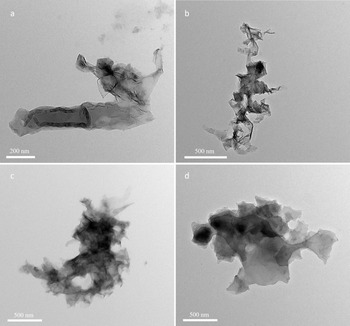
Thus a variety of morphological features including long threads and ribbons, twisted and folded appearance, and globule structures were observed in the shock processing of nucleobases. To get more information on the morphological characteristics of these structures, we subjected the shock processed residue to HRTEM. The HRTEM micrographs of the AGCT mixture showed the presence of fine twisted and folded features at a nanometre scale, as shown in Fig. 7(a) and (b). The AGCU mixtures also showed few sheets with uniform and twisted appearance at a nanometre scale (Fig. 7(c) and (d)). These observations indicate that the property of self-organization seems to be not profound in AGCU bases. Although a possible explanation for these results requires a detailed investigation, a possible reason could be the presence of thymine instead of uracil providing more stability due to the presence of the methyl group in thymine. The self-organization property of the mixture of AGCT bases also favours the early role of DNA and its components in the prebiotic evolution of life, confirming the previously suggested theories on the origin of life that require a heterogeneous genetic system made up of both RNA and DNA (Bhowmik & Krishnamurthy, Reference Bhowmik and Krishnamurthy2019; Kim et al., Reference Kim, Zhou, Zhang, O'flaherty, Rondo-Brovetto and Szostak2020; Xu et al., Reference Xu, Chmela, Green, Russell, Janicki, Góra, Szabla, Bond and Sutherland2020).
HRTEM bright-field images of a shock processed residue of (a & b) AGCT at a temperature of ~6360 K and (c & d) AGCU at a temperature of ~6320 K revealing twisted and folded ribbons and sheets at the nanometre scale.

The shock-processed residues were further characterized by Infrared (IR) spectroscopy. The IR spectroscopy of the shock-processed residue and unshocked sample was performed for single nucleobases as well as the mixture of nucleobases over a wavenumber range of 4000–500 cm−1, and are shown in the Supplementary Figs. S6–S11. Various characteristics peaks corresponding to vibrational modes of nucleobases can be seen in both the shocked and the unshocked samples. This indicates that nucleobases remain intact against the impact of the strong shock.
While from previous investigations it has been revealed that rich chemistry can occur at such extreme conditions, the formation of such microstructures was never revealed before. At present, the chemical composition of these microstructures is unknown. Given that nucleobases can still remain intact in the shock processed residue as revealed from IR data, these structures could possibly be the outcome of the assembly of nucleobases. Such structures play an essential role in the biological function because of their unique architecture. Self-organization of such complex structures on a macroscopic scale under simulated impact shock conditions is an important step in the prebiotic development of life. The formation of such long-range ordered structures in a prebiotic context has always been a difficult task. Life requires a high degree of structural order as well as complexity (Mayer, Reference Mayer2020). Any system which lacks one or another will lead to a dead-end, for example, asphalt or tar (Benner et al., Reference Benner, Kim and Carrigan2012) which is highly complex, or conversely crystals that are highly ordered (Mayer, Reference Mayer2020). A mechanism for the simultaneous increase in order and complexity will have significance for the prebiotic chemistry. The complex organized structures as synthesized by shock processing of biomolecules, thus have an important consequence for the origin of life. Many attempts have been made on the synthesis of such microstructure in primitive Earth environments and justifying their importance for the origin of life studies (Fox, Reference Fox1973; Folsome, Reference Folsome1976; Valladas-Dubois & Prudhomme, Reference Valladas-Dubois and Prudhomme1983; Simionescu et al., Reference Simionescu, Denes and Totolin1985; Yanagawa et al., Reference Yanagawa, Ogawa, Kojima and Ito1988). The formation of such structures is not only limited to terrestrial environments but seem to be relevant in the interstellar space with discoveries of self-assembled membranous structures observed in carbonaceous meteorites (Deamer & Pashley, Reference Deamer and Pashley1989) and further confirmation by experimental investigation of similar self-assembled vesicle structures formed as a result of UV photolysis of interstellar ice analogues containing simple molecules (Dworkin et al., Reference Dworkin, Deamer, Sandford and Allamandola2001). However, our method of shock processing of nucleobases provides a pathway by which these self-assembled organized structures could have appeared on the Earth, without the presence of any additional catalytic activity or atmospheric conditions, only triggered by shock energy provided by impact events.
Many competing models are suggested to explain the origin of life, such as the RNA world, the compartmentalistic approach, the prebiotic metabolism approach and many others. There is still no united model available for the origin of life (Luisi, Reference Luisi2016). However, the universal presence of cellular life on the Earth demands the emergence of cell-like architectures and functionality (Szostak et al., Reference Szostak, Bartel and Luisi2001; Mann, Reference Mann2012). The first step in this process is to search for a system that can spontaneously organize itself into structures that can act as a prototype that mimics various characteristics of minimal cellularity (Mann, Reference Mann2012; Zhang, Reference Zhang2012). The formation of complex structures as revealed in the present investigation is a possible answer to the first step in the path of prebiotic cellularity. Evidently, many profound challenges remain that need to be answered to search for the origin of life and find its signature elsewhere (Lingam & Loeb, Reference Lingam and Loeb2021). In future endeavours, we will explore the physical and chemical characteristics of these structures, which will provide significant elucidation of our understanding of the role played by complex molecules and impact events in the origin of life.
Conclusion
The novel shock tube method is used to produce extremely high temperatures (3500–7000 K estimated) shock and pressure of (15–34 bar) for a small duration to interact with the nucleobases. The shock processing of nucleobases has shown a plausible pathway by which nucleobases can spontaneously be self-assembled in complex structures when subjected to impact shock conditions. SEM and HRTEM analysis of shock processed residue provides an insight into the synthesis of a large variety of complex structures, including globules, long helical threads, and ribbons of up to millimetre length scale and twisted patterns at the nanometre scale. The formation of such structures in plausible prebiotic conditions implies their prebiotic significance in the subsequent stage of evolution, these structures may be incorporated with other prebiotic polymers in the right conditions and serve as the basis for the life-like self-assembling system. In future work, we will pursue more experiments to form new complex structures at different shock temperatures and to investigate the new structures by different characterization techniques.
Supplementary material
The supplementary material for this article can be found at https://doi.org/10.1017/S1473550421000136.
Acknowledgements
VSS, MM, SV, AB and BS thank the support from the Department of Space (Government of India). VSS and BS acknowledge the support from Sir John and Lady Mason Academic Trust (UK). VSS and BS also acknowledge the help from Dr Rebecca Thombre (Modern College, Pune, India) during the course of this work. Thanks to Aravind, Chirag and Sarvesh for their help in carrying out the shock experiments successfully. Thanks to IIT Gandhinagar, SICART and CeNSE IISc for providing SEM and HRTEM facilities.