Introduction
Density wave theory provides predictions of the structuring of spiral galaxies with sequences of star formation, gas/dust and different-aged stars through the arms (Pour-Imani et al., Reference Pour-Imani2016; Vallée, Reference Vallée2017a). Detailed studies of our own Galaxy (Choi et al., Reference Choi2014; Wu et al., Reference Wu2014; Hachisuka et al., Reference Hachisuka2015) and others (Foyle et al., Reference Foyle2010; Schinnerer et al., Reference Schinnerer2017) empirically show increased rates of star formation in and around spiral arm structures. What are the consequences for our Solar System and life on Earth as we pass through the spiral arms of the Milky Way? The potential importance of spiral arm passage was noted in the late 1970s and early 1980s (Napier and Clube, Reference Napier and Clube1979; Clube and Napier, Reference Clube and Napier1984; Raup and Sepkoski, Reference Raup and Sepkoski1984) and receives occasional scrutiny, especially with respect to its effect on climate and glaciation (Gies and Helsel, Reference Gies and Helsel2005; Overholt et al., Reference Overholt, Melott and Pohl2009; Svensmark, Reference Svensmark2012; Brink, Reference Brink2015), the timings of extinctions (Leitch and Vasisht, Reference Leitch and Vasisht1998; Gillman and Erenler, Reference Gillman and Erenler2008; Filopović et al., Reference Filopović2013) and the role of gravitational perturbation when passing through regions of dense matter (Yabushita and Allen, Reference Yabushita and Allen1989; Kataoka et al., Reference Kataoka2014; Nimura et al., Reference Nimura, Ebisuzaki and Maruyama2016). Other studies and critiques of periodicity in impact cratering, extinctions and climate have focussed on shorter periods potentially related to oscillations through the galactic midplane (Rampino and Stothers, Reference Rampino and Stothers1984; Yabushita, Reference Yabushita2002; Rohde and Muller, Reference Rohde and Muller2005; Lieberman and Melott, Reference Lieberman and Melott2007; Shaviv et al., Reference Shaviv, Prokoph and Veizer2014; Meier and Holm-Alwmark, Reference Meier and Holm-Alwmark2017).
Evidence on Earth for the galactic journey of the Solar System is expected to be found in the stratigraphic record of biological, geophysical and chemical changes. This includes events believed to be associated with passage through the arms, e.g. high iridium-cobalt ratios suggested as being indicative of encounters with molecular clouds (Nimura et al., Reference Nimura, Ebisuzaki and Maruyama2016), superchrons as potential markers of inter-arm passage (Wendler, Reference Wendler2004) and increased impact cratering (Clube and Napier, Reference Clube and Napier1984). The improved accuracy of event ages (high-precision records), longer and more complete sets of environmental proxy data and increasingly detailed understanding of the structure of the Milky Way (e.g. Urquhart et al., Reference Urquhart2014; Bland-Hawthorn and Gerhard, Reference Bland-Hawthorn and Gerhard.2016; Vallée, Reference Vallée2016, Reference Vallée2017a, Reference Vallée2017b) collectively enhance opportunities for an interdisciplinary investigation of the potential effect of the galactic cycle on the Solar System. Clarifying the timings and mechanisms during galactic cycles is important to determine the extent to which Earth processes, at given points in time, can be viewed in isolation, or coupled to solar system (e.g. Milankovitch) processes and extra-Solar drivers. If this can be achieved, then the galactic cycle may provide a unified theory of extinction and origination of life on Earth (Barash, Reference Barash2016).
The model presented here maps Earth and Solar System events onto the structure and substructure of the spiral arms of the Milky Way.
Methods
A four-arm structure is assumed, with arm centres modelled as logarithmic spirals with an equal pitch of 13° (median value for all arms; Tables 4 and 5 of Vallée, Reference Vallée2015). The galactic radius of the solar system was set at 8 kpc (Vallée, Reference Vallée2017b). The model uses Vallée's notation of 12CO as the arm centre with more negative distances further from the galactic centre, corresponding to younger ages with passage through the arms (Vallée, Reference Vallée2016). The publications of Vallée cited here present summaries and meta-analyses of multiple studies of the structure of the Milky Way.
The distances between the four arm centre spirals and the 12CO marker locations given in Table 5 of Vallée (Reference Vallée2016) (illustrated in our Fig. 1, details in Appendix 1) were minimized by manipulating parameter a of the logarithmic spiral; radius is aebt, b = tan (pitch angle). For Sagittarius-Carina and Scutum-Crux-Centaurus arms, the spiral was fitted between the two observed values (also agreeing with the start of Sagittarius but not fitted to that). The shortest Euclidean distance was found for a resolution of t to the nearest 0.0001. The distance between arm tracer galactic coordinates and the corresponding 12CO coordinates was also determined, independent of the fitted spirals.
Logarithmic spiral model of the Milky Way showing predicted 12CO central lines and observed 12CO markers (x) with arm labels. Both the spiral pattern and our Solar System (located at the top, on a radius of 8 kpc, dashed circle) move clockwise, the Solar System at a faster velocity and therefore passing through the arms. The locations of impacts (diamonds), superchron cluster midpoints (squares) and early Solar System (open circles) are shown on the Solar System orbit.

The model assumes a constant relative motion of our Solar System to the spiral arms and therefore that the galactic orbit angle is proportional to age, which can be determined once the galactic period, defined here as the time for the solar system to pass through all arms and return to its original location, is known. The galactic period is constrained by estimates of the angular velocities of the Solar System and the spiral arms. Taking the weighted mean of 228 km s−1 for the Solar System (LSR, Table 1, Vallée, Reference Vallée2017b) and values between 200 and 160 km s−1 for the spiral pattern (Table 2, Vallée, Reference Vallée2017b) gives a range of galactic periods from 1750 to 720 Myr. This can be constrained further by considering superchrons as markers of inter-arm passage (Wendler, Reference Wendler2004). In particular, we assume that the superchrons end at a fixed distance (and therefore time) before the arms. The difference between the times of the last two superchrons (265 and 83.07 Ma, Wang et al., Reference Wang2016; Belica et al., Reference Belica2017) is therefore equivalent to the difference between the angles of the 12CO centres of the two most recent arms (84.01°), giving a galactic period of 779.58 Myr. Note that while the galactic period is fixed, the passage time between the arms varies according to the structure in Fig. 1. The higher Solar System velocity relative to spiral arm pattern is consistent with the assumption that the Solar System is below the co-rotation radius and therefore, predicted to pass through the arms of the Milky Way (Vallée, Reference Vallée2017a). The process of velocity dispersion (Wielen, Reference Wielen1977), which arises due to local fluctuations in the gravitational field of the galaxy and alters the individual orbits of stars in the galaxy, is a potential source of time-dependent variation in our estimate of the galactic period. Current estimates put the local stellar velocity dispersion near the sun at 25 km s−1 (Rix and Bovy, Reference Rix and Bovy2013), which is an order of magnitude less than the circular orbital velocity. The review of Bland-Hawthorn and Gerhard (Reference Bland-Hawthorn and Gerhard.2016) notes the difficulty of reliably modelling the velocity dispersion of a stellar population. We also note that there is no obvious time-dependent shift in the locations of the events considered here with respect to the locations of the spiral arms.
Based on a circular orbit of radius 8 kpc and a known galactic period, an event of a given age has a location whose distance from the modelled 12CO arm centre can be determined. The shortest Euclidean distance was again found by altering the value of t in the log spiral equation. We contrast the distance of events from the modelled arm centre with the distance between the observed 12CO location and arm tracers, including methanol masers, HI, HII, 870 µm dust and old stars (Tables 6–10 of Vallée, Reference Vallée2016 – our results differ from some of those presented in Table 3 of Vallée, Reference Vallée2016 as we use different averaged values, see Appendix 1).
The Earth and solar system events considered here (detailed in Appendix 2) comprise the largest and most accurately-aged impacts (crater diameter greater than 20 km, age error ≤4 Myr), the top three most ecologically or taxonomically severe extinctions (four extinctions in total, McGhee et al., Reference McGhee2013), superchron ages over the last 2.2 Ga (Driscoll and Evans, Reference Driscoll and Evans2016; Wang et al., Reference Wang2016; Belica et al., Reference Belica2017), the earliest age of the Solar System (calcium-aluminium – rich inclusions, CAIs, Connelly et al., Reference Connelly2012; Connelly et al., Reference Connelly, Bollard and Bizzarro2017) and the origin of the Earth-Moon system from a giant impact (Connelly and Bizzarro, Reference Connelly and Bizzarro2016). The extinctions may be viewed as solely Earth-based events or an interplay of external events (e.g., impacts, molecular clouds) and Earth-based processes. Stratigraphic boundary ages and names follow Cohen et al. (Reference Cohen2013) unless stated otherwise. The aim is to consider the relationship of galactic structure and arm sub-structure to a set of key well-dated events as a template for future work and to provide a broad base for discussion of potential mechanisms.
Three types of statistical analyses were employed. First, clustering of impacts or superchrons around the galactic orbit was tested against a Poisson distribution null model in which the probability of 0, 1, 2 … n events within an angle window are e −m, me −m, (m 2/2!)e −m … (mn/n!)e −m, where m is the density of events (per angle window). Superchron midpoints are assumed to be samples of the same event if they differ by less than the average duration of superchrons (details in Appendix 3). The location of clusters (mean and standard error of angle) was then compared with the independently derived locations of arm centres. Second, we determine whether Earth and Solar System events are located within one standard error of the independently derived arm tracer locations and, finally, whether the fraction of events within a given range of arm tracers is significantly different from expected (likelihood ratio test).
Times and ages are reported to the nearest 0.1 million years (abbreviated to Myr for time and Ma for age). Distances are reported to the nearest parsec. In considering these differences it should be noted that a change of 0.1° galactic longitude equates to an average of 12 pc difference, which in turn relates to about 0.8 Myr near the arm centre. Angles given in the results refer to location around the galactic centre, taking 0° as vertical and the current position of the solar system, with larger angles corresponding to earlier ages (anticlockwise in Fig. 1).
Results
The last four arm-centre (12CO) interceptions are predicted to have occurred at 57.9 Ma (Carina), 239.8 Ma (Crux-Centaurus), 478.8 Ma (Norma) and 659.3 Ma (Perseus). Thirteen of the 16 impacts occur in two significant clusters around the Carina and Crux-Centaurus arms (Fig. 1), with six impacts from 6.8° to 35.2° and seven impacts from 89.5° to 134.0° (P < 0.01 for 29° and 45° windows respectively). The two impacts at 214.2° and 224.2° around the Norma arm have a probability of 0.07 (11° window). The means and standard errors of the first two clusters of angles (24.1° ± 4.4 and 110.4° ± 6.7) overlap with the 12CO arm centre angles for Carina and Crux-Centaurus (26.7° and 110.7° respectively). The third pair of impacts with a mean of 219.2° is within 2° degrees of the Norma centre (221.1°). Five of the 11 superchron midpoints occur in two significant clusters at averages of 134.9° (P < 10−4, 3 superchrons) and 236.4° (P < 0.01), 24.2° and 15.3° prior to the arm centres of Crux-Centaurus and Norma. A third cluster of two superchrons at 37.1° and 10.4° before the Carina arm is marginally non-significant (P = 0.08). The earliest solar system and Earth-Moon system (the midpoint of age estimates) precede the Perseus and Norma arms by 4.7° and 20.7°, respectively.
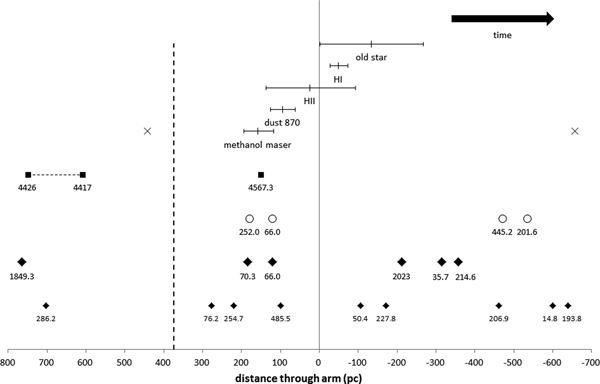
Entry into the arms occurs at about 400 pc (first marker at 440 pc, superchron end at 374 pc), with initial passage through the methanol maser and 870 µm dust regions, followed by HI after the 12CO centre (Fig. 2, combining data across all four arms). The observed HII and old star regions are much wider (Fig. 2); the range of the methanol maser, HI and 870 µm dust tracers are 248 pc, 138 pc and 179 pc, respectively, compared with 828 pc and 600 pc for the HII and old star tracers (the SEs in Fig. 2 are approximately 1/6 of the full range, details of tracer locations in Appendix 1).
Relationship of impacts (diamonds), extinctions (circles) and early solar system (squares) to arm tracer locations during passage through the spiral arms. The labels on the impacts, extinctions and solar system events are absolute ages (Ma, to nearest 0.1 million years). Ages relate to different arm passage as follows: Carina (76 to 14 Ma), Crux-Centaurus (254 to 193 Ma, 1849 Ma), Norma (485 to 445 Ma, 4420 Ma) and Perseus (4567 Ma). The impacts are divided into greater and less than 50 km diameter craters (upper and lower lines respectively, distinguished by font size). The error bars on the arm tracers are one standard error (across all arms, multiple markers within one arm are themselves averaged). The two crosses indicate the first and last arm markers. The vertical dashed line indicates the end of the last two superchrons (used in the calculation of the galactic period and assumed to be an equal distance from the arm centre). The horizontal dashed line links the age estimates for the Earth-Moon system.

Thirteen of the 16 impacts occur within the widest arm regions from 440 to −660 pc (Fig. 2) equivalent to 77 Myr. The observed duration of these impacts, including errors, is from 76.5 Ma to the equivalent of 192.7 Ma (10.8 Ma), i.e. 65.7 Myr. Taking the arm tracer range as an extrinsic (and more conservative) hypothesis, the probability of 13 out of 16 events occurring in 0.395 of the time, i.e. (4 × 77)/779.6, is P = 0.0006 (G = 11.72, likelihood ratio test). Two impacts prior to the earliest arm tracer in the Crux-Centaurus arm (286.2 and 1849.3 Ma) are at similar relative positions to the Earth-Moon system in the Norma arm (4426 to 4411 Ma).
The arms include the four most severe extinctions, in terms of either taxonomic ranking (end-Permian, end-Triassic and end-Ordovician) or ecological ranking (end-Permian, end-Cretaceous and end-Triassic). The end-Permian (178 pc, Crux-Centaurus) and end-Cretaceous (119 pc, Carina) extinctions are within one standard error of the methanol maser average (mean 156 ± 1 SE from 118 to 195 pc, Fig. 2). The midpoint location of the two extinctions (149 pc) is very close to the earliest solar system value (148 pc) in the Perseus arm and within 10 pc of the methanol maser average. The end-Ordovician and end-Triassic extinctions are located at −473 and −536 pc in the Norma and Crux-Centaurus arms, with separation similar to that of the end-Permian and end-Cretaceous.
Discussion
A significant fraction of the largest impacts and the top three most ecologically or taxonomically severe extinctions are located within the spiral arms according to the model presented here. A noteworthy example is the end-Cretaceous extinction, well-known as the final demise of the dinosaurs, set against a backdrop of fluctuating global climate (Bowman et al., Reference Bowman2014; Thibault et al., Reference Thibault2016). The proximal triggers for this extinction are debated but have centred mostly on the Chicxulub impact (Renne et al., Reference Renne2013) and the Deccan traps (Parisio et al., Reference Parisio2016). Nimura et al. (Reference Nimura, Ebisuzaki and Maruyama2016) use the iridium-cobalt ratio as an extraterrestrial index to hypothesize interactions with a giant molecular cloud from about 71 to 65 Ma (using 66 Ma as the end-Cretaceous age), overlapping with intermittent cooling from about 71.6 to 66.4 Ma (Thibault et al., Reference Thibault2016). This timing is consistent with the methanol maser mean location ± 1 SE (Fig. 2), equivalent to 71.1 to 66.0 Ma. The geological study of Nimura et al. (Reference Nimura, Ebisuzaki and Maruyama2016), combined with insights into the possible effects of molecular clouds (Yabushita and Allen, Reference Yabushita and Allen1989; Kataoka et al., Reference Kataoka2014), complements the galactic model presented here. The end-Permian extinction, the most severe both taxonomically and ecologically (McGhee et al., Reference McGhee2013), is predicted to occur in the Crux-Centaurus arm, at an approximately equal distance from the methanol maser average as the end-Cretaceous extinction.
Methanol masers are indicative of regions of high star formation (Fontani et al., Reference Fontani, Cesaroni and Furuya2010). Indeed, the current model places the earliest age of our own Solar System (CAIs) within 10 pc of the methanol maser average in the Perseus arm. The CAIs formed from heating and rapid cooling of dust approximately 1–2 Myr after gravitational collapse within a molecular cloud (Amelin and Ireland, Reference Amelin and Ireland2013). Passage through high mass/density regions offers various possibilities for mechanisms underpinning proximal extinction triggers, including rapid climate change (possibly due to enhanced Milankovitch effects); higher frequency of asteroid/comet impacts including extrasolar induced gravitational scattering events of minor planets (Goździewski et al., Reference Goździewski2010; Malmberg et al., Reference Malmberg, Davies and Heggie2011) and orbital perturbation of Oort cloud objects (Kenyon and Bromley, Reference Kenyon and Bromley2004; Collins and Sari, Reference Collins and Sari2010); increased magmatic activity (altered Earth tides) and higher cosmic ray incidence (Benyamin et al., Reference Benyamin2016). Regions of high star formation are also linked to supernovae which, along with possibly related gamma-ray bursts, have been suggested as causes of extinctions (Russell and Tucker, Reference Russell and Tucker1971; Ellis and Schramm, Reference Ellis and Schramm1995; Melott et al., Reference Melott2004).
Evidence from our own Solar System and many recently discovered exoplanets implies gravitational scattering events are common during the dynamic evolution of planetary systems (Weidenschilling and Marzari et al., Reference Weidenschilling and Marzari1996; Chatterjee et al., Reference Chatterjee2008; Ford and Rasio, Reference Ford and Rasio2008; Bromley and Kenyon, Reference Bromley and Kenyon2011; Ford Reference Ford2014; Batygin and Brown, Reference Batygin and Brown2016; Bromley and Kenyon, Reference Bromley and Kenyon2016). Furthermore, large gas giants that undergo gravitational scattering are likely to lose their moons when located >0.1 R Hill from a giant gas planet (Hong et al., Reference Hong2018). Consequently, gravitational scattering of large planets can cause a cascade of minor planets to become de-stabilized, leading to a rise in impacts. The recent discovery of the interstellar asteroid 1I/2017 U1 in the solar system and analysis of its orbital energy suggests an extrasolar scattering (Wright, Reference Wright2017).
The model presented here suggests that passage through star-formation regions may underpin the largest extinctions and that the location of the origin of our Solar System is identifiable within one such region. A dynamic model of the galactic journey of our Solar System offers the possibility to determine the extent to which that journey contributes to the stratigraphic pattern of geological change on Earth. Conversely, while the predictions of this model are clearly dependent on a set of assumptions about the dynamics and structure of the Milky Way, the increasingly accurate multi-proxy stratigraphic record may provide further checks of those assumptions. Finally, there is the opportunity to investigate the extent to which models of spiral arm passage relate to suggested shorter (quasi)periodic cycles of extinctions, impacts and climate.
Supplementary material
The supplementary material for this article can be found at https://doi.org/10.1017/S1473550418000125
Acknowledgements
We are very grateful to Jacques Vallée and Ed Gillman for advice and encouragement.