Introduction
It is estimated that there will be 6.7 million older adults with dementia in the USA by 2031 and 1.1 million in Canada by 2038 (Hebert et al., Reference Hebert, Scherr, Bienias, Bennett and Evans2003; Alzheimer Society of Canada, 2009). The rate of older drivers involved in fatal collisions in the USA is also expected to rise 155% by 2030 (Lyman et al., Reference Lyman, Ferguson, Braver and Williams2002). North American data show that crash rates in persons with dementia are 2–8 times higher relative to age-matched controls (Friedland et al., Reference Friedland1988; Drachman and Swearer, Reference Drachman and Swearer1993) and while incident dementia is a common reason for driving cessation, between 22% and 64% of individuals with dementia continue to drive (Lucas-Blaustein et al., Reference Lucas-Blaustein1988; Gilley et al., Reference Gilley1991; Foley et al., Reference Foley, Masaki and Ross2000; Herrmann et al., Reference Herrmann2006). A prospective study showed that only 48.5% of patients with mild-to-moderate dementia who were still driving at baseline had stopped driving when assessed one year later (Herrmann et al., Reference Herrmann2006). In contrast, another US observational study indicated that less than 30% of those with mild Alzheimer's Disease (AD) who pass on-road tests were able to pass one year later (Duchek et al., Reference Duchek2003). Given the increasing prevalence of drivers with dementia and the increased collision risk and erosion of skills associated with this diagnosis, the pervasiveness of driving in this population is problematic. Conversely, driving cessation can be associated with significant adverse outcomes, including depression, social isolation, and mortality (Chihuri et al., Reference Chihuri2016), and many patients with mild AD are safe to continue driving, at least in the short term (Hunt et al., Reference Hunt, Morris, Edwards and Wilson1993; Duchek et al., Reference Duchek2003; Molnar et al., Reference Molnar, Marshall, Man-Son-Hing, Wilson, Byszewski and Stiell2007; Iverson et al., Reference Iverson, Gronseth, Reger, Classen, Dubinsky and Rizzo2010).
The challenge is determining which of these individuals are still fit to drive and when driving cessation should occur, given that dementia is a progressive condition and that mild cognitive impairment (MCI) often progresses to dementia. Complicating matters, legislation varies between states, provinces, and countries about when physicians have a mandatory duty to report such patients to transportation authorities (Rapoport et al., Reference Rapoport2007). Most provinces in Canada have mandatory reporting legislation. In the province of Ontario, physicians are required to report any person “suffering from a condition that may make it dangerous for the person to operate a motor vehicle.” In practice, physicians issue a report to transportation administrators, who make recommendations regarding the person's fitness to drive. Responses from transportation administrators range from immediate license suspension to the requirement to undergo a functional assessment at an independently operated, administrator-approved center. These assessment centers are located in rehabilitation and private clinics, are generally staffed by specially trained occupational therapy assessors, and involve substantial fees to patients, which are not typically covered by current health or insurance plans. A recent cross-Canada survey indicated an average cost of $366 CAD (SD = $225) with a range from $40 to $985 (Vrkljan et al., Reference Vrkljan, Myers, Crizzle, Blanchard and Marshall2013).
Our recent Driving and Dementia in Ontario (DADIO) study (Rapoport et al., Reference Rapoport2014a; Rapoport et al., Reference Rapoport2014b) consulted 38 physician experts in dementia care about which patients with either dementia or MCI they believed should be reported to transportation authorities. Despite the strict wording of the mandatory reporting legislation, we found heterogeneity in how physicians apply the legislation in practice. Specifically, 26 case scenarios were presented up to five times to the experts in a modified Delphi process, and cumulative consensus occurred for 69% of the scenarios. We found that caregiver concern and abnormal performance on the Clock Drawing Test (CDT) accounted for 62% of the variance in reporting patients with dementia or MCI to transportation administrators, but also that male physicians were 14% more likely than female physicians to report.
This paper describes the development of a Driving in Dementia Decision Tool (DD-DT), which was created to reduce the variability in physician decision making around reporting drivers with dementia, and to translate existing literature into practice. The DD-DT was designed to provide an online, user-friendly, evidence- and guideline-based, point-of-care recommendation on whether or not to report drivers with mild dementia or MCI to transportation authorities. This report details the methodology of developing this tool, which included a systematic update of the earlier review of the literature, review of international guidelines, qualitative focus groups and interviews, as well as iterative meetings with web developers. The results of this process are described, along with a description of how these steps informed the development of the tool, as well as a description of the decision tool itself. The DD-DT is discussed in light of other knowledge translation initiatives in dementia.
Methods
Literature update
The DADIO study (Rapoport et al., Reference Rapoport2014b) involved a comprehensive literature review of articles focusing on predictors of driving safety in older adults with dementia. That earlier project reviewed articles published up to December, 2010. Therefore, a primary step in the development of the DD-DT involved updating the literature review for articles published between January, 2011 and October, 2013. We searched MEDLINE, PsycINFO, and Embase databases from December, 2010 to October, 2013, for keywords pertaining to dementia, driving and motor vehicle collisions (see Appendix 1, available as supplementary material attached to the electronic version of this paper at https://doi.org/10.1017/S1041610217000242).
Studies were selected by the principal investigator (MJR) if they reported on the association of a clinical variable with driving safety or motor vehicle collisions in dementia. The quality of each newly identified article was then rated by co-investigators, and the strength of each variable in predicting driving safety was assessed. The rating system used was the same as that for the DADIO study (Rapoport et al., Reference Rapoport2014b), which followed a modified version of Iverson/American Academy of Neurology (AAN) guidelines (Iverson et al., Reference Iverson, Gronseth, Reger, Classen, Dubinsky and Rizzo2010), in which articles were graded as Class I, II or III (with Class I indicating the most rigorous study design), and evidence for each predictor variable was graded Category A, B, C, D, or E (with Category A representing “good evidence to support using this variable,” and Category E representing “good evidence to recommend against using this variable”). Variables were considered to have sufficient evidence for inclusion in the tool if they were categorized as Category B (“fair evidence to support using this variable”) or higher. Pairs of co-investigators independently graded the articles and evidence for predictor variables. At a meeting of co-investigators, in November, 2013, consensus was achieved by discussion in instances where there was a discrepancy between raters.
Assessment of international guidelines
In order to highlight any factors associated with dangerous driving in mild dementia that may have been missed in the literature reviews, 12 clinical practice guidelines from seven countries were analyzed. Recommendations regarding driving and dementia were extracted and compared to determine commonalities. We reviewed guidelines from Canada (Byszewski et al., Reference Byszewski, Aminzadeh, Robinson, Molnar and Dalziel2011; Canadian Medical Association, 2012; Canadian Council of Motor Transport Administrators, 2013; Not If But When, 2013), USA (American Association of Motor Vehicle Administrators, 2009; American Medical Association, 2010; Iverson et al., Reference Iverson, Gronseth, Reger, Classen, Dubinsky and Rizzo2010), Australia (Austroads, 2012), United Kingdom (Driver Vehicle Licensing Agency, 2009), New Zealand (New Zealand Transport Agency, 2009); Ireland (Road Safety Authority, 2010), and Singapore (Singapore Medical Association, 2011).
Two research assistants (RAs) extracted recommendations from each of the 12 guidelines during September and October, 2013, and determined the number of concurrences between the guidelines. Because precise wording of recommendations varied, guideline recommendations were considered to be concurrent when the concept contained within a recommendation was found in at least one other guideline, with only minor changes in wording. Concepts contained in the recommendations of at least six of the guidelines were selected for review by a panel of co-investigators in advance of a meeting in November, 2013, and reviewed for integration into the DD-DT.
Focus groups with physicians and caregivers
Three 1-h focus groups with DADIO study participants were held in Toronto in June, 2012, during a post-study meeting, which all DADIO study participants were invited to attend on the campus of an academic teaching hospital. Twelve of 38 DADIO study participants took part in the focus groups. The groups were facilitated by two of the co-investigators and focused on the topic of reporting drivers with cognitive impairment to transportation administrators as well as the potential role of the planned DD-DT. One was a group of four family physicians, the second was a group of five psychiatrists (plus one invited guest, who was a geriatric psychiatrist), and the third group was one geriatrician and three psychiatrists. A fourth focus group consisted of a convenience sample of five family member caregivers (three spouses, two children), recruited with assistance from the local chapter of the Alzheimer's Society; this group was held in Toronto in February, 2012 and was led by an external facilitator. All four focus groups were audio recorded and transcribed. Transcripts were entered into HyperResearch™ software and coded by one of the co-investigators (LR) to identify emergent themes. The method of constant comparison was used, which included searches for disconfirming evidence. See Appendix 2, available as supplementary material attached to the electronic version of this paper at https://doi.org/10.1017/S1041610217000242, for the focus group guides.
Telephone interviews with occupational therapists and transportation administrators
Two occupational therapists (OTs) with specialized knowledge of issues pertaining to dementia and driving in Ontario, Canada, participated in informal one-on-one telephone discussions with one of the co-investigators (LR). Both OTs had clinical experience with on- and off-road driving assessments – one worked as a certified driver rehabilitation specialist, and the other worked primarily in an academic setting. The purpose of these discussions was to gather key background information from those with expertise in driving assessment; and to use this information to inform the interview guides for subsequent interviews with transportation administrators, as well as the recommendations in the tool for specialized on-road testing. Four members of the provincial transportation administration (two managers and two Medical Review team leads) then participated in formal telephone interviews. All data collection took place in September and October, 2013. Discussions with OTs were informal background interviews and were not recorded or transcribed. Each conversation lasted approximately 35–40 min. Interviews with transportation administrators were digitally recorded and ranged from 35 to 47 min. Transcripts were transcribed verbatim and entered into HyperResearch™ software for qualitative data analysis and coded by LR to identify emergent themes. The method of constant comparison was used, including searches for disconfirming evidence. See Appendix 2, available as supplementary material attached to the electronic version of this paper at https://doi.org/10.1017/S1041610217000242, for the telephone interview guide.
Development of a resource package for patients and caregivers
One of the co-investigators (AB) formed a working group with three representatives of the Alzheimer Society of Canada and Alzheimer Ontario, as well as a family member of a person with dementia. The aim of this group was to develop a package of resource materials for physicians to give patients and their caregiver(s) when the physician used the online decision tool. The group began with the “Driving and Dementia Toolkit” (Byszewski et al., Reference Byszewski, Aminzadeh, Robinson, Molnar and Dalziel2011), which was developed in consultation with patients and caregivers, and supplemented the toolkit with updated information on driving safety in the context of MCI and dementia.
Development of the online tool
A computerized clinical decision support system (CCDSS) was developed to provide an easy-to-use evidence-based tool to help physicians decide whether or not to report drivers with mild dementia or MCI to transportation administrators. The CCDSS incorporated the algorithm from the DADIO study (Rapoport et al., Reference Rapoport2014b), findings from the updated literature review and guideline assessment, plus new information gleaned from focus groups and one-on-one interviews with key stakeholders in the mandatory-reporting region of Ontario, Canada. Use of such a CCDSS has been documented in a systematic review to improve physician performance across other aspects of healthcare (Garg et al., Reference Garg2005).
Ethics
The Research Ethics Board (REB) of Sunnybrook Health Sciences Centre, Toronto, Ontario approved the current study (REB ID #249-2010 and 269–2013) and informed consent was obtained from focus group and interview participants. Participants in the DADIO focus groups were not compensated for their participation, though family member caregivers received remuneration for their time.
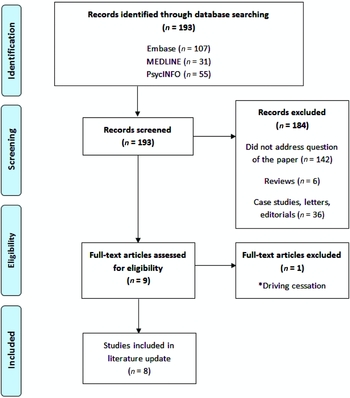
Results
Literature update
The database searches yielded a total of 193 articles of which 184 were excluded because they did not address the purpose of the tool, were systematic reviews or were case studies, letters, editorials, or duplicates. Nine original articles were found to meet the inclusion criteria (Figure 1). Two of the studies reported on driving simulator performance (Devlin et al., Reference Devlin, McGillivray, Charlton, Lowndes and Etienne2012; Kawano et al., Reference Kawano2012), while six dealt with on-road driving performance (Fox et al., Reference Fox, Bowden, Bashford and Smith1997; Carr et al., Reference Carr, Barco, Wallendorf, Snellgrove and Ott2011; Anderson et al., Reference Anderson, Aksan, Dawson, Uc, Johnson and Rizzo2012; Eby et al., Reference Eby, Silverstein, Molnar, LeBlanc and Adler2012; Ott et al., Reference Ott, Papandonatos, Davis and Barco2012; Watanabe et al., Reference Watanabe, Konagaya, Yanagi, Miyao, Mukai and Shibayama2012), and none reported on collisions. One of those papers was published in 1997, but was missed in our earlier literature search, and identified from a review of the bibliographies of the identified papers (Fox et al., Reference Fox, Bowden, Bashford and Smith1997). Eight of these articles contained evidence pertinent to our study and each article was, therefore, sent to the co-investigators for grading. One article pertained to driving cessation in dementia, but did not address driving risk or performance and was, therefore, excluded (Seiler et al., Reference Seiler2012).
Selection strategy for inclusion of relevant articles.
*Article pertained to driving in older adults but did not assess risk or performance and was therefore excluded. From: Moher D, Liberati A, Tetzlaff J, Altman DG, The PRISMA Group (2009). Preferred Reporting Items for Systematic Reviews and Meta-Analyses: The PRISMA Statement. PloS Med 6(6): e1000097. Doi:10.1371/journal.pmed.1000097.

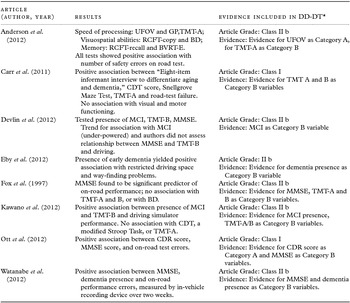
Two of the articles were rated as Class I (Carr et al., Reference Carr, Barco, Wallendorf, Snellgrove and Ott2011; Ott et al., Reference Ott, Papandonatos, Davis and Barco2012) and the remainder was rated as Class IIb (Fox et al., Reference Fox, Bowden, Bashford and Smith1997; Anderson et al., Reference Anderson, Aksan, Dawson, Uc, Johnson and Rizzo2012; Devlin et al., Reference Devlin, McGillivray, Charlton, Lowndes and Etienne2012; Eby et al., Reference Eby, Silverstein, Molnar, LeBlanc and Adler2012; Kawano et al., Reference Kawano2012; Watanabe et al., Reference Watanabe, Konagaya, Yanagi, Miyao, Mukai and Shibayama2012). The evidence extracted from each article for particular variables is highlighted in Table 1. As in the DADIO study (Rapoport et al., Reference Rapoport2014b), the variables of Clinical Dementia Rating (CDR) and Useful Field of View (UFOV) were rated Category A, and the Mini-Mental State Examination (MMSE) and the presence of a mild dementia diagnosis were rated Category B. The present search upgraded the variables of a diagnosis of MCI, and the Trail-Making Test parts A and B (TMT A/B) from Category C to Category B (see Appendix 3, available as supplementary material attached to the electronic version of this paper at https://doi.org/10.1017/S1041610217000242). Other variables remained in Category C.
Summary of evidence obtained from literature update

*Grade represents the quality of the article, and Category represents the consistency with which the evidence supports the relationship between the variable and measures of driving. Unless otherwise stated, associations are between the given cognitive variable and impaired driving performance. As only variables rated Category B or higher were included in the tool, all other results listed in the second column of this table that do not appear in column 3 have been rated Category C.
Notes: BD = Block Design; BVRT = Benton Visual Retention Task; CDR = Clinical Dementia Rating scale; CDT = Clock Drawing Test; GP = Grooved Pegboard; MCI = Mild Cognitive Impairment; MMSE = Mini Mental State Exam; RCFT = Rey–Osterrieth Complex Figure Task; TMT-A/B = Trail Making Test parts A and B.
Caregiver concern was not specifically found as a predictor in our literature search, likely because it was not specifically included in the search strategy. However, the AAN guideline outlined a recommendation with Grade B (“fair evidence”) that the presence of caregiver concern should be given significant weight in assessing drivers with dementia (Iverson et al., Reference Iverson, Gronseth, Reger, Classen, Dubinsky and Rizzo2010). Two additional observational studies not cited in the AAN guideline also suggest the importance of caregiver concerns in this population. An Australian prospective study showed that 94% of patients with dementia who had stopped driving did so because their caregiver had deemed them to be at unacceptable road risk (Seiler et al., Reference Seiler2012). In a mixed population of drivers in Massachusetts with medical conditions, including dementia, moderate or extreme caregiver concern was found in 33% of those who were deemed unsafe to drive, 21% of those deemed marginal, and 10% of those who were deemed safe on an on-road test (O'Connor et al., Reference O'Connor, Kapust, Lin, Hollis and Jones2010). Because of these recommendations and findings, caregiver concern was integrated into the decision tool.
Impact of the literature update on the dd-dt development
On the basis of the revised literature review, decisions were made at a co-investigators’ meeting to retain MCI in the DD-DT, as well as the TMT A/B. Caregiver concern was also retained and emphasized. In accordance with the decision in the DADIO study, the investigators opted not to include either the UFOV or CDR, despite a high category of evidence because these are research-based tools that would pose feasibility challenges in a medical outpatient setting.
Assessment of international guidelines
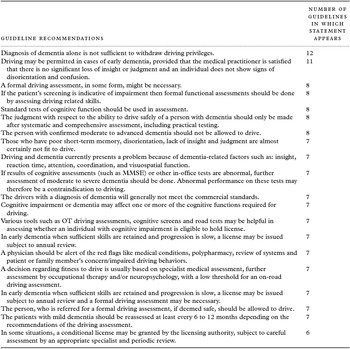
A total of 104 recommendations about driving with dementia were collected from 12 international guidelines. Of the 104 recommendations, 20 were found in 6 or more of the other guidelines reviewed, with only minor variations in wording (Table 2). The recommendation that “diagnosis of dementia alone is not sufficient to withdraw driving privileges” was seen most frequently; appearing in all 12 of the international guidelines. Similarly, the statement that “driving may be permitted in cases of early dementia. . .” was also noted in 11/12 guidelines. The other highly concurrent guideline statements concerned the importance of on-road testing in assessment of mild cases of dementia, the need for longitudinal assessments, the impact of specific cognitive domains on driving, the value of in-office cognitive testing, and red flags suggestive of safety hazards, such as moderate-severe dementia, and concerns of caregivers about driving performance decline.
Guideline statements appearing in at least 6/12 international guidelines

Note: Given that the recommendations appear multiple times in various wordings, paraphrases are reported here to avoid redundancy.
Impact of international guideline assessment on the dd-dt development
The guideline assessment confirmed the contents of the original DADIO algorithm and, at a co-investigators’ meeting, decisions were made to emphasize the importance of on-road testing when driving safety is uncertain. As well, the caregiver report and the stage of dementia for each patient were also considered in tool development.
Qualitative data
Focus groups
Family member caregiver participants described inconsistencies and uncertainties in relation to drivers with mild dementia, with many noting reluctance to act or report on the part of both family members and physicians. Uncertainty about whether a driver's cognitive status warranted intervention, and concerns about potential impacts on the family, finances, and living arrangements were common themes raised by caregivers. Some caregivers also expressed frustration with physicians’ reluctance to act when they raised concerns about a family member's driving.
Physicians raised issues about the potential for negative impact on the therapeutic alliance. They also expressed frustration with the perceived lack of transparency and inconsistency of the transportation administrators’ actions in relation to referrals. Another barrier to physicians reporting patients to the transportation authority was concern about the potential outcome of patients being referred to costly specialized driving testing centers that they need to pay for out of pocket. The clinical complexity of determining a patient's capacity to drive was noted to be in conflict at times with a clear-cut over-reaching duty to report in the context of mandatory reporting legislation in Ontario, Canada. A report to transportation administrators was often seen as an irrevocable act and physicians were reluctant to report because reinstatement of the patient's license once it had been suspended was perceived to be extremely difficult. Given the scenarios described above, many physician participants felt that a decision support tool had the potential to improve consistency of practice amongst physicians and to reassure patients and caregivers that decisions regarding driving capacity were not being made in either an arbitrary or ad hoc fashion. However, in order to gain credibility and buy-in, participants emphasized that the tool would have to be evidence-based, align with established routines, and support the ethos of patient-centered care.
Interviews with ots
Specialist OTs identified a number of issues, including inconsistency and a lack of transparency at the transportation administration, the unfamiliarity of physicians with the licensing authority processes, difficulties with communication between the transportation administrators and physicians, and concerns about the cost to patients referred for specialized on-road testing. They also highlighted the social and emotional complexity that often deterred family members and physicians from acting on concerns about someone's driving ability.
Interviews with transportation administrators
Staff reported that interactions between physicians and the transportation administrators were often hampered by miscommunication, feeding into physician perceptions of opacity and inconsistency on the part of the administration, thereby constituting a barrier to reporting. Specifically, it was suggested that physicians often appeared unaware that particular words, phrases, or indications on referrals would trigger corresponding, protocol-driven actions as dictated by national safety standards. Privacy restrictions on direct communication between the physicians and the driving administrators further compounded communication challenges. Transportation administrators also reported that physician referrals were extremely variable in length and clinical detail. While it is beyond the scope of practice of their analysts to interpret nuanced clinical information, variability in decision making was acknowledged, as was reliance on peer-to-peer training. Where physician reports are too technical or ambiguous to apply protocol-driven actions, staff have the ability to refer the case for consultation with a medical advisor contracted by the transportation administration. However, as their medical advisors interact only with policy-makers on protocol development, operational staff felt isolated from this part of the process.
Impact of qualitative data on the dd-dt development
The physician uncertainty of whether to report patients to transportation administrators, the family caregivers’ frustration with this uncertainty, and the OTs’ and transportation administrators’ concerns about standardization lent credence and importance to the development of the tool. Transportation administrators’ comments about the variability in wording of the reports informed the content of the reporting forms generated by the DD-DT.
The Driving in Dementia Decision Tool (DD-DT)
Technical development
The research team worked with website developers (OSM Networks, Belleville, Ontario, Canada) to create a CCDSS based on the concepts and pathways in the DADIO algorithm (Rapoport et al., Reference Rapoport2014b). The process involved operationalizing each concept in the algorithm as a question to be incorporated into an online decision tool. For example, the concept “caregiver concern” was rephrased as the question, “Does the caregiver/informant have any concerns about the person's driving?”
After an initial version of the tool had been created, logic testing was completed by two RAs (DC, CZS) in order to assure each path of the algorithm was incorporated correctly into the decision tool; this process was completed throughout February–August, 2014. Apart from correcting minor errors in logic identified in testing the hypothetical cases, no changes were deemed necessary. Once this process was complete, eight of the co-investigators pilot-tested the tool with 16 of their patients in an office setting. Minor feedback on wording was provided and incorporated into the final version of the tool.
Format of the dd-dt
The DD-DT was designed so that physicians could access it online during office-based patient encounters, and relatively quickly receive a recommendation on whether or not to report drivers with mild dementia or MCI to transportation administrators. Users are required to log on to a password-protected site, and answer a series of questions about the patient; this data is referred to as “Tool Input.” Using the concepts and pathways in the DADIO algorithm outlined above, the tool generates “Tool Output,” which consists of a recommendation regarding whether or not to report the patient, or to recommend a specialized on-road test. Additional components of the DD-DT include written materials to give patients and caregivers each time the tool is used, plus access to pre-populated transportation administrator-approved reporting forms. Each of these aspects of the DD-DT is detailed below.
Tool input phase 1
Physicians using the tool first input demographic information about the patient, excluding personal identifying information. They are then asked whether the patient has a moderate or severe dementia. If they indicate “yes” to moderate or severe dementia, they see a message indicating that the DD-DT should only be used with patients who have mild dementia or MCI, and they are redirected to an exit screen, with a reminder that moderate-to-severe dementia is a contraindication to driving. See Appendix 4, available as supplementary material attached to the electronic version of this paper at https://doi.org/10.1017/S1041610217000242, for the precise wording for the input variables and outputs of the tool. Physicians are required to input the following variables: Patient's cognitive diagnosis, driving history, caregiver/informant concern, behavioral or neuropsychiatric disturbances, level of independence in the performance of activities of daily living and instrumental activities of daily living (ADLs/IADLs), and results of in-office cognitive assessment (see Appendix 4 published as supplementary material online attached to the electronic version of this paper at http://journals.cambridge.org/ipg). In-office cognitive performance was assessed using the MMSE score and/or the Montreal Cognitive Assessment (MoCA) score, plus the CDT score based on Mini-Cog scoring protocol. The physician is also required to rate the patient's speed of cognition informally based on a global assessment of how quickly or slowly the patient performs during the interview and in-office cognitive testing. Because of the concerns regarding feasibility of integrating the TMT into routine practice, physicians are given the option of inputting TMT versions A and B data, but are not required to do so.
Tool output
Depending on the data input, participants receive a recommendation of “Report” to transportation administrators, “Don't Report” or “No Consensus” – meaning that the information provided does not lead to a definitive recommendation, as determined by the DADIO algorithm. See Appendix 4 published as supplementary material online attached to the electronic version of this paper at http://journals.cambridge.org/ipg for specific wording of these recommendations. Additionally, if the physician chooses to report the patient, they are directed to pre-populated transportation administrator-approved reporting forms that indicate the patient's diagnosis (dementia or AD vs. MCI) and whether or not they recommend a road test. Informed by the qualitative interviews, the physician's level of concern was standardized, asking them to indicate either serious concerns/suggest immediate driving cessation or indicate that the risk to road safety is uncertain. In addition, participants access a link to a list of transportation administrator-approved specialized driving assessment centers in their community.
Tool input phase 2
After using the tool, physicians indicate whether or not they decide to report the patient to transportation administrators, they provide a brief rationale for their decision, and indicate if they recommend a specialized road test for the patient.
Materials
All physician participants are provided by mail with copies/access to in-office cognitive performance tests used in the tool (MMSE, MoCA, CDT, and the TMTA/B). In addition, they have access to an instructional video embedded in the DD-DT website to guide them through the process of using the tool, and access to technical support during business hours. The “patient and caregivers’ material” package is meant for physicians to give to the patient and his/her caregiver(s).The package was developed by the working group over a series of meetings, with a focus on providing information to help families understand the issues, resources, and emotional components of addressing driving safety and possible cessation of driving in the context of MCI and mild dementia. The package includes a copy of “The Driving and Dementia Toolkit for Patients and Caregivers” (Byszewski et al., Reference Byszewski, Aminzadeh, Robinson, Molnar and Dalziel2011), which describes the issues pertaining to driving and dementia in layperson language, geared toward a grade 4 literacy level. The Toolkit was developed in consultation with patients and caregivers, and was reviewed and modified based on their input. The patient and caregiver package also includes information on how to contact the local branch of the Alzheimer Society, a list of helpful online and printed resources, guides on how to initiate conversations about driving safety with persons with dementia, a list of local transportation administrator-approved specialized driving assessment centers, an insert on coping with grief to help readers process the emotional impact that can accompany loss of one's driving license and a list of alternative sources of transportation in the participant's region.
Alternate versions for evaluation of the tool
In order to prepare the online tool for evaluation, two versions were created – intervention and control. The interface for each version is identical, as are Tool Input Phases 1 and 2. For the control version, however, instead of a Tool Output recommendation on reporting, the physician views a generic prompt reminding them of the mandatory reporting legislation for patients with conditions that may affect driving. Control participants also do not have access to the pre-populated reporting forms, the link to on-road testing centers or patient/caregiver support materials.
Discussion
The updated literature review and international guideline assessment confirmed the content of the DADIO algorithm and provided evidence-based rationale for including a wide variety of input variables in the final version of the DD-DT. Although eight original articles were found in the updated literature review, none indicated any predictors of driving performance that was not already found in our previous DADIO study. From the qualitative interviews and focus groups conducted as part of this study, it was noted that engaging physicians to work with patients in addressing progressive cognitive impairment is often contingent on several barriers: (1) an inherent reluctance of physicians to act; (2) physicians’ lack of confidence in their assessment; (3) physicians’ concerns over consequences on the quality of life of their patients; (4) the importance placed on the need to maintain a good physician–patient therapeutic alliance; and (5) perceived communication barriers between caregivers, physicians, and transportation administrators. The idea of a tool was viewed as a way of potentially improving communication and transparency between physicians and transportation administrators, and addressing some of the identified barriers.
The strength of the tool development process lay in the range of systematic approaches used to address the question of when patients with MCI and mild dementia should be reported to transportation administrators in jurisdictions with mandatory reporting. The process included two rounds of systematic literature review (once before and once after a modified Delphi process), a review of existing international guidelines, and qualitative interviews and focus groups with relevant stakeholders.
The primary limitations of the approach pertain to the dearth of high-quality evidence guiding physicians on how to make decisions to report to transportation administrators in cases where mild dementia and MCI are observed. Although we did include a detailed review of international guidelines on driving and dementia from seven countries, the empirical studies found in the literature focus primarily on North American literature and pertain to fitness to drive, rather than reporting. In addition, decisions about reporting have to bear in mind many environmental, legal, and psychosocial factors. While the DD-DT may mitigate some concerns about mandatory reporting identified by key stakeholders in the tool development process, it can do little to address concerns expressed by both service providers and patient advocates about the significant cost of driving assessment, which is borne by the patient in the region studied (Rapoport et al., Reference Rapoport2007; Vrkljan et al., Reference Vrkljan, Myers, Crizzle, Blanchard and Marshall2013) In addition, the group formed to develop the DD-DT resource package for patients and caregivers was heavily slanted toward professionals and may have benefitted from increased lay participant input.
Although most provinces in Canada require mandatory reporting of patients with medical conditions such as dementia, only six US States, six of 27 countries in the European Union, one state and one territory in Australia require reporting (Brashler et al., Reference Brashler2016). Even in jurisdictions with mandatory reporting, where legal repercussions may ensue for not reporting, physicians have many concerns – breaches in confidentiality, the doctor–patient relationship, the costs of road tests, and a lack of confidence in conducting the assessments or in the evidence base behind the assessments (Rapoport et al., Reference Rapoport2007; Brashler et al., Reference Brashler2016). Nonetheless, reports by physicians to transportation administrators do reduce the risk of crashes leading to visits to emergency rooms (Redelmeier et al., Reference Redelmeier, Vinkatesh and Stanbrook2008), and so a standardized approach such as that developed in the current protocol has the potential for positive impact on public safety. Because mandatory reporting legislation varies between different provinces in Canada and other international jurisdictions, and because the DD-DT tool was developed for the Canadian province of Ontario, it would need to be adapted and tailored to other jurisdictions. Nevertheless, the fundamental components can serve many health professionals when addressing this challenging area of dementia care, and physicians practicing in jurisdictions with discretionary reporting of medically unfit drivers have similar need for guidance.
While healthcare providers are the target of this intervention, driving cessation in older adults, including those with dementia is an enormously complex topic, as highlighted by recent qualitative research. Our intervention focuses on safety, as has traditionally been the case with research on driving and dementia (Liddle et al., Reference Liddle, Gustafsson, Mitchell and Pachana2017). Interventions supporting driving cessation need to recognize the stigma that older drivers face, particularly in the media (Liddle et al., Reference Liddle, Gustafsson, Mitchell and Pachana2017). The difficult role that family has to play has been highlighted: On the one hand, it is important that families introduce safety concerns when they arise among older adults or those with dementia (Liddle et al., Reference Liddle, Turpin, Carlson and McKenna2008), but on the other hand older adults often resent input of others and prefer to emphasize their own autonomy in advanced planning and decision making (Liddle et al., Reference Liddle, Bennet, Allen, Lie, Standen and Pachana2013; Liddle et al., Reference Liddle, Gustafsson, Mitchell and Pachana2017). From the point of view of healthcare providers, clarity of roles, and consistency of approaches is important to ensure that the balance of safety and autonomy is addressed fairly (Liddle et al., Reference Liddle, Turpin, Carlson and McKenna2008). The DD-DT provides a standardized approach to the assessment of safety in dementia that would be integrated into broader approaches for driving cessation planning in dementia.
Conclusion
It is unclear how best to translate research-based knowledge into clinical care in dementia, particularly when there are significant gaps and limitations in the empirical evidence. Translational initiatives based on physician or caregiver education have been shown to benefit quality of life and reduce caregiver burden and neuropsychiatric symptoms in dementia (Byszewski et al., Reference Byszewski2003; Meuser et al., Reference Meuser, Carr, Berg-Weger, Niewoehner and Morris2006; Thomas et al., Reference Thomas2006; Stern et al., Reference Stern2008; Corbett and Ballard, Reference Corbett and Ballard2011). However the optimal design of such initiatives is unclear; barriers to uptake or use in clinical practice must be carefully considered (Horvath et al., Reference Horvath2011), and innovative approaches to synthesize and translate research in dementia into clinical practice are needed. The topic of reporting drivers with MCI or mild dementia to transportation administrators in jurisdictions with mandatory reporting legislation is particularly challenging, with many barriers. Using a multifaceted approach that included extensive analysis of the literature and guidelines, qualitative research, and computer programming, we created a computerized decision support system intended to help physicians standardize the process of reporting drivers to transportation administrators. It will be important to evaluate the effects of such a tool in the real-world of clinical practice before wider implementation.
Conflict of interest
None.
Description of authors' roles
D. Cameron conducted the 2011 literature update and the analysis of the guidelines, prepared the first draft of this manuscript and helped to finalize the manuscript submission. C. Zucchero Sarracini was the research coordinator, who conducted the literature review and contributed to all drafts of the manuscript. L Rozmovits conducted the qualitative interviews with occupational therapists and transportation administrators, and conducted the qualitative analysis of these interviews as well as the focus groups with physicians and caregivers. B. Henry and Drs Naglie, Herrmann, Molnar, Jordan, Byszewski, Tang-Wai, Dow, Frank, Pimlott, Seitz, Vrkljan, and Masellis provided extensive guidance and input throughout the tool development process and to the editing of the manuscript. R. Taylor participated in the analysis of the guidelines and literature review. M. Rapoport was the senior responsible author, and wrote the grant application supporting this work, oversaw all phases of the design and implementation of the research, extensively revised the initial drafts of the manuscript, and prepared the final draft.
Acknowledgments
The authors would like to thank Mary E. Schulz, Yoassry Elzohairy (Ontario Ministry of Transportation), Joe Zeagman (Ontario Ministry of Transportation), Elizabeth Weldon (Ontario Ministry of Transportation), Audrey Duff, Sally Bean, Doug Bell, Paul Boase, Michael Gordon, Sharon Cohen, Benoit Mulsant, and Linda Lee for their comments, input and encouragement for this work, and Linda Lee for providing pilot-testing feedback on the tool.
Supplementary material
To view supplementary material for this article, please visit https://doi.org/10.1017/S1041610217000242