Introduction
Neck dissections are one of the cornerstones of head and neck surgical oncology, with cervical lymph node metastasis being the single most important prognostic indicator for patients with head and neck squamous cell carcinoma (SCC). Various types of neck dissection are in the surgeon's armamentarium, ranging from classic radical neck dissection to selective neck dissections, depending on the primary site and disease involvement.Reference Deschler, Moore and Smith1 A standard lateral neck dissection should yield at least 18 lymph nodes, as lower numbers have been associated with reduced overall and disease-specific survival in oral cavity SCC.Reference Ebrahimi, Clark, Amit, Yen, Liao and Kowalski2 Some evidence also suggests improved survival among patients with oral cavity SCC and higher lymph node yieldReference Jaber, Zender, Mehta, Davis, Ferris and Lavertu3 because of the greater chances of detecting a histologically positive lymph node. Multiple different factors can affect the final nodal yield of a neck dissection, and anecdotally, a lower number of lymph nodes has been observed intra-operatively in patients post-radiotherapy as well as in older patients. Previous papers have shown varying results for the impact of radiotherapy on nodal yield.Reference Johnstone, Miller and Moore4,Reference Reyes, Rios, Groves, Solares, Jackson and Byrd5 The goal of the present study was to examine what factors might influence the number of lymph nodes retrieved during a neck dissection and whether there was any correlation between age and number of lymph nodes in the final specimen. We also sought to investigate whether the level of expertise of the pathologist performing the gross dissection influenced the number of lymph nodes identified.
Methods
Data collection
A total of 219 consecutive neck dissections in 146 patients, performed by a single surgeon in a tertiary referral hospital for head and neck cancer, were examined over a 3-year time period (October 2016 to December 2020). Cases performed for non-oncological reasons (n = 5), such as neck dissections performed for access, excisional biopsy for lymphoma or paragangliomas, were excluded from analysis. This left a total of 214 neck dissections for final analysis. Age of the patient and primary site of the cancer were recorded, along with tumour histology, unilateral or bilateral neck dissection, side of the operation, the lymph node levels removed, previous radiotherapy, final nodal count and number of positive nodes on histological analysis. Gross dissection of the histological specimen was categorised as having been carried out by either a pathology trainee alone, a pathologist at staff-grade level or both. All surgical specimens were delivered to the pathology laboratory as fresh specimens. This study was approved by the (blinded for review) ethics committee. Strengthening the Reporting of Observational Studies in Epidemiology guidelines for reporting of observational studies were followed.
Statistical analysis
All statistical analysis was performed using SPSS® (version 26). In order to test differences between two independent groups, an independent-samples t-test was used, following Levene's test for equality of variances. When two categorical variables were compared, Pearson's chi-square test was used.
In order to test differences between multiple groups, a one-way analysis of variance was employed, using post-hoc Bonferroni correction to evaluate between-group differences. Correlations were calculated using Pearson's bivariate correlation following visual analysis on scatterplots.
All results are presented as mean ± standard deviation unless otherwise stated. Statistical significance was assumed when the p value was less than 0.05.
Results
Demographic data
Of the 214 neck dissections, the mean age was 62.2 ± 13.0 (range, 11–89) years. The male-to-female ratio was 2.78:1.
Primary site characteristics
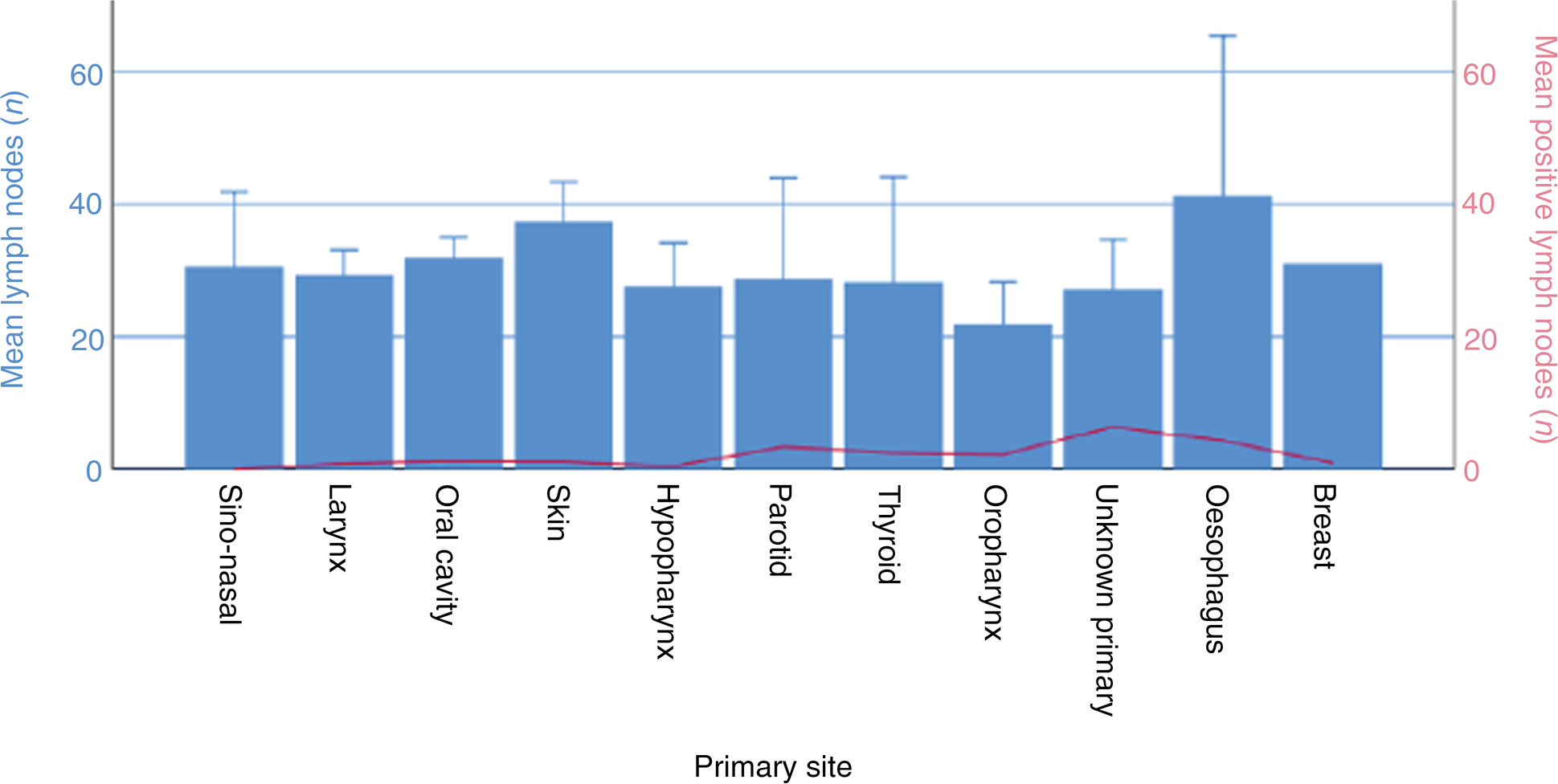
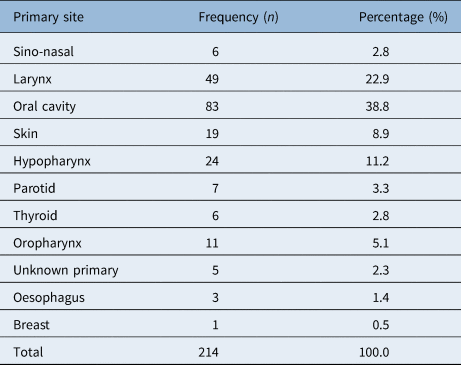
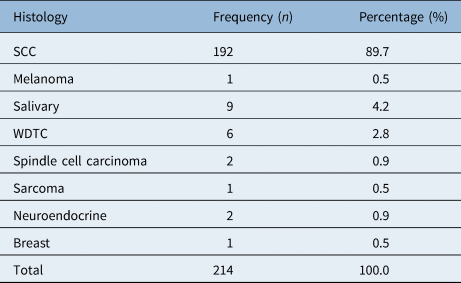
The most common primary site was the oral cavity (38.8 per cent), followed by the larynx (22.9 per cent) and the hypopharynx (11.2 per cent) (Table 1). The most frequent histological diagnosis was SCC (89.7 per cent) (Table 2). Seven cases were revision cases, including those who had undergone any previous head and neck surgery, and 49 per cent of neck dissections were on the right side and 51 per cent were on the left side. The overall mean number of lymph nodes retrieved during a neck dissection was 30.63 ± 13.9. Four-level dissection was carried out most frequently (56 per cent), followed by three- and five-level dissection at 20.5 per cent each. The average nodal yield was 25.9 ± 13.1 for 3-level dissection, 31.7 ± 13.5 for 4-level dissection and 32.77 ± 15.0 for 5-level dissection. These differences did not reach statistical significance (p = 0.93, r 2 = 0.02). The primary site with the highest number of lymph nodes was the oesophagus (41.33 ± 9.7) compared with the lowest number in the oropharynx group (21.82 ± 9.7). Statistical analysis showed no statistically significant difference between the primary site and final lymph node numbers (p = 0.18) (Figure 1). Of the 11 cases of oropharyngeal SCC, 7 were human papillomavirus (HPV) negative. The mean number of lymph nodes was 20.4 in the HPV-negative group and 24.3 in the HPV-positive group. All but one of the patients in the oropharyngeal group had a previous history of radiotherapy. There was also no statistically significant difference between the primary site and final number of positive lymph nodes within the histological specimen (1.36 ± 3.97, p = 0.11).
Mean number of lymph nodes removed depending on primary site (left y-axis) and mean number of positive lymph nodes retrieved depending on the primary site (right y-axis). Error bars show 95 per cent confidence intervals.

Primary site frequency

Primary site histology

SCC = squamous cell carcinoma; WDTC = well differentiated thyroid carcinoma
Age
Age did not seem to impact the number of lymph nodes found in the final neck dissection specimen. The mean number of lymph nodes in those under 60 years was 31.34, and in those above 60 the mean was 30.21 (p = 0.567). There was no significant correlation between age and lymph node numbers (p = 0.675). Furthermore, when correcting for the number of lymph node levels (i.e. total lymph node numbers divided by number of levels), the relationship remained non-correlated (p = 0.534).
Radiotherapy
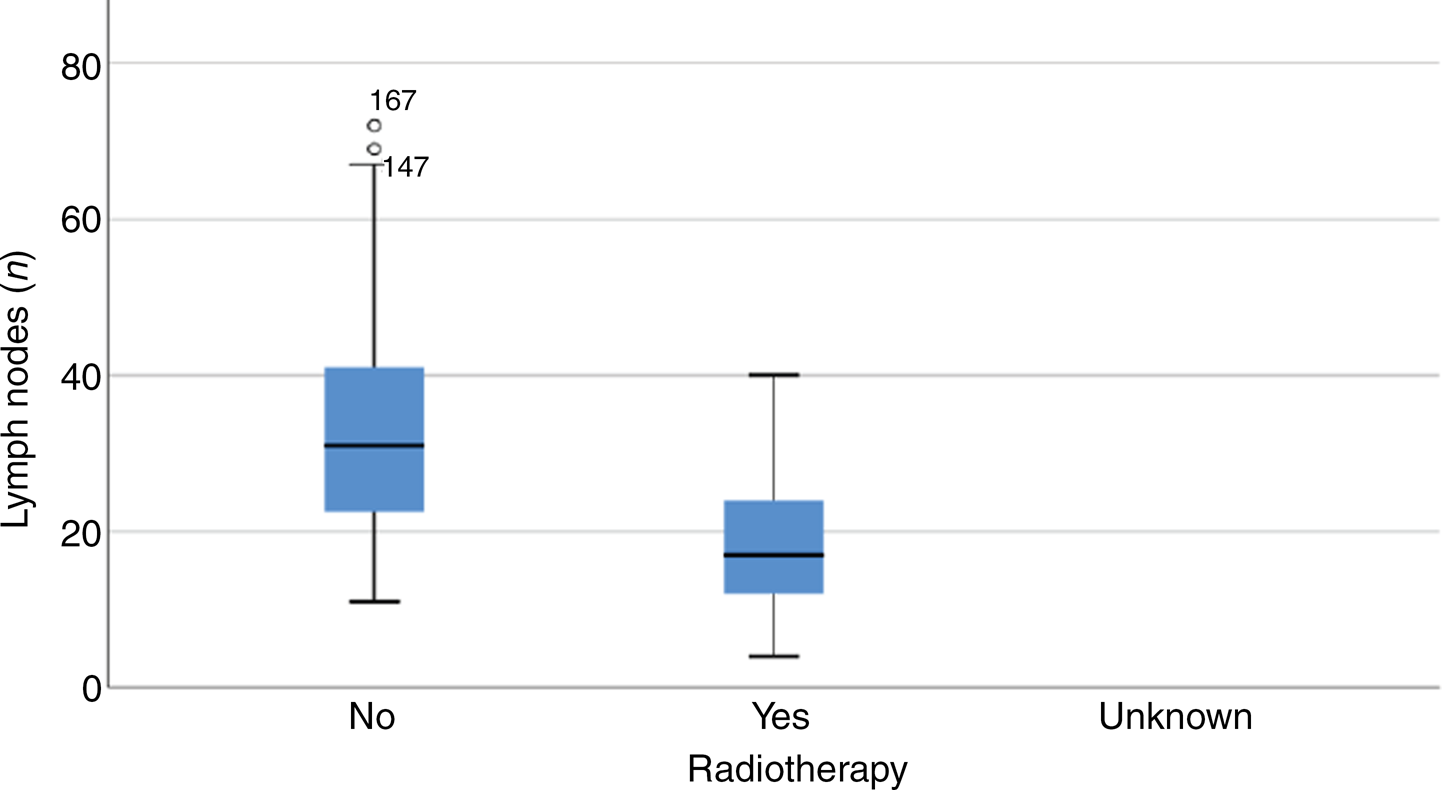
Of the 214 neck dissections included in the final analysis, 38 (17.8 per cent) had undergone previous radiotherapy. The mean number of lymph nodes was 33.26 ± 13.27 in patients with no previous radiation exposure and 18.47 ± 9.46 in those with previous radiation treatment, with a mean difference of 14.78 lymph nodes between the two groups (p = 0.000) (Figure 2). Even when controlling for the number of lymph node levels removed, this difference remained significant (p = 0.000). Radiotherapy did not affect the total number of positive lymph nodes retrieved in the final histological specimen: 1.45 ± 4.17 in the non-radiotherapy group and 1.00 ± 2.50 in the radiotherapy group (p = 0.524). Radiotherapy also did not affect the chance of having a positive lymph node in the neck dissection.
Mean number of lymph nodes removed based on history of previous radiotherapy.

Pathologist
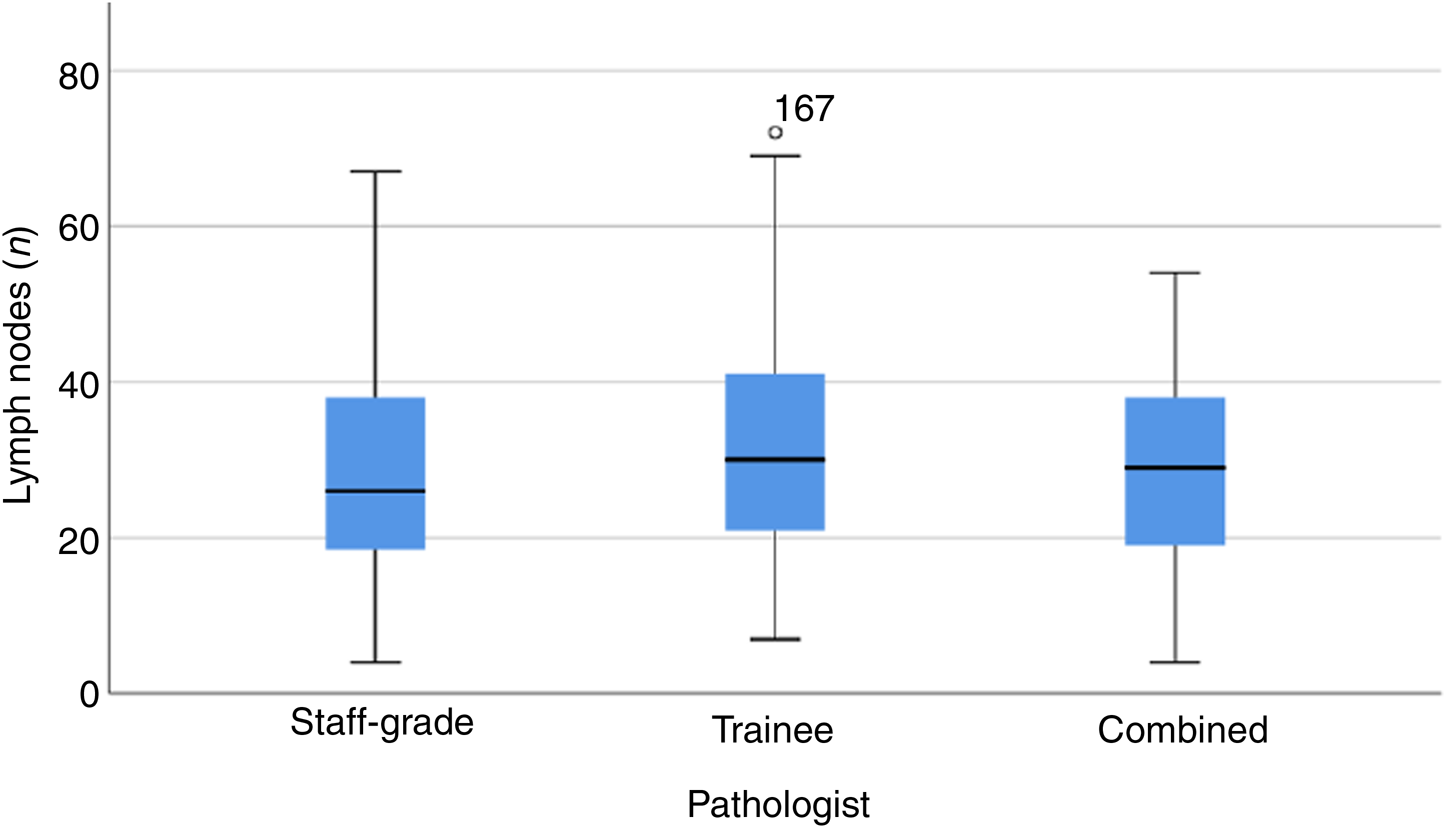
Of all 214 specimens, the gross dissection was carried out by a consultant pathologist in 23.8 per cent of cases, by a pathology trainee alone in 47.7 per cent of cases, and by both a trainee and a consultant in 28.5 per cent of cases. There was no statistically significant difference between the total number of lymph nodes, lymph nodes per level or number of positive lymph nodes retrieved on histological analysis between the three different groups. The mean number of lymph nodes reported was 28.62 ± 13.17 in the consultant-only group, 32.93 ± 14.81 in the trainee-only group and 28.48 ± 12.32 in the combined group (p = 0.068) (Figure 3). There was also no statistical difference between the proportion of neck dissection and previous radiation exposure in the various pathology groups (p = 0.214). The mean number of lymph node levels analysed between the pathology groups did not vary significantly (p = 0.777).
Mean number of lymph nodes identified on histological analysis stratified based on experience of the pathologist.

Discussion
Neck dissection for head and neck malignancies is one of the most important aspects of surgical oncology in the head and neck. It not only serves a therapeutic purpose but can also be a diagnostic and staging procedure. Lymph node yield is an important metric in head and neck surgical oncological quality of care, and knowledge of the factors that may influence final lymph node yield is imperative.
Although there is consensus on the lymph node levels to be removed during a neck dissection depending on the primary site, no clear guidance exists for the lymph node yield.Reference Lemieux, Kedarisetty, Raju, Orosco and Coffey6 Multiple organisations, including the Radiation Therapy Oncology Group, recommend removal of at least 18 lymph nodes during a standard neck dissection to ensure proper oncological representation, and recent reports by Ebrahimi et al. and Divi et al. found reduced overall and disease-specific survival in oral cavity SCCs when fewer than 18 lymph nodes were removed.Reference Ebrahimi, Clark, Amit, Yen, Liao and Kowalski2,Reference Divi, Harris, Harari, Cooper, McHugh and Bell7 In this multicentre analysis, they found an 88 per cent increased risk of death from oral cavity SCC in patients with a nodal yield less than 18 when compared with those having a yield over 18, with a higher risk of locoregional recurrence in the former group as well. They also found no difference in lymph node yield depending on node stage, meaning that results can be reasonably applied to both node negative and positive patients.Reference Ebrahimi, Clark, Amit, Yen, Liao and Kowalski2 Recent evidence also points towards a survival benefit in patients with limited nodal disease in HPV-associated oropharyngeal SCC when more than 26 lymph nodes were removed.Reference Zenga, Stadler, Massey, Campbell, Shukla and Awan8
Various different factors can affect the final number of lymph nodes present in the histological specimen. These can be divided into patient and physician factors. Patient factors include age of the patient, previous surgery or radiation to the neck, primary site of the malignancy (including HPV status in oropharyngeal SCC), and body mass index. Physician factors include volume of neck dissections performed and expertise of the operating surgeon, level of neck dissection and number of levels removed (which is also closely linked to the primary site involved), and expertise of the pathologist in identifying lymph nodes in the histological specimen.
Radiotherapy has been suggested as a factor in reducing the lymph node yield in neck dissection specimens. Data on this are limited to only a few small studies, with conflicting results reported. Moore and Bhattacharyya found no statistical difference in lymph node yield between irradiated (mean lymph nodes 23.5) and non-irradiated necks (mean lymph nodes 23),Reference Moore and Bhattacharyya9 whereas Johnstone et al. found a statistically significant reduction in lymph node yield in patients with a history of radiotherapy.Reference Johnstone, Miller and Moore4 Reyes et al. examined 98 neck dissections in patients with laryngeal SCC and found no difference between those who had received previous radiotherapy and those who had not.Reference Reyes, Rios, Groves, Solares, Jackson and Byrd5
In the present study, there was a statistically significant reduction in the total number of lymph nodes identified in patients who had undergone previous radiotherapy. This is in concordance with anecdotal observations intra-operatively, where marked fibrosis and lymph node atrophy were noted. The mean reduction in the number of lymph nodes was 14. The possible mechanism for the reduction in lymph nodes in irradiated necks is the fact that radiotherapy leads to fibrosis of tissues and fatty replacement of lymph nodes. Fibrosis following radiotherapy usually starts to develop 8 to 12 weeks later.Reference Brook10 These changes also make histological identification of lymph nodes more difficult.Reference Shvero, Koren, Marshak, Sadov, Hadar and Yaniv11 However, multiple other mechanisms for variation in lymph node counts may also be responsible: surgeon technique may play a role in the final lymph node count,Reference Divi, Harris, Harari, Cooper, McHugh and Bell7 and this was not examined in the present study. Seniority of the pathologists examining the tissue has also been suggested as a factor influencing lymph node yield in neck dissection specimens.Reference Divi, Harris, Harari, Cooper, McHugh and Bell7,Reference Ostadi, Harnish, Stegienko and Urbach12 We found no difference in the lymph node count depending on the seniority of the pathologist examining the gross specimen. Tissue fixation can also affect the number of lymph nodes found in the pathological specimen.Reference Lemmens, van Lijnschoten, Janssen-Heijnen, Rutten, Verheij and Coebergh13 The policy at our centre is to send all specimens to the histopathology laboratory fresh and pinned to a cork board, followed by fixation in formalin after reception at the laboratory.
Recent reports by Schoppy et al. and Divi et al. suggested using a lymph node count of greater than 18 in neck dissections as a potential measure of quality in head and neck surgery because of the associated improved survival and lower rate of locoregional failure.Reference Divi, Harris, Harari, Cooper, McHugh and Bell7,Reference Schoppy, Rhoads, Ma, Chen, Nussenbaum and Orosco14 There has to be a distinction on what levels have been removed, and this will depend on the indication for surgery and the primary site involved, as a greater number of lymph node levels removed will lead to a greater number of lymph nodes retrieved. In order to control for this, we divided the number of total lymph nodes by the number of lymph node levels removed.
• Multiple different factors can affect the lymph node yield during neck dissections for head and neck malignancies
• Radiotherapy seems to affect the overall lymph node yield, with a mean reduction of lymph node count by 14
• The average nodal yield for a unilateral neck dissection was 30.63
• Age of the patient, seniority of the pathologist and primary tumour site did not affect final lymph node count
• Knowledge of the factors that can influence nodal yield is important to ensure adequate nodal sampling
The main limiting factor of the present study was the lack of long-term outcome data. This limits our ability to investigate the effect of nodal yield on disease recurrence and disease-specific and overall survival. We were also unable to identify what effect the surgeon's level of training had on the nodal yield. Gathering this information is exceedingly difficult, as the amount of involvement of the trainee in any part of the operation can be highly variable. Nonetheless, we feel that the present data provide useful information on the factors that influence nodal yield and will help guide surgical oncological quality.
Conclusion
Multiple different factors can affect the lymph node yield during neck dissections for head and neck malignancies. Radiotherapy seems to affect the overall lymph node yield, with a mean reduction of 14 in lymph node count. Age of the patient, seniority of the pathologist and primary tumour site did not affect the final lymph node count.
Competing interests
None declared