Introduction
South Africa is the southern limit of tsetse flies (Diptera: Glossinidae), the vectors of trypanosomiasis. Since the elimination of Glossina pallidipes from north-eastern KwaZulu-Natal in 1953 (Du Toit, Reference Du Toit1954), various land-use and development changes occurred in the region (Kappmeier et al., Reference Kappmeier, Nevill and Bagnall1998), and consequently substantial changes could have occurred in the distribution of the two remaining tsetse species, G. austeni and G. brevipalpis. To successfully plan an area-wide integrated pest management (AW-IPM) (Klassen, Reference Klassen, Dyck, Hendrichs and Robinson2005) strategy for the control or elimination of tsetse in South Africa, it was necessary to re-survey the area to establish the present distribution of the two species. Towards this end, it was necessary to evaluate traps for the two species. During earlier trials in KwaZulu-Natal (Kappmeier et al., Reference Kappmeier, Nevill and Bagnall1998; Kappmeier, Reference Kappmeier2001), the Epsilon, Biconical, Pyramidal, Vavoua, Ngu (NG2F) and Siamese traps (Gouteux & Lancien, Reference Gouteux and Lancien1986; Brightwell et al., Reference Brightwell, Dransfield, Kyorku, Golder, Tarimo and Mungai1987; Laveissière & Couret, Reference Laveissière and Couret1990; FAO, 1992; Kyorku et al., Reference Kyorku, Machika, Otieno and Mwandandu1993) were poorly effective for G. brevipalpis and especially G. austeni. Sticky traps, developed for the monitoring of this species in Zanzibar (Schönefeld, Reference Schönefeld1988; Hall, Reference Hall1990), were effective for G. austeni in South Africa (Kappmeier et al., Reference Kappmeier, Nevill and Venter1995). When baited with synthetic ox-odour, these traps were also effective against G. brevipalpis. Other sticky traps have been developed for G. austeni in Zanzibar, namely the Chuka trap (Madubunyi, Reference Madubunyi1990), the free rotating monopanel (MP) and legpanel (LP) (Vreysen et al., Reference Vreysen, Khamis and Van Der Vloedt1996) and the interlocking legpanels (XLP) (Vreysen et al., Reference Vreysen, Zhu and Saleh1998). More recently, the H trap was developed for the two species in South Africa (Kappmeier, Reference Kappmeier2000a).
This paper evaluates sticky traps 3DT, XT and RT of Schönefeld (Reference Schönefeld1988) and Hall (Reference Hall1990) to assist identification of an uncomplicated but effective, practical and cost effective trap for large-scale surveys of G. austeni and G. brevipalpis in north-eastern KwaZulu-Natal. Means of improving the traps were studied by exploring the effect of changes to their colour and size, the type of sticky deposit and its shininess.
Materials and methods
Study area
All work was carried out from 1993 to 1996 at Hellsgate Tsetse Research Station near Lake St Lucia (28°00′–28°04′S and 32°24′–32°27′E) in north-eastern KwaZulu-Natal, South Africa, where G. brevipalpis and G. austeni occur. The study area has been described by Kappmeier (Reference Kappmeier2000b).
Sticky trap tests and designs
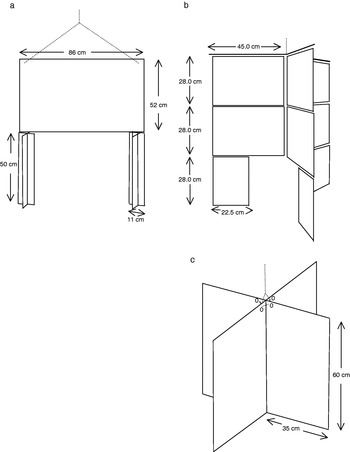
The rectangular sticky screen (RT) (Hall, 1986, cited in Hall, Reference Hall1990), 3-dimensional trap (3DT) (Schönefeld, Reference Schönefeld1988), cross-shape target (XT) (Hall, Reference Hall1990) (fig. 1) and modified monopanels were made from 3 mm tempered hardboard panels, painted light blue (l.blue), electric blue (e.blue), white or black with water-resistant commercial gloss enamel paint. They were suspended with a rope from overhanging branches and could rotate freely with their lowest part ca. 5–10 cm above ground. All traps were initially baited with a blend of 3-n-propylphenol (0.1 mg h−1), 1-octen-3-ol (0.4 mg h−1), 4-methylphenol (0.8 mg h−1) and acetone (350 mg h−1) (Vale et al., Reference Vale, Lovemore, Flint and Cockbill1988). Later, however, a modification of this blend, i.e. the SA blend (Kappmeier & Nevill, Reference Kappmeier and Nevill1999a), was used, which improved the catches of G. brevipalpis significantly (2.8-fold). The SA blend consisted of 1-octen-3-ol (9.1 mg h−1), 4-methylphenol (15.5 mg h−1) and acetone (350 mg h−1). The bait was placed at ground level about 20 cm from the downwind side of the traps.
Designs of sticky traps developed for G. austeni in Zanzibar. (a) Rectangular sticky screen (Hall, 1986, from Hall, Reference Hall1990), (b) 3-DT (Schönefeld, Reference Schönefeld1988, from Hall, Reference Hall1990) and (c) cross-shaped target (XT) (Hall, Reference Hall1990).

The first experiments evaluated the various sticky trap designs and compared black, white, l.blue and e.blue versions. Thereafter, the best design (XT) was improved and evaluated in single- and bicoloured combinations (i.e., one panel of the XT was painted a different colour from the second panel). The best colour combination of the XT was then used for Monopanels (single panels of the XT), which were also tested in various bicoloured combinations and sizes. Flies caught on each coloured panel were recorded separately to elucidate any alighting preferences. The comparisons of trap catches were conducted over a 24-h period.
Sticky material
The sticky traps were painted with polybutene to retain alighting flies. This was diluted with hexane for easier application; the hexane soon evaporated. To collect flies that fell from the lower edges, especially during the first day when excess polybutene dripped off slowly, a clear polyethylene sheet was placed on the ground beneath each trap. This also reduced soiling of the trap with wind-blown sand and leaves.
In accordance with the results of Vreysen et al. (Reference Vreysen, Zhu and Saleh1998), it was observed that most flies settled on the lower half of sticky traps, especially G. austeni. Therefore, polybutene was not applied to the top 10 cm of the traps, which enabled easier handling. Between experiments, the traps were cleaned with kerosene, which was allowed to dry out before polybutene was applied newly with every experiment/replicate.
Polybutene was compared with another sticky material, Temoocid [Kollant S.P.A., Italy], which was used in the Zanzibar tsetse eradication programme (Vreysen et al., Reference Vreysen, Saleh, Ali, Abdullah, Zhu, Juma, Dyck, Msangi, Mkonyi and Feldmann2000a). Temoocid is supplied in diluted form ready for use, and does not drip after application. The relative effectiveness of the two sticky materials was compared using e.blue/l.blue XTs. After application, the traps were allowed to ‘age’ for 0–4 weeks in a ventilated room so that the efficacy (durability) of the sticky materials at different times after application could be evaluated in the field.
Effect of the shininess of traps
The effect of the shininess of sticky deposits on the attraction and the settling responses of tsetse was evaluated by means of electric grids (Vale, Reference Vale1974a). Hardboard panels (1×1 m) were painted in both matt and gloss e.blue and black enamel paint. Each panel (i.e., matt e.blue, matt black, glossy e.blue and glossy black) was then inserted into an electric grid frame, used as an alternative means of catching alighting flies and, thus, incorporated coloured panels into the electric targets. The targets were tested standing alone or with a flanking electric net of 0.5×1 m next to it to determine attraction vs. landing, i.e. flies that fly around the coloured panel will be intercepted by the electric net. The grids were placed on a corrugated iron sheet painted with polybutene so that the flies that were stunned could be retained on the tray for counting.
Trap efficiencies
To determine the relative trap efficiency, a 1×1 m electric net (Vale, Reference Vale1974a) was placed immediately adjacent to the trap. This electric net intercepted flies that were attracted to the trap, but which flew around it and which might never have landed on the trap. The number of flies captured by a trap (without an electric net) was expressed as a percentage of the total number of flies attracted to a trap (trap plus electric net), to give an estimate of trap efficiency (Vale, Reference Vale1982a,Reference Valeb). The comparisons of trap efficiencies and the evaluation of the effect of the shininess of traps with electric grids were determined from data collected from noon until dark, the period which included maximum activity of both species (Kappmeier, Reference Kappmeier2000b).
Experimental design and analyses
Different treatments were incorporated into a series of Latin squares of treatments×days×sites. A minimum of six treatments was tested in each square (Snedecor & Cochran, Reference Snedecor and Cochran1980). One to three squares were used for each experiment so that treatments had a total of 6–40 daily replicates. The daily catches (n) were transformed to log10 (n+1) to normalize the data followed by an analysis of variance (ANOVA). The ANOVA was followed by Bonferroni's multiple range test to compare treatment means (Genstat 5 Committee, 1993). The general test level was P=0.05. Male and female catches were usually analysed separately, but when catches were too low for separate analyses of the sexes the total catches were used.
Unless stated otherwise, the overall trap catch of each treatment is given as an index of increase relative to a control treatment (index of control=1). The detransformed mean catch of the control treatment is given in brackets. Treatments followed by the same symbol (a–f) are not significantly different from the control in the same experiment.
Experiments and results
Effect of shape and colour
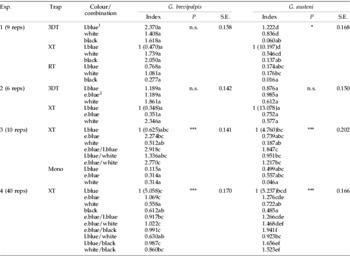
Experiment 1 (table 1) showed that for G. austeni the 3DT and XT caught more than the RT, and that with all traps the l.blue and white variants were more effective than the black. Catches of G. brevipalpis were too small to give reliable indications.
Indices of increase for total catches of G. brevipalpis and G. austeni trapped with various shapes and colours of sticky traps relative to the control treatment (index=1).

Detransformed means of the controls are indicated in brackets.
Treatments followed by the same letter are not significantly different.
P<0.05 (*), P<0.001 (***), not significantly different (n.s.).
1 light blue.
2 electric blue.
In Experiment 2 (table 1) the best traps of Experiment 1 (3DT and XT) were tested in l.blue, e.blue and white. Black was not included due to its poor performance in the previous experiment, while e.blue was the colour most closely resembling phthalogen blue (Green, Reference Green1993), the attractive blue part of a target for these species (Kappmeier & Nevill, Reference Kappmeier and Nevill1999b). White seemed very effective for G. brevipalpis but not for G. austeni. For G. brevipalpis and G. austeni no significant differences were obtained between any treatments, suggesting the 3-dimensional shapes to be equally effective. Therefore, the XT was chosen for upgrading due to its practicality for use in the field, consisting only of two hardboard panels as opposed to the nine panels of the 3DT.
In Experiment 3 (table 1) the e.blue/l.blue XT performed best for both species as compared to the other uni- and bicoloured XTs, as well as single coloured monopanels of the same size as one panel of the XT.
In Experiment 4 (table 1) the e.blue, l.blue, e.blue/white, e.blue/l.blue, e.blue/black and l.blue/black XTs did not differ significantly from each other for G. brevipalpis. However, for G. austeni the e.blue/black XT was significantly better than the e.blue/l.blue XT and increased the catches by ca. 1.5 times.
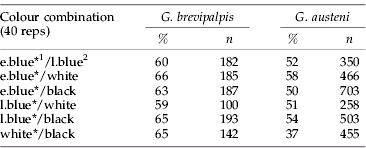
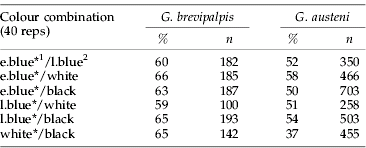
Table 2 indicated the landing biases (mean percentage of flies caught on the first colour calculated as a proportion of the total trap catch) of pooled sexes of the two species. For G. brevipalpis it was shown that, when used with l.blue, black and white, significantly more (60–66%) flies landed on the e.blue surface as compared to the l.blue (P<0.05), black (P<0.001) and white (P<0.001) surfaces. Also, significantly more (65%) flies settled on the l.blue and white surfaces as compared to the black surfaces (P<0.001). For G. austeni there were no significant differences in the landing biases obtained with the e.blue/l.blue, e.blue/black, l.blue/white and l.blue/black traps. However, the landing bias for white (37–42%) was significantly less when used with e.blue (P<0.05) and with black (P<0.001).
Landing biases of G. brevipalpis and G. austeni on bicoloured traps (landing bias is expressed as the catch from the first colour* of bicoloured XTs as a percentage of the total trap catch).
1 electric blue.
2 light blue.
Effect of size and monopanels
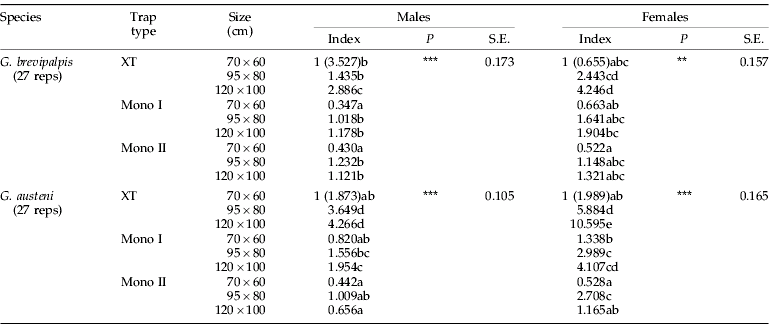
Comparison of three sizes of XTs (table 3) showed that the largest (120×100 cm) improved the catches of both G. brevipalpis males and females significantly by ca. 2.9 and 4.2 times, respectively. No significant difference was found between catches with the larger monopanels (single panels of XTs, i.e. 95×80 cm and 120×100 cm) and the control XT (70×60 cm). For G. austeni the bigger XTs were both significantly better than the control XT, where male catches were increased by ca. 3.6–4.3 times and female catches by ca. 5.9×10.6 times. The largest Mono I panel (120×100 cm) was significantly better than the control XT for both sexes (especially for females).
Indices of increase for G. brevipalpis and G. austeni obtained with e.blue/black 3-dimensional XTs and 2-dimensional monopanels of various sizes relative to the control treatment (index=1) in each experiment.
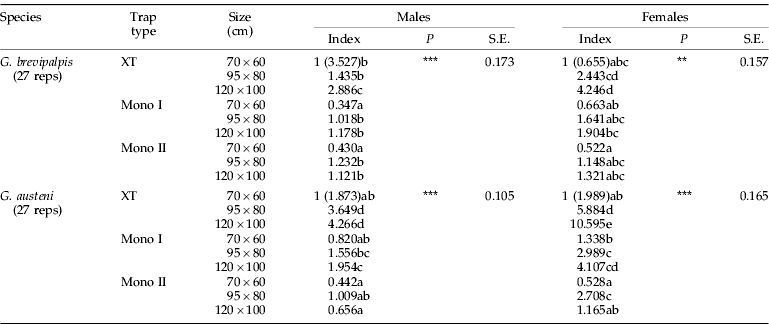
Detransformed means of the controls are indicated in brackets.
Treatments followed by the same letter are not significantly different.
P<0.01 (**); P<0.001 (***).
Mono I, each side of the panel painted with electric blue and black (split vertically in the centre);
Mono II, one side of panel electric blue and other side black.
Effect of sticky material type and age
For both species there was no significant difference between traps painted with Temoocid and polybutene at various ages about 0–2 weeks (table 4). For G. brevipalpis it was shown that traps with newly applied Temoocid were only significantly different than traps applied with Temoocid and polybutene both aged for three weeks. For G. austeni those traps were only significantly better than the traps applied with polybutene and aged for three and four weeks. It appears that Temoocid is optimally effective for up to 2–3 weeks and polybutene for up to two weeks.
Comparisons of polybutene and Temoocid sticky materials on XTs aged for 0–4 weeks for G. brevipalpis and G. austeni. The results are expressed as indices of increase relative to the control treatment (polybutene aged 0 weeks).

Detransformed means of the control in ten replicates are indicated in brackets.
Treatments followed by the same letter are not significantly different.
Effect of shininess of traps
For G. brevipalpis (table 5) the catch (target with flanking net) of both glossy and matt blue and black surfaces was found significantly (P<0.001) better than the settling response (target without net) on these surfaces. Their settling percentages on glossy blue and black were greater than on matt blue and black. For G. austeni only the glossy black surface gave significantly lower settling responses.
Effect of glossy vs. matt electric blue and black surfaces on the attraction and settling of G. brevipalpis and G. austeni as determined with electrified grids (detransformed means are given).

Treatments followed by the same letter are not significantly different.
P<0.05.
Estimates of trap efficiency
The efficiencies of the e.blue/l.blue and e.blue/black XTs (table 6) were expressed as the proportion of flies that were actually caught on the XTs (without flanking net) calculated as the percentage of flies that were caught by the traps with flanking nets (i.e., trap plus net). The low efficiencies of the XTs for G. brevipalpis females explained the low catches obtained during preceding experiments.
Trap efficiencies of e.blue/l.blue (10 reps) and e.blue/black (8 reps) XTs determined with electrified nets (proportion of flies that were caught on the XTs without flanking net is expressed as the percentage that were caught by the traps with flanking nets).

Discussion
Sticky traps of various design and colour combinations have been shown to be useful for the monitoring of G. austeni on Unguja Island, Zanzibar, throughout a tsetse control/eradication trial (Vreysen et al., Reference Vreysen, Saleh, Khamis and Mramba1999a, Reference Vreysen, Saleh, Khamis, Shambwana and Zhub, Reference Vreysen, Saleh, Ali, Abdullah, Zhu, Juma, Dyck, Msangi, Mkonyi and Feldmann2000a; Saleh et al., Reference Saleh, Mussa, Juma and Vreysen2001; Vreysen & Saleh, Reference Vreysen and Saleh2001) and other population ecology studies (Vreysen & Khamis, Reference Vreysen and Khamis1999). These traps were also used to survey G. brevipalpis on Mafia Island, Republic of Tanzania (Msangi et al., Reference Msangi, Kiwia, Mramba, Malele, Kitwika, Byamungu, Chalo, Athuman, Parker and Feldmann2001). Although sticky traps may be useful to survey the distribution of elusive species like G. austeni, they are unsuitable for release recapture and many other ecological studies (Schönefeld, Reference Schönefeld1988; Madubunyi, Reference Madubunyi1990; Vreysen et al., Reference Vreysen, Khamis and Van Der Vloedt1996, Reference Vreysen, Zhu and Saleh1998). For these studies the H trap, developed for G. brevipalpis and G. austeni in South Africa (Kappmeier, Reference Kappmeier2000a), will be more suitable.
The present study indicated that the 3DT and XT were generally more superior than the RT for both species and that single coloured black traps were less effective in comparison to white or blue traps. Low trap catches of G. austeni was also obtained with black XTs on Unguja Island (Vreysen et al., Reference Vreysen, Zhu and Saleh1998). Bicoloured XTs were generally more superior than single-coloured XTs for both species. While l.blue/white XTs were the most ineffective bicoloured traps for G. austeni and also for G. brevipalpis, Vreysen et al. (Reference Vreysen, Khamis and Van Der Vloedt1996) showed that the catch rate of this species in Zanzibar was significantly affected with legpanels (LP) coloured white on one panel side and sky blue on the other side.
From December 1993 the e.blue/l.blue XT was used to survey the distribution of the two species in north-eastern KwaZulu-Natal (Nevill et al., Reference Nevill, Kappmeier and Venter1995; Kappmeier Green, Reference Kappmeier2002). For G. austeni the e.blue/black XT was, however, significantly better than the e.blue/l.blue XT and increased catches by a factor of 1.5 and was, more or less, equally effective for G. brevipalpis. The e.blue/black XTs, therefore, replaced the e.blue/l.blue XTs from May 1995 (Nevill, Reference Nevill1997; Nevill et al., Reference Nevill, Kappmeier and Venter1999; Kappmeier Green, Reference Kappmeier2002) for more effective surveying. Phthalogen blue/black cloth targets were also most effective for the two species (Kappmeier & Nevill, Reference Kappmeier and Nevill1999b). In Zanzibar, however, poor catch results were obtained for G. austeni when black was combined with royal blue, both as XT and XLP (cross-shaped legpanel), while royal blue/white XTs were more effective (Vreysen et al., Reference Vreysen, Zhu and Saleh1998). They ascribed the possible difference in the two G. austeni populations’ behaviour to the genetic variations between the two populations or in differences of the spectral reflectance of the paint material used.
The relative low efficiencies of the e.blue/l.blue and e.blue/black XTs for G. brevipalpis females (0–2%) could probably be ascribed to the small size of the trap, as explained below. However, the trap efficiencies for G. brevipalpis males (33–39%) and G. austeni (28–51% for males, 24–54% for females) were comparable with the H trap efficiency, namely 32% and 38% for G. brevipalpis and G. austeni, respectively (Kappmeier, Reference Kappmeier2000a). For G. brevipalpis very low trap efficiencies for the NG2F (6.4%) and Siamese (9.1%) traps were obtained (Kappmeier, Reference Kappmeier2001). For G. austeni these trap efficiencies seemed relatively high (29% and 19%, respectively), but the overall attractiveness was poor. Kappmeier (Reference Kappmeier2001) also indicated the catches with the e.blue/black XT to be significantly better than any of the standard trapping devices developed for other tsetse species, e.g. Epsilon, NG2F, Vavoua, Biconical, Pyramidal and Siamese traps (Gouteux & Lancien, Reference Gouteux and Lancien1986; Brightwell et al., Reference Brightwell, Dransfield, Kyorku, Golder, Tarimo and Mungai1987; Laveissière & Couret, Reference Laveissière and Couret1990; FAO, 1992; Kyorku et al., Reference Kyorku, Machika, Otieno and Mwandandu1993).
The significantly higher landing responses for G. brevipalpis on an e.blue (60–66%) and a l.blue (65%) surface, when used in combination with black, were in contrast to the responses obtained with coloured cloth targets, where most of the flies landed on black (68–91% and 87%), when used with phthalogen blue and l.blue, respectively (Kappmeier & Nevill, Reference Kappmeier and Nevill1999b). It, therefore, seems that a reversal in landing response is obtained when glossy colours are used against matt colours. For G. austeni the only bicoloured XTs, which gave significant landing biases, were with the e.blue/white and black/white traps, which gave biases, respectively, of 42% and 37% on white. Vreysen et al. (Reference Vreysen, Zhu and Saleh1998), on the other hand, found no significant bias for this species with royal blue/white traps, while with the black/white combination more flies (70–88%) landed on white.
Under South African conditions, Polybutene and Temoocid were optimally effective for up to 2–3 weeks, and for both species no significant difference was found in the number of catches obtained with the two sticky materials. In Zanzibar, however, Vreysen et al. (Reference Vreysen, Khamis and Van Der Vloedt1996) found that catches of G. austeni were significantly greater when using Temoocid than with polybutene.
For both species a general increase in the catches was related to an increase in trap size. For G. brevipalpis females, the bigger traps increased catches up to 4.2 times compared to the ineffective standard-sized XT; while for G. austeni females, the bigger XTs increased the catches significantly up to 10.6 times. Likewise, an increase in catches was obtained with an increase in the width of cloth targets (Kappmeier & Nevill, Reference Kappmeier and Nevill1999b). Vreysen et al. (Reference Vreysen, Zhu and Saleh1998) also found an increase in the width of a blue XT (from 70 to 120 cm) doubled the catch of G. austeni in Zanzibar as compared to a standard-sized blue XT. Vreysen et al. (Reference Vreysen, Saleh, Zhu and Suleiman2000b) also found that increasing the height of a standard panel from 30 to 60 or 90 cm increased the catch two-fold. Size (Hargrove, Reference Hargrove1980) and shape (Vale, Reference Vale1974b) are parameters that also played a role in the catch rate of trapping devices for G. morsitans and G. pallidipes in Zimbabwe.
Larger e.blue/black monopanels (Mono I) proved to be equally or even more effective than the XT for both species and could, therefore, replace the XT. These would be cheaper in terms of construction material, paint, sticky material and kerosene for removal of sticky material. They are also lighter and easier to manipulate in the field, especially in densely forested areas. The Mono I and XT sticky traps, both in e.blue/black, were also compared against G. brevipalpis on Mafia Island, Republic of Tanzania, in 1999. The results indicated that both these traps were effective for this species. However, Mono I was ca. 1.5 times more effective than the XT, catching a total of 142 flies during a 10-day period (Kappmeier, Reference Kappmeier1999).
Sticky traps are simple to manufacture and operate and can, therefore, be deployed very cost and time effectively to cover rather large areas in a relatively short time, thus enabling more reliable comparisons of different areas. The data presented in this paper demonstrated the usefulness of the sticky traps for monitoring populations of G. austeni and G. brevipalpis in South Africa. It must, however, be emphasized that other trapping devices will be more effective for specific aims, for example the later developed H trap (Kappmeier, Reference Kappmeier2000a) or electrified phthalogen blue and black targets. The latter may even increase the catch size up to 2.8 and 33 times for G. brevipalpis and G. austeni, respectively, when compared to the H trap (Kappmeier Green, Reference Kappmeier2002), which renders the XTs to be rather inefficient as opposed to these electric devices. These devices are, however, expensive and impractical to use on a large scale. However, the present results show that the distribution and abundance of G. austeni and G. brevipalpis can be assessed cost-effectively using a simple trap such as the XT.
Acknowledgements
The authors wish to thank Messrs P.W. Trollip, S.B. Ngwane, D.G. de Klerk and J. Greger for assistance during the field work and the South African National Defence Force, in particular late Sergeant-Major Pep van Zyl, for allowing research to be conducted at the former Hellsgate Military Base. We thank Dr Errol Nevill for constructive comments on this study. This work was funded by the Directorate of Veterinary Services (National Department of Agriculture) and the ARC-Onderstepoort Veterinary Institute.