Congenital atrioventricular valve dysplasia includes a wide spectrum of morphologic and clinical features and occurs uncommonly as isolated defect: tricuspid malformation includes Ebstein anomaly or a no Ebstein tricuspid valve dysplasia; whereas isolated mitral valve dysplasia can often be a cleft of the anterior leaflet, or a pathology of sub-valvular apparatus. We here report a singular combination of both atrioventricular valves dysplasia in a newborn who required surgery 1 month after birth.
Case presentation
A newborn prenatally diagnosed with a mitral and tricuspid valve dysplasia presented after birth with low cardiac output symptoms, severe mitral and tricuspid insufficiency, biatrial enlargement, and severe pulmonary hypertension. After birth he was discharged home with medical treatment.
Gradually, his parents noticed progressive generalised oedema and failure to thrive. The echocardiographic control at 1 month after birth showed a dysplastic tricuspid valve with a short fibrous septal leaflet and a central coaptation failure with a severe grade of insufficiency. The mitral valve presented pseudo prolapse of anterior leaflet and a short posterior leaflet and a severe grade of regurgitation and a transvalvular gradient of 7 mmHg.
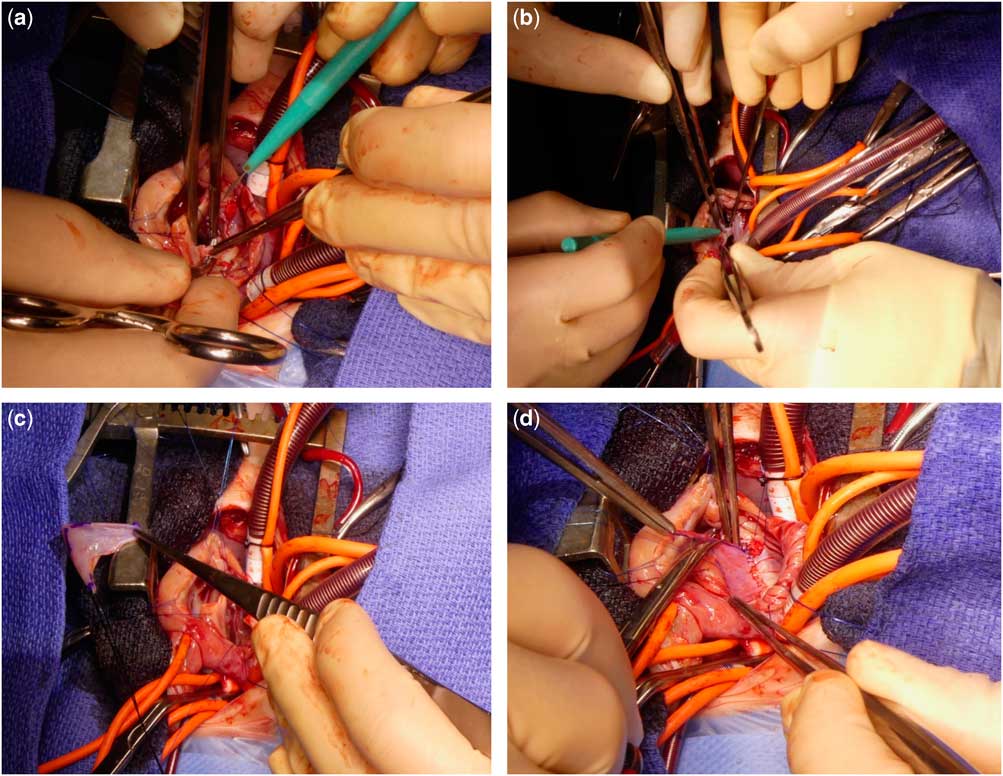
Owing to the worsening of clinical conditions, we decided to perform an early surgical repair of both atrioventricular valves. Through a median sternotomy, the interatrial septum was opened to gain access to the mitral valve. The two hypertrophied papillary muscles attached directly to the free edge of the leaflets, with no true chordae tendinae. We performed a complex mitral repair, consisting of a posterior leaflet extension with glutaraldehyde-fixed autologous pericardial patch (Fig 1), papillary muscles splitting, and second-order chordae resection. Repair of tricuspid valve was performed in the same way, adding an annuloplasty. Intraoperative transesophageal echocardiogram showed a mild-to-moderate mitral regurgitation and a mild tricuspid regurgitation.
( a ) Exposition of mitral valve. ( b ) Papillary muscle splitting. ( c , d ) Posterior leaflet extension using a glutaraldehyde-fixed autologous pericardial patch.

The patient was extubated 8 hours after surgery. Progressively he presented clinical improvement with reduction of polypnea, no swelling, increase of oral intake, and gain of weight. The baby was discharged home 8 days after the operation, with only captopril 1 ml/kg/day as medical treatment, which was suspended 6 months after discharge.
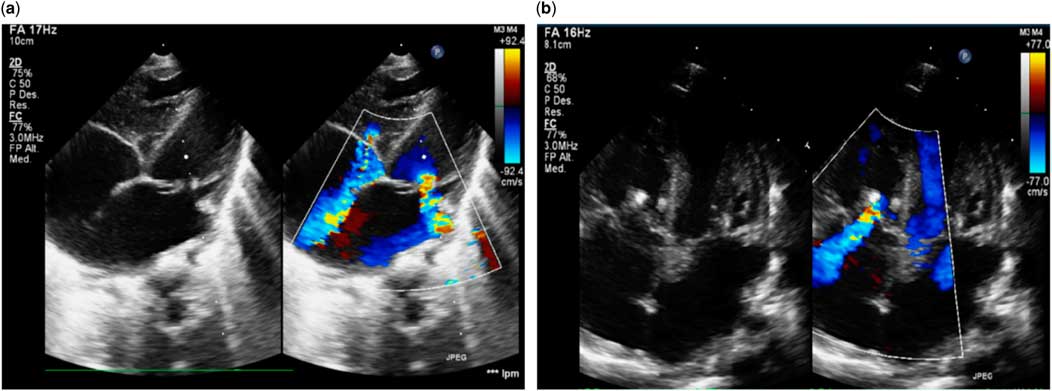
ECHO at discharge showed moderate central tricuspid insufficiency and mild-to-moderate mitral insufficiency, evidently less if compared to the pre-operative one (Fig 2).
Echocardiogram in pre-operative period and at discharge. Mitral and tricuspid valves before ( a ) and after ( b ) repair.

At 1-year follow-up, the child conditions have improved, without symptoms of cardiac failure, and doing an active life with normal motor and cognitive development without medical treatment. The echocardiogram showed mild-to-moderate regurgitation without no stenosis for tricuspid valve and moderate regurgitation with a gradient of 3 mmHg for mitral valve. Both ventricles had a conserved systolic function, and left ventricle had mild diastolic function.
Discussion
In patients with dysplasia of both atrioventricular valves and severe symptoms of cardiac failure, surgery should be recommended whenever there is a possibility to perform a valvular repair that balances residual regurgitation and possible stenosis because of an aggressive technique of reparation.Reference Alghamdi, Yanagawa, Singh, Horton, Al-Radi and Caldarone 1 A too short leaflet could be extended with an autologous pericardial patch; the stabilisation of the posterior annulus with an autologous pericardial strip allows the mitral valve to grow along the anterior annulus, and on re-operation, the pericardium was seen to be completely endothelialised, perfectly integrated into the annular tissue, and completely indistinguishable from the atrial endocardium.Reference Komoda, Huebler, Berger and Hetzer 2 , Reference Walter, Komoda, Siniawski and Hetzer 3 In patients with prevalent regurgitation, surgical repair usually tends to be very aggressive in order to achieve a better leaflet coaptation.Reference Vida, Carrozzini, Padalino, Milanesi and Stellin 4 For the tricuspid valve the addition of an annuloplasty is important to stabilise the repair, which usually includes more than one of these techniques.Reference Said, Dearani and Burkhart 5
Conclusion
Congenital dysplasia of both atrioventricular valves is a rare cardiac malformation and it is a real challenge for cardiologists and cardiac surgeons, especially regarding timing and type of surgery to be performed. We report an early reconstructive surgical strategy in a symptomatic neonate, which dramatically improved his clinical conditions and led him to have a posterior normal somatic and cognitive development.
Acknowledgements
I thank Dr Juan Miguel Aguilar Jimenez for his expertise and assistance throughout all aspects of our study.
Financial Support
This work has not received any financial support.
Conflicts of Interest
The authors declare no conflicts of interests.