


Introduction
Persons with intellectual disabilities (ID) have historically been negatively affected in employment activities due to employment barriers. These employment barriers for persons with ID consist of both personal factors (e.g., dysfunctional thoughts, lack of motivation, lack of self-efficacy) and external or environmental factors (employers’ negative attitudes and paternalistic attitudes of guardians and professionals, including those making career decisions for persons with ID; transportation issues) (Adams et al., Reference Adams, Corbin, O’Hara, Park, Sheppard-Jones, Butler and Bishop2019; Kocman et al., Reference Kocman, Fischer and Weber2018; Nevala et al., Reference Nevala, Pehkonen, Teittinen, Vesala, Pörtfors and Anttila2019; Trembath et al., Reference Trembath, Balandin, Stancliffe and Togher2010). These two types of barriers often influence each other. Understanding personal factors such as employment-dysfunctional thoughts and lack of employment motivation is paramount in obtaining meaningful employment for persons with ID (Duff & Dik, Reference Duff and Dik2009; Lustig & Xu, Reference Lustig and Xu2018). Cognitive behavioral therapy (CBT) and motivational interviewing (MI) are evidence-based interventions that have shown promise in reducing dysfunctional thoughts and improving motivation, respectively (Kukla et al., Reference Kukla, Salyers, Strasburger, Johnson-Kwochka, Amador and Lysaker2019; Lam et al., Reference Lam, Wiley, Siu and Emmett2010; Lecomte et al., Reference Lecomte, Corbière, Giguère, Titone and Lysaker2020).
Cognitive Behavioral Therapy and Motivational Interviewing for Job Seeking
Persons with ID generally face self-efficacy challenges due to past experiences in not obtaining employment or a career as a result of employer bias, which may demotivate their employment seeking (Lent, Morrison & Ezeofor, Reference Lent, Morrison, Ezeofor and Strauser2014). The repeat negative experiences in not obtaining employment can also lead to dysfunctional thoughts (e.g., I am not good at finding employment). Overcoming career-dysfunctional thoughts and motivational interviewing could strengthen employment prospects in obtaining employment (Lam et al., Reference Lam, Wiley, Siu and Emmett2010).
CBT has been effective in addressing dysfunctional thoughts in general (Lecomte et al., Reference Lecomte, Corbière and Lysaker2014; Lecomte et al., Reference Lecomte, Corbière, Giguère, Titone and Lysaker2020; Geschwind et al., Reference Geschwind, Arntz, Bannink and Peeters2019) and in employment seeking situations (Diallo et al., Reference Diallo, Saladin, Groomes, Fischer and Hansmann2013, Reference Diallo, Villarreal, Trejo and Yasasi2015; Lee, Reference Lee2019; Lindsay et al., Reference Lindsay, Tinsley, Beail, Hastings, Jahoda, Taylor and Hatton2015; McFarlane and Lynggaard, Reference McFarlane and Lynggaard2009). (See the Method section for the modified CBT and MI approach used in this study.)
Goal of the study. We sought to replicate and extend the findings on the efficacy of combined MI and CBT for improving the employment seeking activities of persons with ID. We hypothesized that using modified CBT and MI in tandem would (1) improve motivation to obtain employment and (2) decrease career-dysfunctional thoughts.
Method
Research design
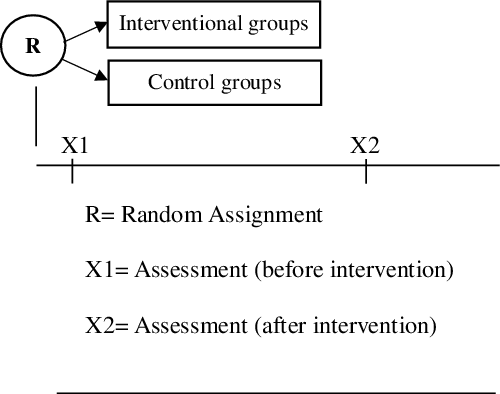
We randomly assigned participants to either an experimental or a control group. The trial had a “pre/post” design; that is, participants’ motivation to obtain employment and their employment-dysfunctional thoughts were measured before and after the intervention. This design was used to make the study rigorous and to control for intervening variables, so we could determine that the intervention was responsible for the study’s outcome: decreasing dysfunctional thoughts and improving motivation to obtain employment (see Figure 1).
Study design.

Participants and setting
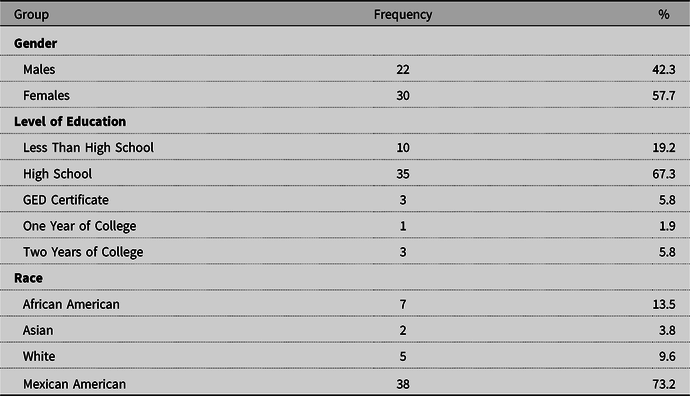
The participants consisted of 52 clients receiving services at the Valley Association for Independent Living (VAIL) in Texas, an agency that assists persons with disabilities in independent-living skills and employment activities. The sample comprised 22 females and 30 males with mild and moderate levels of ID (from case files: age range: 19 to 47 years). By race/ethnicity, the participants comprised seven African Americans, two Asians, five Whites, and 38 Mexican Americans. Ten had less than a high school diploma, 35 had a high school diploma, three had a GED, one had one year of college education, and three had two years of college education (See Table 1).
Participant Demographics

Procedure
This study was approved by the IRB and the VAIL management granted study permission. Participants consented to the study. We assured the participants of the voluntary nature of the study and that the information they provided would be kept confidential.
CBT and MI were used in tandem for the intervention. Table 2 presents the goals, processes, and expected outcomes of the intervention. The intervention took about four and a half weeks and was carried out by professional counselors who received relevant training. Participants took a pretest with regard to their motivation to take action to seek employment and with regard to career-dysfunctional thoughts and a posttest following the intervention using the measures described below.
Intervention Goals, Processes and Activities, and Anticipated Outcomes of the Intervention

To ensure intervention fidelity, the second co-author monitored and ensured adherence to the treatment by witnessing the interventions, meeting with the counselors, and going over their interventions repeatedly to make sure the counselors adhered to the treatment plan.
Modified CBT and MI approach
The modified CBT approach involved separating false from real; putting things in perspective; retaining healthy thinking; and discarding faulty thinking (Diallo et al. Reference Diallo, Villarreal, Trejo and Yasasi2015). The MI component focused on change talk communication strategy for positive self-statements (Miller & Rollnick, Reference Miller and Rollnick2002; Miller & Rose, Reference Miller and Rose2009).
Measures
The career-dysfunctional thoughts scale in this study is based on the Career Thoughts Inventory subscale (Sampson et al., Reference Sampson, Peterson, Lenz, Reardon and Saunders1996 ). Participants answered the following questions on a scale that ranged from “strongly agree” to “strongly disagree”: 1. “I’m not good at making employment decisions.” 2. “I’m not good at finding employment.” 3. “There are no good employment opportunities out there.” 4. “I’ll never get this employment thing figured out.” 5. “Employment never works out for me.” In this study, the internal consistency of the Likert scale was 0.80.
The Lam Assessment on Stages of Employment Readiness for Motivation to Take Action in Obtaining Employment (LASER; Lam et al., Reference Lam, Wiley, Siu and Emmett2010 ) The LASER scale action stages is a four-item subscale to individual’s employment seeking activity. Each of the item is rated on the five-point Likert scale (from 1 = “strongly disagree” to 5 = “strongly agree”). In this study, the internal consistency for scores from the action stage of the LASER scale was 0.81.
Data analysis
To test the hypotheses, we utilized multivariate analysis to predict with the two outcome variables (career-dysfunctional thoughts and motivation to take the steps necessary to obtain employment) simultaneously, since the two outcome variables may be related, thus minimizing inflation of type 1 error rate (Raykov & Marcoulides, Reference Raykov and Marcoulides2008). We also included two covariates (precareer-dysfunctional thoughts and premotivation to take the steps necessary to obtain employment) in the equation. MANCOVA was performed using the general linear model and the multivariate command in the SPSS program
To avoid redundancy in the dependent variables, due to their relatedness, we conducted a step-down analysis (Roy–Bargman analysis) to confirm the fact that the dependent variables were excessively overlapping (Raykov & Marcoulides, Reference Raykov and Marcoulides2008).
Results
Descriptive statistics
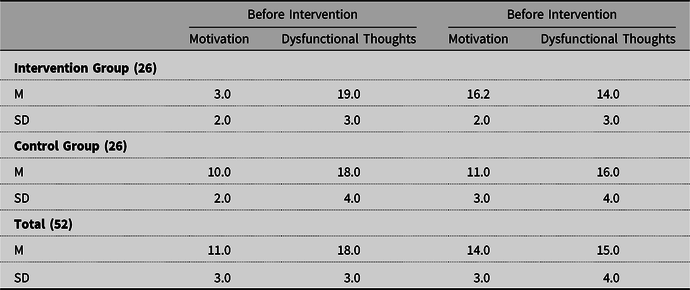
Descriptive statistics (Table 2) show that, compared to the control group (M = 18.0, SD = 4.0), the intervention group had approximately the same mean for precareer-dysfunctional thoughts (M = 19.0, SD = 3.0). However, compared to the control group (M = 10.0, SD = 2.0), the intervention group had a slightly higher mean for premotivation to take the steps necessary to obtain employment (M = 13.0, SD = 2.0). For the posttest, compared to the control group (M = 16.0, SD = 4.0), the intervention group had a slightly lower mean for career-dysfunctional thoughts (M = 14.0, SD = 3.0). However, compared to the control group (M = 11.0, SD = 3.0), the intervention group had a higher mean for motivation to take the steps necessary to obtain employment (M = 16.2, SD = 2.0) (see Table 3).
Descriptive Results

Predicting career-dysfunctional thoughts and motivation from combined modified CBT and MI controlling for precareer-dysfunctional thoughts and premotivation to obtain employment
The MANCOVA result showed that even after controlling for possible group differences on the pretests (premotivation to take the steps necessary to obtain employment and predysfunctional thoughts), there is evidence for group mean differences on the posttest (post-motivation to take the steps necessary to obtain employment and post-dysfunctional thoughts) measures when considered simultaneously. The covariance matrix homogeneity assumption is fulfilled based on Box’s M Test (p = 0.1). The Pillai’s Trace statistic is 0.41, with corresponding F = 16.5, and associated p = 0.001. The model results in predicting motivation to take the steps necessary to obtain employment and reduce career-dysfunctional thoughts. Both motivation to take the steps necessary to obtain employment and career-dysfunctional thoughts showed posttest group differences even after controlling for group differences on the pretests – (F = 30.5, p = 0.001) and (F = 9.0, p = 0.004), respectively (see Table 4), with an adjusted R square = 0.8 (large effect).
Intervention effects

* P < 0.5.
The step-down analysis (Roy–Bargman analysis) revealed that group differences remained (F = 20.4, p = 0.001) after accounting for the group effects on the career-dysfunctional thoughts variable. We conclude that there are group differences in motivation to take the steps necessary to obtain employment when we control for group differences on career-dysfunctional thoughts.
Discussion and Conclusion
The combined modified CBT and MI approach was effective both in improving motivation to obtain employment and in decreasing dysfunctional thoughts. MI and CBT have shown positive outcomes for improving motivation (Lam et al., Reference Lam, Wiley, Siu and Emmett2010; Lim et al., Reference Lim, Schoo, Lawn and Litt2019; Segatto et al., Reference Segatto, Andreoni, Silva, Diehl and Pinsky2011) and decreasing career-dysfunctional thoughts (Kukla et al., Reference Kukla, Salyers, Strasburger, Johnson-Kwochka, Amador and Lysaker2019; Lecomte et al., Reference Lecomte, Corbière, Giguère, Titone and Lysaker2020), respectively. CBT has also shown positive outcomes in improving motivation (Foldal et al., Reference Foldal, Standal, Aasdahl, Hagen, Bagøien, Fors, Johnsen and Solbjør2020; Wewiorski et al., Reference Wewiorski, Rose, Wang, Dreifuss, Mueller, Shirk, Resnick, Siegel and Drebing2021). This study’s result suggests that using these two interventions together is effective for enhancing employment seeking among people with intellectual disability.
MI used as a pretreatment before CBT has been shown to be effective in helping individuals with behavioral problems (Westra, Arkowitz, & Dozois, Reference Westra, Arkowitz and Dozois2009). We used a modified CBT and MI protocol in this study because of the cognitive limitations of the study’s population and provided CBT first because addressing the cognitive limitation or dysfunctional thinking first was crucial given that reducing or eliminating career-dysfunctional thoughts put such persons in a position to make their own career choices effectively before motivating them to engage in obtaining employment. Otherwise, they might engage in obtaining employment that would be a mismatch. This could be counterproductive and lead to employment dissatisfaction.
Limitations of the study are a small sample size and a single employment counseling setting. For these reasons, findings cannot be generalized to persons with ID in other contexts. Future research can focus on further recruiting participants in agencies/organizations providing services to persons with disabilities and expand this effort to other populations. Nonetheless, evidence from this study suggests that a combined modified CBT and MI approach improved people with intellectual disability’s motivation to take the steps necessary to obtain employment. A potential explanation for this finding is that addressing dysfunctional thoughts and then motivating persons with ID in obtaining employment are necessary to help people with intellectual disability in their persistence with employment seeking.
Acknowledgments
I want to thank Northern Illinois University for providing the resources (time and funds) to accomplish this research project.
Financial support
Northern Illinois University provided funding for this research project.
Conflicts of interest
There are no conflicts of interest for this research project.