The recent interest in the interliterate Sinographic sphere has spurred a reexamination of the ways in which the shared script and textual tradition made connections between China and its neighboring countries (Denecke Reference Denecke, Bermann and Porter2014; Elman Reference Elman2014; Kornicki Reference Kornicki2018). Redefining the Sinosphere as much more multidirectional than a political and diplomatic hierarchy would permit, scholars have highlighted the transmission of books across national borders and its role in bringing about full-fledged cosmopolitanism in early modern East Asia. Although the international book trade in East Asia historically took the direction of vertical, unilateral movement from China to other countries, the vigorous book transmission between Qing China 清 (1644–1912) and Chosŏn Korea 朝鮮 (1392–1910) in the eighteenth and nineteenth centuries was relatively synchronic and horizontal in its contemporary and bidirectional movement (Im Reference Im2015; Pak Hyŏnkyu Reference Pak2015). The tributary relationship between Qing China and Chosŏn Korea obliged the latter to send tribute missions to Beijing one to four times a year, and members of those missions purchased thousands of books in China both to meet the needs of the court and to satisfy the intellectual and cultural demands of Chosŏn elites. Unlike the generation that had witnessed the Manchu overthrow of the Ming 明 (1368–1644) and its establishment of the Qing dynasty, eighteenth-century Chosŏn intellectuals born after the transition sought to satisfy their curiosity about the contemporary affairs in China, concerning which information was not otherwise readily available after the fall of the Ming. The books imported from China in this period thus included not only those that were traditionally treasured, such as the Confucian classics, histories, and practical treatises, but also genres popular in the contemporary Chinese book market at the time, such as novels, dramas, literary collections, and miscellanies. They were widely distributed through Chosŏn society's dense webs of official, familial, and coterie networks. In effect, an elite scholar in the Seoul area had access to an average of four to five hundred Chinese books, and bibliophiles were able to build up private libraries of tens of thousands of Chinese books (Kang Reference Kang1999; Kim Yŏngjin Reference Kim2006). Albeit with some time lag due to the distance from Beijing to Seoul, Chosŏn intellectuals in the eighteenth century had unprecedented current access to the books their Chinese contemporaries were reading.
Moreover, the eighteenth-century scholars actively joined the tribute mission trips as official or unofficial members to keep abreast of ongoing intellectual, cultural, and political trends in Qing China and attempted to make face-to-face contacts with Qing intellectuals en route whenever the opportunity arose. They not only participated in intellectual and cultural conversations with Qing intellectuals via brush talk (p'iltam 筆談) based on their shared written language, but also gave their own works that they had prepared in advance to their new Qing acquaintances or exchanged poems and prefaces with them as tokens of mutual respect. After they returned to Korea, these international friendships were sustained through the continuous exchanges of correspondence, poetry, and paintings (e.g., Chŏng Min Reference Chŏng2014). Several compilations that contained works by men of talent of both countries were published in Chosŏn Korea and Qing China, particularly with more than twenty books by Chosŏn intellectuals being selected and circulated in Qing China in the form of anthologies (Kim Yŏngjin Reference Kim2015, 115–24; Pak Hyŏnkyu Reference Pak2015). In this period, the Chosŏn literati proudly displayed an awareness of contemporaneity (pyŏngse ŭ isik 并世意識)—that is, of cultural confidence based on their mastery of the shared literary Sinitic and Confucian textual tradition, which enabled them to claim civilizational parity with their Chinese peers (Ch'oe Pakkwang Reference Ch'oe1992, 54; Chŏng Min Reference Chŏng2011).
Such an idealized reconstruction of the early modern East Asian cosmopolitanism is premised on an unquestioned belief in communicability by means of the Sinographic commonalities. The widespread Sinitic script and textual tradition, followed by the establishment of the Confucian education and examination system, is perceived as the unifying force that coalesced the different countries and cultures of East Asia into a single Sinographic zone. In particular, texts written in literary Sinitic based on the Confucian literary tradition are, in contrast to the vernacular texts that asserted local identities, assumed to have constituted a universal medium that guaranteed unhindered communication across national borders. However, as scholars have increasingly shed light on the varied usage of literary Sinitic, which was often combined with local vernaculars in linguistic and inscriptional practices (King Reference King2015; Lurie Reference Lurie2011; Phan Reference Phan and Elman2014), the need has arisen to question the presumption of the unmediated communicative capacity of Sinographic texts that enabled their migration into different areas of the Sinographic realm without translation. How were the Sinographic texts received across national boundaries? Significant advances have been made in studies of the cross-border book movement by identifying lists of the titles of imported and exported books (e.g., Hong Reference Hong2006; Pak Hyŏnkyu Reference Pak2015), yet there has been little progress toward an analysis of how and to what extent the Sinographic text dictated transnational reading in early modern East Asia.
This paper takes up the intertextuality of the eighteenth-century Chosŏn scholar Yi Tŏngmu's 李德懋 (1741–93) Noeroe Nangnak Sŏ 磊磊落落書 (Book of Piled Rocks) as an example to reveal how the Sinographic text was transposed in the interliterate Sinographic realm. Noeroe Nangnak Sŏ is a multivolume compilation of records of Ming loyalists, all of which are excerpts drawn verbatim from imported Chinese books. In particular, Yi Tŏngmu's use of the early Qing compilation of biographies of Ming loyalists entitled Liuxi Waizhuan 留溪外傳 (Unofficial Biographies by Liuxi [Chen Ding]) as the most-cited source for his Noeroe Nangnak Sŏ exemplifies the way in which a Sinographic text reflecting the communal concern about the Ming-Qing transition was read across the national border: by decoupling Liuxi Waizhuan from its own specific conditions of production and circulation in the early Qing and relocalizing it to fit the agenda of eighteenth-century Chosŏn Korea. By reinterpreting the meaning of the loyalty to the fallen Ming in Liuxi Waizhuan, Yi's Noeroe Nangnak Sŏ demonstrates the Chosŏn's concern to attain a position of status in the transformation of the Sinocentric world order after the downfall of the Ming. By simultaneously delocalizing and relocalizing the Sinographic text, Yi Tŏngmu's compilation of Noeroe Nangnak Sŏ demonstrates how each local tradition's exercising of its own cultural entelechy participated in the redefinition of the shifting meanings of loyalty to the fallen Ming, thereby contributing to the reconceiving the shared civilization in flux.
The (Mis)reading of Chinese Books
Yi Tŏngmu's Noeroe Nangnak Sŏ grew out of his voracious reading of contemporary Chinese books. Despite being poor and of low social status (sŏŏl 庶孽), Yi Tŏngmu was able to achieve a reputation as an eminent writer and erudite scholar.Footnote 1 He was especially known for his extensive reading. One friend recalled him as always carrying thin books in his sleeves to read no matter where he was—at an inn or in a boat—and as having perused more than 20,000 volumes of books (Pak Chiwŏn Reference Pak1978, 4:239–40). Not able to afford his own collection, Yi Tŏngmu usually borrowed recently imported Chinese books from his affluent literati friends (Nam Reference Nam2005, 65). His close friend, Yi Sŏgu 李書九 (1754–1825), was the scion of an official family prominent in Seoul for generations and had the resources to assemble a vast collection of imported books. Yi Tŏngmu frequently borrowed books from Yi Sŏgu's library, and the latter, sympathizing with Yi Tŏngmu's impoverished situation, often hired him as a transcriber of the rare books (Yi Sŏgu Reference Yi1978, 4:248; Yi Tŏngmu Reference Yi1977–82, 4:190, 194). In fact, transcribing provided Yi Tŏngmu with precious opportunities to read books that were otherwise inaccessible to him, and he copied thousands of books by himself (Yi Kwangkyu Reference Yi1978, 4:223). He once said of himself sarcastically, “When I heard that there was a person who read the books as he copied them, I ridiculed him for being too studious. Now I suddenly realize that I am just like that very person: my eyes have become dim and my hands have become stiff [due to reading and copying at the same time]!” (Yi Tŏngmu Reference Yi1977–82, 4:193).
In addition to reading books imported from China at home, Yi Tŏngmu gained direct access to Chinese books by serving in the tribute mission to Beijing in 1778. During his stay in Beijing, he visited the flourishing book market of Liuli Chang 琉璃廠 as many times as possible. Amazed by the abundance of books sold there, he dropped by more than twelve bookshops and listed the titles of books there that he had not previously seen in Chosŏn (Yi Tŏngmu Reference Yi2000, 259:220). He established a friendship with one of the bookshop owners and purchased a large number of books from him. This international connection led his friends to visit the same bookseller whenever they traveled to Beijing on tribute missions (Pak Chiwŏn Reference Pak1997, 110; Yu Tŭkkong Reference Yu1934, 1:14a). A year after Yi Tŏngmu's tribute trip, he was appointed collator of the royal library (wŏegak gŏmsŏgwan 外閣檢書官). This position granted him access to the enormous collection of King Chŏngjo, who was also an avid reader of imported Chinese books (Yi Kwangkyu Reference Yi1978, 4:230).
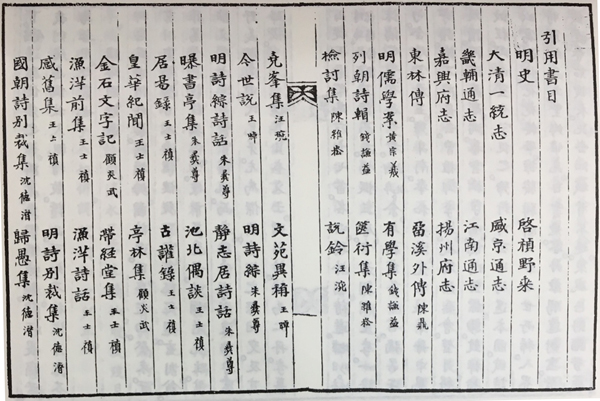
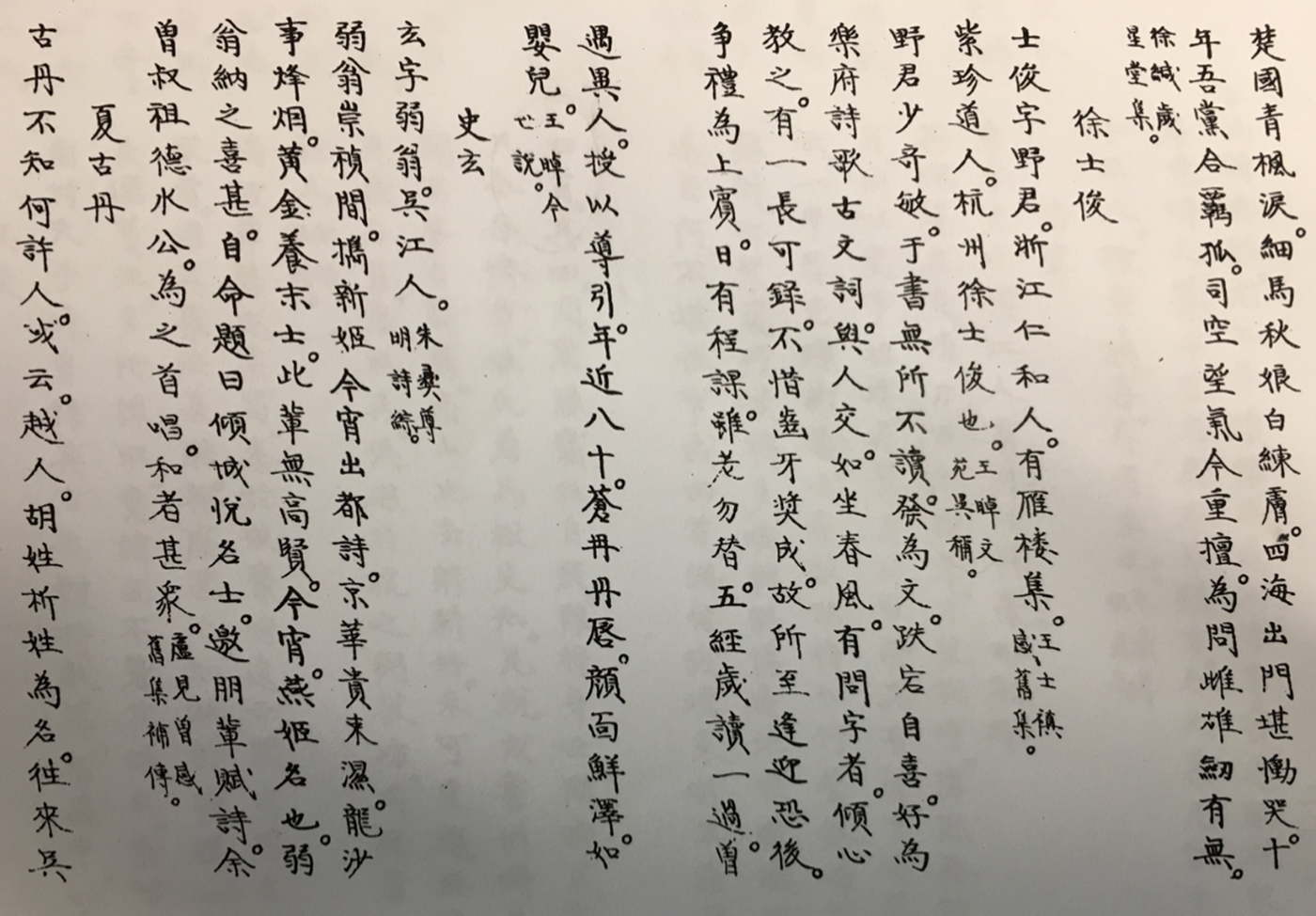
Compiled a year after Yi Tŏngmu's tribute mission trip in 1778, Noeroe Nangnak Sŏ was a massive undertaking in which Yi gathered together biographies of 528 Ming loyalists in 10 volumes (juan).Footnote 2 The collection contains excerpts from 176 Chinese books by 142 writers of the late Ming and early Qing representing a wide range of genres, including official histories, literary collections (munjip 文集), biographies, miscellanies, and anecdotes (see figure 1). Reflecting Yi Tŏngmu's extensive and up-to-date reading of contemporary Chinese books, almost all the books used in Noeroe Nangnak Sŏ had recently been imported from Beijing. Without any specific thematic categorization or structural principles, Noeroe Nangnak Sŏ simply lists the name of each biographical subject, followed by several verbatim excerpts from Chinese books (see figure 2). Such sorting, classifying, and reorganizing of extracts from a wide range of sources emerged as a very popular format for compilations and encyclopedias produced in eighteenth- and nineteenth-century Chosŏn Korea, and was made possible only by the wide circulation of Chinese books in this period (Chin Reference Chin2007, 398; Kim Yŏngjin Reference Kim and Hye-sun2005).
The list of cited works in Noeroe Nangnak Sŏ, reprinted in Yi Tŏngmu (Reference Yi2000, 258:68).

A page from Noeroe Nangnak Sŏ, reprinted in Yi Tŏngmu (Reference Yi2000, 258:260).

Why did Yi Tŏngmu compile Noeroe Nangnak Sŏ? It is difficult to fathom Yi Tŏngmu's exact intention, owing to the absence of an authorial preface or editorial principles (pŏmnye 凡例). His contemporaries, however, bore witness to his desire to compile an authentic historical record of the Ming loyalists. His son, for example, recalled that Yi Tŏngmu identified himself as a remnant subject (yumin 遺民) of the fallen Ming (Yi Kwangkyu Reference Yi1978, 4:223). Yi Tŏngmu's close friend Yun Haengim 尹行恁 (1762–1801) claimed that Yi Tŏngmu had collected and purchased “forgotten histories and rare records” (yusa pis ŭng 遺史秘乘) during his tribute mission to Qing China for the purpose of writing the book (Yun Reference Yun1978, 4:245).Footnote 3 In fact, Yi Tŏngmu had already had some experience compiling records of loyalists. When he had served as a royal collator, he was ordered to compile Songsa Yumin Pojŏn 宋史遺民補傳 (Appendix to the Biographies of Song Remnant Subjects), a compilation of biographies of Song 宋 (960–1279) loyalists who resisted the rule of the Mongol Yuan 元 (1271–1368), as an analogy to the displacement of the Han civilization by the alien Manchu (Yi Tŏngmu Reference Yi1966, 1:424–25, 448–64).
Despite its reception as a reliable historical record of Ming loyalists, however, most of the Chinese books to which Yi Tŏngmu's Noeroe Nangnak Sŏ is indebted were far from authentic materials. In fact, almost all of the books that Yi Tŏngmu's Noeroe Nangnak Sŏ quotes were unofficial histories and private collections of writings. Aside from a couple of official histories, such as Mingshi 明史 (History of the Ming) and Da Qing Yitong Zhi 大清一統志 (Comprehensive Gazetteer of the Great Qing), the majority of the books had been published by early Qing literati in the Jiangnan 江南 area, the cultural center in the late Ming and early Qing periods. After the downfall of the Ming, books of diverse genres were produced to recount the traumatic experiences of the turbulent dynastic transition and reconstruct the public and private memory of the fallen dynasty (Idema, Li, and Widmer Reference Idema, Li and Widmer2006; Struve Reference Struve, Spence and Willis1979, 335–56; Zhao Reference Zhao1999, 368–70). It was popular for early Qing elites to try to rebuild a sense of literati identity and recover their community through publishing projects (Meyer-Fong Reference Meyer-Fong2004; Pattinson Reference Pattinson2006). They often collaborated with commercial publishers and book merchants to publish unofficial histories and private writing collections. These early Qing books, such as Niu Xiu's 鈕琇 (1641?–1704) Gusheng 觚賸 (Leftover Tablets), Wang Zhuo's 王晫 (1636–1710?) Jin Shishuo 今世說 (Contemporary Tales of the World), Zou Yi's 鄒漪 (n.d.) Qi Zhen Yesheng 啟禎野乘 (Unofficial Histories from the Tianqi and Chongzhen Reigns), Wang Wan's 汪琬 (1624–91) Shuoling 說鈴 (Bell of Stories), and Yu Huai's 余懷 (1616–96) Banqiao Zaji 板橋雜記 (Miscellaneous Records of the Plank Bridge), circulated widely beyond Jiangnan and were made available in the bookshops of Liuli Chang, from which they made their way into the hands of Yi Tŏngmu in eighteenth-century Chosŏn Korea (Yi Tŏngmu Reference Yi2000, 258:68–70).
Liuxi Waizhuan, the collection of biographies of Ming loyalists from which Yi Tŏngmu borrowed the largest number of entries, is a typical example of an unofficial history that was produced and circulated in the early Qing Jiangnan area. Its compiler, Chen Ding 陳鼎 (b. 1650), traveled widely during the dynastic transition and collected the stories of a number of late Ming and early Qing figures whose extraordinary deeds were omitted from the official history.Footnote 4 However, the book was far from his own individual undertaking, being a collective endeavor of his coterie: he first compiled the manuscript in 1691, but it did not come out in print until 1692, when his friends Ping Hanying 平漢英 and Gao Dayou 高大酉 helped edit and collate it (Chen Reference Chen1994, 666). It initially consisted of the biographies of 118 figures, but in 1698 it was expanded to include entries on 354 figures in eighteen juan —almost triple the number in the first edition. Numerous Jiangnan literati helped Chen Ding to edit and collate the text. This expanded edition was the work of seven main editors and 131 proofreaders, all of whom belonged to Chen Ding's close circle of friends interwoven with his local and social networks (Chen Reference Chen1698).
Aside from collaborating with his coterie, Chen Ding also relied on his associates in the commercial book market. Following the popular convention of the time with respect to soliciting manuscripts for large compilations (Meyer-Fong Reference Meyer-Fong2004, 33–35; Son Suyoung Reference Son2018, 135–39; Zhang Xiumin Reference Zhang2006, 372), Chen Ding publicly sought additional records from readers. At the front of Liuxi Waizhuan, he attached a solicitation that concludes with the following lines:
If you have any true stories, please send them to the residence of the carver Cai Danjing in front of Cheng'en temple in Nanjing or to the bookshop called Daibao Lou on Xinsheng street in Yangzhou. They will deliver them to me. (Chen Reference Chen1994, 518)
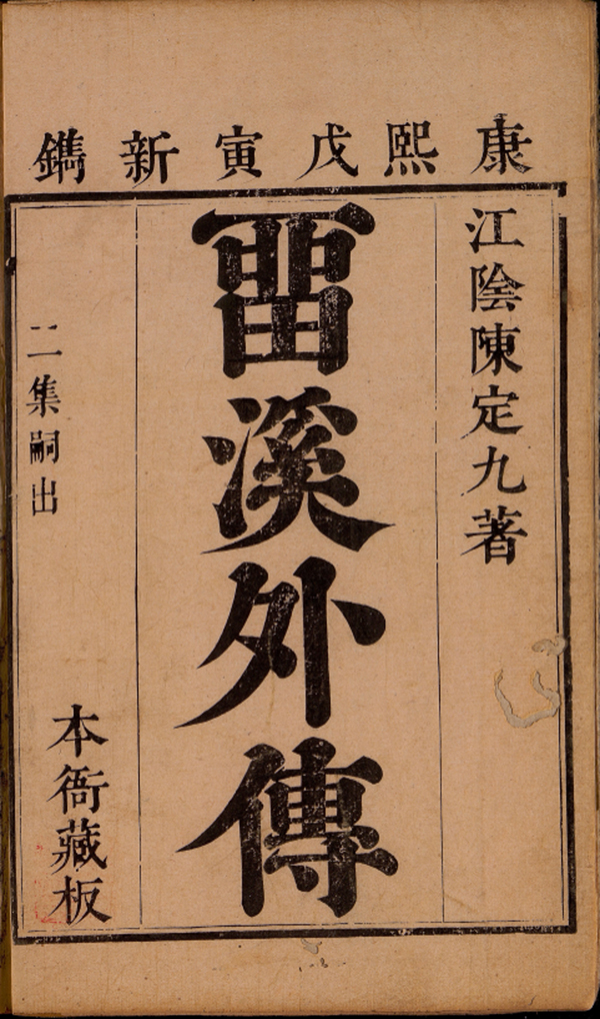
Here Chen Ding is specifically asking readers to send their stories to his associates, including the owner of a bookshop called Daibao Lou, one of the active bookshops in Yangzhou (Son Suyoung Reference Son2018, 111–12). Being a writer with no pedigree or official post, Chen Ding worked closely with commercial booksellers in Yangzhou and Nanjing to print more than thirty titles under the name of his studio, Liuxi Caotang 留溪草堂 (The Thatched Cottage of Liuxi), thus establishing his penname as an identifying brand (Chen Reference Chen1994, 519). He also acted as a middleman for his friend to make contact with the bookshops, forwarding each party's requests, such as the number of copies and the request for the advertisement book covers (Zhang Chao Reference Zhang1780, 6:12b-13a, 10:28a). It appears that he formed a particularly close relationship with Daibao Lou: Daibao Lou took charge of printing and selling the copies of Liuxi Waizhuan once Chen Ding's manuscript was complete; it also planned to make it a serial publication, soliciting submissions from readers. Remaining on the cover page of the extant edition in the National Library of China is a phrase from the advertisement of an upcoming installment: “The second collection will follow” (see figure 3).Footnote 5
The cover page of Liuxi Waizhuan printed in 1698. National Library of China.

In its preface, Liuxi Waizhuan purports to collect only verifiable stories so as to provide authentic biographies of the Ming loyalists (Chen Reference Chen1994, 520), but in actuality its selection criteria did not consistently adhere to this standard. Often colored by favoritism toward stories concerning Chen Ding's own coterie or collected from its members, some of the figures selected for inclusion were his close friends and relatives. For example, Liuxi Waizhuan contains a biography of Zhang Chao 張潮 (1650–ca.1707), none other than Chen Ding's close friend who wrote a promotional preface to Liuxi Waizhuan, although he was not a significant participant in any Ming loyalist actions (Chen Reference Chen1994, 561; Zhang Chao Reference Zhang1780, 8:14a–b).Footnote 6 Moreover, Chen Ding even included a biography of his own mother, listing her under the category of “poverty and uncompromising chastity” (kujie 苦節) (Chen Reference Chen1994, 593). Such contentious partiality accounts for the vehement criticism of Liuxi Waizhuan by later scholars. For example, the commentators of Siku Quanshu 四庫全書 (Complete Library of the Four Branches of Literature) in the late eighteenth century viewed the book as a product of vanity publishing, criticizing Chen Ding's instrumental use of publishing to promote the reputation of his family and coterie at the cost of credibility. They thus denigrated the value of Liuxi Waizhuan as a reliable history, insisting that “its recorded events cannot be believed to be true” (Yong Reference Yong1965, 1:567).
Although it is not clear whether Yi Tŏngmu was aware of the conditions under which Liuxi Waizhuan had been printed and circulated in the early Qing, he was obviously fascinated by the book and perceived it as useful historical material, often using it as evidence to support his arguments (e.g., Yi Tŏngmu Reference Yi1966, 3:295, 328). Yi Tŏngmu first learned of Liuxi Waizhuan from a friend. Before returning the borrowed copy to him, Yi decided to transcribe it in its entirety. He sent a portion to Yi Sŏgu, whom he hoped would come to share his enthusiasm for the book:
I am sending you the first juan of Liuxi Waizhuan. Please return it to me tomorrow morning after you have read it through under the night lamp. This is a book about filial sons, loyal subjects, chaste wives, and extraordinary men, who are beneficial for ruling the world. Whenever I read the stories about the year of 1644 [when the Ming collapsed], I am terrified. I shed tears and my bones ache. (Yi Tŏngmu Reference Yi1977–82, 4:193)
Yi Tŏngmu not only quoted more than seventy-three biographies from Liuxi Waizhuan in compiling Noeroe Nangnak Sŏ but also modeled his own compilation on its format. Liuxi Waizhuan lists the name of each biographical subject under his or her name, followed by the biographical entry. Each entry concludes with a brief comment by Chen Ding. Noeroe Nangnak Sŏ retains this format, differing only in that it omits the compiler's comment.Footnote 7 Yi Tŏngmu's heavy reliance on Liuxi Waizhuan in compiling his Noeroe Nangnak Sŏ led him to include some members of Chen Ding's coterie who were not directly involved in Ming loyalist movements (e.g., Yi Tŏngmu Reference Yi2000, 258:251), thus filling Noeroe Nangnak Sŏ partly with questionable, overly exaggerated, and self-promotional records that at least some Qing literati would have not completely trusted as credible historical materials.
Making a Delocalized Text between Transcriptions
As one of the most knowledgeable readers of the Qing imprints, Yi Tŏngmu was keenly aware of the Qing authors and their backgrounds, often exhibiting his up-to-date information in his conversations with Qing intellectuals and in his several books (e.g., Yi Tŏngmu Reference Yi1966, 2:432–33, 455–56, 465–66, 474–75). Yet his seeming failure to grasp the nature of Chen Ding's Liuxi Waizhuan as the product of coterie and commercial publishing insinuates his disregard for the conditions of early Qing publishing. That is, his (mis)reading of Liuxi Waizhuan as reliable historical material reveals the undeniable spatial and cultural distance between early Qing Jiangnan literati and late Chosŏn Seoul elite readers—a distance that even the common use of literary Sinitic on the shared topic of Ming loyalists could not easily bridge. Although Liuxi Waizhuan was comprised of biographies—an established canonical genre written in literary Sinitic, which any educated person in Chosŏn could read fluently without translation—Yi Tŏngmu's (mis)reading of Liuxi Waizhuan casts doubt on the transparent communicability of the Sinographic text. Instead, it implies a general pattern of transborder reading of a Sinographic text—one in which a “book” originally embedded in specific local conditions of production and circulation was rewound onto a delocalized “text” that was deemed capable of speaking to any elites who mastered the common linguistic and cultural heritage (Kornicki Reference Kornicki2018, 145; Son Suyoung Reference Son2013, 19). The intertextuality of Noeroe Nangnak Sŏ demonstrates the ways in which, despite its faithful rendition of Liuxi Waizhuan, the local conventions and subtextual meanings attached to the original Liuxi Waizhuan were lost in transposition and its delocalized narrative was re-anchored in the specific local conditions of eighteenth-century Chosŏn Korea.
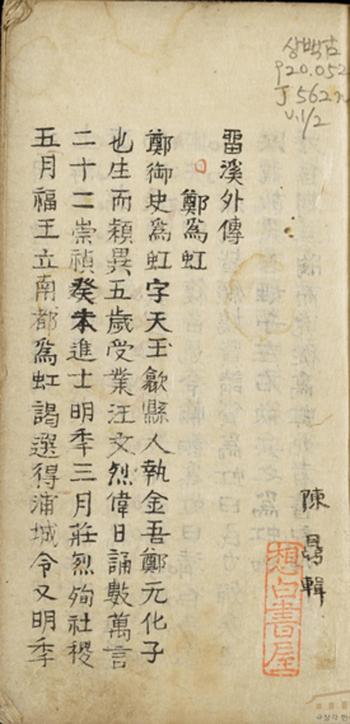
Although Yi Tŏngmu quotes the entries of Liuxi Waizhuan almost verbatim without making any significant changes, it is possible to discern his tacit reading strategy from the different versions of transcriptions that remain extant. For example, a manuscript survives of a selected transcription of Liuxi Waizhuan supposedly done by Yi Tŏngmu himself, copying the biographies of 110 figures in 7 juan, or roughly one-third of the 354 biographical subjects included in Chen Ding's Reference Chen1698 edition of Liuxi Waizhuan (see figure 4). This manuscript appears to be an initial copy made in preparation for compiling Noeroe Nangnak Sŏ, because out of the 110 records in the transcribed copy, Yi Tŏngmu selected 73 biographies for Noeroe Nangnak Sŏ. Yet despite the almost identical accounts in these three different versions—the 1698 Liuxi Waizhuan, the copy of the selected transcription, and Noeroe Nangnak Sŏ—a notable tendency emerges to gradually shear off early Qing local details and also change the designation of the figures in steps that were no doubt designed to make the biographies more accessible and easily digestible to Chosŏn readers.
A leaf of the transcribed copy of Liuxi Waizhuan. Kyujanggak Library in Korea.

One of the minor differences between these three transcriptions is the increasing omission of details that point to subtextual meanings specific to where Liuxi Waizhuan was first created and circulated. The copied passages in Noeroe Nangnak Sŏ often remove facts from the biographical information, such as the name of a person's hometown or the year when a person achieved an official degree. These seemingly trivial tidbits of information were actually important cues in the forming of affinity and local networks among the early Qing literati. But they are excised from Noeroe Nangnak Sŏ due to their lack of direct relevance to the biographical narrative itself.
In addition, Noeroe Nangnak Sŏ deletes all comments by Chen Ding. These remarks not only expressed Chen Ding's brief thoughts about each figure but often cited his friends as the source of personal verification and access to information close to the source. By mentioning the names of specific people who were contemporaries of his readers, Chen Ding reminded readers that they lived in the same region as the hero, that they had heard of the incident before, or that they remembered the historical backdrop of the episode. His Liuxi Waizhuan thus invited its readers to realize that such stories had taken place within the parameters of their everyday lives. In contrast, Noeroe Nangnak Sŏ deletes the personal presence of Chen Ding, as well as his intimate appeal to early Qing readers, by completely dropping his comments. The resultant text, shorn of these details, presents the early Qing biographies as archetypical heroic narratives that flatten local specificities. In other words, Yi Tŏngmu's editorial practice removed concrete local details that would have had significance only for early Qing elite readers. This rendered it less personal but more comprehensible to Chosŏn readers who did not share this local information.
Aside from giving short shrift to the minutiae that endowed Liuxi Waizhuan with subtextual meanings and local connotations, Noeroe Nangnak Sŏ also changes the title of each entry to the figure's official name (ming 名), whereas Liuxi Waizhuan lists the figures by their sobriquets (hao 號). For example, the biographies of “The Master of Laughing at Heaven” (Xiaocang Laozi 笑蒼老子) and “The Old Man in a Thatched House” (Maowu Laoren 茅屋老人) in Liuxi Waizhuan are relisted under their official names, Huang Zhouxing 黃周星 (1611–80) and Hu Changgeng 胡長庚 (n.d.), respectively, in Noeroe Nangnak Sŏ (Yi Tŏngmu Reference Yi2000, 256:114, 268). This change of designation bespeaks the different intended audiences for the two compilations. Since Liuxi Waizhuan was initially supposed to appeal to Chen Ding's community of friends, a sobriquet sufficed to identify the person to whom the record referred. Given the fact that many early Qing literati had numerous sobriquets to express their multiple self-identities, a list of sobriquets was frequently inserted in books published in the early Qing. For example, the long list of contributors to Liuxi Waizhuan that is attached at its front spends a number of pages indicating the sobriquet of each person (Chen Reference Chen1698). Because the sobriquet was an important part of elite sociality and was information that could be acquired only from the person's own literati network, it often served a double function: it created a sense of camaraderie and cemented the close affinity among the coterie members, while for the expanding group of readers outside that circle it became a referent by which to gain access to the exclusivity and prestige associated with the tightly knit coterie.
For Yi Tŏngmu's Chosŏn readers, who were strangers to early Qing coterie culture, however, the sobriquet of each figure was meaningless and unnecessary. Due to his extensive reading of contemporary Chinese books, Yi Tŏngmu easily recognized the sobriquets of early Qing literati (e.g., Yi Tŏngmu Reference Yi1966, 3:328). But to identify which sobriquet represented whom, he often needed to rely on other Chinese books such as Wenyuan Yicheng 文苑異稱 (Different Names of the Literati Circles), which lists 165 sobriquets of the early Qing literati, and Ganjiu Ji 感舊集 (Collection of Remembering Old Friends), which introduces the sobriquets of 333 early Qing poets together with their poems. In other words, the sobriquets that served as a token of coterie solidarity in Liuxi Waizhuan were esoteric knowledge that Yi Tŏngmu himself could decipher only by investigating the relevant references. By listing its entries by each figure's official name rather than by a sobriquet, therefore, Yi Tŏngmu's Noeroe Nangnak Sŏ pruned the undeniable local specificity that had generated the subtextual significance of Chen Ding's Liuxi Waizhuan and replaced it with notional historical material that Chosŏn readers were able to approach more easily. Between transcriptions, Noeroe Nangnak Sŏ deemed Liuxi Waizhuan not necessarily a specific local product, the meanings of which were deeply embedded in the sociability of early Qing coterie culture, but a delocalized text, foregrounding the theme of Ming loyalism, to be shared with Chosŏn literati readers who also perceived Ming loyalism as their own foremost concern at that time.
Local Registers of Loyalty
Having been decoupled from its specific conditions of production and circulation, Liuxi Waizhuan became fairly straightforward and readily intelligible for elite Chosŏn readers, for its narrative theme of loyalty in the dynastic transition from the Ming to the Qing was a transnational concern for any country within the early modern Sinosphere. The change of ethnic, cultural, and political identity from the Han to the Manchu, which involved a series of military conquests, ethnic conflicts, and shifting cultural and discursive practices, had a profound impact on the traditional China-centered world order, spurring neighboring countries to tilt away from a China-centered world order that acknowledged the titular superiority and cultural leadership of China. The biographies in both Liuxi Waizhuan and Noeroe Nangnak Sŏ are undoubtedly centered on the dynastic turnover, and in particular on those loyal to the fallen Ming during that period, but their focus on loyalty is radically different in the two compilations, for loyalty is by nature the most contingent and relative of virtues at such critical moments of political turmoil (McMorran Reference McMorran1994). Far from being a monolithically political virtue limited to the bond between a ruler and his ministers, the meaning of loyalty tended to be requalified by reference to each local condition, as seen both in the early Qing effort to come to terms with the dynastic change by shaping the collective memory of trauma and in the late Chosŏn endeavor to reconfigure its position by remapping the Sinocentric world order.
Liuxi Waizhuan gathers the biographies of a wide variety of people across the divisions of class and gender, ranging from renowned scholars and officials to anonymous recluses, commoners, and women. Chen Ding proclaimed that he intended to create the historical records of otherwise obscure figures that the official history had overlooked—in particular, those people outside the upper social stratum (Chen Reference Chen1994, 520). Thus Liuxi Waizhuan primarily relates the biographies of people of low social rank, including woodcutters, cake vendors, beggars, and prostitutes. Notably, it includes 157 biographies of women out of a total of 354 entries—almost 45 percent of the whole collection. In contrast, most of the biographies that Yi Tŏngmu chose for Noeroe Nangnak Sŏ are of educated Confucian elites, regardless of whether or not they had held an official post during the Ming dynasty. As a consequence, records of the marginalized figures occupy a very small portion of Noeroe Nangnak Sŏ. In fact, Yi Tŏngmu's text includes just a couple of biographies of commoners and only two of women from Liuxi Waizhuan.
Though both compilations put forth loyalty as a prominent theme, the change in the types of figures they profile—from the commoners in Chen Ding's work to educated literati in Yi Tŏngmu's—brings to light the two books’ divergent focus in redefining the meanings of loyalty. While Liuxi Waizhuan expands the boundary of loyalty from one of political allegiance alone to that of a quintessential moral virtue that every human being in the community ought to cultivate, Noeroe Nangnak Sŏ highlights the political dilemma that educated Confucian scholars had to confront in the face of the disintegration of the civilizational order in which they were deeply ingrained. For example, both Liuxi Waizhuan and Noeroe Nangnak Sŏ include the story of a rural scholar named Xu Depu 許德溥 who deplored the doom of the Ming and was determined to “die as a Ming ghost, since I was born as a Ming subject” (Chen Reference Chen1994, 525). He shaved all his hair in defiance of the haircutting order that was enforced in 1645 as a physical sign of acquiescence to Qing rule. But to save his father, who was arrested and brought to the court owing to his son's insubordination, Xu Depu turned himself in. Moved by his filial piety, the Qing authorities released his father, but Xu Depu was eventually executed for his noncompliance with the newly established Qing order.
This remarkable yet not uncommon story of a Ming martyr did not end with Xu Depu's death, however. Chen Ding narrates the aftermath of Xu Depu's execution in a few lines added to the end of the story, which is expanded and included as a separate entry under the title of “Wang Yishi” 王義士 (Righteous Man Wang) in his Liuxi Waizhuan (Chen Reference Chen1994, 581). This separate entry relates that a local minor constable whose surname was Wang was assigned to accompany the wife of Xu Depu into exile following her husband's execution. However, Wang honored Xu Depu's integrity and agonized over his mission. Wang's wife sympathized with her husband and volunteered to go into exile on behalf of Xu Depu's wife. Then Wang also decided to follow his wife's decision, and the couple went into exile together instead of Xu's wife. The local townspeople were all moved by their righteous act of self-sacrifice and paid the ransom to help them return home.
The stories about Xu Depu in Liuxi Waizhuan had different resonances in the early Qing and the late Chosŏn. Both the early Qing collection of extraordinary tales entitled Yu Chu Xinzhi 虞初新志 (The Magician's New Records), compiled by Zhang Chao, and Yi Tŏngmu's Noeroe Nangnak Sŏ reprinted the stories about Xu Depu from Liuxi Waizhuan. But whereas Zhang Chao's Yu Chu Xinzhi only includes the story of Wang (Zhang Chao Reference Zhang2002, 1783:281–82), dropping Xu Depu's biography, Yi Tŏngmu's Noeroe Nangnak Sŏ chooses to include the account of Xu Depu alone (Yi Tŏngmu Reference Yi2000, 256:309–10). This implies a different focus in the reception of these two works: for Zhang Chao, the tale of Xu Depu may have been less unusual than that of Wang, in the sense that Xu Depu's was just one of many stories that documented a scholar who died resisting the change of hairstyle and costumes in the early Qing (Idema et al. Reference Idema, Li and Widmer2006, 2–3; Zhao Reference Zhao1999, 308–17). As both Chen Ding and Zhang Chao note in their comments, however, the story of Wang was rather peculiar, in that he was a commoner, not an educated Confucian scholar-official, who demonstrated such a high level of righteousness. Since many texts by early Qing literati highlighted heroic actions undertaken by commoners and women as a way of indicting the elite class for having failed to uphold loyalty (Li Reference Li2014; Zhao Reference Zhao1999, 55), Chen Ding also explains that his selection of neglected figures reflects his disappointment with the hypocrisy of the self-righteous Confucian elites during the national crisis (Chen Reference Chen1994, 658; also see 527, 533). By foregrounding the marginalized people who had to undergo the tumultuous transition marked by violence, rupture, and destruction through physical suffering, Chen Ding therefore expands his notion of loyalty to any form of unswerving integrity to which all members of a community are challenged to adhere when facing an existential crossroads, rather than limiting loyalty to a virtue performed by a Confucian who is subject to his ruler and dynasty. He praises Wang's wife highly not because she swore allegiance to the fallen Ming dynasty but because she exemplified “vehement indignation for the unjust [treatment of Xu Depu's wife]” as a human being (Chen Reference Chen1994, 581).
In contrast, Yi Tŏngmu's Noeroe Nangnak Sŏ omits Wang's story and only retains Xu Depu's biography. Instead of being impressed by the remarkable heroism of the commoner Wang and his wife, Yi Tŏngmu seems more interested in how the Confucian scholar Xu Depu confronted the political, moral, and ethnic challenges caused by the collapse of the Ming. In a “brush talk” conversation with a Qing scholar during his tribute mission trip to Beijing in 1778, Yi Tŏngmu even brought up Xu Depu's story as that of a typical literatus who witnessed the downfall of the Ming, while making no mention of Wang or his wife (Yi Tŏngmu Reference Yi1966, 3:504). It appears that, for him, Xu Depu's story, despite its rather formulaic plot, not only depicts the epitome of loyalty that all scholars well versed in the Confucian heritage were expected to embody but also sets an example for the masses, thereby resulting in a chain of moral reactions, from Xu Depu to Wang to Wang's wife and then to the local townspeople. Instead of being memorialized as a unique individual, therefore, Xu Depu is celebrated as an archetype of the uncompromised Confucian scholar who stands firm against the ascendency of the Manchu rule. In other words, Chen Ding's Liuxi Waizhuan reconstructs the dynastic transition as the corporeal experience of a community as a whole, while Yi Tŏngmu's Noeroe Nangnak Sŏ views the doom of the Ming as the fundamental crisis testing the epistemological ground of all educated elites—whether Han Chinese or Chosŏn elites—who had been members of the Sinocentric world.
Requalifying Loyalty to the Ming
By emphasizing the different class of Ming loyalists, Noeroe Nangnak Sŏ redirects the locus of Liuxi Waizhuan from that of an ethnographic record of the historical trauma experienced by the Chinese people as a community to that of a biographical history raising the rather metaphysical yet most pressing question for Chosŏn intellectuals in the eighteenth century: how Chosŏn ought to reposition itself in light of the loss of the Ming and the presiding realpolitik presence of the Qing regime. After the initial shock and humiliation of the Manchu's two invasions of the Korean peninsula in 1627 and 1636 to gain control of Chosŏn in preparation for their planned conquest of the Ming, the Chosŏn court was officially subjugated to the Qing, subsuming itself to the Qing-centered tributary diplomacy (Hŏ Reference Hŏ2014, 44–48; Kim Key-Huik Reference Kim1980, 6–8; Larsen Reference Larsen2008, 35–42). But inside Chosŏn itself, the court divulged an ambivalent attitude toward the Qing's ascendancy, for it continued to use the Ming reign year and to retain official uniforms that reflected Ming style in court rituals (Chŏng Okcha Reference Chŏng1992; Haboush Reference Haboush and Struve2005, 121–28). In the eighteenth century, the political climate tended toward Chosŏn claiming itself to be the successor of the Ming dynasty by declaring itself to be a “small central efflorescence” (so chunghwa 小中華). In 1780, the Chosŏn court expanded the sacrificial rites in Mandong temple 萬東廟 (The Far Eastern Shrine) and Taepodan 大報壇 (The Altar of Great Thanksgiving) beyond those memorializing the Ming Wanli 萬曆 emperor (r. 1572–1620), who had sent the Ming troops to help Chosŏn Korea during the Hideyoshi invasions (Imjin waeran 壬辰倭亂, 1592–98); by additionally enshrining the last emperor of the Ming as well as its founding emperor, the Chosŏn court seemed to assert that it was the Ming's only legitimate heir. Chosŏn Korea's self-entitlement as a “small central efflorescence”—often termed “Chosŏn Sinocentrism” (Chosŏn chunghwa juŭi 朝鮮中華主義) by modern scholars—was, however, far from a uniform position.Footnote 8 Rather, the Chosŏn scholars’ attempt to justify Chosŏn's status as the only genuine, qualified carrier of the civilization displayed a wide spectrum of political and cultural positions, ranging between the two extremes of either internalizing or detaching itself from the traditional China-centered world order (An Reference An2010; Chin Reference Chin2013; Cho Reference Cho2009; Haboush Reference Haboush, Haboush and Deuchler1999).
A majority of modern scholars argue that Yi Tŏngmu's compilation of Noeroe Nangnak Sŏ responded to the ongoing chorus of debate about the new identity that Chosŏn Korea was trying to establish for itself, particularly in terms of manifesting his firm rejection of Qing legitimacy. They perceive Yi Tŏngmu as a stalwart Ming loyalist who insisted on a committed allegiance to the Ming, denigrating the Qing as barbaric outlanders (orangk'ae) based on the traditional hierarchy between civilized and barbarian (huayi 華夷) that had sustained the China-centered world order before the fall of the Ming (Ch'oe Sugin Reference Ch'oe2005; No Reference No2014, 264; Yi Haktang Reference Yi2009, 457; Yi Hyesun Reference Yi and Kyu-ik2006). In contrast to the members of Yi Tŏngmu's coterie who traveled to the Qing on tribute missions and supported a radical change in the Chosŏn attitude toward the Qing, even advocating “learning from the Qing” (pukhak 北學), therefore, Yi Tŏngmu is viewed as epitomizing the Chosŏn elite's stubborn refusal to admit the provenance of Qing power and the shifting politics that ensued.
What is striking, however, is that the denotation of the Ming in Noeroe Nangnak Sŏ no longer delimited to the Ming as the center of the Sinocentric order, which integrated national, ethnic, and cultural legitimacy. Instead, it overlaps considerably with Yi Tŏngmu's reaffirmed commitment to timeless Confucian ideals. For example, Yi Tŏngmu's radical adjustment of the time span of Liuxi Waizhuan in his Noeroe Nangnak Sŏ clearly shows that he distinguishes the Ming as a historical polity from the Ming as a civilizational ideal.Footnote 9 Here it is important to note that although most of the entries in Chen Ding's Liuxi Waizhuan are related to the Ming-Qing transition, the book's time frame is not limited to 1644, the year in which all the major events that led to the doom of the Ming occurred, such as Beijing being overrun by the rebel forces of Li Zicheng 李自成 (1606–45), the Manchu forces’ crossing over the Wall, and the suicide of the last Ming emperor. Instead, the book further covers a protracted period of political instability in the early years of Qing rule, including the fall of the Southern Ming (Nanming 南明) dynasty in 1662 and the suppression of the revolt of the Three Feudatories (Sanfan zhi luan 三藩之亂) in 1681. Chen Ding's Liuxi Waizhuan thus characterizes the end of the Ming as something that cannot be assigned a precise date (Struve Reference Struve1984, 1–2) because the repercussions were felt over more than forty years of early Qing rule.Footnote 10 In other words, in Liuxi Waizhuan the dynastic change is not understood as complete until the Qing had firmly consolidated its rule and gained absolute control over all China—that is, until the confusion and suffering of the people had eventually come to an end.
Despite the Chosŏn court's keen awareness of and cautious deliberations about the political developments involving the Southern Ming (U Reference Kyŏngsŏp2013), however, Yi Tŏngmu's Noeroe Nangnak Sŏ includes no mention of the Southern Ming and its subsequent political and military struggles, and selects only accounts set in or very near 1644. His lack of interest in the Southern Ming derived from the fact that he reckoned 1644 as the final year of the Ming (Yi Tŏngmu Reference Yi1966, 3:376–77), which stands in stark contrast to similar compilations made by Ming refugees. For instance, in 1818, Wang Dejiu 王德九, a descendant of Han Chinese who were exiled to Chosŏn Korea after the collapse of the Ming, collected the biographies of nine Ming loyalists who took refuge in Chosŏn. In this collection, entitled Hwangjo Yumin Rok 皇朝遺民錄 (Record of the Remnant Subjects of the Ming), Wang Dejiu makes it clear that he believes the Southern Ming dynasty was the rightful successor to the Ming by using the reign title of the last emperor of the Southern Ming, Yongli 永曆, instead of Chongzhen 崇禎, the reign title of the last emperor of the Ming (Sa Reference Sa2017, 246–51; Sun Reference Sun2007, 356–61; U Reference Kyŏngsŏp2012, 356–61). It appears that Yi Tŏngmu's interest did not lie in the Southern Ming's claim to continue the Ming's imperial bloodline or to recover the Ming's territorial sovereignty; instead, he argues that blind loyalty to the fallen Ming should not be demanded of the generation that was born after the dynastic transition (Yi Tŏngmu Reference Yi1966, 3:358). The loyalty to the Ming in Noeroe Nangnak Sŏ thus represents something far from allegiance to the bygone dynasty in the hope for its political reinstatement (U Reference Kyŏngsŏp2012, 360).
In contrast to the simplistic identification of Yi Tŏngmu as a conservative Ming loyalist, a couple of recent studies have related the compilation of Noeroe Nangnak Sŏ to Yi's envisioning of Chosŏn Korea as the new center in the Sinosphere (Son Hyeri Reference Son2014; U Reference Kyŏngsŏp2012, 353–55). By highlighting the identity of Chosŏn Korea as separate from the influence of the Qing, they interpret Noeroe Nangnak Sŏ as the expression of Yi Tŏngmu's emerging political subjectivity, taking over from Han Chinese who could not make such records under the Manchu regime. It should be noted, however, that his definition of Chosŏn Korea's subjectivity stems less from its departure from the deep-seated Sinocentric hierarchy than from its adherence to and excellence in that. In his travel record to Beijing, “Ipyŏn Ki” 入燕記 (Record of Entering Beijing), he keenly discerns that the Qing regime is failing to act as the proper protector of Confucian civilization. When he passes by Confucian temples and observes the Confucian rituals performed there, he expresses anger at the Qing's neglect of the temple buildings and flawed maintenance of the rituals (Yi Tŏngmu Reference Yi1977–82, 6:211, 241). Borrowing a question posed by another member of the tribute mission, he reveals his frustration with the fact that street performers and commercial merchants crowd into Confucian temples: “We [in Chosŏn] take care of the Confucian temple with great respect. But why do impertinent people disrupt your Confucian temple?” (Yi Tŏngmu Reference Yi1977–82, 6:241–42). By suggesting a clear split between “we” (Chosŏn) and “you” (Qing), Yi Tŏngmu asserts that “we,” the Chosŏn people, are acting as a more steadfast defenders of the Confucian tradition than the people presently living in China, thereby claiming that it is viable for Chosŏn Korea to surpass any other country in its bid to be the bastion of Confucian civilization (Chin Reference Chin2013, 384–86).
Yi Tŏngmu's proud declaration of Chosŏn as the most steadfast guardian of the Confucian tradition, however, does not deny the possibility of the Manchu becoming a member of that same civilization (Kim Taejung Reference Kim2013, 197). Although Yi Tŏngmu's remarks on the Qing state occasionally reflect the old hierarchy of civilized and barbarian, particularly when he disparages exotic Manchu customs (Yu Ponghak Reference Yu1988, 262), he takes an attitude that Confucian civilization is something that anyone—whether Han Chinese, Chosŏn Korean, or Qing Manchu—can embrace fully regardless of national and ethnic boundaries (e.g., Yi Tŏngmu Reference Yi1966, 2:439). Thus he often criticizes Chosŏn's attitude of superiority to the Qing, an attitude popular among conservative Chosŏn scholars: “The scholars in my country do not read widely, yet they often say that ‘In [Qing] China today, they maintain the barbarian custom of haircutting, for there are no [genuine] scholars. How can they possess [authentic] Confucian scholarship?’” (Yi Tŏngmu Reference Yi1966, 1:426). In addition, unlike his peers who did not show much interest in the culture of other countries, he often praises the mastery of literary Sinitic and the creation of Sinographic texts by Japanese and Vietnamese scholars.Footnote 11 Departing from the only China-centered hierarchy, thus, he envisions his own grander Sinographic civilization that encompasses not only the Chosŏn but also the Qing, Japan, and Vietnam, with any distinctions within it relating primarily not to the national and ethnic bounds but to the extent of internalization of the universal values of the Confucian tradition (Yi Tŏngmu Reference Yi1966, 2:286–88).
Conclusion: Reimagining the Shared Civilization
The transborder movement of the Sinographic text defines the interliterate Sinographic realm less as a seamless, homogenous linguistic and textual universe than as an uneven assemblage of local readings unfolding in different regions that were brought into contact with one another. The intertextuality of Yi Tŏngmu's compilation of Noeroe Nangnak Sŏ, on the one hand, testifies to the centrality of the transregional commonalities that contributed to the self-positioning of Chosŏn Korea in the eighteenth century. At the same time, it also demonstrates how the shared tradition was constantly reinterpreted by way of its reference to the compiler's own local conditions on the other. By embodying the dialectic dynamics of these transregional commonalities and local contingencies, Noeroe Nangnak Sŏ asserts Yi Tŏngmu's attempt to carve out the status of Chosŏn Korea as a key constituent to the shared Confucian tradition at the newly imagining Sinographic civilization after the disintegration of Ming-centered world order.
The so-called shared Confucian tradition was by no means an ossified and fixed ideal; rather it was a constantly evolving continuum. Granted that neither Liuxi Waizhuan nor Noeroe Nangnak Sŏ could consider the political restoration of the Ming to be a viable possibility, the loyalty to the fallen Ming foregrounded in both books serves as an open-ended signifier whose meaning needed to be reimagined within shifting historical conditions (Wakeman Reference Wakeman1984, 647–56; Xie Reference Xie2001; Zhang Ying Reference Zhang2017, 186–211). In both books, the kind of loyalty that had been essentialized in Confucian politics—namely, that of subjects and officials self-sacrificingly protecting or pledging allegiance to their emperor and dynasty—was justifiably losing its validity. As a product of the early Qing dynasty, Chen Ding's Liuxi Waizhuan resisted locating the notion of loyalty within a simple dichotomy of loyalists and traitors (Chan Reference Chan2000, 34–43; Zhao Reference Zhao1999, 160). In fact, Liuxi Waizhuan gathers together accounts that do not all fall neatly under the rubric of unalloyed Ming loyalists. Rather, it classifies them into fourteen moral categories, including “loyal and righteous” (zhongyi 忠義), “filial and fraternal” (xiaoyou 孝友), “reclusive and unconfined” (yinyi 隱逸), and “upright and competent” (lianneng 廉能). That is, it highlights a wide range of expressions of Confucian ethical ideals that profoundly transcend political fidelity to a specific historical dynasty. For example, Liuxi Waizhuan includes biographies of figures who were loyal not merely to the Ming but also to the Qing, such as the Han bannermen who chose to fight for the Qing during the revolt of the Three Feudatories (e.g., Chen Reference Chen1994, 521, 548–49). In refusing to obey the Han generals, who had revolted on the pretext of reviving the Ming, these Qing loyalists made almost the same declarations as had Xu Depu: “Since I was born as a subject of the Great Qing, I will become a ghost of the Great Qing!” (Chen Reference Chen1994, 521). Regardless of the dynasty to which a particular figure demonstrates allegiance, therefore, the virtue of loyalty is celebrated in Liuxi Waizhuan as a quintessential moral principle that is impervious to dynastic change.
While the early Qing notion of loyalty as a moral imperative allowed imperial legitimacy not to be grounded in shared ethnicity, thereby providing room for tacit consent to Qing legitimacy, it also chimed with the need of Noeroe Nangnak Sŏ to reconfigure loyalty as a set of civilizational values that transcend territorial and ethnic bounds so as to identify Chosŏn Korea as the member integral to bona fide Confucian civilization. When Noeroe Nangnak Sŏ celebrates the loyalty to the Ming, its designation of the Ming is not necessarily a historical polity but the Confucian principles that ought to be intact despite the collapse of the Ming. The forms of loyalty to the Ming extolled in Noeroe Nangnak Sŏ are thus not limited to the active resistance of martyrs who sacrifice their lives for the Ming dynasty. Instead of confining loyalty to the political fidelity in a narrow sense, it rather includes the unconventional and erratic deeds of the literati who revealed their noncompliance to the Qing rule as eccentrics, beggars, and Buddhist monks—figures who were not considered exemplary within the rigid neo-Confucian doctrine of late Chosŏn Korea (Kim Chŏnghŭi Reference Kim1934; Sŏng Reference Sŏng1840). Since Noeroe Nangnak Sŏ promotes loyalty to Confucian civilization in the name of the Ming, it embraces these motley figures’ varied behaviors as the manifestation of their unwavering dedication to transdynastic Confucian ideals. The reading of Liuxi Waizhuan in the compilation of Noeroe Nangnak Sŏ thus embodies the transnational contact brought about by means of their shared conception of Confucian tradition—the meaning of which was constantly shifted, reimagined, and enriched by local practices rooted in sundry beliefs about and definitions of that very tradition.
Acknowledgments
This paper was first presented at “Book Culture and Vernacular Identity in Premodern Korea and East Asia,” a workshop sponsored by Cornell University in 2016. Its revised form was presented at the Asian Studies Conference Japan and at the Academy of Korean Studies in 2017. I am grateful to all the participants, commentators, and audiences at both conferences, but express my particular gratitude to John Whitman, Clarence Lee, Jeongsoo Shin, Joshua Young, and Rivi Handler-Spitz for their critical suggestions and warm encouragement. The comments of the two anonymous readers were extremely useful in improving the manuscript. I acknowledge the financial support of the Academy of Korean Studies Fellowship to enable my 2017–18 archival research in Korea on which this study is based.