Introduction
As more children born with CHD survive into adulthood, neurodevelopmental disabilities have emerged as a common concern that impacts quality of life. Reference Khairy, Ionescu-Ittu, Mackie, Abrahamowicz, Pilote and Marelli1–Reference McQuillen, Goff and Licht6 Children with complex CHD are particularly affected by a number of neurocognitive and neurobehavioural vulnerabilities that persist into adolescence and adulthood. Reference Patel, Ilardi and Kochilas7–Reference Schaefer, von Rhein and Knirsch9 As high as 25% of children with complex CHD may exhibit behavioural problems and are 50% more likely to require special educational services compared to children without CHD. Reference Riehle-Colarusso, Autry and Razzaghi10,Reference Abda, Bolduc, Tsimicalis, Rennick, Vatcher and Brossard-Racine11 A recent update to the 2012 American Heart Association and American Academy of Paediatrics guidelines for neurodevelopmental care of children with CHD, including revised risk categories for neurodevelopmental delay or disorder in individuals with CHD, reflects the rapid expansion of cardiac neurodevelopmental programmes and research over the last decade. Reference Marino, Lipkin and Newburger12,Reference Sood, Newburger and Anixt13 However, the structure and approaches of neurodevelopment follow-up programmes remain highly variable, and gaps in neurodevelopmental care are still prevalent among children and adults with CHD with less than 30% of children returning to their surgical centre for recommended toddler assessments and fewer resources available for older children and adults. Reference Miller, Sadhwani and Sanz14,Reference Ortinau, Wypij and Ilardi15
The New England Congenital Cardiology Association is a regional organisation comprised of healthcare clinicians from fourteen congenital cardiology institutions across six states. It was established to improve health outcomes and expand care for children and adults with CHD in New England. Reference Flyer, Goudie and Greenstein16–Reference Angoff, Kane and Giddins18 The Health Disparities Working Group is comprised of New England Congenital Cardiology Association members aiming to improve the region’s clinical outcomes through a better understanding of CHD care disparities.
Patients with CHD live in a wide range of rural, suburban, and urban environments with variable resources that present disparate challenges to care access. Previous reports of cardiac neurodevelopmental services are predominantly limited to larger surgical centres with formal neurodevelopmental programmes, Reference Ortinau, Wypij and Ilardi15,Reference Glotzbach, Ward and Marietta19–Reference Hennrick, Miller and Lai21 leaving a paucity of data characterising the neurodevelopmental care practices of smaller, non-surgical cardiac centres. Given the knowledge gap in regional approaches to neurodevelopmental follow-up, we sought to understand how regional academic centres support the neurodevelopmental needs of CHD patients. This paper aims to describe the neurodevelopmental infrastructure, resources, and referral practices of surgical and non-surgical CHD centres across New England.
Methods
Study design
Members of the New England Congenital Cardiology Association, Health Disparities Working Group, collaborated to assess the neurodevelopmental care practices for children with CHD at cardiac centres across the six New England states (CT, MA, ME, NH, RI, VT). This project was determined to meet quality improvement criteria for programmatic evaluation by the Working Group institutional oversight and did not meet the definition of human subject research.
Data collection
A single, multiple-choice survey was distributed electronically via REDCap to each participating centre and accessible for one month (September–October, 2023). Survey questions were designed to capture the extent of typical cardiology and cardiac neurodevelopmental institutional practices. Survey design was modelled on previously published assessments of cardiac neurodevelopmental clinical infrastructure Reference Miller, Sadhwani and Sanz14,Reference Dusing, Turner and Smyth22 and adapted for this study by two of the authors (MED and TAM). Survey content was then reviewed for face validity and refined by all co-authors. Following refinement, the survey was pilot tested with two individuals from the same institution who were not part of the authorship team, to assess clarity of the format and internal reliability. The completed survey was then distributed to the participating centres. Only one response was allowed per centre, and survey participants were encouraged to engage with their institution-based multidisciplinary teams to provide a best-fit answer by group consensus. Participants were asked to provide characteristics of patient education practices, inpatient and outpatient neurodevelopmental services/consults, mental and behavioural health resources, and the professionals involved in cardiac neurodevelopmental care (Supplemental File 1). Centres were categorised by congenital cardiothoracic surgical capability and cardiopulmonary bypass volume. Responding centres included non-surgical, academic (university-affiliated and/or teaching hospital) centres with paediatric inpatient services and academic surgical centres. Surgical size was estimated by annual bypass case volume, dichotomised to small (<150 bypass cases per year) and medium-large surgical centres (≥150 bypass cases per year).
Statistical analysis
Responses were reviewed by the study team (MD, TM) for accuracy and completeness. Direct queries to the responding centres were performed for absent or incomplete data. Results were analysed using descriptive statistics and graphical methods, as appropriate. Fisher’s exact test was used to evaluate contingencies across the small sample size of programmes, with a priori significance determined <0.05. Analyses were conducted using Microsoft Excel (Microsoft Corporation, Seattle, Washington) and GraphPad Prism (GraphPad Software, San Diego, CA).
Results
Site characteristics
Ten of 14 New England Congenital Cardiology Association centres participated in the Health Disparities Working Group at the time of the survey, and nine centres (90%) responded to the survey. Just over half (55%) of responding centres were non-surgical, academic centres with paediatric inpatient services, with the remaining institutions equally comprised of small (22%) and medium-large (22%) surgical centres (Table 1). The one non-respondent was a multi-site outpatient practice. Of the four New England Congenital Cardiology Association sites who were not participants the Health Disparities Working Group, one is a small surgical centre, and the other three are non-surgical, academic centres; 2 with inpatient paediatric services and one without.
New England Congenital Cardiology Association center characteristics

Pediatric cardiac site is listed based on categorization of center. The table lists only those that responded to the survey. Academic center was defined as university affiliated and/or teaching hospital. Small surgical center defined as <150 cardiopulmonary bypass cases per year.
Patient/family education
All institutions report that both foetal and paediatric cardiology care teams either always or sometimes provide neurodevelopmental education to patients and families. However, more foetal cardiology care teams always provide education to patients/families about neurodevelopment (always: 44%, sometimes: 56%) in contrast to non-foetal/paediatric cardiology care teams (always: 0%, sometimes: 100%; p = 0.04).
Referral and scheduling practices
Referral practices for patients with CHD to neurodevelopmental assessments and/or therapies differ by centre type. Only surgical programmes have implemented automatic referral processes. All 4 regional surgical centres refer patients automatically and report specific criteria that prompt automatic referrals. Three of the four surgical centres refer all individuals meeting the American Heart Association CHD high-risk criteria (75%). Reference Stout, Daniels and Aboulhosn23 One surgical centre refers all individuals with single ventricle heart disease or a history of neonatal surgery. Half of the surgical centres schedule follow-up at the time of discharge while the other half depend on family or clinic-initiated scheduling after the automatic referral is placed. Among the five non-surgical centres, automatic referrals for their patients would only occur if done by an outside surgical centre. Otherwise, referral to neurodevelopmental services is most commonly dependent on recognised need from the inpatient team, primary cardiologist, nurse coordinator, or subspecialty team (60%) but also may depend on concern being raised by the patient’s family or primary care team (40%). Regardless of centre type, when a referral for outpatient neurodevelopmental evaluation is made by a clinician, this usually occurs by the cardiology practice (56%) or the general paediatrics practice (33%).
Inpatient neurodevelopmental care practices
The inpatient neurodevelopmental services available to paediatric CHD patients vary across the surveyed centres. While formal inpatient neurodevelopmental care rounds and individualised developmental care plans are available at only one institution (11%), all centres report availability of inpatient developmental care consultation.
The composition of inpatient neurodevelopmental teams differs between institutions. Physical and occupational therapy professionals, social workers, child life specialists, and neurology professionals are present for inpatient consultation at all nine institutions. Speech therapy and psychology professionals are also common (89%), as are developmental and behavioural paediatrics professionals (67%). Neuropsychology and educational speciality consultants are less common but present at some sites (44 and 33%, respectively). Providers are typically consulted depending on patient need, although surgical centres are more likely to offer consultation by select specialists for all patients. Notably, 75% of surgical centres engage inpatient social work with all patients, compared to 0% at non-surgical centres (p = 0.048). Physical and occupational therapy is offered to all patients at 50% of surgical centres compared to 0% at non-surgical centres (p = 0.17) (Figure 1a).
Multidisciplinary teams and services: (a) Inpatient subspecialists and services that are present across institutions are shown based on their utilisation and availability in the inpatient setting. (b) Outpatient subspecialists and providers with different expertise that participate in the local developmental clinic are shown based on their time commitment to the outpatient clinic at which children with CHD are seen. (c) Availability of mental and behavioural health resources for are shown for children with CHD (white bars) and their parents (black bars). PT = Physical therapy, OT = occupational therapy, DB = developmental and behavioural, APP = advanced practice provider.

Outpatient neurodevelopmental care practices
The outpatient neurodevelopmental services available to paediatric cardiology patients in New England vary according to institution type and frequently rely on follow-up from the centre where cardiac surgery was performed. Among the four surgical centres, two have infrastructure for cardiac-specific neurodevelopmental programmes that serve the majority of paediatric patients with CHD at those institutions. The remaining two surgical centres rely on other internal developmental programmes that either have specific representation for paediatric CHD patients or are able to accommodate them.
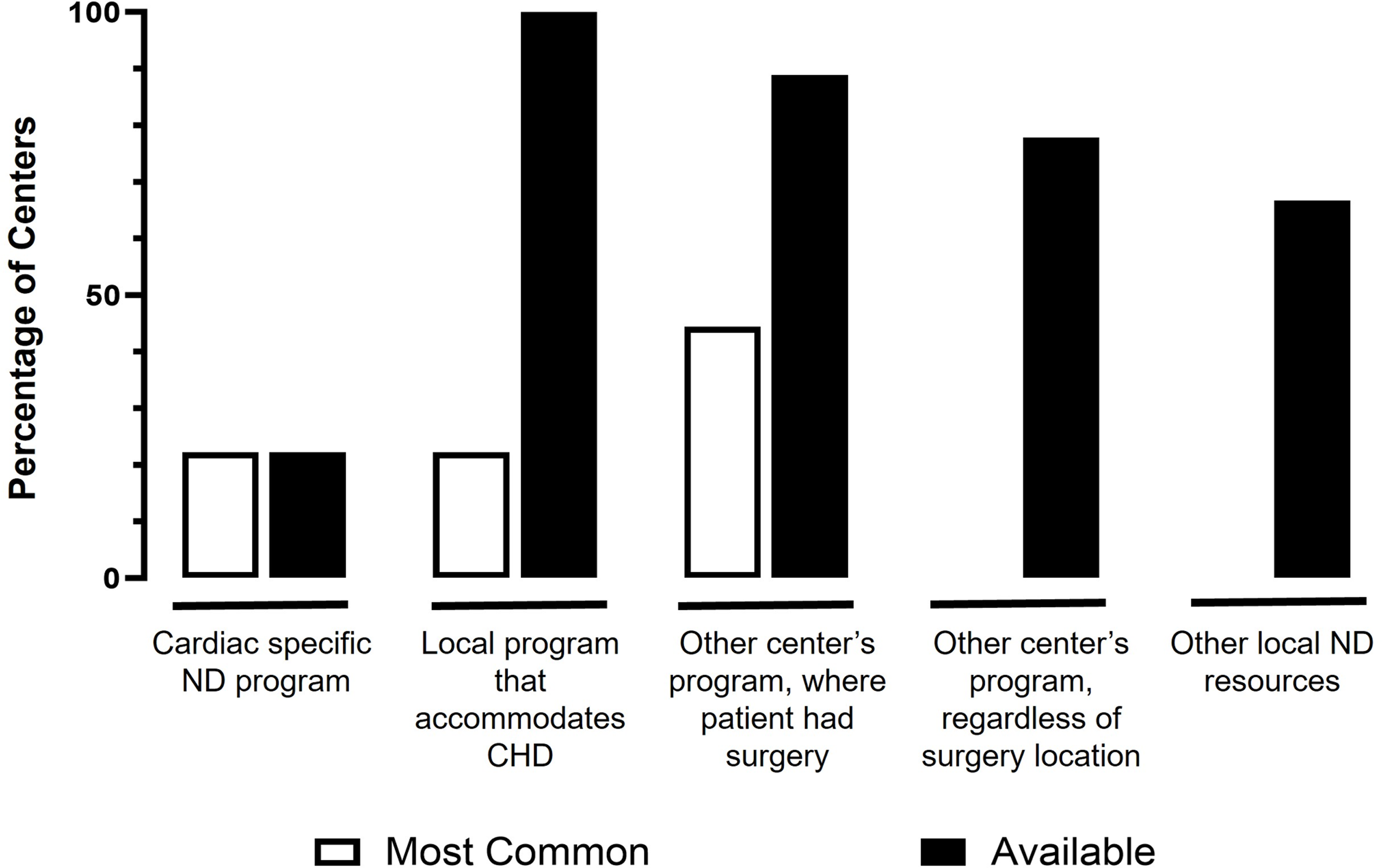
While none of the five non-surgical academic centres reported cardiac-specific neurodevelopmental programmes, all of these institutions have other developmental programmes that can accommodate children with CHD, such as a developmental and behavioural clinic or neonatal follow-up programme. The majority (80%) primarily depend on surgical centre neurodevelopmental programmes to schedule patient follow-up care, rather than their own programmes. Many institutions also report referring patients with CHD to local neurodevelopmental resources not associated with their own centre (67%) or to another paediatric cardiac centre’s neurodevelopmental programme, regardless of where the patient had surgery (78%) (Figure 2).
Outpatient neurodevelopmental programme patterns: bar graph demonstrates the percentages of centres that selected various neurodevelopmental (ND) programme type as either the most commonly utilised (white bars) or available (solid bars) to the patient population of children with CHD at their centre.

The healthcare professionals involved in outpatient CHD neurodevelopmental programmes vary across all institutions, regardless of centre type and size. Social workers (56%), neonatologists (56%), and neuropsychologists (44%) are more commonly included. Six institutions (67%) have at least one full-time developmental professional in their outpatient neurodevelopmental programme. The majority of healthcare professionals included in these outpatient programmes also staff other clinics, rotate through the clinic, or collaborate on an ad hoc basis (Figure 1b).
Outpatient neurodevelopmental programmes are available on the same campus as the outpatient cardiology clinics at over half (67%) of surveyed centres. However, of these, only two (22%) are specifically co-located within the outpatient cardiology clinic. The remaining 33% of neurodevelopmental programmes are primarily situated with paediatric developmental services, on a separate clinical campus from paediatric cardiology. There was no statistical difference between surgical (75%) and non-surgical (60%) centres reporting neurodevelopmental clinic co-location within paediatric cardiology (p = 0.6).
Mental and behavioral health resources
All nine sites provide access to inpatient social work and psychiatry services. Inpatient psychology services are available at 67% of institutions. All sites additionally offer outpatient psychiatry services, and 89% offer both outpatient social work and psychology services.
Similar mental health resources are available for parents of children with CHD at these institutions. Inpatient social work services are available to parents at all sites, and outpatient social work services are available at 89% of sites. Referrals for parental psychology services can be made from both the inpatient (67%) and outpatient (89%) settings, although the receipt of those services is unknown. Most mental and behavioural health services are available based on patient need or at parental request, although two surgical centres offer inpatient social work consultation for all families.
Educational (67%) and peer support groups (78%) are also available for interested patients and parents at the majority of centres. Local counselling referrals, not affiliated with the institution’s paediatric cardiology programme, were offered by all but one centre for both patients and parents (89%) (Figure 1c).
Discussion
This assessment by the New England Congenital Cardiology Association Health Disparities Working Group describes the current landscape of neurodevelopmental care for children with CHD at nine cardiac centres across six New England states, including four surgical centres and five non-surgical academic centres. Our findings reveal variable services with some reliance on the surgical centres, yet many local resources are independent of the surgical centre.
While institutions may have differing approaches to cardiac neurodevelopmental care, a pronounced distinction can be observed in the practices of surgical centres, regardless of size, compared to non-surgical centres. Surgical centres, which are often referral centres for patients throughout the New England region, depend on internal neurodevelopmental programmes for CHD patients, but only 50% have cardiac-specific programmes, and the remaining utilise other internal neurodevelopmental or developmental paediatrics programmes for high-risk groups. Non-surgical centres, in contrast, tend to rely on the services of the institution where cardiac surgery was performed, despite available developmental services for children with CHD and distance for the patient to the original surgical centre, which could be in another state.
Many current recommendations describe best practices and essential components of cardiac neurodevelopmental follow-up programmes. Reference Ilardi, Sanz and Cassidy24–Reference Miller, Lisanti and Witte27 Our survey data suggest many of the components of recommended follow-up may already be present at academic paediatric institutions (including developmental care, multidisciplinary team involvement, continued parental and family education and support) and are not unique to surgical centres alone. Given the low return rates to surgical centres, especially for those from farther distances, Reference Ortinau, Wypij and Ilardi15,Reference Loccoh, Yu and Donohue20,Reference Khan, McGrath, Ramsey, Agarwal, Slatore and Broberg28 our data suggest there is greater opportunity for collaboration between regional academic centres to provide care that may be more accessible. Regionalisation has been a focus of paediatric cardiac surgical care Reference Katz, Mohan and Bacon29,Reference Backer, Overman and Dearani30 but a similar model of comprehensive and essential centres could be considered in the cardiac neurodevelopmental care models where non-surgical academic centres serve as essential regional centres in collaboration with other programmes. Expansion of the telehealth-based neurodevelopmental services initiated at many cardiac centres during the COVID-19 pandemic Reference Vaughan, Moore, Moreno, Dyer, Oluyomi and Lopez31 should also be considered to address health care disparities and reach more CHD patients. Telehealth may provide particular benefit to those who live at a significant distance from cardiac centres with limited access to transportation, but there are still technology- and language-based limitations. Reference Kasparian, Sadhwani and Sananes32
Children with complex CHD have a unique developmental trajectory and well-described common domains of concern. Reference Morton, Ishibashi and Jonas5 As such, an argument could be made that neurodevelopmental programmes and individualised care plans specifically designed for patients with CHD may be ideal. Reference Marino, Lipkin and Newburger12,Reference Ilardi, Sanz and Cassidy24,Reference Miller, Lisanti and Witte27 Given that only two cardiac centres in New England have cardiac-specific neurodevelopmental programmes, however, the reality is that subspecialised paediatric developmental care resources are limited. With attendance rates for large, well-resourced, surgical centre neurodevelopment follow-up programmes reported to be under 30%, Reference Ortinau, Wypij and Ilardi15 the majority of individuals are evidently not returning to large specialised clinics for care. Recent data from the state of Maine exemplified this pattern, as many children with complex CHD engage services outside of the regional centre. Reference Bohnhoff, Cutler and Price33 Therefore, collaboration and shared learning are essential across regional centres to leverage resources closer to home. For example, many local systems may be able to support triage and therapy, while collaborating with regional cardiac neurodevelopmental experts for neurocognitive testing.
A number of approaches can be taken by regional academic centres to increase patient retention in neurodevelopmental care. The presence of hospital-initiated scheduling is an important predictor of patient attendance at neurodevelopmental evaluation. Reference Ortinau, Wypij and Ilardi15 Our data show that 40% of non-surgical centres depend on interest or concern raised from a patient’s family or primary care team for initial referral to neurodevelopmental evaluation. As such, increasing hospital-initiated scheduling is a potential area of improvement for academic centres. Implementation of automatic referral practices based on defined criteria has the potential to reach a higher percentage of patients with neurodevelopmental needs while reducing the burden on clinicians and families to initiate scheduling. Standardised surveillance programmes should additionally be considered to decrease variability in referral processes across cardiac neurodevelopmental programmes and address health care disparities. Standardised checklists for cardiologists during routine visits have been previously shown to increase referral completion with an increased benefit for patients identifying as Hispanic/Latino. Reference Hennrick, Miller and Lai21
Recent efforts have been made to better understand how cardiac care teams can support parent mental health and reduce strain on families of children with CHD. Reference Lisanti34–Reference Utens, Callus, Levert, Groote and Casey36 The Cardiac Neurodevelopmental Outcome Collaborative identified parent mental health and family function as a critical area of advancement in neurodevelopmental care for the coming decade. Reference Sood, Jacobs and Marino37 Our findings reveal that cardiac centres in New England have the infrastructure for psychological services and peer support for both patients with CHD and their parents. However, nearly all centres rely on demonstrated need or parental request to access mental and behavioural health services. Future studies should consider how supports are offered and utilised and how their utilisation impacts psychosocial well-being and quality of life for caregivers and children with CHD. It could be beneficial for centres to refer all parents to mental health screening at the time of CHD diagnosis to increase awareness of these services and minimise social barriers to accessing mental health resources for themselves and their children. Reference Lisanti34
Patient and family education also plays a key role in facilitating familial involvement and improving neurodevelopmental follow-up for children with CHD. Given that 60% of foetal cardiology teams and 100% of paediatric cardiology teams surveyed report only sometimes providing neurodevelopmental education to families of children with CHD at outpatient visits, improving the consistency of early neurodevelopmental education offers a common point of growth across all centres. Early initiation of neurodevelopmental discussions during routine cardiac care improves familial awareness and understanding of the neurodevelopmental vulnerabilities affecting children with CHD and may compel continued participation in care. Reference Brosig, Butcher and Butler26
The current study has several limitations. First, the survey tool used to measure cardiac and neurodevelopmental practices at New England cardiac centres is not validated. Survey questions were used as surrogates for neurodevelopmental care practice and resources of cardiac centres in New England; these were not objectively measured outcomes. Survey questions were designed to capture the extent of typical practice, and therefore, some questions relied on estimation or the best answer if multiple choices were applicable, potentially leading to generalisations of available resources and common practices. Additionally, only a small group of paediatric cardiology providers affiliated with New England Congenital Cardiology Association completed the survey to represent provider perspectives from the entire New England region. Patient perspectives were not measured, nor were providers asked to assess the quality of neurodevelopmental services, wait times for appointments, or confirm the appointment occurred. As such, information about the implementation and quality of available services cannot be evaluated. Finally, New England has a high concentration of paediatric academic centres and a relatively short driving distance between them despite the rurality of Northern New England. Other regions in the United States with fewer paediatric academic centres may have fewer neurodevelopmental resources available in such proximity than those described. As a consequence, the resources available to cardiac centres in New England may not be generalisable to all regions of the United States or world. Regardless, this study provides several new insights into cardiac neurodevelopmental resources that are available to patients with CHD beyond surgical centres and offers a foundation for other regions to consider exploring what aspects of assessment and intervention may be accessible closer to home. While the specific resources may not be similar, the concept of a local team having more knowledge of the local community and therapy supports, may be important to consider for any given region. For any given patient, the role of their surgical centre, paediatrician and his/her local health system, primary cardiologist and his/her local health system, as well as community and school-based resources as it pertains to supporting their development may be very different. Our data suggest that there is opportunity for collaboration, and all regions should consider the broad landscape of opportunity for children with CHD at risk for neurodevelopmental disability.
Conclusions
Neurodevelopmental care approaches differ across New England paediatric cardiac centres for children and families with CHD. While many cardiac neurodevelopmental service components are available at academic paediatric institutions, variation exists in the neurodevelopmental services offered, patient referral patterns, and extent of provider inclusion in neurodevelopmental programmes. Formal cardiac neurodevelopmental follow-up programmes appear more limited to surgical centres within New England, leading to dependence on non-surgical academic centres. Our findings suggest there may be further opportunity for collaboration between regional academic centres, particularly between surgical and non-surgical centres, to leverage local resources and reach more patients with neurodevelopmental needs across New England.
Supplementary material
The supplementary material for this article can be found at https://doi.org/10.1017/S1047951125101297.
Acknowledgements
The New England Congenital Cardiology Association.
Financial support
This work was supported by the New England Congenital Cardiology Research Foundation and the local resources of the individual institutions.
Competing interests
None.
Ethical standard
Not applicable.