The Carthusian Order traces its origins to the year 1084 when Bruno of Cologne and his six companions founded the first monastery in France. The Prologue of the Statutes of the Carthusian Order outlines their vocation to seek union with God in silence and solitude:
To the praise of the glory of God, Christ, the Father’s Word, has through the Holy Spirit, from the beginning chosen certain men, whom he willed to lead into solitude and unite to himself in intimate love. In obedience to such a call, Master Bruno and six companions entered the desert of Chartreuse in the year of our Lord 1084 and settled there; under the guidance of the Holy Spirit, they and their successors, learning from experience, gradually evolved a special form of hermit life.Footnote 1
Today, there are sixteen male and five female Carthusian monasteries worldwide.Footnote 2 The Carthusian contemplative strictly enclosed way of life combines the ideal of an eremitical life of solitude and silence with some elements of communal coenobitical monasticism. This is reflected in their daily recurring horario that alternates between communal and private prayers, as well as dedicated periods of work and study in the cell, with some time reserved for meals and sleep.
Within Catholic monastic traditions, Carthusians are considered among the most austere, with statutes that remain relatively unchanged from their early medieval origins. The ancient monastic path of prayer in solitude and silence, cultivated by the early desert fathers, still marks the lived experiences of Carthusians of modern times. The Carthusian way of life has remained relatively unknown through the centuries, which likely follows from their distinct separation from the world, as written in their statutes: ‘From ancient times it has been the mind of our Order that our absolute dedication to God be expressed and sustained by a great strictness of enclosure’.Footnote 3 The rigour of their enclosure is relaxed a little in order to receive the visit of parents and other relations each year for two days. Apart from this, Carthusians are to avoid visits from friends and conversations with seculars, unless some inescapable necessity is imposed on them by the love of Christ.Footnote 4
It is, therefore, understandable that Peter Nissen, in his 2014 article on the Carthusians, speaks of an ‘enforced outsider-hood’ and an inaccessibility that seem to enhance our fascination with the Carthusian world.Footnote 5 He notes that historians, art historians, theologians, literary scholars and others who study the Carthusians remain no more than outside observers. Participant observation, one of the key research strategies in cultural anthropology, is not feasible in the Carthusian world.Footnote 6 On the other hand, it could be argued that in the age of excessive focus on social media, one’s ‘right to be forgotten’ should be respected by researchers and others with an interest in monasticism. The right to be forgotten applies to all individuals, in particular to those whose stated desire is to lead a solitary life in silence.
As for external sources, Nissen provides a comprehensive survey of recent books written about the Carthusians, all of which are aimed at a general readership.Footnote 7 Among the recent works, he emphasises the importance of the international success of the film Into Great Silence/Die große Stille (2005) by Philip Gröning, which was filmed at the Grande Chartreuse, the mother house of the Carthusian order in the French Alps. The story behind the permission process for this film highlights the relative inaccessibility of the Carthusian Order. When Gröning asked for permission to shoot film scenes in the monastery in 1984, his request was turned down. Only in 1999, fifteen years later, did he receive a message from the prior of the Grande Chartreuse with the final permission.Footnote 8
To complement Nissen’s survey on works published by external sources on Carthusians after 2014, it is worth mentioning Tim Peeters’ When Silence Speaks, which offers a well-researched overview of the Carthusian spirituality.Footnote 9 In addition, a significant Carthusian component is found in two recent works: Cardinal Robert Sarah’s The Power of Silence and Nicholas Diat’s A Time to Die.Footnote 10 Another recommended recent book is Report from Calabria by a Catholic priest (anonymous, in line with the Carthusian tradition) written during his season-long stay in the Carthusian Charterhouse in Calabria, Italy.Footnote 11 From this perspective, he comments on a misunderstanding regarding monastic life: ‘Some critics of the Catholic Church reject the cloistered monastic life as inhumane (although their appraisal might be different if they ever actually talked to a monk or a nun)’.Footnote 12 It is indeed possible that modern societies no longer have sufficient knowledge or understanding of the ancient monastic traditions. It is also true that very few have the opportunity to speak to cloistered monks and nuns, partly for the reasons mentioned above: the contemplative monastic way is separated from the secular world.
Where does this leave us if we still wish to gain a better understanding of the Carthusians? Literature seems the best avenue forward, and nine centuries of texts written by Carthusians offer a rich historical setting against which the Carthusian tradition can be explored today. Despite the challenge of relative inaccessibility, the ancient spiritual heritage justifies an interest in the contemplative way as it is lived today.
In light of this, it is notable that a unique corpus of poetry has recently been permissioned for research by a Carthusian monk, Brother A. In line with the Carthusian tradition, the authors of this Order typically remain anonymous or sometimes publish under a pseudonym. Br. A. is, therefore, an identification designated to distinguish this particular monk-poet from the other contemporary Carthusian authors who use the generic name ‘A Carthusian’.
Respecting the Carthusian tradition, biographical information about Br. A. is limited to details that can be derived from his works. Br. A.’s first poems originate from 1964, which would seem to coincide roughly with the time of his entry into St Hugh’s Charterhouse, likely in his twenties. He has lived in the same Carthusian community in England for six decades. Br. A. writes in English, his mother tongue. Some of the Carthusian monk-poet’s works have been published and translated externally; some are self-published by St Hugh’s Press of the monastery.Footnote 13 Br. A.’s poetry has not yet been widely researched, apart from a comparative study in English literature by Anna Maksjan, whose topic dealt with the mystical dimension of his poetry.Footnote 14
The Carthusian author’s corpus of poetry covers six decades of poems written in the period 1964–2024. It consists of thirty-two collections in booklet format, as well as some individual poems totalling nearly 2,000 compositions.Footnote 15 Br. A. retains the copyright for his original texts but has given permission for their use in scholarly research. The entire corpus of poems was systematically catalogued between February and October 2024 by the author of this paper using initial textual analysis for various categories, themes, influences, references and keywords.
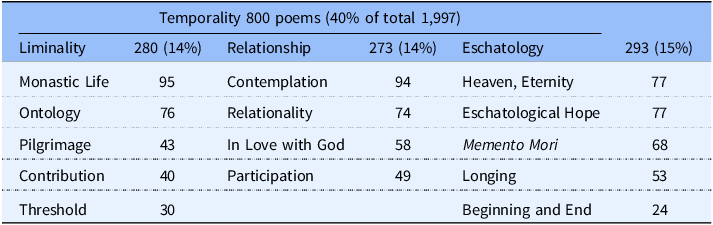
The textual analysis of the entire corpus of texts was conducted at three levels. Level 1 textual analysis constituted a systematic initial classification between temporal and non-temporal themes. With respect to temporality, the classification follows broadly the framework (liminality, relationship, eschatology) outlined in a recent study on Catholic contemplative enclosed monastic traditions.Footnote 16 The classification indicates that 40% of Br. A.’s poems contain a temporal dimension, as determined by a reference in the poem, whether direct or indirect, to temporality (past, present, future) or eternity. The distributions of these categories and subcategories are shown in Table 1. A poem that has been categorised under the main theme ‘Temporality’ can be included in one or more subcategories.
Temporal themes by category and subcategory: number of poems and percentage of total

The other themes without a specific temporal perspective (60% of the total) cover a broad range of categories. The most frequent themes are Salvific Plan (384 poems), Nature (260), Secularisation (245), the Virgin Mary (233), Compassion (177), Reading and Writing (176), Prayer (163), Crucifixion (158), Friendship (154) and Humility (152). In addition, Level 1 textual analysis includes the identification and recording of various keywords and literature references, as well as motivations for writing poetry.
Level 2 textual analysis consisted of a preliminary investigation of the poems’ thematic ideas, based on their frequency as well as further organisation of texts by subcategories. The preliminary interpretation of poetic metaphors and allegories was initiated at this phase.
Level 3 textual analysis involved the selection of the main topics within the broader themes, as well as further analysis of relevant texts. This level included the structured presentation of recurring themes and ideas. It involved, for example, contextualisation of Br. A.’s poetry within Carthusian and Catholic monastic traditions as well as Christian theology more broadly.
The current article explores the subject of death, drawing from a further textual analysis. This topic is catalogued under the main theme ‘Temporality’, within the category ‘Eschatology’, of which ‘Memento Mori’ (dying and preparation for death) forms a subcategory. This subcategory consists of nearly 70 poems within the almost 300 poems classified under ‘Eschatology’. This implies that ‘death and dying’ have remained an enduring topic of interest for Br. A. through six decades. Within this subcategory, sixteen poems are dedicated to dying or deaths in the monastic setting, which is the particular focus of this essay.
The Carthusian author’s poetry is here analysed from the perspective of Catholic monastic spirituality. For this reason, it was sometimes necessary, for clarity, to break the poetic form (i.e. verses and lines) of the original texts. Nevertheless, the selected texts should offer an opportunity to appreciate the monk-poet’s exceptional talent for poetic composition.
Dying monks
During his sixty years in the monastery, Br. A. has seen several of his fellow monks dying. One of his poems describes the slowly approaching death of a Carthusian Father who was treated in the haematology ward:
That’s where Fr Bogdan lies, blood
Dripping into his veins hour upon hour,
Receiving, gratefully, serenely the gift
Of life. Is not all life like that? Life
Falling second after second, gift
Upon gift, the Haematologist,
God-Most-High, imparting drop by drop
A tiny taste of life to billions for free.
Of him we know so little and see much less.
He’s there, we cannot doubt it, the flowing gift
Assures us. A thousand times a day we raise
Our hearts to him, our Benefactor Supreme.
We are his sole concern. The galaxies
Glittering, wheeling bound to eternal laws,
Are like the neglected toys. His gaze is upon
His children loved with the gift of life for free…Footnote 17
‘A thousand times a day we raise our hearts to him’ points towards the daily prayers and, more generally, the Carthusian contemplative way of life shared with the fellow monk. The poem combines gratitude for the gift of life and the love of God with the approaching moment of death, which underlines the fragility of human mortality. Each drop of human life is received from the divine supreme benefactor, who is little known and remains unseen. Yet the very gift of life gives evidence of his existence and his love for all creatures.
Benedictine monk Dom Pateau, OSB, in a recent interview expresses his concerns regarding the modern way of life, where the acceleration of technology overwhelms people until their final moments. They have no time for themselves or for God. They do not have time to die because they do not have time to live. In contrast to the modern ways, ‘the monk agrees to lose all his time for God. Monastic life is happy; monastic death is, also’.Footnote 18 Nicholas Diat suggests that the Carthusian way consists of a beginning full of enthusiasm, then a middle of difficult and contrasted experiences, followed by a peace that announces eternity.Footnote 19 When Br. A., in his eighties, thinks of his future unmarked grave in the monastery graveyard, ‘dug into dense red clay’, he feels relief that he has spent his life seeking Wisdom.Footnote 20 The monk-poet concludes: ‘All my time wasted seeking to gaze God was time well spent… Love’s our only ally with moments left to live. God gave himself; forever he will give…’ Footnote 21 The idea of ‘wasting or losing one’s time for God’, paradoxically, appears to allow for a happy life and for a happy death. Accordingly, it appears that Br. A. has witnessed such a happy and peaceful passing of another monk which he shares in ‘The Death of Dom Stephen’:
O Place remote, denied to mortal view
Where Stephen’s soul aspired, where angels vie
In adoration, where all is always new;
O Place so awesome, so far beyond our sky!
Yet Stephen has no dread. His childlike eyes
Seem blind to doubt of hesitation. They gaze
Beyond too simply for deception or lies
To cloud his hope: his Saviour will crown his days
Of faith. No anxious doubts may intervene;
Where love is perfect all fear is cast from sight.
His eyelids close. No more this earthly scene
Pervades his playful eyes now turned to Light.
O Angels, goad me on to Heaven’s shore
A place more fair now Stephen’s gone before.Footnote 22
The text implies several ‘contemplative’ references to seeing and gazing. The moment of death for a contemplative monk is when the simple ‘blind’ childlike faith transforms into clear sight. The life-long relationship that is based on love does not change as one passes the transparent veil between life and death. There is no fear and no hesitation. Dom Stephen’s disposition echoes that of the desert father Anthony, who towards the end of his journey confessed: ‘Now I no longer fear God, I love him, for love casts out fear’.Footnote 23
Likewise, Dom Bernard’s Dying is a compassionate documentation of the approaching death of an elderly fellow monk. Br. A.’s text here reads like a diary, and it is quoted as a slightly shortened version (with the monastic community’s actions highlighted in italics):
Passion Sunday
For years he’s overcome so many falls, major and mini strokes, and last and worst, confused he ripped out his surgical aides; the result, suppurating wounds, delirious groans. His life hangs on a slender strand. For weeks his mind is back in childhood with childish words and only his family names. All’s narrowed down for one so learned in things of the human heart. Yet over it all God’s mysterious will domes the little world of man. His goals are being realised in spite of man’s pride to conquer the universe.
God’s peace enters our heart; we pray knowing his plans to save our brother will succeed. In life he hung to the will of God and praised his Name. In dying abandonment’s a response to Love.
Palm Sunday
Three pairs of mallard ducks flew overhead and circling settled down in the court. ‘Have you come on a special errand to escort the soul of Bernard home?’ They kept their secret. Faith’s our homing instinct, we feel our way here in the desert of alienation. His faith was spliced on ancient Irish stock; it served him well battling through diminished hearing and sight, the body’s aging systems; frustrated, weak and wary with life he’d show his anger and then submit to the good God. He wrote it down, ‘Here is the secret of life: surrender’, As Christ surrendered all into his Father’s hands so Bernard did a score of times each day.
We sang bearing palms on Sunday aware Bernard would breathe his last. As twilight chilled the air the bright coloured mallards took to flight and swept the soul of Bernard beyond the ghostly moon, beyond the unfeeling stars: in dying abandonment’s a response to Love.
The Vigil
Silence, a single burning candle, a corpse: Bernard’s wake and one by one we watch and pray his soul is safe and eager to receive a fitting body in which to sing that new and everlasting song of love, the sole response worthy of God.
The brazen world of matter blinds our eyes to truth but faith, the assurance of things unseen, reveals the full spectrum of rock-like truth: the billions of God’s children and spirits pure who praise his Name unceasingly. And Bernard’s voice will blend with theirs.
The sheer starkness of time, this corpse before me, dissolves for the dream it is. The song is the truth. The listening heart detects the sound and is enamoured. Impatiently between the dream and truth Bernard lived his days in solitude… In dying abandonment’s a response to Love.Footnote 24
This important composition summarises several key themes in the Carthusian author’s poetry:
-
1. Trust, abandonment, childlikeness and simplicity of the ancient faith, surrender.
-
2. Truth winning in the end: truth being the reality of God’s eternity versus the dream of temporal existence.
-
3. The hope of joining angels, saints and those gone before us in heaven awaiting a new resurrection body.
These themes also echo Olivier Clément’s interpretation of the early fathers on death and the resurrection: ‘God is not just. He is infinitely more than just. He is the foolishness of love that never ceases coming down into our hell to rise up again… nothing else is asked but a cry of trust and hope. The only sin, in fact, is “not to understand the grace of resurrection”.’Footnote 25 Noting that the early Church named everyone who was truly spiritual a ‘risen one’, Clément writes about the anticipatory liminal state in monastic life as witness of the resurrection. The monk is one who of his own choice descends to death and explores it during this life. His aim is to abandon himself without further delay to Christ who has conquered death, and he is already here below to become aware of his own resurrection in the risen one.Footnote 26 This hope of the resurrection was expressed also by a dying Carmelite nun, Sister Kinga of the Transfiguration (1973–2009), who kept a diary that was published after her death. Shortly before dying of cancer, she wrote: ‘A few days ago, a sentence came back to me: Live like someone who has seen the Resurrection of the Lord. Be a witness of the Resurrection of the Lord. What does this mean? A firm faith. To radiate hope in the most desperate situations.’Footnote 27
Dead monks
Carthusians generally prefer to die in the solitude of their cells. The other members of the community are notified about the imminent death so that they can pray simultaneously for the one who is dying. A contemporary Carthusian, Dom Innocent, sums it up: ‘Dying alone is part of our charism. This death resembles us’.Footnote 28
Brother Hugh died in January 2013, when snowflakes were falling on the monastery grounds. According to Br. A., his fellow monk was known all his life for seeking the humblest jobs, and the context of the text indicates that he possibly died while sweeping the cloister courtyard. Br. A. writes about his friend’s passing in the snow-covered landscape:
A setting of innocence was fitting: Hugh
The gentle was hidden in God’s hands till now
And must return to Paradise, sweep through
Our fields to visions the heaven could endow.
Hugh the gentlest mortal in silence bore
Misunderstanding, disdain and suffering, slow
To retaliate: he knew no inner war.
Snow concealed him pure as the gentle snow.Footnote 29
In this composition, Br. A. also likens death to a key that opens the narrow door.Footnote 30 This could be read as a biblical reference to the narrow gate leading to the kingdom of God (Matt 7:13). Death provides the key to pass through the door to heaven. Accordingly, Br. A. trusts that after a gentle and humble hidden life in the monastery, Br. Hugh returns to Paradise through the gates of heaven.
The death of Br. Richard, another fellow monk, links to memories of Br. A.’s parents. When his father died, his mother brought his father’s old rosary (‘beads’) to Br. A. The rosary had a figureless cross, and Br. A. used it until it finally wore down. He buried the remains of the cross together with Br. Richard in his grave:
My treasured inheritance I’ve used all these years but now I’ve lost the wooden cross as well. Nothing to do but fix a new cross this time with figure. Now ‘it will see me out’, as Dad in later life would often say with humour. The remains of the cross, a silver skeleton, I cast in the grave of Br Richard who lived to be ninety-two as father did and was a soldier as he at least for a while.Footnote 31
Following some further thoughts about his father, Br. A. concludes:
We walk together. The goal the same for every man and woman: these beads… his life of prayer, kept him on track… He fought a good fight till the end. May I attain that special grace of perseverance with beads in hand and join our humble parents where there is lasting peace and unsurpassable good…Footnote 32
Br. Cyriacus had been in the monastery only for two years when he died of cancer in May 2013. In a poem dedicated to his mother and family in India, Br. A. describes the monk’s funeral in the monastery graveyard:
White lilac trees like tiny white
Clouds drifting above the graveyard wall,
And white daisies sprinkling the grass, and men
In white habits singing around the grave
By which a white cowled corpse is laid prepared
For its final journey: not far as the body goes,
Six foot deep, and even less for the soul,
A tearing of the veil to reveal the face
Of God. God and the soul are linked in time
As bird and birdsong, womb and babe, yet now
Beyond faith vision reveals the truth:
The soul rises eternally in God
Who loves it and fills it with his good. The soul’s
Response is the loving gaze of gratitude
For God’s eternal and boundless gift of self.
May Cyriacus our Indian brother whose voice
No longer sounds in choir, sing in the choirs
Of heaven blissful among St Bruno’s sons
White as light, brighter than lilac white.Footnote 33
‘Epitaph to a Friend’ likely is also written about another fellow monk. The poem expresses deep feelings of loss but also a notion that ‘Another came with far more claim to friendship whose love you knew of old and longed for, who spoke your deepest name’. This ‘Another’ with far more claim to friendship refers to God, who only knows the true name of each person.Footnote 34 Nevertheless, the monk’s human heart feels the loss and grief: ‘One more candle quenched that played its part and made the room congenial; one more bird is silent; one more vacancy in my heart’.Footnote 35
Elsewhere Br. A. writes more of the profound loss that is felt when friends, with whom life has been shared, depart. Holy Scripture and the hope of the Promised Land are the solace for those who are left mourning:
Scripture: solace when one more friend departs
This Colosseum, contest of faith, the arts
Of killing pitched against the meek. What loss
Profound when those depart who shared our cross.
So deeply we felt as one, one spirit, one heart,
Their passing wrenches our roots, increased the dart
Of longing to live in the shadows of his hand
Who lives eternal. O solace of the Promised Land!Footnote 36
The phrase, ‘so deeply we felt as one, one spirit, one heart’, indicates the communal aspect of monastic life. The reference to Colosseum can be understood also as a monastic allegory, of bloodless ‘white’ martyrdom, a cross that all monks bear through their solitary and silent way of life. The awareness of temporality seems always present. Life in this world is just a short journey over a desert where the nomad pitches his tent for a while before moving on to the afterlife, as another anonymous Carthusian, a novice master, explains: ‘This world is, and always will be, a place of exile and pilgrimage; a desert to be crossed, where for a moment we pitch our tent, soon to strike it again and continue our journey’.Footnote 37
And how does Br. A. think about his own destiny? He seems to avoid presupposition and speculation. Like Christ on the cross, the Carthusian writer can only trust his himself into God’s merciful hands:
We are nothings and God is all. His love
Is all that counts. Naked I came and soon
Naked I must leave this tiny world.
I’ve run the race. I’ve kept the faith. I sit
By the open grave humbled, devoid of fruit.
Despoiled I air my sole concern: trust…Footnote 38
The metaphor of nakedness refers here to the human condition of nothingness. One is born to the world naked, and one leaves this life with nothing. The monk-poet stands naked by his open grave humbled and empty-handed. He admits that in front of the Judge, all is transparent. In dying there is no lie, no pretence.Footnote 39 What remains is the simple trust and faith in God’s love.
In line with the Catholic dogma, Br. A. considers purgatory also as the possible outcome for those not counted among martyrs and saints. He likens purgatory to the compunction that the prodigal son felt for his sins while making his way back from the foreign land. However, in the end, the father welcomed his (temporally) lost but forever loved child back home.Footnote 40 Another Carthusian, Michael of Coutances, the forty-ninth Prior of the Grande Chartreux (from 1594 to 1600), similarly prays for the souls in purgatory: ‘O Jesus, remember that these souls are your friends, your children, your chosen whom you have redeemed’.Footnote 41 He ends the text with a humble personal prayer:
O sweet Jesus, if it can contribute to your glory, grant that I may pass from this life straight into life eternal. But O my God, if you have otherwise decreed, and the contrary is for your greater glory, I resign and give myself into your loving hands. Do with me as you wish, most loving, most faithful and most merciful Lord Jesus.Footnote 42
In other sources, Nancy Klein Maguire, in her study on Carthusians, records the event of the death of Dom Hugo-Maria in the Charterhouse of Parkminster in England. In line with the Carthusian tradition, the monk’s body stayed in the church throughout the night as the monks sang Night Office as well as a special Office of the Dead. Two monks alternated keeping vigil until the funeral mass in the morning. A simple requiem mass was said, and afterwards, Dom Hugo-Maria’s body was carried to the monastery graveyard in a procession of the community singing Psalms. The burial was simple with no coffin or flowers. The grave would later be marked with a wooden cross without a name or date.Footnote 43
Graveyard as the centre square
The departed members of the Carthusian family find their final resting place inside the monastery walls. Their memory and presence inspire those living in the monastery to march on. Br. A. describes the centrality of the cloister graveyard:
With us the centre square’s the graveyard. We walk around our departed men day and night; we carry our dead (about one hundred) as home we march for the Holy City. We keep their memory fresh, fresh as the little flowers that April’s sown across their shallow mounds…
I stroll at peace praying for brothers now at peace, I hope, in the Holy City… Departing I have a sigh longing to be with them singing the song of triumph, the ceaseless song of angels and men, of all creation set free from bondage to sing in him whose eyes are flame, who calls us friends: Jesus our Lord and Saviour in whom we walk…Footnote 44
The graveyard is centrally located within the monastery so that monks pass it several times daily on their way from their cells to the church building for the liturgy of the hours. Symbolically, this architectural location provides a constant memento mori for those who walk daily past the burial site within the monastic confines. The simple wooden crosses without names and without flowers seem to signify another temporal message. The mortal bodies remain in the ground, but the immortal souls of those fellow monks have already gone before to meet God. According to the teaching of the Catholic Church
in death, the separation of the soul from the body, the human body decays and the soul goes to meet God, while awaiting its reunion with its glorified body. God, in his almighty power, will definitely grant incorruptible life to our bodies by reuniting them with our souls, through the power of Jesus’ Resurrection.Footnote 45
In ‘Sometimes Darkness’, Br. A. shares with readers a contemplative moment as he looks over the monastery graveyard late at night. This is likely on his return from the Matins and Lauds prayers in the monastery church (which for the Carthusians typically start just past midnight). The graves in the moonlight bring back memories of brothers who now rest there in peace. The text reads like a poem to ‘brothers in arms’.
The moon was an orange sliver above
The graves; the sky the deepest blue;
A few stars; the mounds were dark
And all was silent. I stood awhile
To pray for these, my brothers, dead
And I trust at peace, ‘their deeds
Follow them’. They and I
‘Were sometimes darkness’, dead and not
At peace. As living dead we knew
No peace and as aliens from the land
Of rest, chained in the restless flesh.
Now alive in the Spirit, dead
In the flesh, they are beyond all harm;
No sin can separate their heart
‘From Christ seated in glory’. I see
Beyond the moon and the great blue
Their faces rapt in wonder. I see
And envy them an alien still…Footnote 46
Br. A. stops to pray for the dead brothers, trusting that they have gone where sin no longer can separate them from Christ. Once he shared days of darkness with these monks; they were ‘living dead’, not at peace in an alien land. Now, he trusts that his departed brothers live at peace in God’s light in the land of rest.
The phrase ‘living dead’ refers to the idea that withdrawal to monastic life already represents a symbolic death. In ancient times the desert fathers indeed considered themselves as ‘already dead’. For example, when the monk Arsenius was delivered the news about a large inheritance from his relative, he said: ‘I died before he did. Now that he is dead, how can he make me his heir?’ He renounced the will and accepted nothing.Footnote 47 Likewise, Abba Poemen gave the justification as to why he had not replied when he had been asked a question: ‘I’ve no reason to do so, for already I am dead. Dead men do not speak. It is not my fault that I am still here in your company’.Footnote 48
The idea of ‘living dead’ is evident also elsewhere in the early (fourth-century) Christian monastic literature, where, Abba Pinufius, one of the desert fathers, in his speech to a new brother claims: ‘Self-denial is nothing other than the sign of mortification and bearing the cross. So that you may know this day that you are dead to this world and its works and desires’.Footnote 49 Furthermore, while the entry to monastic life marked an initial death, dying becomes a daily exercise from thereon. John Cassian writes in his Conferences that those living in monasteries constantly renew their original act of renunciation, and by never fulfilling their own will, they are crucified daily to this world and made living martyrs.Footnote 50 And, as Carmel Bendon Davis argues in her study on medieval mystics, in the assumption of solitude, the contemplative enters a state that is ‘dead’ to the world but alive to spiritual possibilities.Footnote 51
‘A Prayer under the Moon’ is a similar contemplative reflection by the cloister’s graveyard. Again, on his way back to the cell after the night prayers in the church, Br. A. gazes at the night sky above and thinks of heaven and eternity. The contrasts in the moonlit darkness are striking. His friends are laid on the ground where their mortal bodily shells decay while their immortal souls sing in the heavenly choir:
The tolling terminates the work of God
And all retire. A few remaining lights
Go out around the cloister and leave the world
In darkness and here I stand a moment; the moon
Is full and sharp and plays hide and seek
Among the drifting clouds. Higher the Plough
Shines in the deepest blue and at my feet
The graveyard where many friends are laid. Their shells
Decay out of sight but they are high
Above the Plough singing their love of God.
They sang by night the work of God;
They praised him whom they could not see; they sought
To honour him in the dull wrappings of life,
To love in the humblest human way; his sole
Commandment: ‘to love as I have loved’. He loved
Till death; in dying forgave the outrage and won
Freedom from Satan’s rack. Christ has set
Us free from sin’s addiction, free to love
Even as he loved us. His Spirit inscribes
A new name in our hearts: children of God.
Jesus, let their singing be strong as bells
And pity me here among their shells!Footnote 52
The scope of the vertical spatial movement in this text is impressive: from under the ground to beyond the stars. Even greater is the temporal movement, where the relationship with the Divine, cultivated during the years, elevates the contemplative mind from temporality to eternity.
Liminal and temporal perspectives on deaths in the monastery
From the very beginning, the Christian monastic tradition was characterised by the daily expectation of death and preparation to meet one’s Maker. One of the first desert dwellers, Anthony (251–356), taught his fellow monks that life is naturally uncertain, and Providence allots it to us daily. As a monk rises in the morning, he should think that he will not live until evening, and when he lies down to sleep, he should think that he will not rise.Footnote 53 This early monastic tradition of humble abandonment into God’s times and his will remains a central part of the lives of contemporary monks and nuns.
In a recent ethnographic study of Catholic contemplative monks and nuns, Glòria Durà-Vilà and Gerard Leavey found that gradually having a more intense and continuous experience of God resulted in a lack of fear of death. Besides their belief in an afterlife, it seemed that experiencing God in their solitude played a key part in allowing this lack of mortality sorrow.Footnote 54 The researchers concluded that some nuns and monks gave convincing testimonies of not being afraid of death, as they had already experienced the presence of God in their solitude. Moreover, in the state of silence and solitude, the boundaries between the living and the dead members of the community were blurred, and a very strong connection with those who had died was maintained both spiritually (members included them in their prayers) and physically (the monks’ graves were in the monastery garden).Footnote 55 Similarly, in another study, Sister Teresa, an Augustinian nun, expressed her conviction: ‘Dying is nothing to be afraid of: you just leave a house to go to another one that is much more beautiful’. Furthermore, the researchers of this study concluded that the accounts of the deceased nuns dying enveloped by the care and support of the monastic community were cherished and repeated among the sisters. Therefore, these real experiences of nuns who belonged to the community dying well gave a sense of security to the others that they, too, would die with hope.Footnote 56 These findings appear similar to the observations made in the current study on Br. A.’s poems and other texts relating to monastic perspectives on death.
‘Pear Trees in Winter’, our final poem from Br. A., portrays two twilights. The first is a natural twilight viewed from the cloister window, while another is a metaphorical one seen through the hourglass as time runs its course:
Twilight: idly I glanced through the cloister glass;
Huge slate clouds were driving a glow
Of orange to its rest. Twilight recedes
Apace. Suddenly the naked pear
Tree twigs were leprous arms reaching on high,
A silent plea for pity. And it was night…
Twilight: it is a memory now. The glass
Of time in silence runs to its final grain.
My heart like the gnarled twigs reaches on high,
A silent plea for pity for me and all
Within these walls. The slate clouds of death
Are chasing the orange glow. And it was night…Footnote 57
The temporal aspect is felt in the refrain ‘And it was night…’ Twilight is the short elusive period between light and darkness; the liminal moment passes quickly, and very soon, the day has turned into night and life to death. The monks inside the cloister walls are as much in need of God’s mercy as are the pear trees outside in the darkening evening of the winter. A biblical dimension to the words of ‘And it was night…’ (John 13:30) refers to the events in the garden of Gethsemane, which also symbolises approaching death. The liminality of the monastic journey can be read in the text at many levels. It is present in the temporal moment between light and darkness and in the eschatological period between temporality and eternity. It is found in the liminal state as a transition from this life to the afterlife, as well as in the position of the monastery as a halfway house between the secular world and heaven, the place where the monks prepare for dying and for meeting their Maker.
Conclusion
Carthusian Dom Dysmas recounts a memory of his time as novice master at the Grand Chartreuse, where he once took a postulant to an early morning bus that passed on a road near the monastery. They waited patiently at the edge of the road. When the bus finally appeared, there was just enough time to give a farewell hug, hail the driver and load the suitcase. One minute later, the bus disappeared in the darkness of the forest, and Dom Dysmas remained alone on the side of the road. He realised then that for the monks, death is not so different: ‘It is an old friend who drives the bus; we wave to her as she passes, indicating that, the next time, perhaps it is you whom she will take for the beautiful trip. Or someone else, who knows? But we must leave that to God’.Footnote 58
This story, an allegory of life as a transitory journey, is characteristic of the Carthusian enclosed contemplative tradition. The Carthusian ‘enclosed journeys’ are historical and horizontal in time (past, present, future), while the ‘contemplative way’ simultaneously integrates them with the vertical timelessness (eternity) of the Eternal. The convergence of temporalities (viz. the present and eternity) might also be understood through God’s immanence and transcendence in Christ’s promise to the dying thief: ‘Today shalt thou be with me in paradise’ (Luke 23:43, KJV). Time on earth thereby becomes an eschatological anticipation of eternity. Time spent with God in a cloister, while frequently witnessing deaths of other members of the community, prepares one for a transition where death is followed by resurrection and life. In the Carthusian monastery, the proximity of the graveyard, as Br. A. describes, serves as a daily memento mori for those who pass by the graves of their ‘brothers in arms’ who fought the good fight until the end.
However, Br. A.’s texts also indicate that the monastic journey is not a self-centred one, as prayers for the dying and the dead unite the members of the community. Equally, he turns to the brothers ‘who have gone before’ for prayers of intercession. In a broader perspective, prayers of intercession reflect the ancient role of the monastics as intermediators between fellow humans and the Divine. It is noteworthy that while hope and trust in God are the dominant sentiments in Br. A.’s texts, so is humility. He seems to take care to avoid presumption, employing phrases such as ‘I trust’ in ‘my brothers, dead and I trust at peace’,Footnote 59 and ‘I hope’ in ‘brothers now at peace, I hope, in the Holy City’,Footnote 60 as well as when anticipating his own passing: ‘Despoiled I air my sole concern: trust’.Footnote 61 Overall, throughout his writings, Br. A. emphasises an attitude of trust and humble abandonment to God, both in life and death, exemplified by his frequent use of the dying Son’s words: ‘Father, into thy hands I commend my spirit’ (Luke 23:46, KJV).
The monastic journey is also a transformational one, where the aim is to learn to die in this life while simultaneously, each day, taking a step towards the afterlife. This is a form of monastic detachment, of gradually letting go of this imperfect, limited life to enter an everlasting, perfect life. Such a life-long gentle process of detachment ideally softens the abrupt final moment of physical death. The sayings of the desert fathers indicate that this monastic approach was recognised by Archbishop Theophilus, who, at the moment of his dying, said to monk Arsenius, ‘Arsenius, you are blessed of God, because you have always kept this moment before your eyes’.Footnote 62 It might be suggested, therefore, that the ancient monastic traditions today continue to stand as living witnesses for secular modern societies, where the thought of dying and death is often feared or denied, of a countercultural perspective of Christian eschatological hope.