INTRODUCTION
The leishmaniases are severe vector-borne diseases caused by parasites belonging to the genus Leishmania. The diseases are caused by about 30 species of Leishmania that are transmitted by the bite of female sand flies. Visceral leishmaniasis (VL) is the most severe form of the disease and is frequently fatal if left untreated. The incidence of VL is approximately 0·5 million cases per annum and it is present in both the Old World (principally North and East Africa, Middle East, Asia and Southern Europe) and the New World (principally Central and South of America) (Desjeux, Reference Desjeux2001). Multilocus enzyme electrophoresis (MLEE) has been the gold standard for taxonomy and strain typing of Leishmania, but has several limitations including the relatively small number of characterized loci and alleles and the requirement for bulk parasite culture (Kuhls et al. Reference Kuhls, Keilonat, Ochsenreither, Schaar, Schweynoch, Presber and Schonian2007). An alternative reliable and fast genotyping method is multilocus microsatellite typing (MLMT; Kuhls et al. Reference Kuhls, Keilonat, Ochsenreither, Schaar, Schweynoch, Presber and Schonian2007).
MLMT is a powerful tool for population genetic and epidemiological studies of Leishmania spp. (Kuhls et al. Reference Kuhls, Keilonat, Ochsenreither, Schaar, Schweynoch, Presber and Schonian2007). Various panels of microsatellite markers have been reported for Leishmania species. Jamjoom et al. (Reference Jamjoom, Ashford, Bates, Kemp and Noyes2002b) reported a panel of 20 microsatellites that are polymorphic in L. donovani and L. infantum. Kuhls et al. (Reference Kuhls, Keilonat, Ochsenreither, Schaar, Schweynoch, Presber and Schonian2007) established 15 microsatellites for L. donovani complex. Montoya et al. (Reference Montoya, Gállego, Gavignet, Piarroux, Rioux, Portús and Fisa2007) developed 8 microsatellites for L. infantum in 3 regions (ITS, Lm4 and Lm2) and detected 17 alleles. Russell et al. (Reference Russell, Iribar, Lambson, Brewster, Blackwell, Dye and Ajioka1999) screened all parasites of the subgenus L. (Viannia), except L. naiffi, with a panel of 3 loci. Bulle et al. (Reference Bulle, Millon, Bart, Gállego, Gambarelli, Portús, Schnur, Jaffe, Fernandez- Barredo, Alunda and Piarroux2002) found 10 microsatellite markers for L. infantum. The microsatellite panel detailed by Jamjoom et al. (Reference Jamjoom, Ashford, Bates, Kemp and Noyes2002a) was developed using the genome sequence of L. major; however, with this exception, most microsatellites have essentially been selected at random. This is perfectly adequate for population analysis and where it is possible to integrate additional datasets it would be desirable to continue to use these existing panels. However, a number of additional applications for the genotype data become possible if mapped microsatellites with known positions in the genome are used. For example, it may be possible to undertake association studies to identify correlations between the frequency of marker alleles and different parasite phenotypes. It may also be possible to search for evidence of recombination within a chromosome. For the Leishmania genomes that have been sequenced, it is relatively straightforward but laborious to manually extract mapped microsatellites and design primers for PCR (Jamjoom et al. Reference Jamjoom, Ashford, Bates, Kemp and Noyes2002a). In this study, to facilitate the selection of microsatellite loci in future research, we have compiled a database of most microsatellite loci that have been mapped to chromosomes in the L. braziliensis, L. infantum and L. major genomes.
A significant part of the cost of a panel of microsatellite markers is the requirement for a labelled primer for each locus. This cost is particularly onerous when developing new marker panels since it is common to find that around half of all loci tested will either not produce a satisfactory PCR product or are not polymorphic between isolates. We have tested a tailed primer method that permits the use of a single set of labelled primers that bind to ‘tails’ on primers for all loci (Oetting et al. Reference Oetting, Lee, Flanders, Wiesner, Sellers and King1995; Boutin-Ganache et al. Reference Boutin-Ganache, Raposo, Raymond, Christian and Deschepper2001).
To date, all MLMT studies of Leishmania have required cultured parasites for microsatellite typing. Parasite culture is a well-established technique but requires laboratory facilities and is relatively costly, laborious and time consuming. Nested PCR combined with whole genome amplification has recently been developed for genotyping Trypanosoma brucei direct from clinical samples (Morrison et al. Reference Morrison, McCormack, Sweeney, Likeufack, Truc, Turner, Tait and MacLeod2007). We have tested this method for genotyping L. infantum isolated from Iran.
The aim of this paper is to validate the application of a programme that extracts microsatellite information from existing genome sequences and provides a strategy for generating PCR primers for microsatellite genotyping. In addition, we assess the use of a nested PCR strategy for the routine genotyping of Leishmania parasites from clinical samples, to avoid potentially costly and time-consuming parasite culturing.
MATERIALS AND METHODS
Parasites
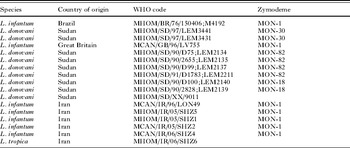
Leishmania spp. samples used in this study are detailed in Table 1. Eleven strains were derived from cultured parasites isolated from Brazil, Sudan and Europe (7 L. donovani strains, 4 L. infantum strains). Six additional cultures (5 L. infantum strains, 1 L. tropica viscerotropic strain) were isolated from the Far and East-Azarbaijan Provinces of Iran, which are the main endemic regions in Southern and Northwesten Iran, respectively (Table 1). A further 56 DNA samples were isolated from bone marrow, spleen and liver tissue smears on microscope slides from humans and dogs also from endemic regions of Iran.
Strain, and country of origin data for the Leshmania spp. cultures used in this study

DNA extraction
Genomic DNA was extracted from cultured parasites or slide preparations following a high salt method (Aljanabi and Martinez, Reference Aljanabi and Martinez1997): a detailed protocol is available from http://www.genomics.liv.ac.uk/animal/Protocol1.html. For cultured samples, 400–500 μl of medium (~107 parasites) was pelleted and digested with 20 μl of proteinase K (20 mg/ml) in 200–300 μl of TNES buffer (10 mm of Tris-HCl, pH 7·5; 100 mm of EDTA, pH 8·0; 400 mm NaCl; 0·6% SDS). Cell debris and protein was precipitated with saturated salt solution (6·0 M NaCl). DNA was precipitated with 2·5 volumes of absolute ethanol and subsequently washed twice in cold 100% ethanol and once in 70% ethanol. Samples were air dried and resuspended in 50 μl of TE buffer (10·0 mm Tris-HCl, 1·0 mm EDTA, pH 7·4). To extract DNA from tissues mounted on microscope slides, sealed slides were first soaked in xylene (Gibco) for 1 week to remove the cover-slip. Samples were left to air dry for ~10 min and then lysed with 200 μl of TNES buffer. After 1–2 min the tissue smear was completely detached from the slide and transferred to a microcentrifuge tube. To extract DNA from non-sealed microscope slides, 200 μl of TNES buffer was applied to the slide and the TNES-sample mixture was aspirated after 1–2 min and transferred to a microcentrifuge tube. The subsequent extractions proceeded as detailed above. For all samples, DNA concentrations were measured using a Nanodrop™ spectrophotometer (Labtec co), and were adjusted to ~20 ng/μl for subsequent PCR.
Nested–PCR protocol
All PCR amplifications on clinical samples from microscope slides followed a 2-step nested PCR strategy using external and internal primer sets (listed in Table 3). For the first round of PCR, each reaction contained 75 mm Tris-HCl (pH 8·8), 20 mm (NH4)2SO4, 0·01% (v/v) Tween 20, 0·2 mm of each dNTP, 1·5 mm MgCl2, ~20 ng template DNA, 10 pmol of each primer and 0·25 U Taq polymerase (Thermo Life Sciences). PCRs were performed using a PTC-0221 Dyad thermocycler (MJ research) and the following conditions: 95°C for 3 min, 5 cycles (95°C 30 s, Ta °C 45 s, 72°C 45 s), 35 cycles (92°C 30 s, Ta °C 45 s, 72°C 55 s), 72°C 10 min (where Ta is the locus-specific annealing temperature). For the second round of PCR, 1 μl of the amplified product from round one was used as template. Pre-amplifaction of the DNA template with the Genomiphi™ whole genome amplication kit (GE Healthcare), following the manufacturer's protocol but with half volumes of reagents, was tested on a subset of samples.
Labelling of PCR products
To allow fragment detection on a genetic analyser, PCR products were fluorescently labelled using a tailed primer method (Oetting et al. Reference Oetting, Lee, Flanders, Wiesner, Sellers and King1995; Boutin-Ganache et al. Reference Boutin-Ganache, Raposo, Raymond, Christian and Deschepper2001). Briefly, 4 standard primers with unique sequences were separately labelled with 1 of 4 fluorescent dyes (forward labelled primers, Table 3: dye labels 6-FAM, NED, PET, VIC; Applied Biosystems). Forward internal primers for microsatellite loci were then designed with a 3′ tail (forward tailed primer) complementary to the forward labelled primer. Reaction conditions for the second round of PCRs were identical to the first, except that round two PCRs contained 3 primers (3·0 pmol reverse primer, 3·0 pmols labelled forward primer and 1·0 pmol forward tailed primer). PCR amplification was confirmed via electrophoresis of products on a 2% agarose gel containing ethidium bromide and visualization under UV illumination. To size PCR fragments, products were pooled into 1 of 2 genotyping panels along with a genescan-500 liz size standard (Applied Biosystems) and separated by capillary electrophoresis through POP7 denaturing polymer on an ABI3730xl automated sequencer (Applied Biosystems). Allele sizes were determined using the cubic model of analysis in GeneMapper software (Applied Biosystems).
Evaluation of nested PCR
To assess the sensitivity of the nested PCR approach, PCRs were conducted using DNA template prepared from serial dilutions of parasite cultures. Culture medium (Dulbecco's modified eagle's medium, DMEM) containing Chinese hamster ovary cells was seeded with known numbers of cultured promastigotes (L. infantum MHOM/BR/76/150406; M4192). Parasites were counted using a Neubauer haemocytometer slide. For each dilution, 80 μl of culture was dispersed on microscopic slides. The final concentrations of the parasites were 106, 105, 104, 103, 102, 101, 10 promastigotes per ml of culture medium corresponding to 8×10⁴, 8×10³, 8×10², 80, 8,0·08, 0·008 promastigotes per sample on slides. Seeded samples were left at room temperature before DNA extraction as described above.
The RV1 and RV2 primers directed at the conserved region of the kinetoplast minicircle were used to confirm the presence of amplifiable parasite DNA (Ravel et al. Reference Ravel, Cuny, Reynes and Veas1995). There are approximately 10 000 copies of the kinetoplast minicircle and consequently the RV1-RV2 PCR is expected to be much more sensitive than even nested PCR for single copy microsatellite loci because multiple minicircles can be present in the sample used for PCR even after many genomic loci have been diluted out.
RESULTS
Microsatellite primer design
To facilitate the use of the Leishmania genome sequences for microsatellite primer design two Web Pages were developed; one is the front end for a database of microsatellite containing sequences and the second is a front end for the Primer3 programme and designs a single pair of primers against each sequence in a file. Leishmania genome sequences were downloaded from ftp://ftp.sanger.ac.uk/pub/databases/. A Perl script was developed to extract all microsatellites in a genome and enter them in a searchable MySQL database. The script crawls along each chromosome looking for a perfect match to 6 repeats of all possible di, tri and tetra-nucleotide repeat motifs. When a match is located, the script identifies the number of perfect repeats and writes to a database the following information for each locus: the number of perfect repeat units, the repeat unit length, the full repeat sequence, and a 700 bp sequence starting 350 bp upstream of the microsatellite. To minimize the frequency of overlapping loci in the database, the script then moves 200 bp along the chromosome before resuming the search. This strategy means that microsatellite loci that are interrupted by imperfect repeats will be assigned a size that corresponds to the first run of perfect repeats. Many of the loci may therefore have effective lengths greater than that recorded in the database. A web front end was constructed for the microsatellite database and is available at http://www.genomics.liv.ac.uk/tryps/resources.html ‘Microsatellite Locus Extractor’.
All microsatellites on a chromosome or a region of a given chromosome that meet the following criteria set by the user can be extracted: chromosome, start position, end position, repeat unit length, minimum number of repeat units and maximum number of repeat units. The output file from the microsatellite database contains the flanking sequence and is formatted for entry into a second webpage at the same site ‘Primer Design Programme’. This page uses a local copy of the Primer3 engine (Rozen and Skaletsky, Reference Rozen and Skaletsky2000; obtained from http://primer3.sourceforge.net/releases.php) to design primers against each of the microsatellite containing sequences in the output from the microsatellite database. Most of the usual Primer3 parameters can be set by the user to adjust the length of product and annealing temperature of primers etc. Primers for this project were designed with an annealing temperature of 60°C and a 2 bp GC clamp. For nested primer design the maximum product length of the inner primer pair was set at 300 bp. To design external primers (flanking the internal primers) the output file was modified for resubmission to the primer design website using Excel to specify new target start positions and product lengths. Seventeen microsatellite loci designed against the L. infantum genome using this approach were evaluated against 2 species in the Leishmania donovani complex.
The programmes used to populate the database are availbale on request from the authors. A modified version of the programme that writes microsatellite loci to a file instead of a database, and that can be used on any sequence, is available for download from the website http://www.genomics.liv.ac.uk/tryps/resources.html. The output file can be loaded into the Primer Design webpage after removal of metadata from the top of the file.
Microsatellite loci
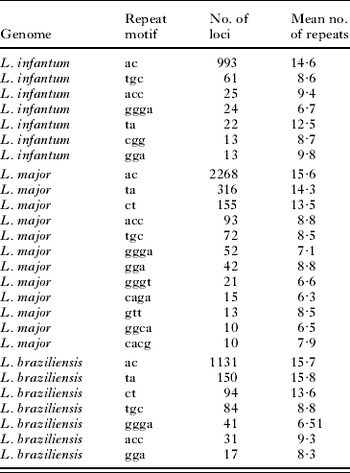
The abundance of different microsatellite repeats, identified by the Perl programme, in the Leishmania species for which sequence data are available is shown in Table 2. Microsatellite repeat classes that were represented by fewer than 10 loci are not shown. CA repeats were the most abundant repeat class in all genomes tested at ~78% of all loci detected. Over twice as many microsatellite loci were identified in the L. major genome as in the L. infantum or L. braziliensis genomes. However, this may be a consequence of the higher finished quality of this genome rather than a reflection of any fundamental difference in number of microsatellite loci.
Numbers of microsatellites identified in the Leishmania major, L. donovani, and L. braziliensis genomes

Primer testing
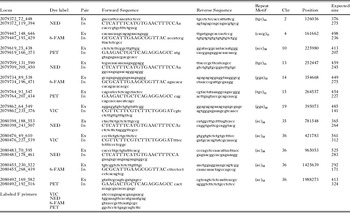
Primers were designed for 17 microsatellite loci for the L. donovani complex using the L. infantum sequence data (Table 3). Two principles guided the selection of loci for testing. Firstly, 4 and 5 markers respectively were selected for the 2 largest chromosomes (35 and 36) so that the data could be tested for the presence of recombination within those chromosomes. Secondly, 8 markers were selected from 8 different chromosomes so that any apparent linkage disequilibrium would be evidence for a clonal population structure. Primers were tested against a panel of control DNA: 7 L. donovani from Sudan and 4 L. infantum from Sudan, Brazil and the UK. Primers designed against 12 out of the 17 loci generated PCR products suitable for microsatellite genotyping by standard PCR using internal primers. To allow fragment detection on a genetic analyser (i.e. ABI3130xl), PCR products were fluorescently labelled using a tailed primer strategy. Briefly, in the initial PCR cycles, amplification is primed by a forward tailed primer (5′ end complementary to the target sequence) which generates extension products bearing a ‘tail’ complementary to the labelled primer, subsequent rounds of PCR are then primed by the forward labelled primer, which produces a pool of fluorescently labelled products. The ratio of labelled forward primer to forward tailed primer is critical to produce a majority of labelled PCR products for fragment detection: if the relative concentration of the unlabelled tailed primer is too high, the proportion of labelled products will be low and subsequent detection will be poor. Labelled to tailed primer ratios of 1:1, 3:1, and 10:1 were tested to optimize the labelling protocol. Here, a forward-labelled to forward-tailed primer ratio of ⩾3:1 was found to produce a sufficient pool of labelled PCR products for fragment detection on the ABI3130xl. At a ratio of 1:1, PCR products were detected by agarose gel electrophoresis, but did not produce a detectable signal on the ABI3130xl, indicating that an insufficient pool of fragments were labelled during PCR. The observed heterozygosity and number of alleles observed at each locus for the control DNA samples is shown in Table 4.
Twelve microsatellite loci successfully amplified in Leishmania donovani complex
(Internal (In) and external (Ex) primer pairs for nested PCR are indicated. Each internal forward primer also included a 3′ ‘tail’ (in upper case) complimentary to the forward labelled primer with the required fluorescent dye. The primer name is made up of 3 components, the locus id from the database and the start and end positions within the 700 bp sequence that are associated with the locus in the database. The microsatellite that was identified by the Perl script starts at position 350 within the 700 bp sequence.)

Number of alleles observed at each locus (Na), observed heterozygosity (Ho), allele size range, and PIC (polymorphism information content, calculated according to Botstein et al. Reference Botstein, White, Skolnick and Davis1980) at 12 polymorphic microsatellite loci for Leishmania donovani and L. infantum strains
(For L. donovani and L. infantum 7 and 4 strains were genotyped respectively.)

Five L. infantum samples from Iran were also tested and gave PCR products at 8 out of the 12 loci tested. The loss of alleles in the Iranian samples may be a consequence of DNA polymorphisms in the primer binding sites or may be because the parasite cultures were shipped from Iran to the UK at ambient temperature in culture medium and the DNA may have degraded. A single cultured strain of L. tropica was also analysed, but only amplified for 4 of the 12 microsatellite loci (data not shown).
Sensitivity of nested PCR
To estimate the sensitivity of the nested PCR a series of dilutions of parasites in hamster fibroblasts were spotted onto microscope slides from which DNA was subsequently prepared. DNA precipitated from microscope slides was resuspended in 50 μl of TE, diluted to a concentration of 20 ng/μl for PCR and 1μl of this solution was used for the nested PCR reaction. The PCR detected down to 800 parasites per slide. After dilution this corresponds to 1·6 parasite equivalents in the PCR reaction. The RV1 and RV2 primers for kinetoplast DNA generated a positive PCR product at all parasite dilutions, indicating the presence of at least 1 parasite on all slides.
Nested PCR on clinical samples on microscope slides from Iran
DNA prepared from 6 out of 56 microscope slides bearing Iranian L. infantum parasites generated PCR products by nested-PCR at 8 out of the 12 microsatellite loci tested. Pre-amplifcation of DNA with Genomiphi™ whole genome amplifcation protocol did not increase sensitivity and the results presented are from samples that did not receive a Genomiphi™ pre-treatment. However, RV1 and RV2 primers for the conserved region of the kinetoplast minicircle generated PCR products from all slides, confirming the presence of parasites on these slides.
DISCUSSION
For population studies it is recommended to use at least 12–15 polymorphic loci (Kuhls et al. Reference Kuhls, Keilonat, Ochsenreither, Schaar, Schweynoch, Presber and Schonian2007). In this study 12 out of 17 newly designed loci generated polymorphic products, which is a higher yield of functioning polymorphic loci than is commonly obtained by de novo isolation of microsatellite loci by cloning and sequencing genomic DNA. However, while we have developed a new panel of microsatellites, the markers per se are not the major output of this study. Indeed, numerous microsatellite panels exist for Leishmania species and are in extensive use for population analyses (see Introduction section). The objective of this paper is the validation of a rapid and cost-effective strategy for the development and application of mapped microsatellite markers from existing genomic sequence. We anticipate that the main application of this ‘pipeline’ will be the development of mapped markers for specific applications such as association studies and the search for recombination within chromosomes.
In addition to the development of the microsatellite extractor programme we have also assessed the use of clinical samples and nested-PCR to avoid the need for culturing in the genotyping of Leishmania parasites. We are not aware of any previous reports of the use of MLMT directly on clinical samples from leishmaniasis cases without prior cultivation of the parasite. However, it has been successfully applied using DNA isolated from FTA cards spotted with blood from Human African Trypanosomiasis cases (Morrison et al. Reference Morrison, McCormack, Sweeney, Likeufack, Truc, Turner, Tait and MacLeod2007). We have confirmed that microsatellite genotyping can be performed directly from biological material recovered from microscope slides, sufficient DNA could even be recovered from archival Giemsa-stained slides that had been protected by a cover-slip and sealed by a mountant. However, the number of slides from which amplifiable DNA could be recovered was too low to make this a routine sample collection strategy for microsatellite-based studies although it may be appropriate where no other sample is available. A more appropriate sample collection and storage medium such as FTA cards may give an increased success rate. Trypanosoma brucei gambiense-infected human blood samples on FTA cards have been used as a source of DNA for microsatellite PCR using a similar protocol and 11/11 samples carrying 250–1100 parasites per ml of blood were positive (Morrison et al. Reference Morrison, McCormack, Sweeney, Likeufack, Truc, Turner, Tait and MacLeod2007).
Further to the low success rate achieved here for genotyping directly from clinical samples on microscope slides, 2 additional technical issues should be noted. Firstly, when only very small amounts of parasite DNA are present in the PCR there is a substantial risk of amplifying only 1 of the 2 alleles present giving rise to a false excess of apparent homozygotes and therefore it is necessary to use the products of at least 3 independent genome amplification reactions as template for the PCR (Morrison et al. Reference Morrison, McCormack, Sweeney, Likeufack, Truc, Turner, Tait and MacLeod2007). This was not attempted here since no downstream analysis was undertaken but would be necessary before any population genetic analysis was attempted. Secondly, it is common practice to dilute the product of the first round PCR before the second round to reduce the potential occurrence of PCR artefacts, which may occur if external primers (from the first PCR round) continue to prime fragment synthesis in the second round. Such artefacts may be erroneously scored as higher molecular weight alleles after electrophoresis. Dilution was not used in this study in an attempt to maximize sensitivity. At most loci the observed allele size range was small, which suggests that all products were from the internal primers. However, at 2079709_205_450 the size range was 48 bp which could include PCR artefacts. The large size range for this locus was attributable to a single isolate MHOM/SD/XX/9011 that had an exceptionally small size (222 bp) whereas the remaining 4 alleles were between 256 and 269 bp. It is possible that this anomalously small allele is an artefact, but the small size suggests that it is not a consequence of carry-over of first round primers.
The main causative agent of VL in Iran is L. infantum, (Mohebali et al. Reference Mohebali, Edrissian, Nadim, Hajjaran, Akhoundi, Hooshmand, Zarei, Arshi, Mirsamadi, Manouchehri Naeini, Mamishi, Sanati, Moshfe, Charehdar and Fakhar2007) but recently, L. tropica (Viscerotropic strain) has been reported as another aetiological agent for immunocompetent patients infected with VL in Southern Iran (Geramizadeh et al. Reference Geramizadeh, Fakhar and Motazedian2006; Alborzi et al. Reference Alborzi, Rasouli and Shamsizadeh2006). In the present study a viscerotropic strain of L. tropica isolated from southern Iran, was included. Four loci gave a PCR product for this strain. In a previous study we showed that markers designed against the L. major genome would amplify homologous loci in the L. donovani genome but that the loci were not polymorphic in L. donovani (Jamjoom et al. Reference Jamjoom, Ashford, Bates, Kemp and Noyes2002a). It remains to be seen whether loci that are polymorphic in L. infantum are also polymorphic in L. tropica. However, since some L. infantum loci were amplified in L. tropica it may at least be possible to identify this species of parasite when it is circulating in the same focus even if it may not be possible to classify it using these primers.
Despite the absence of polymorphisms in L. donovani when using L. major microsatellites, it has been reported that loci informative in L. braziliensis are also informative in other members of the L. braziliensis complex (Russell et al. Reference Russell, Iribar, Lambson, Brewster, Blackwell, Dye and Ajioka1999). Consequently, the loci that were identified in the L. braziliensis genome in this study may also be amplifiable and polymorphic in L. guyanensis, L. peruviana and L. panamensis. The programme is currently being used to generate a whole genome mapping panel of tri- and tetra-nucleotide microsatellites in the bovine genome. Additional parasite genomes can be added to the microsatellite database on request to the authors. A stand-alone version of the Perl programme that extracts the microsatellite loci is available for download from the website http://www.genomics.liv.ac.uk/tryps/resources.html. This programme outputs loci to a file rather than a database, the file is formatted for upload to the primer design programme after removal of metadata.
In summary, we have presented a programme that offers a rapid strategy for the extraction of microsatellite loci from existing genome sequences and the design of PCR primers for genotyping. Here we illustrate the use of the strategy for the genotyping of 2 Leishmania species in the first report of the use of the pipeline.
The authors are grateful to Dr Hatam, Dr Kumar, Dr Sarkari, Dr Mohebali and Dr Fallah for preparing some samples, to Mrs Habibi, Mr Kalantari, Miss Mikaeli for helping collection of the samples, and to Dr Jamie Wilson for assistance with parasite culture in Liverpool. Control L. infantum and L. donovani DNA was a kind gift from Dr M. Jamjoom. We would also like to thank the Office of the Vice Chancellor for Research of Shiraz University of Medical Sciences, Shiraz, Iran, for financial support of this study. H.N. is supported by Wellcome Trust, grant number GR066764MA.