Introduction
The small mines and prospects of the Pampa Larga mining district in the Atacama Region of Chile have yielded a surprising variety of rare minerals, most of which contain essential arsenic. The four new minerals previously described from these deposits, alacránite, As8S9 (Popova et al., 1986), rruffite, Ca2Cu(AsO4)2⋅2H2O (Yang et al., Reference Yang, Jenkins, Downs, Evans and Tait2011), joteite, Ca2CuAl[AsO4][AsO3(OH)]2(OH)2⋅5H2O (Kampf et al., Reference Kampf, Mills, Housley, Rossman, Nash, Dini and Jenkins2013) and tapiaite, Ca5Al2(AsO4)4(OH)4⋅12H2O (Kampf et al., Reference Kampf, Mills, Nash, Dini and Molina Donoso2015), all contain essential arsenic and three are arsenates. Joteite and tapiaite, both first described from the Jote mine, also contain both Ca and Al. There are numerous Ca-arsenate and Al-arsenate minerals; however, arsenates containing essential Ca and Al are very uncommon and include only eight mineral species. Described herein is the ninth Ca–Al arsenate, alumolukrahnite, also from the Jote mine.
The name alumolukrahnite reflects the fact that the mineral is the aluminium (alumo) analogue of lukrahnite, CaCuFe3+(AsO4)2(OH)⋅H2O (Krause et al., Reference Krause, Blass, Bernhardt and Effenberger2001). The new mineral and the name (symbol Alkr) have been approved by the Commission on New Minerals, Nomenclature and Classification of the International Mineralogical Association. (IMA2022-059, Kampf et al., Reference Kampf, Mills, Nash, Dini and Molina Donoso2023). The description is based upon three cotype specimens deposited in the collections of the Natural History Museum of Los Angeles County, Los Angeles, California, USA, catalogue numbers 76256, 76257 and 76258.
Occurrence
The mineral occurs at the Jote mine, Pampa Larga district, Tierra Amarilla, Copiapó Province, Atacama Region, Chile. Mineralisation occurs in a narrow (20 to 40 cm wide) hydrothermal vein hosted by volcanoclastic rocks. The occurrence is similar to that of the mineral rruffite (Yang et al., Reference Yang, Jenkins, Downs, Evans and Tait2011) at the Maria Catalina mine in the same district. A detailed description of the geology and mineralogy of the area was provided by Parker et al. (Reference Parker, Salas and Perez1963). The specimens of alumolukrahnite were collected by one of the authors (AAMD) in 2011.
The deeper unoxidised portion of the vein contains primary and supergene minerals including acanthite, native arsenic, Ag sulfosalts, baryte, calcite, chalcopyrite, domeykite, feldspar, pyrite, quartz, native silver and stibnite. Alumolukrahnite occurs as a late-stage, low-temperature, secondary mineral in narrow seams and vughs in the oxidised upper portion of the vein. The matrix is an intergrowth of quartz and microcline–albite ‘microperthite’. The microperthite varies from fresh to heavily altered. The more heavily altered areas are impregnated with massive mansfieldite and/or scorodite. Other secondary minerals in direct association with alumolukrahnite are conichalcite, coronadite, gypsum, olivenite, pharmacosiderite, rruffite and scorodite. Other minerals found in the oxidation zone include arseniosiderite, ceruleite, chlorargyrite, gartrellite, goudeyite, joteite, karibibite, koritnigite, krautite, lavendulan, metazeunerite, opal, tapiaite and zincolivenite
Physical and optical properties
Alumolukrahnite occurs as crude diamond-shaped tablets, to ~0.1 mm in maximum dimension, intergrown in crude spherical aggregates to ~0.5 mm in diameter (Figs 1 and 2). No twinning was observed. By analogy with gartrellite, tablets may be flattened on {111}; however, helmutwinklerite, another triclinic tsumcorite-group mineral, is tabular on {001} (Krause et al., Reference Krause, Belendorff, Bernhardt, McCammon, Effenberger and Mikenda1998). The Bravais–Friedel–Donnay–Harker principle (Donnay and Harker, Reference Donnay and Harker1937) predicts tablets flattened on {001} with the bounding forms {100} and {010}.
Alumolukrahnite balls with gypsum (colourless) and coronadite (black) on scorodite (FOV 3.35 mm); specimen #76256.

Intergrowths of alumolukrahnite tablets (scanning electron microscopy image, specimen #76256).

Crystals are transparent to translucent, with vitreous lustre and a white streak. The mineral does not fluoresce in long- or short-wave ultraviolet light. The Mohs hardness is 3½ based on scratch tests. The tenacity is brittle, fracture is irregular and no cleavage was observed. The density was not measured because Clerici solution of necessary purity was not available. The calculated density is 4.094 g⋅cm–3 for the empirical formula and 4.085 g⋅cm–3 for the ideal formula. The mineral is insoluble at room temperature in concentrated HCl or concentrated H2SO4.
Poor crystal quality made optical measurements very difficult. Even the smallest crystal fragments exhibited undulatory extinction. Alumolukrahnite is biaxial (+) with α = 1.73(1), β = 1.74(1) and γ = 1.76(1) (measured in white light). Poor crystal quality made conoscopic observation and extinction measurements impossible, so 2V could not be measured. The calculated 2V is 71°. Dispersion could not be observed and the optical orientation could not be determined. The mineral is non-pleochroic. The Gladstone–Dale compatibility 1 – (K p/K c) is 0.024 (excellent) for the empirical formula and 0.019 (superior) for the ideal formula (Mandarino, Reference Mandarino2007).
Raman spectroscopy
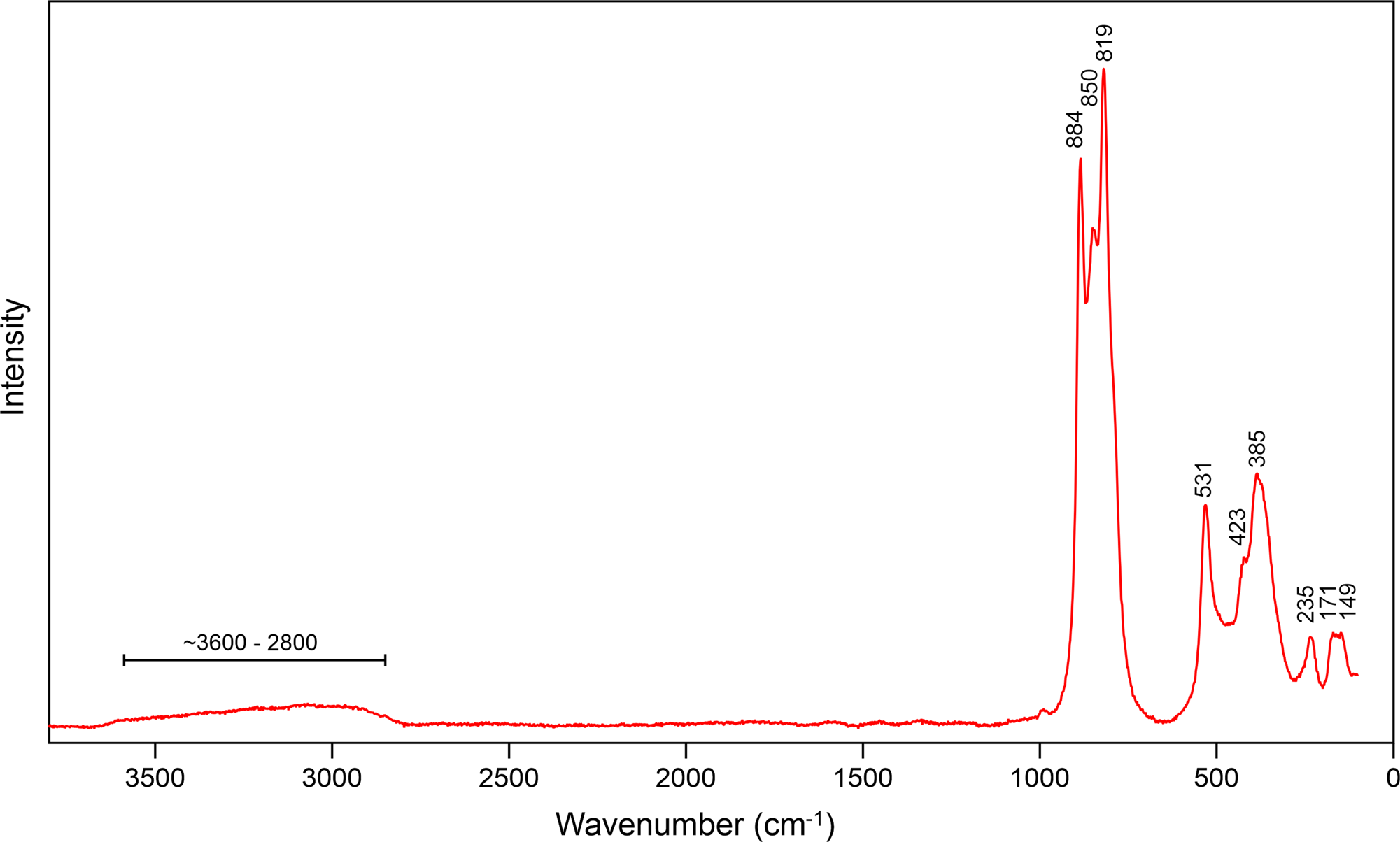
Raman spectroscopy was done on a Horiba XploRa PLUS micro-Raman spectrometer using an incident wavelength of 532 nm, laser slit of 200 μm, 1800 gr/mm diffraction grating and a 100× (0.9 NA) objective. The spectrum recorded from 3800 to 60 cm–1 is shown in Fig. 3.
Raman spectrum of alumolukrahnite recorded with a 532 nm laser.

The Raman spectrum exhibits general similarities to that reported by Frost et al. (Reference Frost, Xi and Palmer2012) for gartrellite from the Ojuela mine, Durango, Mexico. The most important bands are related to the AsO4 group. The bands at 884 and 850 can be assigned to ν1 symmetric stretching vibrations and that at 819 cm–1 to ν3 antisymmetric stretching. Those at 531 and 423 cm–1 relate to ν4 bending modes and that at 385 cm–1 relates to ν2 bending. The very broad weak band from ~3600 to 2800 cm–1 corresponds to OH stretching.
Composition
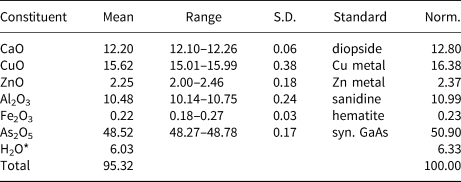
Analyses (3 points) were performed at the University of Utah on a Cameca SX–50 electron microprobe with four wavelength dispersive spectrometers and using Probe for EPMA software. Analytical conditions were 15 kV accelerating voltage, 20 nA beam current and a nominal beam diameter of 10 μm. Counting times for each element were 20 s on peak and 10 s each on low and high background. No other elements were detected by energy dispersive spectroscopy. Raw X-ray intensities were corrected for matrix effects with a phi-rho-z algorithm (Pouchou and Pichoir, Reference Pouchou, Pichoir, Heinrich and Newbury1991). Alumolukrahnite exhibits no damage in the electron beam; however, a somewhat rough surface is apparently responsible for the low totals. Because insufficient material was available for a direct determination of H2O, the amount of water in alumolukrahnite was calculated on the basis of Ca + Cu + Al + Fe + Zn + As = 5 and O = 10 atoms per formula unit, as indicated by the obvious relationship of the mineral to gartrellite, lukrahnite and other members of the tsumcorite group (see below). Analytical data are given in Table 1.
Analytical data for alumolukrahnite.

S.D. – standard deviation; * calculated based on the structure.
The empirical formula based on 10 O atoms per formula unit is Ca1.01(Cu0.92Zn0.13)Σ1.05(Al0.96Fe0.01)Σ0.97(As0.985O4)2(OH)0.88(H2O)1.12. The simplified structural formula is Ca(Cu2+,Zn)(Al,Fe3+)(AsO4)2(H2O,OH)2 and the idealised formula is CaCu2+Al(AsO4)2(OH)(H2O) which requires CaO 12.65, CuO 17.94, Al2O3, 11.50, As2O5 51.83, H2O 6.09, total 100 wt.%.
X-ray crystallography
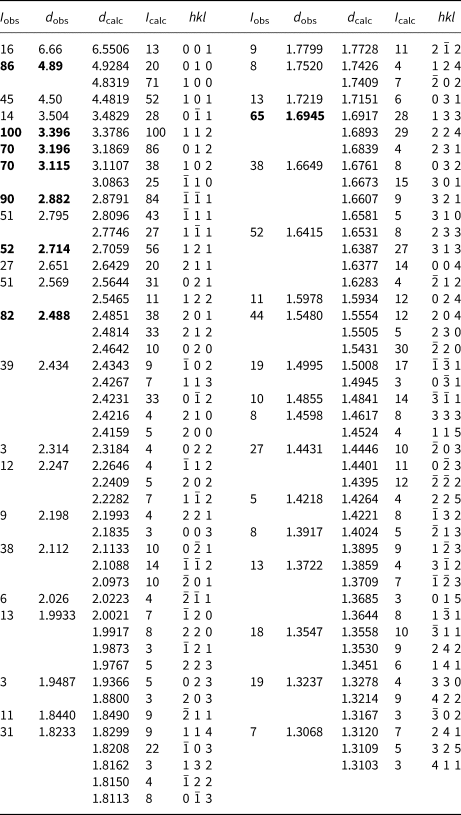
The small size, poor quality and intergrown nature of alumolukrahnite crystals made X-ray single-crystal diffraction study impossible. Powder X-ray diffraction (PXRD) data were recorded using a Rigaku R-Axis Rapid II curved imaging plate microdiffractometer with monochromatised MoKα radiation. A Gandolfi-like motion on the φ and ω axes was used to randomise the sample. Observed d values and intensities were derived by profile fitting using JADE Pro software (Materials Data, Inc.). The unit-cell parameters, refined using whole pattern fitting in JADE Pro based on the structure of gartrellite (Krause et al., Reference Krause, Belendorff, Bernhardt, McCammon, Effenberger and Mikenda1998) with Ca in place of Pb and Al in place of Fe, are space group P $\bar{1}$ , a = 5.343(5), b = 5.501(5), c = 7.329(5) Å, α = 67.72(2), β = 69.06(2), γ = 69.42(2)°, V = 180.3(3) Å3 and Z = 1. The resulting calculated PXRD pattern is an excellent fit for the observed alumolukrahnite PXRD pattern (Fig. 4), confirming that alumolukrahnite is isostructural with gartrellite and other triclinic members of the tsumcorite group. Note that the fit with the PXRD pattern of monoclinic members of the tsumcorite group is not as good. The observed and calculated data are compared in Table 2.
Powder X-ray diffraction pattern for alumolukrahnite compared with the lines and simulated pattern based on the structure of gartrellite with Ca in place of Pb and Al in place of Fe and with the cell parameters refined using whole pattern fitting.

Powder X-ray data (in Å) for alumolukrahnite.

Description of the structure
The structure of tsumcorite-group minerals (Krause et al., Reference Krause, Belendorff, Bernhardt, McCammon, Effenberger and Mikenda1998) consists of edge-sharing chains of M2-centred (M2 = Fe, Mn, Cu, Zn, Co, Ni and Al) octahedra that are linked by corner sharing with X-centred tetrahedra (X = As, P, V and S) to form sheets with an eight-coordinated M1 (M1 = Pb, Ca and Na) site nestled between adjacent sheets with M1–O bonds linking the sheets into a framework. The general formula is MlM22(XO4)2(OH,H2O)2. When there is no significant ordering of cations in the M2 site, the structure is generally monoclinic (although ordering of hydrogen bonds in species with two H2O per formula unit leads to triclinic symmetry). When the M2 site is split with different cations occupying each of the split sites, the structure is triclinic. In all cases of tsumcorite-group M2 site splitting, Cu2+ occupies one of the split sites, where it assumes 4+2 coordination due to the Jahn–Teller effect. It is also worth noting that, in general, for structures containing essential Cu2+ and Al (e.g. ceruleite; Mills et al., Reference Mills, Christy and Favreau2018), these cations are almost invariably ordered into separate sites because of the different coordination preferences for Cu2+ and Al3+. The composition of alumolukrahnite clearly suggests the likelihood of Cu2+ and Al ordering at M2 and the excellent fit of the PXRD pattern with that calculated based on the triclinic structure supports that conclusion (see above and Fig. 4). The structure of lukrahnite based on that of gartrellite is shown in Fig. 5.
The structure of alumolukrahnite based on that of gartrellite.

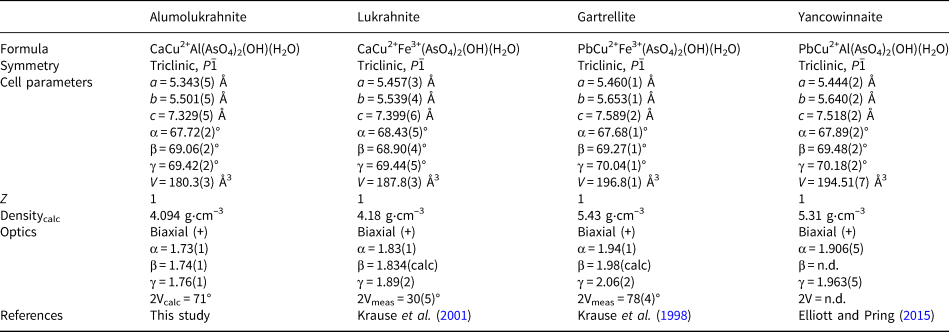
In addition to being the Al analogue of lukrahnite, CaCuFe3+(AsO4)2(OH)⋅H2O (Krause et al., Reference Krause, Blass, Bernhardt and Effenberger2001) and the Ca–Al analogue of gartrellite, PbCuFe3+(AsO4)2(OH)⋅H2O (Nickel et al., Reference Nickel, Robinson, Fitz Gerald and Birch1989; Krause et al., Reference Krause, Belendorff, Bernhardt, McCammon, Effenberger and Mikenda1998), alumolukrahnite is the Ca analogue of yancowinnaite, PbCuAl(AsO4)2(OH)⋅H2O (Elliott and Pring, Reference Elliott and Pring2015). Selected characteristics of these minerals are compared in Table 3.
Comparison of selected characteristics for alumolukrahnite and triclinic Cu-arsenate members of the tsumcorite group.

Acknowledgements
An anonymous reviewer, Igor V. Pekov and Structures Editor Peter Leverett are thanked for their constructive comments on the manuscript. A portion of this study was funded by the John Jago Trelawney Endowment to the Mineral Sciences Department of the Natural History Museum of Los Angeles County.
Competing interests
The authors declare none.