

1. INTRODUCTION
The trend towards constitutional adoption of environmental rights thus far is discussed mainly in normative and descriptive terms. Scholars have debated the merits of alternate linguistic phrasings of such rights,Footnote 1 disputed the extent to which environmental rights are anthropocentric or biocentric,Footnote 2 catalogued legal developments at the intersection of environmental human rights and constitutional law around the world,Footnote 3 and assessed whether constitutional environmental rights are even necessary.Footnote 4 While recent work has sought to explain the scope and evolution of environmental constitutionalism on a global scale from a historico-legal perspective,Footnote 5 as Kotzé notes, the very concept of ‘environmental constitutionalism’ remains insufficiently specified and research in this area has largely neglected systematic analyses.Footnote 6 Furthermore, few scholars have endeavoured to explain the reasons for the emergence of constitutional environmental rights in the context of specific cases using social scientific methods of analysis. In this article, I seek to rectify this gap in the literature and augment the current understanding of this global development through a comparative study of Nepal and Sri Lanka. I operationalize ‘environmental constitutionalism’ as the explicit instantiation of human rights to the environment within a state’s governing charter. I identify historical and structural factors that influence the likelihood that a given country might adopt constitutional guarantees related to environmental protection and human rights. I also assess the extent to which environmental constitutionalism is driven by factors endogenous (originating from within) or exogenous (emanating from outside) to the state. Lastly, I contribute to the small but growing literature on South Asian constitutions in a comparative perspective. Specifically, I present an uncommon social scientific analysis that delves into issues of development, governance, human rights and justice – four concepts that hold ‘conflicted’ implications for constitutionalism within the region.Footnote 7 I begin by reviewing extant research which has sought to shed light on this important trend in constitutional design.
Initial scholarly efforts focusing on constitutional environmental rights suggest that the global expansion of such rights has been the result of growing international concern for the environment which began in the 1960s.Footnote 8 More recent work by legal scholars has provided additional reasons for the worldwide emergence of environmental constitutionalism: concurrent trends involving the proliferation of constitutional democracies throughout the developing world and the internationalization of constitutional rights,Footnote 9 normative influence derived from the enactment of international laws on environmental rights such as the Convention on Access to Information, Public Participation in Decision-Making and Access to Justice in Environmental Matters (Aarhus Convention),Footnote 10 and an array of global factors, such as a massive wave of new and amended constitutions, a concomitant elaboration of rights contained within national Bills of Rights, and a steadily expanding body of national and international jurisprudence vindicating environmental rights.Footnote 11 Yet other observers describe the rise of constitutional environmental rights as a result of the confluence of three major international trends: (i) the move towards constitutional democracy (mainly among developing nations); (ii) a global ‘rights revolution’;Footnote 12 and (iii) the global environmental crisis.Footnote 13 However, despite these reasoned commentaries, few researchers writing on this issue have attempted to undertake a systematic analysis of the causal foundations for this global phenomenon.
Hancock attempts to address this inquiry by conducting a global survey.Footnote 14 He finds that the growing recognition of environmental rights in constitutions is related to the international normative environment and social movement activism. However, the author is careful to point out that the results of the survey are unlikely to be capable of generalization because of the low response rate (only three respondents replied). Gutmann, Imhof and Voigt present an international, quantitative examination of the expansion of constitutional environmental rights.Footnote 15 Using survival analysis on unbalanced panel data, the team of German law and economics scholars determines that the adoption of constitutional environmental rights is significantly associated with ‘the level of democracy, legal tradition, sustainability of tourism, and major changes to the constitution’, as well as spatial diffusion.Footnote 16
The noble efforts of the aforementioned scholars have laid the foundation for future studies on constitutional environmental rights. What has been absent from these works is a granular social-scientific analysis designed specifically to parse out those factors that may contribute to our understanding of why states adopt constitutional environmental rights. The remainder of this article describes and analyzes a qualitative study devised precisely to provide suggestive, rather than dispositive, evidence about the reasons why countries engage in environmental constitutionalism.
2. CASE SELECTION
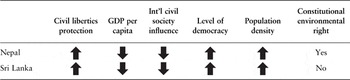
Using the results of a global, quantitative analysis,Footnote 17 I developed a case selection process based on a most similar systems design. The goal was to identify and analyze two countries that featured similar values on the statistically significant independent variables, but different outcomes on the dependent variable (that is, whether or not a constitutional environmental right was adopted). The process was as follows:
1. I computed the mean scores for each significant independent variable for every country-year in the data set.
2. I sorted every country-year according to whether the value for each independent variable fell above or below the mean value for that variable.Footnote 18
3. I located cases in which constitutional environmental rights were adopted and searched for potential comparison cases by finding countries that matched the binary value on each of the independent variables, but which have not ratified a constitution containing an environmental right.
4. I compared the values of the independent variables during the most recent year in which a ‘constitutional event’Footnote 19 occurred.
I identified two countries, Nepal and Sri Lanka, as states with similar values on the independent variables during years in which constitutional events occurred (that is, both above or below the mean for all countries),Footnote 20 but differences in their constitutionalization of environmental rights (see Table 1 below).Footnote 21
Most Similar Systems Design for Case Selection

3. METHODOLOGY
Both case studies were conducted in three phases: (i) interviewee prospecting and interview scheduling; (ii) interviewing; and (iii) transcribing and analyzing. Each phase is detailed below.
3.1. Interviewee Prospecting and Interview Scheduling
Potential interviewees were identified in four ways.
1. I contacted individuals suggested to me by academic colleagues who had conducted research in the region.
2. Those individuals provided me with the contact information for other potential respondents whom I then emailed.
3. I supplemented my list of possible interviewees by conducting research to identify people who played an influential role in the process of drafting constitutions or who possess knowledge of constitutional and/or environmental law in their respective country.
4. I established additional interview candidates through the assistance of my colleagues at the Southasia Institute of Advanced Studies (SIAS) in Nepal and the American Institute for Sri Lankan Studies (AISLS) in Sri Lanka.
These processes produced an initial list of 35 contacts in Nepal and 28 contacts in Sri Lanka. All potential interviewees were then sent a recruitment letter via email to solicit their participation in the study.
3.2. Interviewing
During the second phase of the study, I conducted interviews with eight individuals in NepalFootnote 22 and seven individuals in Sri Lanka.Footnote 23 All study participants agreed to have their interview recorded on a digital audio recorder. Each interview was logged manually on a separate form, which included a unique interview code to enable record keeping, and to afford anonymity when requested.
In Nepal, all interviews were conducted at different locations throughout Kathmandu, with the exception of two interviews, both of which were held at the main office of the same civil society organization. In Sri Lanka, all interviews were completed at different locations throughout Colombo, except for one interview conducted via Skype.
3.3. Transcribing and Analyzing
The interviews were transcribed in the order in which they were conducted.Footnote 24 Following transcription, emails were sent to all respondents to afford them the opportunity to review the transcript from their interview.
I then proceeded to analyze the qualitative data according to steps outlined by Hsieh and Shannon,Footnote 25 and Elo and Kyngäs.Footnote 26 Because the study aimed to identify factors that influence the likelihood of adopting constitutional environmental rights that were not already captured by the theoretically driven global quantitative analysis, I elected to perform inductive (also referred to as ‘conventional’) content analysis on the interview data.Footnote 27 This decision led to the use of open coding during the analysis of the transcripts.Footnote 28 Subsequent iterations of coding and categorizing produced ten broad code groups for the Nepalese dataFootnote 29 and two broad code groups for the Sri Lankan data.Footnote 30 Finally, definitions were composed for every code, and exemplars for each were drawn from interview data. These resources became the official code books for the study.
4. CASE STUDY: NEPAL
In order to understand how the Nepalese people came to adopt constitutional environmental rights, some background information and historical context is essential. Situated in South Asia between emerging world powers China to the north and India to the south and west, Nepal is a relatively small country with a population of just over 30 million. Yet, the country features significant ethnic diversity: ‘Nepal is home to 101 caste/ethnic groups, 91 linguistic groups and 9 religious groups’.Footnote 31 It is one of the poorest countries in the world, as evidenced by its gross domestic product (GDP) per capita (as at 2011) of only $620. In terms of its Human Development Index (HDI) rating, Nepal ranks 157th out of 187 countries. The transportation infrastructure is in poor condition; the country’s ability to attract foreign direct investment (FDI) is below average among low-income developing countries, and it is ‘highly susceptible to climate change risks’.Footnote 32 Despite its small size and low-income status, Nepal commands a wealth of biological resources (such as forests, plains and the Himalayas) that, if managed in a sustainable manner, could present substantial opportunities for economic development.Footnote 33
For most of its history, Nepal has existed under monarchical rule. After a brief flirtation with a multiparty system achieved through the adoption of a democratic constitution in 1959, Nepal reverted to monarchical rule in 1960 when King Mahendra seized power and installed a partyless system of governance known as the Panchayat regime. This system would remain in place until the first People’s Movement (Jana Andolan I) occurred in 1990 and a new constitution, which ‘represented a dramatic advance in the evolution of a democratic, constitutional order in Nepal’, was adopted.Footnote 34 However, some observers criticized the document for failing to incorporate the views of traditionally marginalized groups.Footnote 35
Although this popular movement restored multiparty democracy (at least temporarily), other issues loomed. In 1996, as a result of lingering discontent over the state of social and economic inequality in Nepal,Footnote 36 Maoist insurgents (members of the Communist Party of Nepal-Maoist) waged an ‘armed struggle against the state’,Footnote 37 or ‘People’s War’, that led to over 13,000 deaths.Footnote 38 This conflict exacerbated tensions in the country and increased the propensity of the state to resort to aggressive tactics to quell unrest.Footnote 39 Royal coups in 2002 and 2005 led by King Gyanendra returned the country to the rule of the crown. Yet, the insurgency would soon come to an end and the monarchy found itself in a precarious situation when Maoists joined forces with political parties to oppose the king. This political union coincided with the 2006 People’s Movement (Jana Andolan II) in which the citizens of Nepal ‘[took] to the streets’ to ‘[rally] for republicanism’ and overthrow the monarchy once and for all.Footnote 40 It was in the wake of these events that Nepal sought to write a new, more inclusive and more democratic constitution.
The results of the qualitative content analysis revealed that the process by which an environmental right came to be included in Nepal’s 2007 Interim ConstitutionFootnote 41 was influenced by more than mere constitutional borrowingFootnote 42 or policy convergence.Footnote 43 The adoption of Nepal’s constitutional environmental right may best be understood as the product of contextual factors and political dynamics present before and during the constitution-drafting process. I develop these concepts below and explain how they contributed to the phenomenon at the heart of this study.
4.1. Analysis
Through an analysis of interviews conducted in Kathmandu (Nepal) in September 2012, three types of contextual factor – historical events, ongoing issues, and international influences – were identified as having influenced the constitution-drafting process in non-trivial ways. Firstly, interviewees suggested that four historical events shaped the political environment in which the constitution was ultimately written. They were the 1990 People’s Movement; the Maoist Conflict; the 2006 People’s Movement; and the Nepalese Supreme Court’s ruling in the Godavari Marble case.Footnote 44
At the conclusion of the 1990 People’s Movement and with the passage of the 1990 Constitution, the Nepalese people were granted the opportunity to establish civil society organizations, which resulted in the founding of groups that focused on environmental issues. As civil society began to flourish, groups engaged in research and advocacy activities that drew attention to these concerns. For the first time, Nepalese people engaged in public debates about pressing environmental problems. Thus, the environmental movement in Nepal began in earnest. However, the main focus of the Movement was to end monarchical rule rather than to address environmental problems.
Yet, the end of the 1990 People’s Movement quickly transitioned into a period of Maoist Conflict, which lasted for 16 years. The Conflict perturbed the popular psyche and heightened the desire to install a form of government to which people could exercise their ability to voice concerns about the way in which the country was being governed. It raised people’s expectations regarding how responsive government should be to their concerns. As a consequence, the populace sought to replace the 1990 Constitution, play a more decisive role in the drafting of a successor document, and expand the number of rights formally recognized by the state.
The Maoist Conflict ended with another popular uprising, the 2006 People’s Movement. This event signalled the end of monarchical rule in Nepal, and prompted the transition from a highly centralized form of government to a more decentralized system. Although the Movement mainly focused on changing the system of governance, it was also driven by an array of cultural, environmental and social factors, which the public sought to address in a new constitution. At this point, civil society organizations, which had been in existence for over a decade, exerted their influence on the political process by actively participating in the Movement. Environmental groups lobbied elected officials to include environmental rights in the new constitution. Unlike the 1990 People’s Movement, which was mainly focused on and influenced by domestic concerns,Footnote 45 the 2006 People’s Movement was informed by non-governmental organizations (NGOs), which were tapped into the global discourse on human rights. The evidence suggests that the emergence of civil society organizations after 1990 led to the Nepalese people being exposed to ideas and concepts that broadened their scope of aspirations and demands to be placed on the new government.
Between the two People’s Movements, the Supreme Court of Nepal decided the landmark Godavari Marble case.Footnote 46 The decision, delivered by Justice Laxman Prasad Aryal, held that the right to life guaranteed under Article 12(1) of the 1990 Constitution of the Kingdom of Nepal included the right to a healthy environment. This judgment marks the first occasion on which the right to a healthy environment was recognized under Nepalese law. However, it is the path that led to this creative judicial interpretation that is most relevant for the present analysis. Prakash Mani Sharma, one of the lawyers representing the petitioners in Godavari Marble, studied for his Masters of Law at Delhi, where he learned of the renowned Indian environmental lawyer, M.C. Mehta.Footnote 47 Writing on behalf of the Supreme Court, Justice Aryal appeared to be persuaded by Mr Sharma’s argument based on M.C. Mehta:
Mr Prakash Mani Sharma and Mr Upendra Dev Acharya, the learned Advocates, appearing on behalf of the petitioner, have put forward ... Article 11(1) of the Constitution of Nepal, 2019 B.S. which provides that no person shall be deprived of his life and personal liberty save in accordance with law. The works carried out by the respondent Godawari Marble Industries have been disbalanced to the environment. The dust and sand produced during the explosions which is being undertaken in the mining process has polluted the atmosphere and water of the area and caused deforestation. Due to the continuing environmental degradation and pollution created by the said industry, Right to Life of the people has been violated. The absence of appropriate environment caused diminution of human life.Footnote 48
Godavari Marble went on to become a fundamental legal precedent in Nepal’s jurisprudence.Footnote 49
The second type of contextual factor present in the case of Nepal was a group of different – though occasionally related – ongoing issues, which included environmental conditions and governance issues. A history of unchecked environmental degradation and deforestation dating back to at least the 1970s resulted in massive flooding and water pollution, which raised public consciousness about environmental issues. This fuelled the public into demanding the government to address issues of environmental quality through the implementation of law and policy, specifically by including some form of environmental provision in the constitution.Footnote 50 In addition, the heightened awareness spurred increased organization among members of civil society, who formed groups to advocate for changes in environmental governance.
In terms of governance, members of Nepalese civil society recognized the inability of the state to address environmental problems, so they sought to press the government for reform. Significantly, what the people of Nepal desired most was greater autonomy over natural resources (specifically forests) at the local level. The drafting of the Interim ConstitutionFootnote 51 presented a specific opportunity to pursue this agenda. Whereas some believed that adopting a constitutional environmental right on this subject might force the government to enact supporting legislation, others felt that pursuing a constitutional approach to environmental protection might assist in the quest for good governance more generally.
Despite the presentation of scientific evidence demonstrating that local communities are more effective stewards of natural resources than either the government or private entities, the information fell on deaf ears in the Parliament. Only state or private property would be considered for inclusion in the new constitution; collective property and collective rights were off the table. The Nepalese people had wanted greater autonomy to manage natural resources at local community level but, because of considerable opposition from the government, such demands went unheeded. A much broader, and more ambiguous, right was ultimately entrenched in the Interim Constitution instead.
The third type of contextual factor was international influence. Firstly, members of civil society in Nepal were cognizant of provisions relating to environmental rights appearing in or interpreted by courts in the constitutions of other countries. In particular, the constitutions of Bolivia, Ecuador, India, and Namibia were cited as authoritative exemplars and were used to bolster the argument for including environmental rights in Nepal’s Interim Constitution during advocacy efforts and government consultations.Footnote 52
Secondly, knowledge of relevant foreign jurisprudence, specifically India’s series of cases brought by M.C. Mehta, influenced the types of argument made by legal counsel in Godavari Marble, which not only established a legal precedent for the constitutional protection of environmental rights, but also sensitized judges to the concept of environmental rights. Some of these judges would later take part in drafting the Interim Constitution. Interestingly, Justice Laxman Prasad Aryal, the Supreme Court justice who delivered the opinion in Godavari Marble, became the Chair of the Interim Constitution Drafting Committee (ICDC), which was charged with making the final decisions over the content of the Interim Constitution.Footnote 53
Finally, international law may have played a small but significant role in shaping the context in which the Interim Constitution was written. Interviewees spoke in general terms of the importance of international covenants to which Nepal was a party and, in particular, about the International Labour Organization (ILO) Convention No. 169 concerning Indigenous and Tribal Peoples in Independent Countries (ILO 169),Footnote 54 which dealt with the rights of such peoples. While Nepal did not officially ratify ILO 169 until after the adoption of the Interim Constitution, one respondent indicated that this legally binding international document ‘contributed to the inclusion of environment’ in the Interim Constitution.Footnote 55 Although the evidence falls short of proving causation, the interview data indicates that international influences such as foreign constitutions, foreign jurisprudence, and international law may have contributed to the overall political environment which facilitated public discourse on the topic of environmental rights, and informed the advocacy efforts of civil society actors who sought to influence the agenda of decision-making bodies charged with drafting the Interim Constitution.
During the process of drafting this Constitution, certain political dynamics helped to shape discussions among decision makers and stakeholders, and influenced the kind of content that ultimately became entrenched in the document. An analysis of the interviews resulted in the identification of three generic categories or types of political dynamic: (i) actions; (ii) controversies; and (iii) the political environment.
Firstly, the constitution-drafting process in Nepal was impacted upon by actions, which I define as ‘deliberate acts undertaken by people inside or outside government to have environmental issues formally addressed’. Three subcategories of actions were identified: advocacy, collaboration, and support. The type of action most commonly cited by interviewees was advocacy, which concerned the pro-environmental lobbying efforts of individuals and organizations in Nepalese civil society. Advocacy consisted of two types of activity: (i) civil society actors attempting to shape the content of the constitution by interfacing directly with members of subcommittees involved in drafting the constitution either through presentations or written commentary to the subcommittees;Footnote 56 and (ii) civil society actors attempting to shape the content of the constitution by interacting with others who presented to the constitution-drafting subcommittees.Footnote 57
Collaboration, or ‘acts in which different sectors of society banded together to advocate for changes in environmental policy’, also occurred. This form of action was manifested in the establishment of the Natural Resource People’s Parliament (NRPP) – a network of actors who cut across different sectors of Nepalese society, united by the desire to leverage various connections and capacities to influence the direction of environmental governance in Nepal. As one interviewee explained, this group served as both a sounding board and popular decision-making body which sought to represent the interests of the Nepalese people by providing constitution-drafting entities with intellectual input.Footnote 58 The NRPP worked in concert with domestic and international NGOs such as the World Conservation Union (IUCN-Nepal) and the Federation of Community Forestry Users, Nepal (FECOFUN) to influence the political parties (which selected the individuals who comprised the committees and subcommittees vested with decision-making authority), subcommittees, ICDC, and Parliament.Footnote 59
Another form of action noted during the interviews was support, or ‘acts involving members of government who actively lobbied for or did not oppose the inclusion of environmental rights in the Interim Constitution’. In particular, respondents singled out political parties as the main governmental actors who sought to include an environmental rights provision in the new constitution. Interestingly, two interviewees suggested that environmental rights were not subject to controversy among members of the relevant subcommittees that entertained the idea. According to these respondents, there was no debate over the decision to include environmental rights and no one objected to their adoption.Footnote 60 However, as detailed in the above section on natural resource management, there was an apparent gap between the environmental rights provision put forward by the subcommittees and the kind of language pertaining to environmental rights ultimately accepted by the ICDC. Ultimately, the Interim Constitution did not include an environmental right dealing with the right of local communities to manage natural resources. Although less is known about the internal discussions carried out within the ICDC, it stands to reason that this decision-making entity is responsible for amending the content of the environmental rights provision. Not surprisingly, this result was greeted with frustration by civil society members.Footnote 61
Secondly, the constitution-drafting process was motivated by major societal controversies. The concept of environmental rights may have appeared to be relatively unproblematic, at least within committees subordinate to the ICDC, but two other, related topics did generate considerable differences of opinion. Firstly, the continuing state of economic and social inequality intimately tied to access to land was a major driving factor behind the desire to adopt property rights in natural resources in the new constitution. With the memory of undemocratic state behaviour regarding land ownership still fresh in the minds of the public, people sought to develop restrictions that would ensure that the government would not revert to land expropriation in the future. However, the state seemed reluctant to accept the institutionalization of collective property rights, fearing that it would upset the existing legal order in which only private and state property rights were recognized.Footnote 62 Secondly, the country’s long history of monarchical rule and violent efforts to install a system of government responsive to the demands of the people necessitated a direct and public discussion of power-sharing arrangements. The discourse fell mainly along ideological lines, with the left-wing Maoists favouring a strong central government and the right-wing Nepali Congregation promoting individual rights. More generally, the debate over power sharing focused on the distribution of authority among government leaders (Parliament and President, President and Prime Minister) and among levels of governance (federal and local).Footnote 63 The interviewees asserted that natural resource property rights and power sharing, rather than environmental rights, figured most prominently as issues to be addressed during the constitution-drafting process.
Thirdly, attributes of the political environment at the time during which the Interim Constitution was drafted are likely to have played a role in determining the language that was finally adopted. Not only were the Nepalese people at the time aware of environmental degradation and climate-related issues in the country, but also political parties were aware that people wished to have the concept of environmental justice addressed in the new constitution.Footnote 64 In addition, historical events and recognition of the importance of this particular constitutional moment fostered a sense of opportunity. The two People’s Movements brought different kinds of opportunity: the 1990 People’s Movement created a space for civil society organizations in Nepal, while the 2006 People’s Movement introduced the country to a more comprehensive human rights discourse.Footnote 65 Finally, the range of actors involved in the constitution-drafting process, in addition to the roles in which they served, were arguably the most important aspects of the political environment. Unlike the 1990 Constitution, for which the king nominated those who would become the architects of the charter, the drafting of the Interim Constitution involved a more inclusive process whereby the people could express their opinions through elected representatives in Parliament and civil society organizations. This change was a function of both the reduced role of the monarchy as well as the political space created for civil society.Footnote 66 Turnover in the Constituent Assembly also reinvigorated the institution with a younger, more globally conscious generation of legislators.Footnote 67 It was of no small consequence that Judge Laxman Prasad Aryal – a justice whose amenability to the concept of environmental rights was clearly articulated in Godavari Marble – served as Chair of the ICDC, the most powerful committee in the constitution-drafting process.Footnote 68 When viewed in concert, these aspects of the political environment present a compelling suite of temporally bound conditions that may have contributed significantly to the adoption of a constitutional environmental right in the Interim Constitution.
4.2. Discussion
The results of the qualitative content analysis highlight several factors which contributed to the enactment of a constitutional environmental right in Nepal. Historically, the 1990 People’s Movement appears to have been indispensable in explaining the phenomenon observed. This Movement was responsible for creating the political space required for civil society to blossom. Civil society organizations went on to raise awareness about human rights and environmental issues and advocate on behalf of the Nepalese people. To be sure, the 2006 People’s Movement exposed Nepal to a broader human rights discourse and elevated the level of demands that Nepalese citizens placed on their government. However, these aspects of the latter movement could have been effectively checked by a reticent authority and thus rendered impotent. Therefore, at least in part, the adoption of a constitutional environmental right in Nepal was enabled by both historical contingency and a major alteration to the political opportunity structure.
At the same time, critical junctures and opportunity structures are influenced by the context in which they exist. In the case of Nepal, the main contextual factor that served as the impetus to enact substantial environmental policy reform at the constitutional level was environmental degradation, mainly as a result of deforestation.Footnote 69 Thus, poor environmental quality, the result of increasing industrialization, precipitated the need for enhanced legal protection. Without a damaged environment that negatively affected the lives of Nepalese citizens, it is unlikely that the desire for constitutional action on environmental issues would have developed.
5. CASE STUDY: SRI LANKA
An island located off the south-eastern coast of India, Sri Lanka has a population of more than 21 million. As a lower middle-income country, Sri Lanka boasted a GDP per capita (in 2011 PPP$) of $8,862. Its HDI score ranks 73rd out of 187 countries, and 91% of the adult population is literate.Footnote 70 While the country suffered through an internal conflict that lasted for 26 years and ended in May 2009, Sri Lanka has recently produced the highest levels of economic growth in South Asia. Some of this growth may be attributed to private sector development of forested areas, which have seen a reduction of almost 21% between 1990 and 2010. Despite being on track to meet many of its Millennium Development Goals (MDGs), especially in the areas of universal primary education and gender equality, Sri Lanka is either not making progress or falling behind in safeguarding forest cover and reducing carbon dioxide (CO2) emissions.Footnote 71
Sri Lanka’s history is punctuated by alternating periods of concurrent kingdoms and unification, colonial control and, until recently, civil conflict. In the space that follows I will focus on aspects of Sri Lankan constitutional history from the 1500s onwards. During the 16th century, Sri Lanka consisted of three kingdoms: ‘the Tamil kingdom of Jaffna in the north, the Kotte kingdom with its capital in Colombo, and the kingdom of Kandy in the central highlands’.Footnote 72 The geographic and political division among the kingdoms enabled successive colonizers to achieve dominion over the island, which bestowed upon Sri Lanka ‘the longest history of colonialism in South Asia’.Footnote 73 With the aid of strong naval forces, the Portuguese sought to conquer the three kingdoms but were successful only in subjugating Jaffna and Kotte. European continental disputes spilled over into Sri Lanka and, by 1658, the Dutch effectively expelled the Portuguese from the country. The Dutch initially concentrated their efforts on weakening the formidable Kandyan kingdom, but this approach was not supported by the leadership back in Holland, who preferred to maintain a focus on maximizing resource exploitation for commercial gain. Meanwhile, Dutch dominance was undermined by the British East India Company’s geopolitical interest in access to Kandy. Eventually, the British capitalized upon the diminished position of the Dutch in the wake of the French Revolution and seized control of Dutch possessions in Sri Lanka in 1795–96. Sri Lanka, or Ceylon as it was known at the time, formally became a British Crown Colony in January 1802.Footnote 74
The British established complete sovereignty over the country by 1818, ushering in an extended period of successive constitutional reforms. The Colebrooke-Cameron reforms of 1833 recommended consolidating provinces into a single administrative unit, establishing representative legislative bodies, and creating an independent judicial system, among other changes. Many of the reforms were implemented, and a new constitution that offered some adjustments to the system of representation was promulgated in 1910. However, the growing tension between the English-speaking elite class and the broader public instigated calls for a new wave of reforms. The Special Commission on the Constitution, led by Earl Donoughmore, suggested the introduction of universal suffrage, geographic representation, and executive committees focused on ministerial subjects. Although the Donoughmore Constitution was never fully implemented and lasted for only 16 years, it paved the way for a relatively peaceful transition to independence. Following the passage of the Ceylon Independence Act of 1947, Ceylon became an independent member of the British Commonwealth. In 1948, the terse Soulbury Constitution, with the intention of installing the Westminster model of governance, came into effect. With the inclusion of Article 29(2), which offered protection for the free exercise of religion, human rights became formally codified in the country’s constitutional law.Footnote 75
In 1972, Sri Lanka, as the former colony was now called, adopted a new constitution which asserted its status as an independent republic and articulated directives and human rights in the form of chapters entitled ‘Principles of State Policy’ and ‘Fundamental Rights and Freedoms’, respectively. Significantly, the latter chapter included a provision guaranteeing Sri Lankans the right to life under Article 18(1)(b). In 1977, the ruling regime responsible for crafting the 1972 constitution suffered major electoral defeats. The new government, led by the United National Party, endeavoured to amend the existing charter but ultimately decided to enact an entirely new constitution. Notably, the chapters on ‘Principles of State Policy’ and ‘Fundamental Rights and Freedoms’ underwent important revisions, including the addition of environmental directives in the former and the elimination of the right to life in the latter. It is this constitution, along with its 18 subsequent amendments, that currently provides the architecture for governance in Sri Lanka.Footnote 76
Attempting to decipher the reason why a particular event did not happen presents certain methodological difficulties. I was unable to interview anyone who participated directly in the drafting of the 1978 Constitution, and I interviewed only one person who played an important role in proposing new fundamental rights for the 2000 Draft Constitution. In many cases, interviewees provided subjective speculation regarding the topic of interest. Therefore, this section offers only tentative explanations for the absence of constitutional environmental rights in Sri Lanka, based on information drawn from interviews and augmented by scholarly literature. The results of my analysis, the product of interviews conducted in Colombo (Sri Lanka) in March 2013, reveal that the reasons why environmental rights were not incorporated into either the 1978 Constitution or the 2000 Draft Constitution differ significantly between the constitutional events, but may be construed as largely relating to domestic political dynamics. In the case of the former, the exclusion of environmental rights was not deliberate; instead, the drafters focused on legalizing civil and political rights. In the case of the latter, the omission was likely to have been the product of several factors which affected the demand for such rights and the ability of the government to address concerns about environmental quality in the country. I develop these explanations further below.
5.1. Analysis
Interview data suggest that environmental rights did not appear in the 1978 Constitution for at least two reasons. Firstly, the environment was not a central concern during the drafting of this constitution.Footnote 77 On the contrary, the United National Party, which enjoyed an overwhelming majority in Parliament following the 1977 elections and was led by Prime Minister Junius Richard (J.R.) Jayewardane, ‘was animated by two concerns – the need for political stability and the need for rapid modernization’.Footnote 78 Political stability involved addressing questions regarding the participation of the Tamils in democratic processes. The desire to achieve rapid modernization was inspired by the economic and industrial successes observed in Singapore and South Korea. Secondly, the Sri Lankan government emphasized the protection of civil and political rights in the constitution rather than social and economic rights.Footnote 79 Moreover, the government responsible for drafting the constitution was right wing and would not allow ‘the restriction of civil and political rights in the interests of principles of a social and economic nature’.Footnote 80 These conditions resulted in a new constitution which mainly featured first-generation human rights.
The literature suggests additional potential explanations for the particular content featured in the 1978 Constitution. Firstly, the chapter on ‘Fundamental Rights’, the section of a constitution in which one might find a provision on environmental rights, was drafted by lawmakers who were influenced by the Constitution of the Fifth Republic of France,Footnote 81 the American Bill of Rights, the chapter on ‘Fundamental Rights’ in the Indian Constitution, and the Universal Declaration of Human Rights.Footnote 82 As none of these documents contain environmental rights, it is not surprising that this particular intellectual derivative is similarly devoid of such provisions. Secondly, while the 1978 Constitution presented numerous changes from its predecessor,Footnote 83 it was not intended ‘to be ideologically innovative’; instead, it was crafted with the aim of addressing ‘immediate economic and social problems’.Footnote 84 The fact that environmental rights were not incorporated into the document may be, therefore, a logical outgrowth of constitutional pragmatism or perhaps a signal that environmental issues were considered to be neither immediate, nor economic/social, nor problematic at the time. Thirdly, the government, in the form of the Select Committee on the Revision of the Constitution, did in fact solicit the advice of the general public on which fundamental rights to include in the 1978 Constitution through a questionnaire which was published in major newspapers.Footnote 85
Following the ratification of the 1978 Constitution, an unsuccessful attempt was made to enact a new constitution in 2000. Like its forebear, the 2000 Draft Constitution did not include environmental rights. However, the absence of such rights in this contemporary document can be explained as the product of four conditions: (i) actions; (ii) controversies; (iii) the political environment; and (iv) process – which informed the political dynamics in Sri Lanka on this subject for at least two decades.
First, actions taken or not taken by civil society or government affected the prospect of adopting environmental rights in the 2000 Draft Constitution. While it was suggested during one interview that ‘there hasn’t been a strong environmental lobby’Footnote 86 to advocate the inclusion of a right to the environment in this draft, civil society groups did in fact urge the Parliamentary Select Committee on the Constitution to consider adding a right to a clean environment. However, these groups were unsuccessful in convincing lawmakers of the importance of this provision, as ‘none of the drafts put forward by the government made any reference to environmental rights’.Footnote 87 With regard to the government, the general attitude of the leadership has been to relegate environmental rights to the realm of ‘luxuries that can be postponed’ until Sri Lankans ‘solve other pressing problems of the present’.Footnote 88 However, this does not mean that government actors have not endeavoured to promulgate constitutional environmental rights. Indeed, formal legal recognition of such rights has been attempted at least three times since 1978:Footnote 89 in the 1995 draft of the National Environmental Act,Footnote 90 in the 1997 Government’s Proposals for Constitutional Reform, and in the 2008 Draft Constitutional Bill of Rights. Yet, none of these documents ultimately became law and thus constitutional environmental rights in Sri Lanka remain absent from the legal infrastructure. A discussion of the 1997 Government’s Proposals for Constitutional Reform and the 2008 Draft Constitutional Bill of Rights follows below.
Following the distribution of the March 1997 draft of the government’s proposed constitution, the Law & Society Trust, a Sri Lankan legal research and advocacy organization, formed a group of experts and activists to review the document and make recommendations to the Parliamentary Select Committee on the Constitution.Footnote 91 The Working Group published their recommendations in a lobby document that appeared in Fortnightly Review shortly thereafter.Footnote 92 Some of the Group’s suggestions were incorporated in the October 1997 draft of the proposed constitution, but the request to include the right to a clean and healthy environment went unheeded. However, certain provisions relating to environmental rights did make it into the October edition. In Chapter III (‘Fundamental Rights and Freedoms’), Article 8(1) guarantees the right to life and Article 21(1) provides a right to ownership of property which was ‘subject to the preservation and protection of the environment and the rights of the community’.Footnote 93 In Chapter VI (‘Principles of State Policy and Fundamental Duties’), under the section on ‘Principles of State Policy’, Article 53(6) stipulates that ‘[t]he State shall protect and preserve and improve the environment and safeguard the reefs, shores, forests, lakes, watercourses and wildlife of Sri Lanka’.Footnote 94 Finally, the ‘Fundamental Duties’ section of the same chapter mandates under Article 54(6) that ‘[i]t shall be the duty of every citizen to […] protect and improve the environment and conserve its riches’.Footnote 95 All of these proposed provisions were included in the 2000 Constitution Bill, using the same phrasing as that which appears in the October 1997 draft with the exception of the fundamental duty relating to the environment, which added the phrase ‘and value all forms of life’.
The Draft Bill of Rights includes a ‘Right to an Adequate Environment’ under section 14T: ‘All persons have the right to an environment that is – (a) not harmful to their health or wellbeing; and (b) protected for the benefit of present and future generations’.Footnote 96 While the Draft Constitutional Bill of Rights did receive mention in the 2011 National Action Plan for the Protection and Promotion of Human Rights (although environmental rights were not specifically addressed), the document can only be considered to have afforded the Bill of Rights tacit, tentative endorsement rather than granting full legal effect:
The commitment of the Government of Sri Lanka towards the full realization and guaranteeing of human rights was further manifested when in 2008, a Committee was appointed to give effect to proposals in Mahinda Chinthana [President Mahinda Rajapakse’s national development policy framework], for the inclusion of a comprehensive Bill of the Rights into the Constitution. A Draft Bill of Rights was thereafter formulated which is being deliberated by stakeholders, with a view to its incorporation’.Footnote 97
Secondly, controversies, or central political debates which occurred before and during the constitutional reform process, focused drafting efforts and political negotiations on addressing topics other than constitutional environmental rights. According to interviewees, the issue of devolution of power was the central focal point of the deliberations.Footnote 98 Here, the concern revolved around ethnic power sharing and striking an appropriate balance of power between the varying levels of governance in Sri Lanka. As with the drafting processes in 1972 and 1978, environmental concerns did not feature prominently in the preparation of the 2000 Draft Constitution.
Thirdly, and perhaps most importantly, the political environment – that is, contextual and institutional factors present during the constitution drafting or reform process which may have informed decisions on whether and how to address environmental issues in the constitution – appears to have had a discernible impact on the prospect of adopting environmental rights in the Sri Lankan constitution. Three such factors were determined to have influenced the level of interest in pursuing constitutional environmental rights: (i) consciousness; (ii) judicial receptiveness; and (iii) the legal framework. In the years immediately following ratification of the 1978 Constitution, rights consciousness in general was said to be noticeably under-developed in the country. One observer argues that this lacuna was the result of a ‘lack of legal discourse or doctrine in Anglo-American constitutionalism which adequately deal with the dilemmas of development’, which stifled the creation of innovative legal doctrine and established a culture of judicial deference to the executive branch.Footnote 99 These institutional conditions were compounded by the absence of groups that advocated taking a rights-based approach to redressing grievances. Although it is no direct measure of increasing consciousness, it bears noting that from the time of Sri Lanka’s independence in 1948 until the middle of 1972 only seven environmental NGOs operated in the country. Following the United Nations (UN) Conference on the Human Environment in 1972 until the middle of 1992, 176 environmental NGOs were founded. From July 1992 through to June 2002, advocacy efforts in this area expanded dramatically, with 468 environmental NGOs coming into being.Footnote 100 This evidence suggests that a sizeable environmental civil society has emerged in the country. In this context, one interviewee argued that the people of Sri Lanka possess an awareness of environmental issues.Footnote 101 However, this development apparently has not (yet) translated into a popular campaign to see this ambition formally recognized in the constitution.
Judicial receptiveness – or the degree to which the court system has positively embraced environmental litigation brought under existing legal instruments – offers another potential explanation for the absence of constitutional environmental rights in Sri Lanka. One respondent described how ‘courts have been sympathetic’ to public interest litigation on the environment,Footnote 102 which has enabled environmental groups to bring cases using the extant legal regime instead of focusing efforts on adding a new right to the constitution.Footnote 103 Other interviewees echoed that the courts have interpreted existing statutes and constitutional provisions in ways that have resulted in favourable judgments for claimants who seek to have environmental grievances redressed.Footnote 104 Four examples from Sri Lankan case law help to support these assertions.
In The Environmental Foundation Ltd v. Attorney-General,Footnote 105 the Supreme Court allowed the petitioner, an environmental NGO, to bring a case against the government on the basis that fundamental rights had been violated.Footnote 106 The Supreme Court did not rule on the issue of locus standi directly, but it signalled its willingness to entertain claims made by organizations representing the public interest on environmental concerns. In Ashik v. Bandula and Others (Noise Pollution Case),Footnote 107 the Supreme Court held that noise pollution emanating from loudspeakers at a mosque constituted a violation of the fundamental right to equal protection caused by the failure of the executive to properly safeguard the public from the harmful effects of noise pollution, as mandated under the National Environmental Act.Footnote 108 This decision demonstrated that the Court was open to resolving environmental claims under the banner of fundamental rights when couched in terms of public nuisance doctrine. In the Eppawala Phosphate Mining Footnote 109 case, Justice Amerasinghe, giving judgment on behalf of the Supreme Court, determined that an agreement with a United States (US) company to exploit a phosphate mine in Eppawala ‘should be considered in light of the principles embodied in the Stockholm Declaration of the UN Conference on the Human Environment of 1972Footnote 110 and the Rio Declaration on Environment and Development of 1992’.Footnote 111 With its extensive reliance on international soft law, ‘the Court clearly endorsed principles of international environmental law, including sustainable development, and stressed that development activities in Sri Lanka should be evaluated against these principles’.Footnote 112 Finally, in Watte Gedara Wijebanda v. Conservator General of Forest,Footnote 113 the Supreme Court found that the fundamental right to equal protection guaranteed under the constitution inherently includes the right to a clean environment and the principle of inter-generational equity.Footnote 114 Members of the Court also relied on the public trust doctrine and international laws pertaining to sustainable development to inform their interpretation of the Sri Lankan environmental legal regime. Thus, this case provided jurisprudential recognition of a constitutional environmental right through a broad interpretation of the equal protection provision. In short, where environmental issues are concerned, the Sri Lankan Supreme Court has looked to international law on sustainable development for guidance, and has liberally interpreted fundamental rights in the constitution in ways favourable to plaintiffs, perhaps eliminating the need among interested parties to enact constitutional environmental rights.
The final element of the political environment that may have lessened the desire to adopt constitutional environmental rights lies in Sri Lanka’s legal framework – understood here as the presence or absence of existing legal or policy instruments that are designed to achieve pro-environmental and/or human rights outcomes. One respondent has characterized the need for a constitutional environmental right in Sri Lankan law as follows: ‘the incorporation of [an environmental right] as a constitutional feature has never struck people as being either necessary or being important as long as it is there in the policy guidance’.Footnote 115 To be sure, Sri Lanka has an extensive history of environmental regulation, which spans over two thousand years. Following its independence from Britain in 1948, the country adopted a new set of environmental laws and ratified several international treaties relating to the environment.Footnote 116 By the late 1970s, it was estimated that over the past hundred years or more Sri Lanka had promulgated at least fifty laws relating to the environment.Footnote 117 Constitutional law, codes, and statutes were cited by interviewees as contributing substantially to a robust environmental legal infrastructure which might make constitutional environmental rights unnecessary at best, and redundant at worst.Footnote 118
In the absence of constitutional environmental rights, alternative constitutional provisions have been utilized in Sri Lanka to achieve similar ends. Interviewees specifically mentioned provisions contained in Chapter III (‘Fundamental Rights’) and Chapter VI (‘Directive Principles of State Policy and Fundamental Duties’). Regarding the former, Article 12(1) of the 1978 Constitution on the right to equalityFootnote 119 has proved to be particularly useful in framing the legal claims of plaintiffs in environmental litigation, especially where human rights are implicated.Footnote 120 In addition, Article 126 allows individuals to petition the Supreme Court directly where a violation of fundamental rights is alleged, bolstering the ability to bring a claim relevant to the equality provision and thus offering a potential avenue for redressing environmental grievances. Regarding the latter, Article 27(14) in the section on ‘Directive Principles of State Policy’ declares that ‘[t]he state shall protect, preserve and improve the environment for the benefit of the community’.Footnote 121 Under the section on ‘Fundamental Duties’, Article 28(f) states that it is the duty of every person in Sri Lanka ‘to protect nature and conserve its riches’.Footnote 122 Considered in tandem, these provisions ‘have been cited as the general principles on which environmental litigation has been based’.Footnote 123
Sri Lankans may also seek to resolve environmental problems in court by the use of codes and established common law doctrine relating to public and private nuisance.Footnote 124 In the case of public nuisance, claims may be brought before local magistrates ‘under Section 98 of the Code of Criminal Procedure Act No. 15 of 1979, and under Section 261, 283 and 284 of the Penal Code No. 2 of 1883’.Footnote 125 Bringing complaints in public nuisance presents potential claimants with a viable alternative to engaging in environmental litigation before the Supreme Court on the basis of alleged fundamental rights violations. There are magistrate’s courts throughout the island, but only one Supreme Court located in Colombo.Footnote 126 The public nuisance avenue affords lay people, especially those living in remote areas, greater access to courts.Footnote 127 In addition, compared with fundamental rights litigation, ‘public nuisance actions are simpler, speedier, and have better remedies’.Footnote 128
Finally, certain statutes have been invoked to establish a cause of action where environmental problems have arisen, serving a function similar to that which inheres in constitutional environmental rights. In the case of environmental pollution, public nuisance provides the basis for registering complaints with either the Central Environmental AuthorityFootnote 129 or the police,Footnote 130 as stipulated by section 31 of the National Environmental ActFootnote 131 and a 1995 circular from the Inspector General of Police, respectively.Footnote 132 In addition, the National Environmental Regulations No. 1 of 1993Footnote 133 under the National Environmental Act provide procedural environmental rights in the context of potential environmental impacts of new development projects. Under this provision, the public may participate in the environmental impact assessment (EIA) process.Footnote 134
Fourthly, process – that is, the internal motivating factors that have shaped the nature and outcomes of constitutional reform efforts – are likely to have played an important role in determining the content of the 2000 Draft Constitution.Footnote 135 The main factor cited as having a major impact on the product was the degree of politicization during the reform discussions. In particular, ‘[c]onstitutional reform … has been driven really by the interests of the party in power’ as opposed to a ‘principled, open, transparent process’.Footnote 136 To be sure, politicization of constitutional reform is not a new phenomenon in Sri Lanka. Indeed, the country has a history in which ‘[t]he making and unmaking of constitutions seems to have now become more a matter of prestige for political parties than a serious and deliberate exercise’.Footnote 137 Previous constitutions have been criticized for ‘serving the government’,Footnote 138 being ‘partisan’ and ‘non-consensual’,Footnote 139 and having been drafted in a ‘slipshod manner’.Footnote 140
5.2. Discussion
The results of the qualitative content analysis present several explanations for the absence of constitutional environmental rights in Sri Lanka. In terms of the 1978 Constitution, had the drafting process involved addressing environmental issues, including third-generation human rights and featuring innovative solutions to future problems, it is more likely that environmental rights would have been firmly planted in the Chapter on Fundamental Rights.Footnote 141 During the drafting of the 1978 Constitution, lawmakers sought only to provide basic human rights that reflected contemporary international norms. At the global level, environmental rights were still in their infancy. The majority of the drafting effort focused on designing political institutions. In terms of the post-1978 era in Sri Lanka, three conditions seem to have been particularly influential. Firstly, had the focus of constitutional reform not been consumed by the issue of devolution of power, it might have freed political capital to address other important problems facing the developing country. Secondly, without substantial support from the judiciary to see that environmental grievances are redressed, the Sri Lankans might have decided to pursue more constitutional solutions to problems such as pollution and economic development that harms the environment. Thirdly, if Sri Lanka’s legal framework had been undeveloped or critically lacking in the area of environmental regulation, perhaps the people of Sri Lanka, not just a single Working Group, would have made a major push to include environmental rights in the constitution.
6. SYNTHESIS OF CASE STUDIES
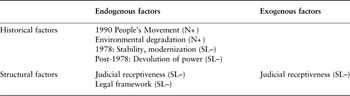
The two case studies help to reveal factors not identified in the global statistical analysis of constitutional environmental rights that may be causally important in explaining the outcomes observed in Nepal and Sri Lanka. On the basis of a comparative analysis, it is possible to uncover historical and/or structural influences on decision making regarding constitutional provisions. Moreover, the study offers insights on whether prospects for pursuing constitutional environmental protection are influenced more by factors endogenous or exogenous to the state. The results are summarized in Table 2 below.
Factors which Increased(+)/Decreased(–) the Likelihood of Adopting Constitutional Environmental Rights in Nepal (N) and Sri Lanka (SL)

As Table 2 indicates, both historical and structural factors played an important role in determining the likelihood that either country would adopt a constitutional environmental right. Interestingly, each of these factors relates primarily to conditions internal to the state and secondarily to conditions of the international environment. These findings lead to a conclusion that supplements the results of the global statistical analysis cited earlier: the likelihood that a country will adopt a constitutional environmental right is directly associated with its domestic political conditions and structures, and indirectly associated with the international normative context in which its constitution is written.
In the case of Nepal, the inclusion of an environmental right in the 2007 Interim ConstitutionFootnote 142 was facilitated mainly by two major historical factors: the 1990 People’s Movement and the issue of ongoing environmental degradation. The 2007 Interim Constitution was drafted at a time when civil society groups focused on the environment, human rights had been active for over 15 years and concerns about environmental degradation had steadily increased as the country wrestled with economic development. By 2007, approximately 69 countries had already adopted constitutional environmental rights, and jurisprudence within the region had established a link between human rights and environmental protection. These external factors conditioned the normative environment in which the Interim Constitution was written, providing a set of ideas that had gained widespread acceptance since their formal inception in 1974.
Although determined not to be directly influential in the adoption of a constitutional environmental right, three types of international influence – foreign constitutions, foreign jurisprudence, and international law – indirectly affected the likelihood that Nepal would include an environmental right in its 2007 Interim Constitution. In particular, the constitutions of Bolivia, Ecuador and Namibia, as well as Indian environmental case law and ILO 169, were all cited by interviewees as external influences that affected the decision to enact a constitutional environmental right. There is insufficient evidence of their intentional usage during the constitution drafting process to afford them causal importance. However, at the very least these sources of international influence may be construed as having shaped the ideational context in which the constitution was written.
In the case of Sri Lanka, the absence of environmental rights in either the 1978 Constitution or the 2000 Draft ConstitutionFootnote 143 occurred as a result of two historical factors (a focus on stability and modernization present during the drafting of the former constitution, and on the devolution of power present during the time leading up to the latter constitution) and two structural factors (judicial receptiveness to redressing environmental grievances through litigation and the existence of a robust environmental legal framework). While neither the 1978 Constitution nor the 2000 Draft Constitution featured environmental rights, these results can be seen as the product of different reasoning. When the 1978 Constitution was drafted, environmental rights were in their infancy. At this point in time only two countries – Yugoslavia (1974) and Portugal (1976) – had adopted constitutional environmental rights. In addition, concerns regarding political stability and modernization, rather than the environment, dominated political discourse during the constitution-drafting process. During the period leading to the 2000 Draft Constitution, environmental concerns continued to take a back seat to other issues as the focus of political discourse had shifted to a debate over devolving power. As Sri Lanka already had in place an environmental regulatory regime which extended over two millennia, by 2000 the country’s legal framework, along with its progressive judiciary, minimized the need for a constitutional right regarding environmental protection. Interestingly, the landmark decision in Sri Lankan law holding that the right to equal protection included the right to a clean environmentFootnote 144 occurred only months after Nepal ratified its 2007 Interim Constitution.
Of the factors listed above, only one – judicial receptiveness in Sri Lanka – involved the explicit, verifiable penetration of international norms. Members of the Sri Lankan judiciary have incorporated insights from international soft law instruments such as the Stockholm and Rio Declarations to inform their decisions in environmental law cases. This progressive form of judicial decision making has, to a certain extent, convinced environmental groups that they can utilize the existing legal regime to pursue environmental justice without the need to explore constitutional reform.
7. CONCLUSION
The cases examined here demonstrate the varying levels of influence that historical and structural conditions may have on the prospects for environmental constitutionalism, and complicate the view that constitutions are products of either endogenous or exogenous factors. Historical events alternately had positive (Nepal) and negative (Sri Lanka) effects on the likelihood of adoption, whereas the presence of domestic institutions and structures dealing with environmental governance was observed to reduce the likelihood that a country might enact constitutional environmental rights. These findings suggest that a state’s past and present (during the constitution-drafting process), along with its perceived capacity (actual or potential) to address environmental issues, are important attributes that affect the likelihood of acquiring constitutional protection for environmental human rights.
In contradistinction to scholars of endogenous constitutional design, I show that international influences were at least indirectly relevant in the design of both the Nepalese and Sri Lankan constitutions. Although the exogenous camp is more forgiving in terms of its willingness to accept that a range of inputs may affect constitutional design, I provide a fuller view of the specific conditions under which certain rights are likely to be enacted in a constitution. As a corollary to this finding, I add the important qualification that just because a right does not appear in the constitution does not mean that it has not been legalized elsewhere. This means that theories of constitutional convergence are likely to be under-inclusive, and studies of this phenomenon should examine the entire legal infrastructure within a country. The comparative case study also identifies and traces specific examples of two forms of transnational constitutionalism – cross-national legal dialogue and constitutional convergence. These examples bolster the claim that these dynamics are part of a global trend.
Following in the spirit of Boyd’s recommendations for further study on constitutional environmental rights,Footnote 145 I present several suggestions for expanding research on the topic in new areas. Firstly, additional work on environmental rights should analyze the conditions under which people utilize these provisions to redress grievances. Drawing from literature on legal mobilization in socio-legal studies and mobilization in social movement studies, these analyses might examine important drivers of litigation such as judicial independence, judicial leadership, rights consciousness, and sustained material resources intended to support advocacy efforts.Footnote 146
Secondly, more attention needs to be paid to the relationship between constitutional environmental rights and public opinion. At present, little is known about how the adoption of environmental rights affects popular views on important issues relating to governance. Evaluating this dynamic on a cross-national basis using survey instruments could advance existing knowledge regarding public concern about and support for the environment,Footnote 147 perceptions about the rule of law in a country,Footnote 148 and opinions on the protection of human rights.Footnote 149
Thirdly, the comparative case study elucidates an interesting area worthy of further exploration: understanding the conditions under which international norms become institutionalized in one domestic structure over another or in multiple domestic fora. The prospect that international norms effect change at state level may depend upon the site where the norm is adopted. In order to understand whether the site at which a norm takes hold affects the likelihood that the norm is successfully internalized, a global statistical analysis will be necessary.
While these innovative legal provisions present a wide range of opportunities to conduct future research across many disciplines, I hope to have drawn a preliminary map of the yet uncharted terrain where students of constitutional environmental rights may find new treasures of knowledge and caves for profitable spelunking.