INTRODUCTION
An estimated half a million people provide informal care at the end of life, and family caregiving in this context is now an international research priority (Stajduhar et al., Reference Stajduhar, Funk and Toye2010). This may not be surprising, given that family caregivers are integral to the care of those at the end of life and crucial for enabling home death (Funk et al., Reference Funk, Stajduhar and Toye2010; Linderholm & Friedrichsen, Reference Linderholm and Friedrichsen2010; Grande et al., Reference Grande, Stajduhar and Aoun2009; Stajduhar et al., Reference Stajduhar, Martin and Barwich2008; Kwak et al., Reference Kwak, Salmon and Acquaviva2007; Seymour et al., Reference Seymour, Payne and Chapman2007).
Williams and McCorkle (Reference Williams and McCorkle2011) found in their systematic review that, in assuming the role of family carer for those with cancer, caregivers incur an increased risk of physical and mental morbidity and psychological stress. Indeed, family members may readily accept the end-of-life caring role, often because of the expectations of relatives and health professionals, but they may do so with ambivalence, fear, and anxiety, and without sufficient preparation or information (Linderholm & Friedrichsen, Reference Linderholm and Friedrichsen2010). Furthermore, end-of-life family caregivers at home may assume that role for lengthy periods of time, sometimes over a year, which can lead to a sense of imprisonment (Andersson et al., Reference Andersson, Ekwall and Hallberg2010), and the responsibilities involved in end-of-life family caregiving tend to escalate and become more complex over time (Linderholm & Friedrichsen, Reference Linderholm and Friedrichsen2010).
A number of studies detail the adverse effects of end-of-life caregiving, including anxiety, depression, and fatigue (Grande et al., Reference Grande, Stajduhar and Aoun2009); financial, social, and relationship challenges (Stajduhar et al., Reference Stajduhar, Funk and Toye2010); worsening of physical health and difficulty revealing personal needs (Funk et al., Reference Funk, Stajduhar and Toye2010); and economic disadvantage (Aoun et al., Reference Aoun, Kristjanson and Currow2005). For all these reasons, we need a better understanding of how best to support family caregivers so that they can deal with the range of challenges involved in helping to provide end-of–life care at home (Grande et al., Reference Grande, Stajduhar and Aoun2009).
Applebaum and Breitbart (Reference Applebaum and Breitbart2012) systematically reviewed the psychological services that help reduce caregiver burden and found that structured, goal-oriented, and time-limited interventions that are integrative are of greatest benefit. Such interventions may help family caregivers maintain a normal relationship with their loved one, which Exley and Allen (Reference Exley and Allen2007) suggest can be seriously compromised by the responsibility of being a pivotal caregiver, and can also improve bereavement outcome (Grande and Ewing, Reference Grande and Ewing2009). As well as meeting psychological needs, home-based services should help provide respite care and attend to psychosocial, spiritual, and emotional needs (Stajduhar et al., Reference Stajduhar, Funk and Toye2010; Andersson et al., Reference Andersson, Ekwall and Hallberg2010). The Office for National Statistics National Bereavement Survey (ONS, 2012) found that, of the 11,269 family caregivers who responded to questions about support provided at home, 16% had received support but wanted more, 9% had not received support but had tried to get help, and 9% would have liked support but did not ask, the latter another indication of the lack of articulation of need referred to earlier. Healthcare providers sometimes lack resources and sufficient training to focus on the needs of both patients and family caregivers (Linderholm & Friedrichsen, Reference Linderholm and Friedrichsen2010).
To summarize, the availability of community-located professionals who can both care for patients and support family caregivers appears to be a critical factor in the viability of home-based end-of-life care. The focus of our study, on which this paper is based, was the unique benefits of skilled workers and innovative services that make a positive difference in the lives of caregivers and their loved ones dying at home, often through seemingly inconsequential interventions, such as unhurried home visits and provision of respite care at short notice, which increase caregivers' confidence and resilience.
This paper explores the role of two types of domiciliary care workers. Domiciliary care workers (DCWs) usually have a generic workload but typically provide the majority of routine personal care and support required by end-of-life patients. Though not medically trained, they increasingly undertake tasks, such as percutaneous endoscopic gastrostomy (PEG) feeding, wound care, and stoma care, previously performed by registered nurses. In addition, they are commonly employed by private agencies (Watson, Reference Watson2011). As part of a larger evaluation of end-of-life care provision in two counties in England (Marie Curie Cancer Center, 2012), we explored the role played by DCWs in meeting the emotional and practical support needs of family caregivers. Service provision in both counties included an end-of-life care coordination center, which received referrals from hospital- and community-based professionals and organized necessary care, including placement of DCWs.
In one county, referred to in this paper as District B, the end-of-life care coordination center could call on the services of domiciliary care workers in 18 different private agencies to provide care in their largely rural population. These agency staff were not specialists in end-of-life care. In the other county (District A), the end-of-life care coordination center had an in-house specialist team of eight domiciliary care workers who only cared for end-of-life patients and worked to NHS terms and conditions. This in-house team of specialist domiciliary care workers (SDCWs) was directly attached to the end-of-life care coordination center. The SDCWs themselves had a variety of professional backgrounds that included hospices and private care agencies, as well as previous experience as NHS healthcare assistants. However, this specialist team alone could not respond to the county-wide demand for personal care for end-of-life patients, and families often received additional or alternative care from domiciliary workers from the 10 private agencies operating in this mixed urban/rural county.
The aim of the present paper is to explore key themes affecting the quality of family support provided by SDCWs and agency domiciliary care workers (ADCWs), from the perspective of family caregivers themselves, to compare and contrast the experiences of each type of domiciliary care provision, and to examine important implications that arise.
METHODS
This work draws on the qualitative element of our evaluation. The methods employed included interviews and observations. We conducted in-depth face-to-face interviews with 42 family carers and 1 patient. To understand more about the DCW role and the different types of service provision, we interviewed six staff, including DCWs and other end-of-life care service providers. In order to obtain empirical data about the work that the SDCWs carried out, we undertook two observation sessions, during which informal interviews were carried out with two additional SDCWs, as well as relevant family members and patients. All interviews were recorded and transcribed, and, together with notes taken contemporaneously and following periods of observation, were subject to thematic and content analysis (Silverman, Reference Silverman2006). Analysis involved careful reading of each transcript, at least three times, which provided an opportunity for increased awareness of important and unifying subject domains, followed by progressive refinement of a robust scheme for coding themes and subthemes. As these themes and their components became clearer, so too did the proportional weighting attached to them by participants, which led to identification of comparisons and contrasts between components of the two types of DCW provisions. Observation notes were drawn on to refute or confirm themes arising from the interview analysis. An outline document with key findings was then drafted, and, in the interpretive phase, various members of the team met on several occasions to discuss this document, debate interpretations, and refine understandings before agreeing to the final set of themes.
RESULTS
In exploring the ways in which ADCWs and SDCWs met the emotional and support needs of family caregivers, we found that the following themes arose from our data:
• Sensitivity and consistency
• Proactive, family-centered approaches
• Allocation of sufficient time to meet physical and emotional needs of patients and family caregivers
• Close monitoring and flexible response to changing family needs
• Training and quality of care
Sensitivity and Consistency
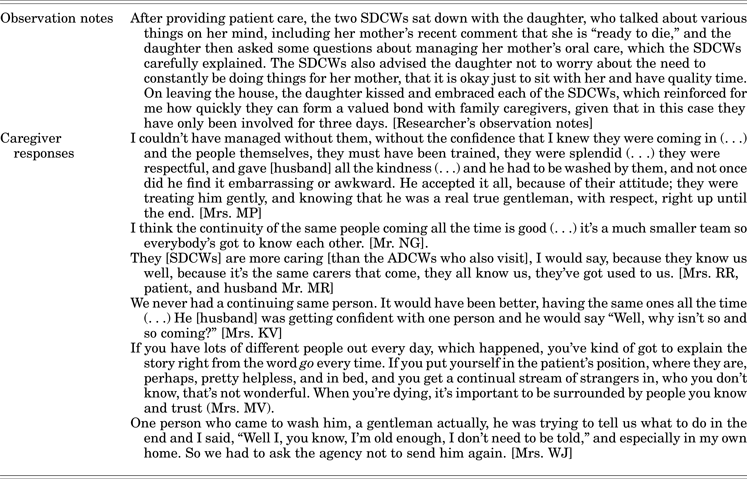
The sensitivity and respect of DCWs appeared to help open a dialogue in which patient and family caregivers' fears and needs could be safely expressed and articulated, and practical advice given and understood. Informal interviews during research observations confirmed the importance of sensitivity and respect on the part of SDCWs.
From interviews with family caregivers we learned about the ability of SDCWs to provide care in a sensitive and respectful manner that impressed both patient and family caregivers, helping raise the credibility of SDCWs as caring individuals and professionals. Observations of domiciliary care workers during the course of research also confirmed the importance of sensitivity and respect. Relevant observation notes and caregiver responses are contained in Table 1.
Sensitivity and consistency

Families who did not receive a service from the SDCW team also cited examples of sensitivity shown by the assigned ADCW staff, although this was mentioned much less often in interviews and also featured alongside accounts that workers did not take time to get to know an individual patient and family members or their tried and tested routines, as mentioned by Mrs. WJ in Table 1. Along with sensitivity, a subject that emerged throughout the interviews with family caregivers, was their appreciation of SDCW provision with respect to continuity of personnel, a highly valued aspect that helped confer confidence by establishing a personal bond, sometimes described as integral to a “caring” service and an aspect less apparent in anonymous and changeable ADCW teams, as suggested in the responses from Mr. NG and Mrs. RR and her husband MR in Table 1. Moreover, family members who only experienced ADCWs regretted that the private agencies on which they relied were unable to provide continuity of care, indicated by Mrs. KV and Mrs. MV in Table 1.
Proactive and Family-Centered Approaches
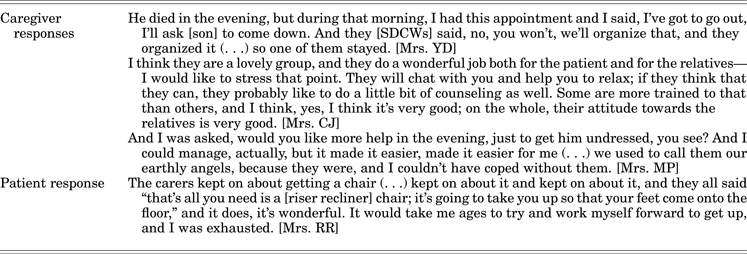
Family caregivers in this study cited situations where the SDCW team had flexibility and, most importantly, time to offer a solution to practical problems, reflecting a “can-do” approach that resulted in a family-centered, specially designed service. Responses from family members and one patient are included in Table 2.
Proactive, family-centered approaches
This constructive, family-centered approach typically involved attention to the needs of family caregivers as well as patients, a point emphasized by Mrs. CJ, included in Table 2, who was especially grateful for the emotional and psychological support provided by SDCWs. Respondents often commented on how the SDCW team operated in a proactive manner, through engaging in discussion of additional practical ways to help. One example was how the team obtained a riser recliner chair following their observations of Mrs. RR's increasing difficulty getting into and out of her living room chair, as Mrs. RR, a patient, explained during the interview and as referred to in Table 2. For Mrs. MP, also represented in Table 2, the SDCW team's proactive approach helped raise her morale at a difficult time and reduce some of the physical demands of caring for her dying husband.
Allocation of Sufficient Time to Meet Physical and Emotional Needs of Patients and Family Caregivers
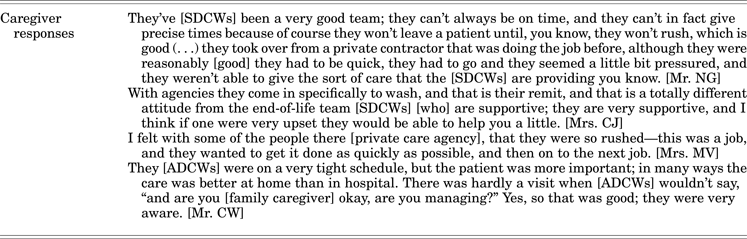
Sufficient allocation of time, enabling the SDCW team to engage flexibly, according to an individual family member's changeable daily circumstances, was greatly appreciated, even if this sometimes resulted in lack of punctuality with regard to scheduled appointments, an inevitable consequence that respondents were often prepared to accept. Indeed, as the extracts in Table 3 suggest, the provision of sufficient time can be seen as a hallmark of a good-quality domiciliary care service.
Allocation of sufficient time to meet needs of patients and family caregivers
There was some, though substantially less, evidence from families who received support from ADCWs that they also operate proactively, as Mrs. SC, a recently bereaved widow, indicated (see Table 3) when she told us that support workers who were “really worried” about her husband's condition would contact district nurses, who would then visit. However, families also raised concern about ADCWs' lack of time and their narrow task-oriented focus, as revealed by MV, in Table 3. Not all family caregivers criticized ADCWs' lack of time and family focus, and presented positive examples of the support offered, such as Mr. CW, also quoted in Table 3. Notwithstanding the excellent care that some ADCWs provided, when family caregivers had had experience of both ADCW and SDCW provision, and were therefore able to make a comparison, they invariably favored the latter as more flexible, proactive, and family focused.
Close Monitoring and Flexible Response to Changing Family Needs
Embedded within the end-of-life care coordination service, SDCWs participated in daily briefings and regularly provided feedback to coordination center managers on their perceptions of changes in patient condition, or in family caregiver circumstances, information that could readily lead to refinements in level or timing of visits or lead to installation of other equipment:
Since we've had the support workers [SDCWs] in place, they come in three times a week for handover and we get very up-to-date, very good information from them. It's more cohesive and we all know where we are. We all know what's happening to the patients, and it just sits a lot more comfortably. [Manager, District A end–of-life care coordination center]
Employing an in-house SDCW team also facilitated flexibility in resource allocation:
By selecting and employing an in-house team [of SDCWs], the controls and monitoring are set by us [NHS managers] [and] we can react promptly. For example, I assessed a man in hospital in the morning. His wife desperately wanted him home as he was clearly dying, and by the end of the day he was home, as we were able to reschedule some visits that the [SDCWs] were doing to enable this. We were also able to provide a night-sit at very short notice by one of our team. We did not have to do the lengthy referral [for ADCW provision] with no guarantee that a sitter would be found. [Manager, District A end-of-life care coordination center]
This manager also commented that SDCWs conferred with each other to “rework” their daily schedules to accommodate any sudden increases in provision that were required. It is important to emphasize that the ability of the SDCW team to respond so flexibly to family needs was because this team was directly line managed by the end-of-life care coordination center staff, who had an up-to-date, comprehensive overview of end-of-life care provision across the county. Such a perspective was not available to ADCW managers, who would only be aware of the needs in their own small patch. Family caregivers who did not receive care from the SDCW team, and therefore relied on ADCWs, sometimes raised problems experienced when trying to get additional support, including night-sitters, and also spoke of the need for closer monitoring, so as to address variability in the quality of care.
Training and Quality of Care
SDCWs were expected to have achieved National Vocational Qualifications (NVQ) level 2 or 3 in health and social care, or show willingness to undertake such training within 18 months of employment. Specialist end-of-life care training was provided in-house by three qualified and experienced community nurses who worked at the end-of-life care coordination center, where the SDCW team was based, and included mouth-care and simple wound dressing. Continuous ad hoc training was also provided in the course of daily briefings and supervision of the SDCWs, who, in addition, had access to a qualified nurse at all hours. SDCWs could also access online e-learning modules on end-of-life care cases.
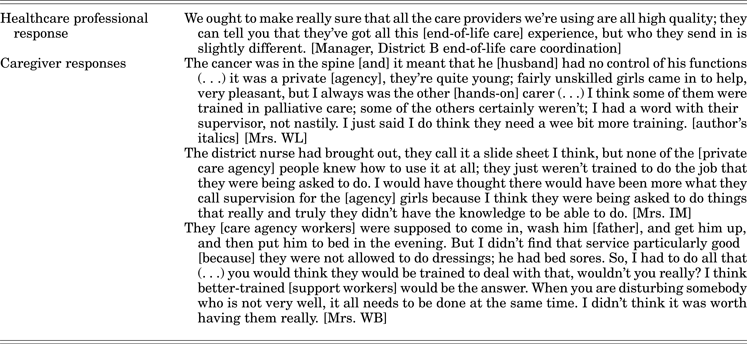
In contrast, it is unclear to what extent ADCWs had regular supervision and training in end-of-life care. Healthcare professionals who were in a position to compare feedback they had received from family members who had received SDCW and/or ADCW input concluded that there were possible questions about the supervision and support of ADCWs by their managers. The end-of-life care coordination center that only supplied private agency staff had arranged end-of-life care training places for agency domiciliary care providers, to help improve end-of-life care knowledge in particular agencies, and had also signposted agencies to other educational sources of information, including relevant websites and Marie Curie Center training videos (e.g., on the use of syringe drivers). Despite such initiatives, healthcare professionals remained equivocal about the quality of staff and end-of-life care provided by the agencies, and caregivers also shared concerns about the quality and skill of ADCWs, as the content in Table 4 demonstrates.
Training and quality of care
Clearly, according to interviewees, lack of training of ADCWs can affect the potential to provide a holistic service, which in turn may adversely affect patient comfort at home.
DISCUSSION
The aim of our paper was to explore factors that affect the quality of family support provided by agency and specialist domiciliary care workers. We found that sensitive, consistent, proactive, family-centered, and flexible components of support were highly valued by family members, and that these features were more apparent in the service delivered by the SDCW team, due to the provision of sufficient expertise, continuity, and contact time.
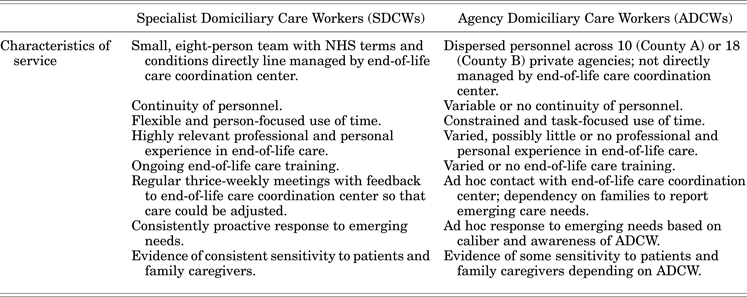
The study had its limitations. Only one patient was formally interviewed, as most who were seen in the course of visits to family caregivers were too ill to participate. Nonetheless, the major focus of this paper was the experience of family caregivers, which was successfully captured. Second, as with qualitative descriptive studies, generalizability is an issue. For example, the skill mix and capabilities of staff in one ADCW team will not be the same as those in another, and caution is therefore required in reaching general conclusions about such provision. Furthermore, respective caseload sizes and lengths of time available for visits to patients are likely to differ between SDCWs and ADCWs, and are not easily comparable, given the exclusive end-of-life care remit of the SDCW team and its concerted family approach. Despite these issues, our findings give rise to important implications, based on distinctive service characteristics emphasized by research participants, in respect of ADCWs and SDCWs for these two counties. These characteristics are presented in Table 5.
Respective DCW characteristics
In considering the implications of our data, along with evidence from studies reported earlier in this paper, particularly the pivotal role of family caregiving for people receiving end-of-life care at home, the challenges of anxiety, fatigue, and stress, and their needs for ready access to emotional and practical support, the following points are relevant:
• The National End-of-Life Care Programme (NEoLCP, 2012, p. 5) emphasizes that care provision “needs to be flexible so that if the individual's circumstances change the care package can change without any major delays.”
• A “proactive” and “preventative” approach may help prevent the adverse effects of informal care but is rarely attended to in research studies (Grande et al., Reference Grande, Stajduhar and Aoun2009, pp. 339–342).
• The ability of support workers to step up their level of involvement and provide additional care to family members, as required, is evidence of innovative support that facilitates home deaths (NEoLCP, 2012).
• Knowledge of patient and family changes is dependent on flow of information, which support workers need to share “in a timely and appropriate manner” (Skills for Care, 2012, p. 14).
We found that the in-house structure of the SDCW team and its operational base within an end-of-life care coordination center enhanced the regularity with which feedback to managers was provided and improved information exchange within the small team, so that support could be flexibly and proactively adjusted. Such support attributes were not profiled in our interviews with family caregivers who had relied on ADCWs, and this may be because private agency DCWs tend to strictly adhere to allotted lengths of time (Baxter et al., Reference Baxter, Glendenning and Clarke2008), which typically results in a short duration of calls (Patient and Client Council, 2012).
Family members who are caring for relatives at the end of life value sensitive, proactive, and experienced intervention, underpinned by well-trained professional support workers. According to the NHS National End-of-Life Care Programme, training is one of nine “critical success factors” that facilitate choice regarding preferred place of death and are crucial for general support workers delivering end-of-life care, given the fact that district nurse numbers are in decline and the pressures on those in post is growing (NEoLCP, 2012, p. 7). However, private agencies often work in “silos” and lack awareness and information about the “complexity” of end-of-life care provision (personal correspondence with Cheshire & Merseyside NHS Palliative and End-of-Life Care Network). It is therefore sobering to reflect that two fifths of the social care workforce hold no formal care-related qualifications, a situation exacerbated by the fact that the DCW turnover rate is around 20%, with over one in five leaving each year (CFWI, 2011). Indeed, according to a recent investigation by the BBC (British Broadcasting Corporation, 2012), more than 200 domiciliary care providers in England have been using staff without proper qualifications. It is not surprising to learn, therefore, that specialist, up-to-date training on end-of-life care is unlikely to be received by all agency care workers involved in its delivery (Skills for Care, 2010). More surprising, perhaps, is that there is “no formal requirement” for agencies that deliver end-of-life care to provide end-of-life care training or access specially designed qualifications (personal correspondence from “Skills for Care”).
Public policy in England has increasingly acknowledged that people's ordinary home setting is their preferred place to receive end-of-life care (DH, 2008; 2012), a choice favored by almost three quarters of respondents involved in the first national survey of bereaved people in England (ONS, 2012). However, as we noted earlier on in this paper, studies emphasize a myriad of challenges faced by family caregivers, together with unmet support needs. Domiciliary care workers play a significant role in enabling home-based end-of-life care but too often lack sufficient resources, training, and time to provide good-quality continuity of care (Watson, Reference Watson2011). Our findings are not nation- or culture-specific, and, indeed, many countries seeking to provide home-based end-of-life care services could profitably reflect on the benefits of specially appointed and well-resourced domiciliary care workers. In our opinion, the availability to families of targeted support from an appropriately trained and carefully monitored team of specialist domiciliary care workers, who are able to operate flexibly and with staff consistency, appears to be an important foundation on which to build greater confidence in the reality of “earthly angels” and to facilitate the possibility of a good death at home.
ACKNOWLEDGMENTS
The authors are extremely grateful to all the family caregivers and patients who hosted research visits and to the professional carers involved in this study. Their combined experiences and insights have been valued and, we trust, diligently employed.