1. Introduction
Advances in communication technologies coupled with reductions in transportation costs have increased the scope of global trade over the past 100 years. Recent global trade patterns have included the export of used electronic waste (e-waste) from developed to developing economies. For example, about 10.2 million used computers – roughly 80 per cent of all used computers collected from firms and households in the United States – were exported to Asia in 2002 (Puckett and Smith, Reference Puckett and Smith2002). Roughly one-fourth of all used computers collected from firms and households in Japan were exported to developing nations in 2004 – up from just 8 per cent in 2000 (Yoshida et al., Reference Yoshida, Tasaki and Terazono2009). About 2.5 million used cars and trucks were exported from the United States to Mexico between 2005 and 2008 (Davis and Kahn, Reference Davis and Kahn2010).
Exporting used durable goods to developing economies for further consumption, a concept we call ‘global reuse’, provides utility to consumers in developing countries but can have negative social consequences if the resulting waste contains toxic substances and developing nations lack appropriate disposal practices or policies. The cathode ray tubes (CRTs) of televisions and personal computers, for example, contain large amounts of lead oxide and cadmium – substances harmful to the natural environment and human health. The circuit boards of computers and cell phones also contain lead and cadmium. Modern flat-screen panel monitors contain mercury, another harmful pollutant potentially damaging to human organs.
Thus the waste from these durable goods can be hazardous, and appropriate disposal techniques are necessary to mitigate the external effects of disposal. But less developed importing countries such as China, the Philippines, India, Pakistan, Mexico or Nigeria rarely possess the technologies, policies and enforcement infrastructures necessary to address external disposal costs. In Guiyu, China, for example, broken CRTs are regularly dumped on open land or pushed into rivers (Puckett and Smith, Reference Puckett and Smith2002). In Nigeria, used televisions and computers are used to fill swamps (Puckett, Reference Puckett2005).
This paper develops a two-country representative agent model to solve for the optimal taxes and subsidies necessary in an economy with electronic waste and global reuse. The model, we believe, is easy to understand and replicate. Results are intuitive and relevant to policy formation. Before introducing the model, the next section of the paper summarizes the literature on durable goods and the international market for waste. Section 3 provides a brief summary of current practices and policies. The model is introduced in section 4, and then expanded in section 5 to allow for international shipment of e-waste. Section 6 discusses the distribution of benefits to each country from a global deposit-refund system implemented only in the developed country. Section 7 concludes the paper.
2. The literature
In a closed economy, several papers have demonstrated that the optimal policy for internalizing the social costs of waste disposal is a tax on disposal set equal to the external marginal cost of disposal (beginning with Wertz, Reference Wertz1976). Where illegal dumping is problematic, the disposal tax is replaced by a subsidy to recycling coupled with a tax on consumption – a deposit-refund program (Fullerton and Kinnaman, Reference Fullerton and Kinnaman1995). Shinkuma (Reference Shinkuma2007) extends the waste policy literature for a closed economy to the case of durable goods by demonstrating that advanced disposal fees lead to inefficient choices between reuse and disposal.
The solid waste literature on open economies focuses almost entirely on the international transfer of pure waste, rather than on waste embedded in used goods. Copeland (Reference Copeland1991) argues that eliminating transnational shipments of waste can improve welfare if importing governments do not adequately regulate waste disposal or if such regulations cause illegal dumping in those countries. For the case of durable goods, banning international trade may not be efficient if the additional value consumers place on imported used durable goods exceeds the difference in the external costs of disposal between the importing and exporting country.
A collection of other papers examines the strategic use of waste taxes to alter trade patterns. For example, Krutilla (Reference Krutilla1991) suggests national governments will set waste taxes in exporting industries to levels above the external cost of disposal to reduce supply and therefore improve international terms of trade. Waste taxes in importing industries, on the other hand, are set below external costs to help these industries compete globally. Alternatively, Kennedy (Reference Kennedy1994) argues that where competition is imperfect, governments could (1) reduce domestic disposal taxes to improve rents to exporting industries while at the same time (2) increasing domestic disposal taxes to encourage the transfer of waste to other countries. The first effect is found to outweigh the second effect if the external costs of waste disposal do not extend beyond a nation's borders. Cassing and Kuhn (Reference Cassing and Kuhn2003) find that importing countries levy waste taxes below the external marginal cost of disposal and below waste taxes in exporting countries to correct for the market inefficiency caused by imperfect competition in exporting countries. Barrett (Reference Barrett1994) and Simpson (Reference Simpson1995) also examine the use of environmental waste taxes as substitutes for trade taxes. Although we do not model strategic trade behavior, the paper contributes to this literature by considering the substitutability of waste and trade taxes for reaching global efficiency.
Research into closed economies with durable goods goes back at least as far as Anderson and Ginsburgh (Reference Anderson and Ginsburgh1994). More recently, Yokoo (Reference Yokoo2010) examines the impact of reuse activity on consumer welfare. Shinkuma and Managi (Reference Shinkuma and Managi2011) is the first to distinguish durable goods from non-durable goods in the context of optimal waste policy in a global setting and finds that an advanced disposal fee is globally inefficient. Our study expands upon the work of Shinkuma and Managi (Reference Shinkuma and Managi2011) by considering policy options beyond a producer responsibility measure.
3. Current global practices and policies
When a consumer in a developed country wishes to dispose of a used television, computer or other electronic durable good, it may find that traditional municipal curbside collection is not available. In the United States, for example, many states ban such goods from disposal in landfills or incinerators. Instead, a municipality may establish infrequent drop-off sites where residents carry these goods. Upon disposal, these goods are first shrink-wrapped on pallets and then placed in shipping containers for export to developing countries for reuse or recycling. This process is important, as a shipping container filled with unwrapped and unorganized piles of old computers and other goods cannot be legally exported under the Basel Convention (Kahhat et al., Reference Kahhat, Kim, Xu, Allenby, Williams and Zhang2008).
Once these goods find their way to developing countries, a portion may be consumed again. Others may be transported directly to recycling centers where low-skilled workers recover the imbedded precious metals by burning the circuit boards on open fires. The health and environmental consequences of this practice can be substantial, and public policies designed to govern this process are often non-existent.
A highly capitalized and less hazardous alternative, available in some developed countries, is to first mechanically shred the used computers and other old electronics into small pieces. Magnets and blowers then serve to recover the valuable metals embedded in these electronic goods. The remaining plastic bits are then incinerated, disposed of in landfills or in some cases recycled. However, the private costs associated with this process often exceed the cost of simply shipping the material to developing countries.
4. A model with a durable good and global reuse
This model expands upon a domestic waste model of Fullerton and Kinnaman (Reference Fullerton and Kinnaman1995), Fullerton and Wu (Reference Fullerton and Wu1998) and Kinnaman (Reference Kinnaman2010) to include the disposal of a durable good in an open economy comprised of two countries (A and B). Assume each country has a population of identical consumers (n in Country A and m in Country B), whose behaviors can be modeled by a representative consumer in each country. Assume the economy is endowed with technology to produce a durable good (with quantity d NA) such as a television, computer or automobile, and a non-durable good (c) that does not generate waste sufficient to affect the utility of the representative consumer in each country, such as an agricultural product, a local service or leisure. For reasons exogenous to the model, assume only the representative consumer in Country A consumes the newly manufactured durable good. This assumption will result in one-way trade in used durable goods from Country A to Country B, which is consistent with many observed global trade patterns. After consumption, the representative consumer in Country A either disposes of the good as waste in Country A (w A) or exports the used durable good to Country B for additional consumption by the representative consumer in Country B (d UA).Footnote 1 The latter implies the global reuse activity. Thus d NA = w A + d UA (where w A, d UA ≥ 0).
Note that the quantity of used durable goods consumed by the representative consumer in Country B (d UB) must equal the quantity of used durable goods exported from the representative consumer in Country A (the only supply source). Where m > n, the representative consumer in Country B must share each unit of the used durable good imported from Country A. Where m < n, the representative consumer in Country B enjoys more than one unit of the used durable good for each unit exported by the representative consumer in Country A. For example, if m = 2n, then the representative consumer in Country B consumes 1/2 of a unit previously consumed by the representative consumer in Country A (two people share each computer imported from Country A).Footnote 2 Thus,  $d_{U}^{B} = {n \over m}d_{U}^{A}$.
Once the used durable good is consumed again in Country B, providing utility to the representative consumer along the way, it becomes waste to be manually recycled and/or disposed of in Country B (w B), thus 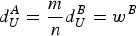 $d_{U}^{A} = {m \over n}d_{U}^{B}=w^{B}$. Note that the per capita share of waste in Country B is
 ${n \over m}w^{B}$. Assume all of this consumption and disposal activity occurs within a single time period. Within the context of a dynamic model, these material flow conditions could describe a steady state.Footnote 3
Assume the representative consumer in Country A gains utility (U A) from its own consumption of the durable good (d NA), the non-durable good (c A), and the total quantity of waste disposed of in Country A (nw A),
 $$U^{A}=U^{A}\left(d_{N}^{A}\comma \; c^{A}\comma \; nw^{A} \right)\comma \; \hbox{where}\ U_{d}^{A}>0\comma \; U_{c}^{A}>0\comma \; U_{w}^{A}\le 0.$$
In Country B, the representative consumer gains utility (U B) from consuming the imported used durable good (d UB), consuming the waste-neutral non-durable good (c B), and the aggregate quantity of waste resulting from the imported used durable goods (the population, m, times the per-capita production of waste,  ${n \over m}w^{B}$).
 $$U^{B}=U^{B}\left(d_{U}^{B}\comma \; c^{B}\comma \; {nw}^{B}\right)\comma \; \ \hbox{where}\ U_{d}^{B}>0\comma \; U_{c}^{B}>0\comma \; \ \hbox{and}\ U_{w}^{B}< 0.$$
Assume a global economic resource such as capital or energy (k) constitutes the only input into five production processes.Footnote 4 Each of these five industries is comprised of competitive identical firms, whose behavior can each be modeled by examining a representative firm. First, the economic resource (with quantity k d) can be employed to produce the new durable good (d NA) according to the production function,
 $$d_{N}^{A}=f\lpar k^{d}\rpar \comma \; \ \hbox{where}\, f^{\prime} \gt 0.$$
Second, the non-durable good (c = c A + c B) is produced using the global economic resource (with quantity k c) according to the production function,
 $$c=h\lpar k^{c}\rpar \comma \; \ \hbox{where}\ h^{\prime}>0.$$
Recall that the non-durable good generates no noticeable waste.
Third, the economic resource (k w) can be used to collect and then dispose of the remaining materials from the used durable good in Country A (w A) according to the production function
 $$w^{A}=g\lpar k^{w}\rpar \comma \; \ \hbox{where}\ g^{\prime}>0.$$
Fourth, shrink-wrapping, stacking on pallets and transporting the used durable good from Country A to Country B requires the economic resource (k u) according to d UA = q −1(k u). This function can be inverted to solve for k u,
 $${k^{u}=q\lpar d}_{U}^{A}\rpar \comma \; \ \hbox{where}\ q^{\prime}>0.$$
Fifth, the waste resulting from the consumption of the used durable good in Country B is manually recycled and disposed of using the economic resource (k b) according to
 $$w^{B}=b\lpar k^{b}\rpar \comma \; \ \hbox{where}\ b^{\prime}>0.$$
Finally, assume the total quantity of the global economic resource available to the five production processes is  $\overline{k}$ and is fully employed,
 $$\bar{k}=k^{d}+k^{w}+k^{u}+k^{c}+k^{b}.$$
4.1. Social efficiency
To achieve the Pareto optimal allocation of the economic resource across the five production processes, a social planner maximizes the utility of the representative consumer in Country B subject to holding the utility of the representative consumer in Country A constant at  $\overline{U}^{A}$. The social planner is constrained by the materials balance conditions
 $\lpar d_{N}^{A}=w^{A}+d_{U}^{A}\comma \; d_{U}^{B}={n \over m}d_{U}^{A}\comma \; \hbox{and} d_{U}^{A} = w^{B}\rpar $ and the five production functions in equations (3)–(7), and the economic resource constraint (8). Upon substitution, the problem reduces to choosing k b, k w, k c, k d and c A to maximize the Lagrange function,
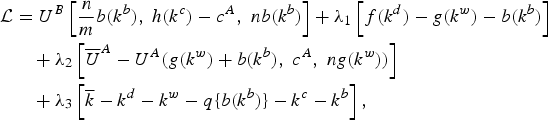 $$\eqalign{{\cal L}&=U^{B}\left[{n \over m}b\lpar k^{b}\rpar \comma \; h\lpar k^{c}\rpar -c^{A}\comma \; nb\lpar k^{b}\rpar \right]+\lambda_{1}\left[f\lpar k^{d}\rpar -g\lpar k^{w}\rpar - b\lpar k^{b}\rpar \right]\cr &\quad+\lambda_2 \left[\overline{U}^{A}-U^{A}\lpar g\lpar k^{w}\rpar + b\lpar k^{b}\rpar \comma \; c^{A}\comma \; ng\lpar k^{w}\rpar \rpar \right]\cr &\quad+\lambda_{3}\left[\overline{k}-k^{d}-k^{w}-q\lcub b\lpar k^{b}\rpar \rcub -k^{c}-k^{b}\right]\comma \; }$$
where λ1, λ2 and λ3 are Lagrange multipliers. We expect λ1 and λ3 to be positive but λ2 to be negative. The first-order conditions are
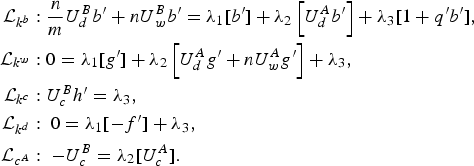 $$\eqalign{{\cal L}_{k^b}&\colon {n \over m}U_{d}^{B}b^{\prime}+{nU}_{w}^{B}b^{\prime}=\lambda_{1}\lsqb b^{\prime}\rsqb +\lambda_{2}\left[U_{d}^{A}b^{\prime}\right]+\lambda_{3}\lsqb 1+q^{\prime}b^{\prime}\rsqb \comma \; \cr {\cal L}_{k^{w}}&\colon 0=\lambda_{1}\lsqb g^{\prime}\rsqb + \lambda_{2}\left[U_{d}^{A}g^{\prime}+nU_{w}^{A}g^{\prime}\right]+\lambda_{3}\comma \; \cr {\cal L}_{k^{c}}&\colon U_{c}^{B}h^{\prime}=\lambda_{3}\comma \; \cr {\cal L}_{k^{d}}&\colon \ 0=\lambda_{1}\lsqb -f^{\prime}\rsqb +\lambda_{3}\comma \; \cr {\cal L}_{c^{A}}&\colon \ -U_{c}^{B}=\lambda_{2}\lsqb U_{c}^{A}\rsqb .}$$
Upon substituting and simplification, the system of equations representing the Pareto optimum (PO) is reduced to
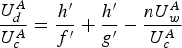 $${U_{d}^{A} \over U_{c}^{A}}={h^{\prime}\over f^{\prime}}+{h^{\prime} \over g^{\prime}}-{{nU}_{w}^{A}\over U_{c}^{A}}$$
 $${U_{d}^{A}\over U_{c}^{A}}+{nU_{d}^{B}\over mU_{c}^{B}}={h^{\prime} \over f^{\prime}}+ h^{\prime} q^{\prime}+{h^{\prime}\over b^{\prime}}-{{nU}_{w}^{B} \over U_{c}^{B}}.$$
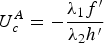
Both equations equate marginal benefits with private plus external marginal costs. The first condition suggests that the marginal rate of substitution between the durable good and the non-durable good for the representative consumer in Country A must equal the ratio of private marginal costs of first producing (h′/f′) and then disposing of (h′/g′) the durable good in Country A, relative to the marginal cost of producing the non-durable good, plus the external cost of disposal in Country A  $\left(-{{nU}_{w}^{A} \over U_{c}^{A}}\right)$. The second condition equates the marginal benefits and costs of the used durable good as it travels from Country A to Country B. This time the sum of the marginal rates of substitution across the two consumers (accounting for the fact that each used durable may be shared in Country B) must equal the sum of the marginal private cost ratios of producing the good, preparing the good for export and finally disposing of the used durable good in Country B. The external marginal cost of disposal in Country B is then added to these private marginal costs. Notice that this external cost is represented as a function of n, the population of Country A and the only supplier of the used durable good to Country B. These two expressions can be compared to the condition representing the competitive equilibrium to determine optimal tax rates.
4.2. Competitive equilibrium
Assume initially that four policy instruments are potentially available to this global economy. Each country can implement a tax on the disposal of the durable good (t wA and t wB), Country A can tax the purchase of the new durable good (t nd), and Country B can tax the import of the used durable good from Country A (t ud). The disposal tax in Country A can take the form of a landfill ban (suggesting perhaps that t wA = ∞), or an opportunity cost associated with any subsidy paid to consumers for taking used goods to a recycling center for eventual export. The disposal tax in Country B may be difficult to conceptualize. Perhaps low-skilled workers could be required to pay a small fee to the importing company before taking old computers from containers for manual recycling, and the importing company might then pay the tax to the government of Country B. The import tax, if legal under existing trade agreements, could be administered at ports of entry.
Assume the representative consumer in Country A pays one dollar (the numeraire) plus a tax (t nd) to purchase the new durable good, pays p c to purchase the non-durable good, pays p wA to dispose of the resulting waste from the durable good in Country A, and receives p ud for each unit of the used durable good exported to Country B. Assume the consumer must also pay p k for the economic resource necessary to employ the technology in (6) to prepare and transport the used durable good to Country B.Footnote 5 These prices give rise to the representative consumer's budget constraint,
 $$M^{A}=\left(1+t_{nd}\right)d_{N}^{A}+p_{c}c^{A}+p_{w}^{A}w^{A}+p_{k}q\lpar d_{U}^{A}\rpar -p_{ud}d_{U}^{A}\comma \;$$
where M A denotes an exogenously determined income level. This representative consumer maximizes utility (1) subject to the above budget constraint and the materials balance constraint d NA = w A + d UA. Because the number of consumers is large (n), the representative consumer considers its own contribution to the overall waste externality to be zero. The aggregate quantity of waste (nw A) is therefore exogenous to the representative consumer. Upon substitution, the consumer chooses w A, c A, and d UA and to maximize the Lagrange function,
 $$\eqalign{{\cal L}&=U^{A}\left(w^{A}+d_{U}^{A}\comma \; c^{A}\comma \; \overline{nw}^A\right)+\gamma^{A}\left[M^{A}-\lpar 1+t_{nd}\rpar \left(w^{A}+d_{U}^{A}\right)\right. \cr &\left.\quad -p_{c}c^{A}-p_{w}^{A}w^{A}-p_{k}q\left(d_{U}^{A}\right)+p_{ud}d_{U}^{A}\right]\comma \; }$$
where γA, the Lagrange multiplier, denotes the marginal utility of income. The first-order conditions are
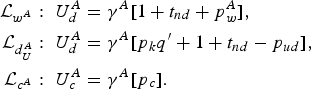 $$\eqalign{{\cal L}_{w^{A}}\colon \, \, U_{d}^{A}&=\gamma^{A}\lsqb 1+t_{nd}+p_{w}^{A}\rsqb \comma \; \cr {\cal L}_{d_{U}^{A}}\colon \, \, U_{d}^{A}&=\gamma^{A}\lsqb p_{k}q^{\prime}+1+t_{nd}-p_{ud}\rsqb \comma \; \cr {\cal L}_{c^{A}}\colon \, \, U_{c}^{A}&=\gamma^{A}\lsqb p_{c}\rsqb .}$$
The representative consumer purchases the durable good to the point where the marginal utility of consumption is equal to the price of the durable good plus the overall cost of each of the two disposal options. The utility-maximizing representative consumer will allocate the economic resource to prepare and transport the used durable good such that
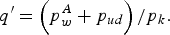 $$q^{\prime}=\left(p_{w}^{A}+p_{ud}\right)/p_{k}.$$
The representative consumer in Country B maximizes utility (2) subject to 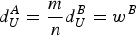 $d_{U}^{A} = {m \over n}d_{U}^{B}=w^{B}$ and the budget constraint,
 $$M^{B}=\lpar p_{ud}+t_{ud}\rpar d_{U}^{A}+p_{c}c^{B}+p_{w}^{B}w^{B}.$$
Prices and taxes appearing in this budget constraint (p ud, t ud and p wB) are defined elsewhere in the model in terms of units of the durable good rather than shares of the durable good. Thus, consumption and disposal quantities in this budget constraint are also defined in per-unit terms (d UA and w B).Footnote 6 Because the number of consumers in Country B is large (at m), the representative consumer considers the aggregate quantity of used durable goods disposed of in Country B to be exogenous. These first-order conditions are
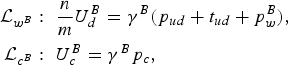 $$\eqalign{{\cal L}_{w^{B}}&\colon \, \, {n \over m}U_{d}^{B}=\gamma^{B}\lpar p_{ud}+t_{ud}+p_{w}^{B}\rpar \comma \; \cr {\cal L}_{c^{B}}&\colon \, \, U_{c}^{B}=\gamma^{B}p_{c}\comma \; }$$
which can be simplified to,
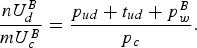 $${nU_{d}^{B}\over mU_{c}^{B}}={p_{ud}+t_{ud}+p_{w}^{B} \over p_{c}}.$$
Assume a representative competitive firm utilizes the production technology defined in (3) to produce the durable good. This firm chooses the quantity of the economic resource to employ (k d) to maximize profit,  $\pi=f\lpar k^{d}\rpar -p_{k}k^{d}$. Profit is maximized when
 $$p_{k}=f^{\prime}.$$
A representative competitive firm uses the technology in (4) to produce the non-durable good to maximize profit,  $\pi =p_{c}h\lpar k^{c}\rpar -p_{k}k^{c}$, by choosing k c such that
 $$p_{c}={p_{k}\over h^{\prime}}.$$
Assume a representative competitive waste disposal firm in Country A receives and disposes of the waste from consumers in Country A by employing the economic resource (k w) and the technology given in (5). This firm receives price, p wA, from the representative consumer in Country A to dispose of the durable good. The waste firm must pay the waste tax of t wA on each unit of domestic waste disposed of. The waste firm maximizes profit,  $\pi =\lpar p_{w}^{A}-t_{w}^{A}\rpar w^{A}-p_{k}k^{w}$. Profit is maximized by equating
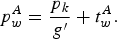 $$p_{w}^{A}={p_{k}\over g^{\prime}}+t_{w}^{A}.$$
A representative competitive firm in Country B employs the economic resource and the technology in (7) to recycle and then dispose of waste from the durable good in Country B. If the government of Country B can tax this waste to encourage the representative waste producer to internalize the social costs of disposal, then profit,  $\pi =\lpar p_{w}^{B}-t_{w}^{B}\rpar w^{B}-p_{k}k^{b}$, is maximized when
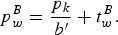 $$p_{w}^{B}={p_{k}\over b^{\prime}}+t_{w}^{B}.$$
Combining these eight utility and profit maximizing conditions results in the following set of competitive equilibrium (CE) conditions:
 $${U_{d}^{A} \over U_{c}^{A}}={h^{\prime} \over f^{\prime}}+{h^{\prime}\over g^{\prime}}+{h^{\prime} \over f^{\prime}}t_{nd}+{h^{\prime} \over f^{\prime}} t_{w}^{A}$$
 $${U_{d}^{A} \over U_{c}^{A}}+{{nU}_{d}^{B} \over {mU}_{c}^{B}}={h^{\prime} \over f^{\prime}}+q^{\prime}h^{\prime}+{h^{\prime} \over b^{\prime}}+{h^{\prime}\over f^{\prime}}t_{nd}+{h^{\prime} \over f^{\prime}}t_{w}^{B}+{h^{\prime} \over f^{\prime}}t_{ud}.$$
4.3. Optimal policy
Comparing (PO1 and PO2) with (CE1 and CE2) suggests that the following tax rate (TR) conditions are necessary for efficient policy:Footnote 7
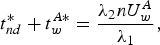 $$t_{nd}^{\ast}+t_{w}^{A\ast}={\lambda_{2}nU_{w}^{A}\over \lambda_{1}}\comma \;$$
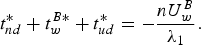 $$t_{nd}^{\ast}+t_{w}^{B\ast}+t_{ud}^{\ast}=-{nU_{w}^{B} \over \lambda_{1}}.$$
If the tax on the new durable good is set to zero (t nd = 0), then optimal policy is rather intuitive. Waste disposed of in Country A is taxed at the external marginal disutility from aggregate disposal (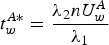 $t_{w}^{A\ast} ={\lambda_{2}nU_{w}^{A} \over \lambda_{1}}$, the λ2 is negative and converts Consumer A utiles to Consumer B utiles, and then the λ1 converts Consumer B utiles to dollars). The implementation of this tax encourages the representative consumer in Country A to optimally shift income from purchasing the durable good to purchasing the non-durable good, and thus sets the efficient level of waste in the global economy. The tax, in combination with policy measures implemented in Country B, ensures that the consumer internalizes all costs of disposal and therefore makes efficient purchasing and disposal choices.
The availability of two remaining instruments makes policy in Country B relatively flexible. If waste can be taxed in Country B, then the Pareto optimum can be achieved by setting the waste tax equal to the marginal disutility of waste disposal (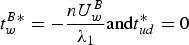 $t_{w}^{B\ast} =-{nU_{w}^{B} \over \lambda_{1}} \hbox{and} t_{ud}^{\ast}=0$). If the government of Country B is unable to tax waste allocated for manual recycling
 $\lpar t_{w}^{B\ast}=0\rpar $, then instead the government in Country B can levy a tax on imported used durable goods
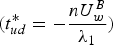 $\lpar t_{ud}^{\ast} =-{nU_{w}^{B}\over \lambda_{1}}\rpar $. This optimal import tax is set equal to the external marginal cost of waste disposal in Country B. Either tax (t wB or t ud) increases the overall cost of consuming the used durable good for the consumer in Country B. The consumer in Country A responds to either tax by reducing exports of the used good and substitutes the non-durable good (c B) for the used durable good (d uB) in consumption.
This tax equivalency disappears if the representative consumer in Country B faces disposal alternatives with varying disposal costs. If, for example, two methods of recycling, each with a different environmental effect, were available in Country B, then the import tax alone would not foster the optimal choice between these two options. A second policy instrument would be necessary.
Next, suppose Country B is unable to assess the waste tax or the import tax (t wB = t ud = 0), perhaps due a previous trade agreement. Mexico, for example, eliminated trade restrictions on all 10–15-year-old vehicles in 2005 in accordance with the implementation of NAFTA (Davis and Kahn, Reference Davis and Kahn2010). The only remaining tax instruments available to the global economy are the tax on new purchases of the new durable good and the disposal tax levied on waste disposed of in Country A.
The global Pareto optimum can now be obtained by the competitive economy without policy implemented in Country B. The condition (TR2) above is satisfied when 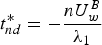 $t_{nd}^{\ast}=-{nU_{w}^{B} \over \lambda_{1}}$. The tax on new purchases of the durable good in Country A must be set equal to the marginal external cost of disposal in Country B. The condition (TR1) suggests that the efficient waste tax in Country A now takes on the value of
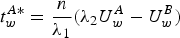 $t_{w}^{A\ast}= {n \over \lambda_{1}}\lpar \lambda_{2}U_{w}^{A}-U_{w}^{B}\rpar $. The tax on waste disposed of in Country A is set equal to the external marginal cost of disposal in Country A minus the external marginal cost of disposal in Country B. If external marginal disposal costs in Country B exceed those of Country A (as measured in units of the durable good after dividing by the Lagrange multiplier), then the tax will be negative – a subsidy on waste disposed of in Country A.Footnote 8 The representative consumer in Country A responds to the subsidy by efficiently reducing exports of the used durable goods to Country B. In the case where the external marginal cost of waste disposal in Country A is zero, then the value of the subsidy equals the tax on new purchases of the durable good. Optimal tax policy would take the form of a deposit-refund system, where the refund is awarded only if the used durable good is disposed of in Country A rather than exported to Country B.
That an open country should set a waste tax above or below the domestic external cost of disposal has been found in previous studies, but for other reasons. Krutilla (Reference Krutilla1991) demonstrates that waste taxes are set above external marginal costs of disposal to reduce imports and therefore improve the terms of trade. Kennedy (Reference Kennedy1994) suggests waste taxes be set below the external marginal cost of waste to subsidize domestic industries. Cassing and Kuhn (Reference Cassing and Kuhn2003) suggest waste taxes fall below the external marginal cost of waste to compensate for the market distortion caused by imperfect competition in the exporting country.
Consider the marginal case when the external disposal costs (measured in units of the durable good) are equal across the two countries (λ2U wA = U wB). The optimal waste tax in this case is zero. If these two external effects are nearly equal, and if the administrative costs of assessing the waste tax are non-trivial, then no waste policy may be consistent with global efficiency. Public policy would not affect the consumer's disposal of used computers and televisions. The only policy instrument required is the tax on purchases of the new durable good.
5. Allowing global waste trade
Recall from the discussion in section 3 that present policy discriminates between used goods exported for reuse (shrink wrapped on pallets) and used goods exported for waste disposal (loosely scattered in shipping containers). Relaxing this distinction and allowing free waste trade not only eliminates the need to shrink-wrap used goods destined for recycling centers in developing countries (in attempts to circumvent the Basel convention), but also allows waste from developing counties to be returned for disposal in developed countries. Such returns could allow the mechanized recycling technologies available in some developed countries to replace the manual and hazardous process employed in many developing countries. Global external disposal costs could fall.
Assume a technology is available to employ the economic resource to transport waste from the used durable goods between the two countries. If governments permit such trade, then the representative consumer in Country A faces three disposal choices. Used durable goods can either be disposed of in Country A, or prepared for export and reuse by the representative consumer in Country B, or exported as waste to Country B (w eB). Thus, d NA = w A + d UA + w eB. The consumers in Country B can now choose between disposal in Country B or returning the waste from the used durable good for disposal in Country A (w rA). Thus,  $d_{U}^{A}=w^{B}+w_{r}^{A}$. Once again, per capita consumption in Country B depends upon the relative population,
 $d_{U}^{B}={n \over m}d_{U}^{A}$. Representative consumer utility functions are amended to include the disutility associated with both domestic and imported waste,
 $$U^{A}=U^{A}\left(d_{N}^{A}\comma \; c^{A}\comma \; nw^{A}+nw_{r}^{A}\right)\comma \; \, \hbox{where}\, U_{d}^{A}>0\comma \; U_{c}^{A}>0\comma \; U_{w}^{A}\le 0\comma \;$$
 $$U^{B}=U^{B}\left(d_{U}^{B}\comma \; c^{B}\comma \; nw^{B}+nw_{e}^{B}\right)\comma \; \ \hbox{where}\ U_{d}^{B}>0\comma \; U_{c}^{B}>0\comma \; U_{w}^{B}\le 0.$$
Two production functions are added to support the global waste trade. First, the economic resource (with quantity k e) can be allocated to transport waste (w eB) from Country A to Country B according to
 $$w_{e}^{B}=e\lpar k^{e}\rpar \comma \; \ \hbox{where}\ k^{\prime}>0.$$
Second, the economic resource can also be allocated (with quantity k r) to transfer waste from the used durable good back to Country A for disposal,
 $$w_{r}^{A}=r\lpar k^{r}\rpar\, \hbox{where}\, r^{\prime}>0.$$
The global economic resource constraint in (8) is updated to reflect these two new uses,
 $$\bar{k}=k^{d}+k^{w}+k^{u}+k^{c}+k^{b}+k^{e}+k^{r}.$$
5.1. Social efficiency
Maximizing the utility of the representative consumer in Country B as in equation (2′), subject to holding constant the utility of the representative Consumer in Country A from equation (1′), yields the following Lagrange function,
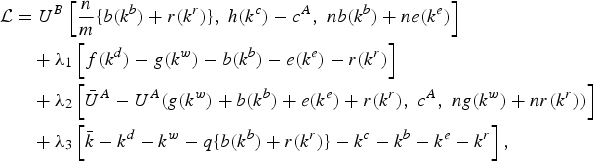 $$\eqalign{{\cal L}&=U^{B}\left[{n \over m}\lcub b\lpar k^{b}\rpar +r\lpar k^{r}\rpar \rcub \comma \; h\lpar k^{c}\rpar -c^{A}\comma \; nb\lpar k^{b}\rpar +ne\lpar k^{e}\rpar \right]\cr &\quad+\lambda_{1}\left[f\lpar k^{d}\rpar -g\lpar k^{w}\rpar -b\lpar k^{b}\rpar -e\lpar k^{e}\rpar -r\lpar k^{r}\rpar \right]\cr &\quad +\lambda_2\left[\bar{U}^{A}-U^{A}\lpar g\lpar k^{w}\rpar +b\lpar k^{b}\rpar +e\lpar k^{e}\rpar +r\lpar k^{r}\rpar \comma \; c^{A}\comma \; ng\lpar k^{w}\rpar +nr\lpar k^{r}\rpar \rpar \right]\cr &\quad +\lambda_3\left[\bar{k}-k^{d}-k^{w}-q\lcub b\lpar k^{b}\rpar +r\lpar k^{r}\rpar \rcub -k^{c}-k^{b}-k^{e}-k^{r}\right]\comma \; }$$
where the materials constraints  $d_{N}^{A}=w^{A}+d_{U}^{A}+w_{e}^{B}\comma \; d_{U}^{B}=w^{B}+w_{r}^{A}$ and
 $d_{U}^{B}={n \over m}d_{U}^{A}$, the two additional production functions defined in equations (9) and (10), and the amended resource constraint in (8′) have been added to the original problem. Upon simplifying the first-order conditions, we recover the same efficient marginal conditions found in (PO1) and (PO2) plus two additional conditions,
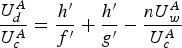 $${U_{d}^{A}\over U_{c}^{A}}={h^{\prime}\over f^{\prime}} +{h^{\prime}\over g^{\prime}}-{{nU}_{w}^{A} \over U_{c}^{A}}$$
 $${U_{d}^{A} \over U_{c}^{A}}+{{nU}_{d}^{B} \over {mU}_{c}^{B}}= {h^{\prime} \over f^{\prime}}+h^{\prime}q^{\prime}+{h^{\prime} \over b^{\prime}}-{{nU}_{w}^{B} \over U_{c}^{B}}$$
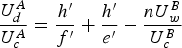 $${U_{d}^{A} \over U_{c}^{A}}={h^{\prime} \over f^{\prime}}+{h^{\prime} \over e^{\prime}}-{{nU}_{w}^{B} \over U_{c}^{B}}$$
 $${U_{d}^{A} \over U_{c}^{A}}+{nU_{d}^{B} \over {mU}_{c}^{B}}={h^{\prime} \over f^{\prime}}+h^{\prime}q^{\prime}+{h^{\prime} \over r^{\prime}}-{{nU}_{w}^{A} \over U_{c}^{A}}.$$
These four equations collectively summarize the Pareto optimal allocation of the economic resource across the seven possible uses in the global economy. Each of these conditions equates the marginal benefit associated with each disposal option with the sum of its private and external marginal costs. These conditions can once again be compared to the condition representing the competitive equilibrium to determine optimal tax rates.
5.2. Competitive equilibrium
Assume that six policy instruments are potentially available to this global economy. Once again, we have disposal taxes in each country (t wA and t wB), the tax on new durable purchases (t nd) and the import tax on used durable imports (t ud). Assume now that each country can also tax the import of waste (t eB for waste imported to Country B and t rA for waste returned to Country A).
Assume once again a representative consumer in Country A faces a price of 1 (the numeraire) to purchase the durable good. The consumer may now export waste directly to Country B by paying price (p eB) plus the tax (t eB). All other prices are as defined above. These conditions give rise to the consumer's amended budget constraint,
 $$M^{A}=\lpar 1+t_{nd}\rpar d_{N}^{A}+p_{c}c^{A}+p_{w}^{A}w^{A}+p_{k}q\lpar d_{U}^{A}\rpar -p_{ud}d_{U}^{A}+\lpar p_{e}^{B}+t_{e}^{B}\rpar w_{e}^{B}\comma \;$$
where M A denotes an exogenously determined level of income to the representative consumer in Country A. The consumer maximizes utility (1′) subject to the above budget constraint and the materials balance constraint  $d_{N}^{A}= w^{A}+d_{U}^{A}+w_{e}^{B}$. This maximization process yields the same three first-order conditions from section 4 plus the additional condition
 $${\cal L}_{w_{e}^{B}}{\colon }\, \, U_{d}^{A}=\gamma^{A}\left[1+t_{nd}+p_{e}^{B}+t_{e}^{B} \right]\!.$$
The representative consumer purchases the new durable good to the point where the marginal utility of the durable good is equal to the after-tax purchase price plus the price and tax of disposing of the waste in Country B.
The representative consumer in Country B, who can now choose to return waste to Country A for disposal (w rA), maximizes utility (2′) subject to the materials balance constraint d UB = w B + w rA and the amended budget constraint,
 $$M^{B}=\lpar p_{ud}+t_{ud}\rpar d_{U}^{A}+p_{c}c^{B}+\left(p_{r}^{A}+t_{r}^{A}\right)w_{r}^{A}+p_{w}^{B}w^{B}\comma \;$$
where all variables are defined as above. The maximization of utility yields the same condition as in section 4 plus the new condition
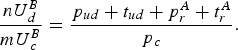 $${{nU}_{d}^{B} \over {mU}_{c}^{B}}={p_{ud}+t_{ud}+p_{r}^{A}+t_{r}^{A} \over p_{c}}.$$
Utility is maximized when the marginal rate of substitution between the durable and non-durable good is set equal to the after-tax price ratio.
Assume the representative competitive waste disposal firm in Country A expands its operations by utilizing the economic resource and the technology r(k r) to transport and dispose of waste returned from Country B. It maximizes profit such that  $p_{r}^{A}={p_{k} \over r^{\prime}}$. Likewise, the waste representative disposal firm in Country B maximizes profit from accepting imported waste from Country A such that
 $p_{e}^{B}={p_{k} \over e^{\prime}}$. All other conditions representing a decentralized competitive economy are identical to those found above.
Upon combining the various utility and profit maximizing conditions in the economy, we are left with the same two equations above, (CE1) and (CE2), plus two additional conditions,
 $${U_{d}^{A} \over U_{c}^{A}}= {h^{\prime} \over f^{\prime}}+{h^{\prime} \over g^{\prime}}+{h^{\prime} \over f^{\prime}}t_{nd}+{h^{\prime} \over f^{\prime}}t_{w}^{A}\comma \;$$
 $${U_{d}^{A} \over U_{c}^{A}}+{{nU}_{d}^{B} \over {mU}_{c}^{B}}= {h^{\prime} \over f^{\prime}}+q^{\prime}h^{\prime}+{h^{\prime} \over b^{\prime}} +{h^{\prime} \over f^{\prime}}t_{nd}+{h^{\prime} \over f^{\prime}}t_{w}^{B}+{h^{\prime} \over f^{\prime}}t_{ud}\comma \;$$
 $${U_{d}^{A} \over U_{c}^{A}}+{{nU}_{d}^{B} \over {mU}_{c}^{B}}= {h^{\prime} \over f^{\prime}}+q^{\prime}h^{\prime}+{h^{\prime} \over r^{\prime}} +{h^{\prime} \over f^{\prime}}t_{nd}+{h^{\prime} \over f^{\prime}}t_{r}^{A}+{h^{\prime} \over f^{\prime}}t_{ud}\comma \;$$
 $${U_{d}^{A} \over U_{c}^{A}}= {h^{\prime} \over f^{\prime}}+{h^{\prime} \over e^{\prime}}+ {h^{\prime} \over f^{\prime}}t_{nd}+{h^{\prime} \over f^{\prime}}t_{e}^{B}.$$
The interpretation of each of these equations is similar to that of above. In equilibrium, the marginal benefit of consuming and in some cases re-consuming the durable good must equal the sum of marginal costs associated with each disposal option.
5.3. Optimal policy
Comparing the socially efficient conditions in (PO1)–(PO4) with the competitive equilibrium conditions in (CE1)–(CE4) results in the following set of efficient policy options,
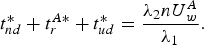
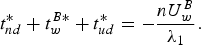 $$t_{nd}^{\ast}+t_{w}^{B\ast}+t_{ud}^{\ast}=-{nU_{w}^{B} \over \lambda_{1}}.$$
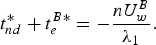
 $$t_{nd}^{\ast}+t_{r}^{A\ast}+t_{ud}^{\ast}={\lambda_{2}{nU}_{w}^{A} \over \lambda_{1}}.$$
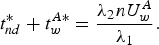
 $$t_{nd}^{\ast}+t_{e}^{B\ast}=-{nU_{w}^{B} \over \lambda_{1}}.$$
 $$t_{nd}^{\ast}+t_{w}^{A\ast}={\lambda_{2}nU_{w}^{A} \over \lambda_{1}}.$$
5.3.1. All taxes available
Assume first that all taxes are available to the economy. The efficient economy is most intuitively achieved by the following set of policy instruments,
 $$\matrix{&t_{w}^{A\ast}={\lambda_{2}nU_{w}^{A} \over \lambda_{1}}\semicolon \; & t_{w}^{B\ast}=-{nU_{w}^{B} \over \lambda_{1}}\semicolon \; &\quad t_{ud}^{\ast}=0\semicolon \; \cr & t_{e}^{B\ast}=-{{nU}_{w}^{B} \over \lambda_{1}}\semicolon \; & t_{r}^{A\ast}={\lambda_{2}nU_{w}^{A} \over \lambda_{1}}\semicolon \; &\quad t_{nd}^{\ast}=0.}$$
These four positive tax rates are all rather intuitive; all disposed-of waste is taxed at its external marginal cost. The representative consumer in Country A and Country B facing these tax rates internalizes all costs and therefore makes efficient purchasing and disposal decisions. With all waste taxes in place, the tax on the purchase of new durable goods in Country A and the tax on imported used durable goods to Country B are not necessary.
5.3.2. No waste taxes in Country B (t wB = 0 and t eB = 0)
Owing to the lack of public resources to administer and enforce tax policy, assume Country B is unable to tax waste disposed of in Country B or the import of waste from Country A (t wB = t eB = 0). This assumption might be consistent with the present state of affairs of most countries importing e-waste. Only four tax instruments are available to this global economy. The tax values necessary for the PO are:
 $$\matrix{t_{w}^{A\ast}&={n \over \lambda_{1}}\left(\lambda_{2}U_{w}^{A}+U_{w}^{B}\right)\semicolon \; &t_{w}^{B\ast}=0\semicolon \; & t_{ud}^{\ast}=0\semicolon \; \cr & t_{e}^{B\ast}=0\semicolon \; & t_{r}^{A\ast}={n \over \lambda_{1}}\lpar \lambda_{2}nU_{w}^{A}+U_{w}^{B}\rpar \semicolon \; & t_{nd}^{\ast}=-{nU_{w}^{B} \over \lambda_{1}}}$$
As was the case in section 4 with no global waste trade, the tax on the purchase of the new durable good in Country A (t nd*) is set equal to the external marginal cost of disposing of the resulting waste material in Country B. The waste tax in Country A (t wA*) is once again set equal to the difference in external costs, and can be negative if external costs are greater in Country B than in Country A. Free trade in waste necessitates a third tax instrument, a tax on waste returned to Country A for disposal, 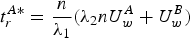 $t_{r}^{A\ast}={n \over \lambda_{1}}\lpar \lambda_{2}nU_{w}^{A}+U_{w}^{B}\rpar $. If the external disutility of waste disposal is greater in Country B than in Country A, owing perhaps to inefficient recycling and disposal methods in Country B, then
 $t_{r}^{A\ast}<0$, a subsidy. Because the disposal tax is unavailable in Country B, the only other disposal option in Country B – returning the waste to Country A – must be subsidized. Tax policy resembles a global deposit-refund system. The deposit is paid upon purchase of the new durable good. The return is awarded when waste from the used durable good is either disposed of directly in Country A or, following reuse in Country B, returned for disposal in Country A. The size of the subsidy increases with external costs of disposal in Country B and decreases with the external cost of disposal in Country A.
The PO does not require a fourth policy instrument; the optimal tax on the export of used durable goods from Country A to Country B is zero (t ud* = 0). This result stems from the equality between the external marginal cost of waste disposal in Country A from domestic and returned waste, respectively. If the physical attributes of the two forms of waste are identical, then this tax rate is zero and therefore not necessary for global efficiency.
6. Benefits to each country from optimal policy
One important policy implication from the model above is that the globally efficient allocation of resources can be obtained without the implementation of public policy in the developing country (Country B). A tax on the purchase of the new durable good in Country A combined with a subsidy paid upon the disposal of the used durable good in Country A is globally efficient. But is Country A willing to implement this set of globally efficient rather than domestically efficient policy instruments? If Country B requires the globally efficient policies as a necessary condition for global trade in used durable goods, then Country A prefers global trade in used durable goods with globally efficient policies over no trade with domestically efficient policies.
To see this, assume the marginal willingness to pay for the new durable good in Country A and the used durable good in Country B diminishes with quantity consumed. Assume also that the marginal social cost of disposal (all private and external disposal costs) in both countries rises with quantity. Finally, for simplicity assume that the marginal cost of producing the new durable good and the marginal cost of transporting the used durable good to Country B are both zero. With no policy and no global trade in used durable goods, the representative consumer in Country A purchases positive quantities of the new durable good until the marginal willingness to pay is equal to the marginal disposal costs in Country A.
Opening trade of used durable goods with optimal policy in Country A benefits both countries. After consuming the new durable good, the representative consumer in Country A now chooses between domestic disposal and export. The only cost associated with exporting the used durable good is the foregone subsidy (return) offered for domestic disposal. The consumer optimally exports used durable goods only if the social marginal cost of disposal is greater than this return. The consumer in Country A also chooses the optimal quantity of the new durable good to purchase. With zero production costs, the only cost associated with consuming the new durable good is the envelope of lowest cost disposal options – the social marginal cost in Country A or the lost return when exporting to Country B.
Relative to the no-trade outcome, the representative consumer in Country A benefits from the free disposal of all exported units and a slight increase in domestic production and consumption of the new durable good (owing to lower marginal consumption costs on these units).Footnote 9 Country B benefits from trade policy if marginal willingness to pay is greater than the social marginal disposal costs for the first unit imported (i.e., an interior solution). Note that under efficient policy the quantity of used durable goods imported to Country B is such that the marginal willingness to pay is equal to the marginal social disposal cost in Country B.
The benefits to Country A from exporting used durable goods decrease with increases in the external disposal costs in Country B. Such increases increase the optimal deposit and refund and therefore reduce exports. If social disposal costs in Country B exceed those of Country A, then consumers in Country A cease to export the used durable good. Under the optimal policy regime, the market for used durable goods will not materialize when social disposal costs in Country B exceed private disposal costs in Country A.
This result, that the optimal deposit-refund policy implemented only in Country A yields benefits to both countries relative to the no-trade outcome, is robust to relaxations in the simplifying assumptions made above. Increasing from zero the new durable good production costs or the costs to prepare and transport the used durable good to Country B merely serves to reduce the size of the total benefits from trade to each country. Benefits to Country A equal the saved private and external disposal costs less the loss associated with the output reduction.
Permitting global trade in waste also does not change the basic result that trade with optimal policy implemented only in Country A may benefit both countries. If Country B can return the waste from the used durable good to Country A for disposal, then Country B potentially saves domestic external disposal costs if the return subsidy exceeds the private cost of returning the waste. From Country A's perspective, the optimal return subsidy will result in waste imported from Country B, but this same waste would have been originally disposed of in Country A if all global trade were eliminated (recall that all durable goods are produced and initially consumed only in Country A). On net, Country A benefits from saved disposal costs on any positive quantity of waste that remains and is disposed of in Country B. Country A may also benefit from an increased production of the new durable good if external disposal costs in Country B are sufficiently low. But because the return subsidy is paid by Country A to Country B, these benefits must be compared to the cost of the return subsidy to determine the net benefits to Country A. This is an empirical issue.
7. Conclusion
Many developing countries that import used durable goods lack waste or import taxes. The lack of waste taxes could be due to administrative barriers associated with the highly decentralized e-waste recycling industry. Or governments may worry about tax evasion and illegal dumping (Copeland, Reference Copeland1991). Or perhaps the dead weight loss associated with the inefficiently high quantity of waste is small when compared to the cost of administering any kind of tax in a developing country. Or perhaps government agents in developing countries do not internalize the social costs of disposal, and political traditions render citizens bearing the external costs of disposal unable to put public pressure on their government. Lacking the ability to tax waste for any of these reasons, an inefficiently high quantity of waste from durable goods is disposed of in developing countries.
This paper developed a model of two countries trading a used durable good for global reuse to solve for various tax schemes that allow a competitive equilibrium to achieve the Pareto optimal allocation of an economic resource. If the importing country is unable to tax waste or the imports of used durable goods, then the Pareto optimum can be achieved with a tax on new purchases of the durable good and a waste tax in developed countries set below the domestic external marginal cost.
Perhaps waste taxes are already inefficiently low in developed countries. If not, then reducing domestic waste taxes to improve environmental conditions in a developing country may not be politically popular – imagine a situation where the collection of used computers for possible disposal in local landfills is subsidized. If the developed country internalizes domestic disposal costs, then it may wish to set domestic waste taxes equal to domestic external disposal costs. Only the threat of closure of international markets for used durable goods may motivate Country A to subsidize local disposal and initiate a tax on new durable goods.
The paper also considered the implications of opening global trade in e-waste. Such free trade could allow e-waste from used durable goods to be returned from underdeveloped to developed countries for disposal. Free trade would also presumably allow e-waste to be exported to underdeveloped countries. Results suggest e-waste imported to each country must be taxed. Where such taxes are impossible in underdeveloped countries, a subsidy must be placed on the return of waste from used durable goods from Country B to Country A. The magnitude of this subsidy depends upon the difference between the external marginal costs of waste in the two countries.
These results contribute to the broad assessment of the desirability of the Basel Convention. Banning international trade in waste materials, as is the case for any good or service, involves welfare losses to the economy. Such losses can be justified if externalities are prevalent. But if the Basel Convention was deemed necessary because of the lack of policy options in underdeveloped countries to address those externalities, then this paper suggests another policy approach that relies exclusively on policy in developed nations. If the return of e-waste to developed countries can be subsidized, then the Basel Convention banning e-waste is not necessary for global efficiency.