INTRODUCTION
Animal disease prevention and control has become a key element in the development of competitive livestock production systems and their associated value chains (Schwabenbauer Reference Schwabenbauer2012) with disease at the farm-level incurring substantial costs for societies worldwide (Bennett Reference Bennett2003). Indeed, animal health is one of the key factors affecting the economic efficiency of dairy herds due to, among other things, the higher costs of production associated with disease (Huijps et al. Reference Huijps, Hogeveen, Lam and Oude Lansink2010; Heikkilä et al. Reference Heikkilä, Nousiainen and Pyörälä2012). The economic gains of best practice with regard to dairy herd health have been well documented (Stott Reference Stott, Hogeveen and Lam2011; Bruijnis et al. Reference Bruijnis, Hogeveen, Garforth and Stassen2013). Dairy herd health can be considered as a valuable indicator of milk quality, improvements in which are fundamental to the continued sustainable growth of the Irish dairy industry in the context of EU milk quota abolition post-2015. According to McCoy (Reference McCoy2012), superior animal health has an important role to play in ensuring improved competiveness, meeting consumer demand and enhancing profitability. In this context, total bacterial count and somatic cell count (SCC) in particular are important indicators of milk quality and key components of national and international regulation for milk quality (More Reference More2009).
Somatic cell count is the number of cells present in milk (body cells as distinguished from invading bacterial cells) and is used as one indicator of udder infection. Somatic cells are made up of a combination of white blood cells and epithelial cells. White blood cells enter milk in response to inflammation, which may occur due to disease, or occasionally to injury. Epithelial cells are shed from the lining of the udder tissue. White blood cells make up the majority of the somatic cells, especially when the cell count is raised (Blowey & Edmondson Reference Blowey and Edmondson2010). Elevated levels of SCC (above 200 000 cells/ml) are generally accepted as an indicator of the presence of intra-mammary infection (Doohoo & Leslie 1991; International Dairy Federation 1997). Sub-clinical cases occur when the cell count level is elevated although the cow is not showing any clinical signs of the disease. Mastitis is the inflammation of the mammary gland caused by bacterial infection (Huijps Reference Huijps2009) and remains a particular and costly challenge for the dairy industry. As such, the economics of mastitis, the most prevalent production disease across dairy herds worldwide, needs to be addressed at the farm level (Seegers et al. Reference Seegers, Fourichon and Beaudeau2003).
The economic losses of diseases such as mastitis are often underestimated by farmers due to mostly hidden effects (Van Asseldonk et al. Reference Van Asseldonk, Renes, Lam and Hogeveen2010; Hogeveen et al. Reference Hogeveen, Huijps and Lam2011). The disease results in reduced milk yield, lowered butterfat and casein contents, deterioration in taste and a reduction in the ease of processing (Hortet & Seegers Reference Hortet and Seegers1998). Furthermore, milk with elevated SCC levels is not desirable for processors due to a subsequent reduction in shelf-life (particularly in the manufacture of cheese). The value of milk to the dairy industry is a function of its composition and quality, and as such the price received by producers is dependent on this. As milk processors increasingly apply incentives and penalties across a range of different milk quality parameters, including SCC, it important that producers maintain low cell count levels. Milk quality premiums offer producers a competitive advantage and represent one of the few mechanisms to significantly impact on milk price (O'Brien Reference O'Brien2008). In addition, production efficiency gains can help insulate against milk price volatility, a particular phenomenon in recent years.
Mastitis is a costly disease, due to a consequent reduction of output and the additional inputs required to reduce the level of disease. Published international estimates of the economic losses of clinical mastitis vary from €61 to €97 per average cow on a farm per year, with large differences across farms (Hogeveen et al. Reference Hogeveen, Huijps and Lam2011). In an Irish context, research by O'Brien (Reference O'Brien2008) estimates the cost of mastitis to be €60 per cow for the average milk supplier, €3000 for the average herd and €66 million for the dairy industry. Although less documented, it is expected that sub-clinical cases are responsible for a large proportion of the economic loss caused by mastitis. A recent Dutch study by Hogeveen et al. (Reference Hogeveen, Huijps and Lam2011) which took account of such cases found that annual losses varied between €17 and €198 per cow. In the context of country specific cost estimates, Nielsen et al. (Reference Nielsen, Østergaard, Emanuelson, Andersson, Berglund and Strandberg2010) stress that ‘the cost of mastitis is highly dependent on the specific context in which it has been estimated because of differences between countries and regions as regards prevalence, management practices and price levels of inputs and outputs.’
Thus, within this context, the main objective of the current research is to assess the economic benefit of improved animal health practices in relation to mastitis control in Ireland. In particular, nationally representative farm-level data from 2008 to 2011 and panel data methods are used to consider the independent effect of herd-level SCC on both milk yield and gross margin per cow. The current research is the first Irish study to explore the issue of SCC and profitability using herd-level nationally representative data. It is also the first to employ panel data techniques, allowing for the control of the effects of unobserved farm-level heterogeneity. This is important, since simple cross-sectional or pooled models of the impact of SCC on yields and/or margins are likely to suffer from omitted variable bias. Since SCC is found to have important effects on both outcomes in the current paper, the factors associated with lower SCC are also considered, again using panel data methods. The paper is structured as follows: the next section describes the data and methods employed, followed by sections outlining the results, discussion and conclusions.
DATA AND METHODS
Data
The data employed was from the Teagasc National Farm Surveys (NFS) from 2008 to 2011. The NFS is operated as part of the Farm Accountancy Data Network (FADN) of the EU and fulfils Ireland's statutory obligation to provide data on farm output, costs and income to the European Commission. A random nationally representative sample is selected annually in conjunction with the Central Statistics Office. Each farm is assigned a weighting factor so that the results of the survey are representative of the national population of farms. Data on over 1000 farms are collected to represent the farm population of over 105 000 farms. Farms are assigned into six farm systems on the basis of farm gross output, as calculated on a standard output basis. Standard output measures are applied to each animal and crop output on the farm and only farms with a standard output of €4000 or more are included in the sample (Hennessy et al. Reference Hennessy, Moran, Kinsella and Quinlan2011).
For the purposes of the current analysis, only data collected on dairy farms was of relevance, resulting in an annual sample of over 300 specialist and mixed dairy farms (1286 observations in total over the 4-year period). The panel dataset was unbalanced in the sense that some farm respondents did not remain in the sample for the complete 4-year period. As a result, new respondents were introduced to ensure the data remained nationally representative. On average, farm respondents participated in the sample over the reference period for 3·2 years. Those remaining in the sample for a 2-year period (which need not be concurrent) could be included in the panel data model. As well as facilitating longitudinal analysis, another advantage of examining SCC using a database like the NFS (as opposed to processor databases) is that data on farm performance is also collected in an objective representative manner, allowing for a thorough economic analysis.
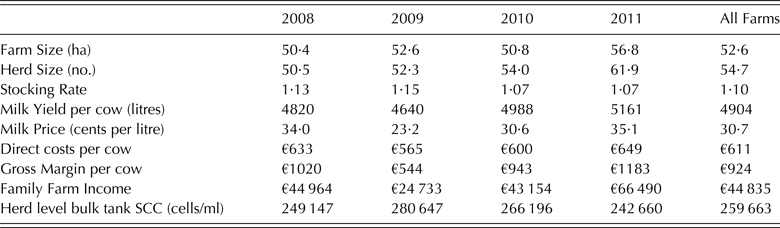
Table 1 presents mean values for some of the key variables in the nationally representative dataset of dairy farms from 2008 to 2011. Variables such as farm size (utilizable agricultural area) and stocking rate (herd size as a proportion of farm size) did not change much over the 4-year period. On the other hand, price, cost and income volatility were reflected in the variation in related variables across the time period examined. Direct costs per dairy cow relate to costs directly allocated to the dairy enterprise, e.g., purchased feed, winter forage, veterinary expenses, etc. Dairy enterprise gross margin is calculated as dairy gross output less direct costs. Family farm income represents the total return to family labour, management and capital investment in the farm business, i.e., gross output less total net expenses. An annual average milk price of 30·7 cents per litre was reported, while annual gross margin per cow was calculated to be €924, on average. Herd size (the average number of cows in the dairy herd) was seen to increase over the period, most likely in anticipation of EU milk quota abolition. Somatic cell count as reported in the survey relates to a monthly (herd level) bulk tank reading (it should be acknowledged that bulk tank readings can be influenced by factors such as the exclusion of milk from cows with high SCC, stage of lactation or indeed culling). A weighted average yearly SCC figure for each herd (taking account of monthly milk production) was then utilized in the analysis. Although data relating to bulk milk tank SCC is only available through the NFS for a relatively short period, a reduction in the variable was evident from 2009. A related increase in annual average milk yield per cow was also apparent. The proportion of milk produced across SCC thresholds is discussed further later, as well as other trends in SCC across Irish dairy herds.
Description of key variables (mean values) across NFS dairy farms (2008–2011)

Source: Teagasc National Farm Survey data (Connolly et al. Reference Connolly, Kinsella, Quinlan and Moran2009, Reference Connolly, Kinsella, Quinlan and Moran2010; Hennessy et al. Reference Hennessy, Moran, Kinsella and Quinlan2011, Reference Hennessy, Kinsella, Moran and Quinlan2012)
Methods
In order to estimate the independent effect of SCC on milk yield per cow and gross margin per cow, separate fixed-effects panel data models were employed using the NFS data described above. This approach allowed for the control of farm-specific effects which may have been correlated with both SCC and the other independent variables included in the model. Simple cross-sectional or pooled models are likely to suffer an omitted variable bias if, for example, there are unobserved farm-specific factors which jointly determine SCC and the dependent variable of interest. By controlling for farm-level heterogeneity in a fixed-effects framework, the independent effect of SCC on both yield and margins can be isolated.
The farm-specific fixed-effects model was given by:
 $$y_{it} = \alpha _i + x_{it} \beta + \varepsilon _{it} $$
where y is a scalar dependent variable (yield per cow or gross margin per cow) taking values for individual farm i at time t; x denotes a vector of control variables including SCC; β is a vector of parameter coefficients for estimation and ε represents the idiosyncratic error term. In the model, α i represents the farm-specific effects and, importantly, in a fixed-effects model these effects are permitted to be correlated with x. A drawback of the fixed-effects model is that parameter estimates are not identifiable for time-invariant variables, though this was not a problem in the current work since the key variables of interest did vary over the sample period. The employment of random-effects models was also considered. In such models it is assumed that the farm-level effects are purely random and not correlated with the independent variables included. This assumption can be tested using a standard Hausman test and in this case the fixed-effects model was found to be more appropriate: the results of these tests are available from the authors on request. The statistical package STATA was used in the analysis.
Two separate versions of Eqn (1) were estimated where y represents yield per cow and gross margin per cow, respectively. In each case the ‘tested down’ or parsimonious version of the model is reported, whereby variables not found to be statistically significant are excluded. The robustness of the final parameter estimates were reflected upon by considering different subsets of explanatory variables and also conducting a range of diagnostic checks. Given the panel nature of the data s.e. were thus adjusted for clustering. In all models the primary independent variable of interest was SCC, i.e., an evaluation of the impact of SCC on milk yield per cow and gross margin per cow.
RESULTS
Trends in somatic cell count across Irish dairy herds
Monthly data on Irish herd-level SCC (based on milk bulk tank readings) is available on an annual basis from 2008 through the NFS. Based on weighted monthly deliveries computed for each dairy herd, trends in SCC as a proportion of milk produced over the period 2008–2011 were examined. Figure 1 presents the distribution of Irish milk production across cell count levels in 2011 compared to 2008, illustrating an increase in the proportion of milk produced below the EU regulatory cell count limit of 400 000 (cells/ml) over the period (EEC 1992). The EU regulation states once the 3-month geometric mean SCC reaches 400 000 cells/ml the processor must issue a warning to the supplier who then has 3 months to reduce this. Figure 1 also shows that a higher proportion of milk was produced with a cell count of less than 200 000 (cells/ml) in 2011, benefitting from preferential milk prices given financial incentives offered by milk processors. While the proportion of herds exceeding the EU SCC regulatory limit was lower in 2011 than in 2008, it still accounted for 0·031 of national production (3 285 500 litres) in 2011.
Proportion of milk produced in Ireland across SCC thresholds (‘000 cells/ml) 2008 and 2011.
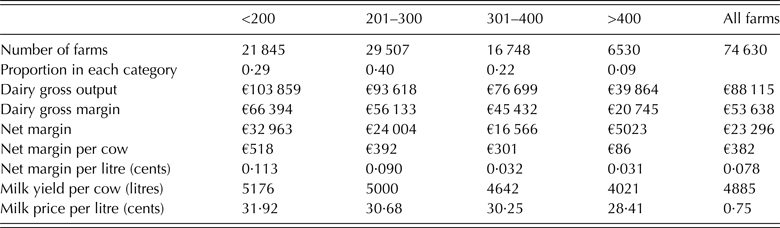
Table 2 summarizes some key variables across a range of SCC thresholds, suggesting that both output and margin decrease as SCC increases. For example, those herds with an SCC of 200 000 (cells/ml) or below reported a net margin per cow of €518, compared to only €86 per cow for those in the higher (400 000 cells/ml or above) category. A negative correlation between SCC and milk yield per cow and milk price was also evident. These associations are explored further using econometric techniques in the next section.
Economic indicators (mean values) across SCC thresholds (‘000, cells/ml) 2008–2011
Analysis using Teagasc National Farm Survey data (Connolly et al. Reference Connolly, Kinsella, Quinlan and Moran2009, Reference Connolly, Kinsella, Quinlan and Moran2010; Hennessy et al. Reference Hennessy, Moran, Kinsella and Quinlan2011, Reference Hennessy, Kinsella, Moran and Quinlan2012).
Impact of somatic cell count on yield and margins
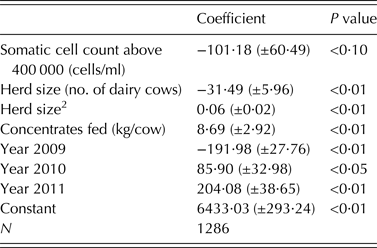
The results from the tested-down yield model are presented in Table 3. Focussing first on the impact of SCC on milk yield per cow, the estimated coefficient suggests that for farms with an SCC of greater than 400 (‘000 cells/ml), milk yield per cow was lower by 101·18 litres, all else being equal. This compares to an average yield of 4904 litres within the sample and suggests a 2% reduction in productivity compared to the average. The effect is not statistically significant (above 0·05) but at P < 0·1 shows a trend overall and implies small but important potential productivity gains from reducing SCC for those in this category. As shown in Table 2, this is a sizeable proportion of all farms in the sample.
Fixed effects model examining factors affecting milk yield per cow
Robust s.e. (i.e. s.e. allowing for heteroscedasticity (variation) in the data) reported in parentheses.
The results in Table 3 also suggest that milk yield per cow is decreasing with respect to herd size, albeit at a diminishing rate. When interpreting this result, it should be borne in mind that this effect is found after controlling other variables, including the farm-level fixed effects. Yields were found to increase strictly with respect to concentrate usage (kg fed per dairy cow), while the time (year) variables in the model were also shown to have important effects, with a large reduction in yield in 2009 compared to the base year of 2008. This was due to a reduction in output as a result of low milk prices and high costs.
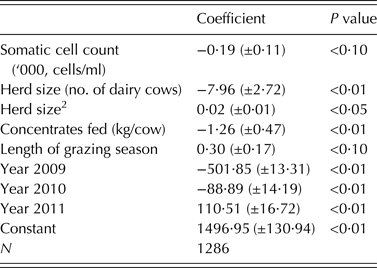
The results from the tested-down profit model are presented in Table 4. Controlling for other relevant factors, gross margin per cow was found to be a decreasing function of SCC, implying that higher SCC leads to lower profits. The magnitude of the estimated coefficient suggests that, all else being equal, a 100 (‘000 cells/ml) increase in SCC leads to a reduction in gross margin of €19 per cow, or about 2%. Alternatively, a drop in SCC from 400 (‘000 cells/ml) to 300 (‘000 cells/ml) for a herd size of 55 cows (the average in the sample) will result in an annual improvement in gross margin of €1045. This effect of SCC was found not to be statistically significant (i.e. >0·05) but at P < 0·1 suggests there is a potential trend for some increase in profitability arising from reductions in SCC.
Fixed effects model examining factors affecting gross margin per cow
Robust s.e. reported in parentheses.
Table 4 also suggests that (controlling for farm-level fixed effects), gross margins per cow are decreasing in herd size at a diminishing effect. The relationship between concentrate usage (kg fed per dairy cow) and gross margin per cow was negative and statistically significant, while again 2009 is identified as a poor year in terms of profitability. Unlike the yield model, extended grazing season was found to have a significant impact on profitability. Thus, the economic advantage of the Irish grass-based system identified by, among others, Dillon et al. (Reference Dillon, Crosse, O'Brien and Mayes2002) and Läpple et al. (Reference Läpple, Hennessy and O'Donovan2012) is confirmed by the present study. Days at grass was found to be positively related to gross margin per cow and although not statistically significant (>0·05), at P < 0·1 indicates a trend in terms of the potential to increase profit, all else being equal. The further utilization of a grass-based dairy system remains one of the main competitive advantages of the Irish dairy industry, one which may become increasingly important in a post-quota environment.
Factors impacting on herd-level somatic cell count
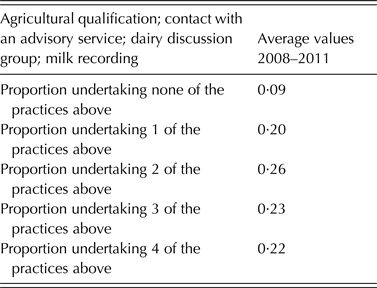
The results presented above illustrate the potential productivity and profitability gains associated with reducing SCC across herds. Thus, the factors influencing SCC are worthy of examination and in this regard a number of farm-level characteristics were considered. These included formal agricultural training, contact with an advisory (extension) service, engagement in milk recording and participation in a dairy farmer discussion group. Taking each in turn, the NFS data indicated that 0·68 of the nationally representative sample had undergone or previously attained some form of formal agricultural training over the 4-year period (no differentiation is made here with regard to type of agricultural training, which ranges from short-term courses to university level degrees). Furthermore, 0·80 of NFS respondents were in contact with an extension advisory service, while 0·36 participated in a dairy discussion group, a form of participatory extension which has become a very popular form of agricultural extension in Ireland in recent times (Hennessy & Heanue Reference Hennessy and Heanue2012). Finally, 0·45 of respondents engaged in milk recording, the monitoring of individual cow and bulk tank milk quality, across the time period. The proportion of respondents in none, one or more of these ‘management practices’ is presented in Table 5.
Participation by farm respondents in certain ‘management’ practices
Analysis using Teagasc National Farm Survey data (Connolly et al. Reference Connolly, Kinsella, Quinlan and Moran2009, Reference Connolly, Kinsella, Quinlan and Moran2010; Hennessy et al. Reference Hennessy, Moran, Kinsella and Quinlan2011, Reference Hennessy, Kinsella, Moran and Quinlan2012).
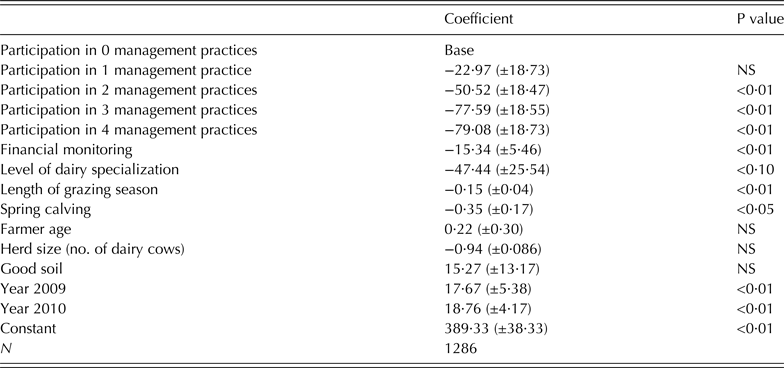
In considering the factors impacting on SCC, the impact of participation by farm respondents in these practices is of particular interest. Thus, an additional panel data model was estimated with SCC for individual farm i at time t as the dependent variable. A range of controls were included, including a range of dummy variables relating to the number of management practices engaged in as per Table 5. The variables were included in this form, as opposed to separate dummy variables for participation in each individual practice, due to high levels of correlation between participation in the different schemes for respondents. As before, both fixed-effects and random-effects models were considered, and based on results from a Hausman test, the latter was preferred. The estimated coefficients from the random-effects model of SCC are presented in Table 6.
Random-effects model examining factors affecting herd-level SCC
Robust s.e. reported in parentheses.
NS, not significant.
Overall the results from this model suggest that farmer participation in some or all of the practices discussed above (agricultural training, advisory contact, farmer discussion group and milk recording) resulted in lower SCC, e.g., herd-level SCC was reduced by 79 (‘000, cells/ml) when all four practices were undertaken, all else being equal. As one would expect, the magnitude of the coefficient is larger as the number of practices undertaken increases. The model further indicates that farmer participation in only one practice did not significantly affect herd-level SCC. This is not surprising as the suite of ‘practices’ are generally considered to be complementary. These results are in line with those of Green et al. (Reference Green, Leach, Breen, Green and Bradley2007), who, using an intervention study in England and Wales, found that the impact on cell count reduction and clinical mastitis incidence was largest on those farms where more of the suggested actions proposed within a mastitis control plan were undertaken.
In addition, the current analysis indicates that a number of other characteristics of the farm are shown to be significantly associated with reduced SCC at the herd level, including utilization of eProfit monitoring (a financial monitoring tool) and extended grazing season, which was also found to be significant and positive in the profit model earlier. Both of these were significant here at P < 0·01. The relationship between level of dairy specialization (calculated here as the proportion of farm gross output coming from the dairy enterprise) and cell count was also negative and non-significant (>0·05) at P < 0·1 (with those farms more ‘specialized’ in dairy production relative to other on-farm enterprises displaying a lower herd-level SCC. An early spring (i.e. January to March) calving variable (as a measure of summer milk production) was also included in the model to take account of the impact of seasonality. This is in line with previous Irish research by Valencia & Anderson (Reference Valencia and Anderson2000) and Shalloo et al. (Reference Shalloo, Dillon, O'Loughlin, Rath and Wallace2004) which considered the profitability of an early spring calving system. The results here suggest a negative and significant (P < 0·05) relationship between early spring calving and SCC.
DISCUSSION
Improved animal health and management of milk quality at the herd level is important for the dairy industry with processors and consumers demanding high quality products in an increasingly competitive market (Stott Reference Stott, Hogeveen and Lam2011). In a more general sense, animal health improvements have implications beyond the farm level, increasingly so with regard to the competitiveness and marketability of agricultural output. The quantification of both productivity and economic gains resulting from animal health improvements is all the more important given the underestimation by farmers of the impact of diseases such as mastitis.
In this context, the current research presents new evidence on the farm-level economic gains of SCC reduction in terms of yields and gross margins in Ireland using comprehensive and nationally representative herd-level data and panel data techniques. Results indicate that for farms with an SCC of greater than 400 (‘000 cells/ml) there is a 2% reduction in productivity compared to the average, highlighting the important potential productivity gains from reducing cell count for those in this category. Furthermore, a decrease in SCC from 400 (‘000 cells/ml) to 300 (‘000 cells/ml) for a herd size of 55 cows (the average in the sample) is likely to result in an annual improvement in gross margin of €1045, suggesting there is potential for considerable increases in profitability arising from reductions in SCC.
These results can be compared to recent Irish research conducted by Geary et al. (Reference Geary, Lopez-Villalobos, Begley, McCoy, O'Brien, O'Grady and Shalloo2012) who, using a simulation model, found that as a result of elevated SCC levels (going from 100 000 to 400 000 cells/ml at the herd level), net farm profit decreased by €19 504, due to milk production losses and culling costs. They also found, in line with previous international research (Dufour et al. Reference Dufour, Fréchette, Barkema, Mussell and Scholl2011; Hogeveen et al. Reference Hogeveen, Huijps and Lam2011), that mastitis-related losses are often underestimated at the farm level due to reduced milk production, higher rates of culling, increased mortality and lower herd growth potential. Further losses due to poorer compositional quality, shelf-life and taste of milk resulting in reduced ease of processing have also been highlighted previously, e.g., De Vliegher (Reference De Vliegher, Fox, Piepers, McDougall and Barkema2012).
Additional results from the current research, arising from the SCC model, indicate that herd management factors, as opposed to physical factors such as soil type or herd size, are most influential in SCC reduction. Previous international research has highlighted the effectiveness of management practices such as milk recording, improved hygiene, etc. in improving herd-health and reducing mastitis incidence (Barkema et al. Reference Barkema, Van Der Ploeg, Schukken, Lam, Benedictus and Brand1999; Dufour et al. Reference Dufour, Fréchette, Barkema, Mussell and Scholl2011). The current findings provide additional evidence in favour of the efficacy of practices such as milk recording and participatory extension in an Irish context. Furthermore, since SCC is a good indicator of herd health in general and mastitis in particular, the results from the current analysis underline the importance of herd management factors in improving animal health at the farm level. This is an important finding since it suggests that farmer behaviour is as, or more, important in controlling animal health performance than physical infrastructure, implying an important role for the extension agent and herd veterinary advisor among others. As such, within an Irish context (as part of the national mastitis control programme) a recent undertaking (CellCheck) with regard to the organization of farmer workshops facilitated by a team of trained service providers (veterinary advisors, farm advisors, milking machine technicians and co-op milk quality advisors) is positive. Further information on the CellCheck programme can be found at: http://www.animalhealthireland.ie/page.php?id=29.
Alongside this, given the potential for improved profitability arising from SCC reduction, the role of industry stakeholders in fortifying farmer knowledge and influencing behaviour relating to within herd-health and the uptake of innovative practices is then worthy of further examination. A key finding of the work of Green et al. (Reference Green, Leach, Breen, Green and Bradley2007), which has already been alluded to, was that individual management changes made by farmers were not significantly associated with changes in the incidence of mastitis, implying that the overall improvements were a result of a cumulative effect of a number of changes. To this end, research is on-going by the authors relating to farmers’ attitudes and behaviour towards animal health best practice and the role of knowledge transfer in influencing optimum herd health management. It should be acknowledged here that with regard to sub-clinical and clinical mastitis in particular, any such advice must be tailored to farmers depending on the source of new infections into the herd. For example, in the event of contagious mastitis, improved hygiene in the milking parlour may be necessary. If on the other hand winter environmental factors are the cause, improvements in housing and cubicle hygiene may be more appropriate. Similarly, Archer et al. (Reference Archer, McCoy, Wapenaar and Green2013) conclude that if herd-level SCC is driven by a high proportion of infected heifers calving down, then control measures must then be directed at this group. The undertaking of this type of research is important given that improvements in animal health and milk quality are essential if the Irish dairy industry is to grow sustainably and retain a competitive advantage in a post-quota environment, most especially in the manufacture of high value dairy products.
The authors wish to acknowledge the funding received from the Department of Agriculture, Fisheries and Food Research Stimulus Fund. They are also grateful to the staff of the Teagasc National Farm Survey for the provision of data and to colleagues for helpful advice received. Valuable comments received from the anonymous referees are also acknowledged with thanks.