Introduction
Poultry production has important economic, social, nutritional and cultural benefits in developing countries (Tadesse et al., Reference Tadesse, Singh, Mengistu, Esatu and Dessie2013) providing animal protein of high biological value in terms of eggs and meat (Penderson, Reference Penderson2002; Ahmad et al., Reference Ahmad, Ahsan-ul-Haq, Ashraf, Hussain and Siddiqui2010; Moula et al., Reference Moula, Diaw, Salhi, Farnir, Antoine-Moussiaux and Leroy2013). In most developing countries today, poultry production is still based on the scavenging local chicken flocks (Kitalyi, Reference Kitalyi1998; Dana, Reference Dana2009; Osei-Amponsah, Kayang and Naazie, Reference Osei-Amponsah, Kayang and Naazie2013). Free ranging chickens comprise about 80 percent of the continent's poultry flock in Africa, producing about 1 695 620 metric tonnes of eggs and 2 096 000 metric tonnes of meat annually, almost exclusively from scavenging in the backyards with little or no extra input, management or health care (Guèye, Reference Guèye1998; Dana, Reference Dana2009). These chickens contribute to food security, protein nutrition and empowerment of rural women whilst alleviating poverty (Guèye, Reference Guèye1998; Branckaert et al., Reference Branckaert, Gavirna, Jallade and Seiders2000; Etim et al., Reference Etim, Etim, Edem, Offiong and Essang2013; Adomako et al., Reference Adomako, Olympio, Hagan and Hamidu2014; Ayim-Akonor and Akonor, Reference Ayim-Akonor and Akonor2014). Local chickens therefore play a crucial role in breaking the vicious cycle of poverty, malnutrition and disease (Roberts, Reference Roberts1992; Osei-Amponsah, Kayang and Naazie, Reference Osei-Amponsah, Kayang and Naazie2012; Afolabi et al., Reference Afolabi, Adegbite, Ashaolu and Akinbode2013).
In Ghana, poultry production is based on the traditional free range local chickens in the country-side, peri-urban and urban centres as well as a commercial sector based on intensive systems of rearing around the principal towns and cities. Egg production in Ghana has seen a steady increase (GAIN, 2013) with nearly 15 000 metric tonnes recorded between 2004 and 2012 (FAOSTAT, 2013). Similar to other countries in Africa, rural poultry production accounts for 60–80 percent of the national poultry population (Okantah et al., Reference Okantah, Aboe, Boa-Amponsem, Dorward and Bryant2003; Gyening, Reference Gyening2006). At the beginning of the 21st century, the rural poultry population was estimated at 12 million (Amakye-Anim, Reference Amakye-Anim2000), increasing to 20 million by 2005 (Aning, Reference Aning2006). Currently, it is estimated that there are about 25 million free-roaming village poultry in Ghana. The poultry subsector is practised by about 66 percent of the 3.7 million households in Ghana, especially on the Guinea Savannah agro-ecological zone (Aning, Reference Aning2006). Ghanaian local chickens therefore represent a huge genetic resource of immense value to the livelihoods of many families and households.
Egg production is a crucial aspect of poultry production and therefore the number of eggs produced by a hen in a production cycle, daily hen-housed egg production, low mortality rate and efficient feed conversion rate are important traits in the success of a poultry enterprise (Grobbelaar, Sutherland and Molalakgotla, Reference Grobbelaar, Sutherland and Molalakgotla2010). In Ghana, income from the sale of eggs from local chickens contributes significantly to the family budget (Okantah et al., Reference Okantah, Aboe, Boa-Amponsem, Dorward and Bryant2003; Aboe et al., Reference Aboe, Boa-Amponsem, Okantah, Dorward and Bryant2006; Osei-Amponsah, Kayang and Naazie, Reference Osei-Amponsah, Kayang and Naazie2012). Therefore, local chicken farmers need to know the number of eggs that can be produced by a hen in a production cycle to enable them make informed decisions about efficient production. Hardly any research has been done on this local genetic resource to characterize them either at the phenotypic or the genetic level and the potential of local chickens for egg production is unknown. Lack of data on the productive performance of chickens makes it difficult to develop sustainable egg production programmes.
A project to characterize Ghanaian local chicken was undertaken with funding from the French Government through the DURAS project. This paper presents results of the egg production potential and feed conversion efficiency for egg production of Ghanaian local chickens raised under improved management as compared with that of SASSO T44 chickens, a French Label Rouge free range chicken, raised under the same management in Ghana.
Materials and methods
Local chickens from the forest and savannah zones of Ghana used in this study were hatched at the Livestock and Poultry Research Centre (LIPREC), University of Ghana. LIPREC is located on latitude 05°40′N and Longitude 00°16′W on the Accra Plains which forms part of the Coastal Savannah. Annual rainfall of the ARC is 785 mm with a range of 128–1 709 mm distributed bi-modally. The long rainy season usually occurs between March and July with a peak in June and the short rainy season occurs between August and November with a peak in October. Mean monthly temperatures range from 24.8 °C in August to 28.3 °C in February with a mean of 26.9 °C. Relative humidity at 1 500 h ranges between 58 and 83.7 percent and is slightly lower at 0 9:00 h.
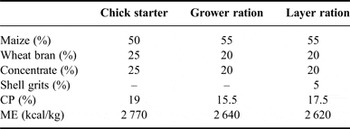
Two hundred Chicks of SASSO T44 day-old chicks were imported from France to coincide with the hatch of the local chicks. Chicks of each ecotype were managed similarly in three replicates in one deep litter house. In all, 227, 224 and 107 females of the savannah, forest and SASSO T44 chickens survived to produce egg records for analyses. Management of the experimental chickens has been described by Osei-Amponsah, Kayang and Naazie (Reference Osei-Amponsah, Kayang and Naazie2012). Briefly, chickens were given the same starter (0–4 weeks), grower (4–18 weeks) and finisher (after 18 weeks) rations, compositions of which are as indicated in Table 1. The feed consumption and eggs laid by each replicate were recorded daily. The number of eggs laid by local and SASSO T44 chickens between 22 and 49 weeks of age were evaluated against their feed consumption.
Composition of ration fed to experimental chickens.

CP, crude protein; ME, metabolizable energy.
Source of concentrate – Agricare Feed Products, Ltd, Ghana.
Average hen-day production, calculated as percentage of hens in lay and feed intake, were recorded on a daily basis. Feed conversion ratio (FCR) was then calculated as the ratio of feed consumed per gram of egg produced. Analysis-of-variance (ANOVA) procedures were used to measure the effect of breed (ecotype) on average feed intake, average egg weight and feed conversion. Test of difference of means on the data was performed by the Least Significant Difference (LSD) method using GenStat Release 10 (Payne et al., Reference Payne, Harding, Muray, Soutar, Baird, Welham, Kane, Gilmour, Thompson, Webster and Wilson2007).
Results
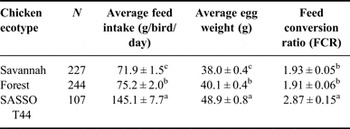
Average feed intake and egg weight were significantly (P < 0.05) higher in SASSO T44 chickens than in the local chicken ecotypes (Table 2). SASSO T44 chickens consumed more feed for every unit of egg produced.
Egg production performance of local and SASSO T44 chickens.

a,b,c within columns, means followed by different superscripts are significantly different.
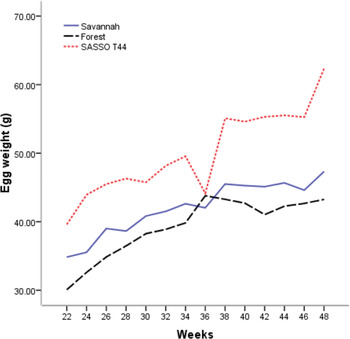
The age at first egg production was 22 weeks for all ecotypes, even with ad libitum feeding. Average percent egg production (hen-day production) and FCR were both significantly (P < 0.05) superior in the local chicken ecotypes. However, SASSO T44 chickens produced heavier eggs than local chickens throughout the study period (Figure 1). The forest chickens were on the average inferior to the savannah chickens in egg weight but consumed less feed per every unit of egg produced though this was not significant. Irrespective of the ecotype of chickens, egg weights increased during the study period (Figure 2).
Variation in egg weight of experimental chicken

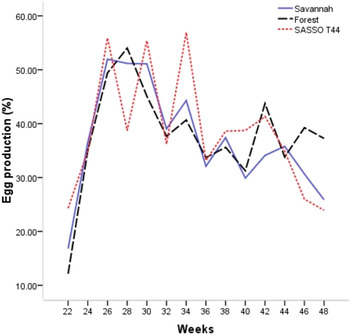
Egg production (%) of experimental chickens.

The highest percent hen-day production recorded by the experimental chickens was between the period 24 and 34 weeks of age (Figure 2). Percent hen-day production in the savannah chicken ecotype was better compared with the forest chicken ecotype. In general, fluctuations in hen day production in SASSO T44 chickens were comparable with those of the local chicken ecotypes.
Discussion
In chickens egg production can start anytime from 18 weeks of age. The fact these chickens all began laying from week 22 implies that they are late starters. The late start of egg production is likely an adaptation for surviving under scavenging conditions. Egg production is very demanding of nutrients and so under free range it is likely that the bird must first build its reserves adequately before engaging in this nutrient demanding activity and hence adapted to starting later rather than earlier. The relatively higher egg weights obtained for SASSO T44 chickens compared with local chickens can be attributed to genetic differences. This is expected because heavy birds such as the SASSO T44, a strain of the French Label Rouge free range chickens, consume more feed and lay larger eggs (Leeson, Caston and Summers, Reference Leeson, Caston and Summers1997). The average egg weights of local Ghanaian chickens fall within the range reported for village chickens in Africa (Guèye, Reference Guèye1998; Adomako, Hagan, and Olympio, Reference Adomako, Hagan and Olympio2010). However, Adomako et al., (2014) found higher egg weights in naked neck local-exotic crossbred chickens. Small egg size is a characteristic of indigenous tropical fowl breeds and this may be an adaptation to the tropical climate (Smith, Reference Smith1974; Aganga, Tshwenyane and Molefhe, Reference Aganga, Tshwenyane and Molefhe2003). Egg production traits are quantitative in nature with a continuum between high and low-performing birds (Zaman, Sørensen and Howlider, Reference Zaman, Sørensen and Howlider2004; Chatterjee et al., Reference Chatterjee, Sharma, Mishra, Dange and Bhattacharya2008). For instance, Nthimo (Reference Nthimo2004) found average egg weights ranging from 46.6 to 52 g in native Lesotho chickens which are higher than those of local Ghanaian chicken ecotypes, whilst Sazzad (Reference Sazzad1992) found the average egg weight for the exotic chicken breeds to be 72 percent higher than that of a local chicken breed. Addison et al. (Reference Addison, Adomako, Olympio, Hamidu, Aboagye-Poku and Djan-Fordjour2013) and Tadesse et al. (Reference Tadesse, Singh, Mengistu, Esatu and Dessie2013) reported average egg weights of between 49 and 60 g for exotic chickens raised in Ghana and Ethiopia, respectively.
Differences in egg production and quality exist between different strains of laying hens (Grobas et al., Reference Grobas, Mendez, Lazaro, De Blas and Mateos2001; Anderson, Reference Anderson2002). Results of average egg weights of local Ghanaian chicken ecotypes are lower than those reported for indigenous chickens of Iraq (Al-Rawi and Al-Athari, Reference Al-Rawi and AL-Athari2002) but superior to those reported for native chickens of South Africa (van Marle-Köster and Casey, Reference van Marle-Köster and Casey2001). Values of egg weights, laying percentage and FCR obtained in the present study were better than those obtained for local Bangladesh chickens but lower than Rhode Island Red (RIR) and White Leghorn (WLH) hens (Yeasmin, Howlider and Ahammad, Reference Yeasmin, Howlider and Ahammad2003). Rahman, Baqui and Howlider (Reference Rahman, Baqui and Howlider2004) reported average egg weights 49.4 and 48.7 g and feed consumption of 96 and 98.4 g/bird/day in a study on RIR × (Fayoumi) FAY and FAY × RIR crosses. The relatively lower egg weights observed in the present study compared with those observed by Rahman, Baqui and Howlider (Reference Rahman, Baqui and Howlider2004) would be largely attributable to genotypic variations. Vij, Tantia and Vijh (Reference Vij, Tantia and Vijh2006) characterized the native Punjab Brown chicken of India and reported average egg weight of 46.01 g which is slightly higher than average egg weights obtained in the present study due to genetic and environmental effects.
Egg production curves describe the relation between number of eggs and time of the laying period and their shape is defined by sexual maturity (which marks the onset of production), followed by a stage of increasing production to a maximum or production peak followed by a steady decline in egg production or persistency of production (Wolc et al., Reference Wolc, Jesus, Petek, O'Sullivan and Dekkers2011).The egg production curves of the experimental chickens followed the typical egg production curve for a flock which increases during the first 8 or 9 weeks of production and decreases to the end of the production period (Grossman and Koops, Reference Grossman and Koops2001). The laying cycle of a chicken flock usually covers a span of about 12 months starting when the birds reach about 18–22 weeks of age, depending on the breed and season (Jacob, Miles and Mather, Reference Jacob, Miles and Mather2000). Flock production rises sharply and reaches a peak of about 90 percent between 6 and 8 weeks after which production gradually declines to about 65 percent after 12 months of lay (Jacob, Miles and Mather, Reference Jacob, Miles and Mather2000). In the present study, the highest hen-day (peak of) production for SASSO T44 chickens was observed at the same age as those of the local chicken ecotypes indicating an insignificant effect of genotype on this trait under the experimental conditions. Egg production of indigenous chickens of Ethiopia peaked between age 26 and 29 weeks (Mogesse, Reference Mogesse2007) as obtained the current study. Rahman, Baqui and Howlider (Reference Rahman, Baqui and Howlider2004) in a study on RIR × (Fayoumi) FAY and FAY × RIR crosses reported average percent egg production for the two crosses respectively as 48.2 and 52.8; The RIR × FAY and FAY × RIR crossbreeds reached peak egg production at 25 and 26 weeks of age, thereafter the egg production decreased as observed generally in the present study.
Results of egg-laying performance in the present study are lower than those reported by Anderson (Reference Anderson2002) for brown and white hens and egg-type crosses of chickens based on Fayoumi, Leghorn, ISABROWN, Mandarah and R strains raised in Morocco. In comparison, eggs of the chicken ecotypes in the present study were lighter but the FCRs of local Ghanaian chicken ecotypes were better than the egg-type crosses (Benabdeljelil, Lahbabi and Bordas, Reference Benabdeljelil, Lahbabi and Bordas2003). Except for the RIR breed, egg production per cent for Ghanaian local chickens were higher than Bangladesh local chickens and their crosses with RIR and (Barred Plymouth Rock (BPR)) (Sazzad, Reference Sazzad1992).
Birds considered to have better feed efficiency typically have a lower proportion of feed intake to body weight gain (Willems, Miller and Wood, Reference Willems, Miller and Wood2013). FCR reported for native chickens of South Africa (van Marle-Köster and Casey, Reference van Marle-Köster and Casey2001) are inferior to those recorded for local Ghanaian chicken ecotypes. Galal et al. (Reference Galal, Ahmed, Ali and Younis2007) however reported lower feed conversion ratios for hens with the dwarf gene in Egypt compared with the three ecotypes in the present study. Mogesse (Reference Mogesse2007) found average feed intakes ranging from of 86.03 to 98.46 g/bird/day in various indigenous chickens of Ethiopia which are higher than those recorded for local Ghanaian chickens but lower than SASSO T44 chickens. Egg-laying percentage of chickens in the present study are lower than those of local Deshi Dwarf and Fayoumi chickens of Ethiopia and its crosses with WLH (Yeasmin, Howlider and Ahammad, Reference Yeasmin, Howlider and Ahammad2003) but local Ghanaian chickens on the average consume less feed per gramme of egg produced.
Results of the present and other studies indicate substantial variations in egg production abilities of different chicken ecotypes. Egg production can be affected by such factors as feed consumption (quality and quantity), water intake, intensity and duration of light received, parasite infestation, disease, and numerous management and environmental factors (Jacob, Miles and Mather, Reference Jacob, Miles and Mather2000). Local chickens have low output expressed as low egg production, small egg size, slow growth rate and poor survival of chicks (Tadelle, Reference Tadelle2003). Under village conditions the annual egg production per bird ranges from 20 to 100 eggs with an average weight ranging from about 30–50 g (Guèye, Reference Guèye1998). Such low productivity of indigenous chickens has been partly attributed to poor management practices, in particular lack of proper health care, poor nutrition and housing (Dutta, Islam and Kabir, Reference Dutta, Islam and Kabir2013). South African indigenous chickens for instance performed much better in all egg production parameters under improved housing and management (Grobbelaar, Sutherland and Molalakgotla, Reference Grobbelaar, Sutherland and Molalakgotla2010).
Improving the environment of chickens should thus contribute immensely towards improvement of their production qualities including egg production (Varguez-Montero et al., Reference Varguez-Montero, Sarmiento-Franco, Santos-Ricalde and Jose Segura-Correa2012). The present study indicates that egg production of local chickens compares favourably with SASSO T44 chickens meaning that with proper management, more eggs can be obtained from local chickens than what obtains under free range. This is an opportunity to bridge the wide gap between demand and supply of animal protein. This should increase poultry production to provide required animal protein for human beings (Das et al., Reference Das, Chowdhury, Khatun, Nishibori, Isobe and Yishimura2007) whilst decreasing unemployment (Khawaja et al., Reference Khawaja, Khan, Mukhtar, Ullah and Parveen2013) particularly among the youth.
Conclusions
Local chicken ecotypes had significantly (P < 0.05) lower average egg weight and feed intake per bird compared with SASSO T44. However, the local chicken ecotypes had comparable egg production performance and better feed conversion for every unit of egg produced. Local Ghanaian chickens can therefore be said to be relatively more efficient egg producers. Low feed intake, good feed conversion ratios and adaptation to the environment are traits local chicken harbour which can be exploited in a breeding programme to improve on chicken meat and egg production in Ghana.
Acknowledgements
Appreciation is expressed to the DURAS Project for permission to use data and the University of Ghana Graduate Fellowship programme for award of fellowship to R. Osei-Amponsah. The Carnegie – funded University of Ghana “Next Generation of Academics in Africa” Project for the Write-Shop held in June, 2013 facilitated the preparation of the manuscript for publication and the authors are grateful to the co-ordinator, mentors and all participants for their valuable inputs.
Statement of interest
The authors declare no conflict of interest.