1. Introduction and background
Among the around 175 impact structures currently known on Earth, the majority is still insufficiently dated (e.g. Rei-mold, Reference Reimold2007; Earth Impact Database, 2008: http://www.unb.ca/passc/ImpactDatabase; accessed on April 15, 2008). In many cases, the age of the target rock provides the only (maximum) age constraint for crater formation (e.g. the < 1.9 Ga Paasselkä impact structure, Finland; Schmieder, Moilanen & Buchner, Reference Schmieder, Moilanen and Buchner2008). Besides some exceptionally good ages (e.g. the 14.4 ± 0.1 Ma Ries crater, Germany (Buchner, Seyfried & van den Bogaard, Reference Buchner, Seyfried and van den Bogaard2003); the 64.98 ± 0.05 Ma Chicxulub crater, Mexico (Swisher et al. Reference Swisher, Grajales-Nishimura, Montanari, Margolis, Claeys, Alvarez, Renne, Cedillo-Pardoa, Maurrasse, Curtis, Smit and McWilliams1992); the 214 ± 1 Ma Manicouagan crater, Québec, Canada (Hodych & Dunning, Reference Hodych and Dunning1992); the 682 ± 4 Ma Jänisjärvi impact structure, Russia (Jourdan, Renne & Reimold, Reference Jourdan, Renne and Reimold2008); the 2.023 Ga age for the Vredefort impact structure, South Africa (Kamo et al. Reference Kamo, Reimold, Krogh and Colliston1996)), isotopic age data obtained from impact melt rocks and glasses are commonly of high apparent precision but of equivocal accuracy due to the use of poorly reliable chronometers (e.g. K–Ar or Rb–Sr) or over-interpretation of inaccurate or scattered dating results caused by rock alteration or post-impact thermal overprint (Reimold et al. Reference Reimold, Kelley, Sherlock, Henkel and Koeberl2005; Jourdan, Renne & Reimold, Reference Reimold2007, Reference Reimold, Barr, Grieve and Durrheim2008; Renne, Jourdan & Reimold, Reference Jourdan, Renne and Reimold2007). At impact structures that lack lithologies suitable for isotopic dating, tentative stratigraphic dating commonly accounts for significant age uncertainties of up to 100 % (e.g. the 250 ± 80 Ma Kursk impact structure, Russia, or the 200 ± 100 Ma Wells Creek impact structure, Tennessee, USA). At higher levels of precision, biostratigraphic dating may yield apparently precise age data (e.g. the 167 ± 3 Ma Puchezh-Katunki impact structure, Russia, which was dated using palynostratigraphic methods by Masaitis & Pevzner, Reference Masaitis and Pevzner1999), but these techniques still lack satisfactory international calibration (e.g. Pálfy, Reference Pálfy, Dypvik and Burchell2005). Discussing the highly variable impact ages reported for the large Puchezh-Katunki crater (Russia) and the Obolon impact structure (Ukraine), this brief and critical case study intends to emphasize palaeogeographic studies as a supporting method to test, disprove, affirm, and further constrain incoherent isotopic and stratigraphic ages of terrestrial impact structures.
2. Impact structures
As an exemplary case study, palaeogeographic considerations focus on the Puchezh-Katunki (Russia) and Obolon (Ukraine) impact structures that are buried beneath Mesozoic to Cenozoic sedimentary rocks of the Russian Platform and the Ukrainian Shield (e.g. Masaitis, Reference Masaitis1999).
2.a. Puchezh-Katunki, Russia
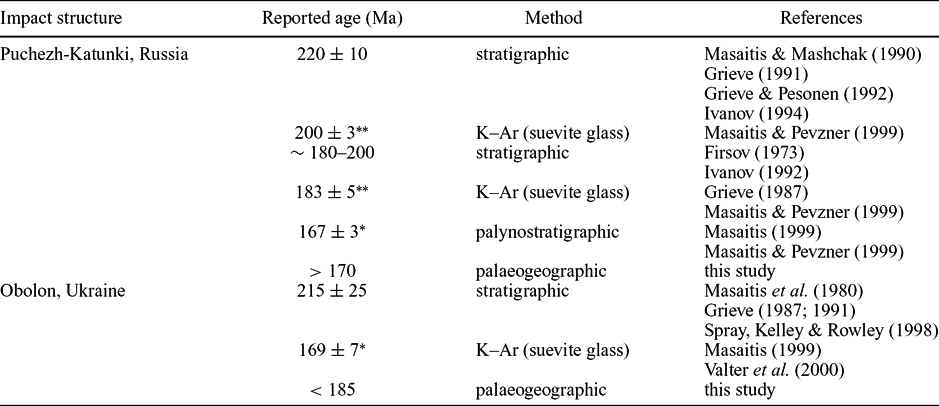
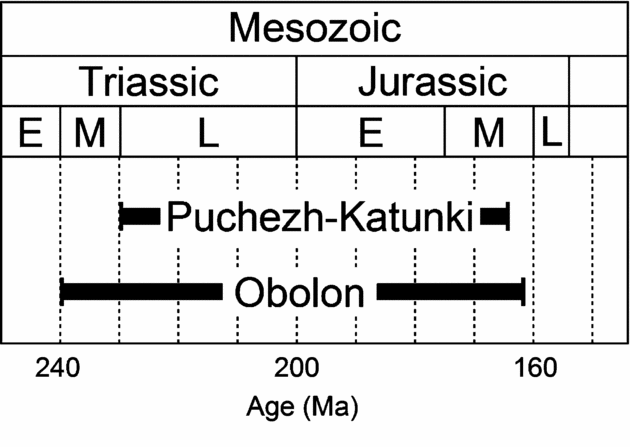
The ~ 80 km diameter Puchezh-Katunki crater (Russia; centred on 56°58′ N, 43°43′ E) counts among the ten largest impact structures known on Earth and even among the five largest that were generated during Phanerozoic time. The whole structure lies within Archaean crystalline and uppermost Proterozoic to Lower Triassic sedimentary rocks of the Russian Platform and is overlain by Middle–Upper Jurassic (crater lake sediments of the Kovernino Formation) and younger post-impact sediments. Impactite lithologies comprise lithic impact breccias, suevites, and subordinate impact melt rocks (Masaitis & Mashchak, Reference Masaitis and Mashchak1990; Masaitis, Mashchak & Naumov, Reference Masaitis, Mashchak and Naumov1996; Masaitis, Reference Masaitis1999; Pálfy, Reference Pálfy, Dypvik and Burchell2005). Enrichment in Os and Ir and specific interrelations of siderophile elements in suevites suggest a chondritic body as impactor for the Puchezh-Katunki structure (Masaitis & Balmasov, Reference Masaitis and Balmasov1996; Masaitis, Reference Masaitis1999). Although extensively studied and deeply drilled in the central uplift area (the Vorotilovo deep scientific well drilled 1989–1992 reached a depth of 5374 m), the Puchezh-Katunki impact structure has not yielded reliable age data (Fig. 1; Table 1). Masaitis & Mashchak (Reference Masaitis and Mashchak1990) and Ivanov (Reference Ivanov1994) proposed an age of 220 ± 10 Ma by stratigraphic methods, which would correspond to a Late Triassic impact age. In contrast, K–Ar isotopic dating of impactites by Masaitis & Pevzner (Reference Masaitis and Pevzner1999) resulted in ages of 200 ± 3 Ma and 183 ± 5 Ma, which suggest impact ages respectively at the Triassic–Jurassic transition or for the Lower Jurassic (the latter would also correlate with the first stratigraphic age estimations of ~ 180–200 Ma for Puchezh-Katunki given by Firsov, Reference Firsov1973). Masaitis (Reference Masaitis1999) and Masaitis & Pevzner (Reference Masaitis and Pevzner1999) reported a Middle Jurassic age of 167 ± 3 Ma for Puchezh-Katunki obtained by palynostratigraphic studies of the oldest crater lake deposits. A discussion of the impact age of the large Puchezh-Katunki structure and its possible relation to Mesozoic extinction events is given by Pálfy (Reference Pálfy, Dypvik and Burchell2005), who concluded that ‘the possibility cannot be ruled out that the Puchezh-Katunki impact is coeval with either the end-Triassic or the Early Jurassic (Pliensbachian–Toarcian) extinction’.
Impact ages for the Puchezh-Katunki and Obolon impact structures as reported in the literature (also compare Fig. 1)

*currently accepted as impact age in the Earth Impact Database (April 15, 2008); http://www.unb.ca/passc/ImpactDatabase.
**see also Pálfy (Reference Pálfy, Dypvik and Burchell2005) for discussion.
Impact age ranges for the Puchezh-Katunki and Obolon structures, compiled from the literature (compare Table 1).

2.b. Obolon, Ukraine
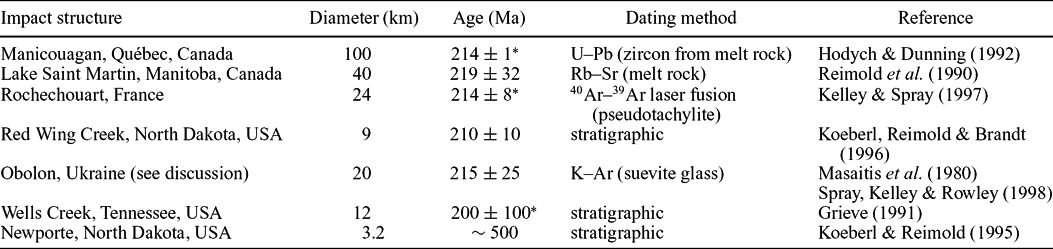
The ~ 20 km Obolon crater (Ukraine; centred on 49°35′ N, 32°55′ E) is located within Carboniferous to Lower Triassic sedimentary rocks that overlie Early Proterozoic crystalline rocks of the northeastern Ukrainian Shield (Donets Graben region). The impact structure, with a deep central annular basin, a flat central uplift, local depressions, and gentle outer slopes, is covered by up to 500 m of Middle Jurassic to Cenozoic sedimentary rocks. Core drilling recovered lithic breccias and suevites in the annular trough of the structure. Small particles of taenite and kamacite found in suevite were interpreted as remnants of the Obolon impactor (Valter & Ryabenko, Reference Valter and Ryabenko1977), probably an iron meteorite (Grieve, Reference Grieve1991; Grieve & Pesonen, Reference Grieve and Pesonen1992). Enrichment in Cl and Br in impact glasses (Gurov & Gurova, Reference Gurov and Gurova1995), together with an inverted sombrero structure and the presence of poorly graded ‘resurge breccia’ deposits in the central crater basin, indicate a shallow marine Obolon impact scenario (Valter, Reference Valter2002). Stratigraphic dating by Masaitis et al. (Reference Masaitis, Danilin, Mashchak, Raikhlin, Selivanovskaya and Shadenkov1980) suggested a most likely Late Triassic age of 215 ± 25 Ma for the Obolon impact structure (see also Grieve, Reference Grieve1987, Reference Grieve1991; Spray, Kelley & Rowley, Reference Spray, Kelley and Rowley1998). K–Ar ages of suevite glass samples, in contrast, yielded a Middle Jurassic age of 169 ± 7 Ma (Masaitis, Reference Masaitis1999; Valter et al. Reference Valter, Asimov, Voizizkji, Sirchenko and Churyumova2000; Fig. 1; Table 1). Spray, Kelley & Rowley (Reference Spray, Kelley and Rowley1998) proposed that the Obolon crater could be part of a semi-global-scale impact crater system (together with the impact structures of Manicouagan, Québec, Canada; Lake Saint Martin, Manitoba, Canada; Red Wing Creek, North Dakota, USA; Rochechouart, France; as well as possibly Wells Creek, Tennessee, USA, and Newporte, North Dakota, USA) that formed during a Late Triassic multiple impact event ~ 214 Ma ago (see Table 2).
Proposed members of a Late Triassic (~ 214 Ma) impact cluster as postulated by Spray, Kelley & Rowley (Reference Spray, Kelley and Rowley1998)

*currently accepted as impact age in the Earth Impact Database (April 15, 2008); http://www.unb.ca/passc/ImpactDatabase.
3. Discussion
Although the Puchezh-Katunki and Obolon impact craters have been well investigated (core drilling, petrography and geochemistry of impactites, sedimentology, geophysics; see Masaitis, Reference Masaitis1999, for summary), both structures are associated with significant age uncertainties. At the large Puchezh-Katunki impact structure, results of stratigraphic dating (220 ± 10 Ma), isotopic dating of impact glasses (200 ± 3 Ma and 138 ± 5 Ma), and palynostratigraphic dating of the lowermost crater lake sediments (167 ± 3 Ma) cover a range of uncertainty of 66 Ma (Fig. 1; see also Pálfy, Reference Pálfy, Dypvik and Burchell2005, for discussion). The same obviously holds true for the Obolon crater (215 ± 25 to 169 ± 7 Ma), which is associated with an age uncertainty of 78 Ma (Fig. 1; see Table 1 for variable impact age data reported in the literature and references).
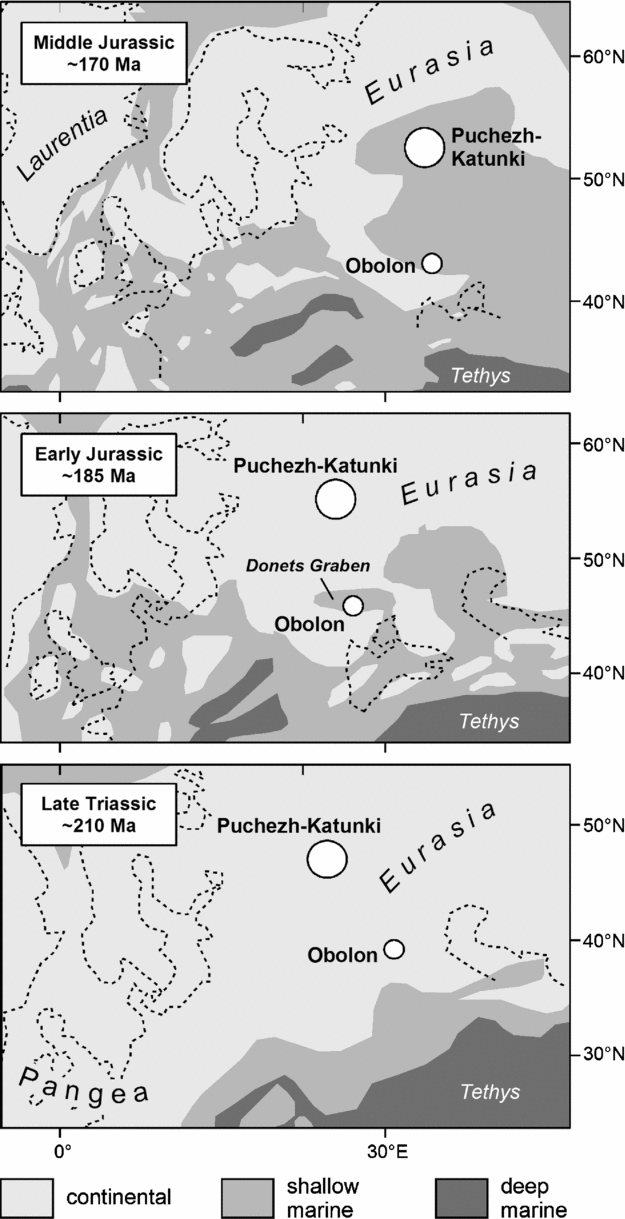
Different environmental (continental or marine) conditions basically influence the development of structural and sedimentary features at terrestrial impact sites (e.g. Dypvik & Jansa, Reference Dypvik and Jansa2005) and can be used to constrain the timing of an impact event. According to palaeogeographic maps by Ziegler, Scotese & Barrett (1983) and Golonka (Reference Golonka2000, Reference Grieve2007), most parts of the Russian Platform and the Ukrainian Shield were continental during Triassic and Early Jurassic time; marine sediments were deposited from Bajocian or Bathonian (~ 170 Ma) time onwards in this region (e.g. Ziegler, Scotese & Barrett, Reference Ziegler, Scotese and Barrett1983; Pálfy, Reference Pálfy, Dypvik and Burchell2005). An exception was the Donets Graben, which was already flooded in Early Toarcian time (~ 180–185 Ma; Krymholts, Reference Krymholts1972; Ziegler, Scotese & Barrett, Reference Ziegler, Scotese and Barrett1983; Pálfy, Reference Pálfy, Dypvik and Burchell2005; Fig. 2). At Puchezh-Katunki, crater lake sediments up to ~ 200 m in thickness (e.g. Masaitis, Mashchak & Naumov, Reference Masaitis, Mashchak and Naumov1996; Pálfy, Reference Pálfy, Dypvik and Burchell2005) suggest that the impact structure formed under continental conditions. The palaeogeographic framework is in general conflict with the recent palynostratigraphic dating results for the Puchezh-Katunki crater (167 ± 3 Ma corresponding to Bajocian–Bathonian time; Masaitis & Pevzner, Reference Masaitis and Pevzner1999; see also Pálfy, Reference Pálfy, Dypvik and Burchell2005 for discussion), as this age would imply a marine impact scenario (Fig. 2). The lacustrine (i.e. continental) crater sediments of the Kovernino Formation, in contrast, rather support a Late Triassic to early Middle Jurassic minimum age (> 170 Ma) of the Puchezh-Katunki impact structure. Stratigraphic dating of the Obolon impact structure suggested an age of 215 ± 25 Ma (corresponding to Middle Triassic to Early Jurassic time; Masaitis et al. Reference Masaitis, Danilin, Mashchak, Raikhlin, Selivanovskaya and Shadenkov1980; see also Spray, Kelley & Rowley, Reference Spray, Kelley and Rowley1998). Impacts into marine targets are characterized by specific (mostly soft) rock deformation behaviour and submarine sedimentary processes involved in crater formation (such as deposition of ‘resurge breccia’; Sturkell, Reference Sturkell1998; Ormö & Lindström, Reference Ormö and Lindström2000; King et al. Reference King Jr, Neathery, Petruny, Koeberl and Hames2002; Dypvik, Burchell & Claeys, Reference Dypvik, Burchell and Claeys2004; Poag, Koeberl & Reimold, Reference Dypvik, Burchell and Claeys2004; Dypvik & Jansa, Reference Dypvik and Jansa2005). From the fact that Obolon is a marine impact structure (Gurov & Gurova, Reference Gurov and Gurova1995; Valter, Reference Valter2002), a Late Triassic crater formation under continental conditions is unlikely. Thus, from a palaeogeographic point of view, marine ingression in the Donets Graben at ~ 180–185 Ma (Ziegler, Scotese & Barrett, Reference Ziegler, Scotese and Barrett1983; Pálfy, Reference Pálfy, Dypvik and Burchell2005; Fig. 2) provides an Early Jurassic maximum age (< 185 Ma) for the Obolon impact structure. This also precludes that the Obolon structure could be a member of the putative ~ 214 Ma Late Triassic multiple impact system postulated by Spray, Kelley & Rowley (Reference Spray, Kelley and Rowley1998). Further field work and refined isotopic dating of suitable materials (e.g. 40Ar–39Ar dating of least-altered impact melt rocks and glasses; high-resolution U–Pb dating of zircons grown in impact melt rocks) will be necessary to obtain more accurate and representative impact ages for both impact structures.
Palaeogeographic map of Eurasia in Late Triassic, Early Jurassic, and Middle Jurassic time (modified from Golonka, Reference Golonka2000, Reference Grieve2007) and the positions of the Puchezh-Katunki and Obolon impact structures (Mollwide projection).

4. Summary and conclusions
In addition to isotopic and stratigraphic dating, palaeogeographic studies can be an appropriate method to check and further constrain possible formation ages of terrestrial impact structures. The available isotopic and stratigraphic ages of the Puchezh-Katunki and Obolon impact structures are highly incoherent and associated with age uncertainties of up to 66 Ma for Puchezh-Katunki (220 ± 10 Ma to 167 ± 3 Ma) and 78 Ma for Obolon (215 ± 25 Ma to 169 ± 7 Ma), respectively. Palaeogeographic reconstructions, according to Late Triassic to Middle Jurassic palaeogeographic maps by Ziegler, Scotese & Barrett (Reference Ziegler, Scotese and Barrett1983) and Golonka (Reference Golonka2000, Reference Grieve2007), suggest that the continental Puchezh-Katunki crater is older than 170 Ma and that the marine Obolon impact structure is younger than 185 Ma. Furthermore, these observations rule out that the Obolon impact structure formed during a ~ 214 Ma Late Triassic multiple impact event as recently discussed. This work underlines that the chronological data for impact craters and impact stratigraphic correlations (e.g. as listed in the Earth Impact Database) should not be applied without careful examination of the original literature.
Acknowledgements
We kindly thank Christian Koeberl, University of Vienna, Austria, for helpful comments on an early draft of our manuscript. We are also very grateful to Fred Jourdan, Curtin University of Technology, Perth, Australia, and an anonymous reviewer for helping to improve the quality of this paper.