

1. Introduction
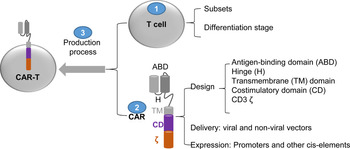
Over the last decade, immunotherapies with checkpoint blockades and adoptive cell transfer (ACT) have made remarkable progress in cancer treatment. The success of immunotherapy requires tumour-specific T cells (Ref. Reference Tumeh1), which do not exist in most tumours. Engineering patient's T cells with T cell receptors (TCR) (Refs Reference Docta2, Reference Zhu3) or chimeric antigen receptors (CAR) (Ref. Reference June and Sadelain4) can provide tumour-specific T cells. ACT of the ‘engineered’ T cells (TCR-T and CAR-T) is a rapidly evolving research field and represents a promising approach of cancer immunotherapy (Refs Reference Rosenberg5, Reference Garber6). CARs target surface antigen and do not have MHC restriction. Additionally, the antibody usually has a 1–3 log higher affinity than TCR. While TCR-T is still in the stage of trials,(Ref Reference Manfredi7) CAR-Ts are approved for haematological malignancies (Table 1). In this review, we only focused on CAR-Ts. Readers are referred to two excellent recent reviews on TCR-Ts (Refs Reference Manfredi7, Reference Zhao8). The complete control of blood cancers by CAR-Ts marks a new era in cancer treatment (Refs Reference Garber6, Reference Newick9, Reference Miliotou and Papadopoulou10). There are ~253 ongoing CAR-T trials for different cancers (Ref. Reference June11). CAR molecule is composed of the antigen-binding domain (ABD), a flexible hinge (H), transmembrane (TM), and intracellular signalling domain (SD) that include 1–2 co-stimulatory domain (CD) and CD3ζ (Fig. 1). The ABD and SD are from different sources and form into one artificial receptor (chimaera) that recognise tumour surface antigen independent of MHC. In this article, we will review the factors that affect the function and antitumour efficacy of CAR-Ts. We will cover the T cell subset selection, CAR design, delivery, expression, and the process of CAR-T production. We hope this review will help us to understand the role of each component in the CARs and to design effective CAR-Ts to generate potent and durable antitumour effects, especially for solid tumours.
The parameters that affect the function and antitumour effects of CAR-T cells.

CAR-Ts approved for treating haematological cancers

FDA, U.S. Food and Drug Administration; AEMPS, The Spanish Agency of Medicines and Medical Devices; NMPA, the National Medical Products Administration of China.
1.1 T Cells
Although allogenic CAR-Ts can be pre-made as ‘off-the-shelf’ with better standardisation, the graft-vs-host diseases is a big hurdle for their success (Refs Reference Depil12, Reference Kim and Cho13). Currently, autologous T cells are the main source for CAR-T generation. The CAR-Ts approved by USA, Spain and China are generated from autologous T cells. The subset of T cells and their differentiation can affect CAR-T's function and antitumour effects.
1.1.1 Subsets
CD4 and CD8 T cells are important in antitumour immunity (Refs Reference Farhood, Najafi and Mortezaee14, Reference Borst15) and used to generate CAR-Ts, alone or in their unselected composition (Refs Reference Yang16–Reference Sommermeyer19). The cytotoxicity of CD8 CAR-Ts can be higher (Ref. Reference Sommermeyer19), equal (Ref. Reference Yang16) or lower (Ref. Reference Wang17) than CD4 counterparts. Although more IFNγ–producing CD8 CAR-Ts were observed upon antigen stimulation (Refs Reference Wang17, Reference Sommermeyer19), CD4 CAR-Ts produced a higher amount of IFNγ, TNFα and IL-2 (Refs Reference Yang16, Reference Sommermeyer19). The CD4 CAR-T outperformance was also observed in the glioblastoma-targeted IL13Ra2-specific (IL13-41BBζ) CAR-Ts (Ref. Reference Wang17), possibly because CD4 cells are less prone to exhaustion than CD8 (Refs Reference Wang17, Reference Agarwal20). The composition of blood CD4 and CD8 cells vary in their activation and differentiation state, especially for cancer patients receiving chemotherapy, which can affect the therapeutic effect and toxicity of CAR-Ts (Refs Reference Turtle18, Reference Jayaraman21). The antitumour effects of CD4 and CD8 CAR-Ts may vary due to their origin, CAR-T design and tumour types, but CD8 and CD4 CAR-Ts have synergistic antitumour activity (Refs Reference Turtle18, Reference Sommermeyer19). The unselected T cells with both CD4 and CD8 are frequently used to generate CAR-Ts. In this approach, CD8 CAR-Ts can undergo rapid activation and provide a prompt response against the tumour, whereas CD4 CAR-Ts persist longer and generate a durable antitumour effect. Together, they work more effectively than their own. Though CAR-Ts are usually generated ex vivo, a recent study reported in vivo selective transduction CD8 and CD4 cells by CAR genes. Using lentivirus with either CD8α- (CD8-LV) or CD4-specific DARPin (designed ankyrin repeat protein) (CD4-LV) as entry receptor, Agarwal et al. selectively delivered CAR gene into CD8 or CD4 T cells in NSG mice (Ref. Reference Agarwal20). CD4-LV exhibited superior antitumour effects compared to CD8-LV alone or even in their combination.
1.1.2 Differentiation stages
T cells undergo differentiation from naïve (TN) to stem-like memory (TSCM), central memory (TCM), effector memory (TEM), and effectors (TE) (Ref. Reference Restifo and Gattinoni22). In a mouse study, ACT of the activated tumour-specific CD8 cells derived from TCM generated stronger antitumour effects compared to TEM CD8 cells (Ref. Reference Klebanoff23). Then, they showed that the activated CD8 T cells derived from TN generated stronger antitumour effects than that from TCM (Ref. Reference Hinrichs24). In a non-human primate study, the CD8 T cells with TCM phenotype persisted longer in vivo (Ref. Reference Berger25). Similarly, the CAR-T's proliferation and persistency are affected by their differentiation states as well (Ref. Reference McLellan and Ali Hosseini Rad26). CAR-Ts derived from TN, TSCM and TCM have a greater proliferative potential and longevity (Refs Reference Busch27, Reference Sadelain, Riviere and Riddell28). In one study (Ref. Reference Sommermeyer19), investigators found that human CD4/CD8 CD19 CAR-Ts derived from TN had the highest cytokine secretion, followed by TCM and TEM. The in vivo antitumour efficacy of the CD4 CAR-Ts derived from different differentiation stages follows the same order: TN > TCM > TEM. In contrast, for CD8 CAR-Ts, those derived from TCM generated longer antitumour effects (TCM > TN = TEM). Importantly, a combination of the TCM-derived CD8 CAR-Ts with the TN-derived CD4 CAR-Ts resulted in complete tumour eradication in treating leukaemia xenografts. Thus, it is generally believed that CAR-Ts generated from defined T cells subsets (TN and/or TCM) may be more effective.
1.1.3 CD26hi T cells
CD26 is a marker for terminal TE. However, in contrast to conventional reasoning, one study showed that the CAR-Ts generated from using CD26hi CD4 T cells persisted and regressed solid tumours (Ref. Reference Bailey29). Further study showed that the CD26high CD4 T cells are a distinct cell population and can be used to develop CAR-Ts with enhanced antitumour effects in treating solid tumours (Ref. Reference Nelson30).
2. CAR design
CAR, the other component of CAR-T, has four major domains: ABD, H, TM, and SD (Fig. 1) (Ref. Reference Jayaraman21). The selection and design of each domain affect CAR-T activation and antitumour effects.
2.1 ABD
The ABD recognises tumour antigen and confers specificity to CAR-Ts.
2.1.1 Targets
An ideal target should have high coverage to recognise all tumour cells, high specificity to prevent toxicity, and stable expression to maintain durable CAR-T recognition (Ref. Reference Wei31). However, such an ‘ideal’ target is rare. Instead, shared antigens are frequently targeted. For example, CD19 is on both normal and malignant B cells. Although CD19 CAR-Ts lead to B cell aplasia, this ‘on-target/off-tumour’ toxicity is tolerable and can be managed by immunoglobulin replacement (Ref. Reference Hill32) or by CAR-T removal (Ref. Reference Paszkiewicz33). Loss of antigen is a common mechanism of CAR-T therapy failure (Refs Reference Shalabi34, Reference Majzner and Mackall35). Even initial response was outstanding in multiple trials, long-term follow-up revealed that a notable proportion of patients received KYMRIAH (Ref. Reference Grupp36) or YESCARTA (Ref. Reference Oak37) relapsed with CD19-negative leukaemia. Other B-cell restricted surface molecules such as CD20, CD22, and CD123 are detected in patients with CD19-negative relapses (Refs Reference Haso38, Reference Ruella39). CD19 CAR-T failure due to loss of CD19 was overcome by using another single-targeted (Ref. Reference Fry40), sequential infusion of 2 single-targeted CAR-Ts (Ref. Reference Huang41), or dual/multi-targeted (Refs Reference Ruella39, Reference Gardner42) CAR-Ts. Antigen density on tumour cells also affects the cytotoxicity and cytokine production of CAR-Ts (Refs Reference Majzner43, Reference Watanabe44). Using CD20 CD28ζ CAR-Ts and target cells with various levels of CD20, Watanabe et al. demonstrated that the antigen threshold was ~200 and a few thousand molecules per target cell for lytic activity and cytokine production, respectively (Ref. Reference Watanabe44). Similarly, low expression of targets CD19 (Ref. Reference Majzner43), CD22 (Ref. Reference Ramakrishna45), EGFR (Ref. Reference Caruso46), and anaplastic lymphoma kinase (ALK) (Ref. Reference Walker47) might negatively affect CAR-T function and persistence. The epitope location (membrane-proximal or distal) determines the synapse cleft distance and kinetic segregation of phosphatases like CD45. This will affect the signalling strength and cytotoxic granule delivery (Refs Reference Jayaraman21, Reference Srivastava and Riddell48). The consensus view is that CAR-Ts targeting membrane-proximal epitopes generate stronger effects. The CAR-Ts targeting the membrane-proximal epitope of mesothelin (Ref. Reference Zhang49) and CD33 (Ref. Reference Godwin50) or membrane-distal epitope of CD22 (Ref. Reference Velasco-Hernandez51) could be modified by regulating the length of the hinge to enhance antitumour function (see section 2.2).
2.1.2 scFv (single-chain variable fragment)
Although other molecules, such as IL13 (Ref. Reference Wang17), adnectin (Ref. Reference Han52), DARPin (Refs Reference Agarwal20, Reference Hammill53), and nanobodies (Ref. Reference Xie54), are used in CAR design, mAb scFv is the most common ABD due to its size, affinity, and specificity (Ref. Reference Ahmad55). The scFv consists of variable heavy (VH) and light (VL) chains connected by a flexible linker of 10 to 25AA in the format of VH-linker-VL or VL-linker-VH (Refs Reference Rafiq, Hackett and Brentjens56, Reference Guedan57). The scFv derived from murine mAb (FMC63) is used in 5 approved CD19 CAR-Ts (Table 1). While one report showed that both VH-linker-VL and VL-linker-VH orientations had the similar antigen-binding capacity and CAR-T function (Ref. Reference Riano-Umbarila58), other found that the antigen recognition could be maintained only in particular VH and VL orientation (Ref. Reference Cheng59). Murine mAbs are used in approved CAR-Ts, they are immunogenic and may induce anti-drug antibodies (ADA) that cause side effects, CAR-T loss, and therapy failure (Ref. Reference Gorovits and Koren60). Humanised CD19 CAR-Ts (Ref. Reference Zhao61) and fully human anti-CD19 CAR-Ts (Ref. Reference Sommermeyer62) maybe more effective.
2.1.3 Linkers
(G4S)3 and (G4S)4, the 3 and 4 repeats of pentapeptide (Gly–Gly–Gly–Gly–Ser), are the common linkers between VL and VH (Ref. Reference Stoiber63). Glycine and serine contribute for flexibility and solubility, which are critical for scFv proper folding and antigen-binding. Recent studies reported that short scFv linker (G4S)1 enhanced ‘tonic signalling’ in CD22-BBζ and CD33-BBζ CAR-Ts (but not CD19-BBζ CAR-Ts) without causing more exhaustion, but leading to better anti-leukaemic function (Ref. Reference Singh64). In contrast to this beneficial effect, a previous study showed tonic signalling in anti-GD2 CD28ζCAR-Ts resulted in exhaustion and decreased antitumour activity (Ref. Reference Long65), which was ameliorated by replacing CD28 with 41BB. These data suggest that the effect of tonic signalling on CAR-T function depends on multi-factors including target, co-stimulatory domain, and even the length of the linker. Thus, tonic signalling is not always bad for CAR-T function, but needs to be taken into consideration in CAR design (Ref. Reference Hege66).
2.1.4 Affinity and avidity
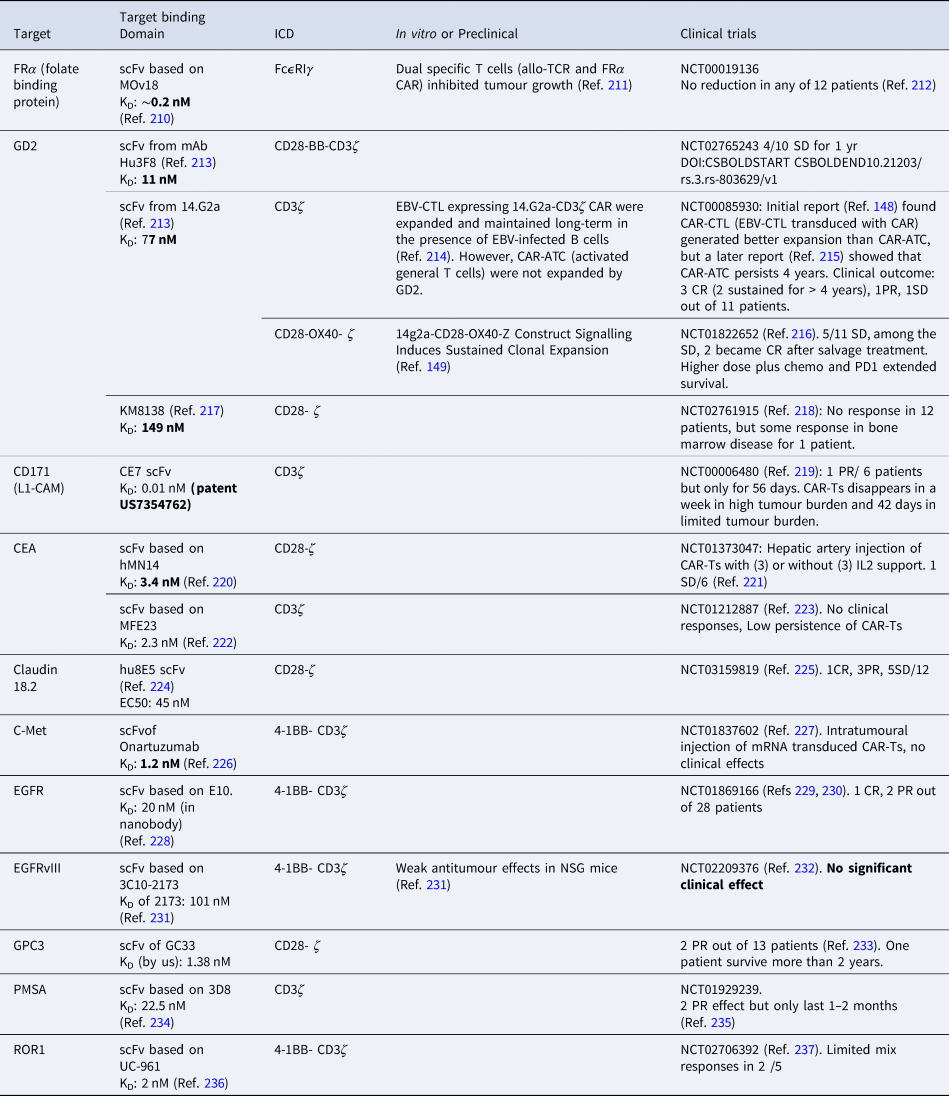
The affinity (single pair of molecular interaction) of scFv and the avidity (multiple pairs of molecular interaction) can affect CAR-T's function and therapeutic effect (Refs Reference Lynn67–Reference Hudecek69). Conventionally, scFvs of high affinity are preferred in CAR-Ts for increased antigen recognition, binding capacity, and tumouricidal effect (Ref. Reference Jayaraman21). However, CAR-T's avidity beyond a certain threshold would not increase efficacy (Ref. Reference Chmielewski70) and even exhibited inferior responses (Ref. Reference Oren71). A recent report showed that a low-avidity CD19 CAR-T enhanced expansion and persistence in treating refractory acute lymphoblastic leukaemia (Ref. Reference Ghorashian72). Drent et al. studied 8 anti-CD38 scFvs covering an affinity of 10–1000 folds (Ref. Reference Drent73). In the study, CD38 CAR-Ts from scFv with ~1000 folds lower affinity could effectively lyse CD38high multiple myeloma cells but not CD38low healthy haematopoietic cells. Recently, how the biophysical properties of CAR (affinity, avidity, and antigen density) contributed to CAR-T function was further studied using CD28ζ CAR-Ts with varying avidity to the same antigen, HLA-A2/Tyrosinase369–377 (Ref. Reference Greenman74). The CAR-T derived from the highest-affinity scFv (4 nM) showed a lower lytic response determined by CD107a, as compared to CAR-Ts from intermediate-affinity scFv (35 and 16 nM). The CAR expression and CAR-T avidity, measured by Tyr/HLA-A2 monomer and multimer binding respectively, correlated with each other in CAR-T function. Increasing avidity resulted in high sensitivity to low antigen concentrations. However, the polyfunctional CAR-Ts (IFNγ, TNFα and IL2 triple-positive) was more in the medium-avidity CAR-Ts. In summary, the intermediate avidity CAR-Ts can reduce the ‘on target/off tumour’ activity by recognising only antigen-high tumour cells (Ref. Reference Drent73), but also are more polyfunctional, correlating to better clinical efficacy (Refs Reference Sommermeyer62, Reference Stoiber63) (Table 2).
Summary of 14 completed clinical trials of solid tumour CAR-T therapy: scFv affinity vs clinical efficacy

The underlying mechanism how intermediate avidity CAR-Ts generated a strong and durable antitumour effect is unclear. Weber et al. reported that in vivo persistence and antitumour effects of CAR-Ts could be improved by temporarily suppressing CAR expression (Ref. Reference Weber75), suggesting that transient disengagement between CAR-T and tumour may avoid exhaustion or to restore their functionality. Recently, we developed a novel 8F8 mAb that recognised a human glypican 3 epitope next to that of the widely used GC33 mAb, but had 17 times lower affinity (Ref. Reference Caraballo Galva76). Despite different avidity, 8F8 and GC33 CAR-Ts possess similar in vitro function. However, in vivo study showed more 8F8-BBζCAR-Ts in the tumour than GC33 CAR-Ts. Importantly, the tumour-infiltrating 8F8 CAR-Ts were less exhausted and better functional than GC33 CAR-Ts, generating durable antitumour effects in treating HCC xenografts. The low-avidity 8F8 CAR-Ts were in a ‘lightly exhausted’ state (PD1lo), whereas high-avidity GC33 CAR-Ts exhibited ‘deeply exhausted’ (PD1hi) (Ref. Reference Xu-Monette77). Compared to high-avidity CAR-Ts, the unstable engagement (Slow on/Fast off) between the low-avidity CAR-Ts and tumour cells may provide a transient break for CAR-Ts and prevent them from exhaustion and apoptosis inside solid tumours.
2.2 Hinge (H)
Hinge is the spacer between scFv to TM. It contributes to the flexibility of scFv and the synaptic distances during CAR-antigen engagement (Refs Reference Jayaraman21, Reference Hudecek78, Reference Guest79). The optimal hinge length depends on the location of the antigen epitope and steric hindrance on cancer cells. The length of the hinge should provide adequate synaptic cleft distance and enhance epitope binding by scFv (Refs Reference Srivastava and Riddell48, Reference Hudecek69). In general, a short hinge is more suitable for CAR targeting membrane-distal epitopes (Refs Reference Hudecek69, Reference Hudecek78), whereas a long hinge is flexible and more effective for CAR targeting membrane-proximal epitopes that are often sterically hindered (Ref. Reference Wilkie80). Two types of the hinge are in current CARs.
2.2.1 IgG-based hinges
Are from human IgG (IgG1 and IgG4) CH2 and CH3 domains (Ref. Reference Guedan57). The CH2 domain of IgG1 and IgG4 can interact with Fcγ receptors, resulting in ‘off-target’ toxicities and activation-induced cell death. Modification or deletion of the CH2 domain could minimise this side effect (Refs Reference Jayaraman21, Reference Guedan57). The IgG4 hinge is in one FDA-approved CAR-Ts (BREYANZI).
2.2.2 CD8α and CD28 hinges
Are naturally without FcγR binding site and used in most FDA-approved CAR-Ts (Refs Reference Jayaraman21, Reference Guedan57). Alabanza et al. demonstrated that CD19 CARs with H/TM from human CD28 or CD8α had similar anti-tumours in mice (Ref. Reference Alabanza81). However, CARs with CD8α-H/TM may have a clinical advantage due to lower cytokine production. On the other hand, Majzner et al. reported that CD28-H/TM had a more stable and efficient immunological synapse that could enhance CD19 CAR-Ts to recognise low antigen (Ref. Reference Majzner43). In addition, CAR-T with CD28-H showed stronger lytic activity although the CAR level of CD8α-H and CD28-H are similar. CAR-Ts with H/TM from CD8α or CD28 had higher antigen-specific cytotoxicity compared to the basic CD3ζ CAR-T, indicating that TM is another crucial factor to affect CAR-T function. However, it was still difficult to identify which domain (H or TM) contributed to the different CAR-T function as the H and TM were changed simultaneously. In addition, the H length affects CAR-T function. In a recent study, six anti-VEGFR2 CARs were generated in which the H/TM from CD4, CD8α, and CD28 was exchanged individually in the basic CD3ζ CAR (Ref. Reference Fujiwara82). The data showed that longer H length (CD8α:65AA and CD28:36AA) had a higher expression that CAR with shorter H (CD4:23AA and CD3ζ:9AA). In another study (Ref. Reference Ying83), a series of anti-CD19 CARs were generated based on CD19 CD8α-H/T BBζ prototype (71aa) (Kymriah) by altering H and intracellular domain, but not TM. The CD19-BBζ CAR (86aa) variant contains 86aa from CD8α with a longer extracellular fragment (55aa versus 45aa) and a longer intracellular sequence (7aa versus 3aa). These CD19-BBζ (86aa) CAR-Ts had a lower level of expansion and cytokine production than Kymriah, but achieved complete or partial remission with no neurotoxicity or CRS in 15/25 patients. This data further indicates that hinge plays a key role in CAR-T function and safety.
2.3 TM
TM was frequently selected together with upstream H and/or downstream SD. It anchors scFv to the cell membrane and contributes to CAR expression, stability, and CAR-T function (Ref. Reference Fujiwara82). CD19 CAR with CD28-TM domain was more stable on T cell surface than CD19 CAR with a CD3-ζ TM domain (Ref. Reference Savoldo84). However, CD28-TM but not CD8 TM domain in the CAR could form a heterodimer with the endogenous CD28, which may affect CAR-T's function (Ref. Reference Muller85). The TM can also regulate CAR signalling and CAR-T function by CAR expression level (Ref. Reference Fujiwara82). H/TM domains from CD8α and CD28 are used in the FDA-approved CAR-Ts KYMRIAH and YESCARTA, respectively. In addition, the inducible co-stimulator (ICOS), including its TM, improved the anti-tumour response and increased persistence of the 3rd generation ICOS-41BBζ CAR-Ts (Ref. Reference Guedan86).
2.4 SD
The chimeric molecule of antibody and TCR was first created in the late 1980s, in which the VL and VH of mAb were linked to TCRα and TCRβ separately (Refs Reference Kuwana87, Reference Gross, Waks and Eshhar88). In the following study, scFv was linked to CD3ζ to develop the 1st generation CARs (Ref. Reference Eshhar89). The CD3ζ remains an essential component of SD in all following generations of CARs. However, CD3ζ alone did not show significant antitumour effects in vivo (Ref. Reference Sadelain, Riviere and Brentjens90). The addition of 1–2 CD improved CAR-T proliferation, function, persistence, and antitumour effects. The number of CD classify the CARs into 1st (CD3ζ only), 2nd (one CD + CD3ζ), or 3rd (more than one CD + CD3ζ) generation. In general, a CD is placed proximal to the cell membrane, followed by CD3ζ (Ref. Reference Finney91). Different CD may generate different effects on CAR-T activation, expansion, function, and survival (Refs Reference Finney, Akbar and Lawson92–Reference Drent94).
2.4.1 CD28 and 4-1BB
Are the most frequently used CD in CAR design. All the FDA-approved CAR-Ts use CD28 or 4-1BB CD. In general, CD28 CARs confer greater functionality (Ref. Reference Zhao95) and higher sensitivity (Ref. Reference Majzner43). Using cell lines with different CD19 level, Majzner et al. demonstrated that CD28 CAR outperformed 4-1BB CAR against antigen-low tumours, whereas both CD28 and 4-1BB CARs had a similar effect against tumours with high antigen (Ref. Reference Majzner43). In addition, for low-avidity CAR-Ts, the CD28 domain may enhance their cytotoxicity and cytokine secretion (Ref. Reference Drent94). However, the higher functionality of CD28 CAR-Ts comes at a cost. They are less persistent in vivo (Ref. Reference Maude96). In contrast, 4-1BB CAR-Ts have longer persistence with more Tcm (Ref. Reference Kawalekar97). Metabolically, CD28 enhances glycolysis and 4-1BB increases mitochondrial biogenesis in T cells (Ref. Reference Kawalekar97). Interestingly, 4-1BBζ CARs can be re-engineered to enhance functional activity against antigen-low tumour and maintain persistence by incorporating 2 copies of CD3ζ or by replacing the CD8α-H/T domain with CD28 H/T domain (Ref. Reference Majzner43). Furthermore, the use of both CD28 and 4-1BB could improve the antitumour effect of CAR-Ts with very-low affinity scFvs (Ref. Reference Drent94).
2.4.2 Other CDs
From other CD28 and TNFR families were also used in CARs. (1) ICOS belongs to the CD28 family. Incorporation of ICOS resulted in Th17 differentiation and enhanced persistence of both CD4 and CD8 CAR-Ts (Ref. Reference Guedan86), probably due to ICOS-induced PI3 K/Akt signalling (Refs Reference Guedan86, Reference Parry98, Reference Fos99). The CD4 CAR-Ts with ICOS have a‘ helper effect’ that increase the persistence of CD8 cells expressing either CD28- or 4-1BB–based CARs. Furthermore, the 3rd-generation CAR-Ts using both ICOS and 4-1BB displayed superior antitumour effects and increased persistence in vivo compared to the 2nd-generation with ICOS or 41BB alone (Ref. Reference Guedan86). (2) OX40 is a member of the TNFR family. Different from CD28 required for T cell activation and IL2 production, OX40 is expressed after activation and needed for ongoing T cell proliferation and cytokine production (Ref. Reference Croft100). Recently, the antigen-independent effect of various co-stimulatory receptors on T cell proliferation was evaluated by transducing T cells with CD20-BBζCAR with an additional P2A-linked full length of 12 different co-stimulatory receptors (Ref. Reference Zhang101). Interestingly, compared to original CD20-BBζCAR-Ts, expression of OX40 showed the greatest increase in proliferation, followed by CD27-expressing, and GITR-expressing CAR-Ts. In addition, the OX40-expressing CAR-Ts possess enhanced cytotoxicity and reduced apoptosis and exhaustion. Moreover, a co-stimulatory combination of CD28 and OX40 benefited the survival and cytotoxicity of the 3rd-generation CAR-Ts (Refs Reference Guercio102, Reference Hombach and Abken103). (3) CD27 enhanced effector cytokine production and cytotoxicity, and reduced apoptosis with upregulation of Bcl-XL protein (Ref. Reference Song104). In vivo, CD27 signalling enhanced CAR-T's survival compared to CD28, and generated strong antitumour activity similar to CD28ζ and 4-1BBζ CAR-Ts. In a recent study, the T2–27ζ CAR-Ts targeting trophoblast cell surface antigen 2 (T2) was found to exhibit more durable antitumour activity compared to T2–28ζ CAR-Ts via promoting IL7Rα expression to enhance survival and to reduce exhaustion (Ref. Reference Chen105). On the other hand, Wang et al. proposed that CD27 co-stimulation might display dual-function: the transient CD27–CD70 interaction between CD27+ CAR-Ts and tumour cells enhanced antitumour potency, but constitutively CD27 expression induced CAR-T exhaustion and apoptosis (Ref. Reference Wang106). (4) CD3ε improves CAR-T function by mediating CD3ζ signal (Refs Reference Flemming107, Reference Wu108). CD3ε is the only CD3 chain that downregulates Lck activity and associates with CD3ζ phosphorylation and signal transduction by recruiting inhibitory tyrosine kinase CSK. The incorporation of CD3ε cytoplasmic domain into CD19-28ζ CAR at membrane-proximal position results in improved antitumour effect, by negatively regulating excessive cytokine production.
3. CAR delivery vectors and expression promoters
3.1 CAR gene delivery vectors
The majority of the CAR-Ts in development and all seven FDA-approved CAR-Ts were generated by delivering CAR genes with lentivirus or retrovirus (Refs Reference Brentjens109, Reference Noaks110). A small fraction of CAR-Ts was developed by transposon such as sleeping beauty (SB) and PiggyBac (PB) (Ref. Reference D'Aloia111). Compared to viral vectors, gene delivery via transposon is less immunogenic, generating stable genome integration and higher gene expression, which may benefit their clinical application (Ref. Reference D'Aloia111). However, the transduction efficacy of non-viral vector needs improvement.
3.2 Promoters and CAR expression level
The CAR level can affect CAR avidity and CAR-T function. One study found that targeted insertion of CD19–28z CAR into native TCR loci reduced CAR level by two-fold, generating a better antitumour effect by preventing tonic signalling and CAR-T exhaustion (Ref. Reference Eyquem112). In contrast, high-level CARs damages CAR-T's antitumour effects (Ref. Reference Frigault113). The LTR (long terminal repeat) promoter in γ retroviral vector expresses a higher level CAR and causes more CAR-T apoptosis than EF-1α promoter (Ref. Reference Gomes-Silva114). On the other hand, in the lentivirus-mediated CAR-T transduction, among the four promoters (CMV, EF-1α, hPGK and RPBSA), EF-1α promoter yielded the strongest cytotoxicity, especially for longer genes (Ref. Reference Rad115). In another study, Ho, et al. reported that the replacement of EF1α with MND promoter in the CD19-BBζ could reduce CAR density and increase the transduction rate (Ref. Reference Ho116). The MND-driven CAR-Ts had prolonged activity with low IFNγ and toxic effect in the preclinical study. ABECMA, an MND-driven CAR-T targeting B Cell Maturation Antigen, was recently approved by FDA for refractory/relapsed multiple myeloma.
4. CAR-T production
The CAR-T production process includes T cell isolation from patient peripheral blood, activation by anti-CD3/CD28 coated beads, CAR transduction, and CAR-T expansion. The optimal manufacturing process is an important step to generate high-quality CAR-Ts (Ref. Reference Stock, Schmitt and Sellner117). (1) The ratio of anti-CD3/CD28 coated beads versus T cells needs to be optimised so that the T cells are sufficiently activated, but not over-activated to be driven into exhaustion (Ref. Reference Kalamasz118). (2) In the process of CAR-T production, IL2 is present in media. The use of other common γ chain cytokines (γc-cytokines) such as IL7, IL15 and IL21, alone or in combinations IL7/IL15 (Refs Reference Zhou119–Reference Gargett and Brown122), IL4/IL7, and IL4/IL7/IL21 (Ref. Reference Ptáčková123) have been reported to produce superior CAR-Ts with a higher percentage of TCM.
5. CAR signalling and CAR-T function
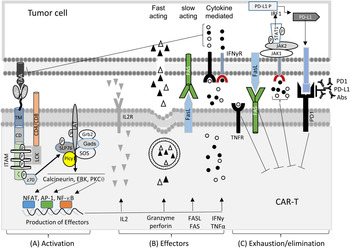
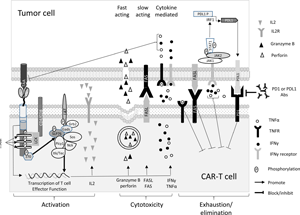
Proper CAR signalling is critical for CAR-T's activation, effector function and antitumour effects (Fig. 2). As CAR contains CD3ζ and CD, CAR signalling may follow TCR signalling pathways. Two recent reviews compared the signalling of TCR and CAR (Ref. Reference Wu124) and among different CARs (Ref. Reference Lindner125). Here, we highlight the main points.
The schematic diagram of CAR signalling and CAR-T activation (A), the effector function of CAR-Ts to kill tumour cells (B), and the exhaustion/death of CAR-Ts by persistent tumour antigen stimulation (C).

5.1 TCR signalling
TCR signalling is well delineated (Refs Reference Courtney, Lo and Weiss126, Reference Hwang127). Briefly, co-receptor CD4 or CD8 helps TCR-MHC/peptide engagement and bring leukocyte-specific tyrosine kinase (Lck) to the TCR complex. The Lck phosphorylates the immuno-tyrosine activation motif (ITAMs) in CD3ζ, CD3δ, CD3ε, and CD3γ, which recruit and phosphorylate Zap70. Zap70 phosphorylates a membrane-associated scaffolding protein, linker for activation of T cells (LAT), which become a docking site for other signalling proteins, including Grb2, Sos, Slp-76, and PLC-γ1. The Sos/Grb2 activates RAS guanyl nucleotide-releasing protein (RasGRP)-MAPK-Erk and transcription factor AP-1. The activated PLC-γ1 cleave phosphatidylinositol triphosphate (PIP2) to generate diacylglycerol (DAG) and inositol trisphosphate (IP3). DAG, a membrane-associated lipid, activates protein kinase C θ (PKC-θ), participating in the pathway leading to the nuclear entry of NF-κB. DAG also activate RasGRP-MAPK pathways, leading to activation of AP-1. IP3, on the other hand, stimulates the efflux of Ca2 + from ER to the cytoplasm. Elevated Ca2 + activates calcineurin, which dephosphorylates NFAT. Dephosphorylated NFAT enters the nucleus to join AP-1 and NF-κB to induce specific gene transcription. Productive T cell activation also needs co-stimulation from CD28, CD2, CD5, CD30, 4-1BB, OX40, LFA-1 and ICOS.
5.2 CAR signalling
CAR combines CD3ζsignal 1) and co-stimulatory (signal 2) and may use similar signalling machinery as natural TCR (Refs Reference Wu124, Reference Lindner125, Reference Salter128) (Fig. 2A). However, there are several major difference between TCR and CAR signalling. (1) The signal triggering of TCR and CAR may be different (Ref. Reference Wu124). While TCR does not need clustering (Ref. Reference Brameshuber129), CAR requires oligomerisation (Ref. Reference Chang130), to initiate signalling. Thus, soluble antigen does not normally activate CAR-Ts. (2) CAR forms a nonclassical immunological synapse (Ref. Reference Davenport131). (3) The sensitivity of TCR and CAR is different. TCR can detect as few as one MHC/peptide complex, while CAR requires at least hundreds of antigen even though it has a higher affinity (Ref. Reference Watanabe44). (4) Though CD28 and 4-1BB CD are associated with PI3 K-Akt and TNFR-associated factors (TRAFs), respectively (Ref. Reference Lindner125), they activated similar signalling proteins based on phosphor-proteomic analysis (Ref. Reference Salter128). In addition, compared to 4-1BBζ, CD28ζ CARs activated faster and higher-magnitude changes in protein phosphorylation, correlating with effector T cell phenotype and function. (5) The 3rd gen CD28-BBζ CAR-Ts showed enhanced activation by phosphorylation level of the signalling proteins than 2nd gen CAR-Ts (Ref. Reference Karlsson132), and may benefit antitumour effect of CAR-Ts with very-low-affinity scFvs (Ref. Reference Weinkove93). However, a contradictory report does exist, which showed 2nd gen CAR promoted stronger TCR signalling than 3rd gen CARs (Ref. Reference Ramello133).
5.3 CAR-T function
CAR-Ts may use a similar mechanism as natural T cells to exert their cytotoxicity and to undergo exhaustion after strong and persistent engagement with tumour cells (Ref. Reference Benmebarek134) (Fig. 2B, 2C). (1) Fast-acting lytic activity. This fast-acting cytotoxicity depends on the perforin/granzyme B (Ref. Reference Voskoboinik, Smyth and Trapani135). Granzyme B induces caspase-dependent and independent apoptosis whereas perforin enables granzyme B enters target cells by forming pore (Ref. Reference Meiraz136). (2) Slow-acting lytic activity. Fas/FasL mediates caspase-dependent apoptosis (Ref. Reference Meiraz136). The Fas/FasL pathway plays a key role in the on-target killing of antigen-positive as well as off-target ‘bystander’ killing of antigen-negative tumour cells (Ref. Reference Upadhyay137), preventing tumour escape. But, Fas/FasL also cause the death of stimulated T cells (Ref. Reference Siegel138). A recent report showed that CAR-Ts were prone to Fas-mediated cell death (Ref. Reference Tschumi139), whereas the use of Fas-DNR (dominant-negative receptors) engineered CAR-Ts resulted in intrinsic disruption of Fas signalling, and leading to longevity and superior antitumour efficacy (Ref. Reference Yamamoto140). (3) IFNγ and TNFα mediated cell death. Activated CAR-Ts secrete IFNγ and TNFα into the target cell by exocytosis and induce tumour cell death (Ref. Reference Zhang141). Similar to Fas/FasL, TNFα and IFNγ can induce bystander eradication of antigen-lost tumour variants. However, the role of TNFα and IFNγ on tumour progression and immunotherapy is paradoxical. TNFα can promote tumour progression by inducing TNFα-dependent tumour cell dedifferentiation (Ref. Reference Landsberg142), triggering TNF/TNFR1 signalling and T cell death (Ref. Reference Bertrand143), and promoting Treg (Ref. Reference Torrey144). Similar to TNFα, IFNγ exposure reduced antigen expression (Ref. Reference Le Poole145). IFNγ is also a strong inducer of PD-L1 expression on tumour cells, which increase CAR-T exhaustion. Furthermore, the increase of these cytokines may lead to cytokine release syndrome and activation-induced cell death (Refs Reference Montfort146, Reference Jorgovanovic147).
6. CAR-Ts for solid tumours
Most human tumours are solid tumours. Scientists and physicians had been studying CAR-T therapy on solid tumours for nearly two decades (Refs Reference Pule148–Reference Rossig150). However, compared to the ~80% complete remission in blood cancers (Ref. Reference Aamir151), CAR-T therapy in solid tumours generated limited effects even to this day. One meta-analysis of 22 clinical trials and 262 patients showed only a 9% of response rate (Ref. Reference Hou152). In another review of CAR-T solid tumour therapy (Ref. Reference Schaft153), the authors summarised 42 clinical trials of 375 patients. There were 13 complete responses, 35 partial responses, four mixed responses, and 121 stable diseases. The low efficacy of solid tumours may attribute to various reasons, which include antigen heterogeneity, low tumour infiltration, suppressive TME, short CAR-T survival, and life-threatening toxicities. In this section, we are going to review potential strategies to improve the efficacy of CAR-Ts in treating solid tumours.
6.1 Optimise CAR design for better tumour recognition
As discussed in section 2, recognition of tumour cells by CAR-Ts can be optimised by adjusting CAR avidity, epitope location, the hinge, TM, and the signalling domain (Ref. Reference Majzner43). In addition, optimal CAR design includes targeting multiple epitopes on the same antigen (Refs Reference Zhao61, Reference Gu154), a 2nd different target antigen (Ref. Reference Fry40), 2 or more antigens sequentially (Tandem CARs) (Ref. Reference Huang41) or simultaneously (Ref. Reference Bielamowicz155).
6.2 Co-express protein payloads
The 4th generation CAR-Ts, also named as Truck (T cells redirected for antigen-unrestricted cytokine-initiated killing), are CAR-Ts with a constitutive or inducible transgenic ‘payload’ including cytokines (IL7, IL12, IL15, etc.) (Ref. Reference Hurton156) or chemokines (CCL19) (Refs Reference Chmielewski and Abken157–Reference Jin159), which improve TME (Ref. Reference Chmielewski, Hombach and Abken160), prevent CAR-T exhaustion (Ref. Reference Xu120), reactivate endogenous innate lymphocytes to exert their anti-tumour responses (Ref. Reference Jin159), or increase CAR-T trafficking and infiltration (Ref. Reference Di Stasi161). Furthermore, the 5th generation CAR-Ts were being developed by incorporating the JAK-STAT activation domain between CD28 and CD3ζ, leading to increased proliferation and persistence but decreased differentiation of CAR-Ts (Ref. Reference Kagoya162).
6.3 Co-express immunostimulatory RNA
In the latest study (Ref. Reference Johnson163), June and colleagues reported that co-expression of RN7SL1 RNA enhanced CAR-T expansion and persistence, and reduced exhaustion. Importantly, the RN7SL1 RNA could activate myeloid-derived dendritic cells via RIG1/MDA5 pathway and activation of the endogenous T cell responses, generating broader antitumour immune responses to target tumour variants with antigen-loss.
6.4 Develop variants of mAb/TCR chimaera
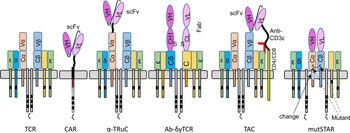
The native TCR complex contains 10 ITAMs on CD3ζ, γ, ε, and δ. In CAR, there are only three ITAMs in the CD3ζ. The use of chimeric VL (VH) with different TCR chains will likely incorporate a native TCR complex to improve CAR-T sensitivity and reduce toxicity. Several studies reported the combination of Fab or scFv with native TCR or co-receptors (Fig. 3).
Different variants of chimeric antibody-TCRs.

6.4.1 TRuC (TCR fusion construct)
In TRuC, scFv is fused to one of the intact TCR chains (except ζ chain) (Ref. Reference Baeuerle164). The data show that some TRuC (ε-TRuC, scFv fused to intact CD3ε) generated better antitumour effects with less cytokine-mediated toxicity.
6.4.2 Ab-γδTCR
Another format of mAb/TCR chimaera is the Ab-γδTCR, which has the Fab domain of H and L chain links to CD3δ or CD3γ chain (Ref. Reference Xu165). The CD19 Ab-γδTCR engineered T cells are less exhausted and lower cytokine production and, but generated compared antitumour effects.
6.4.3 TAC (T cell antigen coupler)
TAC has the scFv for antigen binding fused anti-CD3ε domain and then linked to CD4 or CD8 molecules (Ref. Reference Helsen166). While the scFv binds tumour cells, its anti-CD3ε domain engages with native TCR. In solid tumour models, HER2 TAC-T cells outperformed CD28ζ CAR-Ts with increased tumour infiltration and anti-tumour efficacy and reduced toxicity.
6.4.4 muSTAR
Different from the original CAR design (Ref. Reference Kuwana87), in the muSTAR (mutated Synthetic TCR with Antigen Receptor) (Ref. Reference Liu167), the VL and VH were connected to mutant mouse TCRα or β constant region. The mutant TCR constant region will pair with each other and reduce mispairing with endogenous TCRα and β chains. The muSTAR engineered T cells had overall advantages compared to CAR-Ts. They (1) recognise both antigen high or low tumour cells to avoid ‘tumour escape’; (2) have less auto-activation and tonic signalling; (3) generate stronger tumour killing capacity; (4) have earlier and higher tumour infiltration; (5) are less exhausted. Further improvement in persistence, activity/proliferation of CAR-Ts could be achieved by developing dual targeting muSTAR and by incorporating IL2Rβ/ costimulatory domain. Thus, the muSTAR has superior potential for solid tumour treatment by combining the advantage from CAR for antigen-specific recognition and advantage from TCR for proper recruitment of other molecules for signal transduction. The muSTAR leads to increased T cell activity and less toxic effect, probably by becoming an integral part of the TCR complex (Ref. Reference Baeuerle164).
6.5 Improve CAR-T traffic and infiltration into tumour
For solid tumours, insufficient CAR-T migration, infiltration, and intratumour expansion and accumulation are the likely causes of failure in therapy (Refs Reference Rafiq, Hackett and Brentjens56, Reference Donnadieu168–Reference Tian171). Solid tumour mass is characterised by abnormal angiogenesis and stromal formation, altered chemokine expression, inhibitory checkpoint receptors and hypoxia environment, which are in favour of recruiting immunosuppressive cells such as Tregs but preventing effector immune cells (Ref. Reference Scarfo and Maus172). Several approaches can overcome these obstacles to enhance CAR-T tumour infiltration.
6.5.1 Chemo and irradiation
They are an integral part of ACT as they are often used to pre-condition patients. They induce lymphodepletion to free space for incoming CAR-Ts and modify TME to attract T cells and create a favourable milieu for them to exert their function (Ref. Reference Pocaterra, Catucci and Mondino173). A short course of radiotherapy or chemotherapy before CAR-T treatment benefited CAR-T migration/infiltration by depleting the immunosuppressive cells such as Treg in TME (Refs Reference Donnadieu168, Reference Xu174). For example, cyclophosphamide treatment generated pro-inflammatory myeloid and T cell signatures in tumours, and enhanced the recruitment of antigen-presenting cells, as well as endogenous and adoptively transferred T cells, resulting in long-term anti-tumour immunity (Ref. Reference Murad175). In another study, Lin et al. reported that ionising irradiation enhanced IL8 secretion by brain tumour cells and that the CD70-specific CAR-Ts co-expressing IL8 receptors CXCR1 and CXCR2 markedly enhanced CAR-T tumour infiltration and antitumour effects (Ref. Reference Jin176).
6.5.2 Targeting stroma cells
Facilitates CAR-Ts across the extracellular matrix (ECM) barrier into tumour lesion. Recent studies showed that CAR-Ts co-expressing heparanase (often lost during CAR-T preparation), an enzyme that degrades heparan sulphate proteoglycans, the main components of ECM, significantly increased tumour infiltration (Ref. Reference Caruana177). Another study showed that inhibition of the NADPH oxidase 4 (NOX4), an enzyme upregulated by cancer-associated fibroblast in the stroma, increased CAR-T tumour infiltration (Ref. Reference Ford178).
6.5.3 Chemokine/chemokine receptors
Play important role in CAR-T migration and infiltration into tumours. Tumour cells can produce certain chemokines in their abnormal growth whereas CAR-Ts often do not express the chemokine receptors. Improved CAR-T infiltration have been reported via the expression of IL7/CCL9 (Ref. Reference Adachi179) that is essential for the recruitment of T cells and DCs from the periphery. In addition, expression of CCR2 (Ref. Reference Craddock180), CXCR2 (Ref. Reference Whilding181) or CCR4 (Ref. Reference Di Stasi161) on CAR-Ts improved infiltration by binding to the CCL2 or IL8 or CCL17/CCL22 elevated in TME. Other pairs of chemokine/chemokine receptors such as CCL5 and CXCL9 may also improve CD8 CAR-T infiltration (Ref. Reference Dangaj182). On the other hand, CXCL12 produced by stromal fibroblasts may prevent T cell infiltration and should be avoided (Ref. Reference Feig183).
6.6 Improve CAR-T survival
CAR-T survival inside the tumour is a critical factor for generating antitumour efficacy. Several strategies are being studied to enhance their survival. (1) The CAR-Ts derived from TN/TCM have an enhanced cytokine production with longevity (Refs Reference Turtle18–Reference Agarwal20, Reference Tay, Richardson and Toh184). (2) The affinity of ABD may be important for CAR-T survival, especially in solid tumour mass. We analysed 14 complete trials of CAR-T therapy in solid tumours (Table 2). We found that CAR-Ts constructed from intermediate affinity scFv (KD from 20–100 nM) generated some clinical responses in all 4 trials. In contrast, 8 other clinical trials with high-affinity CAR-Ts (KD from 0.2–11 nM) showed no clinical responses except one. All the responders have a longer persistence of CAR-Ts. Intermediate avidity CAR-Ts can prevent them from exhaustion and apoptosis due to transient break from continuous stimulation inside solid tumours (Refs Reference Weber75, Reference Xu-Monette77). (3) 4-1BB enhanced mitochondrial biogenesis that benefit for CAR-T persistence and function in hypoxia environment (Ref. Reference Kawalekar97). (4) The 3rd generation CAR-Ts with ICOS-4-1BB (Ref. Reference Guedan86) or CD28-OX40 have longer survival than the 2nd generation CAR-Ts (Refs Reference Guercio102, Reference Hombach and Abken103). 4) Co-expression of stimulatory cytokines and chemokines: IL4/IL7 (Ref. Reference Leen185) and IL-4/IL21 (Ref. Reference Wang186) receptors increase STAT5/STAT3 phosphorylation and improve CAR-T persistence.
6.7 Improve and reprogram TME
Hostile and suppressive TME severely hinder CAR-Ts to exert their function inside tumour lesion. Improving or reprograming TME (Ref. Reference Datta187) could enhance CAR-Ts efficacy in solid tumours. (1) Counteract immune inhibitory molecules: Co-expression of TGFβ receptor (Ref. Reference Chang, Hou and Chen188) (or TGFβ dominant-negative receptor (DNR) (Ref. Reference Bollard189) by CAR-Ts can competitively bind TGFβ to block its immunosuppressive effect. Secondly, co-expression of PD1 DNR (Ref. Reference Cherkassky190) or Fas DNR (Ref. Reference Yamamoto140) on CAR-Ts can block the PD1-PD-L1 inhibitory interaction. Similarly, a combination of PD1-PD-L1 checkpoint inhibitor (Ref. Reference Rafiq191) and tyrosine kinase inhibitor (dasatinib) (Ref. Reference Weber75) also enhanced TME and improved CAR-T survival and activity. In addition, CAR-Ts with ‘payload’ cytokines of IL12 (Ref. Reference Pegram192), IL18 (Ref. Reference Hu193) or IL23 (Ref. Reference Ma194) inhibited Treg in TME. (2) Deplete or reprogram suppressive cells: Treg could be depleted to increase CD8 T effector function and antitumour immunity (Ref. Reference Buchan195). Interestingly, down-regulation of Helios could convert Treg into T effectors (Ref. Reference Nakagawa196). Another study showed knockout of Nrp 1 made Treg lost its inhibitory function and promote antitumour immunity (Ref. Reference Overacre-Delgoffe197). Secondly, tumour associated macrophages could also be reprogrammed to become tumouricidal (Ref. Reference Beatty198). Thus, reprograming tumour macrophages and other myeloid cells is another strategy to improve TME (Ref. Reference Petty199). (3) Remodel tumour vasculature: The neovasculature in the tumour lesion can be targeted to change TME. A study showed that angiogenesis inhibitor Bevacizumab could remodel tumour vasculature to increase tumour infiltration of anti-GD2 CARTs and enhance antitumour effects (Ref. Reference Bocca200). (4) Other approaches such as targeting metabolism (Ref. Reference Bader, Voss and Rathmell201) and tumour stroma (Ref. Reference Valkenburg, de Groot and Pienta202) may also improve TME and create a favourable environment for CAR-Ts to exert their antitumour function.
6.8 Reduce CAR-T toxicity
CAR-T toxicities include on-target/off-tumour toxicity, cytokine release syndrome (CRS), and neurotoxicity. Optimising parameters in the ‘CAR design’ (section 2) can reduce CAR-T toxicity. Other strategies are also studied to reduce CAR-T's toxicity that are well-reviewed (Ref. Reference Yu203). Here, we focus on two novel strategies in CAR design to reduce toxicity.
6.8.1 The SynNotch switch
Notch is a transmembrane receptor. The transmembrane domain (TM) and its connected part of the extracellular domain form the ‘notch core’. Upon engaging with the ligand, the intracellular domain will be released downstream of the notch core by protease. Lim's group found that both the extracellular and intracellular domains could be replaced as long as the notch core is retained to create SynNotch (Refs Reference Roybal204, Reference Morsut205). This modular synNotch design provides extraordinary flexibility in engineering T cells with scFv or other ligands targeting specific tumour antigen. Upon engagement, it releases transcriptional factor to drive CAR expression to target another tumour antigen to initiate killing activity. Such design makes sure the CAR-Ts needs to target 2 tumour antigens to initiate killing to avoid toxicity. It will also restrict the cytotoxicity inside the tumour mass (Refs Reference Choe206, Reference Hyrenius-Wittsten207).
6.8.2 Co-LOCKR protein switch
Recently, Lajoie et al. designed a co-localisation dependent protein switch, latching orthogonal cage–key protein (LOCKR) (Ref. Reference Lajoie208). This Co-LOCKR switch enables AND, OR and NOT Boolean logic operations. (1) They implemented AND gates to redirect T cell target tumour cells expressing two surface antigens while avoiding off-target recognition of single-antigen cells. (2) They also tested the three-input switches that add NOT or OR logic to avoid or include cells expressing the third antigen. Such Co-LOCKR design will increase specificity against tumour cells and thus reduce toxicity.
7. Expert and topical summary
In this review, we gave a comprehensive analysis of different factors that may affect CAR-T's antitumour efficacy. While a clear strategy for designing effective CAR-Ts for solid tumours is still lacking, we think the following aspects should be considered in CAR design for solid tumours. (1) CAR-Ts capable of strong in situ expansion and persistence inside tumour mass: The CAR-Ts should undergo antigen-driven expansion, persist and exert their tumour killing activity inside tumour lesion, and generate memory immune responses after tumour regression. Based on current analysis, a combination of TN/TCM subsets and intermediate avidity CAR may generate expandable and persistent CAR-Ts. As demonstrated in Table 2, 7 of 8 high avidity CAR-Ts trials ended up with no clinical responses, future clinical trials should test more on the intermediate affinity CAR-Ts. In addition, innovative design of CAR-Ts that allow CAR expression only when they encounter target tumour cells may help avoid CAR-T exhaustion and deletion, achieving potent antitumour effects in solid tumours. (2) Invoking endogenous antitumour immunity: Due to the antigen heterogeneity of solid tumours, it is unlikely that CAR-Ts targeting one antigen will generate persistent antitumour immunity to achieve complete responses. Designing CARs targeting multiple tumour antigens in tandem or simultaneously may not only prevent immune escape and relapse, but also help avoid off-tumour toxicity. In addition, we think one important outcome of CAR-T immunotherapy should include the activation of endogenous immune cells to invoke broad antitumour immunity. In this case, CAR-Ts kill tumour cells and release tumour antigens (shared or neoantigens) that can be taken up by proper dendritic cells to cross-prime a patient's own immune system. Thus, CAR-Ts will serve as an immune initiator in addition to the direct killing of tumour cells. The incorporation of an innate activator in the CAR-T to activate dendritic cells will facilitate the activation of the patient's own antitumour immunity. A recent report demonstrated that CAR gene engineered macrophage (CAR-M) could effectively activate endogenous antitumour immune response (Ref. Reference Klichinsky209), suggesting that CAR-Ts and CAR-M may work together to eradicate tumour mass and invoke endogenous broad spectrum of antitumour immunity. (3) Targeting TME: Co-expression of immune therapeutics may create a favourable TME for CAR-Ts to exert effector function to generate antitumour effects inside tumour lesions. Delivery of immune-stimulatory cytokines and chemokines, immune-stimulatory RNA, or immune checkpoint inhibitors may not only improve TME, but also can achieve direct antitumour effects and invoke endogenous immune system to achieve complete and persistent antitumour immunity.
Acknowledgement
The authors like to thank current and previous members of Dr He's laboratory. In addition, over the years, research in He's lab has been funded by NIH/NCI grants (CA168912 and CA235159) and Augusta University startup package.