During the Song (960–1279) and Yuan (1234–1368) dynasties, genealogies (jiapu 家譜, zupu 族譜) served as a means of recording the descent line of a kinship group. Especially in southeast China, these texts, either in manuscript or print form, were used to clarify kinship relations and foster lineage awareness. Elsewhere in China proper, however, genealogies at this time can appear to have been far less popular and prominent. Fewer than ten genealogy texts are mentioned in surviving records from the four centuries of Song, Jin (1115–1234) and Yuan rule in north China.Footnote 1 And, since the compilation of a genealogy is regularly seen as a necessary and often incipient stage in the formation of a lineage in the early stage of its development, that is to say, during the Song and Yuan periods, many scholars have concluded that nothing like the lineage system of southeast China and by extension many of its related social changes emerged in north China at this time. As Cohen's landmark work on north China during the late Qing and the Republican periods demonstrated,Footnote 2 the lack of genealogical texts does not necessarily testify to inactivity in lineage-building. Yet, the conspicuous disparity in genealogical text production between north and south China appears to be associated with a distinct historical trajectory for the social history of the north and, possibly, with a distinct model of lineage development for it until the end of the late imperial period, as Cohen discovered.
In the past decade a major breakthrough has occurred in the study of genealogies, promising a solution to this conundrum. To the surprise of many, several scholars have discovered widespread material evidence of another kind of genealogy of Jin and Yuan origin that had by and large previously escaped the attention of library bibliographers and social historians. Their discoveries are not rare books in a provincial archive, but rather genealogical steles standing erect in north China villages, that is, descent line charts and inscriptions with biographical information carved onto large flat stones firmly bedded into or above the village earth to provide an indestructible record of a family's past.Footnote 3
This type of stele, however new the knowledge of its existence has been to modern scholars, actually was long ago mentioned and discussed in Yuan dynasty records. Given a great variety of names such as “A Stele/Epitaph for the Ancestral Graveyard (xianyingbei 先塋碑, qianbiao 仟表),” “A Stele Recording Ancestral Virtue (xiandebei 先德碑, shidebei 世德碑),” “A Stele Clarifying Ancestral History (zhaoxianbei 昭先碑),” “A Stele Clarifying Ancestral Virtue (zhaodebei 昭德碑),” and “A Tomb Stone for Family X (X shi mubiao X 氏墓表),” it was already judged a new category of stele by the fourteenth-century scholar-official Pan Angxiao 潘昂霄 (dates unknown). As Reader-in-Waiting in the Hanlin Academy (Hanlin shidu xueshi 翰林侍讀學士), he would have had many opportunities to see both old and new stele inscriptions, and in his Jinshi li 金石例 (Examples of Epigraphy), an introduction to epigraphy that categorizes types of stele made between the Qin dynasty (221–206 BCE) and the Yuan dynasty, he notes the brevity of their history: “Steles such as Steles for Ancestral Graveyards, Steles Recording Ancestral Virtue, and Steles Illustrating Ancestors seem to be different from [traditional types of stele like] Spirit Road Steles and grave epitaphs. They have originated in the [present] dynasty [i.e., the Yuan], and in the past during the Tang, Song, and Jin dynasties they did not exist at all.”Footnote 4
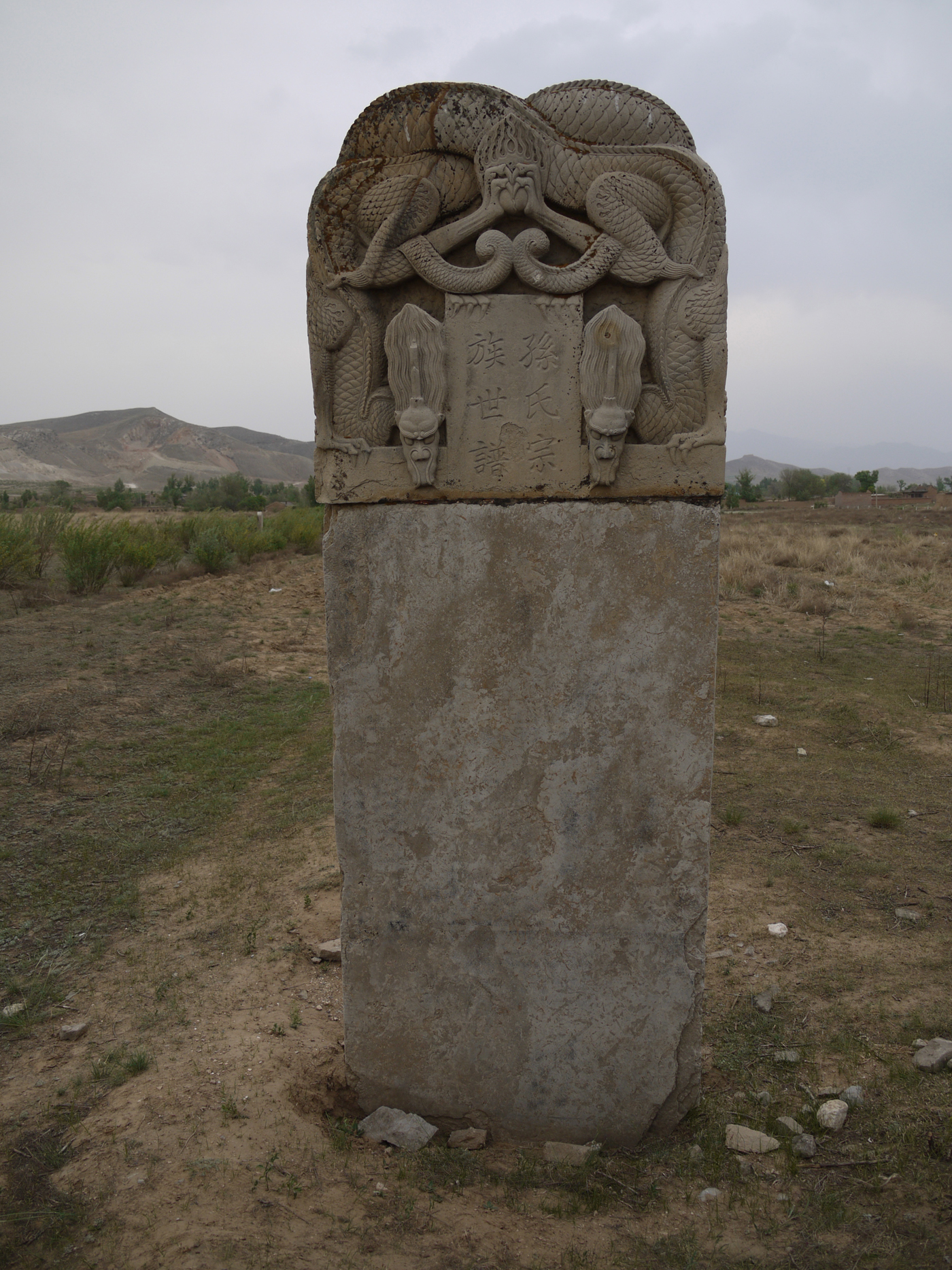
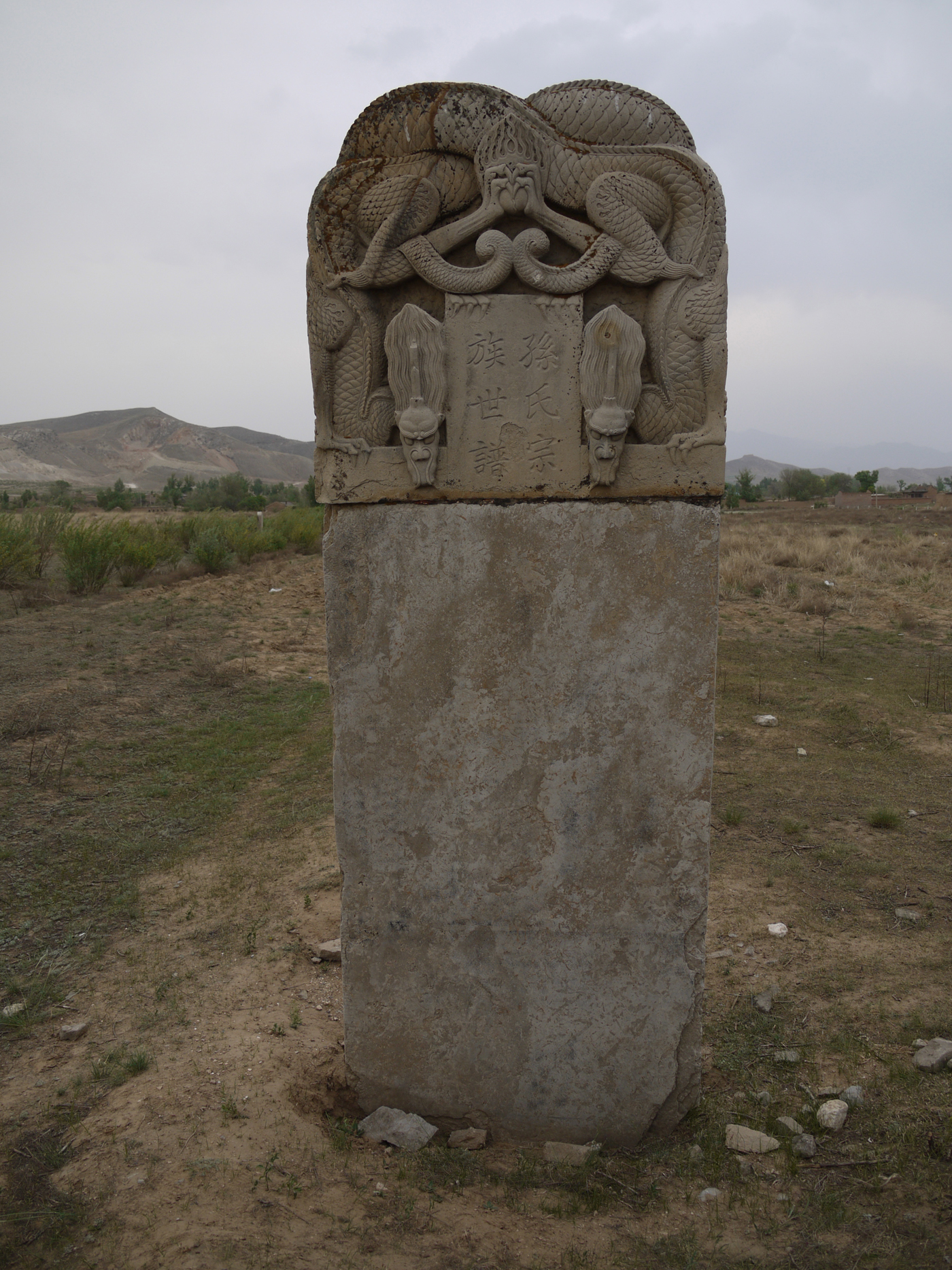
These steles had several characteristics that distinguish them from earlier varieties of stone inscription. They invariably were placed in ancestral graveyards. Many had an inscription carved on the front and a genealogical chart on the reverse. These charts and inscriptions commonly included a body of information about the deceased individual and his kinship group: the name of his earliest or migrant ancestor, the names of kinsmen and their spouses in each subsequent generation of his lineage's descent line, the location(s) of the ancestral graveyard(s), the reasons for erecting the stele, the names of the descendants of its erector(s), the expectations held for their future generations, and instructions on how to read any genealogical chart on the reverse (see Figure 1). These charts, as Pan Angxiao notes, differ from many other descent line charts by “recording the ancestry for three generations and their wives and children.” More than two hundred and fifty inscriptions from such steles survive today, mainly in Qing and later collections of stele inscriptions, and their number increases to around three hundred and twenty when we add inscriptions from the other several tens of steles now known to survive in north China villages. In fact, a comprehensive review of this type of stele uncovers perhaps their most remarkable feature: their explosive increase during the Yuan dynasty.
Genealogical chart on a Yuan stele (photo by author).
In this article I want to take up the challenge of studying the history of genealogies in north China from the Song through the Yuan dynasties and to ask several questions about this area's elite in these four centuries. Firstly, what evidence do we find there of an interest in genealogies as the chosen genre for recording lines of descent and preserving other kinds of information about these descent lines and their members? Secondly, to what extent do we find different genealogy recording practices and institutions that reflect different kinds of kinship organization and local social order in north China from those of southeast China? And, thirdly, what can the differences we discover for the local elite of north China during these centuries suggest to us of long-term trajectories of north China's history that have long been ignored in the unscholarly rush to construct China-wide narratives of social change primarily on the basis of the relatively rich historical materials of the southeast?
To answer these questions, this article will be divided into two sections. The first section, by examining genealogical steles and stele inscriptions that predate the Mongol conquest, will argue that apart from a few well-known cases, educated men in north China in the Song and Jin dynasties generally regarded the practice of inscribing genealogical information onto steles as “vulgar.” The second section is devoted to the Yuan period. It makes a statistical analysis of a comprehensive collection of genealogical steles’ inscriptions to argue that the emergence of this genre of stele and its type of stone inscription were closely related to the emergence of a new local elite stratum under Mongol rule. In particular, the practice of carving a genealogy on steles rapidly spread among office-holding households after the highly disruptive warfare of the Jin-Yuan transition in the 1220s and 1230s. And by the end of the thirteenth century, approximately a century after their appearance, genealogical steles were so closely tied to elite status that Mongol emperors even started to grant a stele and inscription to meritorious subjects as a symbol of imperial favor. Together, these two sections suggest that the Mongol invasion led to a new social order. Access to office and official status was more varied than in the Song and Jin. A new form of elite genealogy, the genealogical stele, became common in the ancestral graveyards of north China, and elite kinship groups showed greater self-awareness as lineages than in the Song and Jin, even if they rarely reached the size and generational depth that were then shaping elite lineage developments in parts of southeast China.
SECTION ONE: THE PRE-JIN GENEALOGICAL STELES IN NORTH CHINA
Ancestral Worship at the Graveyard
Long before the appearance of genealogical steles, the ancestral graveyard had been a focal point for the formation and tightening of agnatic kinship relations. As early as the Han period (206 BCE–220 CE), agnates had assembled at funeral and seasonal sacrifices that were performed alongside graves to confirm and commemorate their common paternal ancestry.Footnote 5 This practice grew in importance over the coming centuries, and was further standardized through the fixing of annual dates for these sacrifices and of the procedures for the attendant ceremonies.Footnote 6 From the Han through the Northern and Southern Dynasties (220–589), the offering of sacrifices at an ancestor's grave was a custom practiced largely by prominent magnate families who could afford the expense. Yet, new customs at the local level facilitated the adoption of this practice of holding periodic graveside assemblies by families of other social strata. While it is still unclear precisely when and how the principal annual occasion of such ceremonies in the Cold Food (hanshi 寒食) FestivalFootnote 7 became enmeshed with the Qingming Festival practice of providing ancestral graveside offerings, eighth-century sources indicate the merger of these two festivals. Families of all social ranks throughout the empire adopted an annual custom of offering sacrifices at their ancestors’ graves on the fifteenth day after the Spring Equinox.Footnote 8
Ancestral worship at graves remained common throughout the subsequent Northern Song period (960–1127). Although no ritual classic prescribed or described the grave visit as a legitimate way to conduct ancestral worship,Footnote 9 neither did any classic ban it. And so, even a critic of the custom like the renowned Song scholar Cheng Yi 程頤 (1033–1107) reluctantly admitted that it did not violate the moral principles he advocated. Moreover, whereas pre-Tang agnates living in separate households tended to construct separate graveyards, Song and post-Song agnates came to view their gravesites as the property of their entire descent group. Membership in the latter group in part became dependent on attendance at regular collective sacrifices and rituals at the graves. Such performances became common during the mid-eleventh century with the rise of enthusiasm for reviving the classical descent-line system (zong system), in which all members of a patriline derived their agnatic descent from a single prime ancestor (shizu 始祖).
In accord with this philosophical and social change several leading figures sought to transform the family graveyard into a primary site of record and remembrance for their own descent group, that is, to serve as a type of visual genealogy. In a project to reconstruct a comprehensive genealogy of his descent line, the eminent scholar-official Han Qi 韓琦 (1008–1075) first dispatched friends and kinsmen to several Han-surname graveyards scattered about modern Hebei, in order to collect and investigate his ancestral tomb inscriptions. Guided by this genealogical information he then tried to transmit accurate descent lines to posterity by planning to place the tombs of his agnates in proper genealogical order (zhaomu 昭穆) within the graveyard of his lineage in Anyang 安陽. Family members in odd- and even-numbered generations were thereby to be buried on, respectively, the right or left side of the prime ancestor's gravesite, with the tombs on both sides arranged by order of generational and then intra-generational seniority. In this way, the entire graveyard was to become a geophysical representation of the Han's descent-line chart. Carved into the landscape, the chart was to be forever visible and unalterable.
Han's contemporary Su Xun 蘇洵 (1009–1066) chose another, ultimately more popular way of attaining permanence for a recording of his family's proper descent line. In addition to creating one of the most influential formats for genealogical texts in Song and later dynasties (i.e., the Supu 蘇譜), Su drew up a genealogy for his own family. Appropriately entitled Sushi zupu 蘇氏族譜, it was carved onto a stele in a Genealogy Pavilion (zupu ting 族譜亭) set up just southwest of the burial mound of his prime ancestor (gaozu muying 高祖墓塋).Footnote 10 Although this stele and its inscription have been lost and so cannot be examined in detail, we know that it presented a unique vision of how to revive an ancient ideal of kinship organization. As a visualization of the agnate descent-line system according to the traditional conception of the zong, the stele became a reference point for performing the appropriate periodic ancestral sacrifices as well as for confirming a person's membership in the Su lineage. In doing so, Su Xun urged each line of descent from their shared great-great grandfather to compile a separate genealogical record, that they all would periodically update and collate together. Likewise, the eminent scholar-official Ouyang Xiu 歐陽修 (1007–1072), who established another archetypal model for a genealogy text (Ouyang pu 歐陽譜), proposed the installation of a stele with genealogical information inside an ancestral graveyard. Ouyang Xiu argued all the descent lines should be included in a collective genealogy; thus, the stele would serve as the primary starting point of reference for all ancestral narratives drawn up by later generations. Patricia Ebrey has persuasively argued that he chose this location because “[the ancestral graveyard] was the place – and probably the only place – where agnates routinely gathered.”Footnote 11
Despite the great attention subsequently accorded their proposals about stele genealogies and kinship organization, Su Xun and Ouyang Xiu were not the originators of genealogical steles. Before the creation of the Su and Ouyang genealogy models, Shi Jie 石介 (1005–1045) and Mu Si 穆涘 (dates unknown), two scholar officials from Fengfu 奉符 (modern Feng'an) and Zhangqiu 章邱 (modern Zhangqiu) counties respectively in Shandong, separately set up steles that recorded several consecutive generations of their kinsmen in their family graveyard. As if acknowledging the early undefined stage of this practice, neither stele's inscription in its title and text refers to a genealogy or family history.Footnote 12 In short, the genealogical stele was not so usual in the Northern Song, and remained a practice without a name.
The Emergence of a “Vulgar” Epigraphic Custom
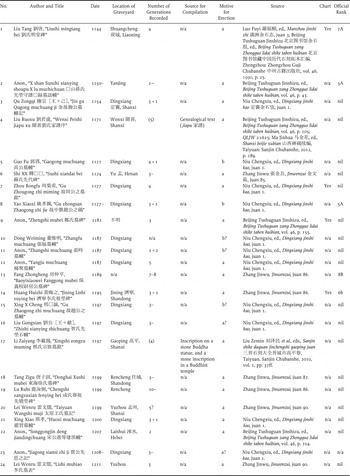
With its imposition of foreign rule onto all of north China the Jin dynasty marked a turning point in the history of genealogical steles. The reigns of Emperors Shizong 世宗 (r. 1160–1189) and Zhangzong 章宗 (r. 1189–1208) in particular ushered in the genre of a commemorative stele inscription, typically entitled “Stele of Ancestral Graveyard” (xianyingbei 先塋碑, or zuyingbei 祖塋碑), “Stele of Descent Group” (zongzubei 宗族碑), “Epitaph of X Clan” (X shi mubei X 氏墓碑), or “Sutra Pillar of X Clan” (X shi muzhuang X 氏墓幢). Such inscriptions were carved onto steles placed in ancestral graveyards or Buddhist temples (the latter's Zunsheng sutra pillars are discussed below). Table 1 (see Appendix) shows the Jin inscriptions that fall comfortably into this genre of inscriptions. In comparing them with their Northern Song predecessors, what first strikes our attention is the fact that the great majority of the installers of steles with these inscriptions (the four exceptions being nos. 1, 8, 13, and 14) came from kinship groups with no other living member holding an official title. This statistical conclusion is supported by the observation of Huang Huizhi 黃晦之 (dates unknown), in “Jining lishi zuying bei” (Table 1, no. 14), that by the Jin period the erection of steles by “commoners (shu 庶)” had become fairly widespread. Nonetheless, some people, presumably well-educated, questioned whether this practice violated burial memorial prescriptions found in the Book of Rites (Li ji). Huang Huizhi's view apparently distinguished genealogical steles from spirit road steles (shendao bei 神道碑), that is, steles with an epitaph commemorating the accomplishments of the deceased, that were placed at the beginning of a tomb passage. While no surviving source discloses the social and intellectual background of Huang Huizhi, his view of “the Steles of an Ancestral Graveyard (zuying bei)” was that they belonged to a genre of stele equivalent to those erected by families unauthorized to put up officially approved steles, such as spirit road steles. As a rule, those many Jin-period families who put up a “Lishi zuyingbei” could boast of no official in their past. The sole example to the contrary is the proverbial exception that proves the rule: a Li 李 ancestor who held only a rank 6b military title (jinyi xiaowei 進義校尉) acquired when he joined the army of the Qi 齊 dynasty (1130–1137), a short-lived puppet state of the Jin. In fact, in the surviving sources we find no Jurchen noble or Han scholar-official with a metropolitan (jinshi) degree who erected such a stele during the entire Jin period.Footnote 13 The fact that Huang Huizhi is the only contemporary to comment on this new epigraphical custom appears to confirm our view that the practice of installing a genealogical stele was not common among the upper strata of Jin society.
Nonetheless, some Jin-period steles date the first appearance of this custom to the early Jin, specifically to the social upheavals of the Song-Jin transition and to the period after the failed incursion into Southern Song territory by Jin forces under Hailing Wang 海陵王 (r. 1149–1161) in 1161. Whereas fear of war and military conflagration were never mentioned in the Northern Song to justify the installation of genealogical steles, from the mid-twelfth century such justifications become the norm in north China. For example, the stele entitled “Wenxi Peishi jiapu xu 聞喜裴氏家譜序” (Table 1, no. 4, dated 1171) discloses how one kinship group's anxiety about its family records leads to its inscription of a genealogical chart onto a stele:
In the Spring and Autumn Period kings, marquises, ministers, and grandees formerly had genealogies (shipu). What the former Confucian scholars recorded was very broad. The genealogical text in the family collection of the Pei family emulates them and so, beginning with a single descent line, that next divided into three descent lines. When the segments and branches are listed in detail, the traces and echoes of their degree holders over a thousand years can be said to be easy and simple to look into as well as clear and easy to know. Peibo is the ancestral home (zhuang 莊) of the Pei family. Hitherto, our elders have transmitted the family genealogy (jiapu). They stored it up as a treasure and rarely showed it to others. To our regret, due first to war and subsequently to banditry, we have constantly worried that the genealogy would be damaged and lost. One day, Pei Zaixing, a distant descendant, consulted with other descendants, saying, “There formerly was a blank stele alongside an ancestral graveyard. It was brought to our village later and was set up at the roadside for years. Do-gooders have passed by and noticed that it was missing a text, and they have repeatedly lamented this. Now we wish to take the model chart of [our] family genealogy and carve it onto this stele. Not only then will people far and near gaze upon the glory [of our family] but also [this] is a scheme that will not deteriorate and disappear.” The lineage members (zuren) hearing this were all delighted to follow [his advice]. Together they employed workers, collected the funds, and also polished the surface of the stele. Then they used it to make a record as follows …
Clearly, the Peis already had a conventional genealogy, in the form of a chart or text that recorded the name and official career of its major patriarchsFootnote 14 (in fact, it is one of just ten genealogies known to have been compiled in north China during the Song, Jin, and Yuan).Footnote 15 Interestingly, some members of the Pei lineage, concerned after the Jurchen conquest that their precious genealogy text might disappear, took the unconventional step of having their descent chart copied onto an abandoned blank stele and not, as in the south, having it printed and circulated. Another stele inscription, the “Liushi mingtangbei 劉氏明堂碑” (Table 1, no. 1, dated 1144) specifically attributes certain Chinese families’ decisions to erect steles to the devastation they suffered during and after the Jurchen conquest of north China, as some northerners in these turbulent years wanted a more durable medium than paper or silk to preserve their family's genealogical records. Stone, not surprisingly, was judged the most durable material readily available for such an enterprise, as is acknowledged in the inscription on “Chengshi zangzu xianfenying bei 成氏葬祖先墳塋碑” (Table 1, no. 19, dated 1199). Typically, this stele inscription goes on to record the lineage's course of migration to its present place of settlement, the names of ancestors for five generations and their spouses, and the location of their ancestral graveyards.
Arguably, the very limited number of surviving Northern Song and Jin dynasty sources on genealogical steles fails to reflect the extent of this practice of erecting a genealogical stele between the tenth century and the early thirteenth century. Yet, surviving textual evidence clearly indicates that few official households had their genealogies carved onto steles in north China under either Northern Song or Jin rule.Footnote 16 It was only after the Mongol conquest that such a practice became popular among families of all social strata.
SECTION TWO: GENEALOGICAL STELES UNDER MONGOL RULE
Imperial Legitimization by the Mongol Emperors
Over two hundred and fifty Yuan genealogical steles with inscriptions survive, as can be seen in the Table 2 (see Appendix) list of Yuan genealogical steles recorded in contemporary literary collections as well as in Qing dynasty (1644–1911) and modern collections of stele inscriptions. Even though many other Yuan stele inscriptions have certainly been lost in the intervening centuries, this number of extant Yuan inscriptions and references to non-extant inscriptions is large enough to indicate the great upsurge in the number of genealogical steles following the Mongol conquest of north China.
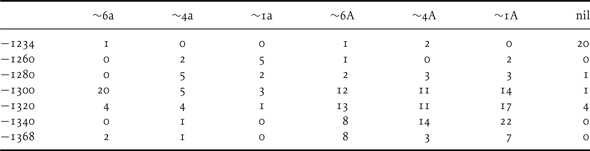
In fact, from the end of the thirteenth century Mongol emperors started to grant genealogical steles to meritorious subordinates they wished to thank and favor. The earliest known example is “Chici Baoding Guoshi xianying beiming 勅賜保定郭氏先塋碑銘,” written sometime between 1294 and 1307 (Table 2, no. 76). These grants were usually linked to the concurrent bestowal of posthumous titles on a living official's parents, grandparents, and great-grandparents.Footnote 17 The number of such grants, as is clear from Table 4's (see Appendix) comprehensive list of steles erected by middle-to-high-ranking civil officials, increased sharply from the first decade of the fourteenth century. The contents and style of these Yuan steles strongly suggest that their authors and installers were consciously imitating the Tang-period genre of stele known as “Stele of the Ancestors’ Hall (xianmiao bei 先廟碑),” which likewise was granted to high-ranking officials by the emperor as a sign of his imperial grace.Footnote 18 As indicated by the remark of Zhang Bojun below, the Khan as donor and the subject as recipient could thereby demonstrate their respective political legitimacy as a Chinese emperor and his honored Chinese subject and so claim the accompanying social and political privileges. This interpretation appears to be corroborated by successive Khans’ commissioning of “steles of the ancestors’ hall” installations during exactly the same period.Footnote 19
Although a few non-Han families had independently erected genealogical steles in the late thirteenth century (nos. 46, 62, 79), more non-Han families like their Han counterparts began to petition for their own genealogical steles from the turn of the century, when more of them became officials and when Yuan government stele grants increased in general. In 1312, for example, Čaγan (Chin. Chahan 察罕, dates unknown), Manager of Governmental Affairs (pingzhang zhengshi 平章政事) whose grandfather hailed from Balkh, successfully petitioned the emperor Renzong 仁宗 Ayurbarwada (Chin. Aiyulibalibada 愛育黎拔力八達, r. 1311–1320) to grant a stele to his ancestral graveyard in Jiezhou 解州, southern Shanxi.Footnote 20 Indeed, when reading this stele's inscription, one is reminded of the non-Han ethnicity of the emperors who granted such steles, as the inscription is multilingual. On one recently discovered genealogical stele, “Quanning Zhangshi xiande beiming 全寧張氏先德碑銘” (dated 1336), the inscription was evidently composed and carved in Chinese and then translated into a Mongolian version transcribed and carved in the Uighur script.Footnote 21
The central government's institutionalized practice of granting genealogical steles indicates that even the highest ruling stratum of the empire and literati communities at the court now regarded the installation of steles as a legitimate way to commemorate a man's ancestry. In “Jiaxinglu zongguan tuiguan Liujun xianyingbei 嘉興路總管府推官劉君先塋碑” (dated 1298, no. 96), Zhang Bojun 張伯淳 (1242–1302) of Chongde 崇德 county, Zhejiang province, insisted, “If we consider that ancestral shrines in former periods had steles, the erection of steles in ancestral graveyards in recent times also reflects this notion bequeathed [to us from the past] (若稽前代先廟有碑, 近世揭石先塋, 亦其遺意).” When we recall Huang Huizhi's observation in 1195 on the appearance of commoners’ generational steles in the Jin dynasty, this statement by a southern literatus takes on renewed significance. It clearly indicates that the late thirteenth century marks a turning point in the social history of the genealogical stele. Whereas the installation of genealogical steles had originally been practiced by commoners and low-ranking officials, the installation of genealogical steles had by the Yuan dynasty become a way for members of a new northern elite, having risen to office in the wake of the Mongol conquest, to demonstrate that they too had been blessed with the throne's imperial grace.
As a rule, once a stele grant was authorized, the author and calligrapher of its inscription were designated by an imperial edict. Chosen from among the scholar-officials at court, the author was allowed to read any biography of the honored official and his forefathers already written by court order and kept in its archives.Footnote 22 These inscriptions, despite the confidence commonly placed in stone as a durable medium, faced a very uncertain future, and their long-term survival remained questionable. Hence, the pressure was on a family to secure a celebrated and highly placed author. The higher his fame and status, the more likely, it was thought, his inscription (and the stele) would survive the vagaries of time. For, even if the stele were destroyed, a famous author's inscription might survive through a separate transmission of his inscriptions in his literary collection (wenji). Inscriptions by less known authors often lacked this additional means of circulation and so tended to be lost once a kinship group failed to maintain its graveyard and ancestral steles. As a corollary, persons (e.g., military families) less acquainted with significant literary figures were less likely to see their inscriptions written by famous literati. Predictably, a smaller portion of their stele inscriptions have been transmitted than those of noted civil officials.
Also, inscriptions composed by literati tended to resemble those they wrote as personal epitaphs. Their focus, as in fact the highly knowledgeable Qing-dynasty compiler of stone inscriptions, Bi Yuan, pointed out, falls mainly on an individual's achievements. For instance, Yao Sui's 姚燧 (1239–1314) “Kaifuyitongsansi taiweitaibao zhongshuyoucheng Shigong xiande bei 開府儀同三司太尉太保太師中書右丞相史公先德碑” (Table 2, no. 108, dated 1307) celebrates the life of the high official Shi Xiande, with very few nods to his family's past.
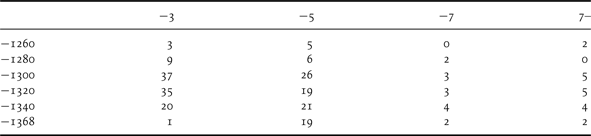
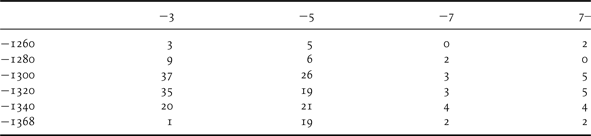
Yet, overall, in the evolution of the genealogical stele and its inscription, from at first being a practice adopted largely by commoners to eventually being promoted by the court for high-ranking Han and non-Han officials, the contents of the genealogical steles themselves were significantly simplified. As Table 3 (see Appendix) shows and as several contemporaries observed, most of the granted stele inscriptions traced the ancestry of a kinship group back for only three or four generations. In the highly stylized text of these inscriptions, the personal accomplishments of key ancestors in the direct line of male descent occupy most of the stone's surface, whereas female and collateral members are mentioned only briefly or never at all. This selective focus was most likely due to the fact that the grant of a stele was very often associated with the bestowal of posthumous titles and honors on male ancestors just one or two generations previous. The main purpose of the inscriptions was to commemorate the virtuous life of recent ancestors who were granted the posthumous title and not to honor their family's entire descent line. Nonetheless, the endorsement of genealogical steles by the Mongol khans soon led to the increased use of the new inscription style.
Geographical and Chronological Distribution of Yuan Genealogical Steles
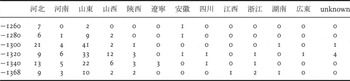
The survey of this Yuan evidence in Table 4 reveals the obvious geographic and chronological concentration of Yuan genealogical steles in north China. Within north China genealogical stele inscriptions appear to have been particularly numerous in the area of modern Shandong province and between the late thirteenth and mid-fourteenth centuries. These initial impressions, however, need qualification and explanation. Close study reveals that the distribution of steles in Shandong province is itself remarkably uneven, with a particularly dense concentration of them in just a few counties in the northwestern part of the province. A more accurate reading of Table 4 then would require a careful bibliographical analysis of the sources providing this data, namely, certain county and prefectural gazetteers of Republican-era (1912–1949) Shandong with editors enthusiastic about compiling extensive records of pre-modern stone inscriptions in their area. Indeed, a considerable number of the steles from Shandong in Table 2 were recorded in the local gazetteers of Weifang 濰坊, Changle 昌樂, and their adjacent prefectures and counties in the 1920s and 1930s. Erecting a genealogical stele had certainly been common in these counties and prefectures and in all likelihood in the rest of Shandong as well. Yet, this statistical distribution of extant recorded steles inscriptions does not adequately reflect the actual distribution of genealogical steles then or now. Nearly seven centuries have passed since the genealogical stele first became popular, and so we should instead note that no fewer than twenty Yuan genealogical stele inscriptions survive in each of the five modern provinces of north China—Hebei, Shandong, Henan, Shanxi, and Shaanxi. When compared with the scant distribution of the pre-Jin genealogical steles there or elsewhere, the figures of Tables 2 and 4 show not just the concentration of this new type of stele in Shandong but also its spread and popularity beyond Shandong in much of the rest of north China under Yuan rule.
Likewise, this data shows the limits to the spread of this kind of stele: genealogical steles were never common in the regions south of the Huai River, the former territory of the Southern Song (1127–1279) dynasty. Moreover, almost all known cases in the south were put up during the Yuan by families who had migrated there from the north following the appointment of their kinsmen to local government or military posts in the Yuan's newly conquered territories. The only exception, “Yongjia Chenshi shidebei 永嘉陳氏世德碑” (dated 1318, no. 160), was set up by a local family with the surname Chen, seemingly of southern ancestry. However, the major figure behind the installation of this stele, a Buddhist monk named Rin chen bkra shis (Chin. Lianchen chilasi 輦真吃剌思, whose original Chinese name was Chen Ping 陳萍, d. 1325), had enjoyed a career exceptionally close to the Mongol government, especially when compared to his southern contemporaries. At the time of this stele's installation, he was serving as the Commissioner for Buddhist and Tibetan Affairs (Xuanzhengshi 宣政使) and was destined a few years later to become the tenth Imperial Preceptor (dishi 帝師). Although both his father Chen Zizhong 陳自中 (d. 1276) and his uncle Chen Yizhong 陳宜中 (dates unknown) had remained loyal to the Southern Song's last emperor right to the end, he himself had upon their death been taken to the Mongol capital Dadu (a.k.a. Beijing) on orders of the ruling khan Khubilai. There Chen Ping was through Khubilai's intervention ordained as a monk by the serving Imperial Preceptor, and for most of the rest of his life he lived in Dadu among Tibetan and northern Chinese monks.Footnote 23 This case of a southerner with a Tibetan Buddhist name and with a northern Chinese residence is so exceptional that it cannot serve as an indication of the acceptance of genealogical steles among contemporary southern families. Instead, the strikingly sparse distribution of genealogical steles south of the Huai River throughout the Yuan dynasty demonstrates that in the thirteenth and fourteenth centuries their installation remained a largely alien custom in central and south China, that is, in the territory of the former Southern Song. For reasons that remain unclear, no steles were granted to officials from south China. Even when a southerner like Cheng Jufu 程鉅夫 (1249–1318) or Yu Ji wrote a stele inscription at the request of an acquaintance, the kinship group of the acquaintance was based in the north.
Stele Installers and Their Social and Political Background
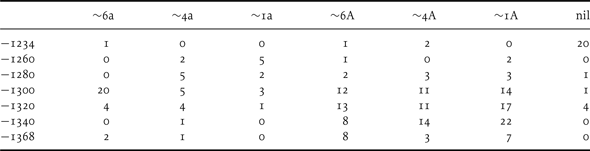
Table 5 (see Appendix) shows the official ranks of those individuals (or their family member with the highest official rank), who installed genealogical steles during the Yuan dynasty. The high proportion of office-holders among these Yuan installers contrasts sharply with the scant presence of office-holders among the Jin installers. Whereas officials of all ranks, from the lowest to the highest, put up a genealogical stele during the Yuan,Footnote 24 only eleven of all the one hundred genealogical steles installed prior to 1300 were put up by an individual (or a family) with an official in his (or its) pre-Jin past. This contrast strongly suggests the emergence of many first-time office-holding families during the Yuan and their use of these steles to mark their new status.
Who then were the installers? What were their social and political origins? If they were as new to their privileged status as the figures suggest, how then did they come by it? We must begin our answer to this set of questions by acknowledging that we know far less about the social and economic origins and circumstances of the men who erected the genealogical steles than about their legal status and the routes they took to gaining that privileged position. Nonetheless, even if they all were from landlord or commercial families (and we have no reason to suspect so), their privileged origins in society would not have marked them off as a social and economic group as distinct and as powerful as had been the “scholar officials” (shidafu) of the Northern Song dynasty. Not only had that era's landed society in north China been violently uprooted by the devastation of the Mongol invasion, but the installers of these genealogical steles also came to their official position and power through such a multiplicity of routes that their social origins were inevitably very varied.
Under the Yuan, unlike the Song and Jin dynasties, there were multiple centers of legitimate political power and multiple routes to these centers of power. Whereas in the Northern Song and Jin dynasties ambitious young men commonly sought wealth and power through success in competitive civil service examinations (or gained official status and appointments through the hereditary principle [yin]), in the Yuan these examinations played no more than a minor role in the enlistment of officials. For its first half-century, in fact, the Mongols made no use of civil service examinations. When from 1313 they announced their restoration on a triennial basis, they set so low a quota of graduands—just twenty-five each for Mongols and all other adult male residents in all of north China at a time when civil government officials numbered no fewer than 20,000 appointees—that at no time during the Yuan did examination graduands account for more than 1 per cent of all those working as civil officials. The office-holding installers of the generational steles, so few of whom had an official in their family's pre-Jin past and even fewer of whom had themselves taken the examination route to office, would thus have far outnumbered the Yuan literati graduands of the examination halls who had predominated during the Northern Song and the Jin dynasties.
In place of these exam-tested civil servants, the Yuan government sought men already tested by war, professional life, and long-term service. Job performance, loyalty, and connections replaced literary skill and Confucian learning as the qualifications for entrance and promotion in officialdom. The beneficiaries of these changes—no surprise to anyone familiar with the occupational groups whom Song civil officials found most objectionable—were the military, specialist households, yamen clerks, and Buddhist monks. Predictably, it is from these occupational groups that many—the majority—of our stele installers (when they were not themselves the beneficiaries of their family's hereditary status) seem to come. This motley crew of Han Chinese of course was joined by all sorts of Mongols, Central Asians, and other non-Han Chinese, who likewise won their appointments through loyal service to Mongol princes and rulers.
Interestingly, few yamen clerks were among those who installed genealogical steles. Even though many educated men were attracted to this career due to its conditional prospect of promotion into officialdom—thirty years of laudable service in a prefectural government yamen could merit promotion into officialdom at rank 7b—their success as clerks and officials appears not to have been elevated enough to gain them a genealogical stele. Likewise, community heads (shezhang), and leaders of various village institutions such as irrigation network associations and popular religious cults may have had considerable influence on village life—just look at the management roles allotted them on contemporary steles erected to celebrate shrine-building and the construction and maintenance of irrigation canals. But like the yamen clerks they rarely entered the upper ranks of the local elite: note that on these same village steles their names are always carved under those of their social betters—civil officials, military officers, and religious leaders. However tangential was their involvement in these construction projects, they in contrast to these local inferiors had powerful external connections, which granted and guaranteed them their local prominence. As the first of these superior groups has been discussed above and as the last of them, the Buddhist official-monks, is analyzed in detail by Wang Jinping in her accompanying article in this issue, I shall focus here on the military households and the much larger and more varied group, the specialist households,Footnote 25 that won the favor of the Mongol government.
Military service was an eminent route to office and to the eventual installation of a genealogical stele during the Yuan. Denied a civil service alternative and interested more in the art of horseback archery than in textual commentary and poetic composition, many Chinese men under Mongol rule enthusiastically entered military life. In the early decades, before the Mongol horsemen ceased expanding their empire in the 1280s, that fervor was fueled by the prospect of rapid promotion in military circles. Men were further drawn into military service by privileges seldom granted to their civilian counterparts: they could transmit their office to their heirs, hold farm and pasture land grants from the central government, and receive annual rents from tenants on these lands. Not surprisingly then, well over one hundred and fifty stele installers on the list in Table 2 had military ties; either they or an ancestor had served in the Mongol military.
Access to office and generational-stele status was offered to some of those households judged proficient in specific skills. Forty-six of the 255 known installers of the genealogical steles were from the ranks of these specialist households; they rose in the ranks to serve the government as superintendents (tiling 提領) of their industry in their region. In the time of Genghis Khan a mere twenty-six (mainly military) varieties of these household categories existed; by the close of the thirteenth century the number of these categories had risen to about ninety, some ethnic but mainly occupational. As Mote has explained, “The basic rationale of the system lay in its control over all productive activities, from farming to the craft industries, mining, ceramics, weaving and other phases of textile production, the smelting and forging of metals, manufacture of weapons and armaments, transport of grain, merchant activities of several kinds, medicine and pharmacology, and dozens other more narrowly differentiated categories.”Footnote 26 Members of these special households were assigned, in place of normal labor service to the local government, to permanent and hereditary service to a variety of government agencies or to the appanages (Mong. ayimay; Chin. Weixia 位下, touxia 投下, hengzhi'er 橫枝兒) of prominent members of the ruling stratum. Men judged by the Mongol ruling elite to be particularly skilled in their category's craft could rise in the ranks of their particular organization and be accorded management responsibilities.
So far these four alternative routes to power represent merely a broadening of the central government's gateway to higher status and wealth. Where the Yuan, however, proved particularly innovative and disruptive to ordinary Chinese government practice was its creation and tolerance of alternative centers of power outside of the regular bureaucracy and administration. Usually the exclusive prerogative of the emperor, this power of private appointment to administrative position was in Yuan times also held by some Mongol princes, empress dowagers, spouses of princesses, and major generals. Empowered to expect service from a set number of “specialist households,” they could use this power to help promote men already admitted to office through these four alternative routes. But more often they could assign members of their private group of hereditary retainers (called a kesig) to a task in the central government, in their own appanage, or in a military expedition. Furthermore, they could independently draw upon government resources and powers to reward their specialist households for their performance (for instance, a Mongol prince was so pleased with paper made by a villager in Dingxiang county that he issued an edict granting this craftsman tax exemption and the privilege to contact the prince whenever necessary).
Likewise, membership in a kesig was often hereditary and presumed patronage from a prominent member of the Mongol ruling elite. To cite just one of many examples, Sun Wei (1183–1240), born into a northern peasant family, became an armor maker. He presented a suit of his armor to Chinggis Khan, who out of appreciation of its quality appointed Sun and his descendants Supervisors of the Imperial Armory and allowed the eldest male in each successive generation of Sun's descendants to enter the kesig of Chinggis’ own successors as khan. Other male members of the family often obtained an intermediate or higher government office, without an examination, presumably because the family retained this close connection to the regime.Footnote 27
Spurred on by the prospect of gaining an extra-bureaucratic appointment or promotion, many people actively sought to take advantage of whatever connection they could foster with powerful patrons. Their success predictably aroused resentment among those who had risen through more orthodox means, such as Xu Youren 許有壬 (1287–1367). One of the first Yuan recipients of the metropolitan degree, Xu complained that every day crowds of hopeful clients, including many from southeast China, pressed to the main gate of the palace in the capital Dadu. They avidly demonstrated their academic literary talent, eloquence, and other skills like painting and the martial arts, all in order to make a connection with a Mongol prince or high-ranking official.Footnote 28 The practice was taken up by the less educated as well. A Muslim peasant from Zhending, Hebei, travelled to Dadu to charge his Han Chinese neighbors with plotting a riot. Hoping to obtain an office, he knocked on the gate of the empress dowager's palace, told his story, and was expecting a rosy future until he was found to have concocted his entire story and so ended up arrested for making this false allegation. Note that he approached not the throne but one of the alternative centers of power. So long as Mongol empress dowagers, princes, and other parties in the Mongol government retained their personal prerogatives, news of such arrests did little to dampen people's wish to achieve a great official leap forward through professions of pure-hearted loyalty to a potential patron.
The Social Context of Stele Installation and Its Historical Sources
What then prompted these newly empowered elite families to put up genealogical steles? Table 2 provides some insight, with its listing of nine types of motives found in the accompanying inscriptions. A general motive often expressed for erecting steles is the wish to “commemorate their ancestral history.” Case-specific reasons, such as “relocating graveyards to a new site,” “expanding the graveyards,” and “recording the generational order,” are also commonly stated.
Behind all this concern obviously lay the instability of life in north China, thanks in large part to the advance of Mongol forces into north China from 1210 onward. As these armies progressed south from one devastated Jin capital to another, they drove more and more of north China's war-ravaged population into desperate flight. While many of these refugees fled south to Southern Song territory, many others stayed in north China, seeking safety south of the Yellow River in territory still controlled by the beleaguered Jin forces. Soon waves of Mongol-government followers moved into abandoned villages farther north to take up residence, seize land, and eventually gain government office.Footnote 29 The dramatic increase in genealogical steles in north China during the Yuan dynasty coincides precisely with the end of these great migrations, the subsequent establishment of a new social order under Mongol rule, and the proliferation of new office-holding families.
A widespread sense of urgency about maintaining a cohesive descent group at this time is suggested by the prompt reconstruction of ancestral graveyards in north China after this period of profound and prolonged social upheaval. The fate of ancestral graveyards was a particularly strong point of concern, leading to many laments by northern refugees forced to abandon what had for centuries been the focus of their descent group's collective life. Consider the anguish of Yang Hongdao 楊宏道 (1189–c. 1280). A prominent Jin poet, he returned home to Zichuan 淄川, Shandong, after years of absence from his family's graveyard. In an inscription he wrote for another family (“Lishi qianzu zhi bei 李氏遷祖之碑” (dated 1270, no. 18 in Table 2)) he expressed the grief he still felt about having left his ancestral graveyard:
If then one takes leave of his ancestral graveyard and departs his home village, he will feel lonely being away from his in-laws and relatives and apart from his friends. He will lose the pleasure of being alive. In moving about from west to east and from south to north, his spirit will feel despair, and the places he puts up at in his travels will be desolate.
Underlying this concern was a sense of shame for neglecting his family's graveyard, for failing to make the regular offerings expected by his ancestors, and for not encouraging interaction among his ancestors’ spirits, such as they would have expected to enjoy due to their burial in the same family graveyard.Footnote 30
Another source of anxiety frequently mentioned in these stele inscriptions is the severe shortage of reliable genealogical records and information these northern families preserved from the devastation of the Mongol invasion. Only three inscriptions in Table 2 (nos. 32, 41, and 136) specify the existence of a genealogical text (jiapu) they have used as a source of reference. In fact, the loss of the family genealogy is the reason most commonly cited on genealogical steles for a family's inability to trace its ancestry prior to the Jin period (admittedly, this reason served many as a handy means of hiding their plebian background of little learning and even illiteracy). The situation of the Suns of Hezhong 河中 in southern Shanxi was far from atypical. Claiming to be descendants of a Northern Song Defense Commissioner of Duanzhou (Duanzhou fangyushi 端州防禦使), Sun Jiye 孫繼鄴 (979–1037), and the family of a provincial decree (juren) holder in the Jin period, they numbered eighty to ninety in the early thirteenth century. But come the Mongol army's conquest of southern Shanxi and Shaanxi in the 1220s, they were widely dispersed. In the chaos they reported losing all their genealogies, official certifications, and ancestral portraits.Footnote 31
In response to this degree of loss some northern families sought to re-compile their history. From the mid- to the late thirteenth century no fewer than five northern families (including the Mengs and Lis of southern Shanxi) are known to have reconstituted their genealogies. But their contents, to the extent we can discern from surviving prefaces, resemble merely a collection of essays on the family's history and genealogical information about specific individuals or just a brief chart (tu). They were a far cry from the contemporary southern genealogies with their numerous prefaces, introductory remarks, detailed genealogical charts, biographies of major ancestors, literary compositions, epitaphs, and copies of official appointment papers. By the end of the fourteenth century this northern genre of a proto-genealogy apparently fell out of favor. No longer written, it was soon forgotten.
When a kinship group had no genealogy or proto-genealogy book to consult, in a few cases it could consult family records recorded on previous steles. Witness the Wangs of Beihai 北海 county, Shandong, who sometime before 1307 decided to erect a genealogical stele that had no pre-Yuan genealogical information. Their reason for this omission is telling: “The [record of] official careers and collateral descent lines exists on the steles in the ancestral graveyard (祖宗歴仕支派, 故塋石刻存焉).”Footnote 32 And, if no manuscript, printed, or carved genealogy was available, then appropriate evidence might be collected from standing steles and their inscriptions’ accounts of the official career of deceased members of eminent families. Such informative steles, we learn from Su Tianjue 蘇天爵 (1294–1352), the compiler of the official histories of the Liao and Jin dynasties (Liao shi 遼史 and Jin shi 金史), were found close to the ancestral tombs of “prominent families of the Liao and Jin periods, such as the Lius, Hans, Mas, Zhaos, Shis, Zuos, Zhangs, and Lüs, who had their ancestral tombs in the capital area (遼、金大族如劉、韓、馬、趙、時、左、張、呂,其墳墓多在京畿,可模碑文,以備採擇。).”Footnote 33
Yet, if, as was very common, the kinship group had no genealogy book or previous stone steles to consult, then anyone assigned to write the biography of a deceased man for a genealogical stele would turn first of all to oral history and begin the process of transforming the spoken word into tangible stone. Next, if fortunate, he might have access to other more conventional biographical materials for past officials, such as the Record of Conduct (xingzhuang 行狀), Unreserved Record of Conduct (shizhuang 實狀), or Record of Deeds (shizhuang 事狀). With the aid of these and other sources already written by a kinsman or a friend of the deceased, a stele's biographer would have been able to trace the life of the deceased and, to a lesser extent, the history of his family. And, for transcribing all this biographical and genealogical information and for assuring its long-term transmission, men in the Yuan had no hesitation in agreeing with the conviction of pre-Tang users of tomb steles,Footnote 34 some Northern Song reformers, and many Jin families: stone was the most effective and durable means available for recording a genealogy. Yuan genealogical stele inscriptions occasionally include sentences such as “Only the solidity of stone can render [the inscription] perpetual (非石無以堅久時不可失也).”Footnote 35 Or, “In the case of any trouble in the future, the descendants of the Yaos [will be able to] look at my writing at the grave site (姚氏子孫他日有事,於墓所□覽予文焉。).”Footnote 36
Furthermore, the preservation of a genealogy in a durable form like stone served a pressing purpose for the stele's owners: it transmitted their claims, or evidence, of a political privilege acquired from contact with the ruling Mongol elite. As Christopher Atwood persuasively argues, the knowledge of one's ancestry and lineage in Yuan China was vitally important not as “some tribal feature opposed to the state but [as] a mode of organization nurtured by the state [original italics]. The government frequently referred to a subject's genealogical information, if only to confirm his political and social status in officialdom.”Footnote 37 And the very close correspondence of the identities of those who installed these stone steles with the names of the recipients of Yuan official appointments strongly suggests that by engraving a genealogy on a stele these men were seeking to facilitate the transmission of not just a descent line but also of their privileged political status.Footnote 38
Nonetheless, today we know far less about the local elites of north China in Yuan times than about their counterparts in south China, and so the information—or rather, more often, the lack of information—in their inscriptions suggests how great was the rupture that had taken place in the ranks of the local elites of north China over the course of the twelfth and thirteenth century.
Descent Group Organization as Recounted in Genealogical Steles
In their generational scale, membership size, and internal organization the kinship groups recorded on these Yuan genealogical steles show, in Patricia Ebrey's useful words, a strong “jia 家 [or family] orientation.” Focused on “tangible material and human entities” such as family members and ancestral graveyards, this concept of kinship was considered “overwhelmingly in unitary, lineal terms,” rather than in the hierarchical ritual kinship relations of the contrasting “zong 宗 orientation” within mourning circles.Footnote 39 As Ebrey also pointed out, the “jia orientation” was traceable to at least the Han era.Footnote 40
Although the historical depth of these Yuan families, as Table 4 shows, averaged four to five and only rarely went above five or below four generations, only thirty families of the listed 255 traced their history back more than five generations, regardless of whether they had produced an official or not. Two likely reasons for this brevity of their descent line merit mention: the recentness of their history as a self-conscious descent group and, as stated in the 1343 stele inscription of one family, the general adoption of the ancient Confucian kinship principle that just five generations would constitute the scope of the mourning group and of the generations of ancestors to be worshipped.Footnote 41 Not surprisingly, the number of family members alive at any time, as discerned from these steles’ specific kinship groups, from the charts on their back, and from their inscriptions’ general observations, seldom exceeded one hundred.Footnote 42
Typically, a genealogical stele was revered as the symbol of the close internal bonds among members of a descent group. The narrative of its recorded descent line usually begins with the prime ancestor who established the graveyard and continues with those of his direct descendants who had been or would be buried there with him. It is commonly thought that one's choice of graveyard was testament to one's affiliation to a particular descent group. Yet, what were the qualifications for membership in the lineage (zuren) and thus for burial in its gravesite? Was it merely birth in the main descent line, inclusion of oneself or an ancestor in a chart or inscription on the genealogical stele; an ancestor's burial in the graveyard, or inclusion in a listing elsewhere (e.g., a genealogy book) of members of the lineage or descent group? Ideally, all these conditions should have been met, but the evidence suggests a more complex answer. For instance, the area of the sole surviving Yuan-dynasty graveyard was expanded to hold collateral branches as well. In addition to the original genealogical stele on the original graveyard site, we find two adjacent graveyards, each with its own genealogical stele, for burying and recording the collateral groups. While the original genealogical stele literally served as the cornerstone in the establishment of the graveyard, the other two were set up to the east in separate parts of the attached graveyard space, each possibly in genealogical order. Furthermore, separate burial did not necessarily signify separate ancestral worship and political separation or independence Another stele inscription, dealing with the Wang family of Fanshi county, Shanxi (erected in 1312, no. 127 in Table 2), reports that although “only direct descendants of Lord Zhaowu [the prime ancestor] were still buried in the ancestral graveyard [of Zhaowu],” all three branches of the Wangs annually assembled at this graveyard to practice ancestral worship together. In other words, the size, scale, and organization of the kinship groups discussed in the genealogical steles were sometimes larger and more complex than suggested by the category of “jia orientation” and recorded on the steles themselves. If all members of the collateral branches are included, the figure we acquire for just the members of the main descent line would have to be at least doubled.
Were some of the larger kinship groups described in these genealogical steles’ inscriptions then striving to weave a lineage out of their main descent line and segmented collateral descent lines? Certainly, the installation of these genealogical steles attracted great attention and drew large crowds. Reportedly more than ten thousand people gathered at the erection ceremony of the genealogical stele for the Yangs in Luoyang,Footnote 43 and several thousand people attended the funerary ritual of Sun Gongliang of the Suns in Hunyuan.Footnote 44 Steles clearly could be shown to visiting guests, and rubbings made of their inscriptions to be sent off to distant lineage members. Yet, Yuan northern descent groups were obviously less cohesive in mobilizing kinsmen for economic and political purposes, not simply because their steles’ genealogical records exclude the collateral branches necessary for such a cohesive lineage but also because exclusion from the stele genealogy and thus from the descent group's main line of descent appears to have barred collateral descendants from sharing in any hereditary benefits of success, such as from the connections with the Mongol princes so important for getting on in the Yuan bureaucracy. Furthermore, only rarely is there mention of the steles’ descent lines, main and/or collateral, sharing ownership of any property other than their graveyard. For instance, when a member of a collateral branch of the Suns returned home and found his brothers threatening to break up their branch due to arguments over property inherited from their parents, he had to divide this property among them and could do so without consulting anyone outside of the immediate family.
In sum, the descent groups recorded in the genealogical steles based their collective activity and identity on their gravesites: they shared an ancestral graveyard, practiced ancestral worship together therein, were eventually buried next to their shared ancestors, and were often mentioned together on genealogical steles. Numbering four or five generations, their membership would reach around a hundred members of the main descent line. Arguably, the making and installation of these steles provided these groups with an opportunity to redefine themselves, to defend themselves in a time of disorder, and also to reach out beyond themselves and their immediate communities to absorb some of the enormous waves of migrants that flowed across north China during and after the long years of Mongol conquest. Yet, although it is wise not to dismiss this possibility completely, the surviving stele inscriptions and genealogical charts by and large make a point of their exclusion of collateral descent lines. Those families with links outside their local society, such as we have found common among the installers of the genealogical steles, would have been more likely, in a time of disorder, to tighten their ranks against intruders and less successful collateral kinsmen whose sphere of activity remained largely in the local arena.
CONCLUSION: THE SPREAD OF GENEALOGICAL STELES IN THE JIN-YUAN SOCIAL TRANSITION
The making of genealogical steles during the eleventh to fourteenth centuries reflects, on the one hand, remarkable cultural continuity and, on the other hand, considerable social and political discontinuity in north China. Throughout this period, an ancestral graveyard was considered essential for the continued coherence of a Han Chinese descent group. Recurrent wars threatened the survival of these ancestral graveyards, but descendants rallied together around them and confirmed their solidarity through preserving and retaining them. The role of these graveyards as a focal point of kinship activity and concern in north China was particularly important in the early decades of Mongol rule, when genealogical books and ancestral halls were far less common and important than in south China. In fact, as should be self-evident by now, the different social, cultural, and political circumstances of north and south China in these centuries shaped the development of different norms and practices in their compilation of genealogies and in the institutions that grew up around them.
With the demise of the Yuan dynasty, the practice of erecting genealogical steles ceased, and most Yuan office-holding households disappeared from contemporary records. Yet, that was not the end of the genealogical steles’ story. For reasons that remain unclear, the practice of setting up this kind of stele revived. Beginning in the eighteenth century, steles of almost the same style, content, and title as seen in the Yuan were erected near Beijing.Footnote 45 Although future large-scale surveys of the spread of this kind of stele throughout north China remain necessary, the practice certainly lasted until the early twentieth century as steles remained important in ancestral graveyards for far longer than is commonly presumed. Overviews of the history of Chinese genealogies as a genre that underwent a strictly unilinear development from stele to text or from manuscript to text seriously neglect the regional and social diversity of this genre and what its rich history might tell us of the variety of Chinese family organizations in the past.
In the Yuan dynasty itself, the spread of genealogical steles had been triggered by the rise of a new elite under Mongol rule. The dissolution of the Northern Song elite in north China due to the invasion and rule by the Jin and especially Mongols broke down some of the distinctions in funerary practices among different social strata, resulting in a new elite's adoption of the previously non-elite practice of genealogical stele erection and eventually the Yuan court's legitimization of this practice. The social upheaval during the Mongol conquest of north China would seem then to have transformed this region's funerary culture, a change that may have been unintended and unexpected by the conquerors. Thus, the rapid penetration in the ruling stratum would appear to run contrary to the gradual spread of the practice of compiling genealogical texts among commoners in some southern regions. After genealogy compilation had become a commonplace among office-holding families, for instance, in the Pearl River delta and Fujian, the compilation of genealogical texts became popular among commoner kinship-groups in conjunction with the incorporation of their descent group into official taxation, defense administration (weisuo 衛所), and labor service units. Compiling genealogical texts according to a standardized style helped newly formed lineages of these regions to negotiate their way through social and economic difficulties on a long-term basis, such as avoiding a heavy service levy, confirming their legitimate residential status in the lijia system, accumulating shared wealth (like land trusts), and facilitating the rotation of a tax or military service obligation among kinsfolk.Footnote 46 Nevertheless, it is important to note that this posited “downward” shift of elite cultural practices in southeast China did not necessarily hold true for other regions and other aspects of administrative life in the late imperial period.
The Yuan genealogical steles attest to the existence of cultural and social transitions not only in the eleventh to fourteenth centuries but also in the mid-sixteenth and the eighteenth centuries. The variety of genealogy compilation practices in different regions of late imperial China thus reveal a quite distinct historical trajectory of the social elite and its kinship organization in north China from that of southeast China. In the future, these findings will allow us to ask and answer new questions about family organization and local society in both of these broad regions of China over the past millennium.
APPENDIX
Genealogical steles from the Jin period

Genealogical steles from the Yuan Period

Generation depth recorded
Geographical and chronological distribution

Official rank of erector