Bronchitis and bronchiolitis are common lower respiratory tract infections resulting in unnecessary antibiotic prescriptions.Reference Fleming-Dutra, Hersh and Shapiro1 Clinical practice guidelines define bronchiolitis as occurring in children <2 years, while bronchitis is often diagnosed in children aged ≥2 years.Reference Hersh, Jackson and Hicks2,Reference Ralston, Lieberthal and Meissner3 Antibiotics are not recommended for either diagnosis because most of these infections are viral,Reference Hersh, Jackson and Hicks2,Reference Ralston, Lieberthal and Meissner3 but antibiotics are frequently prescribed to children with these diagnoses.Reference Fleming-Dutra, Hersh and Shapiro1 Reducing unnecessary antibiotic use is important: antibiotics are the leading cause of emergency department (ED) visits for pediatric adverse drug events and contribute to antibiotic resistance.4
A Healthcare Effectiveness Data and Information Set (HEDIS) measure regarding antibiotic prescribing for adult acute bronchitis began in 2006; a study of this measure found antibiotics were prescribed in 76% of adult bronchitis visits.Reference Roberts, Hicks and Bartoces5 This measure has recently expanded to include children and bronchiolitis diagnoses.6 We characterized antibiotic prescribing for acute bronchitis and bronchiolitis in pediatric visits to EDs, pediatrician offices, and family medicine physician offices in the United States from 2006 to 2015 as a baseline for the expanded HEDIS measure.
Methods
We used the 2006–2015 National Ambulatory Medical Care Survey (NAMCS) and National Hospital Ambulatory Medical Care Survey (NHAMCS) to estimate pediatric (0–18 years) acute bronchitis and bronchiolitis visits and associated antibiotic prescribing. These nationally representative surveys, conducted by the National Center for Health Statistics, estimate visits to nonfederal, office-based physicians (NAMCS) and hospital EDs (NHAMCS) using sampled visits and sampling weights, as previously described.Reference Fleming-Dutra, Hersh and Shapiro1 We limited the study to 2006–2015 due to changes in diagnostic coding in NAMCS/NHAMCS in 2016. All study years included use of International Classification of Diseases, Ninth Revision, Clinical Modification (ICD-9-CM) diagnostic codes.
In NAMCS/NHAMCS, visits may contain multiple diagnosis codes and medications. Our analysis was limited to the first 3 diagnosis codes and the first 8 drug mentions (prescribed, continued, or provided) for consistency across years of data. We identified visits with bronchitis (ICD-9-CM codes 466.0, 490.0) and bronchiolitis (466.11, 466.19) as the first listed diagnosis. We excluded visits with codes for diagnoses where antibiotics are or may be indicated using a previously described classification scheme.Reference Fleming-Dutra, Hersh and Shapiro1 We additionally excluded visits with diagnostic codes for chronic bronchitis, emphysema, or chronic obstructive pulmonary disease (491*, 492*, 496). Visits with referrals to higher-acuity settings (NAMCS, ED and hospital referral; NHAMCS, hospital admission) were also excluded to mirror the HEDIS measure. We defined oral and parenteral antibiotic prescriptions as anti-infective drugs excluding topical medications, amebicides, leprostatics, antihelminthics, antifungals, antivirals, antimalarials, and antituberculosis medications.
We estimated national annual average and 95% confidence intervals (CIs) of the number of visits and antibiotic prescriptions for bronchitis and bronchiolitis for the 10-year study period (2006–2015) using survey weighting procedures to account for the complex survey design. The estimates were made overall, and by condition, sex, US census region (ie, Northeast, Midwest, South, West), clinician specialty (pediatrics, family medicine, emergency department), and setting (emergency department, physician office). Because bronchiolitis should be diagnosed only in children <24 months of age,Reference Ralston, Lieberthal and Meissner3 estimates were also made by age group (<2, 2–18 years). We calculated the proportions of visits with antibiotic prescriptions overall and by strata. To assess for trends in prescribing during the study period, we conducted a chi-square test comparing the proportion of visits in which antibiotics were prescribed in each year. The association between visit setting and clinician specialty (combined into 1 variable) and antibiotic prescriptions, adjusting for age category, diagnosis (bronchitis, bronchiolitis), and region was estimated using multivariable logistic regression. Estimates were not calculated if there were <30 unweighted observations or the relative standard error was >30%.
All statistical analyses were conducted using SAS version 9.4 software (SAS Institute Cary, NC) and α = .05. NAMCS/NHAMCS are deidentified, publicly available data sets exempt from institutional review board requirements as determined by the Centers for Disease Control and Prevention (CDC) National Center for Emerging and Zoonotic Infectious Diseases human subjects advisor.
Results
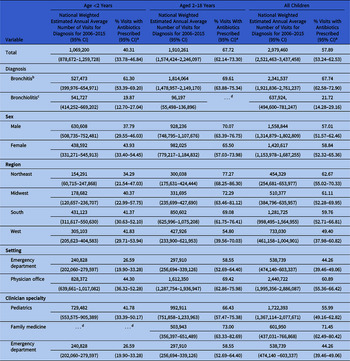
During the 10-year study period, an annual average of 2,979,460 (95% CI, 2,521,463–3,437,458) visits for bronchitis and bronchiolitis took place with children 0–18 years (Table 1). Antibiotics were prescribed in 57.9% (95% CI, 53.2%–62.5%) of these visits, equivalent to 1,724,667 prescriptions annually. The proportion of visits with antibiotic prescriptions did not vary significantly by year during the study period (P = .18) (Supplementary Table 1 online).
Visits and Antibiotic Prescriptions for Bronchitis and Bronchiolitis in Emergency Departments and Physician Offices, Children Aged 0–18 Years, US National Ambulatory Medical Care Survey (NAMCS) and National Hospital Ambulatory Medical Care Survey (NHAMCS), 2006–2015

Note. CI, confidence interval.
a Calculated as number of visits for diagnoses with an antibiotic prescription as the numerator and the total number of visits for diagnoses as the denominator.
b ICD-9-CM codes 466.0 or 490.0 in the primary position with no other codes in any coding position for a diagnosis where antibiotics are or may be indicated.
c ICD-9-CM codes 466.11 or 466.19 in the primary position with no other codes in any coding position for a diagnosis where antibiotics are or may be indicated.
d Sample size does not meet standards for reliability (<30 sampled visits).
Antibiotics were less frequently prescribed in bronchitis and bronchiolitis ED visits (44.3%; 95% CI, 39.5%–49.1%) than office visits (60.9 %; 95% CI, 55.4%–66.4%). Among office visits, antibiotics were prescribed in 71.5% (95% CI, 62.5%–80.4%) of family medicine physician visits and 56.0% (95% CI, 49.2%–62.8%) of pediatrician visits. ED visits were 36% less likely to result in antibiotic prescriptions than pediatrician office visits, adjusting for age, diagnosis, and region (aOR, 0.64; 95% CI, 0.46–0.91) (Table 2). The likelihood of an antibiotic prescription was slightly, but not significantly, higher among office visits to family medicine physicians compared to pediatricians (Table 2).
Association Between Clinician Specialty and Setting and Antibiotic Prescription

Note. OR, odds ratio; CI, confidence interval; NHAMCS, National Hospital Ambulatory Medical Care Survey.
a Unadjusted.
b Adjusted for age category, diagnosis of bronchitis versus bronchiolitis, and region
c NHAMCS does not include specialty information for emergency department visits
Discussion
Although not indicated for acute bronchitis and bronchiolitis, antibiotics were prescribed in 57.9% of pediatric visits to physician offices and EDs for these diagnoses in the United States from 2006 to 2015, leading to >1.7 million unnecessary antibiotic prescriptions annually. Although prescribing was lower in EDs than offices, improvement is needed across settings and specialties. Our findings provide a baseline for pediatric antibiotic use for the expanded HEDIS 2020 measure regarding antibiotic treatment for acute bronchitis and bronchiolitis.6 Expansion of this measure may help drive improvements in antibiotic prescribing in children. Previous studies have found high rates of antibiotic prescribing for these diagnoses: 25% in pediatric ED visits for bronchiolitis and 76% in adults with bronchitis.Reference Roberts, Hicks and Bartoces5,Reference Papenburg, Fontela and Freitas7
Visits to emergency departments were significantly less likely to result in antibiotic prescriptions than office visits to pediatricians. This finding may have been influenced by the high proportion of children aged <2 years seen in EDs compared to physician offices (45% vs 34%) combined with lower prescribing in this age group compared with older children (40% vs 68%). Similar trends were previously observed in a study of bronchitis management.Reference Agiro, Gautam and Wall8 However, antibiotics were still prescribed in >40% of ED visits for these conditions.
Patient pressure has been cited as a major reason that clinicians prescribe unnecessary antibiotics.Reference Dempsey, Businger and Whaley9 Another possible factor contributing to inappropriate prescribing is diagnostic uncertainty, which could lead physicians to treat patients diagnosed with bronchitis as if they have bacterial pneumonia, a condition for which antibiotics are indicated, although our analysis excluded visits with pneumonia codiagnoses. The CDC Core Elements of Outpatient Antibiotic Stewardship provides evidence-based strategies for implementing antibiotic stewardship interventions,Reference Sanchez, Fleming-Dutra and Roberts10 which may be leveraged to address unnecessary prescribing for acute bronchitis and bronchiolitis.
Our study had several limitations. Due to NAMCS/NHAMCS sampling frames, the analysis was limited to EDs and physician offices and nationally representative estimates by prescriber type (MD, nurse practitioner, physician assistant) were not possible; however, HEDIS measures can be used to assess differences among specialties and provider types across settings. Additionally, diagnostic assignment relied solely on diagnostic codes. Chest x-ray use was not assessed, as it is not recommended for these conditions,Reference Ralston, Lieberthal and Meissner3 although this could have impacted prescribing. Strengths of our study include the ability to generate nationally representative estimates.
We found that antibiotics were prescribed in the majority of visits for bronchitis and bronchiolitis in children from 2006 to 2015, even though antibiotics are not indicated for these diagnoses. High antibiotic prescribing for bronchitis and bronchiolitis persists across settings and specialties, highlighting an important antibiotic stewardship opportunity.
Supplementary material
To view supplementary material for this article, please visit https://doi.org/10.1017/ice.2020.1231
Acknowledgments
We would like to thank Dr. Monina Bartoces for her input on statistical analyses. The findings and conclusions in this manuscript are those of the authors and do not necessarily represent the official position of the CDC.
Financial support
This work was supported by the CDC.
Conflicts of interest
Ms Snyder and Ms King are contractors employed by Chenega Corporation to fulfill research needs at the CDC as part of a contract covering many positions and tasks. All other authors report no conflicts.