Introduction
In Argentina, invertebrate records represent an important component of the continental Mesozoic faunas, and are typified mainly by arthropods (spinicaudatans = ‘conchostracans,’ insects, and ostracods) and freshwater mollusks (bivalves and gastropods) (e.g., Papú, Reference Papú1993; Morton and Herbst, Reference Morton and Herbst2001; Camacho and Del Río, Reference Camacho, Del Río, Camacho and Longobucco2007; Griffin and Varela, Reference Griffin and Varela2012; Parras and Griffin, Reference Parras and Griffin2013; Lara et al., Reference Lara, Cariglino and Zavattieri2017; Carignano and Zavattieri, Reference Carignano and Zavattieri2018; Carignano et al., Reference Carignano, Echeverría and Zavattieri2018). The highest diversity of continental fossil invertebrates from the Argentinean Triassic sequences derives mainly from two basins: (1) the Ischigualasto-Villa Unión Basin (= Bermejo Basin) in La Rioja and San Juan provinces, and (2) the Cuyana Basin (= Cuyo Basin) in Mendoza and San Juan provinces. In these basins, the most common and best-studied fossil invertebrates comprise the insects, with 87 described species (Martins-Neto et al., Reference Martins-Neto, Gallego and Melchor2003, Reference Martins-Neto, Mancuso and Gallego2005, Reference Martins-Neto, Gallego and Mancuso2006a, Reference Martins-Neto, Brauckmann, Gallego and Carmonab, Reference Martins-Neto, Gallego and Zavattieri2007, Reference Martins Neto, Gallego and Zavattieri2008; Martins-Neto and Gallego, Reference Martins-Neto and Gallego2009; Gallego et al., Reference Gallego, Rébori, Zavattieri, Sinitshenkova, Lara and Martins-Neto2011; Lara and Lukashevich, Reference Lara and Lukashevich2013; Lara et al., Reference Lara, Rasnitsyn and Zavattieri2014, Reference Lara, Bashkuev and Wang2015, Reference Lara, Cariglino and Zavattieri2017; Lara, Reference Lara2016; Lara and Aristov, Reference Lara and Aristov2016; Lara and Wang, Reference Lara and Wang2016), and the spinicaudatans, with 30 described species (Rusconi, Reference Rusconi1946a, Reference Rusconib, Reference Rusconi1947, Reference Rusconi1948a, Reference Rusconib; Tasch, Reference Tasch1987; Gallego, Reference Gallego1992, Reference Gallego1999, Reference Gallego2005; Camacho, Reference Camacho, Stipanicic and Hünicken1995; Shen et al., Reference Shen, Gallego and Zavattieri2001; Gallego et al., Reference Gallego, Zavattieri and López-Arbarello2004; Tassi et al., Reference Tassi, Monti, Gallego, Zavattieri and Lara2013, Reference Tassi, Gallego and Zavattieri2015; Tassi, Reference Tassi2016).
For the Triassic, data on continental aquatic arthropods (with the exception of spinicaudatans) from South America are scarce and usually referred as first-record mentions in different reports. Aside from those records, Covacevich et al. (Reference Covacevich, Pino and Fuenzalida1988) revealed fragmentary notostracan remains (abdomen, telson, and caudal furca) belonging to Triops Schrank, Reference Schrank1803 from the Triassic Pular Formation (Sierra de Almeida, Antofagasta), Chile. Martins-Neto et al. (Reference Martins-Neto, Gallego and Melchor2001) mentioned the presence of several undescribed crustaceans (isolated carapaces) referred to notostracan or kazacharthan-like specimens from the Ischichuca/Los Rastros formations (Ladinian–Carnian), in the Ischigualasto-Villa Unión Basin, central-western Argentina, but such material has not been described in detail. Recently, Carignano and Zavattieri (Reference Carignano and Zavattieri2018) and Carignano et al. (Reference Carignano, Echeverría and Zavattieri2018) reported Triassic ostracods (Darwinulocopina) from the Cerro de Las Cabras Formation, in the Potrerillos area, Mendoza. However, the paucity of information about freshwater arthropods is more probably a consequence of the lack of fieldwork and studies oriented to the search of these faunas than to the real absence of these taxa in South American deposits.
From three fieldwork seasons (2015–2017) at the Quebrada del Durazno locality, uppermost section of the Potrerillos Formation (Carnian), south of the Cerro Cacheuta, in Mendoza Province, Argentina, more than one thousand fossils were recovered, including abundant plants (typical of the Dicroidium Flora), diverse insects (attributable mainly to hemipterans, and in less proportions odonatans, mecopterans, miomopterans, grylloblattids, dipterans, beetles, and orthopterans), plant-insect interactions (holes, marginal and surface feeding, piercing and sucking, and oviposition), numerous spinicaudatans (e.g., Euestheria forbesi Jones, Reference Jones1863 (Gallego, Reference Gallego1992, Reference Gallego1999), and few fish remains (cf. Neochallaia sp.) (Lara, Reference Lara2016; Lara et al., Reference Lara, Cariglino and Zavattieri2017), most of which are preserved in remarkable detail. The uppermost levels of the Potrerillos Formation at the Quebrada del Durazno locality are interpreted as semipermanent swamp/lacustrine bodies within a delta plain environment, which were affected by occasional flooding from distributary channels/streams, allowing the development of incipient palaeosols (Lara et al., Reference Lara, Cariglino and Zavattieri2017). As the latest novelty from this locality, we report and describe here two enigmatic specimens with arthropod-related traits. Besides providing morphological information about invertebrate anatomy, this new discovery allows us to add information about taphonomic and paleoenvironmental conditions at the Quebrada del Durazno during Triassic times, providing insights about the ecosystems in which the biota lived.
Geological and stratigraphic setting
The Cuyana Basin (also named ‘Cuyo Basin’) is the largest continental rift basin in central western Argentina (> 400 km northwest strike) formed obliquely on the southwestern margin of southern South America. The Triassic continental rift basins of western Argentina are product of the Triassic extensional phase developed at the beginning of the Mesozoic Gondwana breakup (Uliana and Biddle, Reference Uliana and Biddle1988; Ramos, Reference Ramos1992; López Gamundí, Reference López Gamundí1994, Reference López Gamundí2010; Barredo, Reference Barredo and Sharkov2012). The NNW-SSE trending, narrow, asymmetric Cuyana Basin is filled with a thick sedimentary sequence of siliciclastic rocks interbedded with tuffs of coeval volcanics constituting all together the Uspallata Group (Stipanicic and Zavattieri, Reference Stipanicic, Zavattieri, Stipanicic and Marsicano2002). The Cuyana Basin also includes a series of unconnected, asymmetric, fault-bounded depocenters or sub-basins with a half-graben geometry. The Cacheuta Sub-basin (also called Potrerillos-Cacheuta depocenter) represents the westernmost portion of the Cuyana Basin with numerous well-exposed Triassic sections. The initial sedimentary fill of the Potrerillos-Cacheuta depocenter is characterized by basal coarse clastic fan and playa-lake facies (Río Mendoza and Cerro de Las Cabras formations) that grade upward to cross-bedded sandstones, shales, scarce conglomerates, and tuffs deposited in the braided-river systems of the lower to middle part of the Potrerillos Formation to the deltaic systems in the upper part of the unit. The fluvio-deltaic systems of the Potrerillos Formation grade upward to into the widespread, euxinic, lacustrine, bituminous shales of the Cacheuta Formation succeeded in turn unconformably by a second fluvial sequence represented by Río Blanco Formation. The Potrerillos-Cacheuta depocenter contains the thickest and most prolific source rocks of the basin (Chebli et al., Reference Chebli, Labayén, Laffitte and Rosso1984, Reference Chebli, Ploszkiewicz, Azpiroz, Artabe, Morel and Zamuner2001; López Gamundí, Reference López Gamundí2010). Most of the sedimentary units of the Uspallata Group have the most diverse fossil content of the entire Cuyana Basin (Stipanicic and Zavattieri, Reference Stipanicic, Zavattieri, Stipanicic and Marsicano2002; Lara et al., Reference Lara, Cariglino and Zavattieri2017).
The material studied herein comes from the uppermost strata of the Potrerillos Formation at the Quebrada del Durazno locality (33°4′S, 69°7′W), south of the Cerro Cacheuta, Potrerillos-Cacheuta depocenter, Mendoza Province, Argentina (Figs. 1, 2). The basal and middle parts of the Potrerillos Formation are not exposed in the Quebrada del Durazno section. The uppermost outcropping section of the unit in this locality is interpreted as deltaic systems represented by greenish grey, laminated siltstones and sandstones, interbedded with black bituminous shales and tuffs from which the studied specimens were recovered. These facies laterally interfinger with, or are covered by, the widespread lacustrine black shales of the Cacheuta Formation. The whole Potrerillos Formation is constrained to a latest Middle Triassic (late Ladinian) to early Upper Triassic (Carnian) age. Spalletti et al. (Reference Spalletti, Fanning and Rapela2008) determined U\Pb SHRIMP 239.2 ± 4.5 Ma, 239.7 ± 2.2 Ma ages on tuff beds from the base of the unit at the Potrerillos locality. This is also supported by palynological evidence, ranging in age as a whole from late Ladinian to Carnian (Zavattieri and Batten, Reference Zavattieri, Batten, Jansonius and McGregor1996). The levels bearing these enigmatic arthropods and associated fauna (spinicaudatans and insects) of the uppermost part of the Potrerillos Formation at the south of the Cacheuta hill is referred to Carnian age based on palynological evidence (Zavattieri and Rojo, Reference Zavattieri and Rojo2005; Zavattieri and Prámparo, Reference Zavattieri and Prámparo2006). Lara et al. (Reference Lara, Cariglino and Zavattieri2017) described the sedimentary sequence and its paleoenvironmental and paleoecological reconstruction of the Triassic Quebrada del Durazno section (Potrerillos Formation) based on fossil insect, paleobotanical, and sedimentological records.
Aerial view of the southern flank of the Cerro Cacheuta, Mendoza Province, Argentina, showing the studied section (‘A’) of the Potrerillos Formation (Carnian) at the Quebrada del Durazno locality. Modified from Lara et al. (Reference Lara, Cariglino and Zavattieri2017).

Sedimentologic profile of the Potrerillos Formation outcrops (Carnian) at the Quebrada del Durazno locality, south of the Cerro Cacheuta, Mendoza Province, Argentina, indicating the fossil levels bearing the enigmatic arthropods herein described. Modified from Lara et al. (Reference Lara, Cariglino and Zavattieri2017).

Material and methods
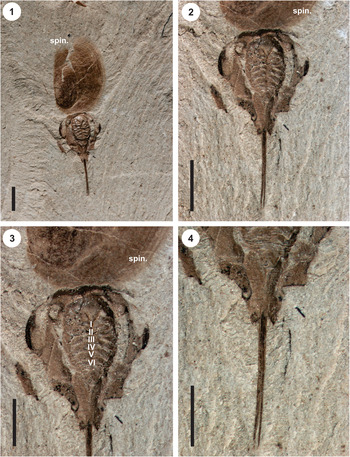
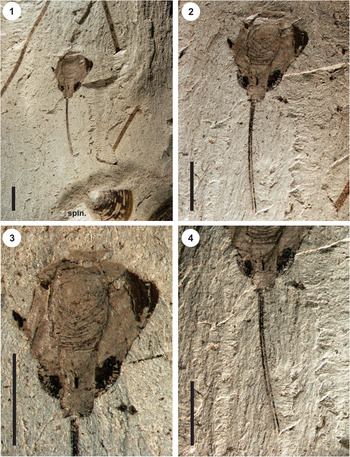
The fossils studied herein include two completely articulated specimens, preserved as a 3D mold (holotype) and a compression (paratype) (Figs. 3, 4). The specimens were photographed under strong unilateral light at different angles to enhance their surface features using a Nikon DS-Fi1-U2 digital camera attached to a Nikon SMZ800 stereomicroscope. Measurements were performed with ImageJ 1.49v software.
Duraznovis gallegoi n. gen. n. sp. from Potrerillos Formation, Cuyana Basin, Mendoza, Argentina, holotype, IANIGLA-PB 203, complete specimen in ventral view: (1) entire specimen; (2, 3) detail showing the morphological characters; (4) detail of posterior region and tail. I–VI = potential paired appendages; spin. = spinicaudatans. Scale bars = 2 mm.

Duraznovis gallegoi n. gen. n. sp. from Potrerillos Formation, Cuyana Basin, Mendoza, Argentina, paratype, IANIGLA-PB 168, complete specimen in dorsoventral view: (1) entire specimen; (2, 3) detail showing the morphologic characters; (4) detail of posterior region and tail. spin. = spinicaudatans. Scale bars = 2 mm.

Repository and institutional abbreviation
The collected material is housed at the Instituto Argentino de Nivología, Glaciología y Ciencias Ambientales-Centro Científico Tecnológico-Consejo Nacional de Investigaciones Científicas y Técnicas (IANIGLA-CCT-CONICET) in Mendoza Province (IANIGLA-PB).
Systematic paleontology
Phylum Arthropoda Latreille, Reference Latreille1829
Order Incertae sedis
Family Incertae sedis
Genus Duraznovs new genus
Type species
Duraznovis gallegoi new species; by monotypy.
Diagnosis
Body differentiated into anterior and posterior regions. Shield with a guitar-shaped outline in dorsoventral view, with a semicircular anterior margin and lateral margins oblique to the median body axis, proximally wide and tapering distally at an angle of 70–74°. Anterior region completely covered by the shield, with six visible segments. Posterior region characterized by a broad, trapezoidal, apparently unsegmented, weakly bulging, apodous abdomen. Finally, a long, styliform tail-like structure is inserted in the center of the posterior area and is distally divided.
Occurrence
Quebrada del Durazno locality, Potrerillos Formation (upper section), lower Upper Triassic (Carnian), south of the Cerro Cacheuta, Potrerillos-Cacheuta depocenter of the Cuyana Basin, Mendoza Province, Argentina.
Etymology
Named after the Quebrada del Durazno locality and from the Latin novis = new.
Remarks
Duraznovis n. gen. is placed in Arthropoda based on a tagmatised body and ventral segmentation indicating the placement of appendages.
Duraznovis gallegoi new species
Figures 3–5
Interpretative drawings: (1, 2) Duraznovis gallegoi n. gen. n. sp., showing the morphological characters preserved: (1) holotype, IANIGLA-PB 203; (2) paratype, IANIGLA-PB 168; (3) morphological features of xiphosurans (modified from Ruppert, Reference Ruppert2004); and (4) morphological features of notostracans (modified from McLaughlin, Reference McLaughlin1980). a = undetermined structures similar to xiphosuran compound eyes; An = anterior region; app = appendages; b = area related to the xiphosurans walking appendages; c = shield injuries; ce = compound eyes; d = ?muscle; e = broad area perhaps related to genital operculum of xiphosurans; f = area transversely lineated perhaps indicating position of gills; g = abdominal plate; gen. op. = genital operculum; gill op. = gill opercula; h = abdominal segments; oph. rid. = ophthalmic ridges; opm = opisthosomal margin; Po = posterior region; po. part = opisthosoma posterior part; pros./thor. artic. = prosoma/thoracetron articulation; S = shield; se = thoracic segments; Ta = tail-like structure. Scale bars = 2 mm.

Type material
IANIGLA-PB 203 (holotype); IANIGLA-PB 168 (paratype).
Diagnosis
See generic diagnosis above.
Occurrence
Quebrada del Durazno locality, Potrerillos Formation (upper section), lower Upper Triassic (Carnian), south of the Cerro Cacheuta, Potrerillos-Cacheuta depocenter of the Cuyana Basin, Mendoza Province, Argentina.
Description
Holotype IANIGLA-PB 203 (Figs. 3, 5.1) is three-dimensionally preserved, retaining part of its original volume in ventral view. The total length of the specimen is 7 mm, and it is 3.4 mm at its broadest part. The body is differentiated into an anterior region (Fig. 5.1, An), and a posterior region (Fig. 5.1, Po). A hard, protective, guitar-shaped shield (S) covers the body (2.57 mm long, 3.4 mm wide) representing approximately half of the body length (tail-like structure [Ta] excluded). The shield (Fig. 5.1, S) is nearly completely preserved, with a semicircular anterior margin, and lateral margins oblique to the median axis at an angle of 74°. Impressions of undetermined structures are visible on the upper part of the anterior region (Fig. 5.1, a). A protuberant area (1.71 mm) is visible, completely covered by the shield (Figs. 3; 5.1, b). It has six segments (Figs. 3, I-VI, 5.1, se) that probably carried six paired structures, or ‘appendages.’ The posterior region (Fig. 5.1, Po) is 1.71 mm long and consists of a broad, trapezoidal, apparently unsegmented, weakly bulging, apodous area. Toward the end, there is an area with a W-shaped posterior margin in which a long, styliform, distally divided tail-like structure (2.94 mm) is inserted (Fig. 5.1, Ta).
Paratype IANIGLA-PB 168 (Figs. 4, 5.2) is a moderately preserved compression, however, its main morphological features can still be recognized. Like the holotype, the body can be discerned as an anterior region (Fig. 5.2, An) and a posterior region (Fig. 5.2, Po), which ends in a long, styliform tail-like structure (Fig. 5.2, Ta), measuring in total 10.36 mm long. The specimen is dorsoventrally flattened with a partially preserved, elongated, guitar-shaped shield (Fig. 5.2, S), 4 mm long and 4.3 mm wide (if complete). The lateral margins of the shield are oblique to the median axis at an angle of 70°, although this specimen suffered slight lateral compression, judging from its asymmetry. The impressions of undetermined structures are visible on the upper part of the anterior section (Fig. 5.2, a). An area (1.7 mm) is visible, crossed by several furrows (Figs. 4, 5.2, b) that are probably pointing to the places where the appendages (Fig. 5.2, app) were attached. The posterior region is 1.8 mm long, unsegmented, trapezoidal, and apodous. This region ends in a long, styliform structure (5.7 mm) inserted in the middle of a rounded square area. This structure is slightly curved and more anteriorly divided than in the holotype specimen.
Etymology
Dedicated to Dr. Oscar Florencio Gallego in recognition of his contributions to the fossil crustaceans of Argentina.
Measurements
Holotype, IANIGLA-PB 203: The total length of the animal including the tail-like structure is (a) = 7 mm; width (b) = 3.4 mm; length/width ratio (c) = 2.05 mm; total length from the anterior margin of the shield to the posterior margin excluding tail-like structure (d) = 2.57 mm. Paratype, IANIGLA-PB 168: a = 10.36 mm; b = 4.3 mm; c = 2.41 mm; d = 4.3 mm.
Remarks
The peculiar morphology observed in Duraznovis gallegoi n. gen. n. sp. is considerably difficult in its interpretation and correct taxonomic allocation. However, the possession of a generalized arthropod morphology and a unique combination of characters similar to those of living and fossil representatives of xiphosurans (Chelicerata) and notostracans (Branchiopoda), e.g., body shape, differentiation of body into anterior and posterior regions, a shield, and a tail-like structure, make documentation of these specimens worthwhile.
Discussion
Comparison with other morphologically similar Arthropoda
Based on the morphological characters observed in Duraznovis gallegoi n. gen. n. sp. (Figs. 3, 4), affinities to either Xiphosura Latreille, Reference Latreille1802 (Chelicerata) (= Merostomata Dana, Reference Dana1852) and Notostraca Sars, Reference Sars1867 (Crustacea, Branchiopoda) can be inferred.
Duraznovis gallegoi n. gen. n. sp. (Figs. 3, 4) could be placed close to xiphosurans (Fig. 5.3) by the presence of a body differentiated into tagmatas, terminating in a long, styliform tail-like structure (Fig. 5.1, 5.2, Ta); large shield (Fig. 5.1, 5.2, S); and six thoracic segments (Fig. 5.1, 5.2, se) that probably bore six pairs of ‘appendages,’ ventrally attached to the shield (Dunlop and Selden, Reference Dunlop, Selden, Fortey and Thomas1997) (Fig. 5.3). The anterior region (Fig. 5.1, 5.2, An) and posterior region (Fig. 5.1, 5.2, Po) in Duraznovis gallegoi n. gen. n. sp. could be considered analogous to the ‘prosomal’ dorsal shield (cephalothorax) and abdomen (opisthosoma/thoracetron) in xiphosurans, respectively (Fig. 5.3). The shield (Fig. 5.1, 5.2, S) in both xiphosurans and Duraznovis gallegoi n. gen. n. sp. has a semicircular anterior margin and lateral margins oblique to the median axis, covering the anterior region (Fig. 5.1, 5.2, An), but in Duraznovis gallegoi n. gen. n. sp., the shield is guitar-shaped, whereas in xiphosurans it has the shape of a horseshoe (Fig. 5.3). The holotype specimen (IANIGLA-PB 203, Figs. 3, 5.1) has an irregularity on the left margin of the shield (Fig. 5.1, c), like the cephalothoracic injuries found in extant xiphosurans (see Bicknell et al., Reference Bicknell, Pates and Botton2018, fig. 2.5). Such injuries could be self-inflicted (from mating or predation), teratological (developmental and genetic), or pathological (disease or parasites). In both of our specimens, the impression of two undetermined structures are visible on the anterior section (Fig. 5.1, 5.2, a), similar to xiphosuran compound eyes (Fig. 5.3, ce), but these are too bulbous, not associated with an ophthalmic ridge, and differ in their position, and therefore are here left as undetermined.
Possible anterior muscle structures (Fig. 5.1, d) are observed in the holotype specimen, resembling those described in Yunnanolimulus luopingensis Zhang et al., Reference Zhang, Hu, Zhou, Lv and Bai2009 (see Hu et al., Reference Hu, Zhang, Feldmann, Benton, Schweitzer, Huang, Wen, Zhou, Xie, Lü and Hong2017, fig. 4c, e), a xiphosuran from the Middle Triassic of China. A central area in Duraznovis gallegoi n. gen. n. sp. (Fig. 5.1, 5.2, b) resembles that of xiphosurans in the presence of six segments (Fig. 5.1, 5.2, se) that are probably related to the walking appendages (Fig. 5.3, app). The posterior region (Fig. 5.1, 5.2, Po) in Duraznovis gallegoi n. gen. n. sp. can be compared with the opisthosoma of xiphosurans (Fig. 5.3), however in Duraznovis gallegoi n. gen. n. sp., this region is more elongated than in xiphosurans, which could be a consequence of postmortem deformation. In both the holotype and paratype specimens, there is a broad area similar to the opisthosomal margin of xiphosurans (Fig. 5.1–5.3, opm). The abdomen of Duraznovis gallegoi n. gen. n. sp. has a broad area (Fig. 5.1, 5.2, e) that could be interpreted as an equivalent to the genital operculum of xiphosurans (Fig. 5.3, gen. op.). Following, an area transversally crossed by numerous lineations could be indicating the position of the gills (Fig. 5.1, 5.2, f, 5.3, gill.op.). The distal placement of the gills in our specimens is in accordance with Lamsdell (Reference Lamsdell2013), who stated that in aquatic chelicerates, the opisthosomal appendages are modified into flattened opercula that bear the respiratory organs (‘book gills’). The posteriormost part of the abdomen in Duraznovis gallegoi n. gen. n. sp. ends in a heart-shaped plate with sharp to rounded lateral extensions (Fig. 5.1, 5.2, g), somewhat comparable to those observed in xiphosurans (Fig. 5.3, po. part). Lastly, the fossil specimens have long, styliform tail-like structure (Fig. 5.1, 5.2, Ta) analogous to the telson of xiphosurans (Fig. 5.3), although in Duraznovis gallegoi n. gen. n. sp., the tail is divided distally in holotype IANIGLA-PB 203, and more anteriorly in paratype IANIGLA-PB 168. The asymmetrical split occurring at different lengths of this structure in the two fossil specimens suggests that it could be taphonomic breakage rather than a taxonomic feature. Similarly, divided telsons in extant xiphosurans have been reported as teratological abnormalities (see Bicknell et al., Reference Bicknell, Pates and Botton2018, fig. 1), so this possibility should not be ruled out.
The main difference observed between Duraznovis gallegoi n. gen. n. sp. and other xiphosurans is their body size (7–10 mm), being smaller than all other known Triassic specimens, although not markedly differing from ‘Paleolimulus’ fuchsbergensis Hauschke and Wilde, Reference Hauschke and Wilde1987 from the Upper Triassic of northern Germany (12 mm long). The remaining species are considerably larger (21–146.5 mm), i.e., Dubbolimulus peetae Pickett, Reference Pickett1984 from Middle Triassic of Australia (21 mm); and Austrolimulus fletcheri Riek, Reference Riek1955, Middle Triassic of Australia (146.5 mm). The variation of size observed in fossil xiphosurids could be explained by the great morphological disparity that they reached during Triassic times (Bicknell et al., Reference Bicknell, Žalohar, Miklavc, Celarc, Križnar and Hitij2019). Other typical morphological structures of xiphosurans that are not visible in our specimens are the opisthosomal spines or the genal spines (Fig. 5.3) (Dunlop and Selden, Reference Dunlop, Selden, Fortey and Thomas1997; Lamsdell, Reference Lamsdell2013). Nevertheless, the absence of ornamentation in our specimens could be due to a taphonomic issue, because spines and other structures are most likely to be lost during the process of fossilization (Bicknell et al., Reference Bicknell, Pates and Botton2018).
At a different level, Duraznovis gallegoi n. gen. n. sp. presents a ‘notostracan-like’ (Crustacea, Branchiopoda) overall appearance (Figs. 3–5), e.g., the presence of a large shield (Fig. 5.1, 5.2, S) that is strongly drawn out laterally and posteriorly; an elongate trunk that carries the appendages (Fig. 5.1, 5.2, 5.4, app); and a long, tail-like structure analogous to the caudal furca of some members of the extant family Triopsidae Keilhack, Reference Keilhack and Brauer1909 (Fig. 5.1, 5.2, Ta; 5.4). At closer look, however, notostracans have an elongated shield with a rounded-acute proximal margin (Fig. 5.4), differing from the guitar-shaped shield of Duraznovis gallegoi n. gen. n. sp. Another difference between these specimens and notostracans refers to total size; extant adult notostracans range from 1–10 cm in length (Rogers, Reference Rogers and Likens2009). The ventral organization also shows variations; for example, the number of appendages on the thorax of both fossil and extant notostracans ranges from 10–80 (Rogers, Reference Rogers and Likens2009; Lagebro et al., Reference Lagebro, Gueriau, Hegna, Rabet, Butler and Budd2015), markedly contrasting from the potential presence of only six pairs in Duraznovis gallegoi n. gen. n. sp. Additionally, the abdomen in notostracans is composed of several segments, surpassing the posterior limit of the protective shield and leaving the more distal segments exposed (Fig. 5.4, h). In comparison, the abdomen of Duraznovis gallegoi n. gen. n. sp. is shorter and almost completely covered by the shield. However, Hegna (Reference Hegna2012) suggested that some abdominal segments in notostracans can be lost during the fossilization process, or potentially, shortened by desiccation. Because both of our fossil specimens are complete and articulated, we consider this as highly unlikely. On the other hand, Wagner et al. (Reference Wagner, Haug, Sell and Haug2018) mentioned that a short trunk is probably related with early juvenile notostracans stages. Unfortunately, the developmental stages of our specimens are hard to tell from the fossils, because no gonads are recognized, and more specimens are needed to show size variations that could clarify this point. Lastly, the long, styliform tail-like structure visible in Duraznovis gallegoi n. gen. n. sp. (Fig. 5.1–5.2, Ta) is centrally inserted to the heart-shaped plate (Fig. 5.1, 5.2, f), whereas in notostracans, the ‘tail’ is composed of two caudal furcas laterally attached to a telson (Fig. 5.4).
In summary, these fossils show a combination of features found in two disparate arthropod groups, i.e., Xiphosura and Notostraca, making correct taxonomic allocation difficult. Therefore, until additional, better-preserved specimens are recovered, which can shed light about development stages, reproductive structures, or even clarify the still-undefined structures mentioned herein, we prefer to maintain their systematic classification as indeterminate.
Taphonomic and paleoenvironmental implications
Duraznovis gallegoi n. gen. n. sp. comes from Facies Association A2 described by Lara et al. (Reference Lara, Cariglino and Zavattieri2017), which refers to ponds or swamps developed within the shallow embayments during deltaic flooding pulses in the lower delta plain. These ponds never dried out completely, as suggested by the absence of desiccation cracks, but their shallow, usually submerged substrates were probably episodically exposed, as the presence of incipient paleosols indicate. Moreover, numerous Euestheria forbesi (Crustacea: Spinicaudata) specimens (Figs. 3, 4, spin.) recorded in this facies present wrinkles in their valves, producing desiccation patterns similar to those described by Astrop (Reference Astrop2014) for the upper Permian spinicaudatan Megasitum harmonicum Novojilov, Reference Novojilov1970 from Kazakhstan.
The material studied herein was found associated with an abundant well-preserved flora, a rich fauna of spinicaudatan crustaceans (Figs. 3, 4, spin.), numerous diverse insects, and a few fish remains (Lara et al., Reference Lara, Cariglino and Zavattieri2017). The low abundance of these enigmatic arthropods at the Quebrada del Durazno locality might be related to the presence of fishes in the water pools, which probably acted as top predators in these habitats. Other explanations could be that the high abundance of spinicaudatans inhibited the diversification of the group by competition for the same resources; or that during extreme flooding events, these specimens were transported accidentally from farther areas. Finally, we do not rule out a potential collection or taphonomic bias.
The faunistic associations of spinicaudatans with notostracans, as well as spinicaudatans with xiphosurans, have been previously recorded from other Triassic localities worldwide. The former association was reported for ephemeral pool communities from the Middle Triassic of the Grès à Voltzia Formation in France (Gall and Grauvogel-Stamm, Reference Gall and Grauvogel-Stamm2005), whereas taphocenosis with both xiphosurans and spinicaudatans have been described from freshwater to brackish-water environments from the Middle Triassic of southern Tunisia (Błażejowski et al., Reference Błażejowski, Niedźwiedzki, Boukhalfa and Soussi2017).
In addition to the similar morphological characteristics mentioned above, Duraznovis gallegoi n. gen. n. sp. was found in a paleoenvironment not very different from those registered for notostracans and xiphosurans. With a fossil record starting in the Devonian, notostracans have developed a wide range of forms that inhabit almost exclusively temporary freshwater bodies on all continents (including Antarctica) (Gueriau et al., Reference Gueriau, Rabet, Gaël, Lagebro, Vannier, Derek, Briggs, Charbonnier, Olive and Béthoux2016), being occasionally found in marine environments (Adamowicz and Purvis, Reference Adamowicz and Purvis2005; Olesen, Reference Olesen2007; Hegna, Reference Hegna2012; Rogers and Padhye, Reference Rogers and Padhye2015). On the other hand, the record of xiphosurans extends to the Lower Ordovician (Van Roy et al., Reference Van Roy, Orr, Botting, Muir, Vinther, Lefebvre, el Hariri and Derek2010). This group of arthropods is nowadays found living in marginal environments, and the same is observed for their fossil counterparts, recovered from marginal marine to brackish paleoenvironments (Fisher, Reference Fisher and Nitecki1979; Babcock et al., Reference Babcock, Merriam and West2000), and more rarely from freshwater settings (Pickett, Reference Pickett1984; Błażejowski et al., Reference Błażejowski, Niedźwiedzki, Boukhalfa and Soussi2017). Lamsdell (Reference Lamsdell2016) suggested that xiphosurans have independently colonized the nonmarine realm many times during their evolutionary history, like Psammolimulus gottingensis Lange, Reference Lange1923, from the Triassic of Germany, which inhabited freshwater floodplain habitats along braided river systems (Lerner et al., Reference Lerner, Lucas and Lockley2017). Therefore, the freshwater paleoenvironment at the Quebrada del Durazno locality would not be a barrier to finding xiphosurans. If in the near future new fossils validate Duraznovis gallegoi n. gen. n. sp. as belonging to Xiphosurida, this site will add new evidence of freshwater xiphosurans as a result of the post-Permian extinction environmental pressure (Foster and Twitchett, Reference Foster and Twitchett2014; Lamsdell, Reference Lamsdell2016; Błażejowski et al., Reference Błażejowski, Niedźwiedzki, Boukhalfa and Soussi2017).
The complete, articulated state and the quality preservation of Duraznovis gallegoi n. gen. n. sp. suggest that the specimens were quickly covered by sediments, protecting them from postmortem processes and/or biological attacks. An analogous example was given by Lagebro et al. (Reference Lagebro, Gueriau, Hegna, Rabet, Butler and Budd2015), who mentioned that the lack of damage in fossil notostracans implies in situ deposition where little or no scavenging or turbulence occurred. Additionally, Hegna (Reference Hegna2012) evaluated how notostracans tolerated disarticulation and fragmentation through decay experiments under laboratory conditions (euthanized by asphyxiation, covered with freshwater in a tray at room temperature; some specimens were dried to assess the effects of desiccation) showing that after 16 days from their death, no fully articulated animals remained. For the xiphosurans, Babcock et al. (Reference Babcock, Merriam and West2000) mentioned that only under exceptional circumstances (i.e., Lagerstätten deposits), the cuticular exoskeleton and disarticulation of body parts will remain relatively low. Likewise, the remarkable preservation as a 3D mold of the holotype of Duraznovis gallegoi n. gen. n. sp. suggests a different taphonomic history from spinicaudatans recorded at the same site (Figs. 3, 4, spin.). The latter taxa are represented by isolated and poorly preserved prints of valves (dorsal shields), which probably corresponded to postmortem disarticulated bodies, deposited in a water depression. The small size observed in Duraznovis gallegoi n. gen. n. sp. points to a juvenile instar stage rather than a mature adult, although this cannot be fully ascertained until we have more specimens that help us to understand their complete life cycle. For instance, Błażejowski (Reference Błażejowski, Carmichael, Botton, Shin and Cheung2015) mentioned that juvenile xiphosurids spend their first years in shallow waters, rapidly increasing in size before moving to deeper waters. Unfortunately, ontogenetic changes in the fossil record are enormously difficult to observe from a limited number of specimens (Allen and Feldmann, Reference Allen and Feldmann2005).
Conclusions
Duraznovis gallegoi n. gen. n. sp. is an enigmatic arthropod from the Triassic of Argentina. The extremely unusual morphology observed indicates that it is a new species to science, and therefore its documentation is of utmost interest. Duraznovis gallegoi n. gen. n. sp. closely resembles in its morphological and paleoecological characteristics (e.g., overall body shape, differentiation of the tagmas, and presence of a shield), living and fossil representatives of xiphosurans and notostracans, two completely different arthropod groups with convergent body structures. However, the combination of their reduced size, the guitar-shaped shield without ornamentation, a tail-like structure divided and centrally inserted to the posterior end of the body, and few thoracic and abdominal segments make correct allocation of these specimens uncertain. Thus, we prefer to maintain the taxonomic position as indeterminate until further specimens are recovered.
These new specimens reveal that the microenvironment at the Quebrada del Durazno locality during Triassic times had an unusual and diverse freshwater fauna that awaits further discoveries. We anticipate that extensive fieldwork and continued research and identification of new specimens will allow us to increase information on invertebrate community structure, also providing a unique opportunity for understanding ecosystem evolution during the Upper Triassic in this part of the world.
Acknowledgments
Grateful acknowledgment is extended to E. Sosa and J. Bustos for facilitating access to the Triassic strata exposed at their farm, E. Zavattieri for editing some of the images, and M. Miñana for technical assistance. We also thank T. Hegna, D. Audo, and two anonymous reviewers for their suggestions and comments, which improved the final version of this manuscript. This work was supported by the Agencia Nacional de Promoción Científica y Tecnológica (ANPCyT) grants PICT 2014–2546 (PI: A.M. Zavattieri), PICT 2016–1954 (PI: M.B. Lara), PICT 2016–0431 (PI: B. Cariglino), Secretaría General de Ciencia y Técnica, Universidad Nacional del Nordeste (Grant No. Q006-2014), and CONICET PIP 2014–2016 No. 11220130100317CO.