Introduction
Several programmes provide educational opportunities in Antarctica for students at tertiary and secondary levels. Formal programmes include those connected to the University of Canterbury (Gateway Antarctica), to the University of Tasmania, and to Lakehead University (Canada), the programme described in this paper. In addition, a Canadian commercial venture, Students on Ice, is in partnership with educational institutions to provide ship-based field trips for secondary and tertiary students (Green Reference Green, Lück, Maher and Stewart2010).
It should not be surprising that these formal opportunities exist given the strong science foundation of human activity in Antarctica, but also the central role of field experience in so many academic disciplines (see Cattadori and others Reference Cattadori, Florindo and Rack2011). Benefits for students of field experience include the possibility of examining phenomena as they are occurring on site, developing skills and abilities in an integrated fashion, and obtaining deeper learning through a stronger affective and cognitive link (for example Kent and others Reference Kent, Gilbertson and Hunt1997; Boyle and others Reference Boyle, Maguire, Martin, Milsom, Nash, Rawlinson, Turner, Wurthmann and Conchie2007). What these experiences mean for outcomes not related to the actual course is a less studied aspect of the field experience, although educators might expect that influences extend beyond the course, particularly for those in high-impact settings such as the polar regions.
This paper explores the influence of a field trip on the post-course outcomes of students who participated in one of six Antarctic Peninsula trips offered between 1998 and 2005 as part of an upper year university course on polar tourism at Lakehead University, Canada. The goal of the course was to enable students to gain first-hand knowledge of tourism in the Antarctic region through immersion on tourist cruises, including participation in ship-based activities, and general interaction with other tourists and expedition staff. Background research and reports helped prepare students for the trip and a reflective component of the course encouraged students to evaluate their experiences within the context of broader themes related to tourism theory and practice upon completion of the trip.
Research described in this paper examines post-course outcomes of the field trip experience that were not specifically related to the course itself or to its evaluation mechanisms. The data collection occurred between three and ten years after participation. Of the 61 students who participated in field trips, 39 took part in this study. Objectives of the research were to examine motivation for travel, post-course behaviour and participants’ views of the influence of the field trip experience on later educational, professional, environmental and other personal decisions.
Field trips and education
Field-based experiences are a valuable part of the curriculum from elementary school to university programmes, creating an expanded classroom through a variety of settings and forms, such as co-op education, internships and exchanges (Katula and Threnhauser Reference Katula and Threnhauser1999). Field experience exposes students to new environments in order to increase their experience and depth of understanding (Gerber and Chuan Reference Gerber, Chuan, Gerber and Chaun2000). Field experiences have a long history in disciplines such as geography, biology and geology, in which hands-on experience is seen as an essential component of skill development (Kent and others Reference Kent, Gilbertson and Hunt1997; Stoltman and Fraser Reference Stoltman, Fraser, Gerber and Chaun2000; McGuinness and Simm Reference McGuinness and Simm2005), providing a link between theoretical and applied learning (DeMartini Reference DeMartini1983; Katula and Threnhauser Reference Katula and Threnhauser1999; Gerber and Chuan Reference Gerber, Chuan, Gerber and Chaun2000) that is a basis for experiential learning (Kolb Reference Kolb1984).
Further, field experience can support students in their personal, emotional and intellectual growth. Students have a direct involvement in, and responsibility for, their learning and, through their experiences, for example, develop their own environmental ethics (Stoltman and Fraser Reference Stoltman, Fraser, Gerber and Chaun2000). Field experiences can encourage an appreciation for diverse landscapes and recognition of the importance of conserving and preserving the environment through environmentally sustainable practices and strategies (Gerber and Chuan Reference Gerber, Chuan, Gerber and Chaun2000). This conceptualisation of pedagogy in experiential education has often followed the cycle described by Kolb (Reference Kolb1984) that explicitly includes a reflection component so that learners can put their experiences into context (but see also Kent and others Reference Kent, Gilbertson and Hunt1997). The goal is to encourage deep learning through critical reflection, enabling students to move beyond preconceptions into new understandings (Dummer and others Reference Dummer, Cook, Parker, Barrett and Hull2008).
Although the effectiveness of field experience in achieving cognitive learning objectives appears to be taken for granted in many situations (Kent and others Reference Kent, Gilbertson and Hunt1997; Houser and others Reference Houser, Brannstrom, Quiring and Lemmons2011), researchers have attempted to evaluate such effects. For example, Houser and others (Reference Houser, Brannstrom, Quiring and Lemmons2011) compare the cognitive results for students who participated in a study abroad field trip and those who did not. Though results were identical in the pre-trip and immediate post trip time frames, the students in the study abroad group fared significantly better on the final examination. Houser and others (Reference Houser, Brannstrom, Quiring and Lemmons2011) suggest that the trip participants were more engaged with the material and also benefited from increased social networks gained through the experience. Boyle and others (Reference Boyle, Maguire, Martin, Milsom, Nash, Rawlinson, Turner, Wurthmann and Conchie2007) conclude that field experiences influenced affect in a positive way and that this led to an enhanced and more effective learning experience for the students.
The use of field experiences is not without criticism (Kent and others Reference Kent, Gilbertson and Hunt1997; Hirsch and Lloyd Reference Hirsch and Lloyd2005; Hankins and Yarborough Reference Hankins and Yarborough2008; Hope Reference Hope2009; Houser and others Reference Houser, Brannstrom, Quiring and Lemmons2011). There are particular challenges related to expense, equity and novelty of long haul or international experiences. McGuinness and Simm (Reference McGuinness and Simm2005) describe the internationalisation of field trips in undergraduate geography programmes in the United Kingdom as linked to social, economic and political changes that have increased the possibility and the expectation of offering such trips. Student financial access to such trips and individual or lifestyle constraints is a concern in relation to fairness and equal opportunity in education (Kent and others Reference Kent, Gilbertson and Hunt1997; Houser and others Reference Houser, Brannstrom, Quiring and Lemmons2011). A further concern is the effect of novel environments on learning, given that familiarity is known to improve student performance (Cotton and Cotton Reference Cotton and Cotton2009). Cotton and Cotton (Reference Cotton and Cotton2009) demonstrate that while psychological novelty is largely a negative influence on learning, geographical novelty is a positive influence and was a highlight of a trip for biology students. The authors note that what students remember from a trip is not necessarily related to learning outcomes, suggesting that other memorable experiences can play a role in students’ decisions to continue learning in the discipline.
Several studies have explored the role of field experiences in post-course decisions. For example, Yarnal and Neff (Reference Yarnal and Neff2007) conclude that an environmental science programme with a six-week field research component achieved its primary goals such as building collaborative research skills, but also encouraged students to undertake further research in human-environment interactions, to pursue careers in geography and to maintain an interest in collaborative research. Davies (Reference Davies, Ward and Muckle2001) outlines the later impacts for graduates of a field directed course on indigenous Australians and environmental management. Graduates reported attitudinal changes that influenced their interactions with co-workers. Field experiences can also foster relationships with others in the region visited, with implications for continuing relationships and later outcomes that might extend beyond the initial expectations of the programme. Maher and others (Reference Maher, Vaugeois and McDonald2010) describe an extension tour programme that brought undergraduates to communities in rural British Columbia to engage in a process of dialogue and mutual learning about tourism. Analysis of final reflections in field journals and comments at on-site debriefing sessions shows that student participants reported feeling better prepared to work in a rural context following the field tour. The authors also noted that a third of the participants did later work in a rural setting. The faculty members involved experienced the development of better networks with tourism stakeholders and greater collaboration (Maher and others Reference Maher2010).
Related to the potential for post-course effects is a growing literature that examines the possibility that visitors to a place become ‘ambassadors,’ that is, following their visits, they advocate for the region or for particular features such as wildlife (Maher Reference Maher, Vaugeois and McDonald2010). Evidence supporting the existence of an ‘ambassador’ effect of Antarctic travel has been divided, with some authors finding evidence of increased awareness and initial intention to change behaviour (for example Maher Reference Maher2010), while others have not found this effect (for example Eijgelaar and others Reference Eijgelaar, Thaper and Peeters2010). A key element in understanding the ‘ambassador’ effect relates to the educational component of on-board interpretation and its potential influence on behaviour and attitudinal changes (see Walker and Moscardo Reference Walker, Moscardo and Dowling2006). Powell and others (Reference Powell, Kellert and Ham2008) examined immediate and short term outcomes of an Antarctic tourism experience related to knowledge, attitudes, environmental behaviour and future intentions through a longitudinal design (first and last day of trip, and three months later). The authors found that at the end of the trip behavioural intentions had increased significantly, but that three months later participants had acted only minimally on these intentions. They also note that existing high levels of agreement with conservation initiatives made it difficult to see evidence of a change in attitude toward conservation (Powell and others Reference Powell, Kellert and Ham2008). The possibility of an ‘ambassador’ effect has relevance for this exploration of post-course outcomes of experiences, particularly in relation to the question of whether the deeper understanding expected of field experiences has an influence on behaviour in the years following participation. Of note, these studies exploring the ‘ambassador’ effect in Antarctic tourist visitation have been undertaken in a time frame close to the actual voyage.
The Antarctic tourism field trip
The field experience being explored in this paper was part of a senior undergraduate course on polar tourism in which students travelled from southern Canada to the Antarctic Peninsula and adjacent islands. As in the experience described by Kelner and Sanders (Reference Kelner and Sanders2009: 136), the design of the field trip used ‘. . . the object of study as the medium of study’ and was based on teaching tourism concepts through participant observation and guided discussion. The students participated as critical and reflective tourists who could analyse their experiences using tourism theory. The tourism field trips were embedded in scheduled tourism cruises. Students participated on trips that followed the established itinerary that is consumed by typical Antarctic Peninsula expedition cruise tourists. They also experienced pre-trip meetings to cover logistical aspects and academic material such as Antarctic history, geography and biology, tourism context and tourism theory, and were accompanied on the trip by a faculty supervisor. Not all groups of students had the same experience and itinerary, since there was a variety of offerings over the six years that the course included Antarctic field trips; also each of the trips was affected differently by weather, sea conditions, landing possibilities, staff and lecturers and routing, for example. Operators were Abercrombie and Kent and GAP Adventures. One constant was the ship itself (M/S Explorer) and the general familiarity of the created tourism experience called ‘Antarctic expedition cruise travel.’
The Antarctic cruise tourism experience in the peninsula has largely followed the expedition model pioneered by Lars-Eric Lindblad in which the experience is managed within a context of exploration and education (Stonehouse and Crosbie Reference Stonehouse, Crosbie, Hall and Johnston1995; Crosbie and Splettstoesser Reference Crosbie, Splettstoesser, Maher, Stewart and Lück2011). Emphasis on an environmental ethic is a strong component of the experience, supported by a minimum impact approach. This material is delivered through messages to passengers about responsible behaviour regarding tourist impacts, on-board lectures including discussion of preservation, conservation and charitable causes, as well as environmental concerns related to the Southern Ocean, Antarctic wildlife, and global climate change, and evening re-cap sessions of the day's activities (Crosbie and Splettstoesser Reference Crosbie, Splettstoesser, Maher, Stewart and Lück2011; see also Powell and others Reference Powell, Kellert and Ham2008). Further, expedition cruising in the Antarctic is a managed experience that offers tourists a sense of challenge and accomplishment through an emphasis on the difficulties of access in a polar wilderness, the interaction of cruise ships with ice, the need to land on shore via inflatable boats (for example Zodiacs), and the quickly changing conditions of weather and sea that bring unpredictability to Antarctic cruising (see Nuttall Reference Nuttall, Hall and Saarinen2010).
Study method
The study was designed to obtain the views of as many of the student participants as possible, taking a census approach to securing respondents for the questionnaire. The population comprised all those people who participated as students on six field trips offered from 1998 to 2005. A total of 61 students participated in the programme, but only 58 were potential respondents (one participant had died and two were members of the research team). To contact participants, this study used class lists and email addresses provided by Lakehead University in accordance with a strict protocol based on Canadian privacy law and following an approved university ethics procedure. In 2008 an invitation to participate in the study was sent to 53 individuals for whom there were email addresses through university records and personal contacts of the researchers. There was no way of knowing whether these were active email addresses.
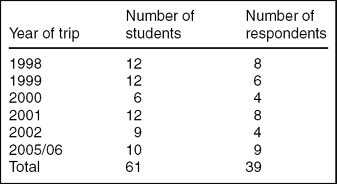
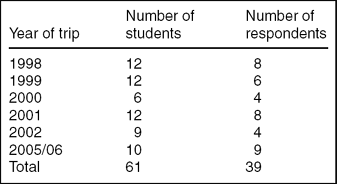
If an individual agreed to participate, a questionnaire was sent by email that could be completed electronically or in hard copy. The questionnaire included open and closed questions about memories and highlights, behaviour, and post-course outcomes related to the field trip. Open ended questions were used to enhance the exploratory aspect of the study with the intention of building categories and themes or similarities among responses from the ground up rather than to restrict responses to categories from other studies that might not be relevant or might restrict thinking of the respondents. Closed questions were used when pre-existing specific categories made sense for comparison. 41 individuals agreed to participate and no individual replied who did not want to participate in the study. After two sets of email reminders, 39 responses were received, equalling about two-thirds of the student participants. All trips were represented by respondents (Table 1).
Number of trip participants and number of respondents by year
12 of the respondents participated in the trip as second or third year students, and 19 were in their fourth year. Eight were part-time students or were taking the course outside of a degree programme. 18 respondents were male and 21 were female. At the time of the questionnaire, respondents’ ages ranged from 23 to 61, with a median of 30 and a mode of 28. 35 of the respondents were living in Canada at the time of response. All held undergraduate degrees, seven held a master degree and one a doctoral degree. Eleven were employed in primary or secondary teaching and seven were employed in other educational positions such as university lecturer. Four were employed as outdoor guides or programmers, three continued to be students, two were business owners, and one was a researcher.
Despite differences in timing, itineraries, actual sites visited and routes taken, respondents reported participating in similar activities from a list of 11 activities provided. All 39 respondents took part in wildlife viewing, short hiking trips, photography, shipboard lectures and viewing scenery. Most of the respondents also took part in swimming, iceberg touring, research station visits, historical tours, philosophical reflection and whaling station visits (32–38 respondents for each). 13 other activities were given by respondents, including 6 who noted participating in a long hike.
Motivation and memories
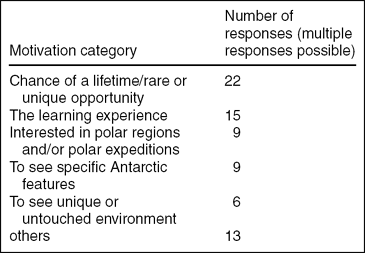
In an open ended format, respondents were asked what had motivated them to participate in the field trip. Content analysis was used to identify frequencies and major categories. Most respondents provided more than one reason and all of these are included in the frequencies given here (Table 2). The most common motivation can be described as seeing the trip as the ‘chance of a lifetime’ and a ‘rare or unique opportunity’ to experience something that would otherwise not be possible (22 respondents). The next most frequently mentioned motivation was the nature of the learning opportunity, either as a hands-on experience or as a specific examination of the Antarctic or polar tourism (15 respondents). Nine respondents noted that they were interested in the polar regions or polar expeditions specifically and nine also mentioned their desire to experience particular polar features, such as 24-hour daylight or the land described by explorers. Seeing the unique or untouched environment of the Antarctic was mentioned by six respondents. Other categories of motivations included adventure, fun, new experiences, wildlife viewing and photography (13 mentions total).
Motivation for participating in field trip

Most respondents provided a picture of overlapping motivations that related to various experiences and interests. For example, one respondent stated:
I had also developed a love of Polar Regions through my courses at Lakehead. Through previous experiences in the North, I had learned that first hand knowledge of the Polar Regions greatly enhanced my understanding of the Polar Regions. Finally, I love adventure and wanted to go where few venture (6).
Another wrote that:
this field trip was a great opportunity to see somewhere that I could probably never afford to visit on my own. . . I think my motivation was at least partially to see somewhere in the world where not too many people have been. As I learned more about the continent during [the] class, I wanted to see first-hand the ways in which tour companies were educating their clients and protecting the resource (15).
When asked about how often they thought about their Antarctic experience in the years since the journey, most respondents reported that they thought about it once a week or more often (25 respondents), while 11 reported thinking about it occasionally or once a month. Some noted these thoughts were triggered by other events occurring in their lives. Pictures or video of the Antarctic were mentioned as evoking particular memories of the trip as were occasions when the region was raised in conversation with friends, students or coworkers. Several described memories triggered by the November 2007 sinking of M/S Explorer.
Respondents were asked in an open ended format what they remember most about the trip; some provided examples of particular experiences that were linked with the highlights they described, though most provided a general impression or sense of key features. There were several answers that referred to specific experiences with wildlife such as: ‘the day when 3 adult and 1 young Humpback whales began feeding on krill right off the bow of the boat and we slowed to a stop so we could watch the bubble net feeding method’ (47). Antarctic landscape was frequently mentioned in the memories: ‘The overall beauty; the ice, water and rock’ (27) or ‘The feeling of being in such a faraway, isolated land. Like we went back in time and could see the landscape much in the same way that Shackleton, Scott and Amundsen saw it’ (33).
Several respondents mentioned a general sense of excitement about the trip. Others noted a feeling of awe or adventure as a powerful memory from their experiences in the Antarctic.
I remember the time on the ship and how it was such a different way of life. . . It was a different sense of space being out at sea and I loved the freedom the sea offered. There was a great sense of adventure among the passengers as well as the crew that made for a very positive and exciting experience for everyone involved. The wildlife encounters were so exciting that I often find myself talking about them years after the trip (44).
Post-course outcomes
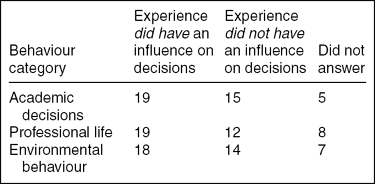
A series of open ended questions asked about the influence of the trip on academic and school life, professional life, and environmental values. Respondents were asked how they thought the trip influenced their life decisions or to indicate if there had been no influence (Table 3).
Influence of experience on post-course decisions and behaviour
Academic decisions
15 respondents reported that the trip did not influence their decisions about education, learning, courses and pursuit of a degree. For some, this was because they had already committed to an academic direction and the experience did not change that commitment or influence the topic of study. For others it was because this course was taken as one of the last electives in a programme before graduation. For several it was because they were already finished education and/or were in careers.
Of those who indicated there had been an influence, four respondents noted a connection between the trip and their decisions to become teachers. 14 other respondents indicated that the experience had influenced them in specific ways in their education, such as through the choice of a master level thesis topic, the continuation of travel for formal education, courses taken (or taught) later, applying knowledge and ideas to later education, and continuing studies on the interaction of people and the environment.
Respondent 25 drew a direct connection to further educational activities, saying:
Travelling to Antarctica sparked an interest in travelling and learning about cultures and environments outside of Canada. I moved to Australia 5 years ago to complete my Masters Degree in Outdoor Education and have often thought about furthering my education in a field that would take me back to Antarctica. . . . Last year I completed a Diploma of Sustainability course in which I did a research project on the sustainability of tourism and research in the Antarctic. The trip definitely influenced my decision to choose Antarctica as a research project (25).
One respondent reported a change in educational direction because of the trip: ‘The trip was the reason I found my calling in life, I am going to be a geologist and it took this trip to show me that's what I want to do with the rest of my life’ (41). This point relates to the next theme on the questionnaire: the influence of the trip on the participant's professional life.
Professional lives
12 respondents commented that the Antarctic trip had no influence on their professional lives, several because they were committed to a particular path when they took the course. Two persons in this group did indicate that the experience might influence future occupations. For example, Respondent 45 wrote: ‘Hasn't altered my professional life yet. But I would love to get into something such as teaching and leading other people in a tourism setting.’
For nine respondents who are educators, the Antarctic experience has influenced the content of their class material, teaching approach and related activities. Respondent 22 reported efforts to encourage high school students to visit Antarctica through the Students on Ice program (see Green Reference Green, Lück, Maher and Stewart2010), while another stated: ‘I have made it my life's work to make sure that all kids leave my classroom knowing that there are NO polar bears in Antarctica and there are NO penguins in the Arctic. Pingu is NOT real’(6).
Another educator recognised the influence of the trip as one element in a more complicated picture of career choice:
The trip opened my eyes to a lot of issues surrounding tourism in the Antarctica and the impact we had as tourists on the environment. I suppose the trip and the things I learned before, during and after the trip have guided me in my decision to work in the field of Outdoor and Environmental Education but I'm sure there were a lot of other factors that played a part in my professional life journey (25).
One individual tied the Antarctic trip to professional choices in the area of wilderness guiding:
My experience in Antarctica has greatly influenced my life professionally. I have spent a great deal of time traveling in Antarctica and in the High Arctic as a sea-kayak guide and hiking guide. I have developed a specialty in my experience guiding in Polar Regions. . . Without my initial introduction to Polar travel . . . I might not have become involved in Polar Guiding (8)
An additional seven respondents found some connection between the trip and their career choices, including three who believed that their choice of work location was related to these experiences and three who discussed insights and ideas from the trip that have influenced their professional lives. One stated: ‘I learned a lot about leadership and group management on the trip and I try to apply that to what I do’ (42). Another connected a growing awareness of water use and abuse obtained through the trip to a career in water resource management and another stated: ‘It was great to witness first hand some of the inner workings of a large scale tourism operation such as GAP Adventures. It has provided me with lots on interesting ideas and insights that I will carry with me thought the jobs I will have in years to come’ (44).
Environmental behaviour
When asked whether the trip had any influence on their environmental values and environmental behaviour, 14 respondents indicated that the Antarctic trip did not influence them. One wrote: ‘No, not really. I think there have been far greater impacts on my environmental values’ (15). But most of these individuals did report some effect on awareness, either in relation to tourism impacts or to sustainability and environmental issues of the Antarctic. For example, respondent 10 wrote: ‘I had strong environmental values previously. . .not sure if the trip added to this. . .but it made me more aware of the impact of tourists in fragile areas.’
18 respondents stated that the trip did influence them. Respondent 12 stated: ‘Much more aware of my footprint. Trying to do all I can to lessen my impact on climate change.’ Respondent 42 wrote ‘I think that I now appreciate how a choice made at home has a much greater impact on the world abroad that I had ever imagined.’ Others indicated specific actions they were taking, including fundraising for Antarctic conservation, paying attention to seafood sustainability, and considering environmental choices in recreation. One respondent stated
This trip has definitely opened my eye to some serious environmental issues that I was not aware of prior to the trip. For example long line fishing and its detrimental impact on the Albatross species in the southern ocean are much more serious that I knew of before the trip. Since then I have made a conscious effort to avoid eating Chilean Sea Bass and have been vocal in my disagreement with restaurants that serve this on their menu. I have talked to restaurant owners, and given written comments on how this fishing practice is endangering species. (44)
Several people noted their ability to understand global issues in a more personal way. References to global climate change and impacts of seafood production were made, along with general sustainability. For example, one respondent wrote: ‘I am conscious and knowledgeable when it comes to issues such as global warming and can visualize and have more of a personal grasp of the effects’ (45). Another participant noted that: ‘Since the trip I have grown a lot more interested in environmental issues and definitely feel my environmental values and behaviours have changed dramatically’ (25), while respondent 9 stated ‘if nothing else, it helped underline the importance of individual stewardship.’
Related to this were comments about enriching influences on respondents’ personal lives. For example, one stated: ‘I feel that because of the trip I have experienced something truly unique. This feeling is likely to give anyone a different outlook on life. I feel completely lucky’ (33). Respondent 10 commented that having read about Shackleton's adventures as a result of the trip led to thinking of ‘his courage and experiences as a role-model for endurance.’ Respondent 8 described striving ‘to make my experiences in Antarctica part of living an inspired life.’
Discussion
Although each time the university course was offered it was focused on allowing students to gain an understanding of the business, context, and managed experience of polar tourism through the expedition cruise ship experience, each trip was unique with regard to the experiences of the participants and the particular combination of sites and attractions visited; crew, staff members and other tourists aboard; and, environmental conditions. It appears that global issues have become an even larger component of the environmental message on board (see Nuttall Reference Nuttall, Hall and Saarinen2010) and such a change may have influenced the respondents on the later trips, especially 2005–2006. Results are also dependent on the recall of memories by individuals over many years and may be affected by personal differences among the individuals at the time of participation (for example year level, age, non-curricular experiences, career intentions). It is not possible to determine from this study whether the outcomes identified by respondents were solely the result of the trip or whether the individuals would have come to the same decision or behaviour through another means. It is also not possible to assess differences related to varying environmental messages over time. Nonetheless, the results do show that many of the participants themselves draw direct connections between the trip experience and particular post-course outcomes, providing some evidence of the nature and extent of the trip's influence. There are also notable similarities that arise in participants’ views on post-course outcomes of their experiences. These are important findings that help identify longer term outcomes of educational trips.
About two-thirds of the respondents reported thinking about the trip once a week or more often. This seems to be frequent behaviour for a trip that had occurred in some cases 10 years earlier. This could be an issue of recall bias or perhaps be related to the sinking of M/S Explorer in November 2007, but it is possible that, given the high number of respondents who were employed in educational positions or involved in guiding or programme provision, there are natural opportunities in their daily lives to think about the experience. The types of memories participants reported included specific situations as well as more general feelings about the experience.
About half of the respondents stated that the field trip experience had influenced their later academic decisions. For most, the influence related to a component of their academic lives such as a thesis topic or courses taken. Five respondents linked the experience directly to academic decisions to follow particular paths: teacher training for four and undergraduate geology major for one. Over half the respondents indicated that the experience affected their professional lives, ranging from informing subject matter for educators to providing options in relation to tourism careers. As well, half of the respondents reported influences on their environmental selves, including increased awareness of tourism impacts, specific Antarctic sustainability issues, and global issues such as climate change. In some cases, respondents described how this increased awareness included an understanding of their personal environmental footprints or contribution to global problems, while some identified concerns about specific conservation issues in the Antarctic that appear linked to the ambassador concept.
These results echo outcomes discussed by Yarnal and Neff (Reference Yarnal and Neff2007), Gerber and Chuan (Reference Gerber, Chuan, Gerber and Chaun2000), and Maher and others (Reference Maher, Vaugeois and McDonald2010), confirming that field experiences can generate outcomes related to educational choices, career paths, and an appreciation for conservation and sustainability that are not related to the specific educational objectives of the course (that is learning about subject matter). Some of the respondents viewed the influence as being one of many influences in a complicated picture, while others were able to draw a direct connection between their experiences and later choices. Explorations of the effectiveness of field experiences must consider post-course outcomes and these pathways, particularly since these aspects are typically part of the intent of field studies (see Kolb Reference Kolb1984; Kent and others Reference Kent, Gilbertson and Hunt1997).
The aspect of geographical novelty also plays a role in effectiveness (Cotton and Cotton Reference Cotton and Cotton2009). For these respondents, motivation to participate in the field experience was strongly linked with themes reflecting novelty. The unique opportunity or chance of a lifetime motivation that appears in numerous Antarctic tourist studies (for example Kriwoken and Rootes Reference Kriwoken and Rootes2000; Tracey Reference Tracey2001; Maher Reference Maher2010) was the most common response among these students. The next most common motivations were related to learning opportunities and seeing aspects of the regional geography and history. Student responses also provided a sense of the overlapping of multiple motivations and the developing nature of motivation with learning. Long-haul international trips such as this one provide an enticing and novel opportunity. Although educators must take care that such a motivation does not overshadow the emphasis on learning for students, novelty can be used to support learning objectives as a positive influence for student engagement and as reinforcement through reflective assessment (see Dummer and others Reference Dummer, Cook, Parker, Barrett and Hull2008). Indeed, the novelty value of Antarctica should be viewed as a positive feature in bringing global issues such as sustainability, climate change and ethics to the forefront for students even when they are not necessarily part of the curriculum
Conclusions
Post-course outcomes of field trips can include academic, professional and personal choices that may be wholly or in part related to insights and experiences gained through experiential learning. In addition to examining the effectiveness of field experiences in cognitive learning and emotional, personal and spiritual development, it is important to consider how these experiences play a role in participants’ lives in the years following their formal involvement in a course. This broad study of outcomes highlights the continuing role that a field experience can play; this was particularly evident for those participants who continue to be involved in education through teaching at elementary, secondary and post-secondary levels.
Our findings suggest that post-course outcomes also may include influences on participants’ awareness of themselves as tourists, as consumers and as members of a global society who need to be cognisant of their impacts, values and agency. Individuals reported influences on their post-course academic decisions, their professional lives and in their environmental behaviour. The experience of the Antarctic field trips played a role for most of the participants in enhancing their understanding not only of the Antarctic Peninsula region and tourism, but also for some propelled them toward further study and contributed to extended learning. It is striking that so many of the outcomes are linked to a later ability of participants to bring awareness to others of tourism impacts, Antarctic region sustainability issues, and global issues. In part, this must reflect the fact that Antarctica ‘has moved to the centre of discourses of global environmental change’ (Nuttall Reference Nuttall, Hall and Saarinen2010: 211) and the attentive audience of student participants on a cruise ship was able to integrate experiences in ways that led to particular outcomes (see Kolb Reference Kolb1984).
Given the high-impact nature of travel in Antarctica, it may be worthwhile to explore a broad sample of those who have participated in educational field experiences in the region, especially on a continuing or longitudinal basis. It would be helpful in the development of Antarctic social science and citizen engagement to know whether there are any lasting impacts related to the educational outcomes of programmes and to the broader influences on actual behaviour. What are the long-term outcomes related to course objectives? What are the unintended impacts of these educational experiences? Are educational visitors more or less inclined to think about climate change, travel, and their own impacts, for example, than other tourists (see Maher and others Reference Maher, Johnston, Dawson and Noakes2011) and what does this mean for their future involvement with Antarctica?
Finally, it may be useful to compare the longer term outcomes for those immersed in research programmes as educational ‘guests’ such as those in the ANDRILL project (Cattadori and others Reference Cattadori, Florindo and Rack2011), those immersed in the university programmes and those immersed, as critical and reflective participants, in the tourism experience. It might be important to examine the influence on later outcomes of the material provided by tour operators and to explore how this material enhances the educational experience. The special preparation, reflection and evaluation of educational programmes may affect not only the experience, but also the longer term outcomes in the years following participation. This research provides a glimpse of the direct influence that an educational experience can have on post-course outcomes for participants years later. In order to understand outcomes more fully, research on educational field trips and the ‘ambassador’ effect for tourists in the Antarctic context should consider a longer time frame than has been typically used, given the evidence provided here by participants of the longevity of the influence of a high-impact destination.