Nowadays there is no doubt that the relationship between healthcare providers and their patients is undergoing a significant shift toward a more patient-centered model (Epstein & Street, Reference Epstein and Street2011; Scholl, Zill, Härter, & Dirmaier, Reference Scholl, Zill, Härter and Dirmaier2014). That patient-centered approach is based on a holistic model where healthcare workers and patients share responsibility and control, where the clinical relationship is based on equality, and a balance of power and control (Mead & Bower, Reference Mead and Bower2000b; Reference Mead and Bower2002). In that respect, patient-centered communication (PCC) is a complex construct; its behavioral components can be summarized as: allowing the patient to express his/her feelings, speaking in a warm tone of voice, maintaining eye contact with the patient, sitting near him/her, asking the patient his/her opinions and feelings, understanding them, active listening, exercising empathy, and confirming s/he understands the information (Epstein & Street, Reference Epstein and Street2007).
This relationship model has been linked to results such as higher satisfaction for healthcare worker and patient alike (Brédart, Bouleuc, & Dolbeault, Reference Brédart, Bouleuc and Dolbeault2005; Epstein & Street, Reference Epstein and Street2011; Mead & Bower, Reference Mead and Bower2000b; Reference Mead and Bower2002; Stewart et al., Reference Stewart, Brown, Donner, McWhinney, Oates, Weston and Jordan2000), greater adherence to treatment (Beach et al., Reference Beach, Sugarman, Johnson, Arbelaez, Duggan and Cooper2005; Loh, Leonhart, Wills, Simon, & Harter, Reference Loh, Leonhart, Wills, Simon and Härter2007; Mead & Bower, Reference Mead and Bower2000b), and increased control over chronic illnesses (Hernández et al., Reference Hernández, Damiani, Wang, Driscoll, Dellabella, LePera and Mentari2015; Mead & Bower, Reference Mead and Bower2002; Michie, Miles, & Weinman, Reference Michie, Miles and Weinman2003).
Traditionally, the focus of health care has been the patient’s relationship with the various healthcare workers (doctors, nurses, technicians, etc.), but a broad range of non-medical staff (administrative, security, etc.) work in patient health care, too. In Spain (Gavilán, Ruiz, Pérez, Parras, & Pérula de Torres, Reference Gavilán, Ruiz, Pérez, Parras and Pérula2004; Gavilán, Ruiz, Perula de Torres, & Parras, Reference Gavilán Moral, Ruiz Moral, Perula de Torres and Parras Rejano2010; González-de la Paz et al., Reference González-de la Paz, Kostov, López-Pina, Solans-Julián, Navarro-Rubio and Sisó-Almirall2015; Reference Leal, Tirado, van-der Hofstadt and Rodríguez-MarínLeal, Tirado, Rodríguez-Marín, & van-der Hofstadt, in press; Mingote, Moreno, Rodríguez, Gálvez, & Ruiz, Reference Mingote-Adán, Moreno-Jiménez, Rodríguez-Carvajal, Gálvez-Herrer and Ruiz-López2009; Prados et al., Reference Prados, Cebriá, Bosch, Borrell, Alonso and Pérez-Valencia2003; Ruiz, Prados, Alba, Bellón, & Pérula, Reference Ruiz Moral, Prados Castillejo, Jurado, Bellón Saameño and Pérula de Torres2001) and beyond (Boon & Stewart, Reference Boon and Stewart1998; Mead & Bower, Reference Mead and Bower2000a; Schirmer et al., Reference Schirmer, Mauksch, Lang, Marvel, Zoppi, Epstein and Pryzbylski2005), there are several instruments that measure communication abilities from the perspective of healthcare workers as well as patients. The majority focus on communication between healthcare workers and patients; no instruments so far have included non-medical personnel.
Gremigni, Sommaruga, and Peltenburg (Reference Gremigni, Sommaruga and Peltenburg2008) conducted an analysis of the bibliography on measures of patient experiences with PCC, arriving at the conclusion that it was necessary to develop and test in Italy a new self-report questionnaire to evaluate the quality of communication abilities in medical and non-medical staff from the patient’s point of view.
The original version of the questionnaire was created by means of two discussion groups, one made up of patients and the other health care providers (medical and non-medical personnel) in which the questionnaires’ dimensions were identified, along with which items were representative of each one. Analysis of the questionnaire in an Italian sample yielded adequate psychometric properties.
The lack of other, similar instruments to measure these aspects in the Spanish context compels us to consider adapting the instrument.
Therefore, the present study’s objective is to adapt and study the psychometric properties of the Health Care Communication Questionnaire in a Spanish population.
Method
To deal with methodology to develop this project, we proposed to conduct an instrumental study to adapt the questionnaire for a Spanish population.
Participants
The final sample was comprised of 200 outpatients at Morales Meseguer Hospital in Murcia, Spain.
As inclusion criteria, all participants were: (1) 18 years of age and up; (2) outpatients; (3) had encountered hospital staff; and (4) signed an informed consent form. The exclusion criteria were the following: (1) inpatients; (2) did not know how to read; and (3) not Spaniards.
As in the original study (Gremigni et al., Reference Gremigni, Sommaruga and Peltenburg2008), we contacted outpatients walking away from the information counter at the Radiology unit, patient reception where security guards are posted, or a visit with a specialist.
Instruments
Participants completed a self-report questionnaire that included:
Participant’s sociodemographic information (age, sex, occupation, level of education), and the code corresponding to the hospital staff member he or she encountered.
Health Care Communication Questionnaire (HCCQ; Gremigni et al., Reference Gremigni, Sommaruga and Peltenburg2008)
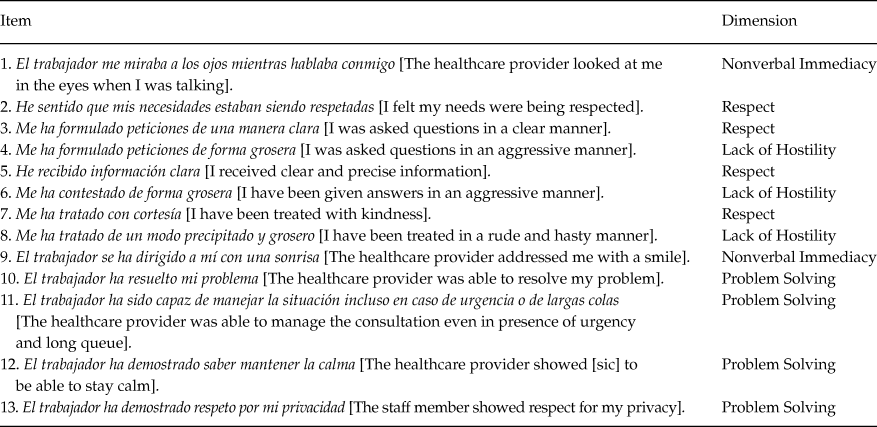
We used the version that was translated into Spanish as described in the Procedure section. Its 13 items are on a Likert-type response scale with five options for response: (1) nada (not at all); (2) un poco (a little); (3) bastante (somewhat); (4) mucho (a lot); and (5) muchísimo (very much). Three items were reverse-coded. The questionnaire has four component dimensions as follows: (1) Problem solving: this refers to the staff member’s ability to perform his or her job during when interacting with patients; (2) Respect: this means protecting the patient’s autonomy support, that is, providing information and involving them in decision-making. It also includes positive regard – accepting and valuing the patient as a person; (3) Lack of hostility: hostility is an attitude of rejection toward patients manifesting itself in the form of rude physical or verbal behavior. This dimension’s items are written and scored in the opposite way as the others; and (4) Nonverbal immediacy: This refers to immediate gestures, in other words, behaviors that reduce the physical and emotional distance between provider and patient (eye contact, smiling, etc.) Table 1 shows the various items and the dimensions to which they belong.
HCCQ Items by Dimension

El cuestionario de calidad de la asistencia hospitalaria percibida por el paciente [patient-perceived quality of hospital care questionnaire] (SERVQHOS; Mira et al., Reference Mira, Aranaz, Rodríguez-Marín, Buil, Castell and Vitaller1998)
This would offer external evidence of validity if our hypothesis was met, that HCCQ dimensions and SERVQHOS dimensions would be positively related. It consists of 19 items, with answers on a Likert-type scale with five categories for response, clustered around the following two factors: (1) Subjective quality, made up of 10 items, covers aspects such as courtesy, empathy, capacity for response, and professional competency; (2) Objective quality, made up of 9 items, asks about more tangible aspects of the patient’s hospital stay, like the hospital room’s state, reliability of the schedule, and the information provided by healthcare workers.
Procedure
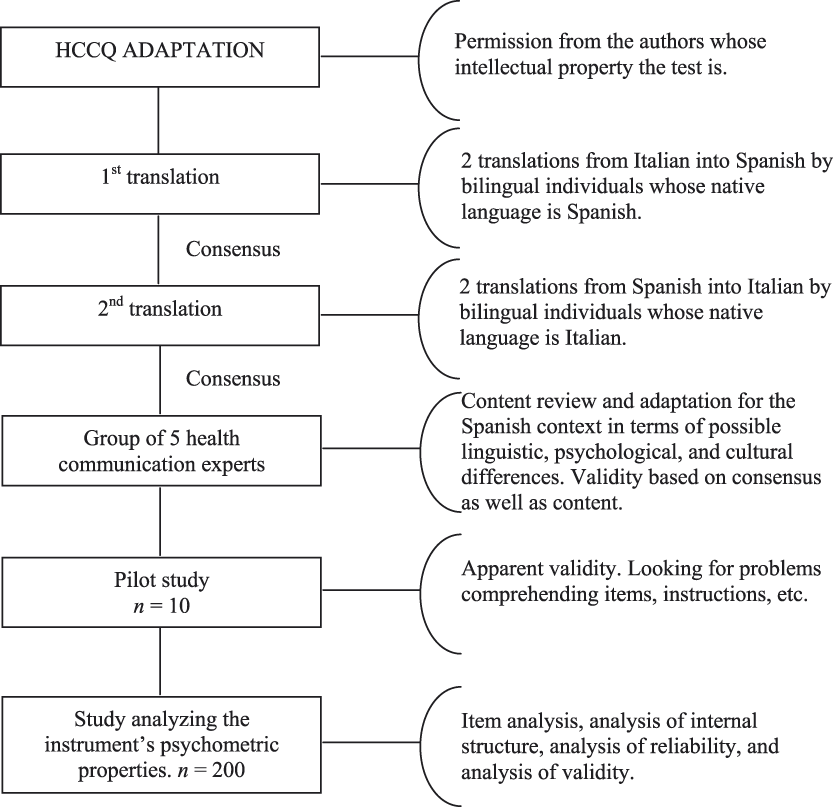
Following the standards proposed by the American Psychological Association (APA), the American Educational Research Association (AERA), and the National Council on Measurement in Education (NCME; 2014), the questionnaire was translated and culturally adapted for the Spanish context. To do so, we obtained the necessary permission from the authors whose intellectual property it is, and bilingual individuals created two translations of the questionnaire, first from the source language (Italian) into the target language (Spanish). In this first round of translation, the translators resolved any discrepancies between their two translations, coming to an agreement to synthesize the two translations. Subsequently, starting with the Spanish-language version and without knowledge of, or having seen the original version of the questionnaire, two bilingual translators – native speakers of Italian – translated the instrument back into Italian to ensure the translated version captured the content of the original version’s items. Finally, a group of five Health Communication experts consolidated all versions of the questionnaire, ensuring that the items’ phrasing and content were adapted for the Spanish context in terms of possible linguistic, psychological, and cultural differences.
Before administering the questionnaire to the final sample, a pilot study was conducted in a small sample (10 outpatients). The objective of those trials was not to analyze metric properties, but rather to test whether difficulties would arise in the assessment due, for example, to the phrasing of items or instructions (whether or not they were understood, if there was some suggestion of how to clear up something they did not understand well, etc.). Evidence of apparent validity was obtained.
Finally, to ascertain the instrument’s psychometric properties in terms of item analysis, internal structure, analysis of reliability, and collecting evidence of validity, the sample was gathered with the collaboration of student interns. Their line of research was Communication in Clinical Settings at Universidad Católica of Murcia, at the Hospital General Universitario Morales Meseguer of Murcia, Spain (Figure 1). Said hospital has a staff of 1,823, of which 9 are directors, 304 doctors, 1,119 medical staff other than doctors, and 391 non-medical staff, providing a broad range of services and medical specialties.
Diagram Showing the Process of Adapting the HCCQ in a Spanish Sample.

Ethical considerations
We followed the ethics guidelines covered in the Organic Law for the Protection of Personal Data, which was put in place to safeguard health data (1999); the Declaration of Helsinki (Asociación Médica Mundial, 2013); and recommendations from the international scientific community (Streiner & Norman, Reference Streiner and Norman2003). Below, we review the ethical aspects most central to the present study: guaranteeing voluntary, informed participation, maintaining the confidentiality of personal data, risks posed to study participants, and informing participants about the study’s results. We got approval to conduct this research from the hospital’s health care ethics committee.
Data Analysis
Data analysis was carried out using the SPSS statistical package, and Amos version 21.0. First we completed a basic descriptive analysis of the items, including means, standard deviations, skewness, and kurtosis. Corrected item-total (dimension) correlation was utilized to measure items’ discriminant ability (Streiner & Norman, Reference Streiner and Norman2003). Some authors advise that any item with a coefficient under 0.30 be eliminated (Nunnally & Bernstein, Reference Nunnally and Bernstein1995). When a scale has constituent dimensions, discriminant indexes must be calculated by dimension, because each component of the construct should be a homogenous category of content, isolated from the other components as much as possible. We studied the questionnaire’s dimensionality through confirmatory factor analysis (CFA) and structural equation modeling to see to what extent its items and dimensions match those of the original instrument. We used maximum likelihood estimation to estimate the model’s parameters, first making sure the assumption of univariate and multivariate normal distribution was met. Before accepting the model, a series of goodness of fit indexes had to be computed: χ2, χ2/df, Incremental Fit Index (IFI), Tucker-Lewis Index (TLI), Comparative Fit Index (CFI), Root Mean Square Error of Approximation (RMSEA), and Standardized Root Mean Square Residual (SRMR). Generally, non-significant values of χ2, values of χ2/df under 3, values of IFI, TLI, and CFI over .90, values of RMSEA less than or equal to .06, and values of SRMR less than or equal to .08, indicate a model has goodness of fit to the data (Hu & Bentler, Reference Hu and Bentler1999). With respect to analysis of reliability, Cronbach’s alpha (α) was utilized to determine the internal consistency of each of the questionnaire’s various dimensions. To obtain external evidence of validity, bivariate Pearson correlations were computed between scores on each HCCQ dimension and each SERVQHOS dimension, which should have been positively correlated.
Results
Participants’ average age was 51.64 years old, and 77 (38.5%) were men while 123 (61.5%) were women. Regarding their employment, 83 (41.5%) were actively employed, 14 (7%) students, 49 (24.5%) homemakers, 41 (20.5%) retirees, and 13 (6.5%) unemployed. Meanwhile, 101 (50.5%) had received primary schooling, 56 (28%) secondary schooling, and 43 (21.5%) undergraduate education. The members of hospital staff these patients evaluated included 58 (29%) doctors, 43 (21.5%) nurses, 31 (15.5%) radiology technicians, 36 (18%) administrative staff, and 9 (4.5%) security staff.
Questionnaire Translation
No issue arose with either translation during the process of translation and back-translation, with both translators quickly agreeing on both translations. Just one item was problematic (“El trabajador ha sido capaz de manejar la situación incluso en caso de urgencia o de largas colas” [“The worker was able to handle the situation even in cases of urgency or long lines”]). That item’s initial Spanish translation, which was subsequently translated back into Italian (back-translation), had certain semantic and cultural issues that the five-person panel of Health Communication experts resolved. They adapted the item to the particularities of the Spanish language and health care context while preserving the content of the dimension for which it was created.
Patients who participated in the preliminary trial of the questionnaire commented that they would not modify any of the instructions or the phrasing of items. They understood and adequately answered all the items proposed in the first version of the scale.
Item Analysis
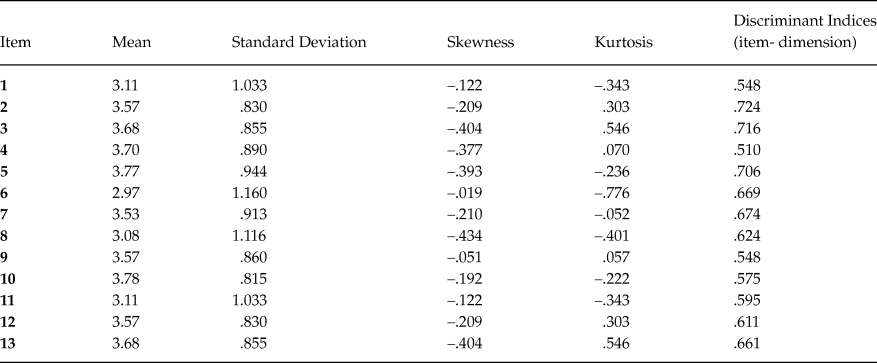
The items’ descriptive statistics (mean, variance, standard deviation, skewness, and kurtosis) were analyzed, obtaining medium-high values on all items, and tending toward normal distribution (values of skewness and kurtosis in the range of 1 to -1). As far as discriminant indexes, the results– corrected item-total (dimension) correlations – were over .50 for all items (Table 2).
Descriptive Statistics (Mean, Standard Deviation, Skewness, Kurtosis) and Discriminant Indices on Items According to the Dimension They Belong to

Scale’s Internal Structure
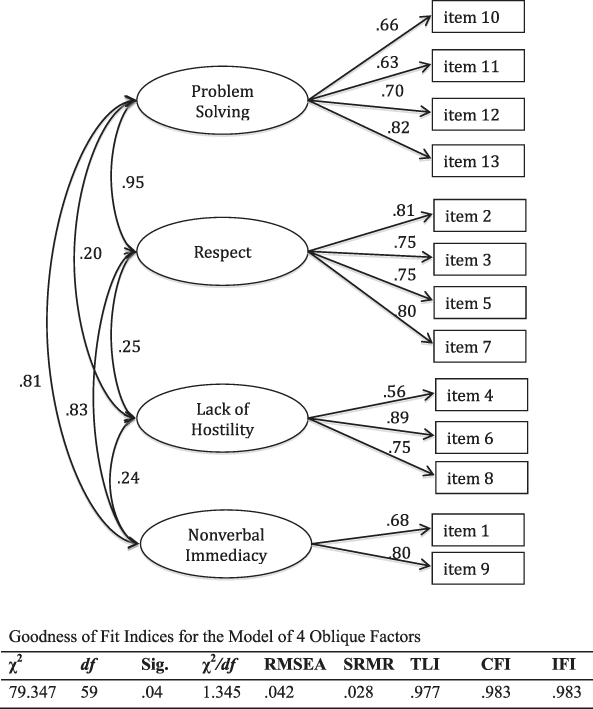
We put to the test the model of four oblique factors proposed by the test’s authors. CFA revealed that all items had adequate factor loadings, over .50, and all the resulting model’s fit indices indicated good fit to the data (Figure 2).
Standardized Parameter Estimates for the Model, and Indices of Its Goodness of Fit.

Analysis of Reliability
The results of internal consistency analysis (α) for each dimension were .79 – Problem Solving, .86 – Respect, .75 – Lack of Hostility, and .71 – Nonverbal Immediacy.
Validity Analysis
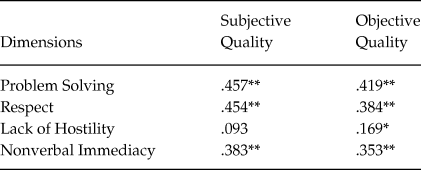
We analyzed the correlations among HCCQ dimensions and SERVQHOS dimensions, and as expected, we found positive, significant (p < .01) correlations between the HCCQ Problem Solving, Respect, and Nonverbal Immediacy dimensions, and the SERVQHOS dimensions of Subjective Quality and Objective Quality. On the other hand, we found low correlations between the HCCQ dimension Lack of Hostility, and the SERVQHOS dimensions of Subjective Quality and Objective Quality (Table 3).
Bivariate Pearson Correlations between the Dimensions of the HCCQ and Dimensions of the SERVQHOS Questionnaire

Note: * (one-tailed) = p ≤ .05; ** (two-tailed) = p < .01.
Discussion
This study adapted the Health Care Communication Questionnaire, HCCQ, for a Spanish population, and analyzed its psychometric properties in a heterogeneous sample of patients who came in contact with different groups of medical and non-medical hospital staff in the Spanish health care system (doctors, nurses, auxiliary administrative and security staff). Toward that end, as numerous studies have recommended (AERA, APA, NCME, 2014) before analyzing the questionnaire’s psychometric properties, there was a process of translation, back-translation, expert consensus, and a pilot study, providing evidence of apparent validity, content validity, and validity based on consensus.
The results of analyses of items, internal structure, and reliability, were consistent with the original study’s findings (Gremigni et al., Reference Gremigni, Sommaruga and Peltenburg2008).
To obtain validity evidence, the construct of PCC has been related to patient-perceived quality, leading us to hypothesize that the two are positively related. To test that hypothesis, we analyzed the relationships among HCCQ dimensions and SERVQHOS dimensions. Looking at Table 3, we were able to confirm a positive, statistically significant correlation between the dimensions Problem Solving, Respect, and Nonverbal Immediacy, and the dimensions Objective Quality and Subjective Quality. The correlations were strongest with Subjective Quality, which we expected since it measures relational aspects, like having a helpful disposition, kindness, personalized treatment, interest in solving problems, etc. (Mira et al., Reference Mira, Aranaz, Rodríguez-Marín, Buil, Castell and Vitaller1998). On the other hand, the correlations between the HCCQ dimension Lack of Hostility, and the Objective Quality and Subjective Quality dimensions of the SERVQHOS were lower. These data are consistent with those obtained by the questionnaire’s authors, who created a general item about patients’ experience of being listened to, finding positive, statistically significant correlations with the dimensions Problem Solving, Respect, and Nonverbal Immediacy on the one hand, and non-significant correlations with the Lack of Hostility dimension (Gremigni et al., Reference Gremigni, Sommaruga and Peltenburg2008) on the other.
With that in mind, we may conclude that the Spanish version of the HCCQ has adequate psychometric properties in terms of item analysis, internal structure, reliability, and validity, similar to those obtained on the original questionnaire. Thus, it is a useful, reliable instrument that serves the purpose and context in which it will be utilized.
From a practical standpoint, the HCCQ evaluates outpatients’ experiences with the communication abilities of medical and non-medical staff, and how those parties respond to patient needs. In the present research, it was administered in the hospital setting, in places where outpatients go. Therefore, we believe it can be utilized in the context of primary care and in hospitals, where patients have contact with medical staff as well as non-medical staff. However, studies would need to be conducted in those contexts to establish that the instrument’s psychometric properties are stable over time. Associations like the AERA, APA, and NCME (2014) all recommend using other samples, and even other contexts, to make sure the obtained results are not due to characteristics of the study’s sample. In that sense, further studies should be conducted in Spanish samples – and even in contexts beyond the Mediterranean (Spain, Italy), to validate the instrument cross-culturally.