Introduction
Although the vast majority of individuals with mental illness are not violent,Reference Mulvey 1 mental health clinicians are frequently asked to determine their patient's risk of future violence. Dangerousness assessments are required in a wide variety of situations that include involuntary commitments, emergency psychiatric evaluations, seclusion and restraint decisions, inpatient care discharges, probation/parole decisions, death penalty evaluations, domestic violence interventions, fitness for duty evaluations, and after a threat is made. The accuracy of a clinician's assessment of future violence is related to many factors, including the circumstances of the evaluation, the length of time over which violence is predicted, and the assessment of psychiatric symptoms that may increase a person's risk of dangerous behavior. Psychosis and mood symptoms are common psychiatric symptoms, and their relationship to violence risk is the focus of this article. Understanding the relationship of specific psychotic and mood symptoms to aggressive behavior can help the clinician not only provide better care but also decrease his or her own risk of malpractice when identified risk factors are more effectively targeted and treated.
Psychosis and Violence Risk
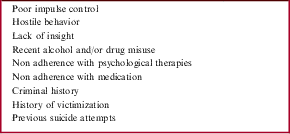
When evaluating a patient's risk of violence, the presence of psychosis is of particular concern. In their analysis of 204 studies examining the relationship between psychopathology and aggression, Douglas etalReference Douglas, Guy and Hart 2 found that psychosis was the most important predictor variable of violent behavior. Witt etalReference Witt, van dorn and Fazel 3 conducted a systematic review and meta-regression analysis of 110 studies to investigate the range of risk factors associated with violence in 45,553 individuals with schizophrenia or other psychosis. Key findings from this study that identified risk factors specific to psychosis are summarized in Table 1.Reference Witt, van dorn and Fazel 3
General risk factors for violence in individuals with psychosisReference Witt, van dorn and Fazel 3

In addition to the dynamic and historical risk factors summarized in Table 1, the clinician should evaluate persecutory delusions and command auditory hallucinations when assessing a psychotic person's risk of future violence.
Evaluating persecutory delusions
Research examining the contribution of delusions to violent behavior provides mixed results. Earlier studies suggested that persecutory delusions were associated with an increased risk of aggression.Reference Wessely, Buchanan and Reed 4 Delusions noted to increase the risk of violence were those characterized by threat/control-override (TCO) symptoms. TCO-type delusions are characterized by the presence of beliefs that one is being threatened (eg, being followed or poisoned) or that one is losing control (ie, control-override) to an external source (eg, one's mind is dominated by forces beyond the person's control).Reference Link and Stueve 5 Similarly, Swanson etal,Reference Swanson, Borum and Swartz 6 using data from the Epidemiologic Catchment Area surveys, found that people who reported threat/control-override symptoms were about twice as likely to engage in assaultive behavior as those with other psychotic symptoms.
In contrast, results from the MacArthur Study of Mental Disorder and Violence showed that the presence of delusions did not predict higher rates of violence among recently discharged psychiatric patients.Reference Monahan, Steadman and Silver 7 In particular, a relationship between the presence of TCO delusions and violent behavior was not found. A subsequent analysis of the data indicated that men were significantly more likely than women to engage in violence during times they experience threat delusions, whereas women were significantly less likely to engage in violence due to threat delusions.Reference Teasdale, Silver and Monahan 8
In a study that compared male criminal offenders with schizophrenia who had been found not guilty by reason of insanity to matched controls of non-offending schizophrenic persons, Stompe etalReference Stompe, Ortwein-Swoboda and Schanda 9 also found that TCO symptoms showed no significant association with the severity of violent behavior, nor did the prevalence of TCO symptoms differ between the 2 groups. However, nondelusional suspiciousness, such as misperceiving others’ behavior as indicating hostile intent, has demonstrated an association with subsequent violence.Reference Monahan, Steadman and Silver 7
Nederlof etalReference Nederlof, Muris and Hovens 10 conducted a cross-sectional, multicenter study to further examine whether the experience of TCO symptoms is related to aggressive behavior. The study sample included 124 psychotic patients characterized by the following diagnostic categories: 70.2% paranoid schizophrenia, 16.1% “other forms” of schizophrenia, 3.2% schizoaffective disorder, 0.8% delusional disorder, and 9.7% psychosis not otherwise specified (NOS). The authors determined that TCO symptoms were a significant correlate of aggression in their study sample. When the 2 domains of TCO symptoms were evaluated separately, only threat symptoms made a significant contribution to aggressive behavior. In their attempt to reconcile conflicting findings from earlier research regarding the relationship of TCO symptoms to aggressive behavior, the authors suggested that various methods of measuring TCO symptoms may underlie the seemingly contradictory findings among various studies.Reference Nederlof, Muris and Hovens 10
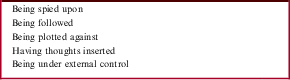
In addition to research examining the potential relationship of particular delusional content to aggression, Appelbaum etalReference Appelbaum, Robbins and Roth 11 utilized the MacArthur–Maudsley Delusions Assessment Schedule to examine the contribution of noncontent-related delusional material to violence. These authors found that individuals with persecutory delusions had significantly higher scores on the dimensions of “action” and “negative affect,” indicating that persons with persecutory delusions may be more likely to react in response to the dysphoric aspects of their symptoms.Reference Nederlof, Muris and Hovens 10 Subsequent research has demonstrated that individuals who suffer from persecutory delusions and negative affect are more likely to act on their delusions.Reference Wessely, Buchanan and Reed 4 , Reference Buchanan, Reed and Wessely 12 , Reference Cheung, Schweitzer, Crowley and Tuckwell 13 Coid etalReference Coid, Ullrich and Kallis 14 found that anger due to delusions is a key factor that explains the relationship between violence and acute psychosis. Angry affect, in particular, has been shown to be an important intermediate variable in the pathway between anger delusions. When translating the various research findings into a practical examination, the psychiatrist should consider asking about 5 specific delusions that may increase the risk of violence, particularly when the patient presents as angry.Reference Ullrich, Robert and Coid 15 These delusions are listed in Table 2.
Specific delusions associated with serious violence when angry affect is presentReference Ullrich, Robert and Coid 15

Evaluating auditory hallucinations
A careful inquiry about hallucinations is required to determine whether their presence increases the person's risk to commit a violent act. Command hallucinations are those that provide some type of directive to the patient. Command hallucinations are experienced by approximately half of hallucinating psychiatric patients.Reference Shawyer, Mackinnon, Farhall, Trauer and Copolov 16 The majority of command hallucinations are nonviolent in nature, and patients are more likely to obey nonviolent instructions than violent commands.Reference Chadwick and Birchwood 17
The research on factors that are associated with a person acting on harmful command hallucinations has been mixed. In a review of 7 controlled studies examining the relationship between command hallucinations and violence, no study demonstrated a positive relationship between command hallucinations and violence, and 1 found an inverse relationship.Reference Rudnick 18 In contrast, McNiel etalReference McNiel, Eisner and Binder 19 reported that, in a study of 103 civil psychiatric inpatients, 33% reported having had command hallucinations to harm others during the prior year, and 22% of the patients reported that they complied with such commands. The authors concluded that patients in their study who experienced command hallucinations to harm others were more than twice as likely to be violent.Reference McNiel, Eisner and Binder 19
Much of the literature examining the relationship of a person's actions to command hallucinations has examined the person's response to all command hallucinations, without delineating factors specific to violent commands. Seven factors associated with acting due to command hallucinations include the followingReference Shawyer, Mackinnon, Farhall, Trauer and Copolov 16 :
-
1. The presence of coexisting delusionsReference Mackinnon, Copolov and Trauer 20
-
2. Having delusions that relate to the hallucinationReference Junginger 21
-
3. Knowing the voice's identityReference Junginger 21
-
4. Believing the voices to be realReference Erkwoh, Willmes, Eming-Erdmann and Kunert 22
-
5. Believing that the voices are benevolentReference Beck-Sander, Birchwood and Chadwick 23
-
6. Having few coping strategies to deal with the voicesReference Fox, Gray and Lewis 24
-
7. Not feeling in control over the voicesReference Bucci, Birchwood, Twist, Tarrier, Emsley and Haddock 25
Factors associated with acting on general command hallucinations as described above have also been found to indicate increased compliance with acting on violent command hallucinations.Reference Junginger 21 , Reference Beck-Sander, Birchwood and Chadwick 23 Studies that have examined compliance specific to harmful command hallucinations provide additional guidance when evaluating the person's potential risk of harm. Some aspects relevant to increased compliance to violent command hallucinations include the following:
-
• A belief that the voice is powerfulReference Shawyer, Mackinnon, Farhall, Trauer and Copolov 16 , Reference Fox, Gray and Lewis 24
-
• A sense of personal superiority by the person evaluatedReference Fox, Gray and Lewis 24
-
• A belief that command hallucinations are of benefit to the personReference Shawyer, Mackinnon, Farhall, Trauer and Copolov 16
-
• Having delusions that were congruent with the action describedReference Shawyer, Mackinnon, Farhall, Trauer and Copolov 16
-
• Experiencing hallucinations that generate negative emotions, such as anger, anxiety, and sadnessReference Cheung, Schweitzer, Crowley and Tuckwell 13
-
• ImpulsivityReference Bucci, Birchwood, Twist, Tarrier, Emsley and Haddock 25
Schizophrenia and violence risk
Although the majority of individuals with schizophrenia do not behave violently,Reference Walsh, Buchanan and Fahy 26 there is emerging evidence that a diagnosis of schizophrenia is associated with an increase in criminal offending. In a retrospective review of 2,861 Australian patients with schizophrenia followed over a 25-year period, Wallace etalReference Wallace, Mullen and Burgess 27 found that patients with schizophrenia accumulated a greater total number of criminal convictions relative to matched comparison subjects. These authors noted that the criminal behaviors committed by schizophrenic patients could not be entirely accounted for by comorbid substance use, active symptoms, or characteristics of systems of care.Reference Wallace, Mullen and Burgess 27 Likewise, Short etalReference Short, Thomas, Mullen and Ogloff 28 found that even schizophrenic patients without comorbid substance-use disorders were significantly more likely than controls to have been found guilty of violent offenses.
Mood Disorders and Violence Risk
Most studies examining the relationship between mood disorders and violence have not differentiated between bipolar disorder, mania, and depression.Reference Graz, Etschel, Schoech and Soyka 29 To evaluate if criminal behavior and violent crimes were more common in the diagnosis of depression versus mania, Graz etalReference Graz, Etschel, Schoech and Soyka 29 examined the German national crime register for 1561 patients with an affective disorder who had been released into the community. The rate of criminal behavior and violent crimes was highest in the manic disorder group (15.7%) compared to patients with major depressive disorder (1.4%). The authors concluded that different mood disorders have different risks of subsequent violence.Reference Graz, Etschel, Schoech and Soyka 29 Other studies that have examined violence risk factors unique to different mood disorders are summarized below.
Depression and violence risk
Depression may result in violent behavior, particularly in depressed individuals who strike out against others in despair. After committing a violent act, the depressed person may attempt suicide. Depression is the most common diagnosis in murder-suicides.Reference Marzuk, Tardiff and Hirsch 30 Studies that have examined mothers who kill their children (filicide) have found that they were often suffering from severe depression. High rates of suicide following a filicide have been noted, with between 16–29% of mothers and 40–60% of fathers taking their life after murdering their child.Reference Marzuk, Tardiff and Hirsch 30 – Reference Rodenburg 32 In a study of 30 family filicide-suicide files, the most common motive involved an attempt by the perpetrator to relieve real or imagined suffering of the child—a motive known as an altruistic filicide. Eighty percent of the parents in this study had evidence of a past or current psychiatric history, with nearly 60% suffering from depression, 27% with psychosis, and 20% experiencing delusional beliefs.Reference Hatters Friedman, Hrouda, Holden, Noffsinger and Resnick 31
In their analysis of 386 individuals from the MacArthur Violence Risk Assessment Study with a categorical diagnosis of depression, Yang etalReference Yang, Mulvey, Loughran and Hanusa 33 noted two important findings relevant to depression and future violence risk. First, violence that had occurred within the past 10 weeks was a strong predictor of future violence by participants with depression, but not by participants with a psychotic disorder. This finding suggests that a past history of recent violence may represent a higher risk of future violence in depressed patients than in those with psychosis. Second, this risk of future harm by depressed patients was further increased with alcohol use.
Bipolar disorder and violence risk
Patients with mania show a high percentage of assaultive or threatening behavior, but serious violence itself is rare.Reference Krakowski, Volavka and Brizer 34 Additionally, patients with mania show considerably less criminality of all kinds than patients with schizophrenia. Patients with mania most commonly exhibit violent behavior when they are restrained or have limits set on their behavior.Reference Tardiff and Sweillam 35
Active manic symptoms have been suggested as playing a substantial role in criminal behavior. In particular, Fazel etalReference Fazel, Lichtenstein, Grann, Goodwin and Langstrom 36 compared violent crime convictions for over 3700 individuals who had been diagnosed with bipolar disorder with general population controls and unaffected full siblings. This longitudinal study had 2 main findings. First, although individuals with bipolar disorder exhibited an increased risk for violent crime compared to the general population, most of the excess violent crime was associated with substance abuse comorbidity. Second, unaffected siblings also had an increased risk for violent crime, which highlights the contribution of genetics or early environmental factors in families with bipolar disorder.Reference Fazel, Lichtenstein, Grann, Goodwin and Langstrom 36
Clinical Implications and Recommendations
When conducting an assessment of current dangerousness, pay close attention to the individual's affect. Individuals who are angry and lack empathy for others are at increased risk for violent behavior.Reference Menzies, Webster and Sepejak 37 Clinicians should also assess their patients’ insight into their illness and into the potential legal complications of their illness. Buckley etalReference Buckley, Hrouda, Friedman, Noffsinger, Resnick and Camlin-Shingler 38 found that violent patients with schizophrenia had more prominent lack of insight regarding their illness and legal complications of their behavior when compared with a nonviolent comparison group.
When evaluating an individual who is making a threat, the clinician should take all threats seriously and carefully elucidate the details. An important line of inquiry involves understanding the exact relationship of the person making the threat to his or her intended victim. In regard to written threats, individuals who send threats anonymously are far less likely to pursue an encounter than those who sign their names. Furthermore, the threatener who signs his true name is not trying to avoid attention; he or she is probably seeking it.
Understanding how a violent act will be carried out and the expected consequences for the patient helps the clinician in assessing the degree of danger. In addition, fully considering the consequences of an act may help the patient elect an alternative coping strategy. For example, a patient may be focused on revenge against his wife because of her infidelity. When confronted with the likelihood of spending many years in prison, he may decide to divorce his wife instead. The clinician should also assess the suicide risk in any patient making a homicidal threat. Violent suicide attempts increase the likelihood of future violence toward others.Reference Convit, Jaeger, Lin, Meisner and Volavka 39 One study found that 91% of psychiatric outpatients who had attempted homicide also had attempted suicide, and that 86% of patients with homicidal ideation also reported suicidal ideation.Reference Asnis, Kaplan, Hundorfean and Saeed 40
Finally, the evaluator should consider asking the person to rate his or her own likelihood of future violence. Roaldset and BjørklyReference Roaldset and Bjørkly 41 asked 489 patients admitted to a psychiatric hospital to rate their risk of future threatening or violent actions toward others. Moderate or high-risk scores on self-ratings of future violence were significant predictors of violence 1 year post-discharge. However, persons who rated themselves as “no risk” or who refused to answer the question also had a considerable number of violent episodes, indicating that a self-report of low risk of violence may produce false negatives.Reference Roaldset and Bjørkly 41
When considering strategies to decrease those risk factors that may contribute to future violence, the clinician should distinguish static from dynamic risk factors. By definition, static factors are not subject to change by intervention. Static factors include such items as demographic information and a past history of violence. Dynamic factors are subject to change with intervention and include such factors as access to weapons, acute psychotic symptoms, active substance use, and a person's living setting. The clinician may find it helpful to organize a chart that outlines known risk factors, management and treatment strategies to address dynamic risk factors, and the current status of each risk factor. This approach will assist in the development of a violence prevention plan that addresses the specific risk factors for a particular patient. An example chart that illustrates approach is provided in Table 3.
Example violence risk management chart

Clinical risk assessments do not typically incorporate any type of structured or standardized risk evaluation process. Unstructured clinical assessments have been criticized for having less accuracy than structured risk assessments. Structured risk assessments to assess future violence risk are based primarily on actuarial models of risks, referred to as actuarial risk assessment instruments (ARAIs). Over 120 structured instruments have been developed for the purpose of predicting violence in psychiatric or correctional populations, and many of them are relevant when evaluating individuals with psychosis or mood disorder symptoms.Reference Singh and Fazel 42 The goals of these prediction schemes are to assist the clinician in gathering appropriate data and to anchor clinicians’ assessments to established research.
Summary
A risk assessment of potential violence is important when evaluating psychiatric patients in both outpatient and inpatient settings. Identifying specific psychotic and mood disorder symptoms that increase a patient's potential for aggression provides a more structured risk assessment approach than unguided or uninformed clinical judgment. In turn, an appropriate risk assessment allows the clinician to target treatments to those identified risk factors, which is a critical component of risk management. Despite improvement in the field of risk assessment and risk management, the prediction of violence remains an inexact science. Predicting violence has been compared to forecasting the weather. Like a good weather forecaster, the clinician does not state with certainty that an event will occur. Instead, he or she estimates the likelihood that a future event will occur. Like weather forecasting, predictions of future violence will not always be correct. However, identifying those risk factors associated with psychotic and mood disorder symptoms assists the clinician in organizing the most accurate risk management approach possible.
Disclosures
Charles Scott and Phillip Resnick do not have anything to disclose.