Introduction
An estimated 5.2 million Americans have Alzheimer's disease (AD) and by 2050 the total estimated prevalence is expected to be 13.8 million. (Thies and Bleil, Reference Thies and Bleil2013) Clinicians have only recently acknowledged that AD qualifies as a terminal illness in addition to a progressively debilitating condition. (Morrison and Siu, Reference Morrison and Siu2000) However, most of the general public does not see AD as a cause of death. Public knowledge of AD symptoms is often limited to memory loss and wandering (Gjerdingen et al., Reference Gjerdingen1999; Arai et al., Reference Arai, Arai and Zarit2008). Behavioral and psychological symptoms of dementia (BPSD) are less well-known and can be more distressing and challenging. BPSD include disinhibition (e.g. undressing in public), physical or verbal aggression, high anxiety, and psychosis (e.g. delusional beliefs) (Margallo-Lana et al., Reference Margallo-Lana2001; Lyketsos et al., Reference Lyketsos2002). These symptoms present in 50% to 90% of people diagnosed with AD (Hersch and Falzgraf, Reference Hersch and Falzgraf2007). The symptoms are associated with increased functional disability, earlier institutionalization, increased psychotropic medication use, decreased quality of life for caregivers and patients alike, and higher mortality rates (Madhusoodanan, Reference Madhusoodanan2001; Hersch and Falzgraf, Reference Hersch and Falzgraf2007). Some non-pharmacological interventions can reduce BPSD, though admittedly they are not effective for every person (Leone et al., Reference Leone2009; Kolanowski et al., Reference Kolanowski2010). Moreover, pharmacological interventions managing BPSD may be associated with serious adverse effects, including increased risk of mortality, falls, and over-sedation. Yet, alternatives to pharmacotherapy for significant aggression, such as physical and environmental restraints, can be traumatizing for the person to experience and family members to witness.
Busy clinicians often address BPSD only when symptoms emerge and become distressing rather than during the initial diagnosis and treatment phase. However, patient involvement and autonomy may be reduced further when they become incapable of making treatment decisions. Empirical studies have shown that in the absence of detailed advance directives or discussions, substitute decision makers – usually family members – often inaccurately choose treatment options preferred by the patient, despite their good intentions (Shalowitz et al., Reference Shalowitz, Garrett-Mayer and Wendler2006; Boustani et al., Reference Boustani2008; Fried et al., Reference Fried2011). Physicians are frequently inaccurate as well (Uhlmann et al., Reference Uhlmann, Pearlman and Cain1988; Hamann et al., Reference Hamann2010). Advance directives are quasi-legal documents wherein people can state their preferences about who should serve as their substitute decision maker and which treatments and care should be continued, initiated, and discontinued. A successful advance care planning program was introduced in the United States in 2015 under medicare, which has resulted in 575,000 (double the expected number) Medicare patients discussing end-of-life issues with their families and physicians (Aleccia, Reference Aleccia2017). Despite this number, only about 10% of people who develop dementia have written directives (Yung et al., Reference Yung2010), which often address only familiar life-sustaining measures such as artificial ventilation and nutrition, dialysis, or cardiopulmonary resuscitation (CPR) in case of organ failure, major neurological events, or cardiopulmonary arrests (Rurup et al., Reference Rurup2005) without written directives for the management of serious symptoms like BPSD.
Studies have shown that education about the cognitive and functional decline associated with the progression of dementia can alter people's preferences for or against life-saving medical interventions (Deep et al., Reference Deep2010). However, the authors were unable to find a published study examining the impact of education addressing the impact of BPSD on seniors’ preferences for medical interventions. Thus, we designed a study to examine the impact of brief education about AD stages and BPSD on the treatment preferences of older adults free of dementia. We also explored their preferences for different management approaches of BPSD and their guiding reasons. We hypothesized that: (1) brief education about AD stages significantly changes treatment/care choices for moderate and severe stages, as evidenced by choosing less active treatment options (i.e. no CPR/hospitalization) as the disease progresses; and (2) most participants would prefer pharmacological options to manage BPSD, despite their risks.
Methods
Participants
This study was conducted in Toronto, a large, multicultural Canadian city, from June 2013 to July 2015.
The target population was adults older than 64 years of age. Participants were eligible if they reported being literate in English and not having a diagnosis of dementia. Posters about the study were displayed at one academic psychiatric hospital and three community senior centers. The research team also contacted people in the hospital's research registry. Interested individuals were informed of the study procedures, risks, and safeguards and mailed a consent form. They and those who enrolled were scheduled in groups of 2–6 people; in total 10 group sessions were held. If participants were family members or close friends, they were assigned to different groups to avoid possible undue influence of their responses and to maintain confidentiality. Accordingly, data from two participants were excluded from analyses when it was learned that they were married yet participated in the same small group.
Study design
A mixed methods approach was used. Demographic information included age, gender, education level, ethnicity, immigrant versus Canada-born background, marital and family status, religious/spiritual affiliation, personal knowledge or experience with family or friends having AD, and formal designation of a proxy decision maker.
In addition to the demographics questionnaire, participants completed two questionnaires prior to a brief education session: an abbreviated version of the AD Knowledge Scale (10 of the 30 original questions focused on diagnosis, prognosis, and management of AD; see Appendix 1, available as supplementary material attached to the electronic version of this paper at www.journals.cambridge.org/jid_IPG) (Carpenter et al., Reference Carpenter2009) and the Health Belief Model Questionnaire (HBMQ) adapted for AD (seven questions about attitudes and feelings about AD; see Appendix 2) (Janz and Becker, Reference Janz and Becker1984; National Cancer Institute, 2011). These two questionnaires were completed again immediately after the brief education session and then one month later (via mail).
Participants also completed two decision grids. Decision grid #1 (see Figure 1) was completed before and after the education session. It focused on preferences for three common treatment plans in four health conditions: current state of health, mild AD, moderate AD, and severe AD. The three treatment plans were CPR and ventilation, hospitalization for testing and in-patient treatment, and at-home comfort measures for medical issues that may arise during the course of the AD.
Decision grid 1. What would you want and not want?

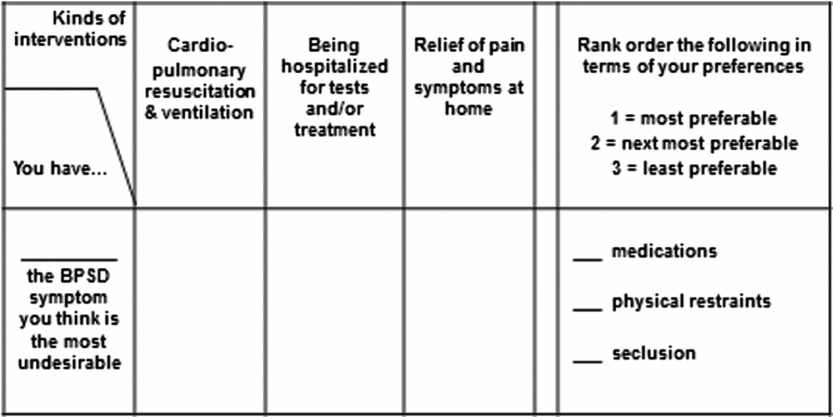
Decision grid #2 (see Figure 2) was completed after the education session. First, it focused on issues related to BPSD symptoms, specifically disinhibition, aggression, apathy, psychosis, and mood changes. Participants were asked to identify which of these symptoms was personally the most worrisome to live with and whether this symptom would change their preferences for and against the three aforementioned treatment plans. Finally, participants were asked to prioritize interventions that can be used to manage BPSD: physical restraints, environmental restraint (i.e. seclusion), and, pharmacotherapy (Narang et al., Reference Narang2010; Kim et al., 2011; Stevens et al., Reference Stevens2014).
Decision grid 2. What would you want and not want?

One of the authors (REW) led most of the education session. The session lasted about 20 min, and consisted of a description of AD's progression from mild to moderate to severe stages using a case, highlighting changes in one's trajectory from semi-independence to complete dependence for Activities of Daily Living, the expected impact of AD on longevity and physical and cognitive abilities, and finally, available health treatments for conditions that may arise in the course of illness, their effectiveness, and potential risks. The session also included a review of five major BPSDs: psychosis, aggression, apathy, disinhibition, and mood changes. The education session was followed by a facilitated discussion of the reasons for expressed preferences, choices of treatment/care options, and any changes following the education session.
The study was reviewed and approved by three hospitals’ Research Ethics Boards. All participants completed an approved written consent form prior to engaging in any of the study's procedures.
Data analysis
Quantitative data were derived from the demographics questionnaire, the shortened AD knowledge questionnaire, the adapted HBMQ, and responses on grid #1 and grid #2. An Omnibus test was used to assess changes in knowledge about AD before and after the education sessions and ordinal logistic regression models were used to assess for the effect of these changes on treatment choices. Correlations between demographics and treatment choices were also assessed.
Qualitative data were derived from transcribed audio-recorded discussions with participants about reasons for their preferences and any changes thereto following the education session. Krueger's methodology for focus group analyses was used to categorize participants’ reasons for preferences (Krueger and Casey, Reference Krueger and Casey2000; Onwuegbuzie et al., Reference Onwuegbuzie2009).
Results
Quantitative data
Participants Baseline Characteristics
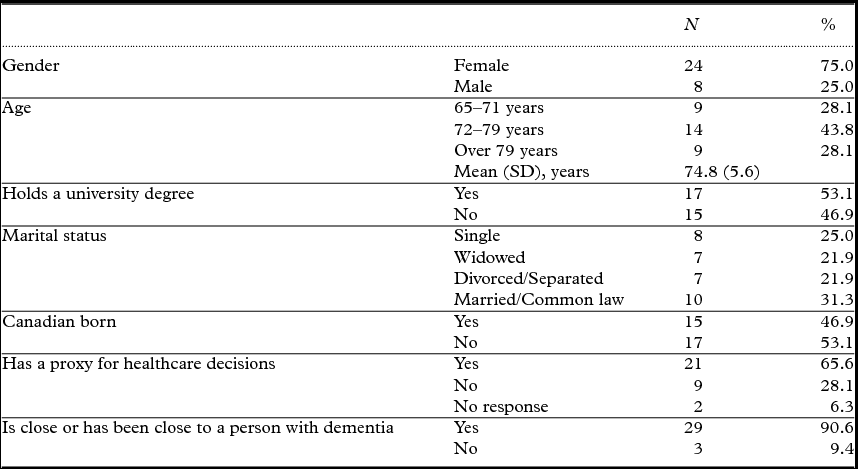
In total, 24 of 32 (75%) participants were women with a mean (SD) age of 75 (6) years; 17 (53%) had a university degree (see Table 1).
Participants’ characteristics

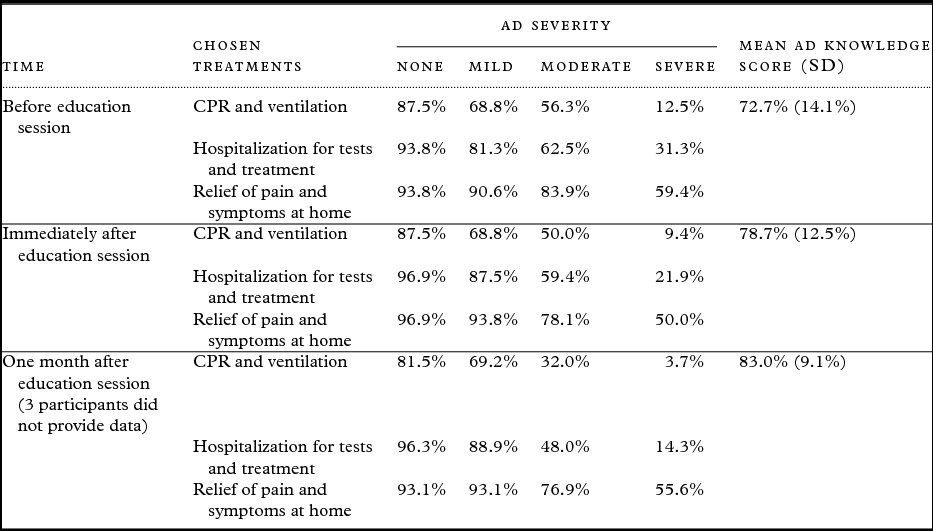
All but 3 (29) participants knew of, or had cared for, someone who had dementia and 21 (66%) had a proxy decision maker in case they became incapable of treatment-related decision making. Of those caring for somebody with AD, approximately 10 were children (34%), 3 were a spouse or partner (10%), and the other 16 were more distant relatives or friends (55%). The mean (SD) scores on the Alzheimer's Knowledge Questionnaire were: 72% (14%) – a i.e. 7.2 questions correct out of 10 questions – before the education session; 78% (13%) immediately after; and 80% (18%) one month later (see Table 2). On the HBMQ, 30 (94%) participants rated developing AD as “very serious.”
Participant choices for treatment by AD severity and AD knowledge before and immediately after education session, and one month later

Participants’ Choices Before the Education Session
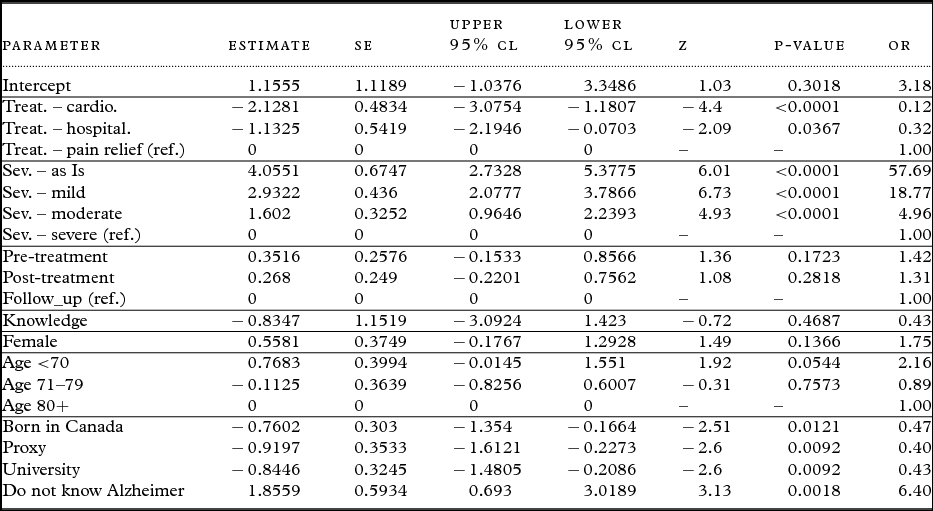
Prior to the education session, there was a pattern of choosing less active treatments as AD progressed. Overall, the odds of preferring to receive a treatment decreased more than 50-fold when the condition progressed from “current health” (OR = 56.7) to “severe stage” (OR = 1) (see Table 3). In their current state of health, 86% of the participants would want to receive CPR, while only 13% would if they had severe dementia.
Coefficient estimates for the variables in the final model predicting treatment choices for Alzheimer's disease

Treat.: treatment; Sev.: severe; Cardio.: cardiopulmonary resuscitation.
Those who were not close to someone with AD were much more likely (OR: 6.4) to want active treatment at the moderate and severe stages than those with direct experience with someone with AD. Being born in Canada, having a proxy, or a university education was associated with about half the odds of preferring to receive treatment compared to those who had none of these characteristics (see Table 3).
Effect of the Education Session on Participants’ Choices
There was a pattern of choosing less active treatments for the moderate and severe stages of AD after the education session. For example, 56% of the participants chose CPR for the moderate stage before the session, as compared to 32% at one month follow up. Similarly, 31% chose hospitalization for a medical issue during the severe stage of AD before the session, and 14% did at one month follow up. However, there was no statistically significant relationship between improving knowledge about AD with the education session and a change in preferences.
BPSD
In total, 12 (38%) and 10 (31%) participants reported that aggression or psychosis, respectively, would be most worrisome among the five BPSDs examined (i.e. disinhibition, aggression, apathy, mood changes, and psychosis). No participants chose apathy as their most worrisome symptom.
Participants were asked to prioritize the use of psychotropic medications, physical restraints, and seclusion in terms of which measure they would prefer when managing the symptom they considered most worrisome. Thirty-one (97%) participants chose medications to manage BPSD. Only one participant chose physical restraints and no one chose seclusion as a first choice.
Qualitative data
Reasons for Changing Preferences after the Education Session
The reasons for preferring less intensive interventions included gaining new information about AD or a particular symptom, envisioning family burdens becoming too great (“I don't want to be a burden on anyone,” S1), or realizing that available medical interventions were futile, (“It looks like a futile effort to take the person to a hospital”S2) or considering life at that AD stage to be purposeless [“. . .with that (lack of self-care) coming into play, forget it,” S2].
Unexpectedly, some participants’ preferences for active treatment increased, rather than decreased, after the education session. Reasons for preferring more active treatment included hope being ever present and life still mattering (“Because life is sweet. You don't really want to die,” S3). These participants also explained these changes in terms of re-evaluating AD stages to be “not as bad as I thought,” renewing a wish not to die, “When I listened to your explanation of moderate, then I thought ‘moderate’ is not too bad,” S3 and re-embracing hope for some kind of recovery or new treatment (“Initially, I thought if I had severe, I don't think I'd really want to live. And then when I thought about it again, I thought there might be hope somewhere. And so I just changed my mind,” S3).
Hospitalization was favoured in many cases because participants believed contemporary large, acute care hospitals had more options to improve the situation. Confidence in medical advances also explained preferences for hospitalization (“I think because the way research is going, they're going to come up with something somewhere along the line, not in the very near future, but it's like all other disease, they do come up with something eventually that helps,” S3). Moreover, some participants believed hospitalization would result in fewer people being harmed than if the person remained in the home or long-term care facility.
Reasons for Most Worrisome Symptom
Aggression was chosen as the most worrisome of the five BPSD symptoms because of its potential consequences for others (“I'm conscious of the fact that I'm a big guy and I could hurt someone. The important thing to me in my current state would be not to cause injury or damage to someone else,” S4) and as being antithetical to personal self-image (“Because I mean all my life I've been a pacifist,” S5). Reasons for choosing psychosis included the intolerability of being disconnected from one's surroundings (“Not to be in the real world. You're out of touch with reality,” S6), increased risk to being harmful to others, and increased risk of having the other symptoms.
Reasons for Management of BPSD
Reasons for the almost universal preference for medications focused on a perceived acceptable benefit-to-risk ratio, i.e. modest symptom relief and small probability of stroke or early death (“I'm prepared to gamble on the drugs. . .the lesser of two evils,” S7). Reasons for preferring physical restraints over seclusion centered on being able to see and speak with other people nearby (i.e. healthcare staff). Reasons for preferring seclusion over physical restraints emphasized not being afraid of being alone (“I don't mind being alone. As a matter of fact, I prefer being alone,” S8). Furthermore, restraints were considered to be not just more restrictive, but for some participants, unimaginable and intolerable (“I've been fiercely independent my entire life and I think that's just a horror to me,” S9). One participant described restraints as an anathema based on membership in a historically oppressed group.
Without solicitation or prompting by the researchers during the group discussions, a handful of participants either stated they would access physician assisted dying (PAD) if they developed AD or expressed hope that PAD would become legally permissible in the near future.
Discussion
We conducted a mixed-method study to assess the knowledge of older persons without dementia about AD and their choices for general medical interventions at various stages of AD and for BPSD. We then assessed whether a 20-min education session would change these choices. Participants perceived AD as a severe illness and they already had high baseline knowledge of AD. They chose less invasive options as AD progresses. Only about half of the participants chose pain relief in the severe stage of AD which was a counter-intuitive finding. A possible explanation comes from the focus groups where people responded that they would “just want to die” at this point in the illness and they did not want any kind of intervention. Not having a close friend or relative with dementia, having below university education, being born outside of Canada, and not having a proxy for decision making were all significantly associated with choosing more active options such as CPR and hospitalization in the later stages of AD. Becoming aggressive or psychotic during the course of AD was worrisome for participants and managing these symptoms with medications was preferred to seclusion or physical restraints, despite the potential adverse effects of medications.
This genesis of this study came from clinical practice. An elderly gentleman with severe dementia was admitted to a geriatric psychiatry unit because his escalating BPSD proved too difficult to manage in a long-term care home. His attending physician (REW) witnessed his devoted family's ambivalence as to whether the short-term benefits of repeated transfer to an emergency department for treatment of his condition made sense. Before developing his dementia, he had commented to family members that acute care hospitalization for advanced disease seemed ill-advised. Yet, there was no written or clearly expressed advance directive that confirmed the strength and consistency of his views vis-à-vis dementia and more specifically about BPSD.
The hospital clinical ethicist (BJR) recommended caution, given that some studies show that neither relatives nor physician beliefs about patient preferences are accurate, despite their loyalty to the patient. The person himself would be the most appropriate evaluator of symptoms such as psychosis and apathy. It is, however, not enough to know which symptoms he – when capable – would have considered tolerable versus intolerable. Knowing why (i.e. what is at stake) is ethically important: for instance, do the symptoms make daily activities more exhausting, less enjoyable, or highly distressing? Do they contradict one's character or identity? Or perhaps they erode personal dignity?
This study highlighted the potential value of discussing advance directives with patients with respect to developing AD specifically. Educational AD and BPSD tools need to be developed with physicians and families in mind. Community physicians’ recommendations to their patients and families to use publicly available tools should be influential. At the same time, families must be supported to understand what lies ahead when a loved one is first diagnosed with AD, both for their own well-being as well as the patient's well-being.
This study has several limitations. First, there was no control group, therefore determining the impact of education on treatment choices relied on a significant change in knowledge of AD prior to and after the education session. This was challenging because there was a relatively low number of participants and their experience with AD and high knowledge at baseline may have limited our ability to detect statistically significant changes and predictors for these changes. Using the complete Alzheimer's Disease Knowledge Scale (Carpenter et al., Reference Carpenter2009) may help to better capture knowledge base and changes. Second, there was likely a sample bias given that several participants appeared to have volunteered because they were seeking out or confirming information about AD. Future studies should recruit seniors who are not as self-motivated to learn about AD and religion's impact on end of life decision making should be studied to help ensure culturally sensitive directives are developed. Finally, because seniors with mild or newly diagnosed dementia may have been alarmed or frightened to learn for the first time about BPSD symptoms, we excluded this population. Future studies should recruit these seniors because they have the most immediate need for advance care planning for dementia and BPSD and are likely still capable to share their own priorities, values, and reasons for and against care options.
Conclusions
The results of our study support the value of a larger study to better understand seniors’ choices, decisions, and reasons for preferring treatment and care options for AD and associated BPSD. Some studies show that video can be an effective educational tool (Volandes et al., Reference Volandes2007). A future study could compare the impact and accessibility of brief video portrayals of AD stages and BPSD symptoms with brief verbal descriptions on participants’ attitudes and treatment preferences. Future studies should consider conducting individual interviews rather than using a group format.
Legislation allowing PAD for people with certain health conditions in Belgium, the Netherlands, and Canada, and related proposals in the United States, are generating much professional and organizational discussion. Relevant to this pilot study, it is critically important to empower people to explain to their families and clinicians what an illness like AD signifies to them and how medical interventions do or do not align with preserving what is meaningful to them in terms of personal identity, treasured relationships and responsibilities, and quality of life in light of the human reality of declining health and foreseeable death. Advance directives, and the reflections and discussions they hopefully represent, are becoming even more important mechanisms to support relational autonomy, interdependence, and solidarity.
Acknowledgments
The authors are grateful to the contributions of each study participant, Tamara Arénovich, Dielle Miranda, and audiences of our presentations about this study. This work was supported by the Physicians’ Services Incorporated (PSI) Foundation.
All authors meet the authorship criteria according to the latest guidelines of the International Committee of Medical Journal Editors. Drs. Waxman, Mulsant and Russell were responsible for the study conception and design. Mr. Iu performed data analysis and Drs. Waxman and Russell drafted the manuscript. All authors critically reviewed the manuscript and accepted the final version. All authors agree to be accountable for all aspects of the work. This manuscript is original research, which has not been published, nor is under consideration for publication elsewhere.
Supplementary material
To view supplementary material for this article, please visit https://doi.org/10.1017/S1041610218000479