Self-esteem is a summary judgment of everything an individual can assess about himself/herself resulting in a general sense of worthiness and satisfaction of self (Mann, Reference Mann2004). Self-esteem not only affects the way one adapts and behaves on a daily basis (Bailey, Reference Bailey2003), but during childhood and adolescence it also has a powerful impact on predicting successful versus problematic trajectories across the life span (Brooks, Reference Brooks1992; Mann, Reference Mann2004; Orth, Robins, & Roberts, Reference Orth, Robins and Roberts2008). Positive self-esteem is associated with enhanced coping skills, persistence in the face of failure, improved physical and mental well-being, healthy social relationships, positive perceptions by peers, and educational and occupational success (Cruz Perez, Reference Cruz Perez1973; McFarlin, Baumeister, & Blascovich, Reference McFarlin, Baumeister and Blascovich1984; Murray, Holmes, & Griffin, Reference Murray, Holmes and Griffin2000; Murray, Rose, Bellavia, Holmes, & Kusche, Reference Murray, Rose, Bellavia, Holmes and Kusche2002; Trzesniewski, Donnellan, & Robins, Reference Trzesniewski, Donnellan and Robins2003; Vingilis, Wade, & Adlaf, Reference Vingilis, Wade and Adlaf1998). Conversely, low self-esteem puts individuals at risk for poor developmental trajectories and outcomes in multiple domains of life.
Low self-esteem in late childhood has been linked to risky and maladaptive behaviors during adolescence, including early sexual activity, disordered eating, and suicidal ideation (Ferro & Boyle, Reference Ferro and Boyle2014; Mcgee & Williams, Reference Mcgee and Williams2000). Further, low self-esteem during adolescence is associated with multiple problems in emerging adulthood, including depression, anxiety, substance misuse, physical health problems, and criminal conviction (Orth et al., Reference Orth, Robins and Roberts2008; Steiger, Allemand, Robins, & Fend, Reference Steiger, Allemand, Robins and Fend2014; Trzesniewski et al., Reference Trzesniewski, Donnellan, Moffitt, Robins, Poulton and Caspi2006). Adolescents with low self-esteem are also less successful in educational and occupational domains; they are twice as likely to leave school before graduation, less frequently attend university, and are at increased risk for long-term unemployment (Trzesniewski et al., Reference Trzesniewski, Donnellan, Moffitt, Robins, Poulton and Caspi2006).
Development of Self-Esteem Across the Life Course
In general, children tend to have unrealistically positive views of themselves during the preschool years (Robins & Trzesniewski, Reference Robins and Trzesniewski2005). As they enter school age and undergo further cognitive development, they begin to integrate external feedback from their environment, and their self-evaluations become largely based on social comparisons with their peers (Orth, Robins, & Widaman, Reference Orth, Robins and Widaman2012). By adolescence, individuals' capacity to think abstractly further develops, they become increasingly critical of how their performance compares to others, and they are able to acknowledge missed opportunities and failed experiences (Robins & Trzesniewski, Reference Robins and Trzesniewski2005). Together, this results in a general decline in self-esteem, and adolescence represents a particularly critical period for self-esteem development. Self-esteem then has a gradual increase across early adulthood and remains relatively stable until middle to late adulthood, declining in older adulthood (Orth et al., Reference Orth, Robins and Widaman2012; Orth, Trzesniewski, & Robins, Reference Orth, Trzesniewski and Robins2010).
Although much research has examined the adaptive consequences and general developmental course of self-esteem, trajectories of self-esteem are likely to differ considerably from person to person. Nevertheless, there is a lack of longitudinal studies examining how perinatal exposures and early differences in childhood development affect self-esteem trajectories from adolescence through adulthood. Given associations between self-esteem and multiple life domains, it is important to identify sources of interindividual differences that may be affecting self-esteem over time and that might serve as targets for early intervention.
Early Developmental Influences on Self-Esteem
The roots of self-esteem are influenced by early developmental experiences. Biological deviations from normal development often emerge early in life and are typically chronic (e.g., neurobiological impairments and other developmental concerns; Aleksandrowicz & Aleksandrowicz, Reference Aleksandrowicz and Aleksandrowicz1987). These problems can compromise children's sense of self as soon as they are old enough to compare themselves with typically developing peers, and through direct interference with multiple domains of functioning. As neurodevelopmental difficulties almost always occur early in life and persist, awareness of their presence precedes the development of metacognitive abilities and may affect the capacity to develop healthy self-esteem (American Psychiatric Association, 2013; Harter, Reference Harter and Mussen1983). Such early problems serve as unique antecedents and may be interesting factors to consider when exploring changes in self-esteem across the life span.
Motor skills are one of the earliest developmental systems to come online in infancy, and the successful completion of tasks requiring motor performance is a primary mechanism by which a preschool-aged child can begin to develop a sense of competency. For example, learning to climb stairs, catching a ball, or riding a bicycle all serve as opportunities for a young child to feel worthy. As children progress to school age, motor performance continues to be at the core of a child's sense of self, particularly within their peer group, with motor competence and involvement in physical activity being strongly linked to positive self-esteem (Orth et al., Reference Orth, Robins and Widaman2012; Schmalz, Deane, Birch, & Davison, Reference Schmalz, Deane, Birch and Davison2007; Tremblay, Inman, & Willms, Reference Tremblay, Inman and Willms2000). However, approximately 6% of children are diagnosed with a clinically significant motor skills disorder referred to as developmental coordination disorder (DCD), which interferes with their ability to perform basic motor tasks in personal, social, and academic contexts (American Psychiatric Association, 2013). While DCD represents a clinical diagnosis, motor skills can be conceptualized as existing along a continuum as opposed to a dichotomous outcome. Psychosocial distress has been demonstrated to correlate inversely with motor performance across the spectrum of motor skills, even in the absence of a DCD diagnosis (Mancini, Rigoli, Heritage, et al., Reference Mancini, Rigoli, Cairney, Roberts and Piek2016; Rigoli, Piek, & Kane, Reference Rigoli, Piek and Kane2012).
Children with poor motor skills are particularly vulnerable to restrictions to participating in physical activity due to either social exclusion by their peers or elective avoidance given their lack of confidence in their physical abilities (Magalhaes, Cardoso, & Missiuna, Reference Magalhaes, Cardoso and Missiuna2011). These children also report higher levels of peer victimization, poorer social skills, lower frustration tolerance, and experience more feelings of failure than their typically developing peers (Cairney, Veldhuizen, & Szatmari, Reference Cairney, Veldhuizen and Szatmari2010; Campbell, Missiuna, & Vaillancourt, Reference Campbell, Missiuna and Vaillancourt2012; Skinner & Piek, Reference Skinner and Piek2001). It is not surprising that cross-sectional research has found that children with poor motor skills usually also have low global self-esteem (Eggleston, Hanger, Frampton, & Watkins, Reference Eggleston, Hanger, Frampton and Watkins2012; Miyahara & Piek, Reference Miyahara and Piek2006; Piek, Baynam, & Barrett, Reference Piek, Baynam and Barrett2006; Poulsen, Ziviani, & Cuskelly, Reference Poulsen, Ziviani and Cuskelly2006; Rigoli et al., Reference Rigoli, Piek and Kane2012; Skinner & Piek, Reference Skinner and Piek2001), as well as elevated levels of internalizing problems (Mancini, Rigoli, Heritage, Roberts, & Piek, Reference Mancini, Rigoli, Heritage, Roberts and Piek2016; Missiuna et al., Reference Missiuna, Cairney, Pollock, Campbell, Russell, Macdonald and Cousins2014; Skinner & Piek, Reference Skinner and Piek2001).
Although individual differences in children's motor skill development have been shown to affect self-esteem in cross-sectional studies, no longitudinal studies have examined how early motor skill development affects trajectories of self-esteem past adolescence and into adulthood. Motor skills are considered to be a relatively stable construct (Leversen, Haga, & Sigmundsson, Reference Leversen, Haga and Sigmundsson2012), and previous studies have found that motor difficulties are frequently chronic, persisting through adolescence and into adulthood (Cantell, Smyth, & Ahonen, Reference Cantell, Smyth and Ahonen1994; Knuckey & Gubbay, Reference Knuckey and Gubbay1983; Losse et al., Reference Losse, Henderson, Elliman, Hall, Knight and Jongmans1991; Poole et al., Reference Poole, Schmidt, Missiuna, Saigal, Boyle and Van Lieshout2015b). The new tasks required during these developmental stages (e.g., driving, and vocational and educational demands) may be particularly distressing for individuals with poor motor skills, and failed attempts and lack of mastery of such motor tasks into adulthood may contribute to continued feelings of inadequacy, frustration, and maintenance of low self-esteem from earlier life. As such, it is plausible that vulnerability to low self-esteem in poorly coordinated children could persist across the life course.
In addition to an absence of research taking a longitudinal, developmental approach in examining self-esteem trajectories based on early motor skills, research on motor skill development and its association with self-esteem has been restricted to population-based samples of children, with little focus on populations known to be at risk for poor motor skills and more susceptible to difficulties with esteem, such as those born prematurely (Edwards et al., Reference Edwards, Berube, Erlandson, Haug, Johnstone, Meagher and Zwicker2011; Finnström, Gäddlin, Leijon, Samuelsson, & Wadsby, Reference Finnström, Gäddlin, Leijon, Samuelsson and Wadsby2003; Rickards, Kelly, Doyle, & Callanan, Reference Rickards, Kelly, Doyle and Callanan2001; Boyle et al., Reference Boyle, Miskovic, Van Lieshout, Duncan, Schmidt, Hoult and Saigal2011; Odberg & Elgen, Reference Odberg and Elgen2011). It remains unknown whether variations in early motor skill development affect self-esteem similarly in preterm populations compared to general population samples born at term.
The Present Study
In light of the current gaps in the literature, we investigated trajectories of self-esteem from adolescence through the early 30s as predicted by early developmental influences. Specifically, our objective was to examine how early motor skill development in childhood interacted with premature birth status to predict self-esteem over three decades. Exploring this interaction longitudinally can provide important insights into the early developmental influences that shape self-esteem and shed light on how certain individual differences affect these trajectories. This has implications for the timing of targeted early life interventions that might foster positive self-esteem across the life span.
Based on previous research (Poole et al., Reference Poole, Schmidt, Missiuna, Saigal, Boyle and Van Lieshout2015b, Reference Poole, Schmidt, Missiuna, Saigal, Boyle and Van Lieshout2016), where it was observed that adults born at normal birth weight (NBW) were more adversely affected by early motor difficulties than survivors of extremely low birth weight (ELBW), we predicted that birth weight status would moderate the association between early motor skills and self-esteem. We hypothesized that the self-esteem of the general population sample (i.e., those born at NBW) would be sensitive to their early motor skill development, such that those with higher scores on the spectrum of motor skills would have more optimal self-esteem development, and those with poorer scores on the spectrum of motor skills would have lower self-esteem from adolescence through adulthood. Conversely, among the group of individuals born prematurely, we predicted that self-esteem would be unrelated to their levels of early motor skills.
Method
Sample overview
ELBW cohort
ELBW participants were recruited at birth and comprised 397 predominantly Caucasian infants born at less than 1000 g between 1977 and 1982 to residents of central-west Ontario. Of these, 179/397 (45%) survived to hospital discharge. Ten children subsequently died, leaving 169 ELBW survivors at age 8. To date, follow-up assessments on the cohort have been conducted during adolescence (12–16 years), young adulthood (22–26 years), and adulthood (29–36 years). Between the childhood and the age 12–16 visit, 13 children were lost to follow-up, 5 lived too far away, 6 refused to participate, and 9 were untestable due to severe neurosensory impairment (NSI), leaving 141 (83%) available survivors at the adolescent visit (Saigal, Lambert, Russ, & Hoult, Reference Saigal, Lambert, Russ and Hoult2002). At age 22–26, we were able to contact and consent 149 (88%) of the original ELBW survivors, and finally, at age 29–36, 100 (59%) of the original ELBW survivors completed assessments.
NBW controls
Participants in our NBW control group were recruited when they and the ELBW survivors were 8 years old. These 145 children were selected from a random sample of students in the Hamilton Public School System (Ontario) who were born at full term and who were matched with the ELBW participants on age, race, sex, and family socioeconomic status (Saigal, Szarmari, Rosenbaum, Campbell, & King, Reference Saigal, Szarmari, Rosenbaum, Campbell and King1991). Subsequent assessments have occurred at the same ages as the ELBW cohort. Between the age 8 and age 12–16 data collection points, 10 children were lost to follow-up, 2 lived too far away, and 9 refused to participate, leaving 123 (85%) participants at the adolescent visit (Saigal et al., Reference Saigal, Lambert, Russ and Hoult2002). At age 22–26 years, 133 (92%) of the original NBW control participants completed assessments, and at age 29–36 years, 89 (61%) of the NBW controls completed follow-up assessments.
Procedures
Study assessments were conducted at McMaster Children's Hospital at age 8 and age 12–16, and at the McMaster Child Emotion Laboratory for the age 22–26 and 29–36 visits. After a complete description of the study was provided, written informed consent was obtained from the parents of all participants during childhood and adolescent visits, and by the participants themselves during the adult visits. The McMaster University Health Sciences Research Ethics Board approved all study procedures.
Measures
Predictor: Early motor skills
We examined early motor skills on a continuous scale so that we could assess their associations with self-esteem across the full spectrum of motor functioning. Early motor skills were assessed using two separate but complementary measures that utilized measurement from two different sources, including a standardized assessment and self-report. Although both instruments assess childhood motor skills, one scale strictly examines motor proficiency, whereas the second gathers additional information about how motor skills interfere with daily functioning. Therefore, we felt inclusion of each measure separately would provide a more comprehensive understanding of how motor skills affect self-esteem and its change over time.
Bruininks–Oseretsky Test of Motor Proficiency Short Form (BOTMP-SF)
The BOTMP-SF (Bruininks, Reference Bruininks1978) was used to assess motor proficiency when participants were 8 years old. The BOTMP-SF has children participate in several motor tasks containing eight subscales that test running speed and agility, balance, bilateral coordination, strength, upper-limb coordination, response speed, visual–motor control, and upper-limb speed and dexterity. The total scale score ranges from 0 to 98. For consistency and ease of comparison between the BOTMP-SF and our second measure of early motor skills (i.e., the Adult Developmental Coordination Disorders/Dyspraxia Checklist [ADC]; see below), we have coded scores on the BOTMP-SF such that higher scores reflect poorer early motor skills (e.g., score of 0 was recoded to 98, score of 1 was recoded to 97). The BOTMP-SF has been validated against the full battery BOTMP, with correlations of .90 to .91 for children aged 8–14, and the average test–retest coefficient for the short form is .86 (Bruininks, Reference Bruininks1978). A trained research assistant who was blind to participant birth weight status administered the BOTMP-SF to participants. Standardized scores on the BOTMP-SF were used.
ADC
In addition to motor skills being objectively measured by blinded assessors at age 8, participants also retrospectively self-reported their childhood motor difficulties during the age 29–36 data collection period using the ADC (Kirby, Edwards, Sugden, & Rosenblum, Reference Kirby, Edwards, Sugden and Rosenblum2010). The ADC is intended to measure DSM diagnostic criterion B for DCD, which outlines how motor skills interfere with activities of daily living, academic achievement, or leisure (American Psychiatric Association, 2013). An example item from this questionnaire is “As a child, did you have difficulties with self-care tasks, such as tying shoelaces, fastening buttons and zips?” Respondents rate how often various motor difficulties were present in childhood on a 4-point scale ranging from 1 (never) to 4 (always). Higher scores on the ADC reflect more reported difficulty with childhood motor skills. This measure has excellent internal reliability as reported by Kirby et al. (Reference Kirby, Edwards, Sugden and Rosenblum2010; α = 0.91) and also had good internal reliability in our sample (ELBW: α = 0.87; NBW: α = 0.71).
Outcome: Global self-esteem at age 12–16, age 22–26, and age 29–36
Age 12–16: Harter Self-Perception Profile for Adolescents global self-worth subscale (GSW)
The GSW (Harter, Reference Harter1988) comprises 5 items that measure the extent to which an adolescent likes himself/herself as a person and is happy with the way he/she is. Thus, it constitutes a global judgment of one's worth as a person, rather than a domain-specific competency or adequacy. An example of an item from this scale is “Some teenagers are often disappointed with themselves, but other teenagers are pretty pleased with themselves.” From these 5 items, a mean score is calculated, ranging from 1 to 4, with higher scores corresponding to higher self-esteem. This subscale has been shown to be strongly related to Rosenberg's notion of global self-esteem (Hagborg, Reference Hagborg1993), though the wording is more appropriate for adolescents. This measure has demonstrated good internal reliability in previous studies (e.g., Wichstrom, Reference Wichstrom1995; α = 0.68), and also had high internal reliability in our sample (ELBW: α = 0.85; NBW: α = 0.89).
Age 22–26: Rosenberg Self-Esteem Scale (RSES)
The RSES (Rosenberg, Reference Rosenberg1965) measures global self-esteem by asking respondents to reflect on their feelings. The scale comprises 10 items answered on a 4-point Likert scale (0–3) with response options ranging from strongly agree to strongly disagree. An example of an item from this scale is “I am able to do things as well as most other people.” Total scores can range from 0 to 30, with higher scores corresponding to higher levels of self-esteem. Previous studies have reported Cronbach α values for the RSES ranging from 0.72 to 0.90 (Gray-Little, Williams, & Hancock, Reference Gray-Little, Williams and Hancock1997; Robins, Hendin, & Trzesniewski, Reference Robins, Hendin and Trzesniewski2001), and this measure also demonstrated high internal reliability in our sample (ELBW: α = 0.90; NBW: α = 0.91).
Age 29–36: Coopersmith Self-Esteem Inventory (CSEI)
The CSEI (Coopersmith, Reference Coopersmith1967) contains a list of 25 items describing how the individual usually feels, which are summed to create a total self-esteem score. An example of an item from this scale is “I often get discouraged with what I am doing,” and the respondent is asked to choose “like me” or “unlike me.” For ease of comparison between this measure of self-esteem and the measures of self-esteem used at age 12–16 and age 22–26, we coded scores on the CSEI such that higher scores correspond to higher self-esteem. This measure has demonstrated good internal reliability in previous studies (e.g., Ahmed, Valliant, & Swindle, Reference Ahmed, Valliant and Swindle1985; α = 0.75) and good internal reliability in our sample (ELBW: α = 0.90; NBW: α = 0.89).
Covariates
Based on previous research, we adjusted for NSI, childhood attention problems, and sex. NSI was a binary variable defined as the presence of at least one of the following: cerebral palsy, blindness, deafness, intellectual disability, and microcephaly diagnosed in childhood by a developmental pediatrician. NSI was deemed a biologically important covariate, as motor skills disorders such as DCD specify in the diagnostic criteria that motor skills deficits are not better explained by intellectual disability or visual impairment, and may not be attributable to a neurologic condition affecting movement (American Psychiatric Association, 2013). Because attention difficulties are often comorbid with motor deficits, we also included childhood attention problems as a covariate. Childhood attention problems were measured using the parent-reported Child Behavior Checklist attention problems subscale during the age 8 visit (Achenbach & Edelbrock, Reference Achenbach and Edelbrock1983). Participant sex was a covariate as males and females are affected by poor motor skills differently (Kirby & Sugden, Reference Kirby and Sugden2007). Data on sex were drawn from the ELBW participants' medical charts and were reported by parents of NBW participants at age 8.
Statistical analyses
Sample characteristics were examined using independent sample t tests for continuous variables and chi-squared tests for dichotomous variables. For our main analyses, we were interested in describing trajectories of self-esteem over two decades from adolescence through to adulthood (i.e., on average from age 14 to age 32), as predicted by childhood motor skill development and birth weight group. Three waves of longitudinal data contributed to the models described below (age 12–16, age 22–26, and age 29–36).
Self-esteem trajectories were estimated using growth curve analysis, in which repeated measures (i.e., self-esteem) are regressed on the timing of these assessments (i.e., participant age) to estimate rates of change at an individual level. Growth curve analysis provides estimates pertaining to variability in baseline self-esteem (i.e., intercept variance) as well as the possibility that individuals grow at different rates (i.e., slope variance; Delucia & Pitts, Reference Delucia and Pitts2006).
The measures of global self-esteem used in the present study were correlated in our sample (GSW and RSES: r = .37, p < .001; RSES and CSEI: r = .58, p < .001; GSW and CSEI: r = .28, p < .001). These correlations are consistent with general variations in the stability of self-esteem across time in which correlations range from .40 to .50 for adolescence to early adulthood (i.e., GSW and RSES), and from .35 to .72 during adulthood (i.e., RSES and CSEI; Trzesniewski et al., Reference Trzesniewski, Donnellan and Robins2003). The convergent validity of the different measures of global self-esteem used in the present study was also demonstrated in previous studies (e.g., Demo, Reference Demo1985; Francis & Wilcox, Reference Francis and Wilcox1995; Hagborg, Reference Hagborg1993; Watson, Suls, & Haig, Reference Watson, Suls and Haig2002), providing support that they are assessing the same construct. However, because different measures of global self-esteem were used in this cohort, z scores were computed and used as the outcome variable.
In our model, we included childhood motor skills, birth weight group, and the interaction among these variables. To provide unbiased estimates of the effect of motor skills and birth weight status on self-esteem trajectories, models were adjusted to control for childhood attention problems, NSI, and participant sex. Separate growth curve models were run for each of the two measures of childhood motor skills (i.e., BOTMP-SF and ADC). Full information maximum likelihood was used to account for missing data in the growth models to present unbiased estimates (Ferro, Reference Ferro2014). This approach uses all available raw data to simultaneously account for the missing data and estimates model parameters and standard errors simultaneously (Graham, Reference Graham2009). Sample characteristics were compared using SPSS 21, and growth models were estimated using SAS 9.2.
Results
Sample characteristics
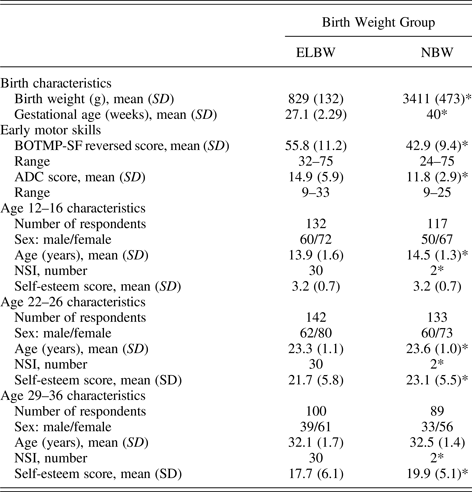
Table 1 presents the sample characteristics for ELBW and NBW participants at each of the three data collection periods. ELBW participants had poorer childhood motor skills than the NBW controls on both the BOTMP-SF (Cohen d = 1.25) and ADC (Cohen d = 0.67). The ELBW participants also had a higher proportion of NSI than the NBW controls. The ELBW participants were slightly younger than the NBW controls at the age 12–16 (Cohen d = –0.41) and age 22–26 (Cohen d = –0.29) data collections. The two birth weight groups did not differ on self-esteem during the age 12–16 visit, but the NBW group had higher self-esteem scores than the ELBW group during both adult visits (age 22–26: Cohen d = –0.25; age 29–36: Cohen d = –0.39). All variables demonstrated normality as indicated by skewness statistics (GSW: –0.75; RSES: –0.49; CSEI: –0.98, BOTMP-SF: 0.50; ADC: 1.75; West, Finch, & Curran, 1999).
Sample characteristics for ELBW and NBW participants

Note: ELBW, extremely low birth weight; NBW, normal birth weight; BOTMP-SF, Bruininks-Oseretsky Test of Motor Proficiency Short Form; ADC, Adult Developmental Coordination Disorders/Dyspraxia Checklist; NSI, neurosensory impairment.
*p < .05.
Self-esteem trajectories as a function of early motor skills and birth weight group
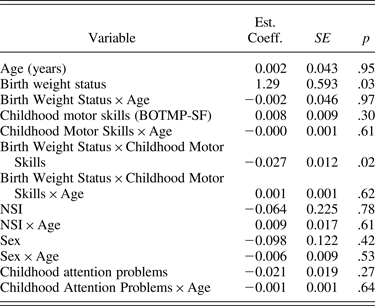
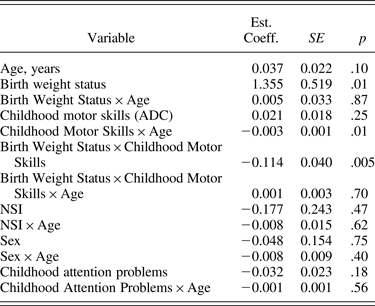
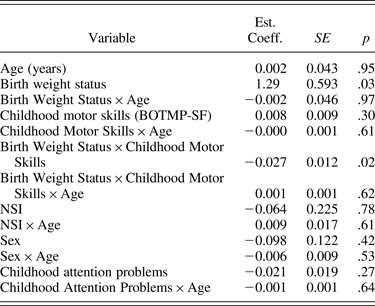
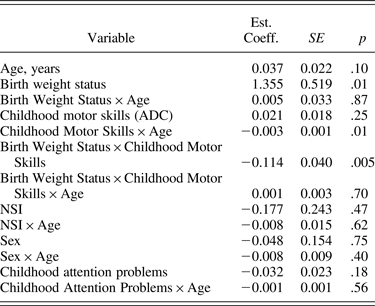
The adjusted parameter estimates for the multilevel growth models of self-esteem over time as a function of early motor skills and birth weight group are shown in Table 2 using BOTMP-SF as the measure of early motor skills, and in Table 3 using ADC as the measure of motor skills.
Growth curve model for self-esteem from adolescence to adulthood as a function of childhood motor skills and birth weight group (BOTMP-SF scores)
Note: BOTMP-SF, Bruininks-Oseretsky Test of Motor Proficiency Short Form; NSI, neurosensory impairment.
Growth curve model for self-esteem from adolescence to adulthood as a function of childhood motor skills and birth weight group (ADC scores)
Note: ADC, Adult Developmental Coordination Disorders/Dyspraxia Checklist; NSI, neurosensory impairment.
Consistent across our two measures of motor skills, we found a significant interaction between birth weight group (1 = NBW, 0 = ELBW) and childhood motor skills, suggesting that variations in early motor skills affect self-esteem differently in NBW and ELBW participants at baseline (i.e., adolescence). We found no significant three-way interaction with time, providing evidence that birth weight status does not moderate the effect of motor skills on the rate of change in self-esteem over time.
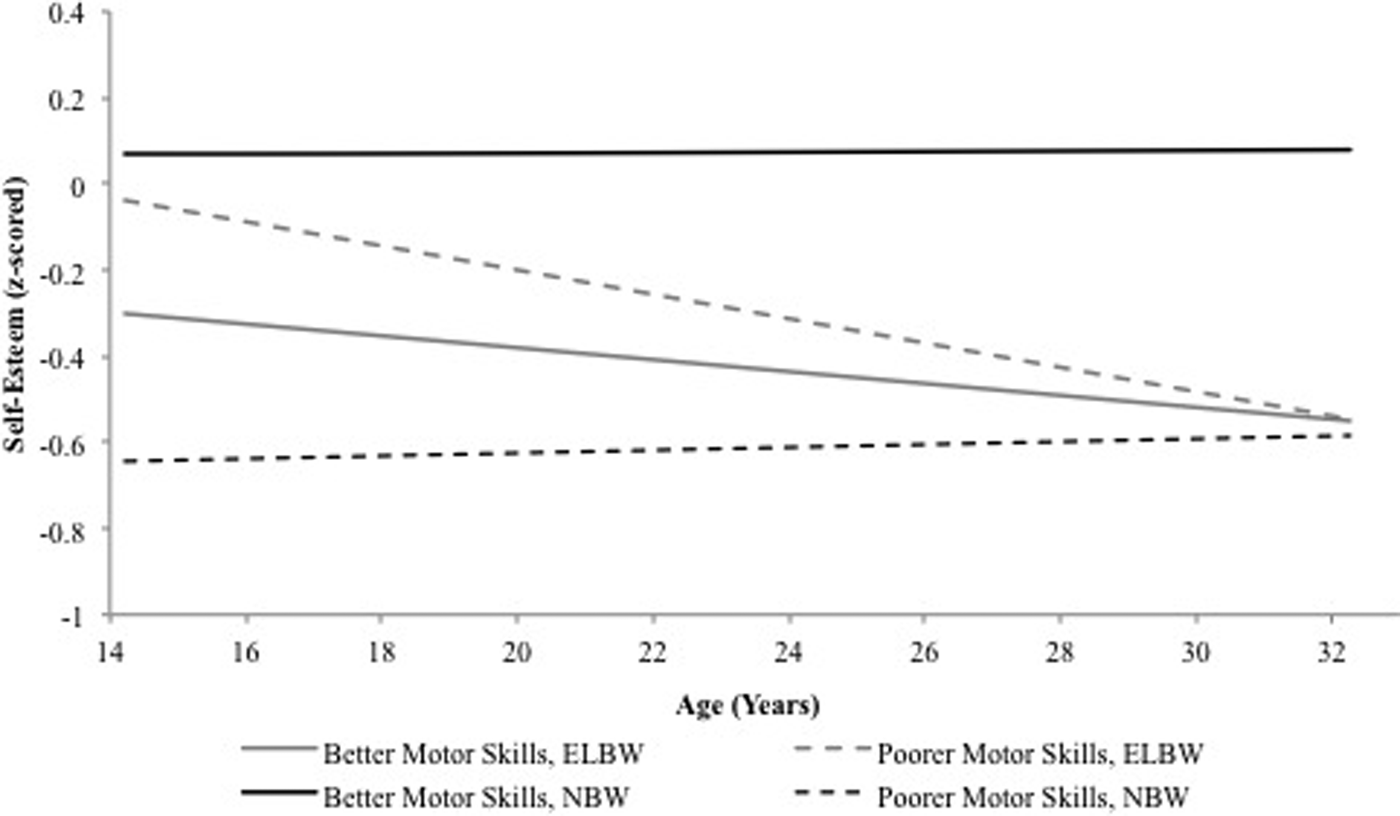
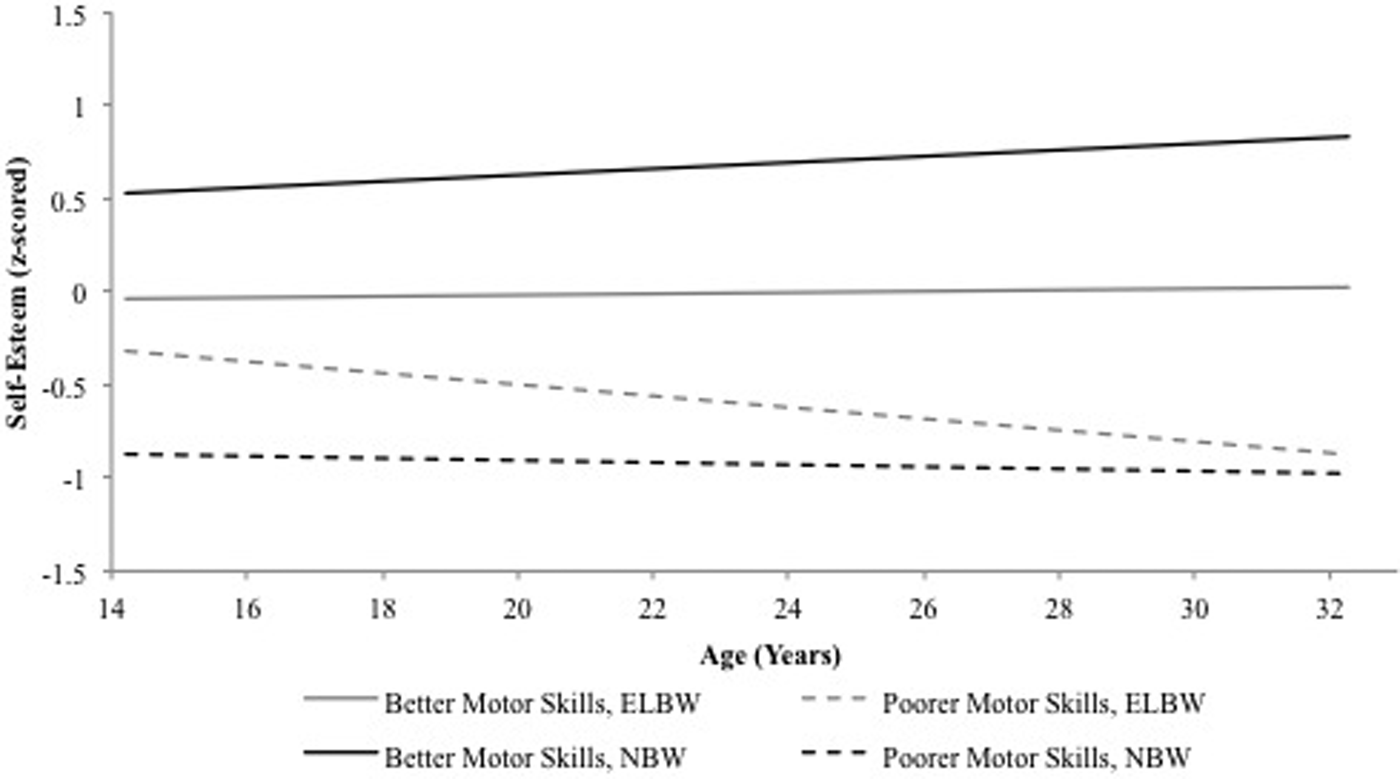
Although early motor skills were treated as a continuous variable in our analyses, we wished to illustrate our results graphically. Therefore, we used the top and lower 10 percentiles of motor scores to depict how early motor skills differentially affect self-esteem in the two birth weight groups. As can be seen in Figures 1 and 2, NBW participants with better early motor skills had the highest self-esteem in adolescence, and this remained stable into middle adulthood. Conversely, the NBW participants with poorer childhood motor skills had the lowest self-esteem in adolescence, and this persisted into adulthood. However, for the ELBW participants, self-esteem was not significantly related to their level of early motor skills.
Self-esteem trajectories based on childhood motor skills (Bruininks–Oseretsky Test of Motor Proficiency Short Form) for extremely low birth weight (ELBW) and normal birth weight (NBW) participants.

Self-esteem trajectories based on childhood motor skills (Adult Developmental Coordination Disorders/Dyspraxia Checklist) for extremely low birth weight (ELBW) and normal birth weight (NBW) participants.

Discussion
We examined the influence of early motor skills on the change in self-esteem from adolescence through to the fourth decade of life for individuals born at NBW or ELBW. We found that the self-esteem of NBW participants was sensitive to the development of early motor skills, such that individuals with poorer motor skills manifested consistently lower self-esteem across two decades, and those with better motor skills manifested stably higher self-esteem over the same 20-year period. Conversely, the self-esteem of individuals born at ELBW did not appear to be influenced by their performance or self-report of childhood motor skills. These results were robust, remaining consistent over a period of 20 years and across two different measures of motor functioning.
Our finding that early motor skills affect self-esteem during adolescence in the general population (i.e., those born at NBW) is consistent with previous research in cross-sectional samples of youth (Eggleston et al., Reference Eggleston, Hanger, Frampton and Watkins2012; Orth et al., Reference Orth, Robins and Widaman2012; Poulsen et al., Reference Poulsen, Ziviani and Cuskelly2006; Rigoli et al., Reference Rigoli, Piek and Kane2012; Skinner & Piek, Reference Skinner and Piek2001; Tremblay et al., Reference Tremblay, Inman and Willms2000). Relative to younger children, older children and adolescents have a greater tendency to evaluate how their performance compares to others, and during this developmental period, they largely integrate external feedback from their peers, teachers, and parents into their sense of self (Orth et al., Reference Orth, Robins and Widaman2012; Robins & Trzesniewski, Reference Robins and Trzesniewski2005). Youth with poor motor skills are also more susceptible to peer victimization and peer rejection based on their lack of motor competence, and this negative peer feedback can have a profound negative impact on a youth's sense of self (Campbell et al., Reference Campbell, Missiuna and Vaillancourt2012). Furthermore, parents and teachers often misinterpret undiagnosed motor deficits in youth as laziness and/or lack of effort, which elicits negative feedback (Miyahara & Piek, Reference Miyahara and Piek2006). Adolescents then internalize this information, contributing to feelings of inadequacy and low self-esteem.
Our findings extend previous research by indicating not only that poor early motor skills adversely affect self-esteem in adolescence but also that this risk persists into the 20s and 30s in the general population. To our knowledge, no prospective or longitudinal study within a single sample has explored how early motor skills affect self-esteem trajectories into adulthood. However, long-term studies show that individual differences in self-esteem are relatively stable across long periods (Orth & Robins, Reference Orth and Robins2014) and that adolescence is a particularly critical period of self-esteem development. Therefore, if individuals have relatively high or low self-esteem compared to their age group at one time period (e.g., adolescence), it is predicted that they will continue having relatively high or low self-esteem decades later (Orth & Robins, Reference Orth and Robins2014). This is consistent with the results found here in NBW participants' self-esteem over time, as predicted by individual differences in motor development.
Many youth with poor motor coordination actively avoid situations that require competent motor skills. This can result in a vicious cycle in which fear of failure leads to withdrawal, and to fewer opportunities for the necessary practice of motor skills (Schoemaker & Kalverboer, Reference Schoemaker and Kalverboer1994). This can accentuate movement problems and may also underlie the continuation of earlier problems with self-esteem into adulthood (Schoemaker & Kalverboer, Reference Schoemaker and Kalverboer1994). During the transition from adolescence to adulthood, avoidance of motor tasks may be more difficult as an individual becomes more independent, and failed attempts and lack of mastery of such motor tasks (e.g., driving) may contribute to continued feelings of inadequacy and maintenance of low self-esteem into the fourth decade of life.
A model has recently been proposed that presents evidence for the association of motor skills and internalizing problems such as anxiety and depression (Mancini, Rigoli, Cairney, Roberts, & Piek, Reference Mancini, Rigoli, Cairney, Roberts and Piek2016). Although the model was originally developed to explain why children with poor motor skills are more apt to develop internalizing problems (Cairney, Rigoli, & Piek, Reference Cairney, Rigoli and Piek2013), several recent studies have led to its revision, and it is now appropriate for population-based samples with a broader spectrum of motor abilities. In the elaborated environmental stress hypothesis, self-esteem and children's self-perceptions are viewed as personal resources within the child that could mediate negative outcomes (Mancini, Rigoli, Cairney, et al., Reference Mancini, Rigoli, Cairney, Roberts and Piek2016). Our findings provide preliminary support for one of the pathways and suggest that supporting children with low self-esteem to have a sense of mastery over some motor tasks could be useful. The authors of that review recommend that universal intervention programs that promote motor skill development for all young children may have psychosocial benefits for many children, not just those with poor motor skills.
Although the spectrum of motor skills differentially affected self-esteem development in the general population (i.e., those born at NBW), self-esteem development in those born at ELBW appeared similar regardless of higher or lower scores on early motor skills. It is not entirely clear why birth weight status moderated the association between early motor skills and self-esteem development. However, the direction of the interactions found here are consistent with the results reported in previous work examining the influence of birth weight and motor coordination on adult psychiatric and social outcomes (Poole et al., Reference Poole, Schmidt, Missiuna, Saigal, Boyle and Van Lieshout2015b, Reference Poole, Schmidt, Missiuna, Saigal, Boyle and Van Lieshout2016). For example, it is possible that differential environmental and individual exposures and circumstances during infancy, childhood, and adulthood in those born prematurely may affect associations between early motor skills and prospective self-esteem. Aside from deficits in motor skill development, those born prematurely tend to have additional developmental difficulties that could affect self-esteem development relative to the NBW controls. An accumulation of multiple developmental difficulties together could lead to lower levels of self-esteem in those born prematurely (Boyle et al., Reference Boyle, Miskovic, Van Lieshout, Duncan, Schmidt, Hoult and Saigal2011; Finnström et al., Reference Finnström, Gäddlin, Leijon, Samuelsson and Wadsby2003; Odberg & Elgen, Reference Odberg and Elgen2011; Rickards et al., Reference Rickards, Kelly, Doyle and Callanan2001), and weaken associations between individual developmental risk factors (i.e., early motor skills) and self-esteem. Conversely, for individuals who were born at NBW and are otherwise typically developing, the influence of individual developmental difficulties such as poor motor skills could be more detrimental to self-esteem.
Further, as preterm born individuals are known to be at risk for a multitude of impairments relative to individuals born at NBW, including social and behavioral difficulties, physical health problems, mental health disorders, and motor deficits (Dahl et al., Reference Dahl, Kaaresen, Tunby, Handegard, Kvernmo and Ronning2006; de Kieviet, Piek, Aarnoudse-Moens, & Oosterlaan, Reference de Kieviet, Piek, Aarnoudse-Moens and Oosterlaan2009; Saigal, Stoskopf, Streiner, & Burrows, Reference Saigal, Stoskopf, Streiner and Burrows2001; Saigal et al., Reference Saigal, Szarmari, Rosenbaum, Campbell and King1991), this at-risk population may have received more screening by health professionals in early life for developmental difficulties relative to the NBW controls. Close neonatal follow-up may have led to formal identification of motor skills problems in the ELBW group and facilitated increased social support from parents, relatives, and/or teachers during childhood and adolescence (Poole et al., Reference Poole, Islam, Schmidt, Missiuna, Saigal, Boyle and Van Lieshoutin press). Increased support in the ELBW population could result in accommodations in academic and home environments that may promote an understanding and acceptance of their functional limitations and allow them to more successfully adapt despite their motor challenges.
Limitations
Although the present study has several strengths, including a longitudinal, developmental approach to understanding self-esteem development, it is important to interpret our findings with the following limitations in mind. Our sample size is relatively small, and this may have limited our ability to detect statistically significant associations. Moreover, while we aimed to provide a complete picture of motor skills via the use of two different measures including a performance-based assessment, our second measure utilized retrospective self-reports, and therefore recall bias could affect our findings for this measure. However, the inclusion of a standardized assessment of motor skills in childhood and the robustness of our results across measures, informants, and time suggests that the effects are real. An additional limitation is the use of different measures of global self-esteem across time. Although the measures are theoretically and conceptually related in assessing the construct of global self-esteem (Hagborg, Reference Hagborg1993) and we standardized scores for comparability across time, we acknowledge that the use of different measures is a shortcoming. Further, although motor skills are thought to be a stable construct, it is important to note that we only measured childhood motor skills and not motor skills during adolescence or adulthood. Therefore, it is hard to disentangle predictive versus concurrent effects of motor skills on self-esteem. Although unavailable in the present study, inclusion of a measure of global self-esteem prior to adolescence (i.e., childhood) would give a better sense of when differences in self-esteem first emerge and would provide a better idea of when intervention for motor skills and self-esteem should take place. It should also be noted that our sample was born approximately 35 years ago, a time when healthcare professionals were just beginning to recognize the importance of treating children with poor motor coordination, and so contemporary cohorts should continue to examine how motor skills and birth weight status interact to affect self-esteem over time. Finally, participants in our study were born in Canada, a developed country where high-quality education and healthcare are universally available.
Conclusions and implications
Findings from this study suggest that individuals' long-term self-esteem can vary in response to early developmental influences. Early motor skill development may exert differential effects on self-esteem, depending on whether one is born at term or prematurely. Individuals born at NBW demonstrated more individual variation in self-esteem development, such that they displayed the lowest self-esteem scores in the context of poorer early motor skills, but exhibited the highest self-esteem scores in the context of better early motor skills from adolescence into adulthood. In contrast, individuals born at ELBW demonstrated similar self-esteem development regardless of early motor skills.
Persisting susceptibility to low self-esteem from adolescence into adulthood in the general population with poor early motor skills is concerning, given the known impact that self-esteem has on multiple domains of one's life. Once individuals reach adulthood, it becomes very difficult to redefine how they view themselves, and early levels of self-esteem appear to persist long term. With an understanding that differences in motor skills might be an early developmental contributor to self-esteem, we should prioritize screening and intervention for these motor problems when children are young. The implementation of targeted intervention (Farhat et al., Reference Farhat, Hsairi, Baati, Smits-Engelsman, Masmoudi, Mchirgui and Moalla2016; Pless & Carlsson, Reference Pless and Carlsson2000; Peens, Pienaar, & Nienaber, Reference Peens, Pienaar and Nienaber2008) to promote motor skill improvement for all children (regardless of premorbid risk status) may provide an excellent opportunity to foster positive self-esteem in early life and set the stage for successful developmental trajectories.