In 2009 President Obama nominated Sonia Sotomayor to fill the Supreme Court seat left vacant by retiring Justice David Souter. While Sotomayor was confirmed by a comfortable margin (final vote: 68–31), the nomination and confirmation itself was not without controversy. Republicans and conservatives latched onto comments President Obama made regarding the role of empathy in a justice's decision making.Footnote 1 Sotomayor, as Obama's first Supreme Court nominee, would be the test case for the extent to which the new president would consider empathy as a requirement for his judicial nominees—or at least Senate Republicans hoped to make it a defining issue.
Further controversy revolved around comments Sotomayor made herself, which tied into this empathy theme. Opponents pounced on comments she made years earlier about the ability of a “wise Latina” to make better decisions than someone without similar experience.Footnote 2 It is unsurprising that a female nominee—indeed, the first Latina nominee—should serve as the lightning rod for this gendered line of attack (see, e.g., Abrams Reference Abrams2010 for a fuller discussion of the gendered angle of this debate). Indeed, it raised an age-old question in a new context: how might the sex of a judge or justice affect the way that individuals assess female judges and their activities?
The question of the role of gender expectations and stereotypes in the assessment of political actors is not a new one (see, e.g., Brooks Reference Brooks2011; Dolan Reference Dolan2012; Huddy and Terkildsen Reference Huddy and Terkildsen1993; Sanbonmatsu Reference Sanbonmatsu2002; Sanbonmatsu and Dolan Reference Sanbonmatsu and Kathleen2009; Schneider and Bos Reference Schneider and Bos2013), nor is the question of the role of judge sex and judging (see, e.g., Boyd, Epstein, and Martin Reference Boyd, Epstein and Martin2010). What is less well known, however, is how citizens might apply the same sorts of gender expectations used to assess political candidates and office holders to female judges and their decisions.Footnote 3 Here, I report on an experimental survey I conducted to examine whether and how a judge's sex influences citizen assessments of a judicial decision and the individual judge. These findings indicate that female judges must navigate some of the same gender expectations that other female leaders do, particularly as it relates to evaluations of their knowledge and empathy. The results also indicate that citizens rely on different factors when determining their support for a decision, depending on whether the decision's author is a male or female. These findings are further evidence of the continuing, though subtle, role that gender plays in assessments of public figures.
As with other public leadership positions, women wield increasing influence in judicial branches, both federal and state. While women's representation on federal courts does not mirror the proportion of women in the population (it currently rests at around 30%Footnote 4), it is closer to reaching proportionality than is the proportion of women in national elective office (which rests at just over 18% in the 113th Congress).Footnote 5 There is vast variation in the individual states, but the states with the highest percentage of women on state courts achieve proportions equal to, if not somewhat higher than, the federal bench proportion.Footnote 6 This increased representation on the bench is no happy accident. Most presidents since Jimmy Carter have made concerted efforts to increase gender diversity on the bench, as well as the diversity of race and ethnicity (Goldman, Schiavoni, and Slotnick Reference Goldman, Schiavoni and Slotnick2009; Goldman, Slotnick, and Schiavoni Reference Goldman, Slotnick and Schiavoni2011; Segal Reference Segal2000). Even with this increasing diversity, the role of “judge” continues to evoke attributions of masculinity (Munoz-Sastre et al. Reference Sastre, Teresa, Fouquereau, Igier, Salvatore and Mullet2000).
One dominant frame in the push for increased diversity was to ensure that alternative perspectives were incorporated into judicial decision-making processes (Clinton Reference Clinton1996; Davis Reference Davis1992; Kenney Reference Kenney2013). A related but separate argument for diversity on the bench picked up on the general theory that institutional legitimacy increases when citizens recognize leaders who look like themselves—in other words, increased descriptive representation (in terms of gender, but also race, ethnicity, and other factors) can increase feelings of good will toward institutions (e.g., Mansbridge Reference Mansbridge1999; Pitkin Reference Pitkin1967). In both of these approaches, difference was emphasized in the fight for equal representation on the bench—female judges look different and can offer a different perspective; therefore, they may be better equipped to represent the different interests of women more broadly and might bolster attitudes toward the courts among women, generally. Have citizens picked up on this difference narrative? And, if so, do they continue to assess female judges differently than male judges? Do citizens expect different traits and substantive decisions from female judges? Are female judges expected to serve as representatives of their gender group? Or, perhaps, have expectations of what it means to be a “judge” swamped gender expectations?
As the results indicate, the sex of the judge affects citizen assessments of judges in certain circumstances. Citizens apply gendered assessments to female judges when those judges take positions that emphasize their identities as “women.” These female judges are subject to the infamous “double-bind,” whereby heightened assessments of empathy are balanced with lower assessments of judicial competence. Yet female judges who do not defend what would be traditionally considered the “pro-woman” position appear to be assessed as judges, rather than women. These findings provide helpful insight into the ways that judges—who, under the “robes on” approach to judicial decision making are typically viewed as more objective and detached from the messiness of the democratic process—may be viewed differently than those competing for elective office. Yet the results suggest that individual attributes of judges—such as their sex, but also the traits and knowledge attributed to them—influence support for court decisions. These results suggest that there are limits, both to when and how gender expectations are applied to leaders and to how effective the “robes on” approach is to understanding judicial behavior and public responses to that behavior.
I proceed with a review of the literature that examines the role of gender expectations in assessments of female candidates and lay out the hypotheses that follow from this work. I then describe an experimental survey that tests whether gender expectations play the same role in assessments of female judges (as compared to male judges). I discuss the findings, which indicate that, under certain circumstances, female judges are assessed through a gendered lens. I finish with a consideration of the implications of these findings, as well as venues for future research.
GENDER AND THE ASSESSMENT OF POLITICAL LEADERS
While political practitioners have been discussing empathy and the role of the judiciary in a gendered context (e.g., the Justice Sotomayor case), there has been little scholarly exploration of the intersection of judge roles, judge sex, and gendered traits and expectations. Fortunately, there has been extensive work, based in scholarship on leadership more generally, that examines how gender expectations color citizens’ assessments of female political leaders. These expectations typically revolve around three areas: traits, issue expertise, and ideology.
First, studies of congressional candidates reveal several traits that are traditionally attributed more to female than male candidates, and vice versa. Related to women's traditional roles that predated formal involvement in politics, women are expected to be “warm, gentle, kind, and passive,” while men are expected to be “tough, aggressive, and assertive” (see page 121 of Huddy and Terkildsen Reference Huddy and Terkildsen1993 for a more extensive review of this work). Kinder (Reference Kinder, Lau and Sears1986) conceived of this grouping of feminine traits as “empathy.” Subsequent studies have broken this term down into three separate trait measures: measures of “compassion,” whether or not the leader “really cares,” and whether or not the leader is “in touch with the people” (Funk Reference Funk1999). More than 90% of Schneider and Bos's (Reference Schneider and Bos2013) respondents would use the word “compassionate” to describe women (11); more than 70% of Dolan's (Reference Dolan2010) respondents indicated that they associate “compassion” with female candidates and officeholders more than males in those roles and chose this option more than “No difference” (77). The Sotomayor anecdote suggests that these assessments carry over to judges. If these typically feminine traits are ascribed to female judges more than male judges, then, holding all else constant, one would expect a female judge to be rated as more empathetic than a male judge, which could have consequences for assessments of her and her decisions.
Held as a counter to the empathy advantage,Footnote 7 scholars of gender and electoral politics have often noted the “double-bind” faced by female candidates (Jamieson Reference Jamieson1995) and leaders (Koenig et al. Reference Koenig, Eagly, Mitchell and Ristikari2011). That is, while female candidates might enjoy an advantage on empathy ratings, they are at a disadvantage when it comes to overall assessments of competency and leadership. In other words, all else held equal, men are seen as more competent and better leaders than women. Moreover, this balancing act is commonly perceived as a zero-sum game—that is, in order for women to bolster their competence ratings, they will sacrifice their empathy assessments. These assessments appear to spring from trait expectations, as the traits associated with men also tend to be associated with strong and competent leadership, while those traits associated with women are not (Eagly and Karau Reference Eagly and Karau2002). A recent meta-analysis finds that this disconnect for women—between leadership and gender expectations—is enduring (Koenig et al. Reference Koenig, Eagly, Mitchell and Ristikari2011). Schneider and Bos (Reference Schneider and Bos2013) find that there are repercussions specifically for female politicians, who are judged to be less “knowledgeable” than male politicians (15). If these findings hold for female judges, then one would expect female judges to be deemed less competent in general than their male counterparts.Footnote 8
In terms of expertise, much work focuses on differentials in issue-specific competencies. Female candidates and elected officials are expected to handle “women's issues”Footnote 9 (Dolan Reference Dolan2010; Reference Dolan2012; Huddy and Terkildsen Reference Huddy and Terkildsen1993; Sanbonmatsu and Dolan Reference Sanbonmatsu and Kathleen2009; Shapiro and Mahajan Reference Shapiro and Mahajan1986) and “compassion issues”—issues such as poverty, education, healthcare, Social Security, and children's issues—better than men. These categorizations do have corollaries in the study of sex and judging. While there has been debate within the judging literature as to what, exactly, constitutes a “woman's issue,” the scope has been narrower than the issue competency advantages for women uncovered in the candidate literature. Specifically, “women's issues” within the study of sex and judging tend to revolve around “gender discrimination, sexual harassment, maternity rights, affirmative action for women, equal employment rights, and reproductive freedom” (Martin and Pyle Reference Martin and Pyle2000, 607; see also Boyd, Epstein, and Martin Reference Boyd, Epstein and Martin2010 and Segal Reference Segal2000). The question remains, however, as to whether or not citizens delineate these types of issues and then expect different levels of expertise on these types of issues from female versus male judges.
Finally, several different studies have verified that citizens expect female candidates and officeholders to be more liberal than male candidates and officeholders (Alexander and Andersen Reference Alexander and Andersen1993; Dolan Reference Dolan1998; Kahn Reference Kahn1996; Koch Reference Koch2000; McDermott Reference McDermott1997, Reference McDermott1998; Paolino Reference Paolino1995). While citizens tend to overestimate female candidates’ liberalism (Koch Reference Koch2000, Reference Koch2002; McDermott Reference McDermott1997), these assessments do have some basis in reality. Female elected officials tend to be affiliated with the Democratic party and have tended to have more liberal voting records than male elected officials (Burrell Reference Burrell1994), particularly on gender-related issues (Norton Reference Norton1999; Swers Reference Swers1998). There is reason to believe that citizens should also perceive female judges to be more liberal than their male counterparts, given that female justices and circuit court judges tend to measure as more liberal using Judicial Common Space scores and tend to find for the plaintiff more often than male judges in sex discrimination cases (Boyd, Epstein, and Martin Reference Boyd, Epstein and Martin2010). Moreover, 64% of sitting female federal justices were nominated by Democratic presidents, as opposed to 41% of sitting male judges.Footnote 10
Additionally, people typically possess relatively little knowledge about the courts, even less so regarding individual judges. This lack of knowledge may make it more likely that citizens rely on gender expectations. In studies of elections, results suggest that respondents are more likely to rely on candidate gender as an evaluative heuristic in low-information settings (Dolan Reference Dolan1998; McDermott Reference McDermott1997). Numerous polls and surveys suggest that any assessing of judges is happening in a low-information environment. In one C-SPAN poll, only 49% of respondents could name a case heard by the Supreme Court (2009). More than half of Americans cannot name a single Supreme Court justice (Ford Reference Ford2006); and, when given a list of four options, only 28% of respondents correctly chose John Roberts as the Chief Justice of the United States. Even when asked to make assessments of the Court that do not necessarily require recalling specific facts, Americans appear to be out of step with prevailing expert opinion. While current elite debate about the Court's ideology tends to focus on its apparent conservative shift since the early 2000s, public opinion indicates a belief that the Court has shifted in a liberal direction (Pew Research Center 2010).
The extent and repercussions of this lack of knowledge are debatable. Gibson and Caldeira (Reference Gibson and Caldeira2009), for instance, argue that the current court knowledge measures are too difficult and underestimate the public's working knowledge of the Court. Indeed, respondents do seem to do relatively well in answering questions about the institutional rules of the Court (Gibson and Caldeira Reference Gibson and Caldeira2009; Kritzer Reference Kritzer2001). For the purposes of assessing individual judges, however, given the public's inability to recall individual judges, compounded by the fact that these surveys are done with the relatively high-visibility Supreme Court, it seems likely that respondents reading about decisions written by Circuit Court judges would have very little information available and would be more likely to rely on obvious traits (i.e., gender) as a heuristic.
AN ALTERNATIVE EXPECTATION
While one line of existing literature gives backing for these gender differences to emerge across traits, issue expertise, and ideology, there is also reason to believe that there may be few, if any, gender differences in assessments of judges and their decisions. A lack of gender difference may have two sources: The first could be the overwhelming strength of the role of “judge,” such that it eclipses competing expectations (i.e., those regarding gender). The second could be a progressive evolution of concepts of leaders, such that these roles are not as starkly gendered as they were in the past.
The first possible source may be that the socialization process of becoming a judge trumps any sort of expectations related to gender socialization. If citizens prioritize the role of judge over other categorizations, then I expect these legal socialization expectations to wash out gender expectations. Given the status Americans typically attach to the courts—and a general belief that judges are able to assume an objectivity that the rest of us cannot—it is plausible that these beliefs might override gender-related beliefs. Indeed, Gibson and Caldeira (Reference Gibson and Caldeira2009) suggest that “… to the extent that legal expectations are satisfied, the influence of ideology, policy, and partisanship is minimized” (12). While they do not explicitly mention the influence of gender expectations, if satisfied legal expectations can trump these other strong beliefs, it seems reasonable that gender expectations might also fall by the wayside, at least as they are (relatively) explicitly manifested.
In addition, studies from the business field suggest that high-status individuals (i.e., leaders) face fewer gender-based restrictions regarding emotional expression than the average person (e.g., Averill Reference Averill, Hogan, Johnson and Briggs1997; Hess, Adams, and Kleck Reference Hess, Adams and Kleck2005; LaFrance and Hecht Reference LaFrance, Hecht, Phillipot, Feldman and Coats1999, Reference LaFrance, Hecht and Fischer2000). Brooks (Reference Brooks2011) verifies that the response to male and female candidates’ displays of emotion (i.e., sadness and anger) are less gendered (based on candidate gender) than the existing candidate studies and conventional wisdom would lead one to believe. Moreover, rather than the usual “double-bind,” Brooks (Reference Brooks2013) finds that empathy and “knowledge” are actually positively related for female candidates (i.e., as empathy assessments increase, so do knowledge assessments). This relationship does not exist for male candidates (129). Certainly, U.S. Circuit Court judges would be considered “high-status” individuals and, therefore, may be assessed similar to business leaders and congressional candidates.
The second possible source of a lack of gender-based differentiation relates to an evolution of gender expectations, at least as they relate to leaders. Schneider and Bos (Reference Schneider and Bos2013) take a closer look at specific trait assessments and their impact on female “politicians.” They find that a female politician subtype has developed, one that diverges significantly from the stereotype of “woman” more broadly. As such, many of the positively construed traits that were automatically ascribed by researchers to female political leaders—because the leaders are women—are not actually attributed to female political leaders at rates higher than male political leaders. Indeed, female politicians are ranked lower, compared to women, on positive traits (e.g., warm, empathetic) (9–10). Female politicians are not rated any more or less empathetic than their male counterparts (12). Koenig et al. (Reference Koenig, Eagly, Mitchell and Ristikari2011) explicitly incorporate time into their meta-analyses of gender and leadership stereotypes and conclude that stereotypes of leaders have evolved, such that they incorporate more traditionally feminine traits (634). There is limited evidence that this transformation has taken place in regard to federal judges and justices as well, as perceptions of these roles have become less masculine over time (Beggs and Doolittle Reference Beggs and Doolittle1993; Munoz Sastre et al. Reference Sastre, Teresa, Fouquereau, Igier, Salvatore and Mullet2000; Shinar Reference Shinar1975).
HYPOTHESES
The literature, then, leads to three different classes of hypotheses. If citizens primarily consider female judges to be women, then we should observe judges being assessed differently in reference to their male counterparts across the areas of empathy, general judicial competence, issue expertise, and ideology. In particular, regardless of the substance of the decision the judge authors, we should observe the following Women are Different hypothesis:
H1:
Holding all else equal, female judges should be rated as more empathetic, less knowledgeable overall, more knowledgeable regarding the issue area of employment-related sex discrimination, and more liberal than male judges and their associated decisions. Footnote 11
On the other hand, as I laid out above, there is ample reason to believe that judge gender may not play into assessments of judges at all. Citizens may believe that the process of socialization into the legal community is so rigorous that it trumps any other identities or predilections. Indeed, an enduring belief that judges are above ideology is a prime example of how citizens may view that socialization as very powerful. On the other hand, or perhaps in tandem with this first line of reasoning, is the possibility that a large enough proportion of the population has developed less gendered attitudes toward leaders. Either case would lead to the following Judges are Judges hypothesis:
H2:
There will not be any significant differences in empathy, general knowledge, issue expertise, or ideology assessments between male and female judges.
There is a third possibility, and that is that assessments of judges will be more or less gendered depending on the circumstances of the decision. In the study here, respondents are presented with two decisions: one that could be construed as defending the rights of women in the workplace (i.e., the minority opinion) and one that could be construed as significantly curtailing the rights of women in the workplace (i.e., the majority opinion).Footnote 12 A female judge who authors the minority opinion (i.e., defending the rights of women to sue for employment discrimination) is acting in a substantively representative manner (Pitkin Reference Pitkin1967); is behaving in a manner that many who advocate for increased diversity on the bench would hope for; and is behaving in a way that is empirically more common (Boyd, Epstein, and Martin Reference Boyd, Epstein and Martin2010). It is reasonable to conclude, then, that for female judges who write a prowoman decision (which, in this case, is the minority opinion), the identity of “woman” will be primed among respondents. If true, the following Substantive Representatives hypothesis would hold:
H3:
When defending the interests of “women,” female judges will be assessed as more empathetic, less knowledgeable, more expert in the issue area of employment-based sex discrimination, and more liberal than male judges.
Authoring opinions, then, that do not defend the rights of women may offer a different signal to respondents. Even if the decision still regards an issue where sex and gender are salient aspects, when a female judge writes an opinion that restricts the rights of women in the workplace, the signal may be that her identity as a judge is paramount to her identity as a woman, a signal that encourages respondents to assess her, first and foremost, as a judge and not necessarily as a woman. If this is the case, then I expect the following Conditional Judges are Judges hypothesis to hold in a limited circumstance:
H4:
When female judges act against group gender interests (i.e., write the majority opinion), there will be no significant differences in assessments of empathy, general knowledge, issue expertise, or ideology between male and female judges.
There is, however, an alternative to this hypothesis. Because gender considerations are salient throughout the case—whether a female judge authors a pro- or anti-women opinion—it is also possible that writing an anti-women decision will not neutralize gender identity in favor of a judge-related identity. Instead, the judge's gender identity may remain the prime focus—in which case, authoring an anti-women decision would counter behavioral expectations. Research suggests that behavior that runs counter to identity expectations results in lower assessments of the “gender deviant” (Prentice and Carranza Reference Prentice and Carranza2002; Rudman and Glick Reference Rudman and Glick1999). Under this alternative Unexpected Behavior hypothesis, then, a woman who authors an anti-woman decision would be punished in comparison to the male judge, specifically on characteristics that would be deemed positive:
H5:
Because acting against group gender interests runs counter to gender expectations for female judges, they will be assessed significantly lower on empathy, knowledge, and issue expertise than their male counterparts when they write the majority opinion.
METHODS AND DATA
Through a grant from Time-Sharing Experiments for the Social Sciences (TESS), I conducted a survey experiment with a nationally representative sample using the GfK Group's (formerly KnowledgeNetwork's) online research panel. I chose an experimental method due to its internal validity advantages. The process of random assignment helps to assure that the two groups are functionally equivalent but for the difference in treatments. As such, any differences that emerge between the two treatments can confidently be attributed to the treatment(s) in question.
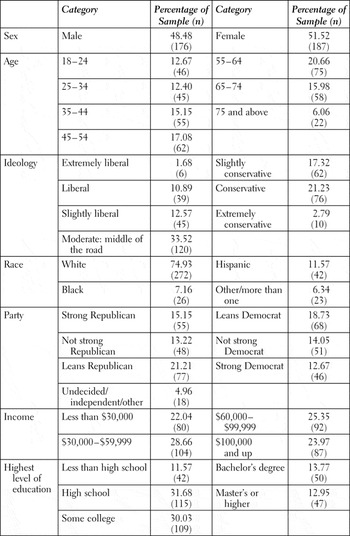
While the research design addresses issues of internal validity, the sample selection process of the GfK Group addresses issues of external validity. The GfK Group recruits respondents using postal mail addresses as the sampling frame. This method produces a probability-based sample that addresses the deficits of other online samples. Specifically, the frame includes homes with and without landlines, which solves the potential sampling bias issue of landline-only samples (Link et al. Reference Link, Battaglia, Frankel, Osborn and Mokdad2007; Tucker, Brick, and Meekins Reference Tucker, Brick and Meekins2007). In addition, the GfK Group provides homes with internet access and/or a device to access the internet, if needed, to preempt the issue of sampling bias through access (or lack thereof) (Bethlehem Reference Bethlehem2010).Footnote 13 Finally, the nationally representative nature of the online sample precludes the usual concerns of using a “college sophomore” sample (e.g., Sears Reference Sears1986). In April 2013, 363 respondents completed the survey experiment, for a response rate of 62.3%. Table 1 breaks down the demographics of the sample, which reinforce the representative nature of the GfK sample.
Distribution of the sample across demographic variables

The experiment included two conditions. In each condition, participants read a supposed New York Times article. The article reports on a case that was heard by the 7th Circuit Court of Appeals in 2007. The article explains how the 7th Circuit ruled that the time frame for women to be able to sue for pay-based sex discrimination was limited to 180 days after the first paycheck was received (rather than 180 days from the receipt of each paycheck in which there is a disparity, which was the Equal Employment Opportunity Commission's prevailing interpretation of the law).Footnote 14 The dissent argues that such a limited time frame does not account for the realities of the workplace, where it typically takes years for women to realize they are being paid less than men. This fabricated article closely resembles an actual Times article from 2007, which reported on the same decision, more widely known as the Lilly Ledbetter case, rendered by the Supreme Court.Footnote 15 The most significant modifications to this article from the original were to change the venue and authoring judges, shorten the article overall, and some other minor changes to make the report consistent with a lower court venue (e.g., to change the final vote to 3–2 instead of 5–4). I changed the venue from the Supreme Court to a circuit court in order to limit the effect of respondents’ potential prior knowledge about the Supreme Court—it seems feasible that some respondents might have preestablished opinions about Justice Alito (the majority author) and Justice Ginsburg (the dissenting author). Moreover, I chose a federal court venue, as opposed to a state court, to enhance generalizability. Individual states have vastly different laws as to how judges are selected. However, a nationally representative sample would be equally familiar with the institution of the federal courts. The text of the articles is included in the Appendix.
The key differences between the two conditions were the authors of the majority and dissenting opinions. In the Male Majority Condition, a fictitious male judge, Judge Anthony Purlane, is the author of the majority opinion, which significantly restricts the rights of women to sue for pay discrimination. The dissenting opinion is penned by fictitious female judge Margaret Beeler. In the Female Majority Condition, the authors are switched. Judge Margaret Beeler writes the decision curtailing the rights of women to sue, while Judge Anthony Purlane is the author of the dissent. Analysis of a manipulation check included in the questionnaire verifies that the gender of the judge registered with respondents. When asked whether the majority opinion was written by a male or female judge, more than 70% of respondents answered correctly.Footnote 16
Following with the Pretest-Posttest Multiple Experimental Condition Design (Holbrook Reference Holbrook, Druckman, Green, Kuklinski and Lupia2011), the research design does not include a traditional “control group” (i.e., a group that does not receive any treatment). Morton and Williams (Reference Morton, Williams, Box-Steffensmeier, Brady and Collier2008) note how political science experiments have evolved beyond control groups being a requisite in all circumstances. For example, when it may not be clear what a “baseline” might represent, experiments remain useful if the researcher can control potentially confounding factors between two treatment groups. In the case of this particular experiment, a baseline was not clear—it would be impossible to test what individuals think of the courts without invoking gender because individuals will presumably fill in those blanks if not supplied that information (i.e., which gender(s) each authoring judge is). Without additionally measuring what those presumptions are, the control group does not present a meaningful comparison group. Thus, in an effort to preserve as many respondents as possible for the two groups that do provide meaningful comparison, the traditional control group was omitted. However, the random assignment and variation of only one pertinent variable between the two treatment groups means that I was able to “control confounding variables” that might threaten internal validity in a nonexperimental design (Morton and Williams Reference Morton, Williams, Box-Steffensmeier, Brady and Collier2008, 342).
In order to make the article meaningful and realistic, it was necessary to focus in on a particular issue. I chose the issue of gender-based employment discrimination for three major reasons. First, choosing a case that deals with gender, when testing for the effects of gender expectations, was a natural first investigation in this area. While it is the easiest test of these hypotheses—in that it is the issue area where gender differences would be most likely to emerge, given the identity's salience when reading the case—the results are instructive. Should the results show no gender differences in assessments of the judges, it would be easy to conclude that judge gender does not play a significant role in the assessment of this case (or any other type of case). Second, I chose this issue because it is relatable and salient for the vast majority of respondents. Even for respondents who may not work in a corporate or office-type setting, the odds of knowing someone who does—and who relates experiences from that situation—are high. Such familiarity may make respondents more comfortable in rendering judgments about the decision.
Third, and finally, I chose the issue of gender-based employment discrimination because research on the courts reveals this particular issue area to be one of the few issue areas where behavioral differences emerge between male and female judges. Women are more likely to find for the plaintiffs in sex discrimination cases than are men; moreover, as the proportion of women on a court panel increases, the more likely it is for that court to find for the plaintiff in these types of cases (Boyd, Epstein, and Martin Reference Boyd, Epstein and Martin2010). Thus, it is realistic to expect that respondents would read a news story about a case like this, that there would be a gender difference in the authors of the pro- and anti-woman opinions, and that a woman authoring the anti-woman opinion would, indeed, run counter to expectations.
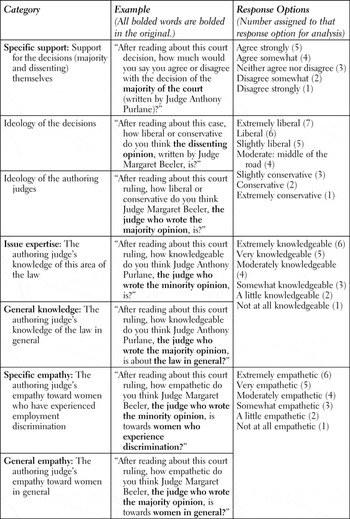
After reading the article, respondents began a questionnaire. The questions begin with some relatively easy warm-up questions about the article itself. These are followed with a series of questions about their responses to the decisions (both majority and dissenting), as well as the associated authors. Table 2 notes the categories and examples of questions from each, as well as the verbal labels respondents were able to choose from for each item. Finally, I have access to a host of standard demographic questions for each respondent, including age, sex, party identification, and ideology of the respondent, that the GfK Group collected previously.Footnote 17
Survey question categories and examples

RESULTS
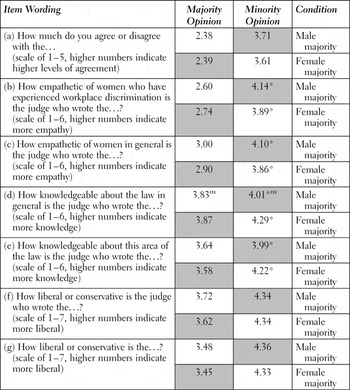
Given the experimental nature of the survey, I use the power of random assignment to isolate the variation highlighted by the experimental conditions. As explained earlier, the randomized experimental design ideally holds all other potentially influential variables constant, allowing for the straightforward comparison of conditions across items of interest. Table 3 displays the mean responses, by condition, across all dependent variables. There were 363 respondents in the study. Actual responses to each item vary, but, on average, each condition for each item includes 173 responses, with the minimum number of responses at 163 and the maximum number at 183. Row A reveals the general unpopularity of the majority decision. For both conditions, levels of support were significantly lower for the majority opinion (which significantly restricts the time frame during which women can sue for pay discrimination) than they were for the dissenting opinion. On a five-point scale, support for the majority opinion hovered around 2.4 (which most closely corresponds to the scale point “Disagree Somewhat”), while support for the dissenting opinion rounds to 4 (or “Agree Somewhat”). These results mirror the reaction to the actual Supreme Court decision that spurred Congress and the President to pass a law overturning the decision.Footnote 18 While it appears that support for the minority opinion is somewhat higher when written by a female judge (3.71 versus 3.61 for a male judge), this difference is not statistically significantly different (t = 0.89, p = .19).Footnote 19
Mean ratings on seven different dimensions, by condition

Notes: Shaded cells indicate a female author. Significant differences between conditions are denoted with *(p < .05). All differences between the “Majority opinion” and “Minority opinion” cells within a condition are statistically significantly different from one another, unless otherwise noted. The average cell sample size is n = 173, with a minimum cell sample size of n = 163 and a maximum cell sample size of n = 183.
I turn now to a test to adjudicate among the hypotheses: are female judges subject to the same double-bind as other female leaders? There is certainly evidence for the Women are Different hypothesis: under certain circumstances, the gender of the judge influences assessments of the judge. Most notably, female judges, in certain circumstances, do appear to be in the infamous double-bind. Dissenting female judges are rated as more empathetic than their male counterparts but less knowledgeable. In terms of both general and specific empathy, the female dissenter holds an advantage over the male dissenter. For specific empathy (row B), on a six-point scale, women are rated at 4.14, statistically significantly higher than the male dissenter at 3.89 (t = 1.79, p = .04). General empathy follows a similar pattern. On the same scale, the female dissenter is rated as “moderately empathetic” (4.10), statistically significantly higher than the male dissenter at 3.86 (t = 1.82, p = .03, as shown in row C of Table 3). At the same time, as rows D and E illustrate, the male dissenter is systematically ranked as more knowledgeable than a woman who writes the same dissent. In terms of general knowledge (row D), the male dissenter is rated as 4.29 on a scale of 1–6 (where 1 is “not at all knowledgeable” and 6 is “extremely knowledgeable”), while the female dissenter is rated at 4.01. This corresponds to a 5% difference in knowledge assessments between male and female judges (t = –2.39, p = .01). The male dissenter is also, unexpectedly, assessed as possessing more issue expertise than the female dissenter: 4.22 versus 3.99, respectively (t = –2.02, p = .02). This produces a gender-based difference, but one that runs in the opposite direction as expected: the male dissenter is perceived to have greater knowledge in the issue area of employment sex discrimination than the female dissenter.
Thus, there is a fair amount of evidence to suggest that citizens apply gender expectations to female judges. At the same time, there is also significant evidence here to support the Judges are Judges hypothesis: that is, due to the prominence of nongendered “judge” expectations or perhaps the evolving nature of leader and gender expectations, judge assessments will not be gendered in the same way that other leadership roles are or have been in the past. First, under no circumstances are there gender differences in assessments for majority or dissenting judges in terms of how liberal the decisions or the judges are. As rows F and G of Table 3 indicate, the majority opinion and majority-authoring judges are, across the board, seen as more conservative than the minority opinion and minority-authoring judge (p < .001 for all relevant comparisons), assessments that are to be expected given the content of the decisions. However, this difference is not affected by the gender of the authoring judge; p-values on these comparisons are all well above conventional levels of significance.
In addition, even in those areas where gender differences emerged for the dissenting authors, there are no gender differences for the majority authors. More specifically, female and male majority opinion authors are assessed similarly for general empathy (2.90 versus 3.00, t = .62, p = .27); specific empathy (2.74 versus 2.60, t = –.88, p = .19); general knowledge (3.87 versus 3.83, t = –.33, p = .37); and issue expertise (3.58 versus 3.64, t = .44, p = .33).
Given the two very different patterns, depending on whether the majority or minority opinion is assessed, the conditional hypotheses offer the best explanation of the data. That is, under certain conditions related to the substance of the opinions, citizens will assess judges through the lens of gender expectations. The Substantive Representatives hypothesis holds in three out of the four measured aspects of gender expectations. When a female judge defends the rights of women in the workplace, she is perceived as more empathetic than a similarly situated male judge, but less knowledgeable, both in general and in terms of this particular area of the law. This suggests, then, that in situations where female judges are associated with opinions that emphasize the identity of “woman,” they will be subject to the infamous double-bind: assessed as more empathetic but less knowledgeable than her male counterpart. Ideology, however, appears to be so entrenched in the identity of “judge” that gender expectations do not override it. In other words, even in a situation where gender issues are primed and the female judge acts in a manner that would emphasize her gender-group identity, ideology expectations do not differ.
The larger pattern of data also reinforces the Conditional Judges are Judges hypothesis, while refuting the Unexpected Behavior Alternative hypothesis. Recall that the Conditional Judges are Judges hypothesis predicted that a female judge who writes an anti-women decision would be emphasizing her gender-neutral identity as a judge, as opposed to gender identity. When a female judge writes a decision that circumscribes women's rights to sue for gender discrimination in employment, gender identity appears to become less salient. Rather than punishing a female author for acting contrary to gender expectations in comparison to her male counterpart (as the Unexpected Behavior [Alternative] hypothesis posits), the unexpected behavior appears to reinforce the identity of judge above gender, manifest in the complete absence of gender-based assessments for the majority opinion and majority-authoring judge. Majority female authors are assessed equivalent to their male counterparts in terms of empathy, general knowledge, and issue expertise, an outcome that supports the Conditional Judges are Judges hypothesis. As such, the double-bind for female judges appears to only apply to those female judges who are serving as substantive representatives for their gender groups (i.e., writing a pro-women decision), but not to the female judge who authors an anti-women decision.
The data, thus far, appear to tell a kind of bad news-good news story for female judges. On the one hand, in certain circumstances, female judges are perceived to be lacking in legal knowledge, even in regard to a specific issue that women are considered to “own.” Even worse, these disadvantages come through when a female judge writes an opinion that is descriptively and substantively representative—an opinion that defends the rights of women in the workplace. From a normative standpoint, increasing women's representation on the court was an attempt to institutionalize the defense of these rights. Yet it appears that, when this mechanism works as intended, judges must navigate the resulting gendered assessments.
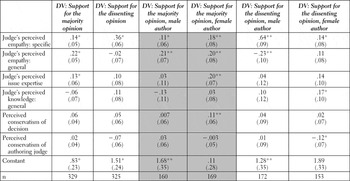
The good news is that the knowledge differential is not pervasive: when female judges write an anti-women decision, that knowledge disparity disappears. Moreover, female judges enjoy an empathy advantage when they write pro-women decisions. Of course, given the opening vignette, though “empathy” is typically perceived as a positive trait among the general public, it does not necessarily mean that a judge, who is supposed to be detached and objective, would be rewarded for being empathetic. To explore whether increased empathy assessments in regard to judges could be considered an “advantage,” multiple regression models are presented in Table 4. The results reinforce that this gendered empathy assessment is, indeed, an advantage. In predicting support for the decisions overall, the perceived empathy of the judge is a statistically significant and positive predictor of support for the decision in three out of four instances (i.e., twice for specific empathy and once for general empathy). These models also suggest that the knowledge differential may not ultimately have a negative effect. The perception of a judge's issue-based knowledge only predicts support for the majority opinion, where there is no gender-based differential in knowledge assessments. In the minority opinion, where there is a gender-based difference in knowledge assessments, it has no statistically significant effect on overall support for the decision.Footnote 20
Regression, individual assessments' impact on agreement with the decision

Notes: **=p < .05; *=p < .1
Thus, while these results suggest that there are conditions under which female judges are assessed in manners similar to male judges, the larger conclusion is of the complex and, ultimately, gendered framework within which judges operate. Citizens use some characteristics of judges to determine how much they support the decision that judge rendered. But the gender of the judge interacts with the decision substance to determine how much. The final four columns of Table 4 display one more way in which the role of judge sex subtly influences views of a court decision. Here, I predict support for the majority and minority decisions by condition. This analysis demonstrates how the mechanism for assessment is different depending on the decision substance and sex of the author. While judge-based assessments of empathy are significant and positive predictors of decision support for both male and female authors, respondents use additional perceptions of individual characteristics when thinking about majority opinions authored by a female. For those respondents who read a majority opinion authored by a female author, perceptions of the decision's ideology and the judge's issue expertise were also significant predictors of decision support. Note that these gender differences happen in the less gendered of the two conditions.
A similar pattern emerges for the dissenting opinion. In three out of four instances, assessments of judge empathy significantly predict overall support for the decision—though notice for the male dissenter, the relationship is actually negative. However, again, support for the female dissenter's decision is also predicted by other individual-level factors: namely her ideology and her general knowledge. These different mechanisms at work within conditions run counter to the ideal of judges as disinterested, objective arbiters of the law. On the one hand, for both male and female judges in most conditions, higher empathy assessments lead to higher opinion support, a relationship that the Republicans who opposed Justice Sotomayor's nomination would be interested to know. On the other hand, these individual-level assessments are more pronounced for female judges than they are for male judges, suggesting that these decision makers are not interchangeable. The ideal of an objective judge appears to fit the concept of a male judge more accurately than a female judge (whose individual attributes are more predictive of specific support).
DISCUSSION
These experimental findings suggest that, in certain circumstances, judge gender matters for citizens as they evaluate court decisions. Female judges who act in a substantively representative manner—by authoring pro-women decisions—are subjected to the infamous double-bind. These judges are perceived as more empathetic than their male counterparts but also less knowledgeable, even in an issue area that is particularly relevant to women. These gender-based differences do not emerge, however, when female judges act against gender-group interests. Across the board—empathy, knowledge, and ideology—female judges who find against the female complainant are not assessed differently than their male counterparts.
These findings have implications for judges and for citizens. Perhaps most obviously, female judges who must run for election or reelection are dealing with some of the same types of gender expectations as their counterparts in other branches of elected government. The astute female judge, then, may temper some of her decisions, in direction and substance—particularly those in issue areas where gender is particularly salient—in anticipation of future electoral contests. This strategizing could take the form of attempting to minimize the knowledge gap; trying to capitalize on the empathy gap; or even affecting the position the judge takes on a case (i.e., choosing between a position that will lead to gendered assessments versus a position that will not). But even in nonelectoral contexts, there are implications for the court and for those most closely affected by these decisions. A fundamental rationale behind increasing women's representation on the bench is to add a different perspective—and perhaps to encourage different sorts of outcomes (i.e., courts that are more sympathetic to claims of employment-based gender discrimination). Yet this gendered context calls into question whether women on the bench can sustain that sort of representation if they are trying to manage their images (among the public or among their colleagues) and trying to manage the image of the court more broadly. While a simple bivariate look at the data does not suggest a direct connection between the gender of the authoring judge and measures of legitimacy, the complex gendered context revealed here suggests closer examination is warranted to fully examine whether and how gender expectations may—positively or negatively—affect institutional legitimacy, particularly given that maintaining legitimacy is a central concern of judges and justices (per the strategic model) (Caldeira Reference Caldeira1987; Caldeira and Gibson Reference Caldeira and Gibson1992; Clark Reference Clark2009; Segal, Westerland, and Lindquist Reference Segal, Westerland and Lindquist2011).Footnote 21
Moreover, these findings raise questions about how citizens experience the implementation of these decisions. Questions of gender equality in the workplace are salient issues for many Americans. The conditional mechanisms revealed here suggest that attitudes toward this policy are more complex than simply supporting or opposing protective policies. Indeed, it is not difficult to imagine situations where the circumstances of a decision could affect not whether or not a workplace implements protective policies per se, but the attitudes surrounding that implementation, which could in turn influence the overall effectiveness of these policies.
As is the case with most studies, this one may create more questions than it answers. The research design here cannot separate the content of decisions from the majority/minority stance of the decision. Is it the difference in substance that makes individuals more or less willing to apply gender (versus professional) expectations to female judges? Or is it the act of having penned a majority versus a minority opinion? To parse this out, future studies should compare the same substance of decision, but with the minority and majority positions switched. In addition, future studies should ask more detailed questions about the processes citizens are performing to get to these assessments. Is the behavior of the judge actually making certain expectations more salient to respondents than others (i.e., woman versus judge)? Or is there a different psychological process going on? And how might the dynamics of these assessments change when compared to conditions where both decisions are written by women or both decisions are written by men?
The scope of future studies could also expand to see how broadly these effects are applicable. Are gender expectations applied to nonfederal judges in the same manner? Do these findings hold in other issue areas, particularly those that are not as explicitly gendered and may not immediately bring judges’ gender identities to mind? What is the relationship between other personal identities (such as race or ethnicity) and expectations associated with being a judge? Do citizens weigh these (perhaps competing) expectations differently? Obviously, many questions remain. Nonetheless, the data here are a first step toward understanding some of the implications of judge gender and citizens' assessments of decisions and the courts.
APPENDIX
Text of the Experimental Article
Judges' Ruling Limits Suits on Pay Disparity
CHICAGO, May 29—The 7th Circuit Court of Appeals issued a ruling on Tuesday, which would make it harder for many workers to sue their employers for discrimination in pay, insisting in a 3-to-2 decision on a tight time frame to file such cases. The dissenters said the ruling ignored workplace realities.
The decision came in a case involving a supervisor at a steel refinery in Gadsden, Ala., the only woman among 16 men at the same management level, who was paid less than any of her colleagues, including those with less seniority. She learned that fact late in a career of nearly 20 years—too late, according to the Circuit Court's majority.
In a ruling issued by [Judge Anthony Purlane/Judge Margaret Beeler], the court ruled that employees may not bring suit under the principal federal anti-discrimination law unless they have filed a formal complaint with a federal agency within 180 days after their pay was set. The timeline applies, according to the decision, even if the effects of the initial discriminatory act were not immediately apparent to the worker and even if they continue to the present day.
In the opinion, Judge [Purlane/Beeler] rejected the view of the federal agency, the Equal Employment Opportunity Commission, that each paycheck that reflects the initial discrimination is itself a discriminatory act that resets the clock on the 180-day period, under a rule known as “paycheck accrual.”
[He/She] writes, “Current effects alone cannot breathe life into prior, uncharged discrimination.”
In [her/his] dissenting opinion, [Judge Margaret Beeler/Judge Anthony Purlane] said the majority opinion “overlooks common characteristics of pay discrimination.” [She/He] said that given the secrecy in most workplaces about salaries, many employees would have no idea within 180 days that they had received a lower raise than others.
An initial disparity, even if known to the employee, might be small, Judge [Beeler/Purlane] said, leading an employee, particularly a woman or a member of a minority group “trying to succeed in a nontraditional environment” to avoid “making waves.” Judge [Beeler/Purlane] noted that even a small differential “will expand exponentially over an employee's working life if raises are set as a percentage of prior pay.”
Judge [Beeler/Purlane] invited Congress to correct the court's “cramped interpretation” of the law.