Acetone rinsing tolerance of lichens is a technique that allows workers to remove lichen secondary metabolites (LSM) while preserving the metabolic integrity of the thallus (Solhaug & Gauslaa Reference Solhaug and Gauslaa2001, Reference Solhaug and Gauslaa2004). Biological activities of LSMs are insufficiently known and represent an exciting research field in nature and the laboratory (Galloway Reference Galloway1993; Molnár & Farkas Reference Molnár and Farkas2010; Latkowska et al. Reference Latkowska, Bober, Chrapusta, Adamski, Kaminski and Bialczyk2015; Duong et al. Reference Duong, Huynh, Chavasiri, Chollet-Krugler, Nguyen, Nguyen, Hansen, Le Pogam, Thüs and Boustie2017; Gauslaa et al. Reference Gauslaa, Alam, Lucas, Chowdhury and Solhaug2017; Neupane et al. Reference Neupane, Malla, Gautam, Chaudhary, Paudel, Timsina and Jamarkattel2017).
Most of the LSMs can be extracted by acetone; this is the normal extraction method for chromatographic studies of these substances (Arup et al. Reference Arup, Ekman, Lindblom and Mattsson1993; Feige et al. Reference Feige, Lumbsch, Huneck and Elix1993; Huneck & Yoshimura Reference Huneck and Yoshimura1996; Orange et al. Reference Orange, James and White2010). Solhaug & Gauslaa (Reference Solhaug and Gauslaa1996, Reference Solhaug and Gauslaa2001) showed that both mycobiont and photobiont survived acetone rinsing treatment in various lichen species when the lichens were well desiccated. Though acetone rinsing affected membrane permeability in some lichen species, the photosynthetic activity and pigment composition did not necessarily alter after treatment (Candotto Carniel et al. Reference Candotto Carniel, Pellegrini, Bove, Crosera, Adami, Nali, Lorenzini and Tretiach2017). Solhaug & Gauslaa (Reference Solhaug and Gauslaa2001) showed that, in general, chlorolichens are more tolerant of acetone rinsing than cephalo- and cyanolichens, based on measurement of the maximum quantum efficiency of PSII (F v/F m). Although previous results have demonstrated that physiological activity is maintained following acetone rinsing, to apply this method routinely, further confirmatory tests are required for generalization across a wider range of species from different ecological settings to ensure reproducibility.
The lichen Cladonia foliacea (Huds.) Willd. (Cladoniaceae, lichenized Ascomycota) has not been tested for its tolerance of acetone treatment. Our aim was to measure chlorophyll fluorescence kinetics in acetone-rinsed samples using the methods of Solhaug & Gauslaa (Reference Solhaug and Gauslaa2001) to quantify the tolerance to acetone rinsing in C. foliacea collected in summer and winter.
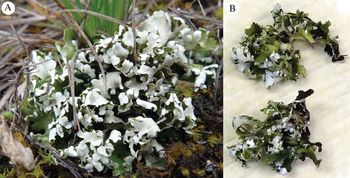
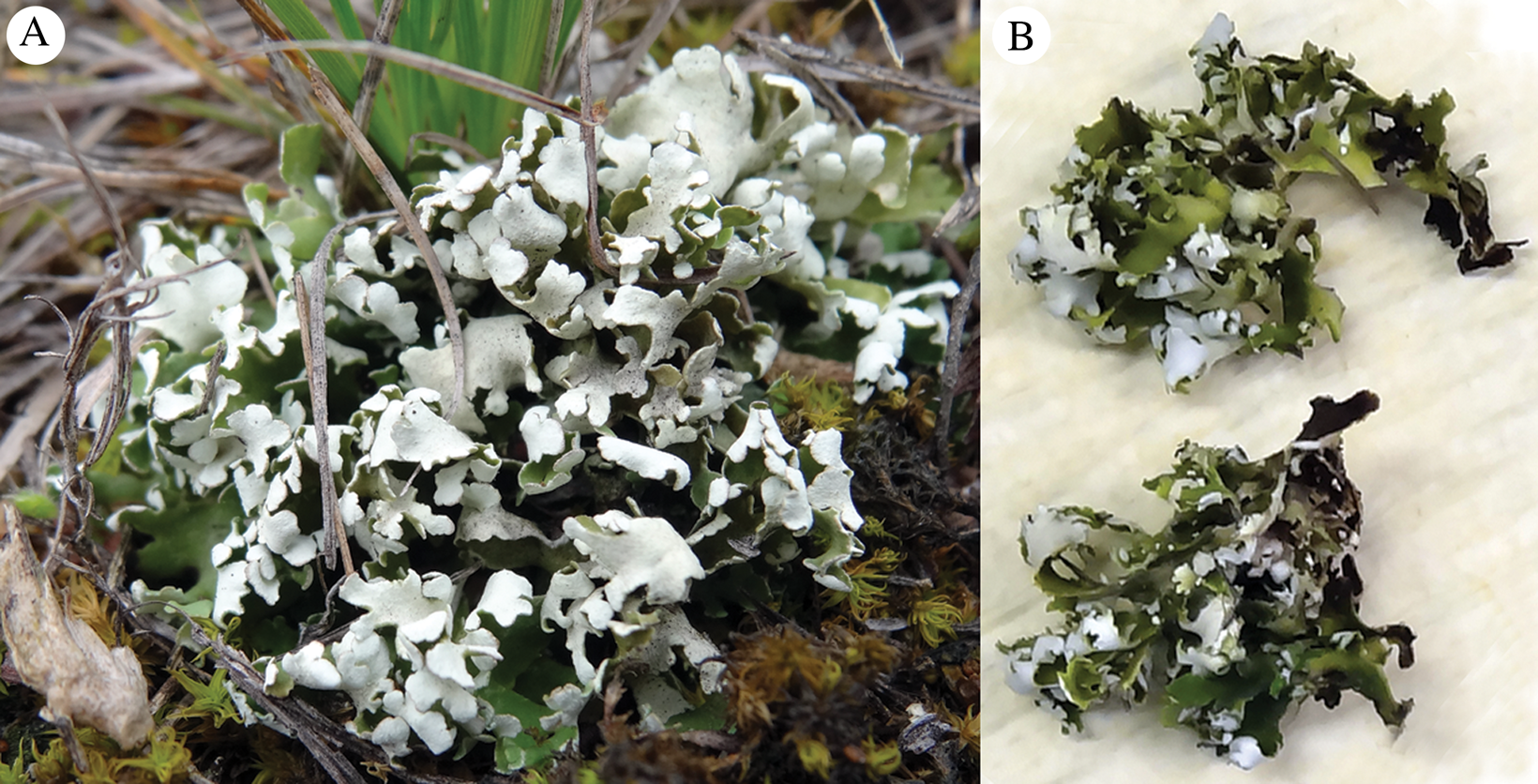
Cladonia foliacea is a relatively frequent, terricolous, squamulose lichen species in Hungary (Fig. 1A), widely distributed across Europe in open, dry and sun-exposed habitats in lowland steppe and mountain grassland communities, and in temperate regions of North America (Smith et al. Reference Smith, Aptroot, Coppins, Fletcher, Gilbert, James and Wolseley2009; Wirth et al. Reference Wirth, Hauck and Schultz2013). The different LSM content of the cortex (usnic acid) and the medulla (fumarprotocetraric acid) has been shown using spot tests (Hillmann & Grummann Reference Hillmann and Grummann1957). The thallus has a thick upper cortex containing usnic acid as a solar radiation protective compound (e.g. Cocchietto et al. Reference Cocchietto, Skert, Nimis and Sava2002; Yilmaz et al. Reference Yilmaz, Turk, Tay and Kıvanc2004). Its photosynthetic layer contains a coccoid green alga photobiont (Asterochloris sp., Trebouxiaceae; cf. Peksa & Škaloud Reference Peksa and Škaloud2008; Škaloud & Peksa Reference Škaloud and Peksa2008; Moya et al. Reference Moya, Škaloud, Chiva, García-Breijo, Reig-Armiñana, Vančurová and Barreno2015). The yellowish white to white lower surface lacking a lower cortex curls when dry, reflecting the strong solar irradiation near the soil surface.
Cladonia foliacea. A, a thallus in its natural habitat before collection. B, thalli immediately after removal from soaking in acetone for 8 h. In colour online.
All chemicals were of analytical or higher grade. HPLC acetone (VWR) was applied to extract LSMs from intact lichen samples and for chromatographic analysis (HPTLC = High Performance Thin-Layer Chromatography, see also below). Toluene (CARLO ERBA), acetic acid (LACH-NER) and sulphuric acid (CARLO ERBA) were obtained from Reanal (Budapest, Hungary) for HPTLC investigations. Reagents for spot reactions are Pd = p-Phenylene-diamine (Sigma Aldrich), K = KOH (Reanal), and C = commercial bleach; for KC reaction, K and C are applied sequentially, K followed immediately after by C (for preparation of reagents and further details on spot tests see Orange et al. (Reference Orange, James and White2010)).
Lichen thalli were collected in the plant association Festucetum vaginatae Rapaics ex Soó 1929 em. Borhidi 1996 (Borhidi et al. Reference Borhidi, Kevey and Lendvai2012) lowland steppe open sandy perennial grassland (Pannonian psammophytic grassland) area Tece of Vácrátót. This area is characterized by a continental climate (mean annual temperature 10.5 °C, mean annual precipitation 552 mm; cf. Borhidi Reference Borhidi1961). Lichen thalli were collected in summer (16 June 2015) and in winter (13 January 2016), and their chemical content was checked by spot tests and HPTLC. Voucher specimens (VBI-L 6104, 6105) are deposited in the VBI Lichen Herbarium (Vácrátót). The thalli were dried, cleaned and randomized at room temperature (24–26 °C). For each treatment (exposure duration), 15 entire thalli or parts of thalli (c. 20–40 mm long × c. 20–25 mm wide × c. 8–12 mm thick) from each of the two seasons were placed in 50 ml Falcon tubes (c. 115 mm long, 28 mm diam.) and acetone was added. Altogether 420 thalli were used (2 (seasons) × 15 (replicates) × 14 (durations including a control)). Lichens were air dried in darkness before acetone rinsing. The relative air humidity of the laboratory was 34% in summer and 32% in winter. The durations of acetone soaking were the same as those applied by Solhaug & Gauslaa (Reference Solhaug and Gauslaa2001): 0.5, 1, 2, 4, 8, 16, 32, 64, 128, 256, 384, 640 and 1024 h. After the thalli were removed from acetone (Fig. 1B), they were left for 12 h for the acetone to evaporate and then hydrated by spraying with distilled water and kept at low light (10 μmol m−2 s−1, 12 h day/12 h night) for 2 days. During this recovery, they were kept at ambient laboratory temperature fully hydrated on wet filter paper in Petri dishes covered by water-sprayed lids of the same size to allow air ventilation and to avoid fast drying. After the 2 day recovery, maximum quantum efficiency of PSII (Fv/Fm) was recorded using a Hansatech FMS2 fluorometer (Hansatech, King's Lynn, UK) after 30 min of dark adaptation.
The first minimum fluorescence yield was ascertained in the dark adapted state (F o) using a weak measuring light for 3 s. The maximum fluorescence yield of the dark-adapted sample (F m) was obtained with a saturation pulse of 7500 μmol m−2 s−1 light intensity for 800 ms. The maximum variable chlorophyll fluorescence yield in the dark-adapted state was calculated as F v = F m–F o. The maximum quantum yield of PSII photochemistry was calculated as F v/F m = (F m–F o)/F m. The size of investigated areas on the thalli was 0.5 cm2. Since the thalli had wavy lobes, relatively flat surfaces (usually one area/thallus) were selected from the treated thalli. The number of replicate areas measured was 15 per treatment.
Collected samples were checked for the presence of usnic acid and fumarprotocetraric acid by HPTLC, according to standard methods for analyzing lichen samples described by Arup et al. (Reference Arup, Ekman, Lindblom and Mattsson1993) and Molnár & Farkas (Reference Molnár and Farkas2011). A 10 × 10 cm CAMAG horizontal chamber, a CAMAG TLC Plate Heater III, and 10 × 10 cm thin-layer chromatographic plates (Merck, Kieselgel 60 F254) were used. Solvent system C (toluene-acetic acid, 20:3) was applied.
For F v/F m values, a two-way ANOVA was used to test for differences between seasons and treatments, followed by Tukey HSD post-hoc tests for comparison of groups (R Core Team 2013).
Viability based on Fv/Fm measurements
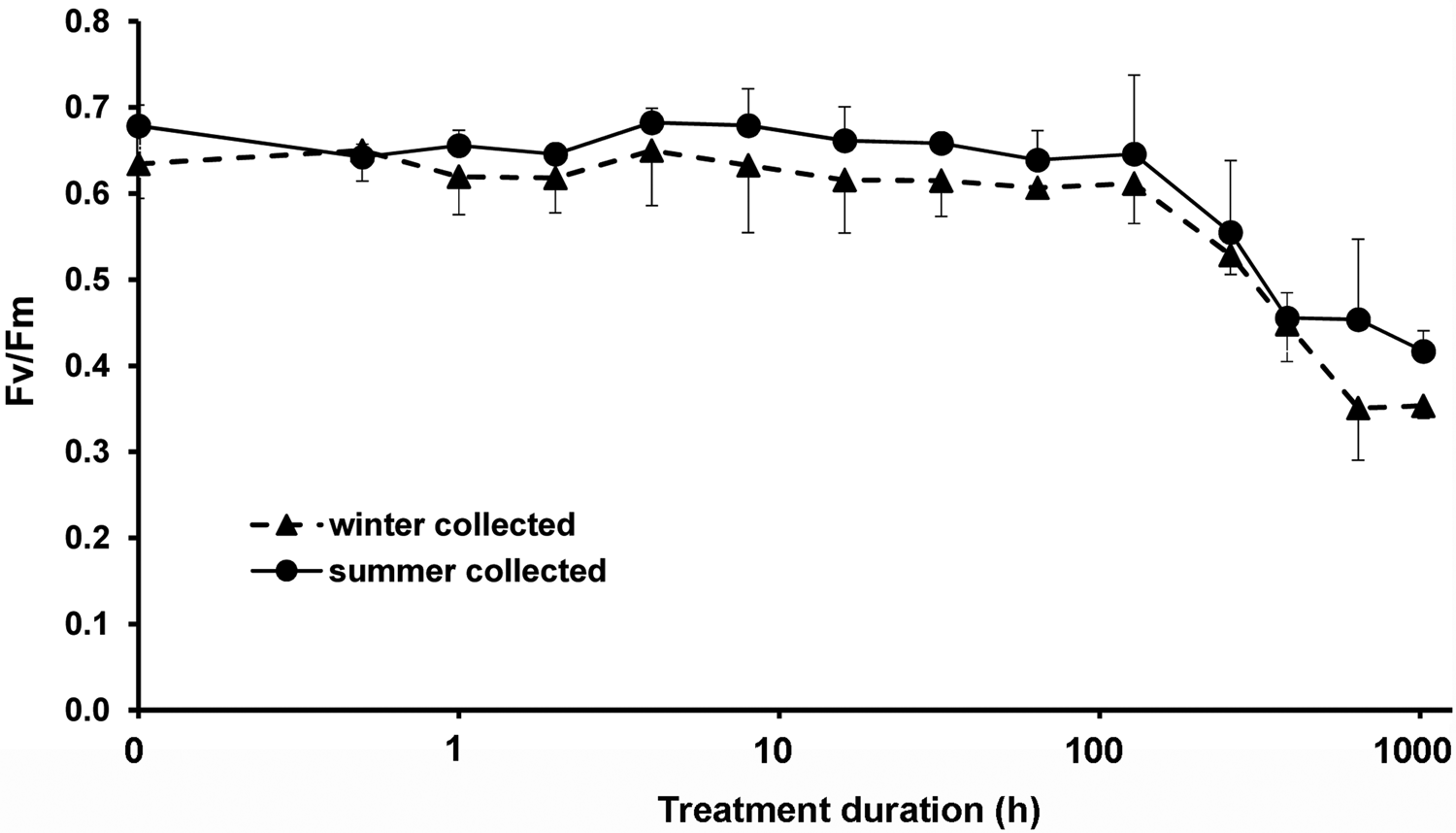
Chlorophyll a fluorescence is often used to estimate various types of damage in lichens (Candotto Carniel et al. Reference Candotto Carniel, Pellegrini, Bove, Crosera, Adami, Nali, Lorenzini and Tretiach2017; Solhaug Reference Solhaug2018); we therefore used F v/F m as a viability measure. The results of measurements from summer and winter collected Cladonia foliacea samples are presented in Fig. 2.
Vitality indicated by PSII efficiency (F v/F m) of acetone-rinsed summer (continuous line–circles, n = 15 replicates per treatment) and winter (dashed line–triangles, n = 15) collected Cladonia foliacea samples over the 14 different treatment durations (including a control) following a 48 h recovery period (error bars = standard deviations).
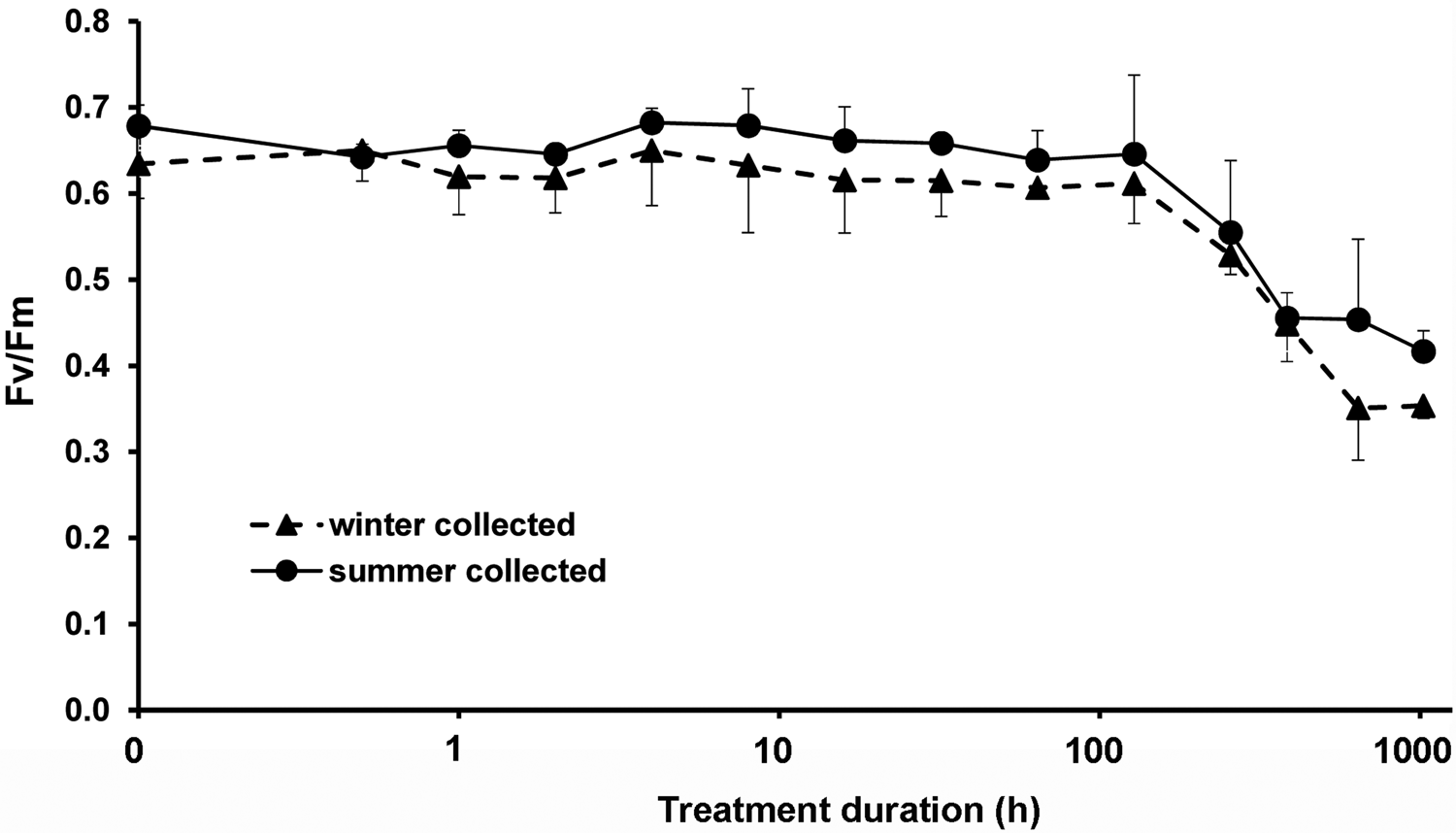
Viability of control thalli of C. foliacea remained rather high (c. 0.66 in summer samples and 0.61–0.62 in winter samples). After the first acetone treatments in the first 1–2 days (until 32–64 h), the F v/F m did not differ from the controls. Then the values declined after 128 h to a level of 0.42 in summer samples and 0.35 in winter samples, even after 1024 h. Values of F v/F m were significantly higher than those of other species studied previously (Solhaug & Gauslaa Reference Solhaug and Gauslaa2001). Severely damaged thalli of C. foliacea were found only after the longest durations (384 to 1024 h) in acetone. Cladonia foliacea had a higher tolerance to acetone rinsing compared to lichens with a Trebouxiaceae photobiont from sun-exposed areas measured by Solhaug & Gauslaa (Reference Solhaug and Gauslaa2001), such as Xanthoparmelia conspersa (Ach.) Hale and Xanthoria parietina (L.) Th. Fr. Although the summer values were above the winter values in each treatment (Fig. 2), the differences between summer and winter values were not significant.
In conclusion, results presented here demonstrate that C. foliacea can be soaked in acetone for 5 days without any harmful effects. Therefore, we can conclude that it is possible to apply C. foliacea as a test lichen for acetone rinsing experiments; however, the extraction efficiency of its lichen compounds needs to be quantified (cf. Farkas et al. Reference Farkas, Biró, Szabó, Veres, Csintalan and Engel2020). Lichen species with coccoid green-algal (Trebouxia sp.) photobionts from sun-exposed habitats have wide ranges of tolerance, as has the investigated species containing a taxonomically related, Asterochloris sp. (Trebouxiaceae) photobiont. Furthermore, it is remarkable that the determined F v/F m values of C. foliacea remained relatively higher, after 1024 h acetone submersion, compared to any of the 12 species studied by Solhaug & Gauslaa (Reference Solhaug and Gauslaa2001).
Acknowledgements
We are grateful to Mrs Sándorné Vadkerti (Vácrátót) for technical help while collecting specimens in the field. Dr Katalin Molnár (Komárom), Mrs Nóra Varga (Vácrátót) and Dr László Lőkös (Budapest) are thanked for reading the manuscript. This work was supported by the Hungarian Scientific Research Fund (OTKA 81232 – PI: EF, 101713 – PI: ZsCs), the Research Centre of Excellence (11476-3/2016/FEKUT for ZsCs and KV) and the project financed by the National Research Development and Innovation Fund (NKFI K 124341 – PI: EF). The travel grant from the British Lichen Society contributed towards a presentation (by EF) of this research during IAL8 2016.
Author ORCIDs
Edit Farkas, 0000-0002-5245-1079.