Introduction
Several randomized controlled trials (RCTs) have indicated the effectiveness of cognitive therapy (CT) in reducing relapse rates and the occurrence of subsyndromal symptoms (Lam et al. Reference Lam, Bright, Jones, Hayward, Schuck, Chisholm and Sham2000, Reference Lam, Watkins, Hayward, Bright, Wright, Kerr, Parr-Davis and Sham2003, Reference Lam, Wright and Sham2005a; Scott et al. Reference Scott, Garland and Moorhead2001; Ball et al. Reference Ball, Mitchell, Corry, Skillecorn and Malhi2006). However, it is evident that not all individuals with bipolar disorder respond to CT. A large RCT did not find any advantageous effect of CT (Scott et al. Reference Scott, Paykel, Morriss, Bentall, Kinderman, Johnson and Abbott2006). The authors commented that their sample had more severe illness in terms of a larger number of previous episodes. Even in Lam et al.'s (Reference Lam, Watkins, Hayward, Bright, Wright, Kerr, Parr-Davis and Sham2003) study, 44% of the CBT group relapsed, compared to 75% in the control condition. It is therefore important to increase our understanding of the group of bipolar individuals who do not respond to CT.
Mansell et al. (Reference Mansell, Morrison, Reid, Lowens and Tai2007) proposed that extreme positive beliefs about the value of the highly activated internal states associated with mania and hypomania form one cluster out of a range of several categories of extreme, personalized beliefs about internal states that maintain bipolar symptoms. Lam et al. (Reference Lam, Wright and Sham2005b) described a proportion of bipolar patients who enjoy being in a state of ‘mild hypomania’, associated with constant high arousal, positive mood and high levels of behavioural activity. These individuals seem to value some of the attributes and characteristics associated with this state, such as being particularly creative, dynamic, entertaining and outgoing. Lam et al. (Reference Lam, Wright and Sham2005b) described these individuals as having a strong ‘sense of hyper-positive self’ (SHPS). Although this state of ‘mild hypomania’ is not severe enough to fulfil criteria for clinical hypomania, it frequently leads to goal-driven behaviour and a lack of routine (Lam et al. Reference Lam, Jones, Hayward and Bright1999). Changes in social routines can elicit an affective episode through disruption of circadian rhythms (Aschoff, Reference Aschoff and Aschoff1981; Ehlers et al. Reference Ehlers, Frank and Kupfer1988; Shen et al. Reference Shen, Alloy, Abramson and Sylvia2008).
The attributes and characteristics of individuals with a strong SHPS value are clearly at odds with relapse prevention goals. Lam et al. (Reference Lam, Jones, Hayward and Bright1999) proposed that individuals with a strong SHPS, who value the attributes associated with being in a state of ‘mild hypomania’, are likely to engage in goal-driven behaviour. There is growing evidence of a link between achievement-striving or goal-attainment beliefs and vulnerability to manic episodes in bipolar I disorder (Rosenfarb et al. Reference Rosenfarb, Becker, Khan and Mintz1998; Lozano & Johnson, Reference Lozano and Johnson2001; Lam et al. Reference Lam, Wright and Smith2004). These studies are consistent with Lozano & Johnson's (Reference Lozano and Johnson2001) finding that scores on the Achievement Striving facet of the NEO Five-Factor Inventory (Costa & McCrae, Reference Costa and McCrae1992) were predictive of increases in manic symptoms in bipolar I disorder over a 6-month period and that bipolar patients exhibited an increase in manic symptoms after life events involving goal attainment (Johnson et al. Reference Johnson, Sandrow, Meyer, Winters, Miller, Solomon and Keitner1999).
Furthermore, Lam et al. (Reference Lam, Wright and Smith2004) reported that the bipolar sample had significantly higher scores on the Goal-attainment subscale than euthymic unipolar individuals. The Goal-attainment subscale reflected beliefs that value the ability to excel at anything if one tries hard enough, solve problems quickly without high levels of effort, have positive emotions all the time and also have total control over one's feelings. Their scores on this subscale correlated with the number of bipolar episodes and past number of hospitalizations due to manic episodes, suggesting that bipolar patients with beliefs captured by the Goal-attainment subscale may be predisposed to a more severe course of illness. In their later study Lam et al. (Reference Lam, Wright and Sham2005b) investigated the relationship between Dysfunctional Attitude Scale (DAS) goal-attainment beliefs and SHPS. They proposed that individuals who believe that they have an ability to excel at anything they attempt, or solve problems quickly and effortlessly, would be likely to value being creative, optimistic, productive and dynamic. Similarly, they suggested that individuals who believe that they should be happy all the time would value the personal attributes of being outgoing and entertaining. As hypothesized, Lam et al. (Reference Lam, Wright and Sham2005b) found that high levels of goal-attainment beliefs predicted high SHPS scores, after controlling for current mood.
Bipolar patients who have high goal-attainment beliefs may be more inclined to see certain prodromal symptoms, such as racing thoughts and being more talkative, as a desirable state of being dynamic and sociable. They may identify with these self-descriptive traits and be less inclined to see them as early warning signs of a manic relapse. Bipolar patients who identified with early warning prodromes as desirable self-descriptive traits would be more inclined to increase or engage in activities that may cause further stimulation, resulting in an ascent into a manic state. Hence, the patient's coping with prodromal symptoms would be predicted by the individual rating of how much they identify themselves with these symptoms as self-descriptive traits.
This study sought to increase our understanding of bipolar patients who were vulnerable to a more severe illness, and had two main aims. The first aim was to investigate the relationship between SHPS and preferred internal state, or mood. It was hypothesized that individuals with a high SHPS would show a preference for a ‘high’ internal state, similar to mild hypomania. The second aim was to address this gap in the literature by examining whether dysfunctional attitudes are predictive of participants' responses to hypothetical scenarios associated with mania prodromes. It was hypothesized that individuals with high levels of dysfunctional beliefs would be more likely to increase their mania-escalating behaviour in the specified scenarios in the Scenarios Ratings Task (Mansell, Reference Mansell2003).
Method
Participants
The study was approved by the Institute of Psychiatry and South London and Maudsley National Health Service (NHS) Trust Ethical Committee. All participants provided written informed consent upon recruitment into the study. Participants consisted of 54 individuals aged between 18 and 70 years who met the DSM-IV (APA, 1994) criteria for bipolar I disorder, did not meet DSM-IV criteria for a current major depressive or manic episode, and scored <30 (severe depression range) on the Beck Depression Inventory (BDI; Beck et al. Reference Beck, Ward, Mendelson, Mock and Erbaugh1961) and <9 on the Bech–Rafaelsen Mania Rating Scale (BRMRS; Bech et al. Reference Bech, Rafaelsen, Kramp and Bolwig1978). A BRMRS score of ⩾9 indicates a probable manic state. Both the BDI and the BRMRS were further measures used to exclude patients who were in an acute state. Individuals who met DSM-IV criteria for current substance abuse were excluded from the study. All DSM-IV diagnoses were made using the Structured Clinical Interview for DSM-IV (SCID; First et al. Reference First, Gibbon, Spitzer and Williams1996).
Recruitment
Participants were recruited from a variety of sources. Sixty-one per cent (33/54) of participants were recruited through the Manic Depression Fellowship newsletter or a newspaper advertisement. Thirty per cent (16/54) of participants were recruited from a pool of volunteers who had expressed an interest in future research at the Institute of Psychiatry. Nine per cent (5/54) of participants were referred by clinical psychologists at the Affective Disorders Unit at the Maudsley Hospital.
Procedure
An initial brief screening was completed by telephone to ensure that volunteers for the study had a diagnosis of bipolar disorder. Information sheets and consent forms were posted to participants and they were asked to complete the consent form prior to the interview appointment. Participants were contacted by telephone a few days before their appointment to determine whether they were euthymic; this was done using the relevant sections of the SCID (current Major Depressive Episode and current Manic Episode). During the on-site appointment, participants completed the SCID and several self-report questionnaires.
Measures
Participants completed a standardized clinical interview and several self-report questionnaires, as follows.
Diagnostic measures
The SCID (First et al. Reference First, Gibbon, Spitzer and Williams1996) is a well-established semi-structured clinical interview that was developed to diagnose a variety of psychological disorders based on DSM-IV-TR criteria. This interview, administered by two final-year doctoral students in clinical psychology, was used to confirm that participants had a diagnosis of bipolar 1 disorder and were not currently experiencing a major depressive or manic episode. The complete SCID for Axis I disorders was administered, to provide information on co-morbidity.
The first 10 SCID interviews were audiotaped. These interviews were then rated independently by two raters. The agreement between raters was found to be 100% for diagnosis of bipolar I disorder. The unweighted κ statistic for the number of symptoms of depression and mania was 0.71 [standard error (s.e.)=0.18, 95% confidence interval (CI) 0.36–1.06] and 0.63 (s.e.=0.21, 95% CI 0.22–1.03) respectively, a ‘fair to good agreement beyond chance’ according to Capozzoli et al. (Reference Capozzoli, McSweeney and Sinha1999).
Mood measures
The BDI (Beck et al. Reference Beck, Ward, Mendelson, Mock and Erbaugh1961) was used to assess current depressive symptomatology. The BDI is a widely used 21-item self-report measure of severity of depression symptoms and has well-established psychometric properties (for a review, see Beck et al. Reference Beck, Steer and Garbin1988). Items are scored on a four-point scale and assess the cognitive, somatic and behavioural symptoms of depression during the past week. The BDI total score ranges from zero to 63. Scores of <10 indicate ‘minimum or no depression’, 10–18 ‘mild to moderate depression’, 19–29 ‘moderate to severe depression’ and scores >29 represent ‘extremely severe depression’.
The BRMRS (Bech et al. Reference Bech, Rafaelsen, Kramp and Bolwig1978) is an assessor-rated measure with 11 domains: motor activity, verbal activity, flight of thoughts, voice or noise level, hostility or destructiveness, mood, self-esteem, contact (intrusiveness), sleep (average of the past 3 nights), sexual interest and work. A rating is made for each domain using a five-point scale, where 0=not present, 1=mild, 2=moderate, 3=marked and 4=severe or extreme. Scores between 0 and 5 represent no mania, 6–9 mild hypomania, 10–14 probable mania and scores >14 indicate definite mania. A review by Bech (Reference Bech2002) found the BRMRS to have good internal validity, high inter-observer reliability and acceptable external validity, in terms of both responsiveness and sensitivity.
Measurement of preferred internal state
The Altman Self-Rating Mania Scale (ASRM; Altman et al. Reference Altman, Hedeker, Janicak, Peterson and Davis1997; Appendix B), a five-item self-report instrument that was used to measure manic symptoms during the past week, was modified to measure the participant's preferred internal state. The ASRM has been demonstrated to have good test–retest reliability, concurrent validity, sensitivity and specificity (Altman et al. Reference Altman, Hedeker, Janicak, Peterson and Davis1997). In the original scale, items consist of five statements, scored from 0 to 4, and respondents are instructed to choose the most appropriate statement. For example, the statements for the first item range from ‘I do not feel happier or more cheerful than usual’ (0) to ‘I feel happier or more cheerful than usual all the time’ (4). In the modified version of the ASRM (M-ASRM), responses were modified such that they started with ‘Ideally, I would like to … ’. For example, the first response for item 1 was modified from ‘I do not feel happier or more cheerful than usual’ to ‘Ideally, I would not like to feel happier or more cheerful than usual’. The M-ASRM was scored in the same way as the ASRM. A total score was computed from the sum of the five items and a high score indicates a strong preference for an elated mood.
Measurement of SHPS
The Sense of Hyper-positive Self Scale (SHPSS; Lam et al. Reference Lam, Wright and Sham2005b) consists of seven adjectives that bipolar patients use to describe the positive attributes they possess when they are in a mildly ‘high’ state. These are: confident, dynamic, adorable, entertaining, outgoing, optimistic and creative. Patients were asked to rate each attribute twice: ‘how well these words describe you most of the time’ and ‘ideally how you would like yourself to be’. Each adjective was rated on a seven-point scale from 1 (not at all) to 7 (extremely). The scale correlated with previous number of bipolar episodes and predicted response in cognitive therapy.
Measurement of dysfunctional attitudes
The Short Version of the Dysfunctional Attitude Scale for Bipolar Disorder (DAS:BD; Lam et al. Reference Lam, Wright and Smith2004) was used to assess dysfunctional attitudes. The DAS:BD is a 24-item self-report questionnaire that was derived from a principal component analysis of data from 143 people with bipolar disorder who completed the original 24-item DAS (Power et al. Reference Power, Katz, McGuffin, Duggan, Lam and Beck1994). Each item is rated on a seven-point scale from ‘totally agree’ to ‘totally disagree’. The DAS:BD has four subscales: Goal-attainment, Dependency, Achievement, and Anti-dependency. Goal-attainment was found to correlate with past hospitalizations for manic episodes and significantly higher scores on this subscale were observed in euthymic bipolar patients than in remitted unipolar patients.
Measurement of coping with hypothetical scenarios
The Scenarios Ratings Task (Mansell, Reference Mansell2003) was used to determine how participants were likely to feel in, and respond to, a series of scenarios suggestive of the early stages of ‘mild hypomania’. This is a self-report instrument in which eight different scenarios are described. The scenarios were designed to describe situations that provide the opportunity for goal attainment (e.g. multiple challenges at work), combined with some information about potential negative consequences of maintaining goal attainment (e.g. loss of sleep). The respondent is asked to read the description of the scenario and imagine that the scenario is actually happening to them. The respondent is then required to rate the extent to which they would identify with a specified descriptive trait (e.g. ‘How dynamic would you feel in this situation?’) from 1 to 7, where 1=‘Not at all’ and 7=‘Extremely’. These ratings (Descriptives rating) are summed for the eight scenarios. In addition, the respondent is asked to indicate the extent to which they would increase a specified behaviour in response to the given scenario (e.g. ‘How much would you decrease or increase the amount of work you would you do in this situation?’) from 1=‘Greatly decrease’, through 4=‘Stay the same’ to 7=‘Greatly increase’. Any indicated increases in activity are deemed to be prone to escalating the patient's mood into mania (mania escalating activity). An overall activity rating is calculated by summing the ratings of activities across the eight scenarios. For example, in the third scenario, the respondent is asked to imagine that they have recently been involved in lots of different activities and have been starting to do many new things. While this has been enjoyable, it has been difficult to keep everything going. Today they notice that their mind is buzzing with new ideas. The respondent is asked to rate both how creative they would feel in this situation from 1 to 7, which gives a ‘Descriptive rating’, and the extent to which they would increase or decrease the number of activities they were involved in, again from 1 to 7, which provides an ‘Activity rating’.
The original study by Mansell (Reference Mansell2003) used participants from three groups (remitted bipolar I disorder, remitted unipolar depression, and non-clinical controls) and indicated an acceptable internal consistency for self-descriptor ratings (α=0.60) and activity ratings (α=0.63) across the eight scenarios.
Statistical analyses
A hierarchical linear multiple regression forced entry procedure was used to test the main hypotheses of the study. When exploratory multiple regressions were performed, the stepwise method was used to enter the block containing the variables being explored. Multi-colinearity between predictor variables was investigated and was taken to be evident if the variance inflation factor (VIF) was ⩾10 (Myers, Reference Myers1990) and if the tolerance statistic, which is the reciprocal of VIF (1/VIF) was <0.2 (Menard, Reference Menard1995). Spearman correlations were used for variables that did not fulfil normal distribution criteria. Because of the multiple testing, a statistical significance level of p<0.01 was used. All tests of hypothesized differences used one-tailed p values. Otherwise, all p values were two-tailed.
Results
Characteristics of the sample
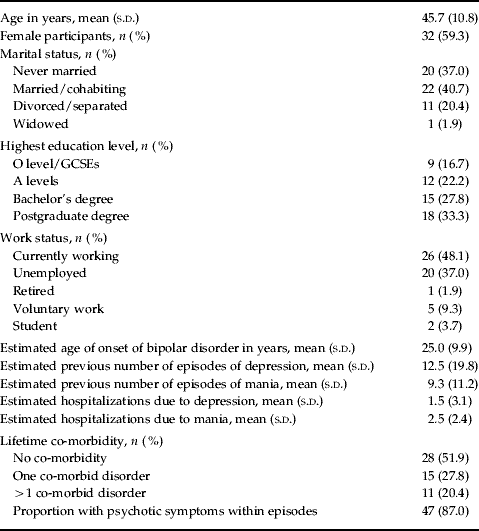
The demographics and clinical details of the sample are specified in Table 1. The participants were predominately well-educated white British subjects with a mean age of 45 years [standard deviation (s.d.)=10.8]. Only 48% (26/54) were in paid work at the time of participation. The sample also had a relatively early onset (mean age of onset 25.0 years, s.d.=9.9) and a severe course of illness. Forty-eight per cent (26/54) of the participants reported at least one lifetime co-morbid disorder, typically an anxiety disorder or past substance abuse or dependency. The majority of participants (87%; 47/54) were taking psychiatric medications. For those taking medication, polypharmacotherapy was the norm.
Demographic and clinical characteristics of the sample (n=54)

s.d., Standard deviation.
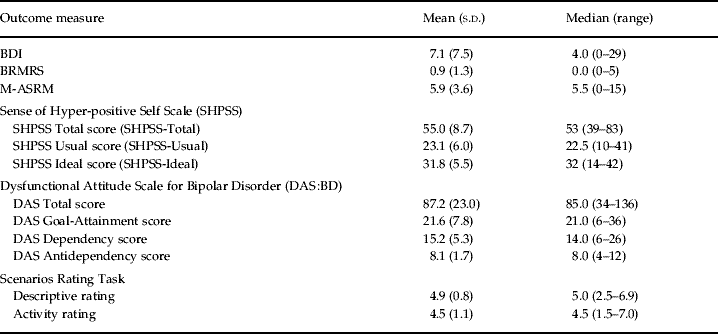
Table 2 summarizes the means and standard deviations of the standardized measures. As expected, there was significant amount of residual depression symptoms in the sample according to the BDI. By contrast, there were hardly any manic symptoms according to the BRMRS.
Mean scores and standard deviations of the standardized measures

BDI, Beck Depression Inventory; BRMRS, Bech–Rafaelsen Mania Rating Scale; M-ASRM, Modified version of the Altman Self-Rating Mania Scale; s.d., standard deviation.
Relationships between the main variables
With the exception of the BDI and the BRMRS, all variables were normally distributed. SHPSS-Total was found to correlate significantly with SHPSS-Usual (0.732; p<0.01, two-tailed) and SHPSS-Ideal (r=0.738; p<0.01, two-tailed). However, SHPSS-Ideal and SHPSS-Usual did not correlate significantly with each other. BDI scores also correlated significantly with SHPSS-Usual in the negative direction (r=−0.154, p<0.01). The correlation between BDI and SHPSS-Ideal was not significant (r=0.13). There were significant correlations between SHPSS-Ideal and the DAS total score (r=0.344, p<0.01, two-tailed) and the Goal-attainment (r=0.373, p<0.01, two-tailed) subscale. The BDI total score was significantly correlated with the DAS total score (r=0.504, p<0.01, two-tailed).
SHPS and preferred internal state (M-ASRM)
SHPSS-Usual was found to be correlated significantly with the M-ASRM (r=−0.363, p<0.01, one-tailed); the correlation coefficient was negative, indicating that a lower perceived ‘usual’ SHPS was associated with a higher preferred mania mood. SHPSS-Ideal was also significantly correlated with M-ASRM (r=0.291, p<0.05, one-tailed) and a higher SHPSS-Ideal was associated with a higher preferred mania mood.
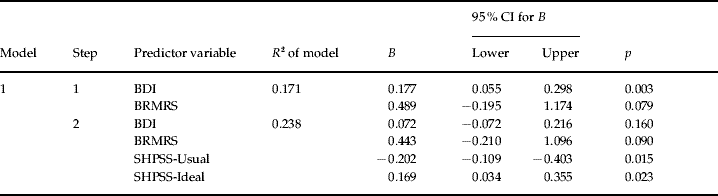
A hierarchical multiple linear regression analysis was performed to examine the relationship between preferred M-ASRM and SHPSS-Usual and SHPSS-Ideal. BDI and BRMRS scores were entered into the first block to control for current mood. SHPSS-Usual and SHPSS-Ideal were entered into the second block. SHPSS-Total score was not included in the regression as it consisted of the sum of SHPSS-Usual and SHPSS-Ideal. The final model was significant with R 2=0.108. SHPSS-Usual [β=−0.202, 95% CI −0.109 to −0.403, p=0.015, one-tailed] and SHPSS-Ideal [β=0.169, 95% CI 0.034–0.355, p=0.023, one-tailed] were found to be significant predictors of M-ASRM.
In this model SHPSS-Usual was found to explain 20.2% of the variance of M-ASRM and SHPSS-Ideal explained a further 16.9%. A unit increase in SHPSS-Ideal produced an increase of 0.169 units in M-ASRM; by contrast, a unit increase in SHPSS-Usual produced a decrease of 0.202 units in M-ASRM. Table 3 summarizes the final model in the multiple regression.
Regression analyses of the relationship between M-ASRM and the SHPSS scores

M-ASRM, Modified version of the Altman Self-Rating Mania Scale; SHPSS, Sense of Hyper-Positive Self Scale; BDI, Beck Depression Inventory; BRMRS, Bech–Rafaelsen Mania Rating Scale; CI, confidence interval.
Multiple linear regression, forced entry for steps 1 and 2. The reported p value is one-tailed.
SHPSS and DAS Goal-attainment scores
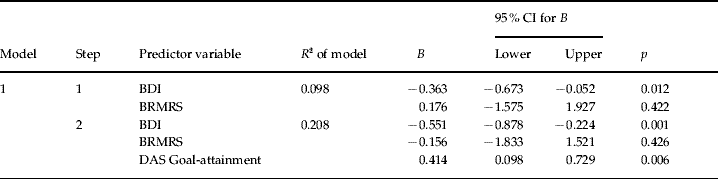
A multiple linear regression was performed to investigate whether SHPSS-Total is predicted by scores on the DAS Goal-attainment subscale, after controlling for current mood. The BDI and BRMRS scores were entered into block 1 and the DAS Goal-attainment subscale score was entered into block 2. The final model was significant, with R 2=0.208. After controlling for scores on the BDI and BRMRS, DAS Goal-attainment contributed significantly to the final model [β=0.414, 95% CI 0.098–0.729, p=0.006, one-tailed]. Table 4 summarizes the final model in the multiple regression.
Regression analyses of the relationship between SHPSS-Total and DAS Goal-attainment

SHPSS, Sense of Hyper-Positive Self Scale; DAS, Dysfunctional Attitude Scale; BDI, Beck Depression Inventory; BRMRS, Bech–Rafaelsen Mania Rating Scale; CI, confidence interval.
Multiple linear regression, forced entry for steps 1 and 2. The reported p value is one-tailed.
Coping with scenarios and dysfunctional assumptions
The mean rating of activity (Activity rating), which captured the way in which participants predicted that they would cope with hypothetical scenarios described in the Scenarios Ratings Task, was significantly correlated with DAS total score (r=0.380, p<0.005, one-tailed). It also correlated significantly with the mean rating of the descriptive traits specified in the scenarios (Descriptives rating), which provided a measure of the extent to which participants identified with the descriptive traits specified in the hypothetical scenarios (r=0.271, p<0.05, one-tailed). There was also a significant correlation between Activity rating and DAS Goal-attainment (r=0.484, p<0.001, one-tailed).
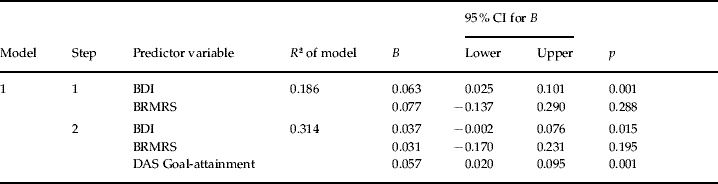
An exploratory, multiple linear regression was performed to determine whether any of the DAS subscales would significantly predict coping, after controlling for current mood (Table 5). As before, BDI and BRMRS scores were entered into the first block. The DAS subscales were then entered into the second block. Goal-attainment was the only DAS subscale that significantly predicted the Activity ratings after controlling for mood [β=0.057, 95% CI 0.020–0.095, p=0.002, two-tailed]: the other DAS subscales were excluded from the model. Goal-attainment was found to explain a further 12.8% of the variance in activity ratings than the mood measures (BDI and BRMRS). Table 5 summarizes the final model in the multiple regressions.
Linear regressions investigating predictors of coping with scenarios

BDI, Beck Depression Inventory; BRMRS, Bech–Rafaelsen Mania Rating Scale; DAS, Dysfunctional Attitude Scale; CI, confidence interval.
Multiple linear regression, forced entry for step 1 and stepwise entry for step 2. The following predictor variables entered in step 2 were excluded: DAS Dependency, DAS Achievement, DAS Antidependency. The reported p value is two-tailed.
Discussion
Patients with a high SHPS tend to desire high mood states. We also found that goal-attainment attitudes were predictive of the ratings for coping with the hypothetical scenarios specified in the Scenarios Ratings Task. Goal-attainment attitudes, characterized by a desire to strive for success and be admired, were predictive of the extent to which individuals indicated that they would increase their activity (e.g. work harder, make more contributions to a project and be more sociable) in these specified vulnerable situations. However, clinical experience would suggest that an increase in these activities in the scenario would stimulate the patient further, possibly resulting in an assent to a manic episode. This finding is consistent with the earlier report that life events involving reward and success would lead to an increase of manic symptoms in bipolar patients (Johnson et al. Reference Johnson, Cueller, Ruggero, Winett-Perlman, Goodnic, White and Miller2008).
These results suggest that excessive goal-attainment beliefs should be tackled in therapy. They seem to be linked to an increase in stimulating behaviour in scenarios akin to a prodromal state, which would be contrary to the relapse prevention goals of stabilizing mood and behaviour. Clinicians could implement cognitive techniques to modify these beliefs and find alternatives that are more consistent with relapse prevention goals. This could involve careful exploration to determine the meaning of the beliefs and examining the evidence for and against these beliefs. Alternative beliefs that are more consistent with relapse prevention goals can be generated. In addition, behavioural change could be encouraged to test the new, alternative beliefs and to gain experiential learning. The finding that high ideal SHPS was related to high preferred mood suggests that, when delivering CT to individuals with a high SHPS, some additional work may be required to address this desire for a higher internal state. It may be beneficial to discuss with clients their desired outcomes in relation to holding these SHPS qualities and find alternative ways to help them to achieve these goals without jeopardizing their health. For example, therapists could explore the meaning of being ‘creative’ most of the time. If the appeal of being ‘creative’ most of the time was found to be due to a desire for enhanced productivity, then alternative ways of increasing productivity could be explored; for example, working more consistently from week to week and enhancing time management. These suggestions are not based on direct clinical evidence but could be tested out in treatment studies.
It was hypothesized that participants with a high SHPS would show a preference for a high ideal mood state. The results here are mixed. Both the SHPS-Usual and SHPS-Ideal predicted the desire for a high mood state. However, the relationship between SHPS-Usual and the desire for a high ideal mood state was negative, suggesting that patients who do not usually see themselves to be, for example, creative and outgoing are not content with their current mood state. We also reported a negative and significant correlation between SHPS-Usual and the BDI scores. This suggests that patients who had more depressed symptoms tended to want higher ideal self-attributes (e.g. outgoing, productive, dynamic, etc.) as depicted in the SHPS. They also preferred to have a higher manic-like state.
The mean rating of the descriptive traits specified in the scenarios (Descriptive rating) correlated significantly with the coping activity (Scenario Activity rating) in the coping with hypothetical scenarios. Some of the adjectives in the Descriptive rating are the same as in the SHPS (e.g. dynamic, entertaining), but some are different (e.g. intelligent, productive, adventurous, superior). These results imply that the more a person identified with the descriptor presented, the more they expected that they would increase the specified mania escalating activity, in relation to the scenarios. This relationship is in the direction expected. For example, if someone feels productive, then they are likely to work more; if someone feels entertaining, then they are more likely to be motivated to meet new people, and so on. Such a finding provides support for the validity of the Scenarios Ratings Task.
The current study had some limitations. The Scenarios Rating Task is a relatively crude measure of how an individual would respond to hypothetical situations. Participants can guess the socially desirable answers. However, the hypothesis relating to the Goal-attainment subscale and the Scenarios Rating Tasks was not so obvious. Hence, the results found between Activity ratings and the Scenarios Ratings Task and the Goal-attainment subscale of the DAS may not be affected by the response bias. Furthermore, although the hypothetical scenarios are deliberately designed to reflect the kinds of real life events experienced by patients, a future study could check through a life events analysis that elevated rates of these events in the bipolar group do not account for the effect we have found. Another limitation is that the SHPS is a recently developed measure based on clinical experience. Although there are preliminary data that the SHPS has adequate psychometric properties (Lam et al. Reference Lam, Wright and Sham2005b), no normative data are available.
Acknowledgements
We thank all the individuals who gave up their time to take part in this study. We also thank the Manic Depression Fellowship and S. Keating for their help with recruitment.
Declaration of Interest
None.