Introduction
In many fields of linguistic research, assumptions are made about the ‘common sense’ stances that nonlinguists take towards language, and about how those stances differ from those of academic linguists. Proponents of critical discourse analysis suggest that language is, for most people, actually constitutive of common sense, and that forms of academic linguistic analysis are required to mount a challenge to this influence (e.g. van Dijk Reference van Dijk1993a, Reference van Dijk2008; Fowler Reference Fowler, Caldas-Coulthard and Coulthard1996; Wodak & Meyer Reference Wodak, Meyer, Wodak and Meyer2009; Fairclough Reference Fairclough2013, Reference Fairclough2015). Opponents of such approaches argue that a critical orientation towards linguistic experience is a fact of everyday life, and there is no need for any specifically academic-linguistic input into this (e.g. Widdowson Reference Widdowson1995; Jones Reference Jones2007). For many other linguists, language users’ commonsensical metalinguistic activity is assumed to focus largely on the preservation of accent and dialect standards and is characterised as ‘prescriptivism’ (e.g. Pinker Reference Pinker1994; Burridge Reference Burridge2010).
Unfortunately, where one stands on the criticality of everyday stances on language has tended to be treated as a matter of faith. There is a lack of research that asks whether, to what extent, or in what ways ordinary people's views on language are critical, or to what extent they do conform to the prescriptivism that is often ascribed to them. Critical researchers have done little to show that their claims make a necessary challenge to common sense, and their opponents have done little to show that they do not. Descriptive linguists have certainly identified prescriptive comments about language in lay commentary (e.g. Niedzielski & Preston Reference Niedzielski and Preston2003), but it is less clear that criticisms of accent and dialect standards do actually dominate ordinary people's thinking about their linguistic experience. Indeed, if the opponents of critical approaches are right, and ordinary people are already engaged in politically nuanced critique of language use, then this would suggest a very different picture of folk stances on language than that embodied in the image of the conservative prescriptivist. So, a series of questions arise, worthy of investigation: Do ordinary people already critique language or not? If they do, what bits of it? What kinds of political significance, if any, do they see in language? How do their metalinguistic stances relate to those of researchers in critical linguistics, and to the image of the conservative prescriptivist?
This article addresses these questions with reference to a particular period and place: Britain in the late 1980s. This was a metalinguistically interesting time in the UK. On the one hand, it was a crucial time in the development of politically progressive ‘critical language awareness’ in university departments of English and linguistics. On the other, it was a period of intensified linguistic conservatism, especially in government and the media (Cameron Reference Cameron1995:ch. 3). Crucially for this article, it is a period about which the Mass Observation Project (MOP), a social research project run by the University of Sussex, is able to provide useful documentation of at least some ordinary British people's attitudes towards language. This data consists of written correspondence from a panel of over 400 people on the subject of ‘rules of conduct’.Footnote 1
I show here that there is a great deal of metalinguistic commentary in MOP correspondence on rules of conduct. In relation to some key phenomena at least, the metalinguistic evaluations of MOP correspondents are extraordinarily close to the concerns of critical linguists writing around the same time. These concerns have to do with the informalisation of English, and specifically to do with ‘synthetic personalisation’ (Fairclough Reference Fairclough1989). MOP correspondents make metalinguistic comments such as the following.
(1) Use of first names bugs me. It is part of trendy pseudo egalaterianism. (R470, male, 55)Footnote 2
Such comments are focused on terms of address in particular, and on the socially deictic properties of those terms of address, that is, their capacity to index relative social position (Foley Reference Foley1997). Correspondents are highly evaluative of changes in terms of address, and they are evaluative in ways that, on occasion, explicitly seek to link these changes to wider sociopolitical changes. In other words, many correspondents are critical, and, in the MOP correspondence at least, they seem to care more about such critical concerns than they do about the standards of accent and dialect supposedly cherished by lay prescriptivists.
The article is structured as follows. First, I introduce a concept that captures the ways in which socially oriented linguistic frameworks have distinguished between ‘lay’ and ‘expert’ metalanguage. I call this the division of metalinguistic labour. I then outline the nature of the Mass Observation data, and my methods. The investigation of this data answers, in turn, the questions posed in this introduction: What bits of language do correspondents evaluate, what kinds of political significance do they see in those phenomena, and how do their evaluations relate to those of critical researchers, and to the image of the conservative prescriptivist? I finish by discussing the implications of my findings for critical researchers, and for socially oriented linguists more generally. I make use of Raymond Williams’ (Reference Williams1977) cultural theory to reconceptualise the relationship between ‘lay’ and ‘expert’ critique in terms of ‘structures of feeling’. And I suggest that the naturalistic methods of metalinguistic investigation adopted in this research, and in much linguistic anthropology (Woolard & Schieffelin Reference Woolard and Schieffelin1994; Heller Reference Heller2003; Gal Reference Gal2005; Hill Reference Hill2009), provide crucial insights into the nature of everyday linguistic experience, demonstrating the complexity of everyday ideas about language.
Divisions of metalinguistic labour
A division of metalinguistic labour is a set of claims that a theory makes about the differences between how linguists and nonlinguists evaluate (or should evaluate) language. Different theories of language work with different divisions of metalinguistic labour, and they may be more or less explicit about how they see that division as working. To give a very prominent example, classical descriptivism says that while ordinary people are often evaluative of language—or ‘prescriptive’—the job of the linguistic researcher is to be neutrally ‘descriptive’. These ordinary evaluations are often also assumed to be conservative, oriented towards maintenance of forms associated with the past and, in most cases, towards the maintenance of ‘standard’ varieties (Pinker Reference Pinker1994; Labov Reference Labov2001; Burridge Reference Burridge2010; Bloomfield Reference Bloomfield1935/2014). From this perspective, while linguists should not be evaluative of language use itself, they can freely make evaluative judgements of lay metalanguage, which is generally dismissed for both its confusion of linguistic and political argument and its supposed cultural illiberalism, a dual criticism well-exemplified by Aitchison's comment on the ‘quaint confusion of morals and speech’ apparently exhibited by lay commentary on language (Aitchison Reference Aitchison1997:9).Footnote 3 So descriptivism has something to say about how we should act towards language as researchers, and it presents a picture of how ordinary, nonlinguist people act towards language.
Probably the defining feature of critical research, in relation to other academic approaches to language, is its alternative stance on the division of metalinguistic labour. It says that it is, and should be, the job of the academic researcher to evaluate language use. It is often noted that much sociolinguistic and discourse analytic research is broadly evaluative in this way (e.g. by Blommaert & Bulcaen Reference Blommaert and Bulcaen2000; Johnstone Reference Johnstone2017), but it is in the field of critical discourse analysis that the question of what it means to be ‘critical’ is most explicitly discussed. Van Dijk tells us that ‘critical discourse analysts (should) take an explicit sociopolitical stance… their work is admittedly and ultimately political’ (Reference van Dijk1993a:252; see also e.g. Billig Reference Billig, Weiss and Wodak2003; Wodak & Meyer Reference Wodak, Meyer, Wodak and Meyer2009). This is critical discourse analysis's central objective, and it is also its most controversial feature. Unsurprisingly, criticisms of critical work on the grounds that it is biased, subjective, and insufficiently neutral are very well-established (e.g. Widdowson Reference Widdowson1995; Hammersley Reference Hammersley1997; Stubbs Reference Stubbs, Ryan and Wray1997).
Another line of criticism, closely related to critical discourse analysis's division of metalinguistic labour, asks why we need linguistic researchers (or discourse analysts) to be doing this ‘critical’ work at all (Widdowson Reference Widdowson1995; Jones Reference Jones2007). Is it not already a feature of day-to-day life that people are critical of language? Do they not manage perfectly well without explicit analyses of transitivity, metaphor, turn-taking, and so on? In this vein, Chomsky, for instance, dismisses Orwell's (Reference Orwell1946/2004) influential analysis of political euphemism (e.g. mass murder represented as pacification) on the grounds that ‘any thoughtful person’ can see through it using ‘ordinary common sense’ (Reference Chomsky and Joseph2010:73, 80).
The critical claim, however, is that an expert perspective is necessary, since linguistic analysis can contribute insights beyond those of ordinary experience. For Fowler, as for Fairclough (Reference Fairclough1989), part of the function of critical work is precisely that it ‘challenges common sense’ (Reference Fairclough, Caldas-Coulthard and Coulthard1996:4). So critical discourse analysis tends to assume, unlike its critics, that common sense is not on its side. Further, even where such claims are not explicitly made, the assumption of disjuncture between how ordinary people interpret language and how critical researchers are able to analyse it is implicitly fundamental to the critical project. For instance, the analysis of some use of metaphor, say, as a persuasive technique suggests that someone, somewhere is persuaded. This is never the analyst herself, so who is it? Some critically oriented research, in response to such opposition, adopts reader-response and experimental methods to test the effects of linguistic choices on readers (e.g. Richardson Reference Richardson, Bell and Garrett1998; Llewelyn & Harrison Reference Llewelyn and Harrison2006; Fuoli & Hart Reference Fuoli and Hart2018). However, such research tends to provide those readers with linguistic material to respond to, rather than investigating, in a more naturalistic manner, what kinds of things, if any, already concern them about their linguistic experience.
The critical analysis of language, then, is explicitly political. It welcomes normative metalanguage, but largely as the preserve of analysts, and has little to say about its existence in the practices of ordinary people. Its division of metalinguistic labour is very different from that of classical descriptivism, the mainstream approach in linguistic work for the past half century or so. It is also different from that of some of its critics who suppose a fundamentally critical common sense that might be taken to render academic critique redundant. It is this dispute that renders the questions posed in the introduction significant.
The Mass Observation data
The data investigated here consists of comments on language taken from a long-running British social research project called the Mass Observation Project. Mass Observation was started in the 1930s by the anthropologist Tom Harrisson and a group of others who sought to provide a quasi-anthropological description of everyday life in Britain (see Jeffery Reference Jeffery1978; Highmore Reference Highmore2002). The project shifted emphasis in various ways over the next few decades, briefly serving the Ministry of Information during the early years of WWII (McLaine Reference McLaine1971; Spencer-Bennett Reference Spencer-Bennett2019), before being disbanded not long after the war. It was re-established in 1981 by researchers at the University of Sussex, in simplified form, as The Mass Observation Project. Since 1981, MOP has issued regular directives to correspondents around the United Kingdom, asking for their views on topics from general elections, strikes, and royal weddings to being thrifty, personal hygiene, and using the telephone (Mass Observation 2015). The material that I investigate is taken from responses to a directive issued in June 1989 that asked correspondents to comment on ‘rules of conduct’. The directive is reproduced below.
Rules of conduct
Somewhere between ‘morals’ and ‘law’ we are guided by (usually unspoken) rules that I'm going to call ‘Rules for Conduct’ a phrase that covers ‘manners’, ‘politeness’, ‘etiquette’, ‘code’ and a few other terms maybe. Please don't feel your answers have to be exhaustive—this is a very big topic! As usual we are most interested in your own immediate experience—what you and your family and friends do.
I would like you to describe appropriate behaviour for as many different situations as you can think of in your own experience and from your observations of others. Describe how you and others do behave and how you think you should behave. What about situations where rules are broken—either deliberately or unconsciously? How do people react? When and to whom and how do people apologise?
(Mass Observation 1989)The prompt, which is almost two type-written pages in length, then goes on to list some possible topics, including, for example, ‘appropriate behaviour’, ‘formal and informal rules’, ‘greeting people’, ‘class and culture’, ‘the use of first names’, ‘appropriate conversation’, and ‘personal remarks’.
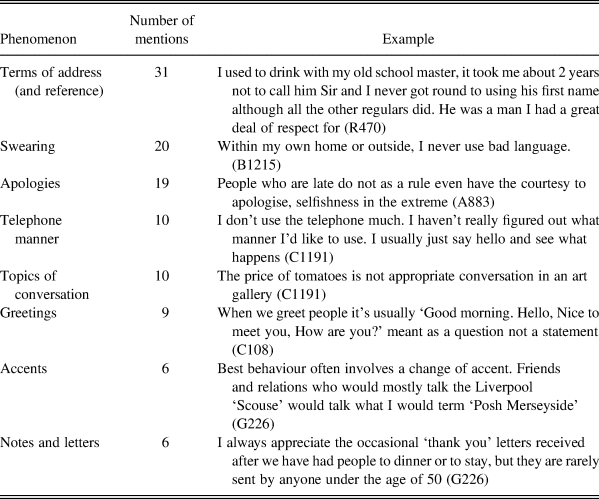
At the time of starting this project in the summer of 2016, seventeen responses to this directive (of the total 405) had been digitised and made available online (Observing the 80s n.d.). These seventeen responses were investigated as a pilot. Correspondents’ comments on language were categorised according to their broad topic area.Footnote 4 As Table 1 shows, comments about terms of address were numerically prominent. There were thirty-one distinct mentions of terms of address, distributed across thirteen correspondents. Given this prominence, further investigations of the pilot data and the collection of data from the wider archive were focused on this particular category.
Frequency of metalinguistic concerns in pilot sample.

This approach was expanded to a sample of the full MOP archive, held at The Keep at the University of Sussex. Given the practical impossibility of investigating the entire archive, the correspondence of forty-nine correspondents whose names began with A or B were read (following Savage Reference Savage2007). Of these forty-nine, twenty-five made some mention of terms of address, and these were photographed in their entirety (160 pages). In total, across the seventeen digitised responses and the forty-nine As and Bs from the archive, thirty-eight of sixty-six correspondents made some comment on terms of address. It is the work of these thirty-eight correspondents that form the core data of this article.
It is noted by the designers of MOP that the project's value is its detailed qualitative information rather than in its capacity to poll the nation (Bloome, Sheridan, & Street Reference Bloome, Sheridan and Street1993). The MOP archive does, though, include a small number of demographic details for correspondents, including age, gender, and rough location. Correspondents’ ethnicity is not indicated. Class identity is potentially indicated in a number of ways, but this information is too incomplete and too general to say much of interest about the correspondents to the June 1989 Directive. More information is available about age. The June 1989 correspondents, like MOP correspondents more generally, tend to be somewhat older than the English population at largeFootnote 5 (Office of National Statistics 2016).
As metalinguistic data, the MOP correspondence is clearly affected by the nature of the directive. ‘Rules of Conduct’ is likely to elicit comments on some phenomena rather than others, especially given the list of suggested topics. However, it also has significant advantages over more direct means by which the lay stances on language could be ascertained (on such methods, see Preston Reference Preston2011). Unlike focus group or experiment-based reader-response methods, for instance, it is relatively naturalistic, since none of the correspondents are required to respond to linguistic data that they would not ordinarily encounter. Further, it remains the case that correspondents have a relatively wide range of choice about what they comment on. They very rarely cover anywhere near all of the directive's suggestions and some bring in other topics not listed. I have therefore assumed that correspondents’ choices of topic indicate matters that are of at least some concern, and that the data is useful in showing what aspects of linguistic conduct correspondents care about in the first place, as well as what they have to say about that conduct.
What linguistic phenomena do correspondents evaluate?
I have indicated above that terms of address were a prominent concern for correspondents. More detailed investigation reveals that they were, in all cases, concerned with the socially deictic properties of such terms (Foley Reference Foley1997; Agha Reference Agha2007a). Social deixis refers to the capacity for linguistic forms to index the relative social positioning of people speaking, addressed, or referred to. Such concern is evident in extracts such as the following.
(2) I do not tolerate familiarity, first names are not encouraged until I am sure of the people or person I am dealing with. (A1733, female, 61)
(3) The Church I worship in calls our new Pastor ‘Billy’ his Christian name… I think Pastor would give him the dignity he is entitled to. (B36, female, 75)
(4) There is no distinction any more between the way a child addresses another child or an adult. When I was teaching I might say to a child,
“Is mummy meeting you from school today?”
“No, Jane is”.
“Who's Jane?”
“Jane is Laura's mummy.” (B668, female, 60)
Correspondents’ comments construe relations between terms of address—sometimes as types (‘first names’, A1733 in (2)) and sometimes as emblematic tokens (‘Jane’, B668 in (4))—and social relations. For A1733 in (2), first names are implied to be instances of ‘familiarity’, and, for B36 in (3), first names are at odds with the ‘dignity’ appropriate to the pastor of a church. As is clear from these examples, the specific kinds of relationship that are deemed pertinent are broad. But in each case what is at stake is a matter of social deixis.
In itself, this awareness of the significance of terms of address is unsurprising. Terms of address (and reference, Dickey Reference Dickey1997) are precisely the kind of phenomenon typically associated with social deixis in linguistic research (e.g. Brown & Gilman Reference Brown, Gilman and Sebeok1960; Paulston Reference Paulston1976; Brown & Levinson Reference Brown and Levinson1987; Foley Reference Foley1997; Agha Reference Agha2007a). Further, they fulfil Silverstein's (Reference Silverstein1981) criteria for the kinds of linguistic phenomena that nonlinguists are relatively likely to be aware of. For instance, they have identifiable referential meanings (unlike, say, stratified phonological variables) and they are relatively context-independent (inasmuch as first names are taken to be less formal than surnames across a wide range of contexts). Academic discussion often points to instances of lay commentary on such terms (Brown & Gilman Reference Brown, Gilman and Sebeok1960; Paulston Reference Paulston1976). In other words, their potential salience is well established.
Nonetheless, it was never a given that terms of address, among the many phenomena that could be mentioned, would actually be a central concern of so many of these correspondents at this point in time. Brown & Gilman, in their classic account of T/V pronouns, write that ‘mode of address intrudes into consciousness as a problem at a time of status change’ (Reference Brown, Gilman and Sebeok1960:270).
Indeed, it is specifically changes in terms of address that seem to matter to MOP correspondents. Relatively hierarchical, formal, or distancing choices are seen to belong to the historical past and/or are associated with older people, while the converse is true of relatively egalitarian, informal, or solidarity-oriented choices.
(5) To me one of the most noticeable changes in rules of conduct in the last twenty years or so is the universal use of first names on meeting—it's a very far cry from Mrs Bennett addressing her husband as “Mr Bennett” in “Pride and Prejudice”. (B668, female, 60)
(6) If at all possible I prefer to be known as Alison and have asked my boss to introduce me as such since Mrs anything makes me feel a. about 100 and b. an appendage of Mr. whose name I share. (G226, female, 47)
(7) My own behaviour/conduct – is ‘dated’ in that I find it difficult to be ‘informal’ with people I see as a higher status (professionally) than myself. Headteachers + even Heads of departments. (often younger than myself.) It is ages before I can call them by their first names + always tend to introduce myself to them as Miss Burgess (altho’ first names are used with other staff). (B87, female, 56)
Largely, then, it is a particular shift in social deixis that concerns correspondents. This shift seems to be similar to that which the linguistic literature calls informalisation, colloquialisation, or personalisation (Biber & Finegan Reference Biber and Finegan1989; Fairclough Reference Fairclough1989; Mair Reference Mair2006; Farrelly & Seoane Reference Farrelly, Seoane, Nevalainen and Traugott2012). Informalisation is a well-established academic explanation of a number of changes in Twentieth Century English, from the decline of the modal verb ought (Leech Reference Leech, Facchineti, Krug and Palmer2003) to the increasingly ‘spoken’ character of political broadcasts (Pearce Reference Pearce2005). In his book Twentieth-century English, Mair (Reference Mair2006) dedicates almost the entirety of his chapter on changing discourse norms to the phenomenon as it occurs in written English. This seems to be a change that MOP correspondents notice, that they understand as significant, and, equally importantly, that, in the summer of 1989, they care about.
What kinds of political significance do correspondents see in those phenomena?
A relatively straightforward story that MOP correspondents might be expected to tell about the political significance of terms of address would go as follows: terms of address are becoming more informal, and that is because society at large is becoming more egalitarian. This democratisation story is essentially the one that some linguists tell about the longer term informalisation of English (Brown & Gilman Reference Brown, Gilman and Sebeok1960; Biber & Finegan Reference Biber and Finegan1989). It is, however, a well-established critical position to suggest that informalisation is more complicated, and more problematic than this (Farrelly & Seoane Reference Farrelly, Seoane, Nevalainen and Traugott2012). A key claim of Fairclough's take on informalisation is that the shift in social deixis is often not accompanied by a concomitant shift in other kinds of social relations. Where this happens we have synthetic personalisation. Fairclough's initial articulation of this idea was published in Reference Fairclough1989, when he wrote that it is ‘a compensatory tendency to give the impression of treating each of the people “handled” en masse as an individual’ (Reference Fairclough2015:89). The concept remains highly influential on critical language research to this day, invoked in analyses of such things as health communication on social media (Hunt & Koteyko Reference Hunt and Koteyko2015) and the language of Donald Trump (Sclafani Reference Sclafani2017). The tendency it names was identified in prominent postwar critiques of consumer capitalism in the UK (Hoggart Reference Hoggart1957; Williams Reference Williams1961/2005) and the US (Marcuse Reference Marcuse1964/2002). It is there too in Brown & Gilman, who write, during Eisenhower's presidency, that while ‘The very President of the Republic invites us to call him “Ike”… the differences of power are real and are experienced’ (Reference Brown, Gilman and Sebeok1960:271).
Some correspondents do tell a version of the democratisation story. For instance, in (6) above, G226 is positive partly on the grounds that the avoidance of titles and surnames is less sexist (see Baker Reference Baker2010). Most correspondents, however, are negative about the change. This is evident in the majority of the extracts presented so far, and in the following.
(8) I do expect formal names to be retained in ‘business’. I phoned the local paper recently to speak to a journalist, giving my full name. The person wasn't available and the receptionist said ‘I'll get her to phone you back, Rosemary’. I found this much too informal from a complete stranger and would have expected ‘Mrs. Archer’.
(A1783, female, 28)
(9) This is an extension of the “Use of First Names” part of the report. There is a tendency for this modern trend to get out of hand, in that we collect a number of contacts, in the course of our work, known as “Bill”, “Joe” or “Jane”, and we have no clue as to their surnames! One gets “cold selling” phone calls, starting with “Hello! This is Angela, of Bloggs Fasteners”. Angela who? You never get told. (A2055, female, 61)
(10) Use of first names: I abhor it. Which Brian? What Brian? And I am only familiar with my immediate family. (B58, female, 67)
The kinds of normative concerns motivating correspondents’ negative judgements are variably explicit. Many are thoroughly affective in their response, suggesting that they feel constraints on their own linguistic behaviour (see (11) and (12)), or that they feel an aversion to that of others (see (13) and (14)). Such evaluations suggest an experiential and affective force to linguistic experience (Ochs Reference Ochs2012).
(11) I would have trouble calling my ex teachers by their first names (C1191, female, 34)
(12) I don't easily use the first names of people older than myself even when asked to
(C108, female, 55)
(13) I find myself upset by salespersons who drop straight into first names terms … I don't really need to know the name of the junior who has answered the phone and it puts my teeth on edge (B1426, male, 54)
(14) I also find it annoying when a conversation is peppered with my name deliberately.
(B1215, female, 36)
Since these correspondents specifically have these reactions to linguistic changes, they might be taken as indicative of a kneejerk, conservative prescriptivism. A woman in her seventies, for example, begins her response by writing of ‘rules of conduct’ in general: “First, of all, may I say, that on the whole they're pretty well obsolete in most cases”. She goes on to say that her concerns “may seem old-fashioned, BUT they were part of everyday behaviour until after the war & made life more pleasant”. She offers a list of ‘personal rules’, given in (15) below.
(15) Introductions are still nice.
Invitations are still nice.
Polite words are still nice.
Apologies for mistakes, still nice.
Orderly behaviour is still nice.
Good manners are still nice. (B736, female, 71)
She concludes, “I blame the loss of respect, the lack of manners, lack of knowing how to behave, & too much T.V violence… I can't see manners & respect for others EVER coming back again & its very sad indeed. It was so much better & a happier way to live, for all concerned”. There is a clear element of ‘Golden Age’ thinking here (Labov Reference Labov2001:6).
However, such affective reactions are not necessarily distinct from more politically oriented insight or judgement. It would be a mistake to assume that, just because correspondents are critical of changes, they necessarily have no other reasons for seeking to conserve elements of the past. A number of correspondents do give further reasons. For R470 in (16), first names in the workplace are indicative of “trendy pseudo egalaterianism”. This “bugs” him. But he has more to say.
(16) Use of first names bugs me. It is part of trendy pseudo egalaterianism. A lot of the problems of British Industry (what is left of it) is that the monkey is turning the handle and not the organ grinder.
As a recent example. The firm I work for is all on first name terms even to the owner (it is a private company). I was talking to the owner about a job we did recently, 232 packs of timber from Deptford to Wisbech. “Not a good job, we lost £700 on that” he said, “It was costed on 30 cubic metres a load, the buggers were only putting on 27 claiming that 30 was unsafe”. “When I started this firm drivers did as they were told, if they said a load was unsafe we said your a professional make it safe.” Now I am well aware, as he must be that this safety argument is spurious. [Discussion of flaws in the safety argument.] The truth is that drivers are allowed to do the job as they please, because there is absolutely no discipline, largely due I believe to this all pals together image of all on first name terms.’ (R470, male, 55)
R470 seems quite comfortable with the idea that to evaluate a use of language (‘use of first names’) is also to evaluate a political or cultural orientation. Here this is “trendy pseudo egalaterianism”, but elsewhere we see “our increasingly informal society” or the question of whether to distinguish between children and adults, or whether to give a pastor “dignity”. Such comments might be seen as a form of explanatory critique in Fairclough's (Reference Fairclough2015) terms, relating the critique of language to broader structural phenomena. However, the details of R470's ‘explanation’ are rather different to that offered by the critical tradition. He dislikes the challenge to hierarchy that he takes changes in terms of address to represent. This challenge to hierarchy is inimical to the interests of British industry. Much as it might appeal to workers’ sense that they have a right to respect in the workplace, it ultimately gives a dangerously false impression of who should be making decisions. These comments can be compared with those in (17), in which the correspondent complains, in rather more concord with critical researchers, that informal terms of address do not alter power relations in the workplace.
(17) Christian/first names straight off—this alters power relations not one iota in either F.E or A.E. or anywhere else. (No number, female)Footnote 6
Both of these correspondents are critical of informalisation. But they are critical for very different—contradictory—reasons. Clearly, engaging in linguistic critique is no guarantee of any particular political stance.
For these two correspondents, this problematic shift in terms of address is something that has taken place in the workplace. Others situate it in professional contexts too.
(18) Just as I don't find it comfortable to touch a lot whilst holding a conversation, I don't tend to call people by their name very often, or use terms of endearment. It grates on me when people insist on body contact because they've been to assertiveness classes or are trying to follow some psychological trend. I also find it annoying when a conversation is peppered with my name deliberately. I don't know if this is an American trait, like saying “have a nice day” regardless of the time or situation, but it always reminds me of door-to-door salesman tactics, trying to create a warmth & familiarity which doesn't exist. (B1215, female, 36)
(19) In business, I have noted telephone manners have improved, because bosses insist their staff identify themselves so we hear “This is JOE BLOGGS LTD, LIZ speaking, may I help you” you could be a customer, placing an order so mannerism's are are of primary importance, however after dealing with a firm over a period, certain staff show their true manners. Their attitude changes once you have identified yourself, they become complacent, their service like their manners deteriorate, the ‘OH ITS YOU’ attitude is adopted, you are left hanging on to a silent line—or have jingles ringing in your ear, whilst probably a new customer the new treatment. (B2109, male, 69)
For these correspondents, informalised terms of address seem to be seen as a linguistic technology, used in the maintenance of ‘public relations’ (Fairclough Reference Fairclough, Caldas-Coulthard and Coulthard1996; Cameron Reference Cameron2000:75–76). Some very clearly see this as a top-down initiative, encouraged by “bosses” or “assertiveness classes”. However, in a striking comment on informalisation outside the workplace, B668 in (20) writes of the “superficial friendliness” she has experienced at parties.
(20) At one time the intimacy of a relationship would be measured by the use of the first name. But not any more. At a party people are often introduced to each other only by their first names. It's meant to create a sense of friendliness I suppose, but it's a superficial friendliness which means nothing. One may never meet ‘Harry’ or ‘Jane’ again or even want to. (B668, female, 60)
Many correspondents, then, seem to dislike the assumption of solidarity with those whom they do not know well, or with whom they have only a professional relationship. They see this “superficial friendliness” as an intentionally deployed strategy to temporarily and, at best, partially overcome social distance. The political details vary, as does the degree to which correspondents articulate the grounds of their judgements, but something very close to a critique of synthetic personalisation seems to have been prominent for many in late 1980s Britain.
Critical research, structures of feeling, and prescriptivism
To begin to answer the final question posed at the beginning of this article—How do the MOP correspondents’ metalinguistic stances relate to those of researchers in critical linguistics, and to the image of the conservative prescriptivist?—correspondents seem to notice the kinds of things that critical researchers notice, and to evaluate them in roughly similar ways (and in politically other ways, too). A distinction made by the cultural theorist Raymond Williams is useful in making sense of this. Williams (Reference Williams1977) distinguishes between structures of feeling and official discourses (see also Rampton Reference Rampton2006). Structures of feeling are partially articulated, deeply evaluative orientations towards the world which are characteristic of groups of people in shared circumstances at particular points in time. Structures of feeling have to do with ‘meanings and values as they are actively lived and felt’ which, at the time of their emergence, may ‘not yet [be] recognized as social but taken to be private, idiosyncratic, and even isolating’ (Williams Reference Williams1977:132). They are the personal gripes, inspirations, experiences, and so on, which later, ‘in analysis (but rarely otherwise)’, become recognisable as socially shared orientations towards experience (Reference Williams1977:132). Structures of feeling are not straightforward ‘common sense’, since they are held in common only by those in particular social and historical situations who share particular experiences. But they are related to what we identify as common sense, since they are implicit and uncodified ways of making sense of the world. They exist in complex relations to ‘official discourses’, but the latter, in broad terms, selectively formalise and reify the former into relatively structured, systematic ‘discourses’, ‘world-views’, or ‘ideologies’.
My claim is that if we read the June 1989 Mass Observation correspondence alongside the critical linguistic literature on informalisation, we see a relationship between a structure of feeling and an official discourse. Critical linguistic research is neither a challenge to common sense, nor a straightforward extension of it. It is an articulation of an existing structure of feeling.
Of course, an alternative possibility is a top-down process, whereby the arguments made by critical discourse analysts and others ‘trickled down’ into the metalanguage of ordinary people. There is, though, little to support this top-down view in the MOP data. Some of the correspondents do refer to figures of academic authority (e.g. Matthew Arnold, Aristotle, Jung), but it is difficult to imagine that most of the correspondents have had much contact with the critical analysis of language. Interestingly, however, there is at least one correspondent who almost certainly did. A1530 in (21) is a Language and Communication Skills Tutor at a YMCA college in London. She is politically left-wing, anti-Nuclear, and feminist. She tells us that she is ‘out of kilter with the Thatcherite mentality’ and complains of social occasions that are ‘wall-to-wall Tories’.Footnote 7 She writes about her professional metalinguistic expertise commenting on the challenges posed by National Curriculum expectations of ‘oracy’ education—“what a task for the teachers, teaching English in its many different modes and registers!” (A1530).
She has the following to say about her father's use of the word hen to address her and other women.
(21) Food was prepared in advance (by the hens). This word, hen, was one of the most frequently used words in my father's vocabulary. It was the Scots equivalent of ducks, luv, chick, babe, sweetheart etc. I HATED IT. I always regarded it as a gross insult, I should imagine because of an intuitive grasp of the power-inequality embodied in its single syllable consigning of my sex to the verbal dustbin. … ‘Hen’ … was delivered with a chumminess by men and women alike in the days of my youth. In my older age, I have come to terms with the expression by doing a lot of hen-centred thinking—my daughter and I have sent the whole thing up and at one stage bombarded each other with hen cards (post and birthday variety) and hen gifts (tea cosies, baskets, dishes small and large). I bought myself a couple of hen egg holders, and I see them every day in my home. (A1530, female, 52)
It is, in part, the “chumminess” of hen that A1530 objects to. She has objected to this since she was young, a fact she attributes to “an intuitive grasp of the power-inequality embodied” in the word. On the one hand, hen is friendly, informal. On the other, it is used by people in positions of relative power to those with less power. This, somewhat like the case mentioned by B668 in (20), is synthetic personalisation in the domestic sphere, and A1530's capacity to recognise this does not depend on her presumably later-acquired metalinguistic expertise. Further, the critical practice that she mentions—her ironic appropriation of all things hen-related—is not taken from any critical linguistic toolbox. It seems unlikely that she has learnt this critical strategy as part of her linguistic education, and much more likely that a broadly critical orientation (towards over-informalised sexist language at least) has long been part of her life.
In theoretical terms, the claims presented so far pose a challenge to the division of metalinguistic labour that underpins critical research. They suggest that the metalinguistic claims of critical linguists and those of ordinary people may be more continuous than is supposed, that, the criticality of critical linguistics may be firmly rooted in much broader structures of feeling. It does not follow from this, however, that we must reject the possibility of academic critique and retreat to a neutrally descriptivist division of labour. The MOP data, as much as it asks questions of critical research, highlights five important reasons to avoid this return to descriptivism.
First, and most basically, descriptive categories overlap just as much as evaluative ones. Niedzielski & Preston write that ‘non-linguists use prescription (at nearly every linguistic level) in description’ (Reference Niedzielski and Preston2003:18). But nonlinguists also use description in prescription. MOP correspondents also use terms like name, word, conversation, and apology, all of which frequently appear in linguistic research. So the existence of overlap between lay and expert metalinguistic orientation is no reason per se to reject an approach to linguistic research. Or, if it is, then it is surely not just critical research that is due a rethink.
Second, it is true that the MOP data might be seen to lend some support to the descriptivist characterisation of lay evaluations of language as conservative. But this does not quite hold of all correspondents. Some do welcome change. And, more importantly, the descriptivist dismissal of linguistic conservatism suggests that there is nothing to ordinary people's judgements other than their conservatism. This is a useful way of suggesting that there is nothing to be argued about, that ordinary people are simply making a category error, and an obviously illiberal one at that, when they condemn linguistic change. But, the MOP correspondents do not just argue against (noncount) change for its own sake, they argue about fairly specific (count) changes. In some cases, they give fairly clear indications of what it is about those changes that they object to. Further, as the correspondents present things, these are not organic changes, but changes that are actively instigated by others, sometimes by others in positions of power (“more and more of the larger concerns seem to be giving their employees the same course”, B1426). In other words, the castle is not ‘crumbling’ as Aitchison (Reference Aitchison1997) suggests; it is being dismantled.
Third, the MOP data is suggestive of cases where ordinary people might not be talking about things that are of concern to critical linguists as much as it indicates areas of overlap. Only one correspondent writes about racist language (B1756, whose entire report is on the topic). This general lack of concern might be seen as striking, given the fact that racist language was, at the time, a matter of some academic concern (e.g. van Dijk Reference van Dijk1987, Reference van Dijk1993b), and that, not many years later, reports on British people's attitudes towards language on television would suggest much greater concern with racist language (Millwood-Hargrave Reference Millwood-Hargrave1998; Synovate UK 2010). One explanation for this may lie in the likely over-representation of white people in the MOP data. Or, it may be that objections to racist uses of language are understood as more fully political or ethical than the question about ‘Rules of Conduct’ suggests. In any case, at a methodological level, seeking to empirically track relations between the critiques proposed by critical researchers and the linguistic concerns of ordinary people can only strengthen our understanding of the social and political life of language. It allows us to see that the political significance of language is neither blindingly obvious to all or something that is clear only through expert analysis.
Fourth, the MOP data suggests that aspects of language identified by critical researchers are, in fact, of real normative concern for people other than the researchers themselves. A much more worrying discovery for critical research would be to find that no one outside the academic world cared about such things. Without at least some resonance in the existing concerns of ordinary language users, critical research would have very little chance of political success. Its role, then, might best be seen as involving much less in the way of challenging common sense or in unearthing ostensibly hidden significances of language, and much more in the way of dialogic engagement with actually existing concerns about language. While we—all of us—might often disagree about the details of that significance (much as we disagree about the details of all kinds of political matters), there is significance in the more general point that language does matter in political and ethical terms.
Finally, as noted at the beginning of this article, descriptivism tends to assume that the most significant stance taken by ordinary language users towards their linguistic experience is a prescriptive one, concerned with standards of accent and dialect. But the MOP correspondence suggests that there were linguistic phenomena that were more acutely troubling for at least some people in 1980s Britain. Few had much to say about accents and dialects, and those comments that the correspondents did have—such as G226's observation that “Best behaviour often involves a change of accent”—suggest a more nuanced view than accounts of prescriptive conservativism would suggest. As with the lack of attention to racist language, this may very well be an artefact of the MOP directive itself, which perhaps many correspondents did not interpret as asking about accent and dialect. But, despite the attention paid to matters of language standards in the British press in the 1980s (and since), it is at least possible that accent and dialect are not as prominent in lay commentary on language as we sometimes imagine them to be. Issues of politeness, social deixis, taboo language, and conversational etiquette may be equally or more salient (Table 1). There is more investigation to be done here, but, to give this ideas some corroboration, these are also the things that studies of parents’ metalinguistic instructions to children tend to highlight, for instance in the ‘politeness routines’ identified by Gleason, Perlmann, & Greif (Reference Gleason, Perlmann and Greif1984; see also Becker Reference Becker1994; De Geer, Tulviste, Mizera, & Tryggvason Reference De Geer, Tulviste, Mizera and Tryggvason2002). Of course, a lot depends here on what we count as ‘linguistic’ behaviour (or indeed ‘metalinguistic’).Footnote 8 It is arguable that the tendency of many linguists to imagine accent and dialect standards as the main focus of lay linguistic evaluation is an outcome of a historically narrow conception of what constitutes language itself, phonology and grammar being central concerns. Prominent advocates of a hard descriptive-prescriptive division of labour also tend to work with such relatively narrow—or ‘extractionist’ (Agha Reference Agha2007b)—conceptions of language (e.g. Pinker Reference Pinker1994; Bloomfield Reference Bloomfield2014).Footnote 9 But if we broaden that conception of language, as most contemporary sociolinguists and discourse analysts certainly have, then it stands to reason that we might broaden our conceptions of nonlinguists’ metalinguistic concerns too, and attend to the various forms of metalinguistic commentary that exist in day-to-day life.
Metalinguistic comments, language ideologies, and linguistic norms
The broadening of metalinguistic concern that I have mentioned above is, it has to be said, well-established in the linguistic anthropological study of language ideologies (e.g. Woolard & Schieffelin Reference Woolard and Schieffelin1994; Heller Reference Heller2003; Gal Reference Gal2005; Hill Reference Hill2009). Indeed, the methods that I have used in investigating ordinary people's linguistic concerns are close to those adopted in this field, where naturalistic documentation of metalinguistic concern is a major research focus, and a somewhat different division of metalinguistic labour tends to be assumed. This tradition takes a more ethnomethodological orientation towards ordinary language users’ metalinguistic stance-taking. Such stances—classically conceived by Garfinkel (Reference Garfinkel1967) as background expectancies and now often as elements of language ideologies (Woolard & Schieffelin Reference Woolard and Schieffelin1994; Blommaert Reference Blommaert1999; Kroskrity Reference Kroskrity and Duranti2004)—are seen as constitutive of linguistic phenomena, rather than as mere after-the-fact commentary. The researcher's task is therefore to investigate these stances in order to understand the normative constitution of linguistic behaviour. It is a meta-metalinguistic approach.
This article might be seen as a step towards a combination of, on the one hand, the ethnomethodological concern with the evaluative stances taken by ordinary language users, and, on the other, the critical linguistic emphasis on the normative significance of language (Slembrouck Reference Slembrouck2001; Heller & McIlhenny Reference Heller and McElhinny2017:235–37). The language-ideological perspective is particularly important in highlighting a point that has perhaps not been clearly stated in my discussion so far. Ordinary people's comments on language are interesting not only inasmuch as they overlap or otherwise with those of academic linguists, and not only inasmuch as they happen to ‘notice’ linguistic phenomena. They are interesting because they are indicative of the more fundamental ‘verbal hygiene’ practices (Cameron Reference Cameron1995) by which linguistic norms are brought into being, contested, and challenged.
What is particularly fascinating in the MOP data is the apparent contingency of this influence. It is sometimes assumed in classic ethnomethodological work—though generally not in more recent work on language ideologies—that linguistic behaviour is fairly straightforwardly shaped by the normative stances that language users take (Garfinkel Reference Garfinkel1967). In conversation analysis, for instance, conversational order is imagined to be the result of ‘a persistent and pervasive orientation by the participants to a set of norms and rules’ (Raymond & Sidnell Reference Raymond, Sidnell, Jaworski and Coupland2014:250), and the investigation of the structure of conversations—and of ‘repairs’ within them (Schegloff Reference Schegloff1992)—is seen as indicative of such orientation. But the MOP data highlights the possibility that people take stances towards language that only emerge at a distance, or upon reflection, rather than making themselves directly felt during the course of interaction itself; or stances that are characterised by uncertainty about, ambivalence towards, or alienation from linguistic behaviour. One correspondent, for instance, writes:
(22) I don't automatically show my feelings [physically?] when I see people although sometimes I want to but am too shy to, I feel awkward and embarrassed. And I still call my mothers neighbours Mr & Mrs yet my children call them by their first names silly isn't it. (D156, female, 37)
Many of the MOP correspondents quoted above report similar alienation from the behaviour of those around them and of themselves. They find it hard to use terms of address in particular ways, or they see some use as being typical but undesirable. It is partly for this reason that I have made use of the concept of a structure of feeling: MOP correspondents’ comments on language suggest a socially shared but also in some sense private orientation towards linguistic behaviour, which likely has a complex, thoroughly contingent relationship with that behaviour.
To look at this from another perspective, we are well used to the idea that the history of English can be characterised by periods (or moments) of metalinguistic concern in complex relations with first-order linguistic changes. We tell that history with reference to dictionary writing, the Inkhorn controversy, nationalist language projects, elocution lessons, and so on. Perhaps a small part of that history is a late twentieth-century concern on the part of some in positions of power with the formality of their public language, and an attempt to personalise and informalise that language. If so, this is a metalinguistic concern which seems to have a correlate in a structure of scepticism about such changes, evident in a set of variably articulate affective and political responses to public informality felt by ordinary people and by academic linguists alike.
Conclusion
The MOP data suggests that ordinary people may have things to say about language that are very similar to the arguments of critical researchers, or at least that this was the case in late 1980s Britain, when the critique of informalisation seems to have been a structure of feeling. That is not to say that linguistic techniques—for example, corpus linguistics, discourse analysis, the development of technical terms like synthetic personalisation—cannot tell us more about this situation. But it is to say that there may be nothing qualitatively distinct about academic interest in it, or critique of it.
The methodological importance of this is to suggest that sustained attention to relatively naturalistic metalanguage, in this case from a social-historical archive, is important for critical approaches to language, and for sociolinguistics more generally. It is important so that we can see what stances ordinary people take, and therefore avoid falling into lazy stereotypes of lay attitudes towards language; these stereotypes may do more to support our own academic self-conceptions of metalinguistic distinction than they do to represent how ordinary people think and feel about their linguistic experience. It allows us to engage with existing arguments about language as largely continuous with (perhaps at some level as forming the basis of) academic ‘critique’. If we wish to engage in properly political argument about language, then there is no point in doing so in ignorance of, or isolation from, the things that people are already saying about it. And we can identify ostensibly private concerns, which may not be articulated during the course of interaction, but which might nonetheless play a significant role in the social life of language. For critical discourse analysis, the key significance is that the investigation of actually existing metalanguage allows us to go beyond the intellectual stalemate between those who see it as our critical duty to point out the political significance of language and those whose faith in common sense tells them that such academic critique is redundant. More generally, for socially oriented linguists, there seems to be little to be gained by drawing any sharp lines between our own academic approach to language and that of everyone else (Paveau Reference Paveau2011). As research on language ideologies (Woolard & Schieffelin Reference Woolard and Schieffelin1994; Heller Reference Heller2003; Gal Reference Gal2005; Hill Reference Hill2009) and on verbal hygiene (Cameron Reference Cameron1995) has suggested, metalinguistic commentary—whether carried out by academic linguists, correspondents to a social research project, or anyone else, in any other setting – is a fundamental, and fundamentally contested, part of the social life of language.