In many countries an international trend regarding cost-effectiveness evaluations is already established to decide on reimbursement and pricing of pharmaceuticals (Reference Zentner, Valesco-Garrido and Busse21). Australia was precursor in 1992. In 1999, the National Institute for Health and Clinical Excellence (NICE) was set up by the Labor government as a special health authority of the National Health Service (NHS) in England and Wales (Reference Rawlins16). As an independent organization, NICE is responsible for providing national guidance on the promotion of good health and the prevention and treatment of ill health (8). The institute produces guidance on public health, health technologies, and clinical practice. The aims of NICE are to improve standards of care for patients and to reduce inequalities in access to innovative treatments (4). NICE has 240 employees and a budget of approximately €40 million available, and the spending is split between the Institute's work programs and the support functions (e.g., 2005–06: 14 percent for communication programs, 10 percent for health technology evaluations) (8).
Technology appraisals are based on clinical and economic evidence. They are recommendations on the use of new and existing medicines and treatments. Treatments include medical devices (e.g., inhalers), diagnostic techniques (e.g., tests used to identify diseases), surgical procedures (e.g., repairing hernias), and health promotion activities (e.g., ways of helping diabetes patients to manage their condition). From March 2000 to November 2008, NICE has published 162 technology appraisals (8;10). Seventy-four are still under development and four have been proposed by the Department of Health as the 19th wave of technology appraisals.
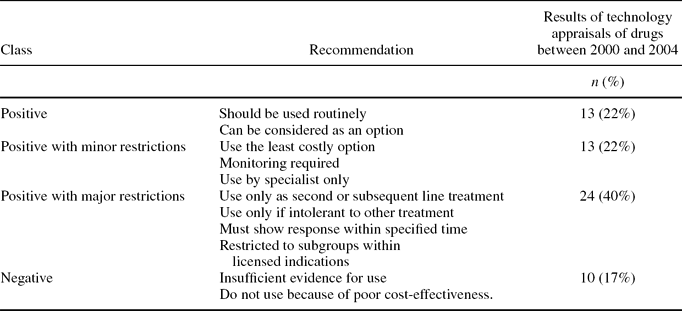
NICE recommendations of technology appraisals are issued in the form of mandatory guidance to the NHS (Reference Raftery13;Reference Raftery14). Recommendations may (i) concern the whole population without restrictions (positive), (ii) be limited to selected indications and/or specific patient groups (positive with minor or major restrictions), (iii) be restricted to clinical trials (positive with minor or major restrictions), or (iv) reject the financing of the treatment completely (negative). Recommendations published from 1999 up to April 2005 were fairly distributed across the four categories: NICE decided 22 (19 percent) as negative, 27 (23 percent) as positive, 38 (32 percent) as positive with major restrictions, and 30 (26 percent) positive with minor restrictions.
Likewise, in Germany the Institute for Quality and Efficiency in Health Care (Institut für Qualität und Wirtschaftlichkeit im Gesundheitswesen, IQWiG) was established by the Federal Committee of Physicians and Health Insurance Funds (Gemeinsamer Bundesausschuss, G-BA) as an independent scientific institute with a budget of €11 million and sixty employees with different professional backgrounds. It receives its commissions from the G-BA or from the German Ministry for Health. The G-BA is a corporation under public law determining the statutory health insurance's (SHI's) catalog of benefits. It issues directives that are legally binding for both physicians and health insurance funds. With the latest healthcare reform enacted in April 2007, the IQWiG was assigned to appraise the cost-effectiveness ratio of drugs to control the drug expenditures in Germany (3).
The purpose of the present study was to examine if NICE's negative and restricting technology appraisals of drugs between 2000 and 2004 influenced (i) the number of prescription items dispensed for each drug according to the approved indication and (ii) the corresponding total net ingredient costs in the ambulatory care in the NHS in England and Wales. Second, we will discuss whether the NICE approach could be a role model for Germany.
METHODS
Selection of Time Period
NICE started its work in 1999, and the first appraisals were generated in 2000 (except a rapid review of antiviral drugs for flu). Between 2000 and 2006 NICE published 89 technology appraisals (8). To get sufficient follow-up data to detect potential effects, we analyzed technology appraisals published up until 2004. Hence, in the present study data from the years 2000 to 2004 are shown. Number of prescription items dispensed and net ingredient costs were followed up until 2005.
Selection of Technology Appraisals of Drugs
From the six guidance types of NICE, the technology appraisals were selected for analyses. Financially, technology appraisals are the most important guidance for the NHS budget. Between 2000 and 2004, medicines (drugs) were identified as the most common technology (n = 42, 67 percent) to be appraised by NICE. Furthermore, eight technology appraisals on medical devices (13 percent), six on surgical procedures (10 percent), five about health promotion activities (8 percent), and two about diagnostic techniques (3 percent) were published.
Classification of NICE Recommendations
Each recommendation of the technology appraisals issued by NICE was classified according to Raftery (Reference Raftery14) as positive, positive with minor restrictions, positive with major restrictions, and negative (see Table 1). To examine a possible effect of funding decisions that are based on negative and restricting cost-benefit evaluations on the expenditures on drugs, the focus was set on technology appraisals with negative recommendations or positive ones with major restrictions. As a result, twenty-seven technology appraisals of drugs yielded thirty-four recommendations that are negative or positive with major restrictions (Table 1). This amount to 57 percent of all recommendations of technology appraisals issued for drugs between 2000 and 2004.
Raftery Classification of NICE Recommendations and Results of Technology Appraisals from 2000 to 2004a

aThe difference between the number of technology appraisals, i.e., forty-two, and the number of recommendations, i.e., sixty, is caused by the fact that some technology appraisals are split into several recommendations for different drugs.
NICE, National Institute for Health and Clinical Excellence.
As drug appraisals issued by the German IQWiG applies only to the ambulatory sector and due to the fact that the NHS funding favors shifting prescriptions of drugs away from the hospitals to general practitioners, the focus in the present study was set solely on drugs relating to the ambulant setting; drugs prescribed in hospitals were excluded. By using the corresponding data base (PCAS, see section below) and by manual selection of drugs, it was ensured that drugs were solely related to the ambulant setting. Thus, seventeen restricting technology appraisals of thirty-four drugs were eligible of which three had to be excluded because the appraisal took place in the year of admission. Finally, fourteen technology appraisals including thirty-four drug assessments were analyzed.
Selection of Data Base and Statistical Analysis
Data on the number of prescription items dispensed and the net ingredient costs of the drugs in England were extracted from the “Prescription Costs Analysis Statistics” (PCAS) from the Web site of the Department of Health (Publications and Statistics) (5). The PCAS covers the years 1998–2005 for the ambulatory care in England in the section Pharmacies and Prescriptions. These statistics can be found on the Web site of the NHS Information Centre for Health and Social Care, where the years 1993–97 were requested from the Prescribing Support Unit. For Wales, the PCAS for 2000–01 were accessible on the NHS Wales Web site, for 2002–05 were inquired from the Health Statistics and Analysis Unit of the Welsh Assembly Government. No statistics were available before 2000.
Statistical Analysis
For the identification of a trend “without” and “with” influence of the NICE guidance by regression analyses, data of drugs for at least 4 years before release up to at least 1 year after release of the appraisal were examined. Hence, twenty-one drugs were examined by regression analyses. If data were not available, drugs were analyzed descriptively. Such study limitations consisted predominantly of data quantity in case of thirteen drugs, whereas in three cases long-time data were not available because drugs were appraised by NICE in the year of their licensing. Thus, data could only be analyzed descriptively and statistical significance levels could not be specified; moreover, each drug is analyzed only once.
Additionally, 95 percent confidence intervals were calculated for each regression line according to the formula X ± 1.96 x s/√n. All changes in prescribing and net ingredient costs exceeding the limits of the 95 percent confidence intervals were considered to be statistically significant, that is, decreases being likely to be influenced by NICE's publication of the corresponding technology appraisal of the drug. The statistical analyses performed in this study were done using the software SPSS Statistics 15.0.
Panel of Experts
During the study, two meetings were held with a panel of experts. They were established for discussion of the study methodology and the results. Prof. Raftery contributed particularly to this study with his classification of NICE's recommendations and his NICE expertise knowledge.
RESULTS
As documented in the present study, fourteen NICE's technology appraisals including thirty-four drugs were rated negative or highly restricting after Raftery classification between the years 2000 and 2004.
Drugs Analyzed by Regression Analyses
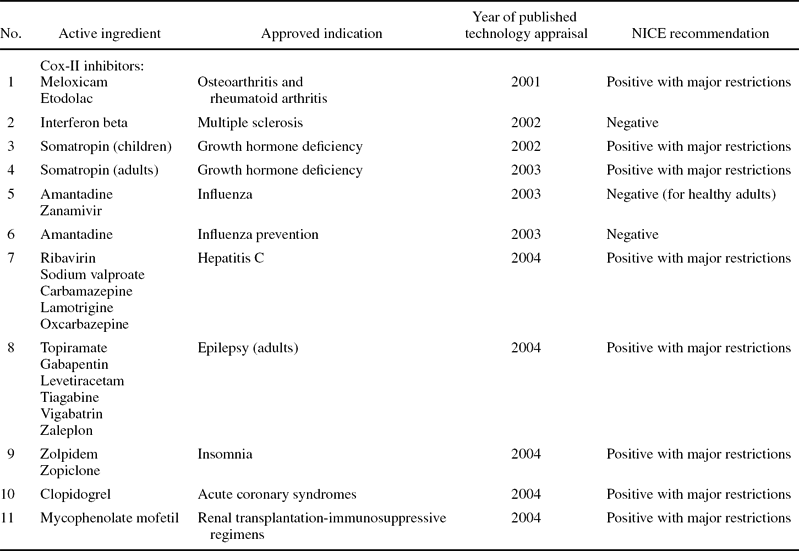
For regression analyses, twenty-one drugs or active ingredients, respectively, for therapy of different diseases were evaluated. Active ingredients examined were meloxicam, etodolac, interferon beta, somatropin, amantadine, zanamivir, ribavirin, sodium valproate, carbamazepine, lamotrigine, oxcarbazepine, topiramate, gabapentin, levetiracetam, tiagabine, vigabatrin, zaleplon, zolpidem, zopiclone, clopidogrel, and mycophenolate mofetil. Table 2 summarizes all analyzed drugs including the approved indications, years of published NICE technology appraisals, and NICE's recommendations.
Drugs from 2000 to 2004 Analyzed by Regression Analyses (N = 11)

In summary, twenty of the twenty-one drugs (95 percent) analyzed by regression analyses showed no decline in prescription rates after the publication of NICE's corresponding technology appraisal. The same results were found regarding the net ingredient costs examined. The proportion of variance explained (r2) accounted in the majority of regression models for ≥80 percent, that is, the regression models had a high prognostic value. Only for Zopiclone for therapy of insomnia a different trend was observable: after publication of NICE's restrictive technology appraisal in 2004, a significant decrease in prescriptions of Zopiclone was observable in England and Wales 2005 (p > .05). In Figure 1, an overview to the regression analyses of prescribing from NICE recommendations concerned drugs is listed in summary and specifically from NICE negative recommendations concerned drugs in detail, as well as the prescribing and net ingredient costs in summary.
Regression analyses of prescription rates from the National Institute for Health and Clinical Excellence (NICE) guidance issued drugs per indication in summary and specifically from NICE negative recommendations concerned drugs in detail, and prescribing and net ingredient costs in summary. Arrows indicate the publication year of the NICE's guidance to the corresponding drug.

Drugs Analyzed Descriptively
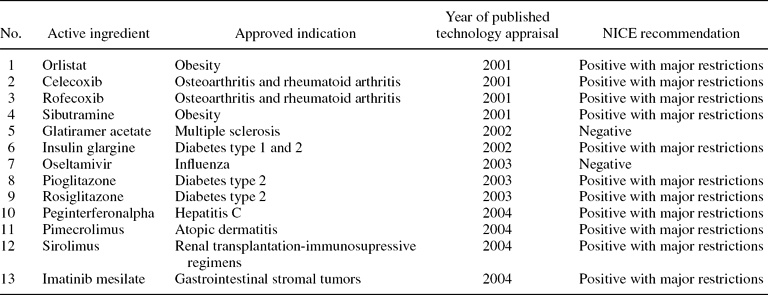
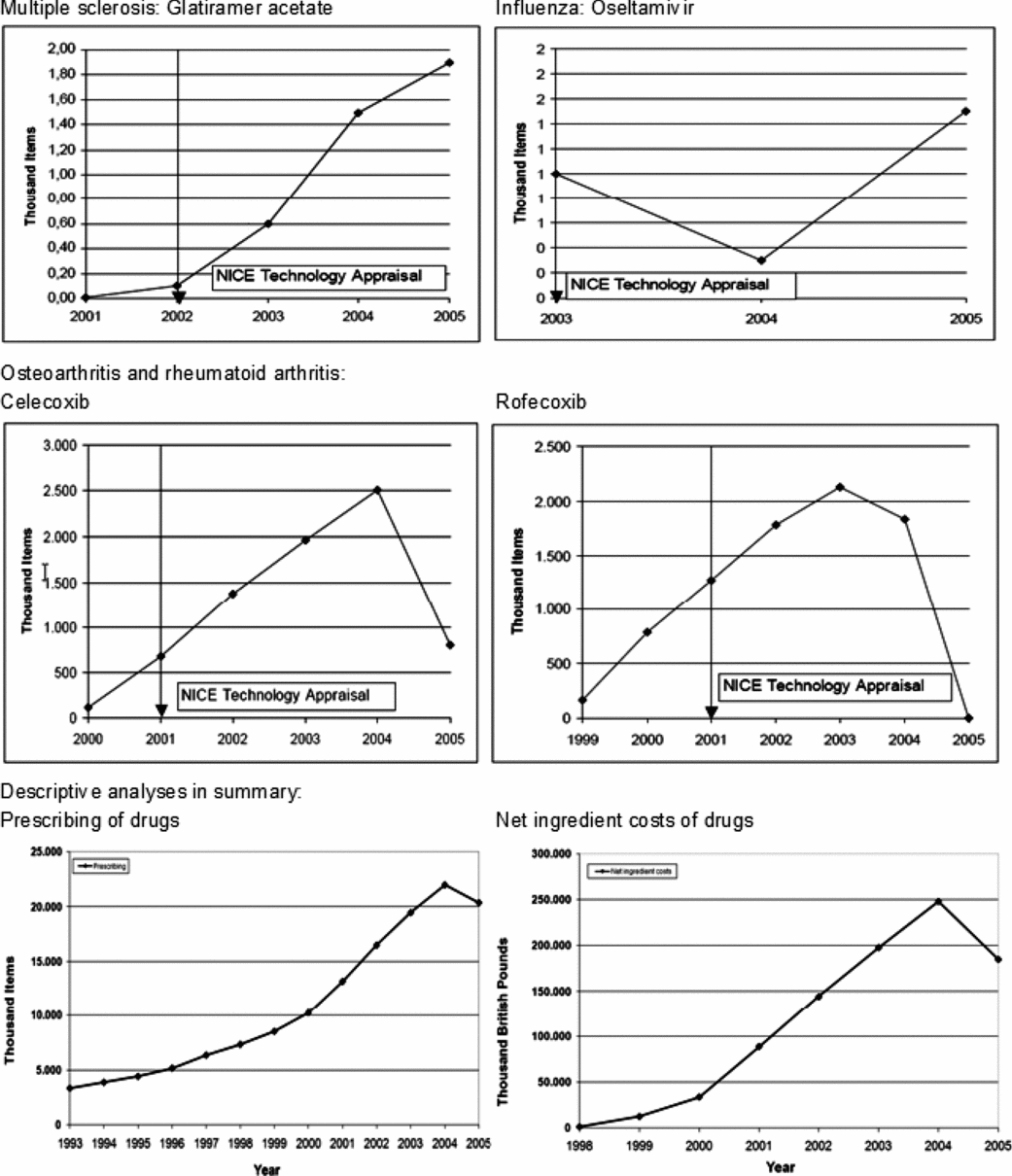
In the case of thirteen drugs, data for at least 4 years before release of the corresponding appraisals were not available. Thus, the prescription rates and net ingredient costs of the following active ingredients were analyzed descriptively: Orlistat, Celecoxib, Rofecoxib, Sibutramine, Glatiramer acetate, Insulin glargine, Oseltamivir, Pioglitazone, Rosiglitazone, Peginterferon alpha, Pimecrolimus, Sirolimus, and Imatinib mesilate (see Table 3). In general, the descriptive analyses showed no decline in prescriptions and net ingredient costs in the case of the examined time interval for all drugs. In the case of the two analyzed COX-II-inhibitors Rofecoxib (Vioxx®) and Celecoxib (Celebrex®), the prescription rates decreased dramatically in 2004. This decline was predominant due to the fact that Rofecoxib was taken off the market in September 2004; however, the NICE appraisal in 2001 did not show a decreasing effect. In Figure 2, the descriptive analyses of prescriptions rates from NICE negative guidance issued drugs and of both the COX-II-inhibitors Celecoxib and Rofecoxib are presented in detail, along with the prescribing and net ingredient costs in summary.
Drugs from 2000 to 2004 Analyzed Descriptively (N = 13)

Descriptive analyses of prescription rates from National Institute for Health and Clinical Excellence (NICE) negative guidance issued drugs and of the both COX-II inhibitors celecoxib and rofecoxib per indication in detail, and prescribing and net ingredient costs in summary. Arrows indicate the publication year of the NICE's guidance to the corresponding drug.

In conclusion, the prescription rates of all thirty-four drugs analyzed doubled from 10 million items dispensed in 2000 to 22 million in 2004 (Fig. 2). In 2005, the prescription rate decreased to 20 million items dispensed. The net ingredient costs of all thirty-four drugs analyzed grew exponentially until 2004 (see net ingredients costs in Figure 2). It totaled 202 million British Pounds in 2000 and increased up to 638.4 million British Pounds in 2004. From 2004 to 2005, the costs declined to 616.4 million British Pounds.
DISCUSSION
For several European Union (EU) member states, NICE is a role model for providing advice on securing the highest attainable standards of medical care (9). NICE's recommendations are issued in the form of mandatory guidance to the NHS (Reference Raftery14). In general, the institute is not engaged with the subsequent effects of its recommendations on the budget for medical care. The government ultimately decides on the basis of the total budget planning whether the NICE recommendation can be financed or not. Only technology appraisals are an exception. Since January 2002, the NHS is legally obliged to fund and resource medicines and treatments recommended by NICE's technology appraisals within 3 months after publication (4). In a press release, the British Health Minister Lord Philip Hunt announced in December 2001: “The Government is fulfilling a commitment to introduce a statutory obligation on the NHS to provide funding for treatments and drugs recommended by NICE on the basis of clinical and cost effectiveness. We want to ensure that patients get the appropriate drugs or treatment they need based on these recommendations. . . . The obligation is intended to fall principally on Health Authorities and Primary Care Trusts to ensure that they properly manage the money in their general allocations.”
NICE Technology Appraisal Guidance and Their Consequences
Beneath NICE's guidance on public health and clinical practice, the institute produces advice on health technologies, that is, the guidance on the use of new and existing medicines, treatments, and procedures within the NHS. Each guidance area is the responsibility of one of three centers of excellence: the Center for Public Health Excellence, Center for Health Technology Evaluation, and the Center for Clinical Practice. Nevertheless, the nonimplementation of the guideline is not sufficiently sanctioned: the Primary Care Groups (PCGs) are allowed to refuse the prescription of medicines if they refer to their limited budget. PCGs are mandatory unions of healthcare providers on regional levels who are responsible for around 100,000 insurants. From the strategic health authorities, they receive around 75 percent of the funds spent by the NHS for medical care (7). However, they are obliged to justify in detail and in written form why they deviate from NICE recommendations. This documentation has to be liable of control (Reference Rothgang, Niebuhr, Wasem and Greß17). Under the new performance assessment system (The Annual Health Check), NHS bodies will be required to make a declaration whether they are conforming with NICE technology appraisals standards when planning and delivering care. Noncompliance will impact on performance assessment and, therefore, represent a greater risk to the organization (2).
NICE Effects on Prescription Behavior and Reimbursement Costs
In general, prescribing rates increase following positive NICE guidance, although in some cases not to the levels anticipated by NICE when the guidance was issued (12). Regarding the implementation of negative recommendations (applying to all or some indications), there are difficulties in interpreting the raw prescribing data, because they do not include information on patient indications. However, it is supposed that a wholly negative guidance might be expected to have more of an effect than one with major restrictions.
As demonstrated in the present study, NICE's fourteen negative or restricting technology appraisals of 31 drugs between 2000 and 2004 had no significant effect on the prescription items dispensed and their net ingredient costs (reimbursement cost of the drugs) of the different drugs in the ambulatory care of the NHS. No decline was measurable. This affected 95 percent of the drugs in the regression analysis—except Zopiclone—and 100 percent of the drugs in the descriptive analysis. NICE recommended prescription of Zopiclone only after nonmedicine treatments have been considered, only for a short period of time, and strictly according to the license of the drug. In the case of the descriptive analyzed COX-II inhibitors rofecoxib (Vioxx®) and celecoxib (Celebrex®), the prescription rates decreased dramatically after 2003. Most likely, this was not caused by the NICE appraisal in 2001 but rather a result of the discussion about the detection of cardiovascular side effects of rofecoxib in the so-called Vioxx® scandal. Whereas Rofecoxib was withdrawn from the market in September 2004, the European Medicines Agency (EMEA) restricted the use of celecoxib (Celebrex®) explicitly. In addition, the decreases of Zolpidem, Zaleplon, and particularly Zopiclone contributed to the fall in prescribing and net ingredient costs between 2004 and 2005. Thus, NICE's negative and restricting technology appraisals had a minimal influence. In total, 97 percent of thirty-one drugs did not show any decrease in costs or prescribing in the ambulatory sector in England due to NICE's fourteen technology appraisals. Especially, no significant effect of NICE's negative technology appraisal was detected in case of Interferon beta. Although interferon beta is being prescribed in England as part of the department of health's risk sharing program, both arrangements had no influence on prescriptions items dispensed and the net ingredient costs.
Two other studies showed similar evidence to the results presented in this analysis. Sheldon et al. (Reference Sheldon, Cullum and Dawson18) assessed the extent and pattern of implementation of guidance issued by NICE in acute and primary care trusts in England and Wales. They also confirmed that the prescribing or use of the five drugs investigated increased after NICE's restricting or negative appraisal, except for, for example, Zanamivir. In this case, the prescribing was already low until the publication of NICE's technology appraisal in 2003. In the present WINEG study, after 2003 until 2005 the prescribing and net ingredient costs of Zanamivir did show a downward trend; this however, was already visible before NICE's negative appraisal and not statistically significant.
In the second Abacus study (1) ordered by NICE, twenty-five technology appraisals on drugs and treatments using IMS Health data were analyzed. For the drugs treated in this study as well as in the Abacus study (Cox-II inhibitors for osteoarthritis and rheumatoid arthritis, interferon beta for multiple sclerosis, somatropin for growth hormone deficiency, imatinib for gastrointestinal stromal tumors), the use did not decrease or did not continue to decrease after the publication of NICE's restricting or negative technology appraisals.
NICE Technology Appraisals as a Role Model for Germany
Regarding the question of NICE being a role model for Germany, it is difficult to give a universally valid answer as the differences between the two healthcare systems are considerable. Regarding the similarities of NICE and the German IQWiG, both institutes assigned to appraise the costs and benefits of drugs financed by public funds. In contrast to NICE, the IQWiG is a foundation of private law, that is, not part of the state administration. In the context of the healthcare reform of June 1, 2004, the IQWiG was set up as a functionally independent and scientific institute for “quality and efficiency in the health care system.” At first it focused on the assessment of the benefit of drugs. Only on April 1, 2007, was it assigned to assess their cost-effectiveness as well. Until then, the G-BA was exclusively responsible for evaluating the economic aspects before deciding whether a drug should enter the statutory benefits catalogue. Usually the IQWiG receives its assignments from the G-BA (Federal Committee of Physicians and Health Insurance Funds) or from the BMGS (Ministry for Health and Social Welfare). The G-BA uses the HTAs of IQWiG to formulate guidelines that might diverge in substance from IQWiG recommendations and are mandatory and juridically challengeable.
There is a crucial difference between both systems: in Germany there are, strictly speaking, two appraising institutions: the IQWiG and the G-BA. The IQWiG does the preliminary work for the G-BA, which makes decisions regarding the reimbursement of drugs and other treatments; in this context, the G-BA is free in its decision to work with the IQWiG. It can also conduct assessments without the support of the IQWiG, which is important as the capacities of IQWiG are a limiting factor. IQWiG employs sixty people and has €11 million at its disposal per year.
Recently the Ministry for Education and Research (BMBF) and the German Research Group (DFG) declared to support the IQWiG for the next 4 years with additional €20 million for cost-benefit analysis. To date, thirteen drugs and treatment methods have been evaluated, that is, approximately four per year. In comparison NICE—working with 240 employees and a budget of €38 million—has evaluated 100 technology appraisals, that is, approximately fourteen per year, and defined approximately fifty guidelines since its foundation in 1999. At present, cost-benefit analyses are associated with a high expenditure of time, but future proceedings will be accelerated with more experiences in this area.
Study Limitations
By examination of the “prescription items dispensed” units, only a rather economic approximation on the prescribing behavior of the physicians was done. No epidemiological evidence regarding the actual use of the drug could be made. Similar as stated in Abacus International (1), in the present study we present trends rather than specifics. Other limitations were caused by the influence of many other factors irrespective of NICE's technology appraisals onto the development of the prescribing and the net ingredient costs. Such factors are the general increasing trend of the pharmaceutical sales and of the population in the United Kingdom between 1993 and 2005. The trend of the latter is likely to have had augmenting effects on the diseases' prevalence, and thus on the development of the prescribing and the drugs net ingredient costs in total. Furthermore, the interpreting of raw prescribing data is difficult to assess with regard to information on patient indications.
Reasons for Deviations from Recommendations Given by NICE
Only in one of thirty-four drugs, NICE appraisals caused a reduction in the number of prescription items dispensed. However, in this context an important aspect could be the compliance of health professionals (Reference Duerden, Miller, Godmann, Mallinson, Sullivan, Klusen and Straub6). NICE recommendations are issued in the form of mandatory guidance to the NHS (Reference Raftery14). Nevertheless, noncompliance is not sanctioned consequently. Health professionals are only “expected” to take NICE guidance into account together with experience and other sources of evidence (8). Physicians often have problems accepting NICE's guidance, and the number of nonresponders is high (12;Reference Rothgang, Niebuhr, Wasem and Greß17).
Furthermore, another possible reason for the rather low impact of NICE appraisals may be their lack of restrictiveness. Between 2000 and 2004, only ten technology appraisals by NICE of the sixty issued were negative according to Raftery (Reference Raftery14). The remainder is positive with minor or major restrictions. The problem is that drugs appraised positively will certainly be reimbursed by the NHS, demanded by patients and prescribed by physicians. This is irrespective of the degree of restrictiveness of the recommendations. Thus, physicians have no incentive to reduce their prescribing of the drug, despite the major restrictions. In addition, guidance saying “yes, with major restrictions” has a lower restricting impact on the prescribing than guidance saying “no,” because the patient population affected by the major restrictions is smaller. However, the extent of restrictiveness is arguable. According to Raftery, five appraisals were classified restrictive. For validation reasons, we performed a re-classification and rated only two appraisals as really restrictive.
Recommendations and Future Prospects
The United Kingdom has been working with “evidence-based guidelines” since the beginning of the 1970s (Reference Waiß20). In comparison to NICE, the German IQWiG was founded 5 years later, and the expertise is still in the development process (Reference Scriba and Middeke19). Additionally, it is important to point out that NICE has been criticized for its over-reliance on evidence-based medicine, that is, to favor certain kinds of econometrically derived types of studies over others. In contrast to NICE, the IQWiG will not use quality-adjusted life-years (QALYs) for utility assessment, and thus have to learn from NICE's and other organization's experience and continue to develop its own methodological approach, as well.
CONCLUSIONS
Cost-effectiveness appraisals as performed by NICE or the German public health system are a useful and important tool to enhance the discussion about methods and acceptance of evidence-based medicine in general. Since its founding in 1999, NICE has published more than 100 drug and technology appraisals. Therefore, in some aspects it can be regarded as a role model for the German IQWiG. When implementing cost-effectiveness appraisals in Germany, IQWiG can benefit from NICE's positive and negative experiences. In addition, it has to keep in mind that a one-to-one transfer from England to Germany is not possible due to different healthcare systems. However, from the results of this study it can be concluded that solely the release of appraisals will not necessarily result in a significant reduction of prescribing rates or costs.
To achieve a really significant reduction of prescribing rates, it is necessary to enhance the prescribers' compliance with the appraisals. Incentives rather than penalties can foster the implementation of guidelines and appraisals. Another possibility to improve the prescriber's compliance is providing information about results of cost-effectiveness analyses at the point of prescribing, for example, these results could be included in electronic prescribing support systems. Furthermore, continuous adult education programs communicating the medical and economic background of these guidelines can foster the patients and physicians acceptance, especially when they are provided from an independent institution. Another major aspect is that the possibilities of pharmaceutical industry to take targeting influence should be diminished.
It will be interesting to observe if German physicians will be more or less compliant with the G-BA resolutions than their English counterparts, and if IQWiG assessments will lead to significant cost savings in Germany.
CONTACT INFORMATION
Eva Susanne Dietrich, PharmD, M.HTA (pharmacoeconomics@web.de), Associate Director, Health Econ Ltd., Steinentorstrasse 19, 4001 Basel, Switzerland