Introduction
Aedes (Stegomyia) aegypti (Linnaeus, 1762) (Diptera: Culicidae) mosquito is one of the main vectors of arboviruses (e.g., dengue, chikungunya, zika, and yellow fever) to humans (Feitosa et al., Reference Feitosa, Sobral and Jesus2015; Zara et al., Reference Zara, Santos, Fernandes-Oliveira, Carvalho and Coelho2016). Therefore, the control of mosquito populations poses a significant public health challenge (Lima-Camara, Reference Lima-Camara2016; Cozzer et al., Reference Cozzer, Rezende, Lara, Machado, Magro and Simões2022). Currently, the main tool for controlling the population of Ae. aegypti is the use of chemical insecticides (Quimbayo et al., Reference Quimbayo, Rúa-Uribe, Parra-Henao and Torres2014), which poses several risks to human health, non-target species, and the environment, including soil, water, and air contamination (Fraga et al., Reference Fraga, Costa, Almeida, Rebelo, Moraes, Rezende, Santana and Maldaner2016; Silva et al., Reference Silva, Torre and Matos2021). The use of chemical pesticides can also contribute to the emergence of resistant organisms, as tolerance to lethal doses may be a heritable trait (Poletti and Omotto, Reference Poletti and Omoto2003). Additionally, chemical pesticides are not selective and can be lethal to both target and non-target organisms, such as pollinators and biological control agents (Pimentel and Burgess, Reference Pimentel, Burgess, Pimentel and Peshin2014). Given these concerns, natural insecticides have emerged as an alternative to chemical insecticides (George et al., Reference George, Finn, Graham and Sparagano2014).
Biological insecticides can help reduce the environmental impact, as they are potentially less toxic to non-target organisms and the environment compared to chemical pesticides (Caneppele et al., Reference Caneppele, Andrade and Santaella2010). However, the toxicity of biological insecticides tends to decrease over time, especially in aquatic ecosystems (Rezende et al., Reference Rezende, Medeiros, Gonçalves, Feio, Gusmão, Gomes, Calor and Almeida2019, Reference Rezende, Cararo, Chimello, Lima-Rezende, Albeny-Simões, Dal Magro and Gonçalves2021). There is also the possibility that these compounds could become a food resource for resistant organisms (Gallo and Sarachine, Reference Gallo and Sarachine2009). As a result, these insecticides may alter the competition dynamics in populations regulated by density-dependent processes (Bellamy and Alto, Reference Bellamy and Alto2018; Cozzer et al., Reference Cozzer, Rezende, Lutinski, Júnior, Busato and Simões2021). In Ae. aegypti populations, density-dependent processes are regulated by indirect competition for food resources (Legros et al., Reference Legros, Magori, Morrison, Xu, Scott, Lloyd and Gould2011). Thus, the density-dependent effect, regulated by food resources, may determine the dynamics of the Ae. aegypti larval stage (Bellamy and Alto, Reference Bellamy and Alto2018). Therefore, understanding the larvicidal effect of natural compounds on target organisms and their impact on density-dependent processes is key to successful biological control (Legros et al., Reference Legros, Magori, Morrison, Xu, Scott, Lloyd and Gould2011; Rezende et al., Reference Rezende, Leite, De-Lima, Silva-Filho, Chaves, Prette, Freitas and Gonçalves2015).
Secondary plant metabolites are currently the main compounds used as biological insecticides (Ukoroije and Otayor, Reference Ukoroije and Otayor2020; Barros et al., Reference Barros, Radünz, Scariot, Camargo, Nunes, Rezende, Gilson, Hackbart, Radünz, Oliveira, Tramontin, Radünz and Dal-Magro2022). These compounds can be obtained through different methods: extraction of essential oils (Barros et al., Reference Barros, Radünz, Scariot, Camargo, Nunes, Rezende, Gilson, Hackbart, Radünz, Oliveira, Tramontin, Radünz and Dal-Magro2022), leaf leaching (Rezende et al., Reference Rezende, Cararo, Chimello, Lima-Rezende, Albeny-Simões, Dal Magro and Gonçalves2021), plant exudates (Hanley et al., Reference Hanley, Lamont, Fairbanks and Rafferty2007), or even during leaf decomposition (Rezende et al., Reference Rezende, Cararo, Bernardi, Chimello, Lima-Rezende, Moretto and Gonçalves2023). The extraction of secondary plant metabolites takes into consideration both plant properties and the chemical characteristics of the target molecules (Soares et al., Reference Soares, Soares, Fernandes, Visôtto and Pires2015). The efficacy of plant compounds as biological insecticides varies among different animal species (Clemensen, Reference Clemensen2018). Therefore, a comprehensive understanding of the interactions between biotic and abiotic components within ecosystems is crucial (Rezende et al., Reference Rezende, Medeiros, Gonçalves, Feio, Gusmão, Gomes, Calor and Almeida2019, Reference Rezende, Cararo, Bernardi, Chimello, Lima-Rezende, Moretto and Gonçalves2023).
Ateleia glazioveana Baill (Fabaceae), commonly known in Brazil as Timbó, is a native tree found in the southern region of the Neotropics in areas near wetlands and known for its anti-herbivory potential with allelopathic potential (Alievi et al., Reference Alievi, Capoani, Buzatto, Miorando, Serpa, Fogolari, Ignácio, Simões, Busato, Lutinski and Junior2021). Eucalyptus grandis W. Hill ex Maiden (Myrtaceae), commonly known in Brazil as Eucalyptus, is an exotic tree in the Neotropics (Liu et al., Reference Liu, Chen, Wang, Xie and Xu2008) with allelopathic potential, inhibiting the germination of several species (Goetze and Thomé, Reference Goetze and Thomé2004). Both A. glazioviana and E. grandis, are frequently used in urban green areas to maintain a clean understory due to their allelopathic potential, thus facilitating the recreational use of these areas. These species have been tested for their larvicidal effects tested essential oils or wood leachate (Liu et al., Reference Liu, Chen, Wang, Xie and Xu2008, Gallon et al., Reference Gallon, Martello, Cozzer, Lima-Rezende, Calisto, Floss, Oliveira, Rezende, Dal Magro and Albeny-Simões2020). However, their effects on the population of mosquitoes that survived the treatments have not been tested. Finally, little is known about the larvicidal efficacy of leaves leachate from these plant species (Saito and Luchini, Reference Saito and Luchini1998; Rezende et al., Reference Rezende, Medeiros, Gonçalves, Feio, Gusmão, Gomes, Calor and Almeida2019), which corresponds to the predominant form of secondary plant metabolites input in the environment (Rezende et al., Reference Rezende, Cararo, Chimello, Lima-Rezende, Albeny-Simões, Dal Magro and Gonçalves2021, Reference Rezende, Cararo, Bernardi, Chimello, Lima-Rezende, Moretto and Gonçalves2023), with potential use in biological control programs in urban areas.
In this context, our aim was to evaluate the effects of secondary metabolites from A. glazioviana (Timbó) and E. grandis (Eucalyptus) leachates as potential biological insecticides against Ae. aegypti. Therefore, this study can contribute to the understanding of how plant species selection for urban green space planning and management can be used in the biocontrol of mosquito vectors, specifically Ae. aegypti. The main premises of our study are (i) that plants produce secondary metabolites with protective functions (e.g., anti-herbivore), and these traits persist in senescing leaves (Rezende et al., Reference Rezende, Medeiros, Gonçalves, Feio, Gusmão, Gomes, Calor and Almeida2019, Reference Rezende, Cararo, Chimello, Lima-Rezende, Albeny-Simões, Dal Magro and Gonçalves2021); (ii) that secondary metabolites are gradually released through leaf leaching over time (Rezende et al., Reference Rezende, Medeiros, Gonçalves, Feio, Gusmão, Gomes, Calor and Almeida2019; Müller et al., Reference Müller, Höhn, Almeida, Patussi, Calisto, Floss, Oliveira, Albeny-Simões, Rezende, Oliveira and Dal Magro2022); (iii) that secondary metabolites increase larval mortality (Gallon et al., Reference Gallon, Martello, Cozzer, Lima-Rezende, Calisto, Floss, Oliveira, Rezende, Dal Magro and Albeny-Simões2020; Barros et al., Reference Barros, Radünz, Scariot, Camargo, Nunes, Rezende, Gilson, Hackbart, Radünz, Oliveira, Tramontin, Radünz and Dal-Magro2022); and (iv) that reduced larval density increases resource availability (Rezende et al., Reference Rezende, Leite, De-Lima, Silva-Filho, Chaves, Prette, Freitas and Gonçalves2015; Cozzer et al., Reference Cozzer, Rezende, Lutinski, Júnior, Busato and Simões2021, Reference Cozzer, Rezende, Lara, Machado, Magro and Simões2022). Based on these premises, our hypothesis is that the high toxicity of secondary metabolites present in leaf leachate, will increase larval mortality, but also enhance the fitness of the survivors. Our predictions are that (i) the use of leaf leachate will result in high larval mortality in Ae. aegypti, and (ii) over time, the reduction in population density will enable survivors to attain a large body size, which serves as a proxy for mosquito fitness.
Materials and methods
Experimental room and microcosms
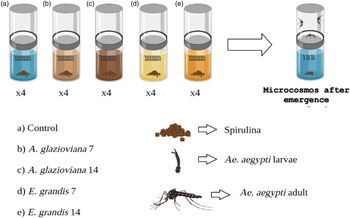
To obtain leaf leachates, leaves of A. glazioviana and E. grandis were collected from different locations in Chapecó, SC – Brazil. The collected leaves were transported to the laboratory, air-dried, and stored in the dark until further use. For each plant species, 100 g (OHAUS scale model ARD110) of dried leaves were leached in 8L of distilled water for 7 and 14 days (fig. 1) at 27°C (±2°C) and humidity of 70 to 80% (Beleza et al., Reference Beleza, Campos, Nunes and Pestana2019).
Experimental design to test the effects of Ateleia glazioviana and Eucalyptus grandis leaf leachates on A. aegypti survival.

Ae. aegypti eggs were obtained from the insectary at the Ecological Entomology Laboratory (LABENT-Eco; nº 001/CEUA/2022) at the Communitarian University of Chapecó Region (Unochapecó). Oviposition strips were placed in the experimental room of the laboratory and immersed in a Becker containing 1 l of tap water for 24 hours to allow the eggs to hatch (Cozzer et al., Reference Cozzer, Rezende, Lara, Machado, Magro and Simões2022). The larvae were then counted and transferred to the microcosms. The microcosm experiment was conducted at a temperature of 27°C (± 2°C), a humidity of 70 to 80%, and a 12:12 hours light:dark cycle (Cozzer et al., Reference Cozzer, Rezende, Lara, Machado, Magro and Simões2022).
Microcosms consisted of entomological traps used to capture emerging adults, each filled with 250 ml mineral water (hereinafter referred to as the control) or leaf leachate (hereinafter referred to as treatment; Cozzer et al., Reference Cozzer, Rezende, Lara, Machado, Magro and Simões2022). All microcosms received 10 first-instar larvae (0.04 larva/ml). A total of four treatments, in addition to the control, were tested with four replicates each, resulting in a total of 20 microcosms. Treatments were named based on plant species and leaching time as follows: Ag7 - A. glazioviana 7 days leachate, Ag14 - A. glazioviana 14 days leachate, Eg7 - E. grandis 7 days leachate, and Eg14 - E. grandis 14 days leachate. All treatments and the control were fed with 0.012 g of Spirulina Alcon (fig. 1) (Cozzer et al., Reference Cozzer, Rezende, Lara, Machado, Magro and Simões2022).
Experimental procedures
The time of adult emergence was recorded, and the adults were captured using entomological traps. Subsequently, the mosquitoes were sexed, and their left-wing length was measured in ventral view for allometric purposes (Hidalgo et al., Reference Hidalgo, Dujardin, Mouline, Dabiré, Renault and Simard2015). First, individuals were photographed using a Zeiss Stemi 305 binocular stereoscopic microscope, and then the images were used to obtain linear wing sizes in ImageJ v.1.51. All measurements, except for mortality, were taken from each individual. Mortality of Ae. aegypti was quantified as the percentage of larval mortality in the microcosm, calculated as:

where N larvae is the number of larvae at the start of the experiment and N adults is the number of emerged mosquitoes at the end of the experiment.
GC-MS analysis of leaves leachates
The chemical composition of the bioactive fraction in the A. glazioviana and E. grandis leaf leachates at the start of the experiment was determined using Gas Chromatography and Mass Spectrometry (GC-MS) with the headspace injection method. For each leachate, nine milliliters were transferred to a 15 ml HS vial, and then 1 ml of methanol was added. The GC-MS analyses were performed using the HS-trap method with an Agilent 7890B gas chromatograph coupled to a 5977A quadrupole mass spectrometer (Agilent Technologies, Palo Alto, CA, USA). As the HS sampler, a CTC-PAL sample injector from Agilent Technologies was used. The temperature of the HS-Trap oven was set to 70°C for 10 min. Helium was used as the carrier gas with a column head pressure of 150 kPa. The GC temperature program started at 40°C (held for 2 min), then increased to 200°C at a rate of 5°C/min, and further increased to 300°C at a rate of 40°C/min (held for 3 min). The MS transfer line temperature was set to 250°C and the ion sources temperature was set to 230°C. An electron ionization system was used for GC-MS detection with an ionization energy of 70 eV and a mass range of m/z 40–400. The analytes were detected in time windows and identified using the NIST-MS library search. Leachate compounds were identified by comparing their mass spectra with those in the National Institute of Standards and Technology (NIST 5.01) libraries provided by the computer controlling the GC-MS system (Agilent P/N G1033A).
Statistical analysis
Larval mortality, emergence time, and adult size (for both females and males separately) were evaluated as response variables among treatments (Ag7, Ag14, Eg7, and Eg14), as well as the control, using One Way Generalized Linear Models (GLM). For all four GLMs, a Gaussian error distribution was used (link = identity, test = F; Crawley, Reference Crawley and Crawley2007). Contrast analyses were also conducted to assess the differences between the response variables in an orthogonal post-hoc test among different treatments using the ‘vegan’ package. In contrast analyses, the response variable was ranked from lowest to highest mean and tested pairwise. Subsequently, the model was gradually simplified by sequentially adding treatment values that did not affect the model and testing with the next variable in the sequence [for more details, see chapter 9 in (Crawley, Reference Crawley and Crawley2007)]. All GLMs were adjusted to correct for cases of under or overdispersion (Crawley, Reference Crawley and Crawley2007).
The effect size was calculated by comparing treatments to the control using a method analogous to the response ratio commonly used in meta-analysis (Koricheva et al., Reference Koricheva, Gurevitch and Mengersen2013). The ratios were calculated for larval mortality and adult size (separately for female and male) between each treatment and the control of their respective sample battery. The ratio was calculated for each replicate. Then, to provide a consistent estimate of the magnitude of change from the null value, the values of larval mortality and adult size (separately for female and male) were log-transformed. Subsequently, 95% confidence intervals were obtained with 1000 bootstrap replicates (Davison and Hinkley, Reference Davison and Hinkley1997) and used to test whether the magnitude and direction for each treatment were different from the control using the BCa method, as implemented in the ‘boot’ function and package (Canty and Ripley, Reference Canty and Ripley2016). All analyses were performed using the R statistical program version 3.6.2 (R Development Core Team, 2014).
Results
Chemistry of the leaf leachate extract
The chemical analysis of A. glazioviana and E. grandis leachates showed the presence of at least ten compounds, with five of them exclusively found on E. grandis leachates and one compound exclusive to A. glazioviana. β-Sitosterol was the main compound found in E. grandis 7 days leachate (74.76%), whereas significant amounts of α-Amyrin (41.95%) and Lupeol (26.71%) were found in E. grandis 14 days leachate (table 1). Stigmasterol was primarily found in A. glazioviana 7 days leachate (70.63%) and was also present in E. grandis 7 days leachate (9.61%). 1-Heptatriocotanol (37.53%) and 2-[4-methyl-6-(26,6-trimethylcyclohex-1-enyl)hexa-13,5-trienyl]cyclohex-1-en-1-carboxaldehyde (59.3%) were the main compounds found in A. glazioviana 14 days leachate. Although 1-Heptatriocotanol was also present in E. grandis 14 days leachate, it was found in a lower amount (9.12%).
Chemical compounds of Eucalyptus grandis and Ateleia glazioviana leaf leachates

Larval mortality, emergence time, and adult size
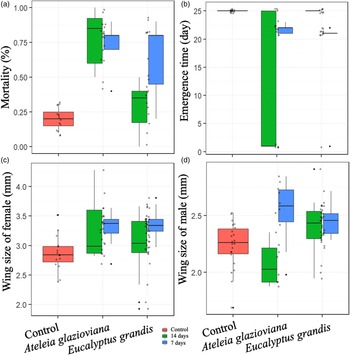
Leachate treatments had a significant effect on Ae. aegypti larval mortality (fig. 2a; table 2a). Mean larval mortality was lower in the control (20 ± 7%; hereinafter, all values are expressed as mean ± SD) and the treatment with E. grandis 14 days leachate (30 ± 17%), with no significant differences between these two (fig. 2a; table 2a). In contrast, the mortality rates of Ae. aegypti were increased by E. grandis 7 days leachate (63 ± 25%) and both A. glazioviana leachates compared to the control (fig. 2a; table 2b). Additionally, there were no significant differences in larval mortality between the 7-day (74 ± 14%) and 14-day (79 ± 19%) leaching times for A. glazoviana leachates. On the other hand, the effect size (treatments vs. control) was significant for all treatments, resulting in an increased Ae. aegypti mortality compared to the control (mean increase: Ag7 = 56%, Eg7 = 46%, Ag14 = 58%, and Eg14 = 18%; Fig. 3a).
Responses in larval mortality (a), emergence time (b) and adult size (female – c – and male – d, separately) to different treatments (control, Ateleia glazioviana 7 days and 14 days leachates and Eucalyptus grandis 7 days and 14 days leachates). The boxes represent the quartiles, the average is indicated by a horizontal black bar, the vertical lines represent the upper and lower limits, open circles represent the sampling units, and closed circles represent the extreme values (outliers).

We employed Generalized Linear Models (GLMs) to investigate the impact of plant species and leaching time (A. glazioviana 7 days leachate ‘Ag7’, A. glazioviana 14 days leachate ‘Ag14’, E. grandis 7 days leachate ‘Eg7’, E. grandis 14 days leachate ‘Eg14’, and control) on larval mortality (a), emergence time (b), and adult size (separately for females - c - and males - d -)

Additionally, orthogonal contrast analyses were conducted to assess the differences among the treatments. The results, including degrees of freedom (DF), residual deviance (Dev), F-statistic, and p-values (Pr > F), provide insights into the effects of the experimental variables
Size and direction of the effect of plant species and leaching time on larval mortality (a) and adult size (b) expressed by the logarithmic relationships between the different treatments (Ateleia glazioviana 7 days and 14 days leachates and Eucalyptus grandis 7 days and 14 days leachates) and their respective controls. Circles represent the means, and the lines depict the 95% confidence intervals. Black circles indicate statistically significant results, with intervals that reject the null hypothesis (indicated by not touching the dashed line at the 0 effect size). Open circles represent statistically non-significant results, with intervals that do not reject the null hypothesis (indicated by touching the dashed line at the 0 effect size).

Leachate treatments had a significant effect on adult Ae. aegypti emergence time (fig. 2b; table 2b). Compared to the control (25 ± 0 days), the emergence times of Ae. aegypti were shorter in A. glazioviana 7 days leachate treatment (21.78 ± 0.6 days), A. glazioviana 14 days leachate treatment (10 ± 2 days), and E. grandis 7 days leachate treatment (21 ± 5 days) (fig. 2b; table 2b). In contrast, the emergence time of Ae. aegypti did not differ between the E. grandis 14 days leachate treatment (25 ± 0 days) and the control (fig. 2b; table 2b).
Leachate treatments had a significant effect on both female and male wing sizes (fig. 2d; table 2d). In the 7 days leachate treatments, both males (Ag7 = 2.534 ± 0.276 mm; Eg7 = 2.44 ± 0.132 mm) and females (Ag7 = 3.305 ± 0.243 mm; Eg7 = 3.346 ± 0.193 mm) had larger wing sizes compared to the control (males = 2.238 ± 0.204 mm; females = 2.871 ± 0.296 mm) and 14 days leachate treatments (males: Ag14 = 2.073 ± 0.199; Eg14 = 2.402 ± 0.216; females: Ag14 = 3.275 ± 0.554; Eg14 = 3.040 ± 0.485). When assessing the effect size, we found that females in the 7 days leachate treatments were, on average, 14% larger compared to the control, while males in the 7 days leachate treatments were 7% larger. Adult sizes did not differ from the control in both A. glazioviana and E. grandis 14 days leachate treatments (fig. 3b).
Discussion
Larval mortality
The compounds present in A. glazioviana and E. grandis leachates are potentially toxic to Ae. aegypti larvae. Despite the scarcity of studies, some of these compounds are known for their larvicidal effects (Gade et al., Reference Gade, Rajamanikyam, Vadlapudi, Nukala, Aluvala, Giddigari, Karanam, Barua, Pandey, Upadhyayula, Sripadi, Amanchy and Upadhyayula2017). Specifically, Stigmasterol, the main compound found in A. glazioviana 7 days leachate, has been reported to cause Ae. aegypti larval mortality by inhibiting acetylcholinesterase activity (Gade et al., Reference Gade, Rajamanikyam, Vadlapudi, Nukala, Aluvala, Giddigari, Karanam, Barua, Pandey, Upadhyayula, Sripadi, Amanchy and Upadhyayula2017). Additionally, the presence of 2-[4-methyl-6-(26,6-trimethylcyclohex-1-enyl)hexa-13,5-trienyl]cyclohex-1-en-1-carboxaldehyde, which is mostly a terpenoid (Erharuyi et al., Reference Erharuyi, Imieje, Oseghale, Ubhenin, Falodun and Choudhary2017), can enhance cellular uptake, thereby amplifying the effect of Stigmasterol (Simas et al., Reference Simas, Lima, Conceição, Kuster, Oliveira Filho and Lage2004), resulting in elevated larval mortality even at lower concentrations of Stigmasterol. On the other hand, compounds found in A. glazioviana leachates have been found to block cellular uptake (Singer and Ramsay, Reference Singer and Ramsay1994) and inhibit mitochondrial respiration in Ae. aegypti, leading to larval mortality (Mascaro et al., Reference Mascaro, Rodrigues, Bastos, Santos and Costa1998).
Regarding 1-Heptatriacotanol, there is no study evidencing its larvicidal activity on Ae. aegypti. However, it is known that 1-Heptatriacotanol is an alcoholic compound that exhibits antimicrobial activities (Erharuyi et al., Reference Erharuyi, Imieje, Oseghale, Ubhenin, Falodun and Choudhary2017). Thus, considering the high amounts of this compound in A. glazioviana leachate, further studies could focus on determining its larvicidal effects on Ae. aegypti by decreasing microbial biomass, one of the main larvae food resources. Similarly, Eucalyptol has been shown to inhibit bacterial proliferation in microcosms (Mączka et al., Reference Mączka, Duda-Madej, Górny, Grabarczyk and Wińska2021; Saleemi et al., Reference Saleemi, Yahaya, Zain, Raoov, Yong, Noor and Lim2022). Although a low amount of this compound was found in A. glazioviana leachate, we cannot rule out its potential to diminish microbial biomass, leading to a decrease in food resources for Ae. aegypti larvae and potentially increasing larval mortality due to starvation (Mączka et al., Reference Mączka, Duda-Madej, Górny, Grabarczyk and Wińska2021; Saleemi et al., Reference Saleemi, Yahaya, Zain, Raoov, Yong, Noor and Lim2022). Additionally, Eucalyptol has also been shown to have anti-herbivory and larvicidal properties (Ebadollahi, Reference Ebadollahi2013).
E. grandis leachates contain the same compounds discussed for A. glazioviana, except for carboxaldehyde. β-Sitosterol and Hexacosane were the major compounds found in E. grandis 7 days leachate, and α-Amyrin and Lupeol were the major compounds in 14 days leachate. The larvicidal property of β-Sitosterol is associated with its neurotoxicity in organisms (Viana, Reference Viana2018). Similarly, Hexacosan acts by inhibiting acetylcholinesterase activity in Ae. aegypti, disrupting normal cholinergic neuronal transmission in the mosquito (Gade et al., Reference Gade, Rajamanikyam, Vadlapudi, Nukala, Aluvala, Giddigari, Karanam, Barua, Pandey, Upadhyayula, Sripadi, Amanchy and Upadhyayula2017). Additionally, previous studies have demonstrated the larvicidal potential of α-Amyrin and Lupeol on culicid larval mortality (Kuppusamy et al., Reference Kuppusamy, Murugan, Arul and Yasodha2009). Larval mortality increases with increasing concentrations of α-Amyrin (Kuppusamy et al., Reference Kuppusamy, Murugan, Arul and Yasodha2009), and Lupeol shows strong larvicidal effects on insects (Nobsathian et al., Reference Nobsathian, Bullangpoti, Kumrungsee, Wongsa and Ruttanakum2018). Therefore, the greater toxicity of A. glazioviana can be attributed to the high concentrations of Stigmasterol and 1-Heptatriacotanol, whereas larval mortality in E. grandis treatments may be linked to the wider range of compounds with potential larvicidal effects, as E. grandis leachates had lower concentrations of Stigmasterol and 1-Heptatriacotanol.
Emergence time
A. glazioviana (at 7 and 14 days) and E. grandis (at 7 days) treatments reduced emergence time compared to the control and E. grandis at 14 days. We infer that this is an effect of increased toxicity in the treatments. Toxic compounds found in A. glazioviana and E. grandis leachates caused the mortality of individuals (Gava et al., Reference Gava, Barros, Pilati, Barros and Mori2001, Reference Gava, Molossi, Ogliari, Melchioretto, Pasquali and Roso2021), leading to an increase in the amount of organic matter in the system due to the decomposition of co-specific individuals (Fader and Juliano, Reference Fader and Juliano2014). The organic matter input derived from decomposed larvae enriches the system and, coupled with reduced competition, shortens the adult emergence time of the surviving larvae, accelerating their exit from the hostile system caused by leachate toxicity (Erharuyi et al., Reference Erharuyi, Imieje, Oseghale, Ubhenin, Falodun and Choudhary2017). This result may also support a density-dependent regulatory mechanism in the immature stages of Ae. aegypti (Legros et al., Reference Legros, Magori, Morrison, Xu, Scott, Lloyd and Gould2011; Cozzer et al., Reference Cozzer, Rezende, Lutinski, Júnior, Busato and Simões2021). The overcompensatory density-dependence process in Ae. aegypti larvae can raise serious concerns for the implementation of control methods, as it may increase the fitness of natural populations (Legros et al., Reference Legros, Magori, Morrison, Xu, Scott, Lloyd and Gould2011).
Nevertheless, some compounds also may quickly deteriorate or decompose after leaching (Rezende et al., Reference Rezende, Medeiros, Gonçalves, Feio, Gusmão, Gomes, Calor and Almeida2019; Cozzer et al., Reference Cozzer, Rezende, Lutinski, Júnior, Busato and Simões2021), or even be consumed by microorganisms (Rezende et al., Reference Rezende, Cararo, Chimello, Lima-Rezende, Albeny-Simões, Dal Magro and Gonçalves2021) or invertebrates (Sena et al., Reference Sena, Gonçalves, Martins, Hamada and Rezende2020; Rezende et al., Reference Rezende, Cararo, Bernardi, Chimello, Lima-Rezende, Moretto and Gonçalves2023). Certain compounds found in E. grandis leachates can exhibit inhibitory activity (β-Sitosterol and Hexacosane) when present at high concentrations, but at low concentrations, they can act as a stimulant (Della Bruna et al., Reference Della Bruna, Fernandes, Borges, Filho and Barros1989; Subramaniam et al., Reference Subramaniam, Keerthiraja and Sivasubramanian2014). High concentrations of β-Sitosterol and Hexacosane were found in E. grandis 7 days leachate, whereas these compounds were not detected in E. grandis 14 days leachate, possibly explaining the high larval mortality at 7 days leachate and a non-significant larval mortality in the 14 days leachate treatment. This result suggests that a specific leaf litter, even with toxic potential, may benefit the larval development of Ae. aegypti during a certain stage of the leaf decomposition process. This result can also raise concerns, as it indicates that even toxic leaf litter can increase the fitness of natural populations of Ae. aegypti during a specific period.
Adult size
Females and males of Ae. aegypti were larger in the 7 days leached treatments compared to the control, regardless of the plant species. This result is attributed to the input of dissolved organic matter from the leachates, which increases resource availability and positively impacts the size of these organisms (Denno et al., Reference Denno, McClure and Ott1995). Additionally, the organic matter input from the death of co-specific individuals may have contributed to the increased resource availability for the survivors (Yee et al., Reference Yee, Kesavaraju and Juliano2007; Fader and Juliano, Reference Fader and Juliano2014). Our results showed that mosquitoes in 7 days leachate treatments were larger compared to those in 14 days leachates. This difference can be explained by the loss of leached organic matter and secondary metabolites due to microbial decomposition over the leaching process (Marangoni et al., Reference Marangoni, Moura and Garcia2013). Thus, mosquitoes exposed to leachates obtained from shorter leaching times incorporated more biomass compared to those exposed to leachates obtained from longer leaching times.
E. grandis 7 days leachate showed significant amounts of β-Sitosterol and Hexacosane. Phytosterols such as β-Sitosterol exhibit estrogenic effects (Ju et al., Reference Ju, Clausen, Allred, Almada and Helferich2004), whereas Hexacosane has been found to be part of insects’ sex pheromone (Wattanachaiyingcharoen et al., Reference Wattanachaiyinssgcharoen, Phanmuangma, Boonphong, Suphrom and Prasanpan2020). On the other hand, E. grandis 14 days leachate contained high levels of the triterpene α-Amyrin and the sterol Lupeol. The triterpene α-Amyrin, an oleanolic acid, possesses growth-regulating properties in insects (Kuppusamy et al., Reference Kuppusamy, Murugan, Arul and Yasodha2009), whilst the sterol Lupeol exhibits larvicidal effects against certain insect species (Nobsathian et al., Reference Nobsathian, Bullangpoti, Kumrungsee, Wongsa and Ruttanakum2018). Although the combination of α-Amyrin and Lupeol did not impact the mortality or emergence time of Ae. aegypti, it may have inhibited the growth of surviving individuals.
The effect size of 7 days leachate on female wing size was twice that observed in males, regardless of the plant species. This finding may be attributed to the shorter development period among males compared to females, a phenomenon known as protandry (Kleckner et al., Reference Kleckner, Hawley, Bradshaw, Holzapfel and Fisher1995), and previously described in Ae. aegypti. In this regard, the shorter emergence times of males may lead to smaller body sizes due to the intense competition resulting from the high larval density at the beginning of the experiment, which hampers their access to food resources. On the other hand, the reduced competition among females due to the early emergence of males enables females to attain larger sizes. Therefore, by accelerating emergence period of males, shorter leaching periods promote the emergence of even larger females.
Conclusion
Our study was conducted based on a microcosm experiment, and although it represents a simplification of natural systems, it provides important insights into the effects of plant species leachates, which occur in the study region, on the mosquito populations. We found that plant leachates had significant effects on larval mortality, emergence time, and wing sizes. These results are possibly associated with the presence of secondary metabolites that possess antimicrobial properties, thereby decreasing the availability of food for Ae. aegypti larvae.
Additionally, the presence of compounds with inhibitory, neurotoxic, and larvicidal effects on Ae. aegypti altered larval mortality and emergence time, consequently affecting the size of adult mosquitoes in comparison to the control treatment. The emergence time was reduced by A. glazioviana and E. grandis, possibly due to the input of dissolved organic matter present in the leachates and the toxicity of the leachates. The toxicity resulted in increased larval mortality and provided an additional resource input through the decomposition of dead larvae, thus alleviating density-dependent competition.
Furthermore, the abundance of resources also led to larger adults in treatments with shorter leaching times, potentially benefiting the fitness of surviving individuals, as larger adults tend to have more energy available for reproduction. This suggests that if the population is not eradicated, the plant compounds can serve as a strong significant resource for the growth of Ae. aegypti larvae, potentially increasing the fitness of the survivors. In conclusion, careful consideration should be given to plant selection in urban green space planning and management, particularly in the context of Ae. aegypti biocontrol, as it may lead to unexpected outcomes, such as the enlargement of pest organisms.
Data
Not applicable. All data is available on paper.
Acknowledgements
RSR are grateful to National Council for Scientific and Technological Development (CNPq) in projects number 403945/2021-6 and 302044/2022-1. We thank the logistic support from the Foundation to Support the Research and Innovation of State of Santa Catarina (FAPESC; TO N° 2021TR001802 and No 2020/TR135) and the Community University of the Chapecó Region (Unochapecó; Ar. 171 N° 23/2019 and UNIEDU N° 013/2019).
Authors’ contributions
R. S. R. conceived the study, I. B., G. D. C., E. R. C., R. D. B. and W. G. B. collected field data and performed the chemical analyses. R. S. R., J. D. M., and C. A. L.-R. managed and analyzed the data. I. B. wrote the manuscript with feedback from R. S. R., E. R. C., G. D. C., R. D. B., W. G. B., J. D. M., and C. A. L.-R.
Financial support
Not applicable.
Conflict of interest
The authors declare no conflicts of interest associated with this manuscript.
Ethical standards
The experimental procedures were conducted following ethical guidelines for invertebrate use in research. The authors have no conflicts of interest to disclose.
Code availability
Not applicable.
Consent to participate
All authors have contributed to the manuscript and approved the submitted version.
Consent for publication
All authors have read and approved the final manuscript and agree with its submission to Bulletin of Entomological Research.