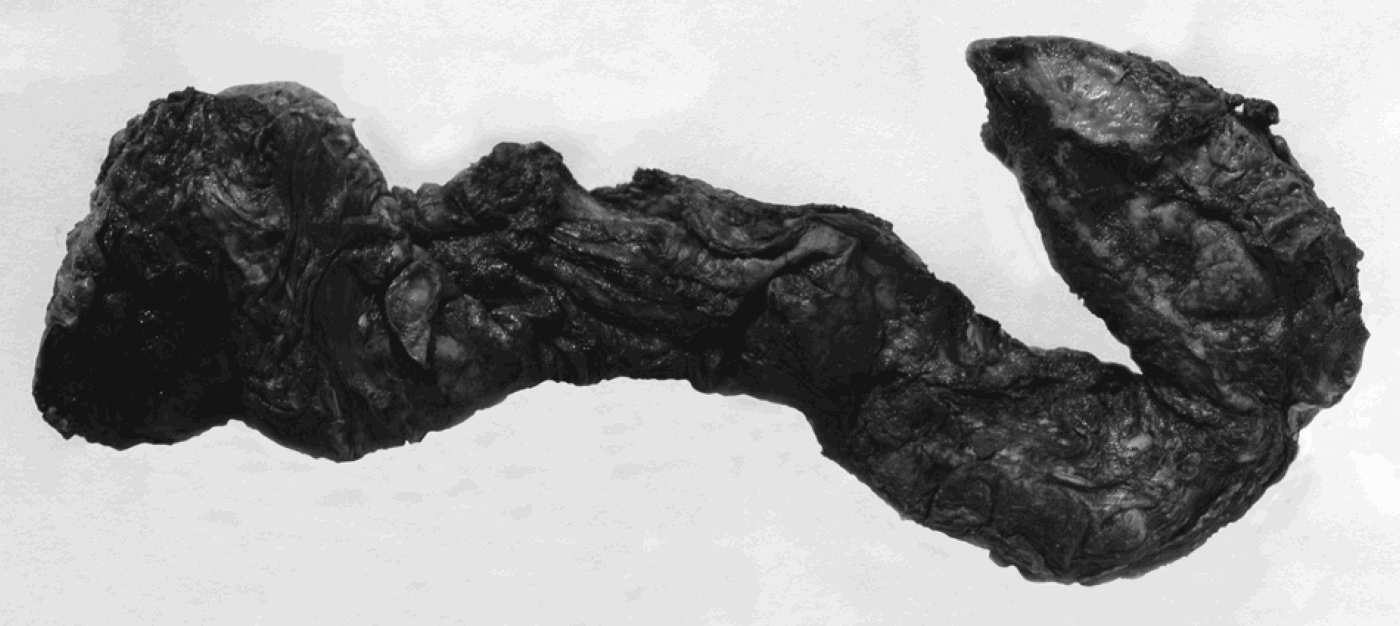
The asteroid species Solaster paxillatus Sladen, 1889 (Figure 1) was collected on the southern California abyssal plain off San Diego (32°N 120°W) in 1981. Two specimens found in the Scripps Institution of Oceanography Benthic Invertebrate Collection were collected in two separate trawls (3632–3689 m and 3660–3740 m). Solaster paxillatus occurs at bathyal depths in the North Pacific from Japan to the Channel Islands off central California. Solaster paxillatus has been collected to a depth of 1280 m in the Channel Islands (Clark, Reference Clark1913). There have been no previous records of any species of the asteroid family Solasteridae being found below 3000 m (e.g. Clark & Downey, Reference Clark and Downey1992). Therefore, this abyssal plain record for S. paxillatus is a bathymetric record for the asteroid family Solasteridae.
Solaster paxillatus.

The abyssal asteroid species Pythonaster pacificus Downey, Reference Downey1979 (Figure 2) is described from a single specimen found on the abyssal plain off southern California (Downey, Reference Downey1979). Since then an additional five specimens have been found in the Scripps Institution of Oceanography Benthic Invertebrate Collection and one additional specimen has been seen in benthic imagery. The additional specimen records of P. pacificus extend the range of the species from off the coast of Baja California to central California (23°59.5′ to 34°42.11′N) at a bathymetric range of 3165 to 4100 m.
Pythonaster pacificus.

There are four species in the asteroid genus Evoplosoma and specimens in this genus are few in number with all four species being extremely rare. Evoplosoma forcipifera Fisher, 1906 (Figure 3) is the only Pacific species and was described from a single specimen collected off Kauai, Hawaiian Islands in a trawl at 1016 to 1364 m. Two additional specimens of E. forcipifera were found in the Scripps Institution of Oceanography Benthic Invertebrate Collection and extend the range of the species to the western Pacific (1°20.815′S 175°20.68′E; 3988 to 4179 m) and to the far eastern Pacific (21°52′N 106°12′W; 730 m) to off the west coast of Mexico.
Evoplosoma forcipifera.

The holothurian species Laetmogone scotoides (Clark, Reference Clark1913) (Figure 4) was described from three specimens collected at 1290 m off the west coast of Baja California Sur, south-west of Ballenas Bay (Clark, Reference Clark1913). Solis-Marin et al. (Reference Solis-Marin, Reyes-Bonilla, Herrero-Perezul, Arizpe-Covarrubias and Laguarda-Figueras1997) reported that L. scotoides was collected off Espiritu Santo Island in La Paz Bay in the Gulf of California in Baja California Sur. In 2005 and 2007, Scripps Institution of Oceanography cruises to the San Diego Trough collected a total of seven specimens of L. scotoides off the coast of San Diego (32°N 117°W; 1210 m and 1215 m). Clark (Reference Clark1913) reported the original three specimens of L. scotoides collected off Ballenas Bay were between 150 and 200 mm in length. The longest measurement for a specimen of L. scotoides from the San Diego Trough was 250 mm. All seven specimens of L. scotoides from the San Diego Trough are in the Scripps Institution of Oceanography Benthic Invertebrate Collection. This is the first record of L. scotoides in the San Diego Trough and the first record for the species outside of the Baja California Sur area.
Laetmogone scotoides. Images courtesy of Dr William Newman of the Scripps Institution of Oceanography.