I. INTRODUCTION
One-dimensional (1D) nanostructured materials, such as nanorods, nanowires, nanotubes, and nanoribbons, have received extensive attention because of the novel optical, electrical, magnetic, and mechanical properties.Reference Kuchibhatla, Karakoti, Bera and Seal1 The fabrication of vanadium oxide 1D nanostructures has been researched intensively. A variety of methods, such as thermal evaporation, surfactant-assisted solution, and hydrothermal/solvothermal synthesis, have been developed to prepare vanadium oxides 1D nanostructures.Reference Chirayil, Zavalij and Whittingham2, Reference Livage3 Most of these methods need templates to induce the growth of vanadium oxide nanostructure. Li et al.Reference Chen, Sun and Li4 developed a self-assembling vanadium oxide nanotube method using organic molecular templates. Nesper et al.Reference Niederberger, Muhr, Krumeich, Bieri, Gunther and Nesper5 synthesized vanadium oxide nanotubes using either vanadium oxytrichloride (VOCl3) or vanadium pentoxide (V2O5) as the vanadium source and primary amines as templates or intercalates, respectively.
CNTs, as a novel carbon material in the nanometer scale, have attracted great interest due to their unique structure and superior electronic properties.Reference Jong and Geus6 Further, their ability to host other materials and to be used as hybrid nanostructures has received increased attention in recent years. In 1995, vanadium oxide-CNTs composites were first prepared by annealing a mixture of CNTs and V2O5 powder in air above the melting point of vanadium oxide.Reference Ajayan, Stephan, Redlich and Colliex7 Such nanocomposites can also be synthesized by coating the surface of nitric acid-treated CNTs with vanadic acid.Reference Satishkumar, Govindaraj, Nath and Rao8 The CNTs, as geometric templates, can be removed to produce vanadium oxide nanorods in these nanocomposites. In 2002, vanadium oxide-CNTs nanocomposites were synthesized by sol-gel method.Reference Sakamoto and Dunn9, Reference Winny, Jeffrey and Bruce10 In 2007, vanadium oxide-CNTs composites were prepared by solution-based hydrolysis of ammonium metavanadate (NH4VO3) in the presence of carbon nanotubes.Reference Chen, Zhu, Hävecker, Su and Schlögl11 Recently, vanadium oxide-CNTs composites were synthesized via in situ hydrothermal process.Reference Chen, Qin, Weng, Xiao, Peng, Wang, Li, Wei and Lu12
The researchers have focused on the synthesis method of 1D nanostructures of vanadium oxide, but the formation mechanism of such composites has seldom been mentioned. Herein, a series of intermediate products were synthesized according to the hydrothermal reaction time. The changes in the morphology and phase structure images indicate that the CNTs play a host role and inducer role in the formation process of vanadium oxide nanorods (VONRs) and vanadium oxide nanotubes (VONTs).
II. EXPERIMENTAL PROCEDURES
A. The functionalization of CNTs
CNTs were functionalized by attaching carboxylic and hydroxyl groups on the surfaces using the following method. Briefly, pristine CNTs (1.0 g), nitric acid (HNO3; 65%, 15 mL), and sulfuric acid (H2SO4; 98%, 45 mL) were mixed and stirred vigorously, then ultrasonicated for 7 h. The mixture was diluted with deionized water, filtered, and redispersed in water. This process was repeated until the pH of the filtrate was around 7. Then, modified CNTs were dried for use.
B. The synthesized of VONRs and VONTs
The VONRs and VONTs were synthesized by hydrothermal method. The vanadium oxide sol was synthesized by melting crystalline V2O5 at ∼800 °C and pouring the melt into deionized water under vigorous stirring. The resulting dark red solution transformed into gel within 4 days. Pretreated CNTs were added into the vanadium oxide sol and ultrasonically dispersed for 30 min. The mixture was hydrothermally treated in a 100 ml polytetrafluoroethylene (PTFE)-lined autoclave at 180 °C for 6–148 h, and then it was cooled to room temperature in natural ambient air. The intermediate products were taken from different autoclaves but in the same sol volume, temperature and pH after hydrothermal reactions at different times. Last, the products were dried in ambient pressure at 80 °C and collected for their characterization.
C. Material characterization
X-ray powder diffraction patterns of the prepared samples were recorded using a diffractometer (XRD; model X’pert PRO-PANalytical, Netherlands with Cu Kα radiation). The structure of products was observed using field emission scanning electron microscopy (FESEM; model no. JSM-6700F, JEOL, Tokyo, Japan), scanning electron microscopy (SEM; model no. JSM-5610LV, JEOL, Tokyo, Japan) and transmission electron microscopy (TEM; model no. JEOL JEM 2100F, Tokyo, Japan). Fourier transform infrared spectroscopy tests were recorded on a spectrometer (FTIR; Nicolet model no SXB-60 IR, Thermo Nicolet, Madison, WI).
III. RESULTS AND DISCUSSION
A. TEM, XRD and FTIR results of surface-functionalized CNTs
A mixture of H2SO4; and HNO3 was used to form carboxylic acid groups on the surface of the CNTs.Reference Lin, Rao, Sadanadan, Kenik and Sun13 Previous research shows that carboxylic acid and hydroxyl groups are formed mostly in the ends and little along the nanotube walls.Reference Jiang, Eitan, Schadler, Ajayan, Siegel, Grobert, Mayne, Reyes, Rerrones and Terrones14 This finding is extremely important when considering the active tubes as a kind of catalyst.
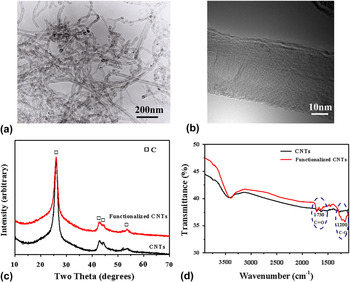
Figures 1(a) and 1(b) show the TEM images of CNTs before and after the mixed acid treatment. The CNTs have a length of about several micrometers and outer diameter about 40 nm before the mixed acid treatment. Figure 1(b) shows that the surface of the functionalized CNTs is rougher than that of untreated CNTs [as seen in Fig. 1(a)]. Figure 1(c) shows XRD patterns of CNTs and functionalized CNTs, the main diffraction planes of the CNTs show almost no change. As shown in Fig. 1(d), the peaks at 3430 cm−1 is attributed to the H–O–H vibration in adsorbent water. It is obvious that the peaks at 1730 and 1200 cm−1 were generated after treatment, and corresponded to the C=O and C–O vibration, respectively. It shows that raw CNTs are attached to negatively charged groups (carboxylic and hydroxyl groups).
TEM images of (a) CNTs, (b) functionalized CNTs, (c) XRD patterns of CNTs and functionalized CNTs, and (d) FTIR spectra of the CNTs and functionalized CNTs.

B. Formation mechanism of VONRs and VONTs with functionalized CNTs
Hydrothermal synthesis refers to the synthesis by chemical reactions of substances in a sealed heated solution above ambient temperature and pressure.Reference Zhu, Mei, Wang and Qian15 Herein, we discovered the formation process of the VONRs and VONTs with the induction of functionalized CNTs. To explore the formation mechanism of the VONRs and VONTs, the evolution process of the typical products was examined thoroughly by detailed XRD, FESEM and TEM.
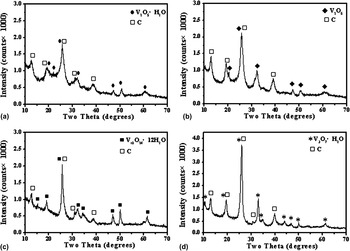
As shown in Fig. 2(a), when the reaction was carried out for 6 h, the diffraction peaks of the main intermediate products can be indexed as the 00l reflections for the layered phase V2O5·H2O [Joint Committee on Powder Diffraction Standards (JCPDS) Card No. 21-1432], and the other diffraction peaks can be indexed as the graphite of the CNTs. When the reaction time was prolonged to 12 h, the XRD patterns of the intermediate product [Fig. 2(b)] displayed the characteristic peaks of the 00l reflections for the layered phase V2O5 (JCPDS Card No. 41-1426) and CNTs. When the reaction was carried out for 18 h [Fig. 2(c)], the peaks corresponded to the main diffraction planes of V10O24·10H2O (JCPDS Card No. 25-1006) and CNTs. For the intermediate reduction time of 24 h [Fig. 2(d)], the peaks correspond to the main diffraction planes of V3O7·H2O (JCPDS Card No. 28-1433) and CNTs. As the intermediate products carried out from 6 to 24 h, the full width at half maximum (FWHM) of the XRD patterns decrease, and the diffraction peaks become sharper. It indicates that the crystallinity increases and the intermediate product become more spherical with increasing hydrothermal reaction time.Reference Pan, Zhang, Nie, Cao, Arey, Li, Liang and Liu16
XRD patterns of the intermediate products at the reaction time of (a) 6 h, (b) 12 h, (c) 18 h, and (d) 24 h.

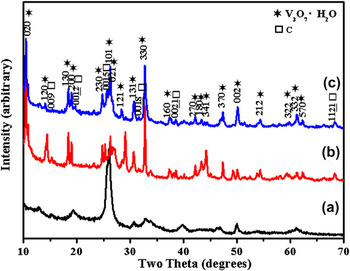
Figure 3 shows the XRD patterns of the intermediate products at the reaction time of (a) 3 days, (b) 5 days, and (c) 7 days. When the reaction was carried out for 7 days, the diffraction planes of orthorhombic V3O7·H2O (JCPDS Card No. 28-1433) appear. From the results in Figures 3(a) and 3(b), it is observed that when the reaction time was increased from 3 to 5 days, the XRD patterns of the intermediate product still displayed the characteristic peaks of V3O7·H2O and CNTs. After 7 days of hydrothermal reaction, all the diffraction peaks could be indexed as the orthorhombic phase of V3O7·H2O, indicating that most of the intercalated water in the V2O5 sol was driven out and the orthorhombic phase of V3O7·H2O was obtained.
XRD patterns of the intermediate products at the reaction time of (a) 3 days, (b) 5 days, and (c) 7 days.

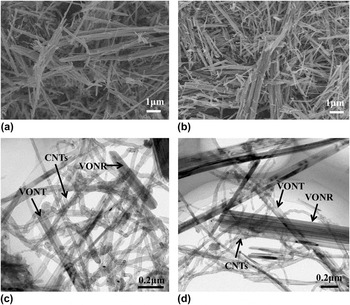
Figure 4 shows FESEM images of the intermediate products at the reaction time of (a) 1 day, and (b) 7 days, TEM images of the intermediate products at the reaction time of (a) 1 day, and (b) 7 days. As observed, the rough and straight products are the VONRs and VONTs, the small curved tubes are the carbon nanotubes. The morphology of the VONRs and VONTs change little after 1 day. The VONRs and VONTs have diameters of 100–200 nm and lengths of several micrometers. The VONRs, VONTs and CNTs form a three-dimensional network structure.
FESEM images of the intermediate products at the reaction time of (a) 1 day, and (b) 7 days, TEM images of the intermediate products at the reaction time of (a) 1 day, and (b) 7 days.

When the hydrothermal reaction was carried out in 24 h, the vanadium sol transforms to VONRs and VONTs, the phase structure transforms from V2O5 H2O to V2O5, V10O24·10H2O and V3O7·H2O. When the reaction time increased from 24 h to 7 days the phase structure of the vanadium oxide remains V3O7·H2O and the morphological evolution of the intermediate products do not change.
1. Phase transformation mechanism
In aqueous solutions, V5+ ions are solvated by dipolar water molecules. However, because of the strong polarizing power of the small and highly charged V5+ ion, coordinated water molecules are partially deprotonated and the solution becomes more acidic.Reference Livage3 It can be easily predicted in the frame of the so-called “partial charge model” based on the electronegativity equalization principle.Reference Livage, Henry and Sanchez17 Therefore coordination expansion mainly occurs via water addition as follows:
 $${\rm{[VO(OH)}}_{{\rm{3}}\,} ]^0 + {\rm{2H}}_{\rm{2}} 0 \to {\rm{[VO(OH)}}_{\rm{3}} {\rm{(OH}}_{\rm{2}} {\rm{)}}_{\rm{2}} ]^0 \quad.$$
The functional groups on the surface of CNTs not only facilitate the dispersion of CNTs but also serve as centers for polymerization and condensation of vanadium oxy-trihydroxide formed during slow hydrolysis of vanadium oxy-tripropoxide.Reference Sathiya, Prakash, Ramesha, Tarascon and Shukla18 In the synthetic progress, the phase transformation mechanism is divided into four main steps: In the first step, the functionalized CNTs with hydroxyl, carboxyl and carbonyl groups could serve as reaction centers. On the other hand, -OH groups were more negatively charging (δ = −0.2) in H2O than in vanadium oxytrihydroxide [VO(OH)3] sol particles (δ = −0.09). Vanadium oxide became 6-fold coordinated and dehydration condensation reaction occurred in which both a good nucleophilic OH group (δ = −0.14) and an easily leaving water molecule (δ = +0.10) were present. Then the reaction via olation occurs along H2O-V-OH, as seen in Eq. (1). In the second step, the layered ribbon-like vanadium oxide formed due to oxolation process.Reference Livage, Henry and Sanchez17 Vanadium oxide phases containing mixed valence (V5+ and V4+) crystallize in the network structures; they can be regarded as layered structures in which VO5 square pyramids are connected by sharing corners and edges.Reference Krumeich, Muhr, Niederberger, Bieri, Schnyder and Nesper19 And then, the vanadium oxide could grow in terms of the oxolation process, as seen in Eq. (2). In the third step, the water molecule in the layered structures of the vanadium oxide is missing, the V2O5·H2O phase transforms to V2O5. And in this step, some vanadium in the +5 oxidation state was reduced to that of +4 oxidation state in the presence of CNTs-COOH, and due to the difficulty in adjusting the relative concentrations of V5+ and V4+ dissolved from a stable V2O5 matrix under the mild hydrothermal condition, the metastable V10O24·10H2O is formed,Reference Chang and Hu20 as seen in Eq. (3). Moreover, the transition of V2O5·H2O phase to V3O7·H2O phase from XRD (Figs. 2 and 3) was due to the reaction at adequate time in hydrothermal system,Reference Zakharova, Volkov, Täschner, Hellmannb, Leonhardt, Klingeler and Büchnerb21 as seen in Eq. (4).
 $$[{\rm{VO(OH)}}_{\rm{3}} {\rm{(OH}}_{\rm{2}} {\rm{)}}_{\rm{2}} ]^0 + {\rm{CNTs - COOH}} \to {\rm{CNTs - CO - [ - OH - VO(OH)}}_{\rm{3}} {\rm{(OH)}}_{\rm{2}} ]^0 \quad,$$
 $$({\rm{2CNTs}}^{\rm{ - }} ){\rm{ - CO - 2[ - OH - VO(OH)}}_{\rm{3}} {\rm{(OH}}_{\rm{2}} {\rm{)]}}^{\rm{0}} + 2{\rm{H}}^{\rm{ + }} \to (2{\rm{CNTs) - CO - V}}_{\rm{2}} {\rm{O}}_{\rm{5}} \cdot {\rm{H}}_{\rm{2}} {\rm{O + 7H}}_{\rm{2}} {\rm{O\quad,}}$$
 $$4{\rm{V}}_{\rm{2}} {\rm{O}}_{\rm{5}} + (3{\rm{CNTs}}^{\rm{ - }} ) - {\rm{COOH + 2[VO(OH}}_{\rm{2}} )_2 ]^0 + 3{\rm{H}}^{\rm{ + }} \to {\rm{V}}_{{\rm{10}}} {\rm{O}}_{{\rm{24}}} \cdot 10{\rm{H}}_{\rm{2}} {\rm{O + CO}}_{\rm{2}} + 10{\rm{H}}_{\rm{2}} {\rm{O + 3CNTs,}}$$
 $$3{\rm{V}}_{\rm{2}} {\rm{O}}_{\rm{5}} \cdot {\rm{H}}_{\rm{2}} {\rm{O + 2CNTs - COOH + H}}_{\rm{2}} {\rm{O}} \to {\rm{2V}}_{\rm{3}} {\rm{O}}_{\rm{7}} \cdot {\rm{H}}_{\rm{2}} {\rm{O + 3H}}_{\rm{2}} {\rm{O + 2CO}}_{\rm{2}} {\rm{(g) + 2CNTs}}{\rm{\quad.}}$$
2. Formation mechanism of VONRs and VONTs
Basically, the mechanism of hydrothermal reactions follows a liquid nucleation model. The reaction mechanism involves mainly diffusion of atoms or ions at the interface between reactants.Reference Feng and Xu22 In this study, we find that vanadium oxide sol can grow into both nanotubes and nanorods under hydrothermal treatment induced by functionalized CNTs. It can be ascribed to that the layered structure of vanadium oxide followed two growth paths in the self-assembly process. We propose that these two growth directions can develop two nanostructures. The formation of the vanadium oxide nanotubes occurs by a “Rolling” mechanism and the nanorods by an “Attaching-Oriented Attachment Growth” mechanism.
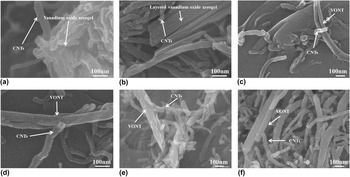
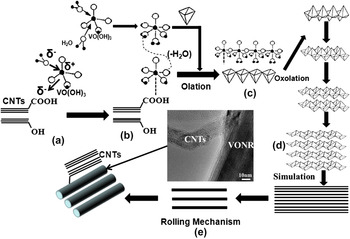
Figures 5 and 6 show the process of “Rolling” mechanism. The process can be divided into three main steps: First, vanadium oxy-trihydroxide anchored via functional groups further undergoes coordination expansion through nucleophilic addition of carboxylic and hydroxyl groups on the end of CNTs, as seen in Fig. 5(a) and Figs. 6(a) and 6(b). Second, the condensation process continued and resulted in more ordered lamellar assemblies, as seen in Fig. 5(b) and Figs. 6(c) and 6(d). Third, these lamellar sheets became loose at the edges and then rolled into themselves to finally form vanadium oxide nanotubes,Reference Chen, Sun and Li4 as seen in Figs. 5(c)–5(f) and Fig. 6(e).
FESEM images of VONTs at the reaction time of (a) 6 h, (b) 12 h, (c) 14 h, (d) 16 h, (e) 18 h, and (f) 24 h.

Schematic illustration of the formation mechanism of VONTs.

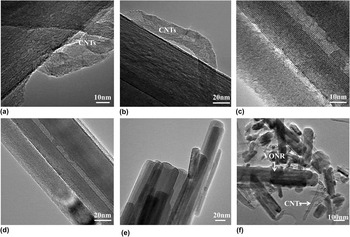
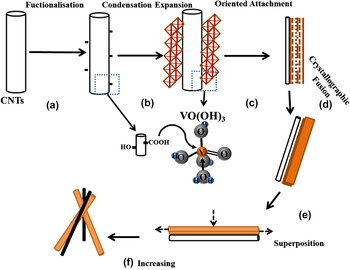
Figures 7 and 8 show the process of “Attaching-Oriented Attachment Growth” mechanism. The process can be divided into two main steps: First, vanadium oxy-trihydroxide condensation occurring through the surface functional groups of the CNTs in horizontal fashion, and the spontaneous attachment growth can be maintained and even enhanced under hydrothermal conditions, as seen in Figs. 7(a) and 7(b) and Figs. 8(a)–8(c). Second, the vanadium oxide sol grains extend the lamellar structures and crystallize, as seen in Figs. 7(b) and 7(c) and Figs. 8(c) and 8(d). Then, the subsequent coalescence leads to the formation of belt-like structure, as seen in Fig. 7(c), the survival of the interfaces is due to the further aggregation of the separated belt-like structure that further decreases the surface energy, which leads to the slight increase in size. And last, several belt-like structures superimpose together to form the VONRs, as seen in Figs. 7(e) and 7(f) and Figs. 8(e) and 8(f). This process is followed by “Oriented Attachment Growth” mechanism, which has been reported by several researchers.Reference Li, Kong, Wang and Li23, Reference Banfield, Welch, Zhang, Ebert and Penn24
TEM images of VONRs at the reaction time of (a) 6 h, (b) 12 h, (c) 14 h, (d) 16 h, (e) 18 h, and (f) 24 h.

Schematic illustration of the formation mechanism of VONRs.

IV. CONCLUSIONS
In summary, a novel hydrothermal route has been demonstrated to synthesize nanostructure of vanadium oxide by using V2O5 sol and functionalized CNTs as precursor. When the hydrothermal reaction was carried out for 24 h, the vanadium sol transforms to VONRs and VONTs, the phase structure transformed from V2O5·H2O to V2O5, V10O24·10H2O and V3O7·H2O. When the reaction time increased from 24 h to 7 days the phase structure remains V3O7·H2O and the morphology keeps to VONR and VONT. The self-assembled process of the VONRs and VONTs are probably described by “Rolling” and “Attaching-Oriented Attachment Growth” mechanism.
ACKNOWLEDGMENTS
Supported by National Natural Science Foundation of China (50872101, 51072152, A3 Foresight Program-51161140399) and a joint project of National Nature Science Foundation of China and Russian Foundation for Basic Research (NSFC-RFBR 51011120252).