On the floor of the church of Santa Maria Novella in Florence lies a small plaque marking the resting place of Jacopo Peri (1561–1633), easy to miss, particularly on crowded days in the church, where guides lead throngs of tourists to the breathtaking frescoes of the Tornabuoni and Strozzi chapels. Etched on this unremarkable monument is a strikingly profound epitaph: qui giace iacopo peri, creatore del melodramma (Here lies Jacopo Peri, Creator of the Melodramma).Footnote 1 The message does not simply encompass the totality of Peri as a historical musical figure, it articulates the very attributes that have shaped the telling of music history since the eighteenth century: Peri is the ‘creatore’ (the first composer) of ‘the melodramma’ (the genre of opera). Peri’s memorial is a visual announcement of the historiography of music as one primarily concerned with great composers and landmark works, neatly summarising the required credentials for monumentalising the musical past.
As far as musicology has come since the 1980s in producing and promoting historical narratives beyond great composers and works, Peri’s memorial is a living, tangible reminder that the historiographical attitude it projects is ever present, and will remain so for as long as the monument is ensconced in the church floor for all to see. Visitors to the plaque are still witnesses to its potent and seemingly permanent message, and in all likelihood without a musicologist in tow to remind them of how much the historiographical framework for writing music history has diversified since the 1980s. Musicologists will also have to account for the consequences of Peri’s memorial, especially in the face of research that tells narratives alien to the great-composer/landmark-works paradigm.
The urgency to do so was powerfully articulated in Gary Tomlinson’s Music in Renaissance Magic: Toward a Historiography of Others, a book published in 1993 that remains as current as ever in its advocacy of difference in musicological research. Tomlinson, in encountering the complex diversity of musical thought and practice in Italian Renaissance musical culture, warns that in ‘making this culture our own, by assimilating it to nearer musical conceptions and practices, we have doomed ourselves to a fragmentary view of it’.Footnote 2 His goal in Music and Renaissance Magic was not to deny the historical relevance or significance of musical works and practices that populate mainstream histories of Renaissance music, but rather ‘to turn away for a moment from the easily heard voices from this past and to listen hard to other voices that have seemed too distant to hear’.Footnote 3
Whispering behind Peri’s memorial is Giovanni Stefani’s Scherzi Amorosi (Venice, 1623), a hugely popular printed anthology of some of the early seventeenth century’s most enduring songs, left unattributed and scored up with strumming chord notation for the fashionable five-course Spanish guitar.Footnote 4 On the eighth page appears Peri’s own ‘Hor che gli augelli cantando volano’,Footnote 5 a song so well known during its time that simply seeing the text printed could jog a reader’s memory of its melody.Footnote 6 Peri’s song from the Scherzi amorosi could not stand in more opposition to Euridice, the landmark ‘melodramma’ that inspired the epitaph of Peri’s memorial plaque. Here Peri’s music lives in the world of anonymous, ordinary and casual music-making, where the lofty humanist goals of the Camerata are replaced by the popular tastes of music consumers; the iconic image of Peri as Orpheus with his kithara counterposed with leisurely scenes of amateur musicians strumming the Spanish guitar, an instrument that by the 1620s had become the symbol of everyday music-making. As Luis Briçeño wrote in 1626: ‘The guitar is the most favoured instrument of our times that has ever been seen, because if today one wants to save money and labour, the guitar is a veritable theatre of savings.’Footnote 7
For those willing to listen hard to historical others – to listen outside Peri’s tomb – playing the Spanish guitar in early modern Italy is a topic that yields many rewards, thanks in large part to the volumes of textual evidence that mark the surging numbers of aspiring and professional musicians who took up the instrument starting around the year 1600.Footnote 8 The number of guitar sources produced c. 1580–1700 is staggering: about 100 or so manuscripts (tutors, books of songs, dances and sonatas), several dozen printed Spanish guitar tutors (reprinted in great numbers throughout the century), and around 120 printed songbooks with guitar accompaniment (not including reprints).Footnote 9 Not even in the Iberian peninsula, where the guitar is believed to have originated sometime in the sixteenth century,Footnote 10 did Spanish composers and maestros diffuse their methods of guitar playing or repertory of guitar songs through music printing as the Italians did.Footnote 11 Key to the dramatic surge of interest in learning and playing the Spanish guitar in Italy was its accessible technique, which could be acquired both quickly and efficiently without a teacher. The sentiment is conveniently summarised on the title page of Girolamo Montesardo’s Nuova inventione published in Florence in 1606, the first tutor for the Spanish guitar printed in Italy: ‘New invention of tablature for playing dances on the Spanish Guitar without numbers and notes, by means of which everyone will be able to learn [to play] without a teacher.’Footnote 12 This is a book designed for beginners as a ‘do-it-yourself’ manual for learning the guitar, the seventeenth-century equivalent of today’s 15-minute YouTube video tutorial. It also became the boilerplate for most Spanish-guitar tutors printed in Italy well into the eighteenth century.Footnote 13
The body of texts that document the instrument’s popularity in Italy is so plentiful – much of it unknown to musicologists until relatively recentlyFootnote 14 – that still today a sustained and systematic study of source materials related to playing the Spanish guitar in early modern Italy is lacking.Footnote 15 To account for even a portion of them would be impossible in the scope of this article. Instead I offer two source-based episodes that contribute to defining the ‘instrumental ethics’ of the Spanish guitar in early modern Italy, a framework proposed by the ‘new organology’, which calls for the consideration ‘of the variable relations between selves and instruments, tools, and machines – a history that parallels that of ethics and of the knowing subject’.Footnote 16 The spirit of my work likewise proceeds from Elizabeth Le Guin’s ‘carnal musicology’,Footnote 17 one of the most significant explications of musical embodiment to which all subsequent historical investigations of playing musical instruments are arguably indebted. Yet in contrast to Le Guin’s proposal, my examination of guitarists and the guitars they played has little to do with establishing relationships between composers and instrumentalists. Seventeenth-century guitarists will be the knowing selves and subjects of this essay, and the texts that they produced, learned from, played from, and marked up will here be the material traces of the musical logics and epistemologies born out of holding the guitar in the hands, touching the fretboard and strumming the strings. From these texts guitar logic materialises as a way of both ‘doing/playing’ and ‘knowing/thinking’, a mutually-dependent technê and epistêmê defined in accordance with the bodily and intellectual relationships that develop between guitarists and the instruments they play.Footnote 18
As with the lute, an instrumental ethics of the Spanish guitar has remained a distant matter for the dominant and mainstream scholarship of music in early modern Italy,Footnote 19 an ‘outsider’ topic reserved for a handful of knowledgeable specialists familiar with the instrument’s unique tablature notation, organology and performing habitus.Footnote 20 It is no coincidence that much of the published musicological research on the Spanish guitar has been carried out by scholar-performers.Footnote 21 Yet it is precisely the distance that separates ‘non-specialist musicology’ from ‘knowing subjects’ that makes an instrumental ethics of the Spanish guitar particularly compelling (and timely) as a subject of musicological inquiry. I localise my investigation in two texts that may seem at first only remotely connected. The first is a little-studied handwritten book of multi-instrument pedagogical lessons, wherein there emerges a palpable frustration with contemporary notational systems and their incompatibility with learning (and teaching) the Spanish guitar and the violin. I follow this with a discussion of the appearance of annotated Spanish-guitar chord tablature in the copy of Giulio Caccini’s Le nuove musiche (1602) held in the Library of Congress in Washington, DC. I have selected these guitar sources for how they so candidly and plainly document the material traces of performers; the first for the explicit purpose of learning the guitar, and the second for the failure of printed music to meet the particular needs of guitar players. As texts marked up and used by guitarists as materials to study or perform from (or both) with the instrument in their hands, these two artefacts offer blunt, unfiltered details of musical thinking not always so explicit in other records of instrumental practice, such as printed instrumental treatises or carefully penned introductions or letters to readers that supplement many music books.
While it is true that these individual specific cases have evaded musicological attention, my purpose here is not to elaborate on ‘new sources’, as attractive as that proposal may be. The anonymous ‘others’ that produced and used these books were performers, not composers, and most likely amateurs or beginners, which sits them outside the privileged circle of virtuosos and star performers celebrated in our field. The significant way in which the anonymous, oral revisions accumulated through unwritten practice sustained the Spanish guitar traditions under consideration multiplies their distance even further from us.Footnote 22 Writing in the wake of recent work on early modern communities of musical amateurs, students and other ‘non professionals’, in particular that of Stefano Lorenzetti, Kate van Orden, Richard Wistreich, Michael A. Bane, Christopher Page and Amanda Eubanks Winkler,Footnote 23 I turn my attention to amateur guitarists with a close eye on (and ear to) their musical needs and demands as evidenced by the material traces they left behind. As these studies emphasise, musical ‘amateurism’ can manifest in variable forms of musicianship, and not always strictly under the widespread and generic notion of the musical ‘amateur’ as literally a ‘lover’ of music with little intention to progress beyond a certain level of musical proficiency. The kinds of ‘amateur’ guitar players explored in the present discussion are those learning to play the instrument – principianti (beginners) as they are identified on the title page of one guitar tutorFootnote 24 – although the larger, long-term contextual goals of their developing musicianship are sometimes difficult to assess. Thus I use the phrases ‘amateur’, ‘dilettante’, ‘non-professional’, ‘student’, ‘learner’ and ‘beginner’ interchangeably throughout this article.
Placing amateur performers and their instrument of choice at the forefront of inquiry, the chief aim is to make a case for the Spanish guitar as an instrument through which knowing subjects sought and secured an epistemology of musical practice, a way-of-knowing-and-doing that could even surpass other musical epistemologies already in circulation. Moreover, the two sources examined here open us to a seventeenth-century musical world-view that hinges on guitar thinking (and playing), even when learning instruments like the violin, or providing an accompaniment for the ‘New Music’ of Caccini and his fellow monodists.
thinking like a guitarist: florence 116
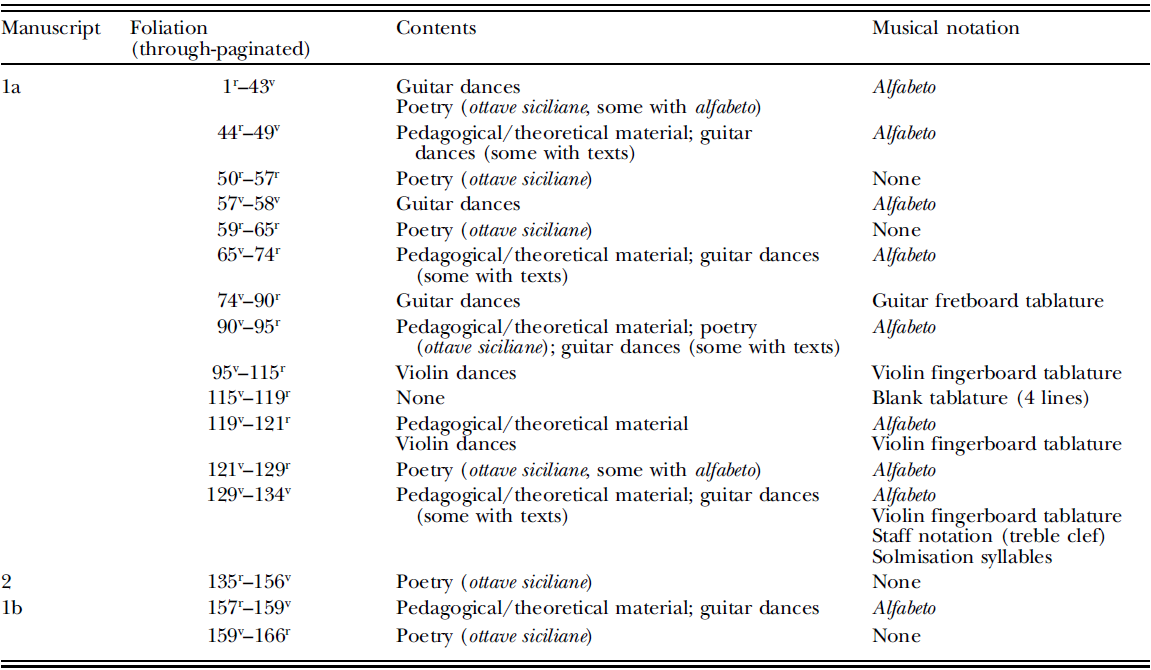
Mus. Ms. 116, acquired by the Music Division of the Biblioteca Nazionale Centrale in Florence in 1998 (hereafter Florence 116),Footnote 25 is a pocket-sized composite book of two manuscripts bound togther and covered in durable parchment.Footnote 26 The date ‘11 8.bre. lunedì, 1681’ (Monday, 11 October 1681) appears on fol. 63r,Footnote 27 but given the multiple hands that appear before this page, some of the manuscript’s contents may have been produced earlier in the seventeenth century. In some respects Florence 116 is typical of other Spanish-guitar tablature books produced in Italy during the Seicento, noted particularly by the presence of guitar dances and song texts in Italian and Sicilian notated with the guitar chordal tablature known in Italy as alfabeto. Some of these manuscripts also share the pedagogical intent of Florence 116, but not nearly with the amount of detail found in sections of the manuscript dedicated to theoretical and practical matters concerning the alfabeto system (see Table 1), some of which appear to document a dialogue between student and maestro.
Collation, foliation, and contents of Florence 116

Although the owners of the manuscript cannot be confirmed here, Florence 116 shares affinities with other sources that can be traced to other Italian guitar maestri and students, namely those written by Francesco Palumbi, who prepared at least two of his guitar manuscript collections for aristocratic patrons.Footnote 28 Palumbi was Neapolitan and travelled northward with an inventory of guitar dances and Italian, Sicilian, Neapolitan and Spanish guitar songs in tow, which probably earned him favour with potential patrons and students, as it had for Montesardo in Florence.Footnote 29 Florence 116 may be another textual artefact that documents the dispersal of guitar maestri and their repertories from Spanish Naples to the north.Footnote 30
Atypical of this guitar manuscript, however, are the folios of music written in numbered violin fingerboard tablature, material that is sometimes integrated with the instructional content for guitar featuring alfabeto. Violin tablatures of this type from the seventeenth century are rare,Footnote 31 and rarer still are those that appear together with guitar alfabeto. The only other known sources with violin tablature and alfabeto are Florence, MS Magl. VII. 618 (hereafter Florence 618) and Bologna, MS AA.360 (c. 1640–80) (hereafter Bologna 360),Footnote 32 the latter of which has been described by Alexander Silbiger as a pedagogical book that includes (among other didactic material) instructions for tuning various instruments and for reading tablatures for the guitar and violin.Footnote 33 Although there is no attempt in Florence 618 or Bologna 360 to integrate violin tablature with alfabeto as there is in Florence 116, these two manuscripts are noteworthy counterparts to Florence 116 on account of their instructional format and inclusion of songs with alfabeto. Another source worth mentioning is a Spanish manuscript of violin tablature dated c. 1659, Madrid, Mus. M/2816 (hereafter Madrid 2816),Footnote 34 where the scribal author has relied on his knowledge of the five-course guitar in writing down instructions for tuning the violin.Footnote 35 The appearance of numbered four-line violin tablature in both Florence 116 and Madrid 2816 (as opposed to the lettered system of French violin tablature)Footnote 36 points further to the provenance of Florence 116 in Spanish Italy. Like the scribal author of Madrid 2816, the authors of the Italian violin and guitar manuscripts were probably versatile instrumentalists, and may have drawn on their knowledge of the guitar to learn other instruments like the violin. Even while the number of these four seventeenth-century manuscripts is few, they represent a common goal of learning to play both the guitar and violin, a symbiosis that may have been more widespread across the Mediterranean than what the number of manuscripts suggests.Footnote 37
These contextual observations aside, it is perhaps unsurprising to find violin tablature in an instructional music book like Florence 116; as noted by Gasparo Zannetti in his 1645 violin treatise Il Scolaro – a work that includes pieces in staff notation and their numbered tablature transcriptions – tablature was the ideal notational format for beginners learning to play the violin.Footnote 38 Zannetti’s book was dedicated to the Milanese senator Don Alonso Del Rio, who was urged by the author in the opening letter to accept the treatise on account of music’s ability to soothe and restore the spirit ‘in the sometimes afflicted and wearisome concerns of human affairs’.Footnote 39 It is tempting to imagine Don Alonso himself working through the tablature of Il Scolaro, as the rhetoric of Zannetti’s dedication matches that of the gentlemanly pursuit of music popularised by Il Cortegiano and subsequently rehearsed by countless noble amateurs of the sixteenth and seventeenth centuries, including many guitarists.Footnote 40 Again, while the identities of Florence 116’s users remain unverified, the circumstances that emerge from the manuscript’s production and content have much in common with those of other sources, including those with known authors and users.
The pedagogical discourse of Florence 116, the details of which are rarely found in other guitar tutors,Footnote 41 is most visible on the pages with diagrams underscored with instructional captions, which essentially impart two kinds of musical information: the transposition of pairs of major and minor guitar chords (with an emphasis on cycles of half-steps and fifths) and how to harmonise the diatonic scale with these major and minor guitar chords. In order to gather the practical and pedagogical significance of these musical lessons, it is first necessary to make a few important points about the alfabeto tablature system.
Alfabeto: The Guitarist’s Way-of-Knowing
Alfabeto is a chordal tablature that teaches guitarists to associate alphabetical symbols (and other characters) with chords to be strummed on a five-course Spanish guitar. Its notational format is similar to the chord notation found in popular music and jazz sheet music of the twentieth and twenty-first centuries; however, the meaning of this notation is fundamentally different. The symbols do not correspond to notes of the scale or chord ‘roots’, but rather to shapes of the left hand on the fretboard. In other words, this tablature system (like most) is more practical than theoretical (although there are theoretical implications, as we will see). It is also a pedagogical tool, present in nearly every Spanish guitar tutor published in the Seicento. It was first advertised in print by Montesardo (1606) as a method to help beginning guitarists ‘imparare senza [un] Maestro’ (learn without a teacher).Footnote 42 Thus, Italian seventeenth-century guitarists were in a position to gauge their abilities along amateur and professional lines defined in accordance with strumming (battuto) or plucking (pizzicato) the strings like a lutenist, a distinction that was also used throughout the century to separate ‘amateur’ guitarists from ‘professional’ vihuelists, theorbists and lutenists.Footnote 43 While alfabeto, a strumming notation, is important to this distinction (a point to be revisited later), one would be remiss in accepting the division of amateur and professional guitar playing according to battuto and pizzicato and their respective notational idioms, alfabeto and fretboard tablature. Many guitar virtuosos, including Francesco Corbetta and Giovanni Battista Granata, issued their music in a mixed-tablature format (alfabeto and fretboard tablature), a clear indication that strumming techniques were central to professional guitar playing. Nevertheless, when alfabeto first appears in Italian sources (manuscripts around 1580),Footnote 44 it is written alongside poetic texts without any other form of musical notation, suggesting that alfabeto was initially employed as a kind of strummed accompaniment chord tablature, later to be standardised in books of guitar and vocal music printed in Italy from the time of Montesardo’s tutor to the end of the seventeenth century.Footnote 45 Spanish guitarists developed their own chordal tablatures for the guitar (some, incidentally, incorporate the Italian alfabeto system), which were diverse and numerous due to the fact that they circulated locally in manuscripts and were rarely printed.Footnote 46
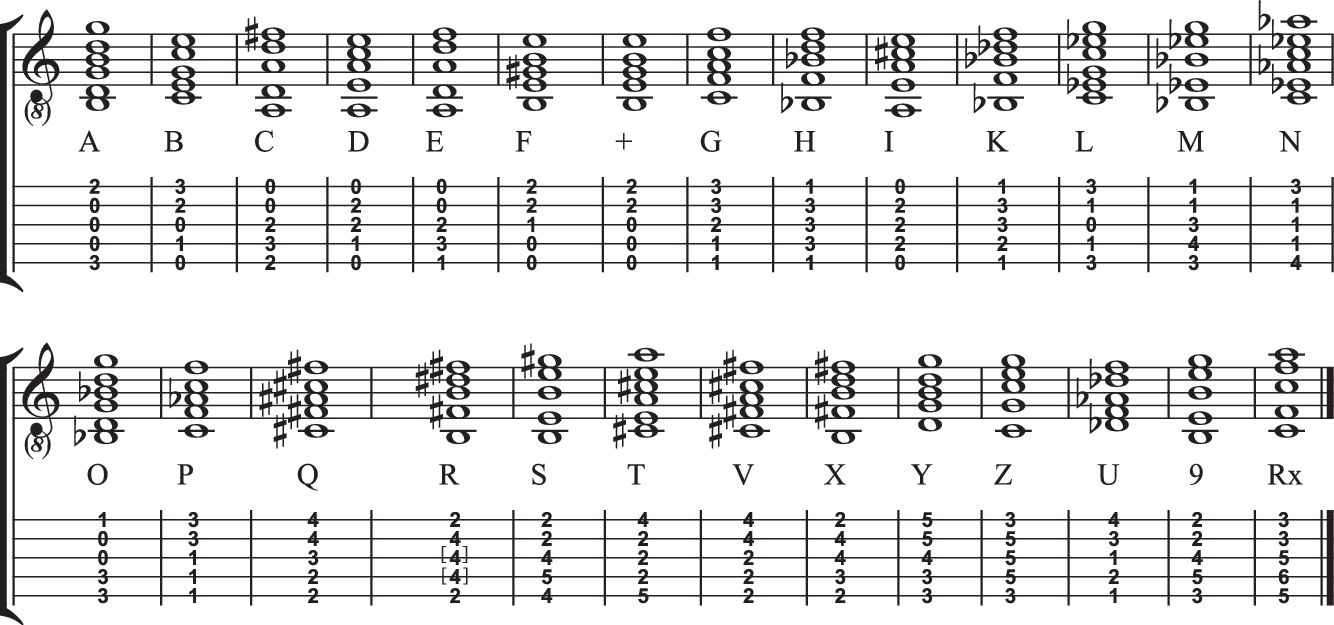
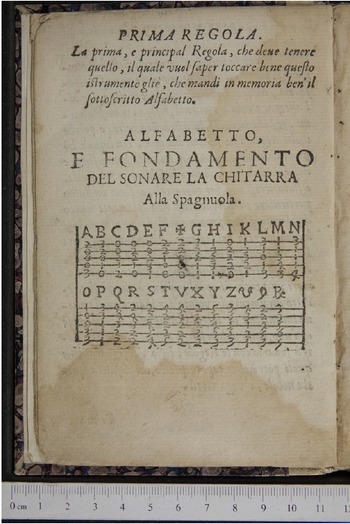
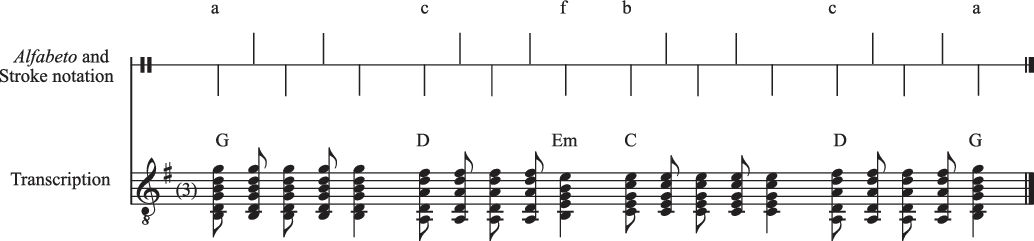
Reproduced in Figure 1 is Montesardo’s alfabeto ‘chart’, which was replicated in many guitar tutors and books of vocal music with guitar accompaniment (such charts also appear in many guitar manuscripts). As shown in the chart and in the transcription (Example 1),Footnote 47 each character corresponds to a left-hand chord position on the fretboard of a five-course guitar. The presentation of chords from A to Rx is governed by a blend of theoretical and practical information: the first six chords outline two sequences of I–IV–V chord progressions (that is ‘passacaglias’) in the most commonly played keys of G major and A minor.Footnote 48 What follows is a series of unrelated chords that employ the first finger as a kind of movable nut – more commonly known as a ‘bar chord’ position. As the chords move through the alphabet, the left-hand shapes become more difficult to make as their barring positions move down the guitar fretboard. This is a tablature system organised by guitar logic, teaching guitarists the most common chord sequences first before tasking them with a series of increasingly difficult chord positions.
Transcription of alfabeto chart from Montesardo, Nuova inventione, p. 1

Alfabeto chart from Girolamo Montesardo, Nuova inventione d’intavolatura (Florence, 1606), p. 1. Image courtesy of the Museo Internazionale e Biblioteca della Musica di Bologna

When alfabeto is encountered on the page of any kind of book, by default so is the Spanish guitar. Moreover, as a notational system that delimits musical practice to a singular performance technique (strumming) exclusive to playing the Spanish guitar, alfabeto only makes sense to readers who know how (or are learning how) to play the instrument. This further distinguishes alfabeto from modern chord-symbol notation and also from ‘lute’ tablature, a general fretboard tablature that was read by players of all fretted plucked and bowed string instruments. This is also why it is misleading to think of alfabeto as a kind of basso continuo notation, which leaves an accompaniment open to a range of instrumental participants, instrumental combinations and instrumental techniques. Also unlike basso continuo notation, alfabeto does not function universally, employed in musical scores across international repertories, genres and styles of all kinds of sacred, secular, professional and pedagogical music. Thus it is rare to find alfabeto printed in separate basso continuo parts,Footnote 49 none of which appear printed outside Italy. Alfabeto is rarely encountered in printed instrumental music outside the media of Italian guitar pedagogical books and collections of guitar music in mixed tablature. It is a tablature system inseparably tied to Spanish-guitar music and to vocal (mostly secular) music produced in Italy, and the significant number of texts scored with alfabeto testifies to the widespread Italian appeal of the Spanish guitar as an accompaniment instrument.Footnote 50 In short, alfabeto embodies a particular logic governed by the practice of strumming the guitar; it was also often the first concept that beginning guitarists were taught in published guitar tutors,Footnote 51 thus serving as a rudimentary component of the guitarist’s way of knowing.
Learning to Think Like a Guitarist
In the pedagogical folios of Florence 116 it is difficult to know if we are reading lessons recorded by teachers (perhaps a guitar or violin maestro), lessons copied by students, or some combination of both. Yet, as mentioned, since the pages are filled with diagrams, theoretical notes and instructional captions, we can be fairly certain that the information recorded held instructional value for its readers. The preference for alfabeto and violin tablature also highlights the educational content of the manuscript, which was probably at one time in the possession of an aspiring musician learning to play the guitar and violin. Moreover, the variety of notational formats including alfabeto written in different hands – some neater and more carefully presented than others – may indicate that the manuscript circulated among a network of multi-instrument music teachers and students, perhaps handed down over the course of several generations. We find in the manuscript no instructions for tuning or stringing, nor are there any fingering charts for the Spanish guitar or the violin, which gives the impression that those learning from the book have at the very least a basic knowledge of playing both instruments. It appears also that readers are fluent in hexachord solmisation and are able to read the four types of musical notation present in the pedagogical folios: staff notation, violin fingerboard tablature, lute-style guitar fretboard tablature and alfabeto for the Spanish guitar. While it cannot be ruled out that musicians other than guitarists and violinists could have learned from this book, it seems that these instruments were the primary targets of the instruction, as alfabeto, violin fingerboard tablature and guitar fretboard tablature are the only notational formats that appear in the non-pedagogical folios of the manuscript.
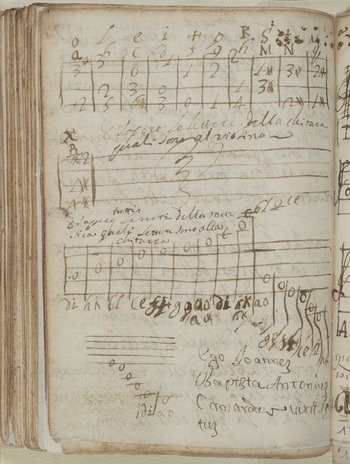
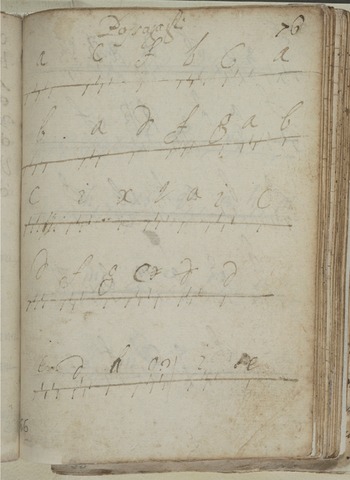
What is most fascinating about the musical teaching and learning recorded in Florence 116 is that the alfabeto system has acquired a logic that could substitute for and even improve on the other notational formats present in the manuscript. This is shown in the multiple diagrams that explain how to match guitar-chord letters with notes of the music staff and hexachord syllables, as well as fingerboard positions on the violin. On fol. 129v, for example (Figure 2), there appears a music-staff illustration of how to harmonise individual pitches of the diatonic scale written with the caption ‘P[er] sapere tutti le noti della musica quali lettere sono alla chitarra’ (To know [from] all of the musical notes [in the staff] what the [alfabeto] letters are on the guitar). And directly above the diagram on the same page is found a series of violin fingerboard positions that correspond to the alfabeto symbols from A to R (in alphabetical order starting in the lower row of major chords, with their corresponding minor chord equivalents in the upper row). The illustration is likewise paired with an instruction: ‘P[er] sapere le lettere della chitara quali sono al violino’ (To know [from] the [alfabeto] letters of the guitar how they are [intabulated] on the violin).
Danze ed aria per la chitarra spagnola, cart.; sec. XVII; Florence, BNC, MUS. Mss. 116, fol. 129v. Image reproduced by permission of the Ministero per i beni e le attività culturali e per il turismo della Repubblica Italiana, Biblioteca Nazionale Centrale (also Figures 3–4)

The readers of this book are learning to rely on the Spanish guitar as the generator of harmonic logic, one governed by the alfabeto system of harmony produced by strumming guitar chords. Simply put, they are learning to think like a guitarist. Moreover, they are at once learning how to derive fundamental pitches from alfabeto symbols while also being taught how to extrapolate two different harmonisations of individual notes of the diatonic scale. After studying these diagrams, guitarists, for example, would come to know that the chords B and L (C major and C minor) both accommodate the note C in the music staff; C and E (D major and D minor) accommodate D in the staff, and so on. Likewise violinists, having mastered their chart, would learn to associate the chords B (C major) and L (C minor) with the note C (and its octave equivalences) on the fingerboard,Footnote 52 and so on, throughout the alfabeto system. With this knowledge, guitarists and violinists are able to ‘think’ simultaneously in layers of harmonic and melodic space.
These principles alone are by no means unusual, nor should they strike us as novel even by early seventeenth-century standards. In 1596, Joan Carles Amat attempted to codify a system of chordal harmonisation on the guitar, providing students with instructional tables to help them select the appropriate major and minor chords over which to harmonise individual bass notes encountered in polyphonic scores.Footnote 53 In Italy, by the 1620s, printed evidence shows that guitarists were being trained to link fundamental bass notes with major and minor alfabeto chords in order to facilitate an improvised harmonic accompaniment above a written bass, even though the stringing and tuning of the guitar produces mostly inverted triadic harmonies.Footnote 54 While scholars have written enthusiastically about such examples – since they show evidence of tonal thought pre-dating the standardisation of the tonal system in the eighteenth centuryFootnote 55 – it is evident that lutenists, vihuelists and later guitarists had been playing and thinking ‘chordally’ since the early sixteenth century;Footnote 56 Amat’s tables and the early guitar prints were themselves attempts at establishing a written theoretical (and pedagogical) discourse about chords that had long been in practice.
While the pedagogical folios of Florence 116 clearly align with these principles, the manuscript is extraordinary for the way in which guitar chordal thinking could be applied to instruments other than the guitar. With alfabeto guiding the harmonic logic of these folios, violinists are learning to associate all of the notes of the fingerboard with pairs of major and minor guitar chords, so that the note C not only corresponds to the chordal (triadic) sonority C–E–G (the alfabeto symbol B), but also ‘C–E♭–G’ (the alfabeto symbol L). Note that here, as everywhere else in the manuscript, there is no attempt made to transcribe the individual pitches of the guitar chords in fingerboard tablature or music staff, even though there is ample space to do so. In contrast to ‘normal’ continuo thinking, which realises intervallic space above a bass, thinking in alfabeto forces musicians instead to account for the theoretical and sonic consequences of playing the Spanish guitar, an instrument whose tuning and stringing produces many chords that lack ‘true’ basses, chords for which the lowest-sounding note is not always the fundamental bass (see Example 1 above). As a result, here violinists are learning to associate both C major and C minor sonorities with any note C on the violin fingerboard, the fundamental tone of the sonority that may or may not emerge as the lowest-sounding note on the guitar.
In Florence 116 such ‘tonal’ thinking was not simply the domain of guitarists. This guitar-centred musical pedagogy shows that it was important for violinists to be able to quickly, if not concurrently, envisage triadic chords implicit in single notes and melodic passages. It is fitting, in more than one sense, that guitar alfabeto and not figured bass or music staff notation is being used in the violin instruction of Florence 116; both are stringed instruments that require left-hand positions on the fingerboard to produce chords, a much different approach to making harmony than on keyboard instruments or harps.
The Benefits of Thinking Like a Guitarist
These examples articulate disappointment with staff notation, solmisation and fingerboard and fretboard tablature, as these notational systems lack the economy with which alfabeto can express individual notes and harmonic sonorities simultaneously. It is even more economical than basso continuo, which requires at the very least a music staff (at most figures) in order to convey harmonic sonority (figured bass appears nowhere in Florence 116). While applications for such synchronous thinking are numerous, in Florence 116 there is evidence to suggest that thinking like a guitarist could assist violin players in realising, perhaps improvising, series of melodic variations based on the chord progressions and basses of standard dances.
This is shown in the folios (95v–115r) that precede the pedagogical material just described, where there appear in violin tablature sets of melodic variations over passacaglias, ciacconas, pavaniglias, spagnolettas and other dances in various keys. These violin dance variations are labelled according to their keys using alfabeto chord symbols (e.g. A = G major, O = G minor, etc.), recalling immediately the instructional content of the later pedagogical folios, where violinists are learning to think in guitar chords. Not only this, but all of the individual dances on which the violin variations are based appear previously in the manuscript in their ‘core’ guitar forms, stripped down to their alfabeto and strumming notation. These guitar dances are also labelled and organised according to their alfabeto keys, which heightens the marked sense of pedagogical continuity that characterises the manuscript. I emphasise this to show how effectively the manuscript circumscribes all of its musical content to guitar logic, even when the guitar itself is not the primary ‘recipient’ of the musical notation.
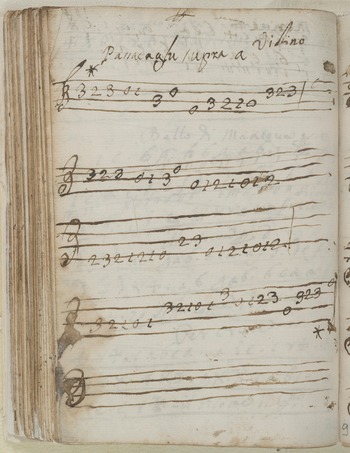
With respect to the guitar logic evident throughout Florence 116, the violin dance variations are remarkable in their application of thinking like a guitarist. This appears most vividly in comparing the violin dances side by side their guitar alfabeto counterparts encountered earlier in the manuscript. I detail such a comparison in two examples, the first guitar ‘Passagaglia’ in G major from fol. 66r (Figure 3 and Example 2) and the violin passacaglia variations ‘sopra A’ (G major) on fol. 95v (Figure 4 and Example 3).Footnote 57
Transcription of the guitar ‘Passagaglia’ in G major from Florence 116, fol. 66r

Transcription of the violin ‘Passacaglu supra A [G major]’ from Florence 116, fo. 95v

Guitar ‘Passagagli’ from Florence 116, fol. 66r. Permission as for Figure 2

Violin ‘Passacaglu supra A [G major]’ from Florence 116, fol. 95v. Permission as for Figure 2

In order to witness fully the close relationships that emerge between these two passacaglias, it is first necessary to elaborate on the rhythm of the tablature notation in both examples, which appears undisclosed in the original tablature. As mentioned, alfabeto is a strumming chord tablature, which is why it often appears – as it does in Figure 3 – with stroke notation, or series of vertical lines that indicate to guitarists which direction to strum the strings (up or down, corresponding to the placement of vertical lines above or below a horizontal axis).Footnote 58 Although the metre and rhythm of the guitar strokes is not always specified in tablature sources (again, as in Figure 3), there is consensus among guitar tutors about the metre and rhythm of passacaglias, the most fundamental chordal patterns for the Spanish guitar in the seventeenth century.Footnote 59 The rhythmic reconstruction of the passacaglia in Figure 3 is based on Benedetto Sanseverino’s guitar tutor Il primo libro d’intavolatura per la chitarra alla spagnuola (1622), where a passacaglia with a nearly identical strumming pattern appears with precise metrical and rhythmic strumming values.Footnote 60 The ubiquity of guitar dances in stroke notation lacking such precise metrical indications that proliferate in guitar manuscripts like Florence 116 testifies to the unwritten tradition of strumming the guitar. In such cases, the metres and rhythms of the guitar strokes seem so deeply embedded in the performing habits of guitarists that even in a pedagogical context like the one in Florence 116 it was unnecessary to specify them in the musical notation. This could explain why there are also lacking metrical and rhythmic specifications in the violin dances; as points of reference, the guitar dances could suffice in providing the general rhythmic character of the violin dances. Or, more simply, and as suggested earlier, the violinist users and producers of this manuscript were also guitarists, well aware of the guitar’s unwritten performing traditions.
In mapping the rhythms of the guitar passacaglia onto the violin passacaglia variations, it is not difficult to line up the violin’s melodic passages with the chord progression indicated by the guitar alfabeto.Footnote 61 I have attempted this in Example 4, where I have invented a rhythmic scheme for the violin melody that produces corresponding alfabeto chord tones (mainly roots and thirds) on strong beats interspersed with passing tones on weak beats. As simple as this process might appear to flow in the modern transcription, in Florence 116 it is facilitated only through a familiarity with the chords of the alfabeto system, which is precisely the learning objective of the pedagogical lessons documented in the manuscript. So, for example, the motivic melodic gesture ‘E–C’ in the violin passacaglias, which links bar 2 to bar 3 in all of the variations except the second, matches the chordal gesture ‘E minor–C major’ in the corresponding guitar passacaglia. Another motivic gesture appears in the final cadence of each variation, where the guitar chords D major and G major are matched with the chord tones ‘F♯–G’ (or an embellishment of this figure) in the violin passacaglias.
Hypothetical superimposition of G major guitar and violin passacaglias from Florence 116

Example 4 is intriguing for the way in which the violin passacaglia variations proceed in a manner that reflects the harmonic rhythm of the guitar passacaglias encountered earlier in the manuscript. The example illustrates a very useful application of guitar logic for playing the violin, namely of knowing which chordal sonorities on the guitar correspond to notes on the violin fingerboard, and using this knowledge to help churn out melodic variations over passacaglias, ciacconas and other dances present in the manuscript. Perhaps this is the reason why violinists using this book are instructed to ‘know [from] the [alfabeto] letters of the guitar how they are [intabulated] on the violin’ (Figure 2 above): to memorise which notes on the violin fingerboard correspond to the various guitar chords derived from the alfabeto system, so that someday, with guitar thinking in mind, they will be able to improvise their own passacaglias on the spot.
Furthermore, this guitar-centred violin pedagogy provides a compelling context for the notational idiom of printed violin music in the seventeenth century, in which melodic passagework and invention prevail.Footnote 62 Harmonic thinking may have informed violin playing much more centrally than what is suggested by the ‘monodic’ violin writing of Monteverdi, Marini, Castello, Farina and Uccellini. Additionally, in cases where double, triple and quadruple stops do appear in these scores,Footnote 63 the guitar-violin pedagogy of Florence 116 compels us to consider the extent to which the harmonic language of guitars (as well as lutes, theorbos and other chordal string instruments) could have served as the basis for a violinists’ harmonic orientation while playing such passages. Such observations align with contemporary Italian authors who commented on the harmonic potential of the violin,Footnote 64 most notably Agostino Agazzari in Del sonare sopra ’l basso (1607), where he listed the violin alongside the ‘Leuto, Arpa, Lirone, Cetera, Spinetto, Chitarrina, [and] Pandora’ in a category of ‘ornamental’ instruments that have the ability to render harmony ‘more agreeable and sonorous’ than others.Footnote 65 As the pedagogical content of Florence 116 shows, ‘thinking like a guitarist’ clearly has its advantages for violinists learning to acquaint themselves with the rudiments of harmonisation. This is not to claim that such guitar thinking was widespread among violin players in Italy, but only to say that guitar and violin manuscripts such as Florence 116 offer some evidence as to how playing the guitar could have assisted instrumentalists in learning to improvise and harmonise on instruments like the violin. It is worth mentioning, in this regard, that the Neapolitan-born Nicola Matteis (fl. 1670; d. after 1713), England’s most respected violin virtuoso of his time, was not only equally proficient on the guitar, but also wrote the most comprehensive harmonic treatise for the guitar published in the seventeenth century.Footnote 66
playing it on guitar: the library of congress le nuove musiche
Alfabeto as a Sign of Use
My second case study focuses on the logic of playing the Spanish guitar as revealed in the more problematic medium of print – ‘problematic’ in the sense that previous scholars have been sceptical and outright hostile about the appearance of alfabeto tablature in printed songbooks for which the Spanish guitar seems ‘stylistically’ inexplicable. Following this line of argument,Footnote 67 ambitious music printers such as Alessandro Vincenti in Venice used alfabeto as a kind of marketing scheme to attract a larger sector of musical amateurs to their songbooks.Footnote 68 Moreover, scholars have persuasively questioned the viability of print as evidence of actual (or future) musical performance,Footnote 69 especially regarding the elaborate secular monodies of the sort carefully and luxuriously printed in the collections of Peri, Giulio and Francesca Caccini, Francesco Rasi, Sigismondo D’India and others.Footnote 70 Such observations suggest a rift in the repertories of secular monody printed in the early decades of the seventeenth century: one destined for amateur music-making, in which performance seems plausible,Footnote 71 and the other for which a ‘performance’ is memorialised,Footnote 72 or in any case secondary to the status of the text as an object of authorship (often self-promotional in the case of ‘vanity’ prints).Footnote 73 The Spanish guitar plays a fundamental role in establishing these repertories along amateur and professional/virtuoso lines,Footnote 74 since alfabeto is largely absent from the sophisticated monody prints of the era as well as from the scores of early operas. Instead alfabeto is more frequently encountered in ‘lighter’ printed collections of canzonette, villanelle and arie, strophic songs with lively (and memorable) dance rhythms amenable to the percussive strumming of the Spanish guitar.
In the context of this historical purview, the copy of Caccini’s Le nuove musiche held in the Library of Congress presents a number of provocative questions about performing from printed scores of monody in the early seventeenth century. In this exemplar of the first edition,Footnote 75 six of Caccini’s twenty-two madrigals and arias are annotated with handwritten alfabeto for the five-course Spanish guitar.Footnote 76 Despite the legendary status of this publication in the history of seventeenth-century music – indeed in the entire history of Western music – to my knowledge there has been no discussion to date of the alfabeto tablature in the LC Le nuove musiche.Footnote 77 It is not my intention here to cross-examine the testimony that printed scores of elaborate and sophisticated monody like Caccini’s Le nuove musiche were off-limits to dilettantes and amateurs. Nor will I develop further a case for strummed guitar accompaniment as an accepted and common approach to performing Caccini’s repertory;Footnote 78 suffice it to say that this example is neither the only nor the earliest instance of alfabeto tablature affixed to Caccini’s songs,Footnote 79 even though the practice belies Caccini’s own views concerning the performance of his ‘New Music’, which he argued in the famous preface of Le nuove musiche was best accompanied by the chitarrone (theorbo).Footnote 80 Still, even though Le nuove musiche seems to have been an expensive ‘vanity print’ produced by the Marescotti in relatively limited quantities,Footnote 81 it would be premature to conclude that the guitar scrawl in this single exemplar represents a widespread phenomenon,Footnote 82 especially given the fact that most of the LC copy is left unannotated. For me the fragmentary appearance of handwritten alfabeto, a precious sign of use, is the more fascinating dimension of the LC copy of Le nuove musiche, since the user has attempted to engage critically with this text as a guitar player. In the paragraphs that follow I want to consider why this user decided to annotate Caccini’s settings with alfabeto, and further only six of the madrigals and arias in the collection and not the sixteen others. I do not believe these were arbitrary decisions, but rather the natural result of this user’s familiarity with the logic of playing the Spanish guitar, as well as with the song repertory most commonly associated with the instrument.
Making It Guitar-friendly (and Less Painful)
Reminiscent of the guitar pedagogy encountered in Florence 116, Caccini’s figured bass clearly presented obstacles for the guitar-playing user of the LC copy of Le nuove musiche. This is seen throughout the alfabeto annotations in the score, which have realised the bass on a much reduced scale. Suspensions, passing chords and inversions are mostly avoided, yet the guitar chords support the vocal melody perfectly, at times as if the bass line and figures were ignored altogether. With guitar thinking-and-doing kept close at bay, however, the alfabeto annotations offer much more than solutions to the problems of realising a continuo figured bass on the strummed guitar; they also solve practical and technical problems unique to playing the instrument. This is most apparent in the alfabeto scribe’s decision to transpose the harmony of all but two of the six annotated selections from the book.
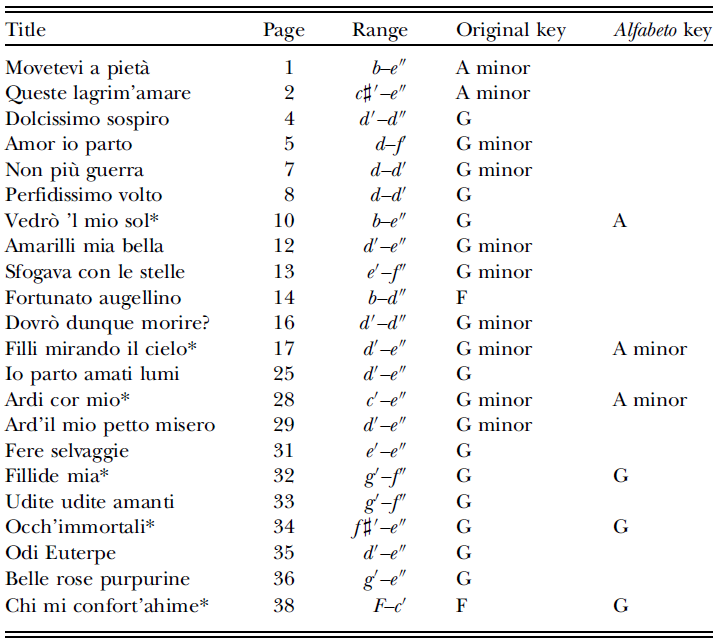
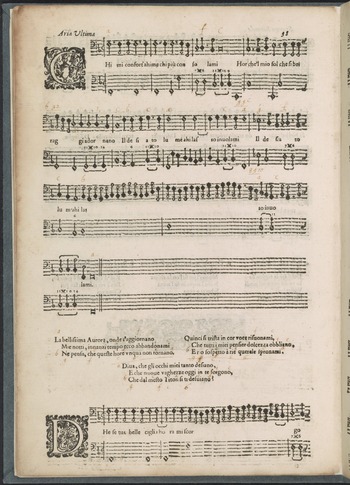
Twice the scribe has transposed songs in G minor up to A minor, once a song in F major up to G major, and once a song in G major up to A major (see Table 2). Judging from the ranges of the alfabeto songs in the LC exemplar, these transpositions might have served to accommodate a higher voice. In fact the two guitar songs left untransposed in the alfabeto (‘Occh’immortali’ and ‘Fillide mia’) are set in the two highest ranges of the entire group of six, suggesting that they required no transpositions. The aria ‘Chi mi confort’ahime’, however, challenges the theory that the alfabeto transpositions were made to accommodate higher voices, since it is the only one of Caccini’s madrigals and arias written in the bass clef, with a range of one and a half octaves from F to c′. Even transposed up an octave and sung in the alfabeto key, a practice advocated by early seventeenth-century monodists,Footnote 83 the song would still require the second lowest (and largest) vocal range of the collection (g–d″). Conversely, those songs that sit well above the range of ‘Chi mi confort’ahime’ could have been sung down one or even two octaves to match the range of the song, thereby explaining all of the alfabeto transpositions as a way to accommodate a slightly higher tenor/bass voice. Of course, this assumes that the transpositions were made to accommodate only one individual singer, which could just as well not have been the case.
Keys, vocal ranges and alfabeto transpositions (marked *) of selections from the LC Le nuove musiche

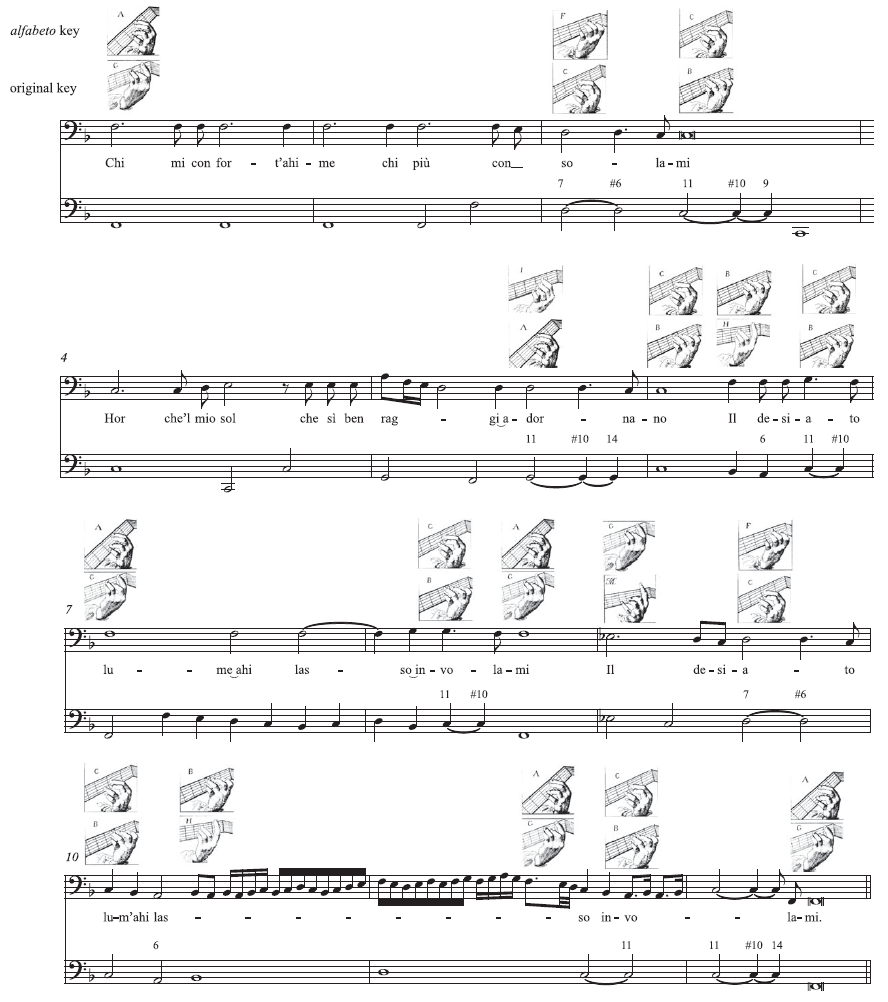
There is a much simpler explanation for the alfabeto transpositions found in the LC copy of Le nuove musiche, as they solve a fundamental technical problem for guitar players: avoiding difficult left-hand positions, especially those that require either a flexible and stretched hand, or those that employ bar chords. In making these transpositions, the alfabeto scribe has rendered these songs with as many ‘open-string’ position chords as possible, thereby reducing the hand and wrist strain required to sustain bar chords like F Major and B♭ major or stretched-hand position chords like C minor and G minor. This is shown in Example 5, where I have annotated Caccini’s ‘Chi mi confort’ahime’ (see Figure 5 for the original) with diagrams of two left-hand position sequences for the guitar accompaniment; one in the painful key of Caccini’s original (F major, on bottom), and one in the much less strenuous key of the handwritten alfabeto (G major, on top).Footnote 84 In particular, the extended passages in F (bb. 1–2; 7) and B♭ (bb. 10–11) of the original key require bars on the guitar’s first fret, while in the transposed key of the alfabeto the left hand holds the easier shapes of G major and C major.
Transcription of ‘Chi mi confort’ahime’ annotated with left-hand alfabeto shapes, bb. 1–12

‘Chi mi confort’ahime’ from the LC Le nuove musiche. Image courtesy of the Library of Congress, Washington, DC

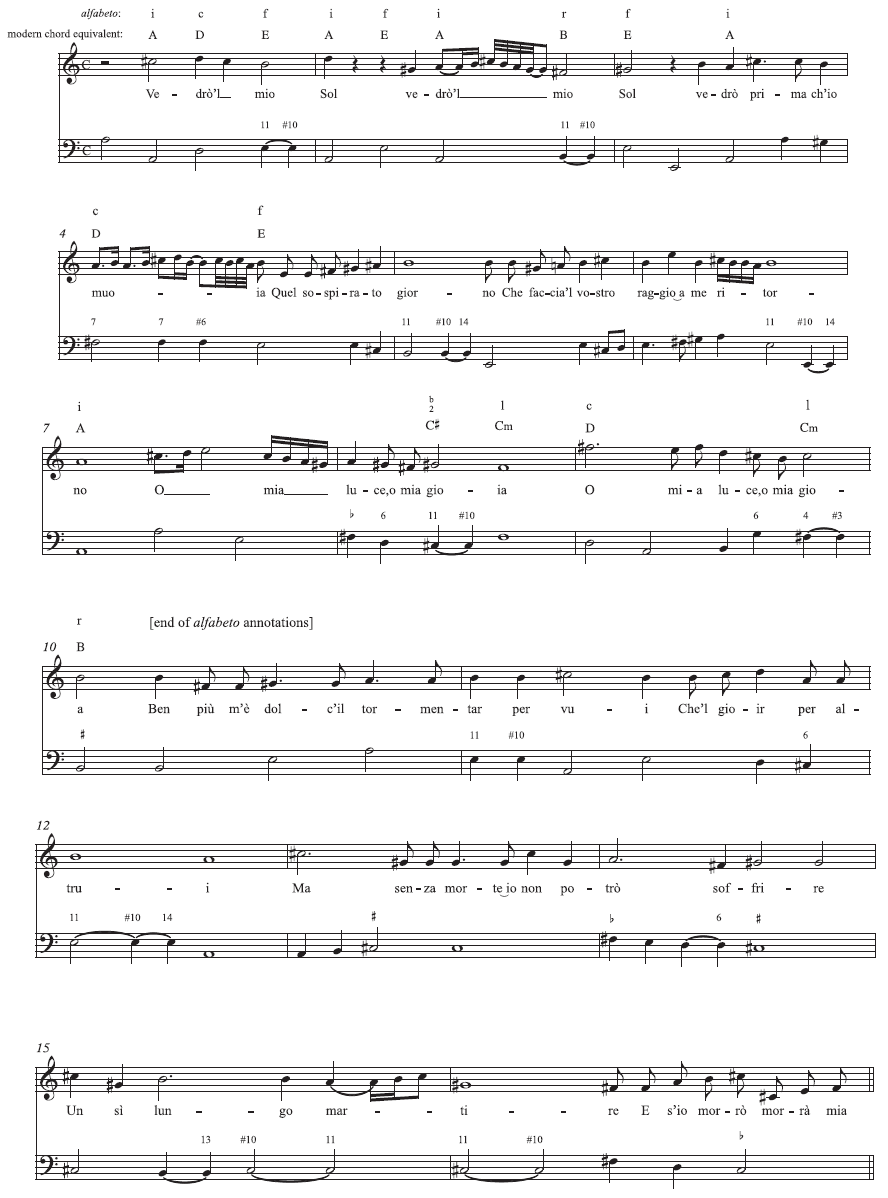
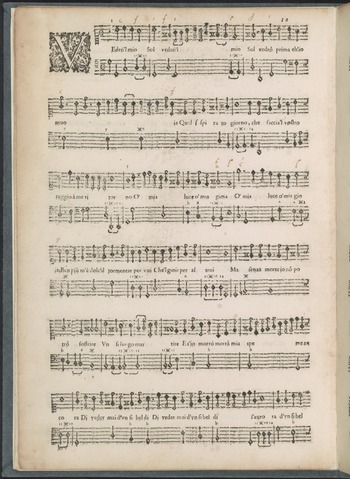
Similarly, ‘Vedrò ’l mio sol’ (Example 6 and Figure 6) might have been transposed from G to A major to accommodate the low range of the song for a slightly higher voice;Footnote 85 of all the G major settings from Le nuove musiche, this song has the lowest range.Footnote 86 Nonetheless, as can be seen in Figure 6 and its transcription (transposed to the alfabeto key), the alfabeto scribe seems to have had second thoughts about transposing up a whole step, as only the first ten bars of the song are annotated with alfabeto. This is the only incomplete alfabeto transposition in the LC copy of Le nuove musiche, which highlights the guitar scribe’s difficulty with this particular song.
Transcription of ‘Vedrò ’l mio sol’ transposed to the alfabeto key of A major, bb. 1–16

‘Vedrò ’l mio sol’ from the LC Le nuove musiche. Image courtesy of the Library of Congress, Washington, DC

The plan to transpose to A starts to derail around bar 8, where the scribe has annotated the C♯ major chord on the third beat with the symbol ‘b 2’, an alfabeto indication to play a ‘b’ chord (C major) up a half step. This requires the left hand to make a C major chord shape with a bar on the first fret, an uncomfortable – but not impossible – hand position. Scanning forward through to bar 10, and then again to bars 13–16, it becomes apparent that relief from this arduous left-hand barring is nowhere in sight. After cadences in F♯ and B respectively (both bar chords on the second fret) in bars 8–10, the alfabeto suddenly stops. It seems that the scribe, now aware that the higher key requires the left hand to sustain uncomfortable barring positions over extended passages, has given up on the transposition. Moreover, the perplexing ‘l’ symbol for the F♯ chord in bars 8 and 9 (l corresponds to C minor in the alfabeto system; see Example 1 above) suggests that the guitar scribe might not have even known the alfabeto symbols for bar chords beyond the first fret. Indeed, such chords are used sparingly in the alfabeto songbooks of the era.Footnote 87 The failure of the A major version of ‘Vedrò ’l mio sol’ to serve the guitarist might also explain why the two guitar songs with untransposed alfabeto are in G major, a key easy on the left hand, and one that requires little knowledge of guitar chords beyond the basic shapes in open-string positions. Regardless, what the alfabeto transpositions in the LC copy of Le nuove musiche tell us is that they were made not to accommodate the voice, but to render the accompaniment guitar-friendly.
Not All Songs Are Guitar Songs
Still, why did the scribe transpose – or attempt to transpose – these songs, and not others? And what accounts for the presence of the other songs from Le nuove musiche in F and G minor, set in similar ranges, yet left unaltered in the LC copy? Stylistic considerations offer little help, as we find alfabeto handwritten in both the solo madrigals as well as in the arias of Caccini’s book. Besides, as incomplete and hypothetical ‘compositional texts’, any discussion of style regarding the content of Le nuove musiche will be fraught with ambiguity.Footnote 88 Instead, exploring concordant sources reveals some noteworthy observations.
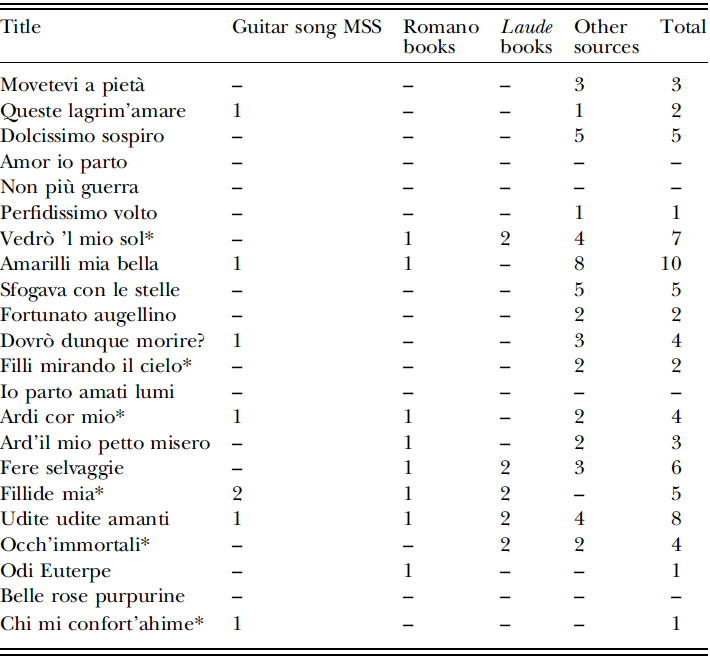
Table 3 breaks down the number of sources – either printed books or manuscripts – that include settings concordant with each of the twenty-two madrigals and arias from Caccini’s Le nuove musiche. The songs annotated with alfabeto in the LC copy are marked with asterisks.Footnote 89 The first two columns break down the concordances according to their appearance in guitar-song sources, namely: manuscripts of songs with alfabeto tablature (column 1),Footnote 90 and the printed guitar song anthologies of Remigio Romano (column 2).Footnote 91 The third column indicates the number of concordances that appear in anthologies of laude (whose significance will be addressed shortly), while the fourth column tallies the remaining concordances found in all other sources.
Le nuove musiche concordances

The data illustrate a number of interesting trends. First, all but two of the LC Le nuove musiche settings with alfabeto annotations circulated in guitar-song sources. Coupled with the observation that ten of the remaining sixteen settings from Le nuove musiche are absent in guitar-song sources, this suggests that the LC alfabeto settings circulated outside Caccini’s collection with guitar strumming in mind. Moreover, of the alfabeto settings from the LC copy, three in particular were known as guitar songs in at least half of their total concordant sources (‘Ardi cor mio’, ‘Chi mi confort’ahime’, and ‘Fillide mia’). These concordances chart common pathways of circulation for the LC settings annotated with handwritten alfabeto, which seemed destined for guitar accompaniment.
The third column presents an even more compelling data set that charts the circulation of Caccini’s settings. These concordances are found in seventeenth-century printed books of laude spirituali with cantasi come settings,Footnote 92 that is, poems set to pre-existent songs. These are songs that circulate widely in the oral tradition, whose titles are known and named, but whose musical identities (melodies, perhaps chords) are assumed to be known.Footnote 93 Five of Caccini’s twenty-two madrigals and arias are listed as cantasi come titles in the laude books;Footnote 94 significantly, three are annotated in the LC copy with alfabeto. As has been shown elsewhere,Footnote 95 a considerable number of cantasi come titles from the laude books travelled extensively as guitar songs with alfabeto in the textual record. This suggests that the alfabeto scribe of the LC copy may have known these three songs through oral channels, and, disappointed not to have them guitar-ready, marked them as such for future use.
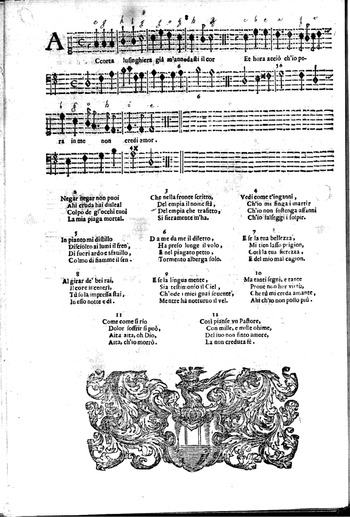
Confidence grows about this suggestion when I think of other printed songbooks with handwritten alfabeto annotations, such as the British Library’s copy of Raffaello Rontani’s first book of Le varie musiche (1623). Here (Figure 7) a one-time user wrote in by hand the alfabeto chords to the song ‘Accorta lusinghiera’, but made no other such markings in the book, drawing our attention even closer to the status of ‘Accorta lusinghiera’ as a guitar song.
‘Accorta lusinghiera’ from Rontani, Le varie musiche (1623), British Library exemplar, p. 8. By permission of the British Library Board, London: K.1.i.5.(1.)

As with the LC Le nuove musiche settings with alfabeto, ‘Accorta lusinghiera’ appears in no fewer than four guitar-song manuscripts,Footnote 96 as well as a cantasi come title in the 1622 laude collection published by Alessandro Guiducci. Guiducci’s book was published a year before Rontani’s collection, hinting that it might have been known to this user prior to encountering it in Rontani. Furthermore, the song ‘Caldi sospiri’, which appears printed with alfabeto on the page before ‘Accorta lusinghiera’, is found in Guiducci’s collection as well. Together these two are the only songs from Rontani’s book that circulated as cantasi come song titles in the laude books. This is not an isolated encounter, but one of many instances linking guitar songs directly to the cantasi come repertory, an occurrence so common that I believe these to be symbiotic repertories, even to the extent that songs living in the cantasi come tradition were purposely selected to serve as guitar songs (and viceversa) in both printed and manuscript sources. The LC copy of Caccini’s Le nuove musiche provides yet another cross-listing of guitar songs and cantasi come orality; moreover, it shows that users appear to have knowledge of a guitar-song repertory, such that not all songs were destined to be guitar songs.Footnote 97
Scripts for Performance
The fact that scribes, not composers or printers, conveyed this information is a fascinating dimension of the two documents considered above. They portray the needs, expectations, strengths, limitations and frustrations that real users encountered when interacting with musical texts. Most pertinently, as editorial actions of musician users – Spanish-guitar-playing users more significantly – this markup reveals precious details of musical practice more difficult to locate in well-curated and unblemished scores of printed music. To quote Kate van Orden in her recent book Materialities, these ‘scripts for performance’ allow for ‘sustained musical analysis at the center of book history, not in the service of style history, generic evolution, or compositional greatness, but in new histories generated from a dynamic view of the social functions of music books’.Footnote 98 Writing from the vantage point of sixteenth-century French chansons, van Orden has offered a music history that privileges the ‘smaller riff-raff’ (musical primers, scribbles, marginalia, etc.) in an effort to make visible the relationships between readers and musical texts in their material form.Footnote 99 The guitar riff-raff of Florence 116 and the LC Le nuove musiche show how far-reaching van Orden’s material history of music books can serve other early modern musical repertories, genres and practices.
conclusion
At the heart of my investigation into musicians and their texts lives the Spanish guitar, an instrument which with its special chordal strumming technique offered an entirely new yet practical way to notate, publish, copy, transmit, circulate, teach, learn and perform music in the seventeenth century. In attending to the logic of the Spanish guitar and its alfabeto tablature, I have placed front and centre guitar practitioners and the texts from which they learned and made music. And in telling this story I provide a counterpoint to seventeenth-century beliefs about guitar players and their methods of learning. The economy of labour required to learn the guitar – which some praised as an advantage to learning the instrumentFootnote 100 – was seen by others as a threat to the cultivation of more serious and learned musical pursuits, such as reading from mensural notation or playing the vihuela in Spain and lute in Italy.Footnote 101 In 1623, Bellerofonte Castaldi, who wished to ban Spanish-guitar players from performing his music, demanded that the arias of his Primo mazzetto di fiori be printed without alfabeto in order to avoid the mistakes of unsuspecting guitar players, namely the harmonic clashes bound to occur when strumming guitar chords against a written, composed bass line and melody:
Please do not turn away because the Author, knowing very well how to do it, did not place the A.B.Cs [alfabeto] of the most Spanish Guitar above each one of these Arias, as one does according to current use. This would have been done if one had not seen that such Pedantry is of little use to those who don’t know – if the letters are not discarded – of the innumerable errors that occur at the cadences because of these hieroglyphs.Footnote 102
The targets of Castaldi’s disdain are potential unlearned guitarists (‘those who don’t know’) who might have hoped to find the trendy alfabeto chords in his book. In calling out their lack of sound musical judgement and their beginner status, the author intimates an opposing team of ‘learned’ musicians (to which he clearly belongs), those fluent in reading from alfabeto yet good enough to know that the system is imperfect.Footnote 103 In other words, the targets of Castaldi’s disdain are musicians like the guitar scribes of Florence 116 and the LC Le nuove musiche, who offer a contrasting viewpoint about guitar alfabeto in which the system makes sense and holds value for their instructional and performing demands. But what is more, these two documents reveal earnest attempts at being musical with a guitar in the hands, as well as cultivating an instrument-centred musical logic that clearly had advantages for guitar players (and also violinists), an approach also reflected in the practically-oriented guitar tutors published throughout the seventeenth century. We owe such attempts, as distant as they are from us, a historical narrative that seeks to understand a guitar-based knowledge from all participants who played the guitar, even those learning practitioners who have long remained anonymous.
Tucson, Arizona