The paediatric exercise tolerance test is non-invasive, relatively safe, and inexpensive, which can be used for children with symptoms suggestive of cardiac disease or to risk stratify and assess exercise capacity in patients with an underlying cardiac diagnosis.
The Bruce protocol is most frequently used to guide the increasing speed and incline of the treadmill. This protocol can be used for all ages from 4 years onwards, no prior experience or practice for running is necessary, and the results can be comparable – for example, metabolic equivalents and heart rate.
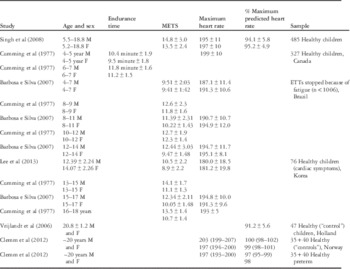
Unlike adults, for children, there is a lack of clear guidelines on the “normal values” that healthy children should be able to achieve. Guidelines describe indications and contraindications for exercise test, technicalities of the procedure and monitoring, and indications for stopping a test.Reference Paridon 1 , 2 A number of published studies provide “normal” values for children with symptoms or heart murmur but with no cardiac conditionReference Cumming, Everatt and Hastman 3 – Reference Amedro, Picot and Moniotte 9 and for children with CHD (Table 1).
Existing studies assessing exercise tolerance test performance in children and young adults.

METS=metabolic equivalent of task; ETT=exercise tolerance test; F=female; M=male
We aimed to compare exercise tolerance test performance at our tertiary centre with values in the published literature, and to explore the extent to which the exercise tolerance test provides diagnostic and prognostic information.
Materials and methods
The last 102 patients to undergo the exercise tolerance test were selected, and these patients had a test between May, 2016 and December, 2015. Results printouts and case notes were reviewed, and demographic and exercise test tolerance printouts and outcome details were recorded in a pre-designed proforma. Collected data included whether the child had any pre-existing cardiac diagnosis, the results of baseline electrocardiogram and transthoracic echocardiogram, indication, duration of exercise test and recovery, reason for ending the exercise tolerance test, metabolic equivalents achieved, percentage of age-predicted maximal heart rate, arrhythmias, ST segment changes, symptoms, and outcome measures such as discharge, follow up, further investigations, and treatment.
Descriptive analytical statistics were compiled, including what percentage of patients achieved 85 and 100% of the age-predicted maximal heart rate and what percentage was discharged following the exercise tolerance test. We divided patients into two groups – those with no cardiac diagnosis and those with CHD – according to whether they had a normal baseline transthoracic echocardiogram.
A positive exercise tolerance test result was defined as a result meeting the American Heart Association 1994 criteria of ST segment J-point depression ⩾2 mm or ST segment depression >1 mm with a flat or down-sloping ST segment at 60 ms.Reference Washington, Bricker and Alpert 10 Results were compared with values from the published literature.
Results
Of 102 patients, 15 were excluded for the following reasons: two because of heart block, one with a single ventricle physiology, six because of a technical error during the exercise tolerance test, including problems with blood pressure tests, and six because notes were not available. For the final study, 87 patients were included.
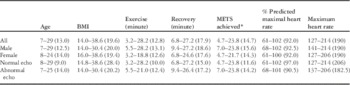
Among them, 86 patients underwent exercise tolerance test according to the Bruce protocol on a treadmill and one patient according to the modified Bruce protocol on a treadmill (Table 2).
Results of exercise tolerance testing in 87 patients at a UK tertiary centre.

BMI=body mass index
* 1 MET=resting metabolic rate, considered equal to an oxygen uptake of 3.5 ml/kg body weight per minute
The age range was 7–29 years (median 13). The present study included 68% males and 32% females. The body mass index range was 14–38.6 (median 19.6).
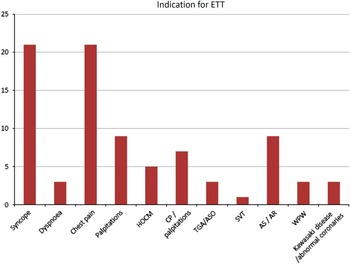
Indication for exercise tolerance test included investigation of cardiac symptoms (50 patients) and cardiac diagnoses (37 patients) (Fig 1). The indication for exercise tolerance test was categorised according to American Heart Association 2006 guidelines. In all, 58 patients underwent the test to evaluate specific signs or symptoms that are induced or aggravated by exercise, such as chest pain, palpitations, dizziness, dyspnoea, or syncope. In six patients, the test was performed to assess functional capacity for recreational, athletic, and vocational activities in children with CHD. A total of 23 patients underwent the test to evaluate prognosis, including both baseline and serial testing measurements. This group included patients with Wolff–Parkinson–White syndrome, supraventricular tachycardia, ventricular arrhythmias, hypertrophic obstructed cardiomyopathy, and abnormal coronary arteries.
Indication for carrying out the exercise tolerance test (ETT) in 87 patients at a UK tertiary centre. HOCM = hypertrophic obstructed cardiomyopathy; CP=chest pain; TGA/ASO=transposition of the great arteries post arterial switch operation; SVT=supraventricular tachycardia; AS/AR=aortic stenosis/aortic regurgitation; WPW=Wolff-Parkinson-White syndrome

In total, 46 patients had no cardiac diagnosis, and underwent exercise tolerance test for chest pain, palpitations, syncope, or dyspnoea on exertion. All of them had a negative test. The percentage of maximum predicted heart rate achieved by healthy participants ranged from 61 to 102% (mean 90.3, median 92.0), whereas in patients with CHD the percentage of maximum predicted heart rate achieved was as low as 38%; 79.3% achieved 85% of the percentage of age-predicted maximal heart rate and 10.4% achieved 100%. Following the exercise tolerance test, 31 patients were discharged from follow-up.
In total, 46 patients had body mass index <20, and 12 patients had body mass index over 25. Total duration and maximum predicted heart rate were adversely related to body mass index.
In the present study, 40 patients had a cardiac diagnosis. Of these, five received treatment, two underwent ablation for Wolff–Parkinson–White syndrome, one underwent the Ross operation, one aortic valve repair, and one aortic valve ballooning. These patients achieved lower exercise duration and heart rate than those without a cardiac diagnosis (a median of 10.0 versus 12.4 minutes of exercise, and maximum heart rate median of 206.0 versus 182.5, see Table 2).
Among all, 70 patients had no arrhythmias; 16 patients had non-significant arrhythmias – four before exercise, eight during exercise, and four during recovery, including single supraventricular or single, uniform ventricular extrasystole. Furthermore, two patients with diagnosis of Wolff–Parkinson–White syndrome in routine electrocardiogram had no loss of pre-excitation at peak exercise and as an outcome underwent electrophysiology study ±ablation.
In 80 patients, there were no ST segment changes, elevation or depression. In two patients, the ST segment could not be assessed because of complete left branch bundle block; six patients had ST changes during exercise: one had more than 3-mm ST depression and had a diagnosis of anomalous left coronary artery from the pulmonary artery repair, the outcome was organising stress cardiac MRI, one had 1-mm ST depression and had a diagnosis of severe aortic valve stenosis and regurgitation, the outcome was ballooning of the aortic valve, and four patients had ST changes, which did not meet American Heart Association criteria.
In 20 patients, there were symptoms during exercise, and two patients had symptoms during recovery.
Blood pressure increased in 79 patients. There were no changes in six patients. In two patients, both with diagnosis of hypertrophic obstructive cardiomyopathy, blood pressure decreased. Of note, there were technical errors in recording blood pressure in five patients.
The main reason to stop a test was fatigue, followed by technical errors – for example, blood pressure or electrocardiogram measurement errors or treadmill not functioning.
Discussion
We found that patients with CHD achieved lower exercise durations and heart rates compared with the group with no cardiac diagnosis, which correlates with a comparative study by Amedro et al.Reference Amedro, Picot and Moniotte 9
The results of our study showed similar median achievement by our healthy population compared with other studies, but with a wider range of values. This may be attributable to the extent to which our patients are encouraged to continue the test. Vrijlandt et al found that in 47 healthy patients the mean percentage of maximum predicted heart rate achieved was 91.2% with a standard deviation of 5.6, compared with a median of 97% in our study, but with a wide range of 61–102%. Clemm et al found that in their two cohorts of 40 and 35 healthy young adults, 100 and 91%, respectively, achieved ⩾95% of their maximum predicted heart rate, whereas in our cohort only 43.7% of patients achieved ⩾95% of their maximum predicted heart rate, which may be due in part to the younger median age of our cohort; 85% of children in our cohort achieved ⩾85% of the maximum predicted heart rate, and only 10.4% achieved ⩾100%.
The exercise tolerance test was negative in all healthy children and young adults, and therefore the question remains whether exercise tolerance test is of use in children. Our study does not include sufficient numbers of patients to test the theory that the exercise tolerance test does not unveil cardiac diagnoses in children who are sent for evaluation. The findings of our study suggest that in our tertiary centre, the exercise tolerance test was requested in patients considered low-risk for cardiac disease – those with symptoms that could correlate with cardiac disease, but with normal electrocardiogram and transthoracic echocardiogram – often with the aim of excluding cardiac diagnoses. In patients with a low pre-test probability of cardiac disease, however, with normal electrocardiogram and echocardiogram, consideration should be given to the usefulness of this test and history taking should be carried out carefully and thoroughly to fully explore “cardiac sounding symptoms” – for example, to clarify whether symptoms really are exercise induced.
The exercise tolerance test was very useful in patients with cardiac diagnosis, including CHD before or after cardiac surgery and arrhythmia, as in some patients the result informed decision making and treatment.
This is the first published study on the achievement of children undergoing exercise tolerance tests at a centre in the United Kingdom. Out study included patients of a wide age range, from 7 to 29. There was variable effort from patients, with many patients choosing to stop the test because of fatigue and without symptoms; therefore, consideration should be given to encourage children to run for longer before ending the test.
The main limitation of our study was the small sample size, which led to a very small number of patients with each cardiac condition and in age and sex group. The fact that six patients had to be excluded because of test results not being available and six of them had to be excluded because of technical errors in recording the results of the test reflects challenges in the reporting and storing of results of exercise tolerance tests at our centre. We are not able to estimate how exclusion of patients for whom results were not available influenced the results of this study.
Conclusion
Collation of the results of exercise tolerance tests from multiple centres in order to provide a larger sample size could help develop normal values for each age category and explore the extent to which this test can provide useful diagnostic information for otherwise healthy children presenting with symptoms suggestive of cardiac disease. In our opinion, efforts should be made to encourage children to continue with exercise tolerance tests for longer if possible, so that more children can achieve their predicted maximum heart rate, and more useful diagnostic information will be obtained.
Acknowledgements
The authors thank the electrocardiogram technicians and staff at the Electrocardiogram Department at the Freeman Hospital and Dr John O’Sullivan.
Financial Support
This research received no specific grant from any funding agency or from commercial or not-for-profit sectors.
Conflicts of Interest
Both authors declare no financial or non-financial conflicts of interest. We can provide IJME forms on request to the corresponding author.
Ethical Standards
All patient names were removed during data analysis for this study. Hospital numbers were retained to enable linking data from patient notes, but were removed before presentation of data beyond the research team, which consisted of the two authors. No patient was contacted directly. The outcomes of the study were presented locally to ensure effective use of the findings to inform improvements in practice.