Introduction: narrative gerontology and stories-about-others
Narrative gerontology ‘explores the various ways in which stories function in our lives, as well as how we ourselves function as stories’ (Kenyon and Randall Reference Kenyon, Randall, Kenyon, Clark and de Vries2001: 3–4). The key metaphor in narrative gerontology is life-as-story (Kenyon, Clark and de Vries Reference Kenyon, Clark and de Vries2001; Randall Reference Randall, Kenyon, Bohlmeijer and Randall2011), and considerable research and reflection have explored how older adults create meaning and coherence by reflectively ‘storying’ and ‘re-storying’ their lives (Birren et al. Reference Birren, Kenyon, Ruth, Schroots and Svensson1996; Kenyon, Birren and Schroots Reference Kenyon, Birren and Schroots1991; Kenyon, Bohlmeijer and Randall Reference Kenyon, Bohlmeijer and Randall2011; Kenyon, Clark and de Vries Reference Kenyon, Clark and de Vries2001). Most of this research focuses on the stories that older adults tell about themselves. However, there is a sense in which the stories that we tell about other people powerfully shape our own stories. At one level, this amounts to the recognition that there is an essentially interpersonal dimension to personal narrative, described by Kenyon and Randall as ‘how our lifestories are shaped by and entwined with the lifestories of other individuals’ (2001: 7).
At a deeper level, we might ask about the content and function of such stories (what gets told and why), as well as the mode of their construction (how they get told). Focusing on the what and why, narrative gerontologists have addressed how narrators use portrayals of others to map the autobiographical terrain that they themselves traverse. For example, Gubrium (Reference Gubrium, Kenyon, Bohlmeijer and Randall2011) reflects on Hochschild's (Reference Hochschild1973) finding that older residents in an apartment building situate themselves relative to one another (hierarchically) in a larger narrative about physical ability and social activity by telling stories about ‘poor dears’ – less fortunate others. Similarly, Phoenix and Sparkes (Reference Phoenix and Sparkes2006a, Reference Phoenix and Sparkes2006b; Phoenix Reference Phoenix, Kenyon, Bohlmeijer and Randall2011) have explored how younger athletes map the unfamiliar world of ageing by relating stories about older family members and older teammates. Thus, at the level of content (what) and function (why), stories about other people provide themes, schemata, and scripts for the storyteller's own story, whether by contrast, comparison or incorporation.
Beyond the what and the why, narrative analysts and narrative gerontologists have also drawn attention to how a story is told (Gubrium and Holstein Reference Gubrium and Holstein1998; Ochs and Capps Reference Ochs and Capps2001; Phoenix, Smith and Sparkes Reference Phoenix, Smith and Sparkes2010; Riessman Reference Riessman2008). An emphasis on the how of the telling aligns with an essentially pragmatic view of language that sees speaking and story-telling as themselves social actions in the world and not simply reports about the world (Austin Reference Austin1962; Bauman Reference Bauman1986; Edwards Reference Edwards1997; Malinowski Reference Malinowski, Ogden and Richards1923). Focusing on the ‘how’ of story construction involves a more fine-grained analysis of the specific narrative, linguistic and discursive devices used by narrators to craft their message and to achieve their effects.
Case-based reasoning and Alzheimer's disease
By analogy to the ‘life-as-story’ metaphor that guides narrative gerontology in general, ‘illness-as-story’ is the metaphor that guides the narration of a case (Kleinman Reference Kleinman1988; Mattingly and Garro Reference Mattingly and Garro2000). Case-based reasoning about health and illness is, of course, quite common in the practice of professional medicine (Hunter Reference Hunter1993; Mattingly Reference Mattingly1998), but it is also a ubiquitous social practice in lay reasoning as well. It involves at least the following three features. First, in case-based reasoning people use stories about other people (or themselves) to represent and reason about symptoms and disease progression. Second, case-based reasoning recruits the power of precedence to guide both perception and action. Third, although from a scientific perspective, one case is simply an anecdote, in common conversation telling a case is a form of evidence grounded in first-person authority (e.g. ‘I know a guy who …’), which in the flow of actual talk must be accepted, contradicted or re-shaped in some way. In essence, cases become evidential in the telling.
For ageing adults, the prospect of Alzheimer's disease can be quite threatening, and not surprisingly they tell stories about it. Generally, these function as maps for an unfamiliar and dangerous terrain marked by loss of memory and even identity. From a biomedical and clinical perspective, Alzheimer's is one form, albeit the most frequent form, of dementia. New diagnostic criteria for dementia and Alzheimer's disease have been proposed by the National Institute on Aging and the Alzheimer's Association in 2011, and these include the following broad specifications (McKhann et al. Reference McKhann, Knopman, Chertkow, Hyman, Jack, Kawas, Klunk, Koroshetz, Manly, Mayeux, Mohs, Morris, Rossor, Scheltens, Carrillo, Thies, Weintraub and Phelps2011). Dementia is marked by cognitive or behavioural impairments, in at least two of the following domains: remembering new information, planning or completing complex tasks, recognising faces or everyday objects, following and participating in conversations, and maintaining emotional stability and appropriate interest in daily activities. Alzheimer's disease is marked primarily by the gradual onset (over years) of memory dysfunction (i.e. the inability to remember new information) plus one of the other inabilities mentioned above. Confirmation of the diagnosis requires evidence of typical Alzheimer's pathology, primarily the accumulation of amyloid plaques in the brain and subsequent neuronal degeneration. It is important to note that the diagnostic separation of Alzheimer's disease from normal, age-related memory impairment is relatively recent, dating to the late 1960s (see Ballenger Reference Ballenger2006), and like all diagnoses, it is as much a socio-cultural construction as a biological one (see Whitehouse and George Reference Whitehouse and George2008; Whitehouse, Maurer and Ballenger Reference Whitehouse, Maurer and Ballenger2000).
For many older adults, telling the story of someone with Alzheimer's disease – or ‘constructing a case’ – is a narrative means of separating out the ‘normal’ from the ‘pathological’ (Canguilhelm Reference Canguilhelm1989 [1978]). Because the majority of early stage symptoms (losing things, forgetting names and faces, repeating oneself, forgetting recent events, being confused, experiencing changes in personality) fall well within the acceptable range of human behaviour (Schrauf and Iris Reference Schrauf and Iris2011a, Reference Schrauf, Iris, Kronenfeld, Bennardo, Munck and Fischerb, Reference Schrauf and Irisc), such behaviours must be explicitly framed as symptoms instead of slips, lapses, mistakes or ‘senior moments’. In this sense, ‘symptoms’ must be socially constructed, and this social construction (i.e. framing a behaviour as a symptom) is quintessentially a linguistic and narrative act. Minimally, the behaviour has to be characterised as an infringement of a schema for normal behaviour. Ideally, the infringement of the schema must be repeated, or seen to be consistent with other infringements, and again, this requires framing successive events as all instances of the ‘same thing’. That is, narrators should demonstrate a pattern, and this suggests ‘building a case’ or ‘presenting a case’.
This paper is focused on how narrators construct such cases. Thus, at a fine-grained level, we ask: What narrative, discursive and linguistic devices does the narrator recruit from his or her cultural/linguistic store to construct a case and to separate symptom from ‘just old age’ (non-pathological, age-related change)? Capps and Ochs (Reference Capps and Ochs1995a, Reference Capps and Ochs1995b) take this narrative and grammatical approach in their treatment of panic disorder, and we follow a similar strategy here. More specifically, we provide detailed analyses of three case-constructions of people with Alzheimer's disease by narrators from three ethnic groups in the United States of America (USA), in three languages: African Americans in English, Mexican immigrants in Spanish, and refugees/immigrants from the former Soviet Union (FSU) in Russian. By investigating three languages, we seek to show commonalities across speakers in the use of these narrative, discursive and linguistic strategies. Thus, although there may be subtle cross-cultural differences in case-construction, we focus on the similarities across the languages.
Case-construction: linguistic devices and narrative practices
Case-construction, though entirely quotidian, nevertheless requires a repertoire of linguistic and narrative skills, and comprehensive treatments of such skills can be found in Ochs and Capps (Reference Ochs and Capps2001) and Riessman (Reference Riessman2008). Some of the key devices that are used by narrators to build a case are the following.
Narrative devices
Concatenation
One method available to narrators for constructing a case of Alzheimer's disease is to string together a series of stories about one individual in such a way that each story describes a behaviour that runs contrary to a commonly accepted, but unarticulated, cultural schema for ‘normal’ behaviour. Narrators often do not provide interpretations of these stories, but simply ‘chain’ them together.
Conjunction
Conjunction here is contrasted with subordination. Narrators often link the stories as items in a list and do not embed or subordinate one story within another. Thus, they mark each story as an independent event, not consequentially related to the previous story nor causally related to the next.
Intertextuality
By chaining together a list of stories about abnormal behaviours, narrators in fact communicate an unarticulated interpretation: the series of stories functions as a frame for each individual story. This is intertextuality in which stories comment on stories (Graham Reference Graham2003), and it creates a rhetorical force favouring one interpretation: ‘This is a case of Alzheimer's disease.’
Discursive and grammatical devices
Conjunctions and conjunctive adverbs
Narrators use simple conjunctions (e.g. and, or) and temporal (not causal) adverbs (e.g. then) to link stories as similar instances or serial events.
Lexical oppositions
Cognitive impairment or the behavioural oddities associated with dementia involve some change from a ‘normal’ to a ‘pathological’ state, and narrators signal this most often by simple lexical opposition: remembering/forgetting, dressing neatly/going out in a housecoat, etc.).
Past progressive tenses
Since individual acts of forgetting, paranoia or aggression are not in themselves markers of illness, narrators must establish a pattern of such behaviour, and this is most easily done through past progressive verbs (e.g. started forgetting, would ask, etc.). Even when narrators describe a single incident that purportedly happened just once, their use of progressive tenses can create the sense that similar incidents were not uncommon.
Temporal adverbials
Narrators use adverbs and adverb phrases to emphasise either patterned change in behaviour (e.g. every morning) or the shift itself (e.g. suddenly).
Reported speech
Reported speech, in which a narrator quotes his or her characters, is perhaps the most powerful rhetorical device by which a narrator shapes up story-characters and characterises the social interaction between them (Clark and Gerrig Reference Clark and Gerrig1990; Waugh Reference Waugh1995). Put simply, narrators put words in characters' mouths for a purpose. It can range from direct reported speech (e.g. He said, ‘I'm forgetting things’) to indirect reported speech (e.g. he said that he was beginning to forget things). It is important to note that reported speech is not a playback of what was said but rather an artful construction by the narrator. Narrators use it to comment on their characters and on what they make them say (Holt Reference Holt1996). This is evident, for example, in the range of quotatives available to narrators (e.g. said, complained, chortled, hissed, screamed, purred, whispered, sighed, etc.). Further, the complete omission of the quotative can give a sense of lively repartee or aggressive intrusion in a reported dialogue. When creating a case-history of a person with dementia, narrators use reported speech to great effect to perform or display symptoms, rather than merely to describe them (Clark and Gerrig Reference Clark and Gerrig1990). As we will see, narrators can also use reported inner speech to display thoughts inside the head.
Prosody
The intonation patterns adopted by narrators also provide a means of commenting on the information that they communicate, and this is especially so in cases of reported speech. Again, in selecting specific intonation patterns, narrators are providing commentary on what was said and not necessarily reproducing the exact prosody of their characters (Clark and Gerrig Reference Clark and Gerrig1990).
Narrative practices: contested and uncontested stories
Narrators tell their stories in social settings, and interlocutors may give narrators sufficient conversational time to develop their characters, plots, conclusions and lessons with little or no interruption or interlocutors may challenge narrators' versions of events and force a more interactive production. Ochs (Reference Ochs and Duranti2004) refers to these as two narrative practices or competences. In the first instance, where narrators are given uninterrupted space to develop their stories, narrators are free to develop their versions and interpretations of events, and the drive to tell a coherent, logical, well-formed narrative predominates. In the second instance, where narrators' versions are contested, narrators and interlocutors together explore both the presentation and interpretation of events, and the drive toward dialogic, open-ended problem-solving predominates. As older adults discriminate between normal memory loss and potential Alzheimer's disease, they engage in both practices with friends, family, clinicians and others. In the data below, we will see examples of both contested and uncontested narratives. Specifically, in the first two narratives (English and Spanish), the narrators tell their stories in one, long, uninterrupted turn, and in the third narrative (Russian), the narrator must struggle with the interviewer to establish her viewpoint.
Methods
Setting
The study was conducted in Chicago, Illinois. Chicago is a multicultural city with growing populations of African Americans, Mexican Americans and Russian-speaking refugees and immigrants from the FSU (Grossman, Keating and Reiff Reference Grossman, Keating and Reiff2004). About 36 per cent of the total population of Chicago is African American. African Americans have formed part of the population of the city since the 1840s, and migration rose substantially after the Second World War through the 1960s (Manning Reference Manning, Grossman, Keating and Reiff2004). Approximately 10 per cent of Chicago's population is Mexican. Mexican immigration to Chicago began in the late 1910s but almost half the population was forcibly repatriated in the 1930s. Industrial production in the war years (beginning in 1943) saw new waves of Mexican immigrants to Chicago's factories, and immigration continues to this day (Arrendondo and Vaillant Reference Arrendondo, Vaillant, Grossman, Keating and Reiff2004). Because US immigration officials used the term ‘Russian’ to include individuals from Russia and other eastern European countries (Zechenter Reference Zechenter, Grossman, Keating and Reiff2004), and because many individuals from these cultural groups learned and used Russian under the Soviet Union, ‘Russian’ is a label with a rather wide extension in Chicago. Waves of these immigrants began coming to the city in the 1880s, and increased after the fall of the Soviet Union. Refugees and immigrants from the FSU make up about 5 per cent of the population in metropolitan Chicago.
Sample
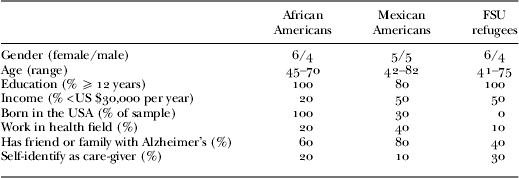
We selected 30 participants, ten from each culture/language group, for qualitative interviews via a reputational case selection methodology (Miles and Huberman Reference Miles and Huberman1994). Within the cultural communities, we sought referrals to individuals who did not necessarily have formal training in ageing-related issues, but who were recognised as knowledgeable about ageing. To ensure maximum variation sampling (Guba and Lincoln Reference Guba and Lincoln1989), we asked each participant to name another community expert known to hold different opinions from him or herself. As shown in Table 1, these participants were middle-aged, with all African Americans and FSU refugees having had some college education and Mexican Americans having had high school education. Most participants either knew someone with Alzheimer's disease or in fact had a family member with the disease.
Demographics of narrative sample
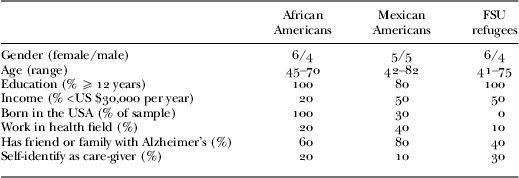
Notes: FSU: former Soviet Union. USA: United States of America.
Data collection and preparation
Interviews lasted approximately 60–90 minutes, and began with typical, ethnographic ‘grand tour’ questions (e.g. ‘Tell me about African American views on ageing’, ‘Tell me about Alzheimer's disease’) and were followed by more focused questions on ageing, memory loss, dementia and Alzheimer's disease (Ryan and Bernard Reference Ryan and Bernard2003; Spradley Reference Spradley1979). Interviews were conducted in the language preferred by the participant (English, Spanish or Russian), with all ten African Americans responding in English, eight Mexicans in Spanish and all ten FSU in Russian (for additional details, see Schrauf and Iris Reference Schrauf, Iris, Kronenfeld, Bennardo, Munck and Fischer2011b).
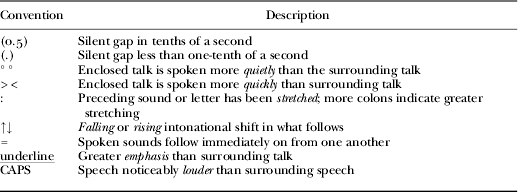
All interviews were initially transcribed according to conventions common in anthropology (Powers Reference Powers2005). Transcripts were coded by the Principal Investigator (M.I.) and the project director (E.N.) in Atlas.ti (Muhr Reference Muhr2004), and the codebook included both a priori codes (e.g. ageing, memory loss, symptoms of Alzheimer's, causes of Alzheimer's, etc.) and inductive codes that emerged from the data (Miles and Huberman Reference Miles and Huberman1994). For the analyses in this paper, we isolated all text coded as ‘cases’, in which the participant spoke about another individual who had Alzheimer's disease or severe memory loss. Across the 30 participants, there were 34 such cases (11 African American, 11 Mexican and 12 FSU). We subsequently re-transcribed these cases in the original languages according to conversation analytic conventions (Table 2). In the excerpts below we employ the transcription conventions in the original languages and make notes on English translations where relevant (Nikander Reference Nikander2008). We display the Russian transcripts using the Library of Congress transliteration system. The project was approved by the Institutional Review Board of the Leonard Schanfeld Research Institute, Chicago, Illinois.
Transcription conventions
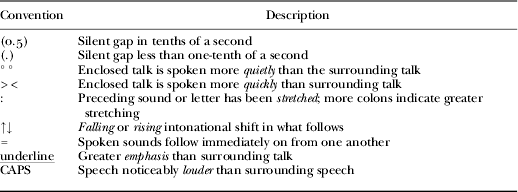
Source: Adapted from Hutchby and Woofitt (Reference Hutchby and Wooffitt1998).
Results
For this paper, we have selected three of the 34 cases for analysis, not because they are modal types or a statistically representative sample, but rather as exemplars of the narrative processes that are present to varying degrees across the 34 stories.
Excerpt 1: ‘A Typical Case Story’
This participant is a 64-year-old, African American woman, with 16 years of education, and an income over US $50,000 per year who works as a director in a social service agency. The interviewer (a 38-year-old white woman, with a research masters degree) has asked about memory loss in general. The narrator responds by telling the story of a woman who worked for her and who exhibited symptoms of serious memory loss (INT: interviewer; PAR: participant).
1 INT: °Um so tell me a little about memory loss (.)
2 what do you (.) >think about memory loss?<
3 PAR: (clears throat) >I think it's<
4 very ↑devastating (INT: umm hmm)
5 um a:nd it's ↑really kind of ↑amazing (.) um (.)
First story in chain of events
6 just ah an experience that I had (INT: mmm hmmm)
7 with uh one of my type-class staff people here
8 a:nd she was (1.0) this (2.0) lady=
9 she was a very immaculate dresser (INT: mmm hmmm)
10 I mean very immaculate (in-breath) then (clears throat)
11 >all of a sudden< she started coming to work
12 wearing her house dresses:: (INT: mmmm)
Second story in chain of events
14 a:nd the:n every morning she came in (.)
15 and she would a:sk one of the other staff people
16 to (.) change her watch
17 >because her watch was always (INT: umm hmm) incorrect
18 but she had the correct time< (.)
Third story in chain of events
19 and (clears throat) the other thing
20 that happened to her was
21 >one morning she came to work<
22 and she hit a parked ↑car
23 she came in(INT: mmm)
24 and the guy came ↑out
25 and followed her to the parking lot
26 and she says (soft voice) oh no I didn't hit nobody
27 yiknow bu:t (.)it was
Fourth story in chain of events
28 =a:nd (.) she: >she::(in-breath)went on vacation
29 =she called me every morning
30 while she< was on vacation
31 and she told me=
32 she says (soft voice) now baby
33 remember I taught school yesterday
Fifth story in chain of events
34 ↓so: (out-breath) at that time
35 >I don't think< (.)
36 I'm not sure
37 °if we were dea:ling with you all or whatever°
38 (INT: umm hmm) but I know she went
39 =we sent her to the University
40 (INT: umm hmm) fo:r an exam and (clears throat)
41 one of the other part-timers went with her
42 and do ↑you know she was so swift
43 until she eluded the other part-time person
44 °that was with her°(.)
45 but (.) and then (.) you know (clears throat)
46 I had to contact all
47 =just all of jis all kind of
48 yuhknow people (INT: umm hmm)
49 that I knew (claps hand)
50 try to help her whatever uh::
51 INT: So that was a kind of a (.) typical case
52 story(INT: mmm hmmm) = case history (INT: mmm hmmm)there.
Narrative case construction in ‘A Typical Case Story’
This is a story that has the flavour of a formal case history, shaped probably in part by the fact that the narrator reports the story of one of her own staff members whom she (the narrator) removed from her position. Although not explicitly stated, the narrator had probably previously (i.e. in other circumstances) constructed a coherent account – a ‘chain of evidence’ – to justify this action. The narrative is organised around four stories of odd behaviours. The events are not hierarchically related and only mildly cumulative, but the narrator arranges them thematically into ‘a typical case history’. Taken separately they might not point to Alzheimer's disease or dementia, but the successive stories ‘comment on one another’ (via intertextuality) and effectively point to cognitive impairment. The structure of the narrative is as follows:
First story: she comes to work wearing a housedress
Dressing appropriately for work requires knowing the proper cultural schemata, and the narrator is careful to point out that this lady did indeed follow the schema prior to these incidents. She may have been hurried, or she may be flaunting the convention, but in the context of this narrative, she is portrayed by the narrator as either disoriented or not remembering the schema or both.
Second story: asking other people to change her watch
Asking that someone check your watch for the correct time is socially acceptable, but doing so repeatedly while having the correct time violates the social schema. She may have been making a bid for attention or may have had an unreliable watch, but in the context of this narrative, she is portrayed by the narrator as either disoriented or not remembering the schema or both.
Third story: denying having hit a parked car
Accidentally hitting a car in a parking lot and denying that one has done so is not a sign of cognitive impairment, and the narrator does not explicitly draw the conclusion that this woman's denial was a sign of impairment. However, in the context of the narrative the implication is that the woman was either disoriented or ‘forgot’ that she hit the car.
Fourth story: insisting that she was at work when she was not
Calling one's supervisor while on vacation may not be ‘normal’ but it is not a sign of cognitive impairment. However, the woman's calling her supervisor every morning while she (the woman) was on vacation and saying ‘remember I taught school yesterday’ (clearly not true) is either a sign of disorientation or lying.
Fifth story: she ‘got away’ when we sent her for an evaluation
Interestingly, this final story is not about either disorientation or memory loss but rather the opposite. By portraying the woman as ‘swift’ and ‘eluding’ the person who was taking her for a cognitive evaluation, the narrator suggests that the woman knows quite well why she is being evaluated and unwilling to expose herself to that evaluation. Interestingly, the narrator presents her ‘insight’ as proof of her condition.
Discursive and grammatical devices in ‘a case history’
In addition to constructing the narrative around a concatenation of evidence, the narrator uses a number of grammatical and discourse devices to create a coherent ‘case history’.
Co-ordinating conjunctions linking stories
The narrator marks the transition from story to story almost exclusively with the co-ordinating conjunction and, which treats each story as equivalent in status and function. This creates the impression that each story is a member of a long list of equally telling instances that add up to the eventual judgement that the woman was cognitively impaired.
[First to second story] And then every morning
[Second to third story] And the other thing that happened to her was
[Third to fourth story] And she she went on vacation
Lexical oppositions marking change
In each of the five stories, the narrator skilfully sets up an opposition that reflects either some cognitive or social dysfunction.
Very immaculate dresser versus wearing her house dresses
Her watch was always incorrect versus but she had the correct time
Hit a parked car versus oh no I didn't hit nobody
Went on vacation versus now baby remember I taught school yesterday
Part-timer went with her versus she eluded the other part-time person
Progressive tenses and modal verbs signalling patterned activity
Similarly, the narrator uses progressive tenses and modal verbs to show patterned behaviour.
She started coming to work wearing her house dresses
She would ask one of the other staff people
Adverbials marking change
The narrator employs adverbs of time to create a sense of change: either dramatic (all of a sudden; one morning) or patterned (every morning).
All of a sudden she started coming to work wearing her housedresses
One morning she came to work and she hit a parked car
And then every morning she came in
She called me every morning while she was on vacation
So at that time
Reported speech as narrator performance of the symptom
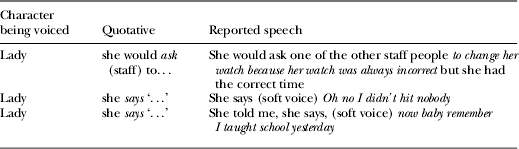
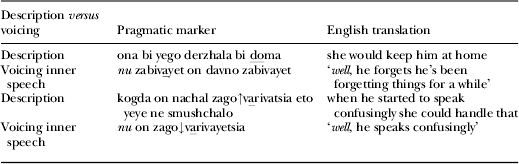
The narrator voices only the woman in this narrative, and in each instance the narrator quotes the woman's speech as the manifestation of her abnormal behaviour. In essence, by quoting the woman, the narrator is performing the symptom for the interviewer. The first instance reflects indirect reported speech and the next two involve direct reported speech (Table 3).
Reported speech in ‘A Typical Case Story’
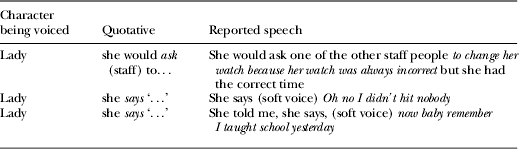
In the latter two cases in which the narrator quotes the woman directly, the narrator voices her speech very softly: in one case denying the accusation that she hit a parked car (when in fact she had), and in the other insisting that she had been to work (when in fact she had not). The soft voicing suggests weak denial of having hit the parked car and weak assertion of having shown up for work.
Interestingly, in each of the first four stories, the woman's behaviour represented by the narrator is not in itself a sign of cognitive impairment, but when framed as an answer to a question about memory loss and when concatenated, each story becomes the story of a symptom. Here, concatenation (the ‘chaining’ together of unrelated incidents as all pointing to something) and intertextuality (the effect of each story's commenting on the other stories) suggest that there is a pattern of problems reflecting a common underlying dysfunction. The effect is achieved in part by the grammatical devices used to create the contrasts between the ‘normal’ and the ‘pathological’ – particularly the lexical and adverbials that highlight marked changes in behavioural patterns. However, the series of stories do not show decline over time (each story does not show more serious cognitive impairment than the last) but rather repeated instances of roughly equivalent severity. It is the accumulation of evidence that ultimately supports the conclusion.
Excerpt 2: ‘Things We Later Saw Were Related’
In Excerpt 2, the narrator is a 60-year-old, Mexican American man, with 12 years of education, and an income over US $60,000 per year. The interviewer was a native English-speaking, female research assistant, whose second language was Spanish, and the interview took place entirely in Spanish. In the larger narrative from which this portion is taken, the narrator chains together three stories of his own father's dementia in response to the interviewer's question about ‘what happens to people with memory loss?’ For reasons of space, only the first story is transcribed here.
1 INT: >Entonces la pérdida de la memoria
INT:Then memory loss
2 es algo mas grave< (PAR: mmm hmmm)
is something serious (PAR: mmm hmmm)
3 Okay (in-breath)bueno (.) qué pasa entonces
Okay well what happens then
4 a la gente mayor que empieza a
to older people who begin to
5 olvidarse las ↓cosas?
forget things?
6 o o >que tiene pérdida de la memoria<
or or who have memory loss?
7 qué cosas ocurren con ellos?
What kinds of things happen to them?
…
First story: accusing the salesman of stealing the pen
23 PAR: y e:ste pues ya llegando a este punto (.)
PAR:and uh then coming around to this point
24 eh por ejemplo con mi papá (INT: mmm hmmm)
for example my father (INT: mmm hmmm)
25 e:ste (2.0) comenzó con (.) muchas cosas
uh it began with a lot of things
26 que luego vimos (.) relacionadas eh
that later we saw were related
27 >al platicar con mis hermanos sobre todo<
In talking especially to my brothers and sisters
28 con mi mamá también
and my mother too
…
31 entonces este: si una vez fueron a comprar (.)
then uh once we went to buy
32 una mueblaría (1.0)
some furniture
33 y que comenanzó a decirle
and he started to talk
34 al vendedor >que este que el otro
to the salesman this and that
35 mi mamá le gustó< una ↑co:sa y fue entonces
my mother liked one of the pieces and then
36 ↑buen-vengan para ↑acá por favor.
Fine, come over here
37 pasan el: vende↑dor
they go off with the salesman
38 tocó una ↑pluma
he takes a pen
39 y se la dijeron a mi papa
and tells my father
40 que llenara el formulario y ↑todo eso
to fill out a form and all that
41 pues firmó entonces se guarda la ↑pluma (.)del vende↓dor
then he signs and he keeps the salesman's pen
42 (in-breath)este: dijo señor este: (.) dice este: (.) eh:
And he says the man says uh he says
43 le presté la ↓pluma
I lent you the pen
44 eh dice no me la devuelva para que (xxx)
he says don't return it so that…
45 (heightened voice) ↑no que esta pluma es ↑mía (INT: mmmm)
(heightened voice) No! that's my pen! (INT: mmmmm)
46 (dropping voice) no señor le dice mi mama
(dropping voice) My mom says ‘No’
47 ↓dice ↓no
She says ‘no’
48 ↓dice sí es del señor
She says ‘It belongs to this man’
49 (heightened voice) >No no no no<
(heightened voice) No, no, no, no
50 tú qué vas a ↑saber?
What do you know?
51 ↓Dice ↑esta pluma es ↑mía yo la traigo ↓aquí
He says ‘This is my pen. I brought it here’.
52 ↓Dice también esto me va a robar?
He says ‘You're going to steal it from me?’
53 Entonce ese tipo de cosas comenzaron (INT: mmm hmmm)
Then that type of stuff started to happen (INT: mmm hmmm)
Narrative case construction in ‘Things We Later Saw Were Related’
As noted, this story is the first of three stories told by the narrator in one long conversational turn. Space does not permit consideration of all three stories, but in each one the narrator presents his father as aggressive, suspicious and unreasonable. As with the English narrative above, the three stories are simply concatenated (‘chained together’) without commentary or interpretation. That is, the narrator does not explicitly draw any conclusion but allows the cumulative effect of the concatenated stories (again via intertextuality) to point to some kind of cognitive impairment.
The story: accusing the salesman of stealing his pen
Of particular interest here is the narrator's positioning of the three main characters of his story. He uses a variety of discursive practices (see below) to present the salesman as accommodating and reasonable, his mother as soothing and mediating, and his father as belligerent and accusing. Although the root cause of the argument may be the father's failure to recognise the pen as belonging to the salesman, the narrator presents his father as unwilling to back down, even when the salesman effectively says: ‘Keep the pen’. The narrator presents his father's behaviour as unnecessarily aggressive.
Discursive and grammatical devices in ‘Things We Later Saw Were Related’
Conjunctive adverbs linking stories:
In the larger narrative involving three stories, the narrator moves from story to story with conjunctive adverbs that effectively convey a simple listing of his father's odd behaviours one following another. In the above transcript, this can be seen in his use of entonces (then), una vez (one time) and entonces después (then afterward).
- [Intro: first story]
Entonces una vez fueron a comprar una mueblería
So one time they went to buy furniture
- [First to second story]
Entonces ese tipo de cosas comenzaron.
Then that kind of stuff started to happen.
Reported speech as performance of the symptoms:
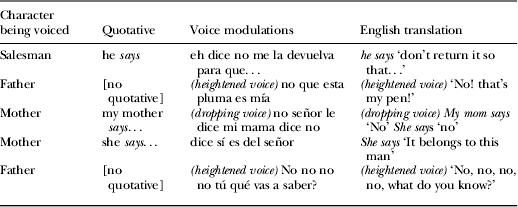
This narrative depends wholly on the dramatic situation described by the narrator (who in fact voices the participants fairly consistently across all three stories). In the salesman story, the narrator alternates between voicing the mother as soft and mediating (he drops her voice, as if in an aside) while heightening the father's voice, which portrays him as argumentative. Further, in reporting the mother's speech he repeatedly uses the quotative ‘she says’ (three times), and similarly for the salesman ‘he says’, whereas in contrast the narrator simply inserts the father's comments with no quotative. This and the heightened voice give an intrusive or imperious quality to the father's turns. The excerpt begins with the narrator quoting the salesman (Table 4).
Reported speech in ‘Things We Later Saw Were Related’

Formal versus informal pronouns: narrative positioning:
In the mouth of the narrator, the salesman does not claim the pen, but he indirectly says that the pen is his by using the simple past indicative (presté). Further, the narrator quotes the salesman as using the formal, polite, second-person plural form of the imperative (devuelva, keep it) when he (the salesman) addresses the father.
le presté la pluma no me la devuelva,
I lent you the pen don't give it back to me
Meanwhile the father dismisses his wife by employing the unnecessary second person, informal pronoun tú. Grammatically, Spanish does not require the subject pronoun but assumes it in the form of the verb, and the use of it in this circumstance suggests his disparaging her.
tú qué vas a saber?
you, what do you know?
Further, when the narrator voices the father as accusing the salesman of trying to rob him, he uses the second-person singular form of the verb (vas), which is inappropriately familiar and probably patronising. In current discourse, the salesman would be addressed in the more formal second-person plural (va).
dice también me vas a robar?
Are you going to steal this from me too?
In each of the stories in the larger narrative, the narrator presents his father as unreasonable, accusing and belligerent in a social and familial world where others are presented as accommodating and reasonable. The narrator uses a series of grammatical and discourse devices (conjunctions, reported speech, voice modulations for the different characters, and the narrative positioning of characters) to construct a patterned, socio-cultural example of a person with Alzheimer's disease.
Excerpt 3: ‘Placed to the Hospital’
The narrator in Excerpt 3 is a 41-year-old Russian woman with 15 years of education and an income between US $30,000 and $39,000 per year. The interviewer is a native Russian speaker whose second language is English. The interview took place entirely in Russian.
Chronic depression and emergence of symptoms of Alzheimer's disease
62 PAR: no kogda oni (.) >°naverno yemu uzhe bilo
PAR:but when they, maybe he was already
63 bolshe chem shesdesiat let koda oni priyehali
over sixty when they came here
64 nemnozhko bolshe < ° (in-breath) koda oni priye:hali
a little bit more when they came here
65 u nevo vsirsav-yevo nakrila novaya volna depressii.
he was covered by a new wave of depression
66 (INT: opiat’)
( INT:again)
67 PAR: i vot eta i vot eta uzhe volna povlekla za soboy
PAR:and this and this second wave resulted
68 simptomi shodniye s alts(.)gaymerom (in-breath)
in symptoms similar to Alzheimer
69 s boleznyu altsgaymera ya ne znayu (0.2) ono li eto
to Alzheimer disease, I don't know whether that was Alzheimer
70 no u:h po simptomatike
but according to the symptoms…
Wife could no longer keep him at home
74 i yego pomestili v bolnitsu
and he was placed to the hospital
75 I tazheliye posledstviya
and he had severe consequences
76 INT: a pochemu ego pomestili
INT:and why was he placed in the hospital?
77 PAR: potomu shto yego zhena (0.5) tovo zhe vozrasta
PAR:because his wife is the same age
78 shto I on to yest yey vosemdesiat let (0.2)
as he is that is, she is eighty years old,
79 vosemdesiat naverno let I ona ne
probably eighty and she can't
80 >mozhet za nim uhazhivat on ne hodit< v tual↑e:t
take care of him, he cannot go to the bathroom
…
86 INT: da u::h i: shto to yeshche on zabivayet
INT:yes and he also forgets things
87 u nego=
he has
88 PAR: net eto bi yeye ne smushchalo
PAR:no she would handle that
89 ona bi yego derzhala bi doma
she would keep him at home
90 nu zabi↓vayet on davno zabivayet.
well, he forgets – he's been forgetting things for a while
91 INT: [to yest simptomi provali v pamiati]
INT:that is, the symptoms of memory loss
92 PAR: [to yest kogda u nego poyavilis prosto
PAR:that is when he just started to have
93 provali v ↑PAmiati] provali v pamiati
momentary lapses, momentary lapses
94 slozhnosti s pamiatyu: u::h zg u::
and had difficulties with remembering
95 kogda on nachal zago↑varivatsia
when he started to speak confusingly
96 eto yeye ne smushchalo nu on zago↓varivayetsia
she could handle that, well, he speaks confusingly,
97 ona yego vodila za ruku vezde
she was accompanying him everywhere
98 poka on hodil v tua↓let (0.2)
as soon as he could go to the bathroom
99 i mog (0.8)vstat’ pomitsia sam v dush:e
and could take a shower on his own
100 no kogda (0.5) uh v kakoy to moment
but when at some point
101 u >nego nogi otkazali<
he couldn't move his legs
…
105 takim obrazom koda ona potomu shto
so when she … because
106 ona ne mozhet yego podniat s ↑pola (1.0)
she can't raise him from the floor
107 (INT: mm hmm)
His understanding and current confusion in the hospital
119 INT: nu vot na segodniashniy den’ on ponimayet
INT:so as of now, does he understand,
120 govorit?
does he speak?
121 PAR: (in-breath)on govorit da (0.5) nesurazitsu
PAR:he speaks, yes, absurdly
122 (INT: nesviazno)
( INT:incoherently)
123 PAR: no v >to zhe vremia< on kak bi ponimayet (0.2)
PAR:but at the same time he understands something
124 on ponimayet shto shto to ne tak shto on ne ↓doma
he understands that something's wrong, that he is not at home
125 shto s nim ne (0.2) shto on ↓bolen
that he is that he is ill
126 (INT: mm hmm)
( INT:mm hmm)
127 PAR: i shto vrode bi: (1.0) yego pochemu to zdes ↓derzhat.
PAR:and that like for some reason he is kept here
128 i nochyu on pochemu to s sosedom
and at night he is for some reason with his roommate
129 a ne so svoyey zhe↓noy. (0.5)
but not with his wife
130 on da on uh uh poni↑mayet no ne polnostyu sebe
he, yes, he understands but he doesn't fully
131 otdayet otchet. = to yest on ne mozhet prinimat nikakih
realise, that is, he cannot make any
132 resheniy bolshe. u:h >sposobnost’
decisions any more, the ability
133 prinimat resheniya< u nego ne sushchestvuyet bolshe.
to make decisions does not exist any more
134 no on ponimayet
but he understands
Narrative reasoning in ‘Placed to the Hospital’
At the heart of this narrative is the struggle between the narrator and the interviewer for possession of the answer to the question: why was the man hospitalised and not at home? The narrator's view is that the man's wife, an 80-year-old woman, could no longer handle her husband's physical decline (‘he cannot go to the bathroom’), but the interviewer, perhaps in her role as the research interviewer, repeatedly interrupts the narrator's account to insist that cognitive decline must have been the reason for the man's hospitalisation (‘yes, and he also forgets things’, ‘the symptoms of memory loss’, ‘speaks … incoherently’). The narrator resists the symptom labels (e.g. preferring ‘momentary lapses’, ‘difficulties with remembering’ and ‘speaks confusingly’ to ‘memory loss’) and insists that the wife could handle these things. Ultimately, the narrator argues for a nuanced view of the man's cognitive impairment, insisting that ‘he understands’ and in particular that he understands ‘something’, ‘that something's wrong’, ‘that he is not at home’, ‘that he is ill’, ‘that for some reason he is kept here at night … with his roommate and not with his wife’.
This argument between narrator and interviewer makes this narrative different from the previous two. Both the African American and Mexican American narrators are given space and time by the research interviewer to develop their stories in a relatively uninterrupted fashion, and so both narrators are able to achieve considerable coherence in symptom and case-construction. This Russian narrator, however, is frequently interrupted by the research interviewer, and the meaning and interpretation of symptoms must be negotiated. These different practices – one favouring coherence, the other negotiation (see Ochs Reference Ochs and Duranti2004) – are common in conversations in which families and friends try to figure out what counts as an odd behaviour and what counts as a symptom.
Discursive and grammatical devices in ‘Placed to the Hospital’
Marking change: Lexico-semantic oppositions between physical ability and disability (‘can’/‘can't) are particularly salient in the narrative and support the narrator's emphasis on physical (versus cognitive) dysfunction as the key factor in the man's hospitalisation. Focusing on the patient, the following are notable.
poka on hodil v tualet (in Russian could is implied)
he could go to the bathroom
i mog vstat’ pomitsia sam v dush:e
and could take a shower
no fizicheski on vse zhe mog
but physically he still could
on ne hodit v tualet (again, cannot is implied)
he cannot go to the bathroom
These have their impact on the wife, who is the chief care-giver.
I ona ne mozhet za nim uhazhivat
she can't take care of him
ona ne mozhet yego podniat s pola
she can't raise him from the floor
Contrastive conjunctions qualifying symptom severity:
Again, given the struggle between the narrator and the interviewer over the importance of the cognitive symptoms, it is interesting to note how the Russian contrastive conjunction no (but) is used to create a complex and contradictory picture of the disease.
intellectualniye poteri bili sovershenno neobratimiye is seryezniye, no
the intellect decline was absolutely irreversible and dramatic, but
fizicheski on vse zhe mog
physically he still could…
on govorit da nesurazitsu, no v to zhe vremia on kak bi ponimayet
he speaks, yes, absurdly, but he understands something
on ponimayet, no ne polnostyu sebe otdayet otchet
he understands but he doesn't fully realise
sposobnost prinimat resheniya u nego ne sushchestvuyet bolshe,
the ability to make decisions does not exist any more
no on ponimayet
but he understands
Reported inner speech:
The narrator counters the interviewer's insistence that the man has been hospitalised because ‘he forgets’ by illustrating simple descriptions with a form of direct reported speech in which she quotes the wife's internal thoughts. The Russian pragmatic marker nu (well) softens and downplays the significance of the symptoms and serves to introduce the narrator's rendition of the wife's inner speech (Table 5).
The wife's reported inner speech in ‘Placed to the Hospital’
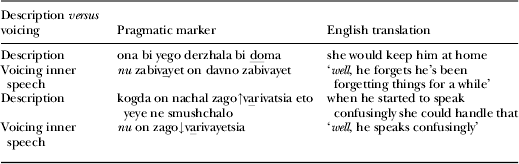
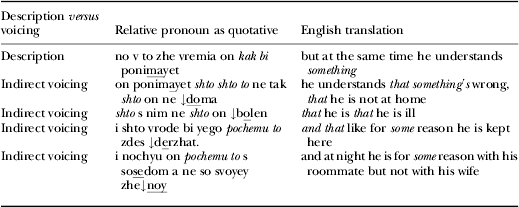
Further on, the narrator uses indirect reported speech to represent the husband's inner speech as well. This takes the form of ‘he understands that…’, where the relative pronoun shto (‘that’) serves as the indirect quotative (Table 6).
Indirect reported speech of the husband in ‘Placed to the Hospital’
Interestingly, by repeatedly saying that the man understands something (three times) and the repetitive relative clauses ‘he understands that’ (three times), the narrator underscores some measure of preserved cognitive ability in contrast to the interviewer's insistence on cognitive impairment. The impression of giving a list of preserved abilities is amplified by the narrator's voicing a falling intonation on the last word of each clause (↓home, ↓ill, ↓here, ↓wife).
Discussion
Each of the three narratives analysed above were triggered by the interviewers' asking: ‘What happens to people with memory loss?’ In response, the interviewees told a story. They constructed a case. We believe that the study participants’ decision to tell stories (versus listing behaviours or symptoms) in the context of these research interviews is a reflection of narrative reasoning about two crucial questions that emerge in the context of daily life: How do I know if it's Alzheimer's? How can I be sure? Research in narrative gerontology suggests that telling stories is a powerful means of processing information, and case-based reasoning – telling ‘stories about others’ – is an extension of that research to everyday reasoning about illness.
As evidenced in our data, case-based reasoning involves the following features. First, these narrators use a story about someone with Alzheimer's disease in order to think through and represent the differences between symptom (pathology) and normal behaviour. Second, drawing on the power of precedence, which is at the heart of case-based reasoning, the narrators present their cases as an answer to the interviewer's question. Third, the narrators claim a first person evidentiality, based on eyewitness authority, in support of the truth of their answers, saying in effect: I know a person who. … These various accomplishments of case-based reasoning depend critically on specific narrative, discursive and linguistic devices that narrators use ‘to make their case’ in conversation. Sometimes, interlocutors give narrators free reign in ‘making their case’ – a narrative practice favouring coherence (seen in our English and Spanish narratives), and sometimes interlocutors interrupt, revise and ultimately force a negotiation of the case – a narrative practice favouring open-ended problem solving (seen in our Russian narrative; Ochs Reference Ochs and Duranti2004). Applied to the two questions that we articulated above, we highlight the following devices.
How do I know whether this behaviour is a symptom of Alzheimer's disease or ‘just normal ageing’? What happens to people with Alzheimer's disease? What does it look like? In verbally constructing a case, narrators distinguish and categorise ‘symptoms’ versus lapses, slips, idiosyncrasies and other, normal, non-pathological, age-related memory changes in behaviour. In the foregoing we have examined narrators’ use of lexical oppositions to make salient the changes that have taken place, and progressive (imperfect) tenses and modal verbs to lend a sense of repetition and pattern to these behaviours. Narrators interpret these behaviours as symptoms, not by drawing obvious lessons (e.g. ‘That's how we knew she had Alzheimer's’), but rather they deploy the subtle narrative devices of concatenation (chaining together stories with similar themes), conjunction (using the simple ‘and’ or ‘and then’ to connect otherwise unrelated events) and intertextuality (implying that each story comments on each other story) to make the case that ‘these behaviours amount to Alzheimer's disease’ or ‘dementia.’ (Interestingly, in our data, respondents either make no distinction between these or they see dementia as a less threatening diagnosis; Schrauf and Iris Reference Schrauf and Iris2011a).
Symptoms are nevertheless negotiable in severity or implication, and interlocutors may contest the narrator's judgement in this regard. For example, in the contested telling of the Russian narrator, both interlocutors struggle to present their version of ‘why the husband went to the hospital’ and in the process they weigh differentially the behaviours of the husband.
Perhaps most striking in these stories is the narrator's skilful use of reported speech not only to report, but also effectively to perform the symptoms about which they talk. As noted above, quotation is never a faithful ‘replay’ but rather involves a strategic re-presentation of both the speaker's words (almost inevitably a paraphrase) and the speaker's prosody (tone, manner, etc.) for the purpose of making some particular point. Further, the narrator qualifies how something is said by choice of quotative, or the narrator can give a hurried, rushed, aggressive or imperious tone to the repartee by eliminating it altogether. In the end, the quotations in the narratives above are not descriptions of symptoms (lack of insight into one's memory problems, paranoid and possibly delusional reactions) but demonstrations or performances of them. In effect, the narrators are saying, ‘This is what Alzheimer's disease looks like’.
How can I be sure that this is Alzheimer's disease? This is probably the thorniest question of all, and of course only an appropriate medical examination can answer the question. Short of that, however (and there are many reasons and motives for putting off such an examination, see Schrauf and Iris Reference Schrauf and Iris2011c), this question touches on the status of stories-about-others as evidence. In everyday conversation, the ‘told story’ becomes itself a piece of evidence to be accepted, confirmed and incorporated or (alternately) contested, discounted and rejected by further conversation. Nevertheless, the first-person, eyewitness quality of a story gives it prima facie authority. We can see something of this in the Russian narrative which showed the study participant arguing with the interviewer over whose version of the story was correct. Here the narrator uses reported speech to voice the wife's inner speech or inner thinking about her husband's preserved (rather than lost) abilities. Effectively, the narrator grounds her version of events in the person closest to the patient: his wife. Thus, the reliability of any narrator's information derives from first-person authority: the patient, the care-giver, the family friend, the neighbour, the news commentator, etc.
One of the limitations of this research was our use of narratives told to a researcher as part of a semi-structured interview instead of narratives told between older adults under natural (or naturalistic) conditions of everyday conversation. The latter would more richly reveal how narratives are negotiated, confirmed, contested, altered, and so on, and would give a more accurate picture of actual conversational cognition. The fact that respondents in the study volunteered their ‘cases’ unbidden encourages us to believe that the discursive and linguistic devices that they employed are indeed reflective of everyday practice. Nevertheless, a next step in this research includes attention to emergence of narrative and case-based reasoning in real-world, conversational environments, including familial, community and clinical contexts.
Applications
Interestingly, how lay people answer these questions is of paramount importance to the professional medical community as well, given that early diagnosis is the aim of public health efforts (e.g. the Alzheimer's Early Detection Alliance of the Alzheimer's Association), effective clinical response (Galvin and Sadowsky Reference Galvin and Sadowsky2012; Holt Reference Holt2011) and the recent research focus on prodromal dementia (e.g. Carrillo et al. Reference Carrillo, Blackwell, Hampel, Lindborg, Sperling, Schenk, Sevigny, Ferris, Bennet, Craft, Hsu, Klunk and Klunk2009). Indeed, if we want to encourage early diagnosis, that is, if we want to intervene in lay persons’ symptom-recognition and help-seeking, we need to ensure that they have accurate information but, perhaps just as critically, we need to address the processes that they use to apply that information. In this regard, it is interesting to note that qualitative approaches have addressed what older adults know about Alzheimer's disease – particularly as shaped by lay, cultural knowledge (e.g. Dilworth-Anderson and Gibson Reference Dilworth-Anderson and Gibson2002; Hinton et al. Reference Hinton, Franz, Yeo and Levkoff2005), but less qualitative research has addressed how older adults reason about the disease.
Given the inherent power of precedence and the authority of first-person evidentiality, a well-constructed case can have considerable influence on both everyday conversation and the private thinking of lay people who are struggling with behaviours/symptoms in the grey area between normal age-related cognitive impairment and pathological cognitive impairment. In this paper, we have examined the specific narrative, discursive and linguistic devices that are common features of case-based reasoning about Alzheimer's disease among lay people. By characterising these micro-features of case-construction, we have both opened a window on to processes of social cognition and equipped ourselves with specific tools for modifying it. Thus, we suggest that intervening in such cognition – in favour, for instance, of encouraging earlier diagnosis and help-seeking – should follow a narrative path as well. In practical terms, our analyses argue for continued integration of narrative thinking into clinician–patient dialogue (e.g. Charon Reference Charon2008) and the use of ‘cases’ in public health that could serve as ‘maps’ for persons struggling with the recognition of symptoms and appropriate steps for help-seeking.
Conclusion
In this paper, we have examined three narratives produced by older adults about other older adults with Alzheimer's disease. We argue that these narratives are instances of case-based reasoning in which people ‘make a case’ to think through the murky issues of what is ‘normal’ and what is ‘Alzheimer's disease’. In particular, we have identified several structural devices (concatenation, conjunction and intertextuality) as well as specific linguistic devices (e.g. lexical opposition, past progressive tenses, temporal adverbials and reported speech) that serve as tools for sculpting these case presentations. We note that these tools also show that people do not craft their cases for the sake of solipsistic, mental review but rather as stories-to-think-with in conversational settings. This reflects our ongoing commitment to a view of knowing, thinking and reasoning as essentially social processes and not the activities of isolated, individual minds.
Acknowledgements
This research was supported by an Alzheimer's Association award (IIRG-06-26520) to the Leonard Schanfield Research Institute of CJE Senior Life (Chicago, Illinois). The project was approved by the Institutional Review Board of the Leonard Schanfeld Research Institute.