Introduction
Japanese foxtail (Alopecurus japonicus Steud.), a tetraploid species, is a competitive annual grass weed that heavily infests wheat (Triticum aestivum L.) and canola (Brassica napus L.) fields in eastern and central China (Bi et al. Reference Bi, Liu, Guo, Li, Yuan, Du and Wang2016). The strong tillering capacity of A. japonicus enhances its competitiveness against crop seedlings, resulting in considerable reduction in grain yield (Wang et al. Reference Wang, Huang, Zhang, Liu and Wang2018). Since the 1990s, this weed has been controlled with POST applications of the acetyl-CoA carboxylase (ACCase; EC 6.4.1.2) inhibitor fenoxaprop-P-ethyl. The plastidic ACCase in grass weeds is the common target of three chemically distinct classes: aryloxyphenoxypropionate, cyclohexanedione, and phenylpyraxoline (Herbert et al. Reference Herbert, Walker, Price, Cole, Pallett, Ridley and Harwood1997). Nevertheless, resistance to fenoxaprop-P-ethyl was confirmed in 2007 (Yang et al. Reference Yang, Dong, Li and Yang2007), after approximately 15 consecutive years of application.
Thereafter, one of the primary herbicides used to control the ACCase-resistant A. japonicus and other grass weeds was mesosulfuron-methyl. Mesosulfuron-methyl, a sulfonylurea (SU) herbicide, inhibits the activity of the enzyme acetolactate synthase (ALS; EC 2.2.1.6) that catalyzes the first step in the biosynthesis of the branched-chain amino acids: valine, leucine, and isoleucine (Zhou et al. Reference Zhou, Liu, Zhang and Liu2007). The ALS isozymes are the common target of five different chemical classes: SU, imidazolinone (IMI), triazolopyrimidine (TP), pyrimidinyl-thiobenzoate (PTB), and sulfonyl-aminocarbonyl-triazolinone (SCT) (Duggleby et al. Reference Duggleby, McCourt and Guddat2008). However, after several years of successful control, many A. japonicus populations also evolved resistance to mesosulfuron-methyl, particularly in the province of Anhui (Bi et al. Reference Bi, Liu, Guo, Li, Yuan, Du and Wang2016).
The ACCase and ALS inhibitors are both susceptible to the evolution of resistance (Beckie and Tardif Reference Beckie and Tardif2012; Powles and Yu Reference Powles and Yu2010), with 48 and 160 weed species identified as resistant phenotypes, respectively (Heap Reference Heap2018). As repeatedly documented (Kaundun Reference Kaundun2014; Yu and Powles Reference Yu and Powles2014), target-site resistance (TSR) is the most common mechanism resulting in resistance to an ACCase or ALS inhibitor. To date, as many as 15 amino acid substitutions (AASs) have been identified at seven codons of ACCase, and 28 AASs have been found at eight codons of ALS (Tranel et al. Reference Tranel, Wright and Heap2018). In A. japonicus, mutations at five ACCase codons (Ile-1781, Trp-1999, Trp-2027, Ile-2041, and Asn-2078) and at three ALS codons (Pro-197, Asp-376, and Trp-574) impact the efficacies of ACCase- and ALS-inhibiting herbicides (Bi et al. Reference Bi, Liu, Li, Yuan, Jin and Wang2013, Reference Bi, Liu, Guo, Li, Yuan, Du and Wang2016; Chen et al. Reference Chen, Wang, Xu, Wu, Pan and Dong2017; Cui et al. Reference Cui, Wang, Han, Chen and Li2015; Feng et al. Reference Feng, Gao, Zhang, Dong and Li2016; Tang et al. Reference Tang, Li, Dong, Dong, Lü and Zhu2012; Xu et al. Reference Xu, Zhu, Wang, Li and Dong2013, Reference Xu, Li, Zhang, Cheng, Jiang and Dong2014).
Since the first report in 2013 (Bi et al. Reference Bi, Liu, Li, Yuan, Jin and Wang2013), resistance of A. japonicus to ALS inhibitors has only been identified in two other studies (Bi et al. Reference Bi, Liu, Guo, Li, Yuan, Du and Wang2016; Feng et al. Reference Feng, Gao, Zhang, Dong and Li2016). Currently, since its patent expired in October 2014, more than 52 pesticide manufacturers have obtained the registration for mesosulfuron-methyl in China (Institute for the Control of Agrochemicals 2018). Therefore, mesosulfuron-methyl will likely remain in large-scale use, and further herbicide resistance is expected to evolve. In previous studies concerning resistance to mesosulfuron-methyl (Bi et al. Reference Bi, Liu, Li, Yuan, Jin and Wang2013, Reference Bi, Liu, Guo, Li, Yuan, Du and Wang2016; Feng et al. Reference Feng, Gao, Zhang, Dong and Li2016), the focus was primarily on one or a few specific populations, and thus the extent of resistance in a specific area remains unclear. In addition, although the proline-to-threonine AAS at codon position 197 of ALS has been reported (Bi et al. Reference Bi, Liu, Li, Yuan, Jin and Wang2013), its cross-resistance pattern has not been investigated in A. japonicus. Some of the AASs at the known mutation sites of ALS are also not yet identified or characterized in this species. Therefore, in this study, 11 populations were collected from different sites in Tianchang, Anhui Province, China, where the wheat fields are the most severely infested with A. japonicus. The aims of this study were the following: (1) determine the sensitivity of different populations of A. japonicus to mesosulfuron-methyl; (2) identify the mutations associated with the resistance; (3) and determine the cross-resistance patterns to other selected herbicides.
Materials and Methods
Plant Material and Chemical Herbicides
In May 2017, mature seeds of putative resistant (R) and susceptible (S) A. japonicus populations were collected from different sites in Tianchang, Anhui Province, China (Table 1). The wheat fields where the R populations were collected received fenoxaprop-P-ethyl and/or mesosulfuron-methyl application(s) for many years; whereas the S population was collected from uncultivated land (roadside) with no history of herbicide application. The seeds were air-dried and stored in paper bags at 4 C until further use. The information for the herbicides used for the dose–response experiments is given in Table 2.
Geographical locations of the collection sites for the seeds of Alopecurus japonicus.

Herbicides and their doses used in whole-plant dose–response experiments for different populations of Alopecurus japonicus.a

a Abbreviations: AS, aqueous solution; HPPD, 4-hydroxyphenylpyruvate dioxygenase-inhibiting herbicide; IMI, imidazolinone; OD, oil dispersion; OF, oil-miscible flowable; SCT, sulfonyl-aminocarbonyl-triazolinone; SU, sulfonylurea; TP, triazolopyrimidine; WDG, water-dispersible granules; WP, wettable powder.
b The field-recommended rates (g ai ha−1) are shown in bold (1×).
c QYM201, 1-(2-chloro-3-(3-cyclopropyl-5-hydroxy-1-methyl-1H-pyrazole-4-carbonyl)-6-(trifluoromethyl)phenyl)piperidin-2-one.
d PD, pesticide registration number.
Single-Dose Herbicide-Resistance Testing
Single-dose testing was conducted as described previously (Zhao et al. Reference Zhao, Yan, Ge, Zhu, Liu and Wang2019b). Briefly, 50 seeds were randomly selected from each population and pregerminated. The germinated seedlings were then transplanted into 50-cell planting trays (54 cm by 28 cm by 8.5 cm) containing moist loam soil and cultured in a controlled-environment greenhouse (natural light, 25/15 C day/night, and ∼75% relative humidity). The trays were watered every other day to maintain an adequate level of soil moisture. At the 3- to 4-leaf stage, the weed seedlings were treated with mesosulfuron-methyl at the field-recommended rate (FRR; 9 g ai ha−1). All herbicides shown in Table 2 were applied using a compressed-air, moving-nozzle cabinet sprayer equipped with a TeeJet® 9503EVS flat-fan nozzle (Spraying Systems Co., Wheaton, IL, USA) following previous methods (Zhao et al. Reference Zhao, Yan, Ge, Zhu, Liu and Wang2019b). After seedlings were sprayed, all plants were returned to the greenhouse and cultured for 3 wk. At 21 d after treatment (DAT), the percentage of dead plants was visually assessed (Kumar and Jha Reference Kumar and Jha2017). Resistance was confirmed when ≥50% of the individuals survived the herbicide treatment at the FFR (Deng et al. Reference Deng, Yang, Zhang, Jiao, Mei, Li and Zheng2017). After the assessment, genomic DNA was extracted from the young leaves of each surviving individual using the classic cetyltrimethylammonium bromide method (Porebski et al. Reference Porebski, Bailey and Baum1997). For those populations in which all plants died from mesosulfuron-methyl treatment, 30 seeds from each population were randomly selected and cultured to the 3- to 4-leaf stage for DNA extraction.
ALS Gene Amplification
A pair of primers previously reported by Guo et al. (Reference Guo, Yuan, Liu, Bi, Du, Zhang, Li and Wang2015) was used to amplify the A. japonicus ALS gene fragments containing all the known mutation sites (Ala-122, Pro-197, Ala-205, Asp-376, Arg-377, Trp-574, Ser-653, and Gly-654) (Kumar and Jha Reference Kumar and Jha2017). The PCR amplification was performed using 2× Es TaqMasterMix (CWBIO, Beijing, China) according to the manufacturer’s instructions. The PCR cycling profile consisted of a “hot-start” at 94 C for 2 min, followed by 35 cycles at 94 C for 30 s, 59 C for 30 s, and 72 C for 1 min, with a final elongation step at 72 C for 2 min. An EasyPure Quick Gel Extraction Kit (TransGen Biotech, Beijing, China) was used to purify all PCR products, which were then directly sequenced from both directions to minimize sequencing errors by Sangon Biotech (Shanghai, China).
DNAMAN v 6.0 software (Lynnon, Quebec, Canada) was used to analyze the sequence data. The DNA fragments and derived amino acid sequence positions refer to the full-length ALS gene of A. japonicus (GenBank accession: KR534607).
Mesosulfuron-Methyl Dose Response
Whole-plant dose–response experiments were conducted as detailed in Zhao et al. (Reference Zhao, Yan, Ge, Zhu, Liu and Wang2019b). Briefly, A. japonicus seeds from each population were pregerminated, transplanted into 12-cm-diameter pots containing moist loam soil (15 seeds per pot), and cultured in a controlled-environment greenhouse under the conditions described earlier. When the seedlings reached the 2- to 3-leaf stage, they were thinned to eight uniformly sized seedlings per pot. Alopecurus japonicus plants at the 3- to 4-leaf stage were treated with a series of doses of mesosulfuron-methyl (Table 2). At 21 DAT, the plants of the different biotypes were cut at ground level, and their aboveground dry weights were recorded.
Cross-Resistance to Other Herbicides
Based on the ALS gene analysis, three R populations, AH-1, AH-4, and AH-10, were selected to determine their cross-resistance to other herbicides. Three ALS inhibitors, a photosystem II (PSII) inhibitor, and a 4-hydroxyphenylpyruvate dioxygenase (HPPD) inhibitor were used in this study (Table 2). A series of doses for the different herbicides were determined based on preliminary tests. At 21 DAT, the aboveground dry weights of the plants were recorded.
Statistical Analyses
All the whole-plant dose–response experiments were performed twice (two runs). The experimental design was a randomized complete block design with three replications for each treatment. The dry weight data were expressed as a percent of the untreated control. No significant differences (P > 0.05) were detected between repeated experiments; therefore, the data from the same trial were pooled across runs and fit to a four-parameter log-logistic curve (Equation 1) in SigmaPlot v. 14.0 (Systat Software, San Jose, CA, USA):
 $$y = C + {{D - C} \over {1 + \mathop {\left( {{{x} \over {{\rm{G}}{{\rm{R}}_{{\rm{50}}}}}}} \right)}\nolimits^b }}$$
where C is the lower limit of the response, D is the upper limit of the response, x is the herbicide application dose, b is the slope at which the herbicide dose causes a 50% growth reduction (GR50), and y is the response at the herbicide dose x. A resistance index (RI) based on the GR50 value was calculated to estimate the level of resistance in the R population relative to that in the S population. The weed populations were categorized as follows: no resistance (RI < 2), low resistance (2 ≤ RI < 5), moderate resistance (5 ≤ RI < 10), and high resistance (RI ≥ 10) (Beckie and Tardif Reference Beckie and Tardif2012).
Results and Discussion
Resistance Screening and Identification of ALS Gene Mutations
Since 2004, the ALS inhibitor mesosulfuron-methyl has been in popular use for weed management in wheat fields in China, particularly for the control of ACCase-resistant weed species. However, the long-term use of single mode of action (MOA) herbicides has frequently resulted in the evolution of herbicide resistance (Norsworthy et al. Reference Norsworthy, Ward, Shaw, Llewellyn, Nichols, Webster, Bradley, Frisvold, Powles and Burgos2012). According to Beckie and Tardif (Reference Beckie and Tardif2012), weed resistance can be selected by ALS inhibitors in less than 10 applications. Therefore, predictably, resistance to ALS inhibitors has evolved in 17 weed species in China, including A. japonicus (Heap Reference Heap2018). In this study, the 10 suspected resistant A. japonicus populations were all collected from wheat fields with a long-term use history of ACCase and/or ALS inhibitors. In a previous study, these 10 populations were highly resistant to the ACCase inhibitor fenoxaprop-P-ethyl, and the Ile-1781-Leu or Trp-2027-Cys mutation in the ACCase gene was very likely one of the key reasons resulting in fenoxaprop-P-ethyl resistance in the different A. japonicus populations (Zhao et al., Reference Zhao, Wang, Zhang, Liu and Wang2019a). These populations were also treated with mesosulfuron-methyl for many years, and therefore, their sensitivity to different ALS inhibitors and the potential TSR mechanism were investigated further.
As Figure 1 shows, all tested plants from populations AH-S, AH-5, and AH-9 died from mesosulfuron-methyl treatment at 9 g ha−1, while more than 75% of individuals survived in each of the other eight populations. These results indicated that 8 of the 11 populations tested evolved resistance to mesosulfuron-methyl.
Resistance screening to mesosulfuron-methyl for different populations of Alopecurus japonicus. Vertical bars represent the SE of the mean. Bars with the same letters are not significantly different at P ≤ 0.05.

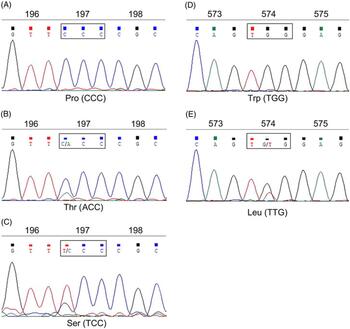
A 1,859-bp fragment spanning all eight known mutation sites of the A. japonicus ALS gene was then obtained from each individual (n ≥ 30) of the different populations. The sequence comparison indicated that the amplified ALS genes of all populations had 99.14% sequence similarity with the same region of the documented ALS gene of A. japonicus. Because they resulted in no AAS, most of the single-nucleotide polymorphisms were synonymous. However, in plants of populations AH-4 and AH-8, a C to A mutation in the ALS gene was detected, which resulted in a proline (CCC) to threonine (ACC) substitution at codon position 197 (Figure 2A and B). Similarly, in plants of the AH-1, AH-2, AH-3, AH-6, and AH-7 populations, a G to T mutation in the ALS gene was identified, which resulted in a tryptophan (TGG) to leucine (TTG) substitution at codon position 574 (Figure 2D and E). Notably, in plants of the AH-10 population, a C to T mutation was identified in the ALS gene, resulting in a proline (CCC) to serine (TCC) substitution at codon position 197 (Figure 2A and C). No known ALS gene mutation was detected in plants of populations AH-S, AH-5, and AH-9 (unpublished data).
Acetolactate synthase (ALS) gene sequencing showing (A) Pro (CCC), (B) Thr (ACC), or (C) Ser (TCC) at codon position 197 and (D) Trp (TGG) or (E) Leu (TTG) at codon position 574 for Alopecurus japonicus.

In the direct sequencing of PCR products, the chromatograms of mutant codon positions always showed double peaks in the surviving plants and sharp, single peaks in the susceptible plants (Figure 2). In addition, no homozygous mutation was detected in sequenced individuals, suggesting multiple alleles of the ALS genes (Iwakami et al. Reference Iwakami, Shimono, Manabe, Endo, Shibaike, Uchino and Tominaga2017). These results are consistent with a previous finding that three or four alleles of ALS were present in the different accessions of A. japonicus (Feng et al. Reference Feng, Gao, Zhang, Dong and Li2016). Because this study primarily focused on identifying the AASs associated with herbicide resistance, we did not identify the allele(s) holding the specific mutation(s) in each resistant population.
Sensitivity to Mesosulfuron-Methyl
Whole-plant dose–response experiments were performed to reconfirm the sensitivity of each A. japonicus population to mesosulfuron-methyl (Table 3). As expected, the susceptible populations AH-S, AH-5, and AH-9 were completely controlled by mesosulfuron-methyl at 9 g ha−1. The GR50 values of these three populations were all below 1.50 g ha−1, which are rates much lower than the FFR. By contrast, the GR50 values of the eight suspected resistant populations (AH-1 to 4, AH-6 to 8, and AH-10) to mesosulfuron-methyl treatment were between 37.97 and 84.91 g ha−1 and were 50.0- to 111.7-fold greater than those of the susceptible population (AH-S). Based on the corresponding RI values, these eight populations were deemed highly resistant to mesosulfuron-methyl (RI ≥ 10).
Parameter values of the four-parameter log-logistic equation (Equation 1)a used to fit the plant growth response of Alopecurus japonicus (as a percent of the untreated control) resulting from the different application doses of mesosulfuron-methyl.

a Equation 1: y = C + (D – C)/[1+(x/GR50)b], where C is the lower limit of the response, D is the upper limit of the response, x is the herbicide application dose, b is the slope of the curve at GR50, and y is the plant growth response.
b Numbers in parentheses represent the SE of the mean.
c GR50 refers to the herbicide dose resulting in a 50% growth inhibition.
Cross-Resistance to Other Herbicides
For the susceptible population AH-S, all plants were killed at the FFR of all herbicides evaluated. Compared with AH-S, AH-1 with the Trp-574-Leu mutation was highly resistant to imazethapyr (RI = 16.36) and pyroxsulam (RI = 20.56) and moderately resistant to flucarbazone-Na (RI = 8.84); AH-4 with the Pro-197-Thr mutation was moderately resistant to flucarbazone-Na (RI = 5.69), had low resistance to pyroxsulam (RI = 3.12), and was sensitive to imazethapyr (RI = 1.91); and AH-10 with the Pro-197-Ser mutation was highly resistant to pyroxsulam (RI = 15.33) and flucarbazone-Na (RI = 13.74) but was sensitive to imazethapyr (RI = 1.31) (Table 4; Figure 3). In addition, all three populations were sensitive to both isoproturon and QYM201, with their GR50 values much lower than the corresponding FFRs (Table 4; Figure 3).
Sensitivities of susceptible (AH-S) and resistant (AH-1, AH-4, and AH-10) populations of Alopecurus japonicus to different herbicides.

a GR50 refers to the herbicide dose resulting in a 50% growth inhibition. Numbers in parentheses represent the SE of the mean.
b RI, resistance index.
c QYM201, 1-(2-chloro-3-(3-cyclopropyl-5-hydroxy-1-methyl-1H-pyrazole-4-carbonyl)-6-(trifluoromethyl)phenyl)piperidin-2-one.
Dose–response curves of the aboveground dry weights of susceptible (AH-S) and resistant (AH-1, AH-4, and AH-10) populations of Alopecurus japonicus for a series of application rates of different herbicides. Vertical bars represent the SE of the mean.

Pro-197-Thr and Trp-574-Leu are well-known mutations documented in many resistant weed species (Chen et al. Reference Chen, Huang, Zhang, Huang, Wei, Chen and Wang2015; Deng et al. Reference Deng, Yang, Zhang, Jiao, Mei, Li and Zheng2017; Han et al. Reference Han, Yu, Purba, Li, Walsh, Friesen and Powles2012; Xia et al. Reference Xia, Pan, Li, Wang, Feng and Dong2015), including A. japonicus (Bi et al. Reference Bi, Liu, Li, Yuan, Jin and Wang2013, Reference Bi, Liu, Guo, Li, Yuan, Du and Wang2016). However, the cross-resistance to ALS inhibitors in A. japonicus due to the Pro-197-Thr point mutation has not been previously tested (Bi et al. Reference Bi, Liu, Li, Yuan, Jin and Wang2013). In the current study, the whole-plant dose–response experiments revealed the resistant population AH-4 with the Pro-197-Thr mutation was highly resistant to SUs, moderately resistant to SCTs, minimally resistant to TPs, and sensitive to IMIs (Tables 3 and 4). Thus, this AAS endowed A. japonicus plants with broad-spectrum cross-resistance to ALS inhibitors in chemically distinct classes. As previously documented, the ALS gene Pro-197-Thr mutant flixweed [Descurainia sophia (L.) Webb ex Prantl] showed similar cross-resistance to ALS inhibitors (Deng et al. Reference Deng, Yang, Zhang, Jiao, Mei, Li and Zheng2017). This substitution can also confer resistance to SUs, TPs, and IMIs in shortawn foxtail (Alopecurus aequalis Sobol.) (Xia et al. Reference Xia, Pan, Li, Wang, Feng and Dong2015). In addition, in the current study, the A. japonicus plants with the Trp-574-Leu mutation were highly resistant to SUs, IMIs, and TPs and moderately resistant to SCTs, which are results consistent with previous findings (Bi et al. Reference Bi, Liu, Guo, Li, Yuan, Du and Wang2016).
In a comparison with other known ALS mutations, the proline to serine mutation is the most common AAS at the 197 codon of the ALS gene (Heap Reference Heap2018). This substitution confers cross-resistance to ALS inhibitors in many other weed species, such as wild radish (Raphanus raphanistrum L.) (Yu et al. Reference Yu, Han, Li, Purba, Walsh and Powles2012), corn poppy (Papaver rhoeas L.) (Kaloumenos et al. Reference Kaloumenos, Adamouli, Dordas and Eleftherohorinos2011), mayweed chamomile (Anthemis cotula L.) (Intanon et al. Reference Intanon, Perez-Jones, Hulting and Mallory-Smith2011), water starwort [Myosoton aquaticum (L.) Moench] (Liu et al. Reference Liu, Bi, Li, Yuan, Du and Wang2013), and eclipta [Eclipta prostrata (L.) L.] (Li et al. Reference Li, Li, Yu, Wang and Cui2017). In these weeds, the Pro-197-Ser substitution is correlated with broad-spectrum resistance to SUs, TPs, PTBs, or SCTs but low or no resistance to IMIs. However, to our knowledge, this AAS has not been documented in A. japonicus. This study is the first to confirm that the resistance to mesosulfuron-methyl in an A. japonicus population, AH-10, was due to a Pro-197-Ser mutation in the ALS gene. Moreover, subsequent dose–response bioassays indicated the Pro-197-Ser mutant A. japonicus plants were highly resistant to SUs, TPs, and SCTs but sensitive to IMIs.
The ultimate aim of investigating the resistance mechanisms in weeds is to develop more effective pest management practices. In addition to a recent study (Zhao et al., Reference Zhao, Wang, Zhang, Liu and Wang2019a) that demonstrated the 10 populations tested were all highly resistant to fenoxaprop-P-ethyl, in this study, eight of these populations also showed the evolution of resistance to mesosulfuron-methyl. This outcome indicates that resistant A. japonicus plants have spread over almost all the wheat fields in this specific area. Notably, many Chinese pesticide manufacturers are continuing to register mesosulfuron-methyl for use in wheat fields (Institute for the Control of Agrochemicals 2018). Therefore, if the use of this chemical continues in this area, the expectation is that the “susceptible” populations will soon develop resistance to mesosulfuron-methyl (Beckie and Tardif Reference Beckie and Tardif2012). Fortunately, in the current study, the PSII inhibitor isoproturon continued to display good efficacy for the control of resistant plants (Table 4). Therefore, according to Collavo et al. (Reference Collavo, Strek, Beffa and Sattin2013), a biennial rotation between ALS inhibitors and isoproturon or a mixture with diflufenican may efficiently control the ACCase-resistant A. japonicus populations and further delay the development of their resistance to mesosulfuron-methyl.
In this study, the efficiency of QYM201 (1-(2-chloro-3-(3-cyclopropyl-5-hydroxy-1-methyl-1H-pyrazole-4-carbonyl)-6-(trifluoromethyl)phenyl)piperidin-2-one) for the control of resistant populations was also evaluated. QYM201 is a novel HPPD inhibitor developed by King Agroot Chemicals (Qingdao, China) in 2011. To our knowledge, such MOA herbicides have not been used for weed control in wheat fields worldwide. In this study, the A. japonicus plants with different ALS gene mutations all died from QYM201 treatment at the FFR of 135 g ai ha−1. Based on the present data, this chemical has great potential to effectively manage herbicide resistance and thus would be an ideal option for weed control in wheat fields.
In addition, Wang et al. (Reference Wang, Huang, Zhang, Liu and Wang2018) found that A. japonicus seeds buried from 0 to 3 cm in soil have a high germination rate (>90%), whereas no emergence is observed when seeds are buried at a depth of 7 cm. Therefore, deep tillage has the potential to bury the seeds below their maximum depth of emergence, and the development of no-till or minimum-till systems in the following years would be a possible management option for establishing a crop in fields infested with resistant A. japonicus (Zhao et al. Reference Zhao, Li, Guo, Zhang, Ge and Wang2018).
In summary, the first case of an A. japonicus population that evolved high-level resistance to mesosulfuron-methyl due to a Pro-197-Ser mutation in the ALS gene was identified. Because the proline to serine mutation is considered the most common AAS at the 197 codon of the ALS gene, the occurrence of the mutation in the species A. japonicus fills a gap in our knowledge. The comprehensive cross-resistance patterns of TSR resulting from a Pro-197-Thr, Pro-197-Ser, or Trp-574-Leu mutation in A. japonicus were also characterized. The evolution of herbicide resistance in A. japonicus has reached a critical point in Tianchang, Anhui Province, and thus the development of an integrated weed management program, including herbicide use or crop rotation, tillage, or other practices that deplete the soil seedbank, is urgently needed.
Acknowledgments
The National Natural Science Foundation of China (no. 31772181), the Funds of “Shandong Double” Tops Program (no. SYL2017XTTD11), and the Major Science and Technology Innovation Project in Shandong Province (no. 2018CXGC0213) funded this research. We thank Tao Jin (King Agroot Chemicals Co., Ltd., Qingdao, China) for his help in the collection of A. japonicus seeds. We also thank editor Vijay Nandula and anonymous reviewers for useful and insightful comments on draft versions of the article. No conflicts of interest have been declared.