Introduction
Schizophrenia is a highly familial disorder of presumed neurodevelopmental origin typically affecting people in their late teens or early adult life. Widespread neuropsychological impairments (Heinrichs & Zakzanis, Reference Heinrichs and Zakzanis1998) have been widely reported in individuals with established schizophrenia but there is uncertainty regarding the degree to which these deficits are present in the pre-morbid state and to what extent they reflect genetic vulnerability to the disorder.
Neuropsychological dysfunctions, including deficits of attention, motor speed, executive function, and verbal learning and memory, have been reported in child and adult relatives of patients with schizophrenia (Cannon et al. Reference Cannon, Zorrilla, Shtasel, Gur, Gur, Marco, Moberg and Price1994; Cornblatt & Keilp, Reference Cornblatt and Keilp1994; Faraone et al. Reference Faraone, Seidman, Kremen, Pepple, Lyons and Tsuang1995; Kremen et al. Reference Kremen, Seidman, Pepple, Lyons, Tsuang and Faraone1994; Toomey et al. Reference Toomey, Faraone, Seidman, Kremen, Pepple and Tsuang1998). This has stimulated interest in searching for specific patterns of neuropsychological deficits that might be related to its genetic aetiology. Cognitive deficits in schizophrenia have been described as potential endophenotypes: discrete aspects of the disorder closer to the mechanism for gene action than the overall disease phenotype (Gottesman & Gould, Reference Gottesman and Gould2003). This view has been supported by the finding of cognitive impairments in people possessing susceptibility alleles for schizophrenia (Hall et al. Reference Hall, Whalley, Job, Baig, McIntosh, Evans, Thomson, Porteous, Cunningham-Owens, Johnstone and Lawrie2006). Such specific impairments may act as markers of vulnerability to schizophrenia and potentially enable further risk stratification in people of heightened susceptibility to the disorder.
Prospective study of individuals at high genetic risk of schizophrenia allows investigation of the extent to which abnormalities present in the disorder reflect genetic vulnerability or illness-related features. The Edinburgh High Risk Study (EHRS) (Hodges et al. Reference Hodges, Byrne, Grant and Johnstone1999; Johnstone et al. Reference Johnstone, Abukmeil, Byrne, Clafferty, Grant, Hodges, Lawrie and Owens2000) recruited subjects as young adults and followed them through a period which incorporated their maximum risk of developing schizophrenia. Previous neuropsychological test reports from the EHRS have shown poorer performance of the high-risk (HR) subjects on general tests of intellectual function, verbal and language ability, motor speed and aspects of executive function and memory (Byrne et al. Reference Byrne, Hodges, Grant, Owens and Johnstone1999, Reference Byrne, Clafferty, Cosway, Grant, Hodges, Whalley, Lawrie, Cunningham Owens and Johnstone2003; Cosway et al. Reference Cosway, Byrne, Clafferty, Hodges, Grant, Abukmeil, Lawrie, Miller and Johnstone2000, Reference Cosway, Byrne, Clafferty, Hodges, Grant, Morris, Abukmeil, Lawrie, Miller, Owens and Johnstone2002). The neuropsychological impairments were evident before there was any evidence of psychotic features (Cosway et al. Reference Cosway, Byrne, Clafferty, Hodges, Grant, Abukmeil, Lawrie, Miller and Johnstone2000) and could not simply be attributed to the presence of symptoms (Byrne et al. Reference Byrne, Clafferty, Cosway, Grant, Hodges, Whalley, Lawrie, Cunningham Owens and Johnstone2003). However, only one variable [the Rey Auditory Verbal Learning Test (Rey, Reference Rey1964)] was associated with the later development of schizophrenia (Johnstone et al. Reference Johnstone, Ebmeier, Miller, Owens and Lawrie2005), indicating that many neuropsychological deficits measured may be related to a state of increased genetic vulnerability, rather than to the development of diagnosable illness.
Computer-based testing for neuropsychological variables may be an improvement on non-computerized testing in minimizing effects of additional influences that can obscure the purely cognitive component under assessment (Schatz & Browndyke, Reference Schatz and Browndyke2002). The Cambridge Neuropsychological Test Automated Battery (CANTAB; http://www.camcog.com/science/cantab-tests-all.asp) applies computerized testing for concise, accurate measurement of a range of cognitive domains (Levaux et al. Reference Levaux, Potvin, Sepehry, Sablier, Mendrek and Stip2007). The CANTAB allows the accuracy and rigour of computerized psychological testing while also allowing for a wide range of ability, thus avoiding ceiling and floor effects. The CANTAB has been used in previous studies of individuals with a diagnosis of schizophrenia or in the prodromal phase (Barnes et al. Reference Barnes, Hutton, Chapman, Mutsatsa, Puri and Joyce2000; Badcock et al. Reference Badcock, Michiel and Rock2005) but, to our knowledge, this is the first time it has been used in a genetic HR group.
The CANTAB tests used in the battery were selected for their putative involvement in executive function, attention, learning and memory: domains with reported deficits in both patients and relatives of those with schizophrenia (Sitskoorn et al. Reference Sitskoorn, Aleman, Ebisch, Appels and Kahn2004). Given the results of other HR studies and studies of adult relatives of patients with schizophrenia, we predicted that in all domains the control subjects would perform better than the HR group.
Method
Participants
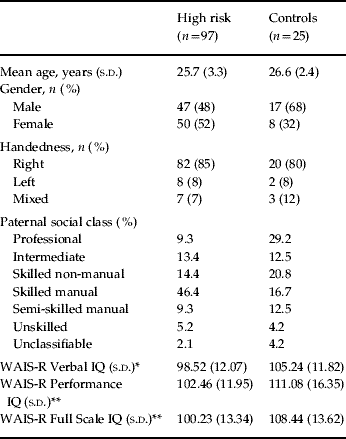
These were all individuals taking part in the EHRS and comprised HR participants and healthy controls without a family history of psychotic illness in either first- or second-degree relatives. Participants were initially recruited aged 16–25 years so that they would pass through the age of greatest risk of schizophrenia in the following 5–10 years. Details of the recruitment process have been described in previous papers (Hodges et al. Reference Hodges, Byrne, Grant and Johnstone1999; Johnstone et al. Reference Johnstone, Abukmeil, Byrne, Clafferty, Grant, Hodges, Lawrie and Owens2000). In brief, individuals with schizophrenia, with a family history of schizophrenia and with adolescent relatives were identified from psychiatric hospital case records in most areas of Scotland. Case-note diagnoses of schizophrenia were verified with the Operational Criteria Checklist (McGuffin et al. Reference McGuffin, Farmer and Harvey1991). HR subjects aged 16–25 years who agreed to participate were given detailed clinical, neuropsychological and structural magnetic resonance imaging assessments which were repeated for consenting subjects approximately every 18 months. The CANTAB was introduced at the second assessment so that of the original 160 HR and 36 control participants assessed at baseline, CANTAB data were available for 97 HR and 25 control participants who remained in the study. Table 1 provides participant information including paternal social class as defined by the Classification of Occupations of the Registrar General (OPCS, 1991).
Participant information
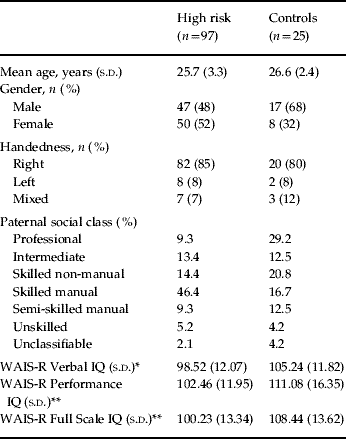
s.d., Standard deviation; WAIS-R, Wechsler Adult Intelligence Scale – Revised; IQ, intelligence quotient.
* p<0.05, ** p<0.01.
CANTAB neuropsychological tests
The neuropsychological tests used were all from the CANTAB. The CANTAB is a series of computerized tests of cognition that runs on a personal computer fitted with a touch-sensitive screen. It has been standardized on many samples (e.g. Robbins et al. Reference Robbins, James, Owen, Sahakian, Lawrence, McInnes and Rabbitt1998). The following three subtests were selected for the present study. For more detailed descriptions of these tests, see the CANTAB website (http://www.camcog.com/science/cantab-tests-all.asp).
Spatial span
This test assesses working memory capacity – indexing individual ability to store information temporarily ‘on-line’ in order to plan further action. This test includes outcome measures of span length (the longest sequence successfully recalled) and error measures.
Spatial working memory
This test is a sensitive measure of frontal lobe and ‘executive’ dysfunction. The subject must retain spatial information and manipulate remembered items in working memory but it is also a self-ordered task requiring a heuristic strategy. The test involves a gradually increasing number of coloured squares (boxes) being shown on the screen. The aim of this test is that, by touching the boxes (a search) and using a process of elimination, the subject finds a ‘token’ in each of a number of boxes and uses the tokens to fill up an empty column on the right-hand side of the screen. Outcome measures for spatial working memory include a strategy score (reflecting the consistency of the search sequencing) as well as ‘within’ and ‘between’ search errors.
Stockings of Cambridge
‘Stockings of Cambridge’ is a spatial planning and motor control test that gives a measure of frontal lobe function. The subject is shown two displays containing three coloured balls. The displays are presented in such a way that they can easily be perceived as stacks of coloured balls held in stockings suspended from a beam. The subject must use the balls in the lower display to copy the pattern shown in the upper display. Subjects are instructed to plan their sequence of moves before starting to move the balls on the monitor. Outcome measures are the time taken to plan the moves until the first move is made (initial thinking time) and the time taken in planning from the time of the first move until the last move (subsequent thinking time). A further outcome measure included was the mean number of excess moves.
Statistical analysis
All statistical analyses were performed using SPSS (version 14; SPSS Inc., Chicago, IL, USA). Performance data were tested for conformity to a normal distribution by using the Kolmogorov–Smirnov statistic. Where normality could not be assumed, the data were transformed using a log transformation (e.g. latency measures for the Stockings of Cambridge). Analyses of covariance were performed on each outcome measure within the three selected CANTAB subtests with group as a between-subjects factor and with intelligence quotient (IQ) included as a covariate.
We subsequently examined whether significant performance differences between groups were likely to be affected by the symptom status of the HR group. For this, we divided the HR group into those who experienced no psychotic symptoms during the course of the study, those who did experience psychotic symptoms but remained well, and those who experienced psychotic symptoms and subsequently developed schizophrenia. We used this symptom status as the between-subjects factor in analyses of covariance where the dependent variables were those tests found to significantly differ between the HR and control groups in the earlier analyses. Again, IQ was included as a covariate.
Results
Table 1 shows participant information for both the HR and control groups. There were no statistically significant differences between the groups on age, gender, handedness, nor social class at birth. With regard to IQ there were statistically significant differences, with HR participants scoring lower on all three measures.
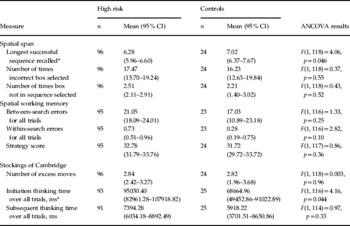
Table 2 shows mean scores for the CANTAB measures in each group with confidence intervals (CIs) and F tests while covarying for IQ.
Scores on CANTAB outcome measures in the two groups and results of analyses of variance comparing the two groups while covarying for IQ (ANCOVA)

CANTAB, Cambridge Neuropsychological Test Automated Battery; IQ, intelligence quotient; ANCOVA, analysis of covariance; CI, confidence interval.
* Significant difference between groups after controlling for IQ (p<0.05).
Spatial span
There was a significant difference between groups in the longest successful sequence recalled [F(1, 118)=4.06, p=0.046]. There were no significant differences in the number of times an incorrect box was selected [F(1, 118)=0.37, p=0.55] or the number of times a box not in the sequence was selected [F(1, 118)=0.43, p=0.52].
Spatial working memory
Although differing noticeably in mean scores, when including IQ as a covariate the total number of between-search errors did not significantly differ between groups [F(1, 116)=1.33, p=0.25]. Strategy scores also did not significantly differ between the two groups [F(1, 117)=0.86, p=0.36]. The number of within-search errors made was very low and also did not significantly differ between the groups [F(1, 116)=2.82, p=0.10].
Stockings of Cambridge
Latencies for the ‘Tower of London’ task were measured to the nearest 10 ms and transformed by using the square root of each score in order to meet the assumptions of the parametric analysis used. Overall latencies for ‘initiation thinking time’ differed significantly between groups [F(1, 116)=4.16, p=0.044].
Latencies for ‘subsequent thinking time’, whilst greater in the HR group, did not differ significantly overall [F(1, 114)=0.97, p=0.33]. There was also no difference in the mean number of moves above the minimum possible (excess moves) [F(1, 118)=0.003, p=0.96].
The HR group divided by symptoms
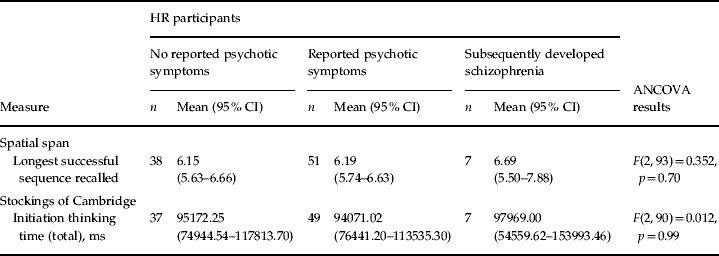
Table 3 shows the mean scores with CIs and F tests while covarying for IQ for the HR group divided by symptom category on the two measures found to significantly differ between controls and HR participants. Analyses of covariance showed no significant differences or trends towards difference between HR symptom groups in any of the measures that had significantly differed between the HR and control groups.
Scores on deficit measures for the HR group divided by symptom category and results of analyses of variance comparing the three groups on each deficit while covarying for IQ (ANCOVA)
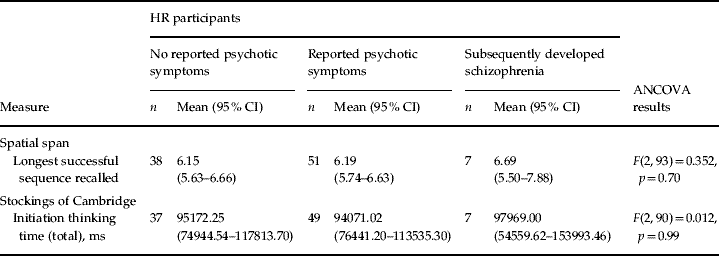
HR, High-risk; IQ, intelligence quotient; ANCOVA, analysis of covariance; CI, confidence interval.
Discussion
In the present study we compared the cognitive performance of a large sample of individuals at genetic HR for schizophrenia with a sample of healthy controls using computerized tests from the CANTAB. Spatial memory capacity (the longest successful sequence recalled in the spatial span task) and planning processing speed (initiation thinking time for the Stockings of Cambridge task) were both significantly reduced in the HR group compared with the control group even after covarying for general intelligence (IQ). Whilst there was a tendency for HR individuals to make more of certain errors and to show poorer performance relative to controls in terms of problem-solving performance and strategy, when taking general intelligence (IQ) level into account, none of these elements significantly differed between groups. Further analysis indicated that these deficits characterized the HR group regardless of symptom status within the group. These results therefore suggest that there are specific cognitive deficits in those at genetic HR for schizophrenia which relate to the genetic vulnerability present in HR individuals.
We are aware of previous studies that have examined neuropsychological functioning using the CANTAB in those in the prodromal stage of psychosis (Wood et al. Reference Wood, Pantelis, Proffitt, Philips, Stuart, Buchanan, Mahony, Brewer, Smith and McGorry2003; Bartok et al. Reference Bartok, Berecz, Glaub and Degrell2005) but believe that this is the first study to use these tests in those at genetic HR of schizophrenia. Previous neuropsychological findings have shown spatial working memory deficits to be present in schizophrenia (e.g. Badcock et al. Reference Badcock, Michiel and Rock2005) before full onset of the illness (Brewer et al. Reference Brewer, Wood, Phillips, Francey, Pantelis, Yung, Cornblatt and McGorry2006), suggesting this as a pre-morbid deficit, and in relatives of patients (Cannon et al. Reference Cannon, Huttunen, Lonnqvist, Tuulio-Henriksson, Pirkola, Glahn, Finkelstein, Hietanen, Kaprio and Koskenvuo2000; Glahn et al. Reference Glahn, Therman, Manninen, Kaprio, Lonnqvist and Cannon2003; Saperstein et al. Reference Saperstein, Fuller, Avila, Adami, McMahon, Thaker and Gold2006), suggesting this deficit as a cognitive endophenotype for schizophrenia. However, identifying the impaired cognitive component(s) from a range of possible subprocesses involved is problematic. It can be argued that a main difference between the spatial working memory and spatial span tasks is that manipulation as well as maintenance is required in the former. Our findings suggest that deficits in cognitive manipulation do not characterize the genetic predisposition to schizophrenia whilst capacity for (or maintenance of) spatial information does. This supports the findings of Glahn et al. (Reference Glahn, Therman, Manninen, Kaprio, Lonnqvist and Cannon2003) who, by varying the extent of manipulation and decision processes involved in a spatial working memory task, identified deficits in the encoding or storage aspects of the task (rather than manipulation) as a possible endophenotypic marker for schizophrenia.
The finding that planning processing speed was significantly lower in participants at genetic HR of schizophrenia may support a previous finding by Cannon et al. (Reference Cannon, Huttunen, Lonnqvist, Tuulio-Henriksson, Pirkola, Glahn, Finkelstein, Hietanen, Kaprio and Koskenvuo2000). In their study investigating neuropsychological functioning among monozygotic and dizygotic twin pairs discordant for schizophrenia, as well as spatial span deficits, they found that ‘choice reaction time’ (CRT) was independently sensitive to genetic loading for schizophrenia. This CRT test involved pressing the appropriate button when a target appeared on either the left or the right side of fixation and was measured as the average time to respond. However, while CRT involves sustained attention, target detection and response selection, the ‘initiation thinking time’ of the Stockings of Cambridge task may also index a substantially greater strategic planning component. Indeed, one of the difficulties of research into cognitive processes in those with schizophrenia and their relatives has been the variety of measures used – many of which may measure subtly different or overlapping cognitive subprocesses (Snitz et al. Reference Snitz, MacDonald and Carter2006).
A further difficulty lies in identifying specific deficits amongst a more general decline in cognitive ability present in schizophrenia (Donohoe et al. Reference Donohoe, Clarke, Morris, Nangle, Schwaiger, Gill, Corvin and Robertson2006). Deficits in general cognitive function, usually measured in terms of deficits on IQ measurements, often yield larger effect sizes than obtained for more specific cognitive impairments (Heinrichs & Zakzanis, Reference Heinrichs and Zakzanis1998), and show evidence of heritability (Goldberg et al. Reference Goldberg, Ragland, Torrey, Gold, Bigelow and Weinberger1990). Consequently, the degree to which putatively ‘discrete’ cognitive endophenotypes such as spatial working memory (Glahn et al. Reference Glahn, Therman, Manninen, Kaprio, Lonnqvist and Cannon2003; Saperstein et al. Reference Saperstein, Fuller, Avila, Adami, McMahon, Thaker and Gold2006) are actually indexing selective aspects of cognition is still unclear.
It can be argued that one of the limitations of the present study is the small but significant difference in IQ between the HR and control groups. Given that we would expect neuropsychological deficits in our HR group to be subtle (otherwise such individuals would be presenting clinically with vocational and social dysfunction) and that the relationship between cognitive subprocesses and general cognitive function is poorly defined (e.g. Dickinson et al. Reference Dickinson, Ragland, Gold and Gur2008), it is difficult to know if covarying for IQ could potentially mask some relevant deficits. However, the control group in the EHRS was carefully chosen to be matched on age, gender, handedness and social class at birth – a ‘normal’ control group which was matched for the low IQ that characterizes many HR individuals would not be representative of the general population and such matching would itself be problematic.
A further limitation of the study, in line with other studies of those at genetic HR of schizophrenia, is that of statistical power. Our sample is a relatively large but specialized group, and the sizes of particular subgroups are small in absolute terms. It is therefore possible that some real differences could remain undetected due to a lack of statistical power and that the specific deficits we have identified are simply the most robust. A related issue is that of the significance levels accepted when comparing groups on a number of cognitive outcomes. In the present study a number of statistical tests were performed, but as we were interested in assessing all areas of functioning individually, and not simply the general null hypothesis, a correction for multiple comparisons was not used (Perneger, Reference Perneger1998).
In order to validate the putative cognitive endophenotypes found using the CANTAB tests in the present study, convergence with imaging and genetic data is required. Whilst no tasks analogous to the spatial span and Stockings of Cambridge have been assessed with functional imaging in the present study, using other cognitive tasks functional differences between HR and controls in this cohort have been shown in functional magnetic resonance imaging (fMRI) paradigms. Analysis of HR subjects and controls performing a sentence completion task detected group differences of apparent genetic origin in medial prefrontal, thalamic and cerebellar regions, suggesting that vulnerability to schizophrenia may be inherited as a disruption in a fronto-thalamic-cerebellar network (Whalley et al. Reference Whalley, Simonotto, Flett, Marshall, Ebmeier, Owens, Goddard, Johnstone and Lawrie2004, Reference Whalley, Simonotto, Marshall, Owens, Goddard, Johnstone and Lawrie2005). Interestingly, these functional differences can be observed in the absence of cognitive performance differences (Whalley et al. Reference Whalley, Simonotto, Moorhead, McIntosh, Marshall, Ebmeier, Owens, Goddard, Johnstone and Lawrie2006). It may be that the subtle deficits in HR individuals revealed by elements of the CANTAB are associated with such abnormal cortical circuitry revealed by fMRI.
Our results suggest there are specific deficits in those at genetic HR of schizophrenia beyond any general cognitive decline. It is not yet clear whether these deficits might represent a vulnerability marker for those at genetic HR of schizophrenia and further studies to validate the use of the CANTAB as a predictive tool for early detection of individuals at genetic risk of developing psychosis are warranted.
Acknowledgements
We wish to thank Majella Byrne, Richard Cosway, Leslie Harrison and Kirsten Russell who were involved in carrying out neuropsychological assessments, and all participants involved in the EHRS. The EHRS of Schizophrenia is funded by a programme grant awarded by the Medical Research Council of Great Britain. J.M.H. was funded by the Stanley Medical Research Institute and the Schizophrenia Research fund. A.M.M. was funded by the Health Foundation.
Declaration of Interest
None.