In the decade and a half since economic liberalization began in Jordan, a little noticed but large-scale organizing trend has taken over the formal provision of social welfare, redefining the institutional conception of familial identity in the process.1
Welfare is the system of social provisioning, the institutions and policies that attempt (at least) to provide protection for the lower classes against poverty and furnish insurance or social security for the middle classes.
The growth of family or kin associations (jamaעiyyāt עāءiliyya)2
Despite differences in kinship definitions and legal structures among family associations, Jordanians invariably identified this trend as a single phenomenon. I utilized exemplars to deal with the lack of a general definitional term for the association. No matter how different the exemplar from the individual's own kin association, the interviewee immediately identified the other as substantively equivalent. Survey institutions list several alternative names for family associations—rābiṭa, diwān, maḍāfa, or jamaעiyya. A consensus is converging on the last, translated as association, and is a recent label.
Center for Strategic Studies, Istitlaע li-l-raءi hawla al-dimuqratiyya fi al-Urdun 1996 [Opinion Survey on Democracy in Jordan 1996] (Amman: Markaz al-Dirasat al-Stratijiyya, University of Jordan, 1996), 18.
Directorate of Research and Social Studies General Union of Voluntary Societies, Dalil al-jamaעiyyat al-khayriyya fi al-Urdun [Directory of Voluntary Societies in Jordan] (Amman: Ittihad al-עAmm li-l-Jamaעiyyat al-Khayriyya, 1999); Waleed Hammad, “Islamists and Charitable Work in Jordan: The Muslim Brotherhood as a Model,” in Islamic Movements in Jordan, ed. Hani Hourani (Amman: al-Urdun al-Jadid Research Center and Friedrich Ebert Stiftung, 1997), 169–92.
Scholars have documented the resurgence of identity divisions and tribalism in Jordan in the 1990s.5
Richard T. Antoun, “Civil Society, Tribal Process, and Change in Jordan: An Anthropological View,” International Journal of Middle East Studies 32 (2000): 441–63; Laurie A. Brand, “Palestinians and Jordanians: A Crisis of Identity,” Journal of Palestine Studies 24 (1995): 46–61; Andrew Shryock, “Bedouin in Suburbia: Redrawing the Boundaries of Urbanity and Tribalism in Amman, Jordan,” Arab Studies Journal (1997): 40–56.
As Polanyi observed, society responds to protect itself against the freeing of the market.6
Karl Polanyi, The Great Transformation: The Political and Economic Origins of Our Time (Boston: Beacon Hill, 1957).
The rise of family associations in Jordan was due to a confluence of incentives affecting multiple social classes simultaneously in economic liberalization. Family associations are a societal trend; they do not contain the classic component of a social movement, namely, its demand-making and state-centered character.7
For a synthesis of social movement studies, see Doug McAdam, Sidney Tarrow, and Charles Tilly, Dynamics of Contention (New York: Cambridge University Press, 2001).
In this article, I first present the theoretical explanation for the genesis of this new organizing trend.8
This study is based on one and a half years of fieldwork in Jordan during 1998–2000, with follow-up visits in 2004 and 2005. I conducted over 200 interviews, 114 of which were with association staff and members, and used targeted questionnaires. The associations in my data set are roughly split between those established before and after 1989, to compare changes in programs and motivations. Most were from the capital region. Through interviews with over a dozen officials of the supervisory bodies, I obtained records and histories, including financial data, membership lists, promotional publications, annual reports, original registration data, and internal administrative reports detailing the associations' activities and funding.
Pierre Bourdieu, The Logic of Practice, trans. Richard Nice (Stanford, Calif.: Stanford University Press, 1990), chap. 7.
ECONOMIC LIBERALIZATION, SOCIAL WELFARE, AND IDENTITY
Despite the widely recognized importance of identity politics,10
Identity is difficult to define and measure. The problem is simplified in this study, because I am measuring membership in formal organizations based on ascriptive identity of kinship or village of origin. The question of internalization of that identity remains; however, my research indicates that, for many, their new memberships have become a real, operative force in daily life.
Kinship and family refer to attachments stemming from belief in a common genealogical lineage, which can be village of origin. In the Arab world, as in many other regions of the world, this is considered kinship (qurāba). Village as a form of kinship has generally not been explicitly spelled out in the literature, but is often implied, conflated with tribe or clan, or referred to as locational or regional identity.
See the excellent studies by Edouard Conte, “Agnatic Illusions: The Element of Choice in Arab Kinship,” in Tribes and Power: Nationalism and Ethnicity in the Middle East, ed. Faleh Abdul-Jabar and Hosham Hawod (London: Saqi, 2003), 15–49; Beshara Doumani, “Endowing Family: Waqf, Property Devolution, and Gender in Greater Syria, 1800 to 1860,” Comparative Studies in Society and History 40 (1998): 3–41; Beshara Doumani, ed., Family History in the Middle East: Household, Property, and Gender (Albany, N.Y.: State University of New York Press, 2003); Margaret L. Meriwether, The Kin Who Count: Family and Society in Ottoman Aleppo, 1770–1840 (Austin, Tex.: University of Texas Press, 1999).
Faleh A. Jabar, “Sheikhs and Ideologues: Deconstruction and Reconstruction of Tribes under Patrimonial Totalitarianism in Iraq, 1968–1998,” in Tribes and Power, 94.
Approaches to the study of identity institutions focus either on the macro or the micro levels, with recent attempts to bridge the gap. Rational choice approaches rely upon methodological individualism, aggregating preferences smoothly and uniformly from the individual to generalize at the macro level. Ignored are the influence of reciprocal networks, the possibility of differential motivations, and the context within which choices are made. Societal-level explanations move from general pressures to individual decisions. Societal factors such as globalization or economic hard times have often been cited as spurring increases in identity politics,14
Manuel Castells, The Information Age: Economy, Society and Culture. Vol. II: The Power of Identity (Cambridge, Mass.: Blackwell Publishers, 1997).
There has been a surprising lack of appreciation for differential incentives among socioeconomic groups in the genesis of identity institutions. Perhaps because multiple classes are included in these movements, differential class-based motivations have been viewed as unimportant to a movement's genesis. White notes that class and economic concerns were disregarded in Islamist debates, even when individuals specifically mentioned these factors.15
Jenny B. White, Islamist Mobilization in Turkey: A Study in Vernacular Politics (Seattle, Wash.: University of Washington Press, 2002), 60.
Richard Flacks, “Knowledge for What? Thoughts on the State of Social Movement Studies,” in Rethinking Social Movements: Structure, Meaning, and Emotion, ed. Jeff Goodwin and James M. Jasper (Boulder, Colo.: Rowman & Littlefield, 2004), 143.
Janine A. Clark, “Islamist Women in Yemen: Informal Nodes of Activism,” in Islamic Activism: A Social Movement Theory Approach, ed. Quintan Wiktorowicz (Bloomington, Ind.: Indiana University Press, 2004), 164–84; Ziad Munson, “Islamic Mobilization: Social Movement Theory and the Egyptian Muslim Brotherhood,” The Sociological Quarterly 42 (2001): 487–510.
New social institutions contain a mix of incentives. Identity movements encompass multiple classes; thus, the analysis must account for the movement's simultaneous appeal to individuals in a wide range of social and economic circumstances, classes, and status groups. Explaining new organizing forms entails the disaggregation of incentives by the type of benefit obtained. In a multiclass organization, equivalent motivations cannot be attributed to elites and middle and lower classes alike. Social groups have neither the same demands of a movement nor identical resources to offer. An institution may provide welfare for its members, but elites are motivated by other benefits. Their contribution of resources for organizational start-up and sustenance creates symbolic capital and sometimes electoral possibilities. Yet overemphasis on leaders amounts to neglect of the critical mass necessary for a movement, often regarding them as simply objects of elite manipulation.
The analysis must begin with the critical juncture responsible for changing the playing field and giving rise to alternative conceptions of social organizing. As theorists of revolution have shown, a vacuum is a necessary precondition for territory to be won by a competitor. The causal chain in this case starts with the withdrawal of state welfare guarantees, which created the opportunity for the privatization of social provisioning. In 1989, Jordan began implementing International Monetary Fund policies to cope with worsening economic problems and obtain debt relief in the wake of the 1980s oil recession. These policies removed subsidies on basic goods and cut state employment, mechanisms for providing welfare to crucial interest groups. Increasingly vulnerable to international relative prices, the population has experienced a large decline in its standard of living and income. Prices on basic goods skyrocketed in the 1990s. Wages for state employees have been frozen amidst inflation. Poverty, declared by the World Bank effectively eliminated in the 1980s, was 30 percent by 2000. Many of the near poor no longer eat meat. Ironically, those hit hardest are from the regime's historical base of support and crucial to the state's own self-definition.
Structural adjustment in Jordan entailed a change in the social rights and demarcation of duties between the state and society. In line with global trends, the state shed its previous public services and social provisioning roles, pushing these onto a private sector viewed as superior to the task.18
Gary Teeple, Globalization and the Decline of Social Reform: Into the Twenty-First Century (New York: Humanity Books, 2000).
Economic neoliberal reforms alone are not responsible for the kin organizing outcome. The prior welfare and economic trajectory of the country laid the basis for the poststructural adjustment trend. In particular, Jordan's economic regime of laissez-faire capitalism with indirect state investment and large-scale employment support resulted in significant regional discrepancies and underdevelopment. The service-oriented character of the economy remained, translating into an irregular and seasonal private labor market. Manufacturing was largely absent and remained so apart from the few export-processing zones. These economic factors both left a dearth of alternative organizations for welfare provision and provided the incentive for cross-class organizing on the part of the middle classes. Although service workers are notoriously difficult to organize, kinship united individuals across the sector and provided welfare under the guise of social provisioning to family members. Notably, employment networks are one of the main elements in family associations, as is demonstrated by interviews and the informal qualifications for leadership in the organization, that is, the ability to provide jobs.
NEW ASSOCIATIONS, OLD MODELS
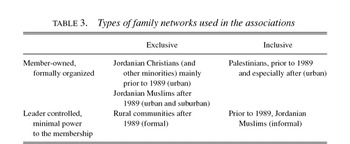
Family associations are collectively owned membership organizations. They formally register as either cooperatives or charitable organizations, with almost identical organizational structures and programs. Membership is limited to kin. Although discrimination on the basis of origin is legally prohibited, it is widely practiced.19
In practice, membership is restricted by the original founders, who have the legal ability to choose or reject new members at will. Members have to be nominated by active or executive committee members, made up of kin. Some associations recently began to include a small category of “friends of the association,” families historically close to the association or neighbors and friends of association leaders. They do not have voting rights and cannot influence the basic nature of the association. The intent is perhaps to deflect criticism from their exclusive character.
Most charitable associations charge an average of 6 dinars yearly. For cooperatives, a minimum number of shares is purchased to join the association, usually 100 shares at 1 dinar each, up to an established maximum.
The contemporary family association is an innovation on several older organizing forms.21
These cultural models have been present throughout the region, but only in a few countries did they lead to the new association. Palestinians organized family associations in Kuwait closely linked to those in Jordan. Lebanon also developed family associations, beginning with the Christians and spreading to other groups. Shafeeq N. Ghabra, Palestinians in Kuwait: The Family and the Politics of Survival (Boulder, Colo.: Westview Press, 1987); Samir Khalaf, Lebanon's Predicament (New York: Columbia University Press, 1987), chap. 8.
The basis for the new organizing form comes from the maḍāfa or tribal guesthouse.22
The guesthouse goes by various names. In Syria, it is called maḍāfa; in Kuwait, diwān; in Lebanon, manzūl or majlis; in Kuwait and Yemen, mafraj. In Jordan, East Bankers generally use diwān or maḍāfa, and Palestinians use rābiṭa.
Abd el-Hakim K. al-Husbani, “al-עAshaءiriyya wa-l-dawla: dirasa li-zahira al-madafat fi madinat Irbid [Tribalism and the State: The Phenomenon of Madafas in Irbid]” (M.A., Yarmouk University, 1991); Shryock, “Bedouin in Suburbia”; Susan Slymovics, The Object of Memory: Arab and Jew Narrate the Palestinian Village (Philadelphia, Penn.: University of Pennsylvania Press, 1998).
Antoun, “Civil Society, Tribal Process, and Change in Jordan”; Jean Hannoyer, “L'hospitalité, économie de la violence,” Maghreb-Machrek (1989): 226–40; Jon Hanssen-Bauer, Jon Pedersen, and Age A. Tiltnes, ed., Jordanian Society: Living Conditions in the Hashemite Kingdom of Jordan, FAFO-Report 253 (Oslo: FAFO Institute for Applied Social Science, 1998), 280, 303–4.
Collective funding draws upon the tradition of the family treasury, an institution used by richer extended families, minorities, and migrants to provide insurance within the group. Kin contributed to a fund for emergencies, extraordinary expenses, or to help less fortunate members with medical, university, and other needs. The family treasury acted as redistributive social insurance, effectively uniting kin across distances and classes.25
Ghabra, Palestinians in Kuwait, 108. Interviews in Jordan and Syria, spring 1998, fall 1999–summer 2000. Non-kin versions of this treasury also exist, a version for women only among others. In Cairo, Singerman identified such informal institutions as jamaעiyyat. Diane Singerman, Avenues of Participation: Family, Politics, and Networks in Urban Quarters of Cairo (Princeton, N.J.: Princeton University Press, 1995), chap. 3.
This combined form of organization is packaged as a grass-roots NGO. Statistically considered part of civil society, the state receives international aid and approval for them. Yet their charity is reserved for members. Some large kin associations aid nonrelatives but only as a special project undertaken with funds separate from the general treasury. Furthermore, the class basis of most grass-roots organizations and family associations differs. Where grass-roots associations typically join individuals in similar economic and social circumstances, family association members span the economic spectrum. They unite thousands of individuals engaged in strikingly different occupations: informal street vendors and government ministers view their interests as served within the same organization. Likewise, their relation to the state differs. Whereas Christian base communities in Latin America have attempted to carve out a sphere of autonomous local development, in Jordan family associations accede to state development plans without contestation.
The state encouraged this trend by channeling registration and financial aid. Previously registered under the Ministry of Interior, the state now only allows familial associations to register as either charities or cooperatives, under the appropriate supervising institution.26
This change occurred in the early 1990s. Officials would not provide specifics.
Quintan Wiktorowicz, The Management of Islamic Activism: Salafis, the Muslim Brotherhood, and State Power in Jordan (Albany, N.Y.: State University of New York Press, 2001), 34–35.
SERVICES AND INCENTIVES OF KIN ASSOCIATIONS
The new organization pools and redistributes resources to supply a variety of welfare services suited to local labor markets. As a malleable idiom, kinship is able to unite various class incentives. Family associations provide services for both the lower and middle classes, providing monthly checks for the former and employment contacts for the latter. The services provided for the lower and middle classes demonstrate the distinct labor market in Jordan. Elites obtain symbolic capital or social prestige through the associations. Establishing themselves by differentiating among potential genealogical lineages, elites outside the traditionally powerful families build upon service provision to amass a clientele. Some of these association leaders attempt to use the kin group to launch electoral bids. A larger number of leaders are loosely affiliated politically with a party or movement. The associations can become fields for competing political trends and indirect electoral support. More often than not, such internal competition leads to the downfall of the organization as allegiances are split and kin unity lost.
Although the motivations of the lower classes are relatively straightforward, obtaining direct welfare payments, it is the middle classes that are central to understanding the relative success of kinship networks over other organizing forms. It is their interest in seeking private forms of social insurance that paves the way for welfare-oriented kinship associations to become the dominant organizing trend in liberalization. Family associations may be one-stop shopping organizations for social welfare among multiple classes, but the membership is predominantly middle class.28
A total of 51 percent of members from one typical urban family association hold a bachelor's degree or higher; 35 percent earn over 500 dinars a month, clearly middle class and somewhat richer than the income distribution of Jordan as a whole or the capital Amman. Interviews, February–April 2000, Amman.
The key to understanding the rise of family associations lies in Jordan's service-based economy and the ability of identity organizations, crossing economic class and sector, to provide business contacts and employment for the middle class after the removal of welfare. The shared identity in family associations creates concrete networks of obligation based on expectations of future reciprocity, not previously established or historical patterns of interaction.29
Ghabra, Palestinians in Kuwait, 122.
al-Husbani, “Tribalism and the State.”
Flexible specialization, atypical work patterns, and informal labor all use networks and often terms of kinship.31
Palestinians in Kuwait were in a similar situation. In response to the lack of “normal” or regular employment, they used and created ties of family and friendship to obtain jobs. Ghabra, Palestinians in Kuwait, 36.
Bryan Roberts, “Informal Economy and Family Strategies,” International Journal of Urban and Regional Relations 18 (1994): 9.
Vicente Espinoza, “Social Networks among the Urban Poor: Inequality and Integration in a Latin American City,” in Networks in the Global Village, ed. Barry Wellman (Boulder Colo.: Westview Press, 1999), 151; Singerman, Avenues of Participation, 192; Gavin Smith, “Towards an Ethnography of Idiosyncratic Forms of Livelihood,” International Journal of Urban and Regional Relations 18 (1994): 78, 83.
Smith, “Towards an Ethnography of Idiosyncratic Forms of Livelihood,” 83–84.
By using a constitutive story35
Rogers M. Smith, “Identities, Interests, and the Future of Political Science,” Perspectives on Politics 2 (2004): 301–12.
Forty-four percent from one urban association declared that increased business or employment was the primary benefit from membership in the family association. Reflecting the fit between particular labor markets and kin networks, a large portion of family association attendees, 40 percent from a single association, were merchants or small business owners, including the owner of a supermarket, a pharmacy, and a money-changing establishment, along with a carpenter and computer software salesman. An additional 50 percent of regular attendees work in the professions or services, jobs that are dependent on contacts for continued business or employment. The family association promoted a pharmacy owner's establishment, for example, who subsequently received business from kin. Kin consumers frequenting other members' businesses receive a discount. In turn, they introduce friends to that business, advertise it, and increase the consumer base.36
Interview with member of Abnaء al-Harith Cooperative, 7 May 2000.
This was a village-based Palestinian charity. Interview with founding member, Sour Bahir Charity, 9 February 2000.
As one member declared, “the family has expanded, and if we don't know each other, anything can happen to the miskīn [unfortunate] among us. There is no other source of social security.”38
Interview with founding member of Mdan Cooperative, 1 December 1999.
Interview with member of al-Sahl al-Akhdar Cooperative, 3 May 1998.
Interview with Bassam F. Mayeh, former president al-Basat al-Akhdar Cooperative, 24 June 2000.
Because this detracts from demands on the state, he believed family associations aid globalization, in which the state's role is diminished. Interview with Munther al-Qaraעen, Vice President of al-Azhar Cooperative Association, 12 March 2000.
Interview with Mohammad Abu Saעad, president of Lifta Charitable Association, 11 February 2000.
Interview with member of Abnaء al-Harith.
An analysis of leader professions demonstrates the connection to employment. Kin associations are established by newly prominent elites operating in either the government or private services sector, such as former parliamentary or cabinet members, bureaucrats, retired army officers, and directors in the large health service sector. The leaders are not from the traditionally powerful families, who are the subject of many analyses,44
Lamia al-Radi, “La famille comme mode de gestion et de contrôle du social chez les élites traditionnelles Palestiniennes,” in Palestine, Palestiniens: Territoire national, espaces communautaires, ed. Riccardo Bocco, Blandine Destremau, and Jean Hannoyer, Les Cahiers du Cermoc (Amman: CERMOC, 1997), 351–66; Andrew Shryock and Sandy Howell, “‘Ever a Guest in Our House’: The Emir Abdullah, Shaykh Majid al-עAdwan, and the Practice of Jordanian House Politics, as Remembered by Umm Sultan, the Widow of Majid,” International Journal of Middle East Studies 33 (2001): 247. Shryock focuses on traditional elite families, allied to the ruling coalition, who are notably divorced from their lower class kin.
The leaders of the family organizations are overwhelmingly male. Although many of the family associations' programs are geared toward women, such as employment training, the presence of women on decision-making bodies is small. Of the thirty-two family associations for which leadership gender data were obtainable, only one (Christian) association had a woman on its board. Overall, the ratio of women on charitable association steering committees is just under one third. This figure includes specialized and women's associations and is not limited to family associations. It also excludes cooperatives, for which data were unavailable. Of charitable associations as a whole, the highest percentage of women on steering committees (45%) is in Amman governorate, where the majority of women's associations are located. General Union of Voluntary Societies, Taqrir al-majlis al-tanfithi. al-Idari wa-l-mali wa-l-mawazina al-taqdiriyya [Executive Report. Administration and Finances and Projected Budget] (Amman: Ittihad al-עAmm li-l-Jamaעiyyat al-Khayriyya, 1997–98).
Interviews, questionnaires, and General Union of Voluntary Societies, al-Sira al-dhatiyya li-l-jamaעiyyat al-mutaעaddida al-aghrad [Profile of Multi-Purpose Associations] (Internal Document) (Amman: Ittihad al-עAmm li-l-Jamaעiyyat al-Khayriyya, 1999).
Despite the temporal coincidence, the return of thousands of Palestinian workers from Kuwait during the 1990–91 Gulf War was not directly tied to the forming of family associations. The returnees themselves were not among the founders or leaders of the new organizations.
An example of an inclusive association demonstrates the strong role of the labor market in determining social allegiances: a Jordanian family joined with a Palestinian village to create a new family association in 1995, and the leader (Jordanian) identified himself as Palestinian.48
Also a Muslim Brother, this leader, Dr. Ali al-Hawamdeh, was elected to parliament in 1989 from Amman (second district). He formed the family association after ending his stint in parliament. Despite that he was born in Kerak, from a Transjordanian background, he was listed in 1989 parliamentary data as a Palestinian. Tim Riedel, Who's Who in the Jordanian Parliament 1989–1993 (Amman, Jordan: Friedrich Ebert Stiftung Amman, 1993), 36. Although this could be a mistake, it is a telling one. The family is mainly engaged in the private sector and is allied with the Palestinians by extension of the leader's membership in the Muslim Brotherhood (which supports Palestinian causes). He alternates identifying as Jordanian or Palestinian.
Interview with member of Abnaء al-Harith.
The family association's activities start with the establishment of a place to meet, a hall or center. In addition to meetings, this place is used for pivotal events in the life cycle—funerals, weddings, and religious holidays.50
These functions are similar to burial societies found in many cultures.
Low- or no-cost loans are fundamental to family association services. These are obtained without the strict requisites of bank loans. Interviewees emphasized the importance of obtaining such short-term, low-interest loans. As formal and government employment declined, collateral for bank loans became difficult to provide. The main alternative to public-sector employment domestically is the service sector, which lacks the formality or job security required to obtain bank loans or advances on paychecks. Educational loans and healthcare clinics are other high priorities for family associations.
Existing family associations altered their array of services to parallel the newly established organizations, emphasizing labor market and financial aid. Service provision only became prominent in the 1990s for most of these older associations.51
Interview with Abu Saעad.
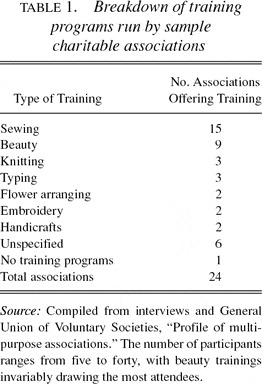
Family associations also provide services more directly related to the labor market, such as training sessions and child-care, predominantly geared toward women. These programs are financially supported by the state. Training programs are generally run by urban associations, whereas child-care dominates association programs in the rural areas. Although the urban trainings do not match labor market needs, the state obtains funding for these programs from international aid organizations, particularly for female-targeted lessons (see Table 1).

Rural associations provide the same basic welfare aid, monthly support to poor families, in addition to nonfinancial services crucial to household income strategies. Child-care services furnished by the associations allow women to work in the state-promoted export processing zones. Since liberalization, the establishment of nurseries by family associations for very young children has skyrocketed in rural and presumably traditional areas. According to officials in the export-processing zones, these nurseries are needed for women from the surrounding villages to place their children while they work, sewing garments for export to the United States.52
Interviews with officials in the Amman, Kerak, and Irbid industrial zones, April–May 2004.
The number of Irbid's nurseries increased from three in 1993 to fifteen in 1999.
Mafraq went from having seven to ten nurseries. Irbid from nine to fifteen. General Union of Voluntary Societies, Riעaya al-tufula [Childhood Care] (Promotional Pamphlet) (Amman: Ittihad al-עAmm li-l-Jamaעiyyat al-Khayriyya, 1999); Mustafa Hamarneh, al-Urdun [Jordan], ed. Saעad al-Deen Ibrahim, Dirasat mashruע al-mujtamaע al-madani wa-l-tahawwul al-dimuqrati fi al-watan al-עarabi [Studies in the Civil Society Project and the Democratic Transformation of the Arab World] (Cairo: Markaz Ibn Khaldun and Dar al-Ameen, 1995), 194.
The only exception to this is Aqaba in the south, which also has a low percentage. It is a new governorate and little populated.
General Union of Voluntary Societies, “Childhood Care,” Hamarneh, Jordan, 190.
In 1997, Kerak had thirty kindergartens; Tafileh, thirteen; Maءan, thirty-two. Kindergartens in Aqaba jumped from three in 1997 to twenty-six in 1999, the same period when the region was the focus of legislation to create free and qualified industrial zones.
The amount increased from fifteen to twenty-five. General Union of Voluntary Societies, Executive Report, 98, Department of Statistics Hashemite Kingdom of Jordan, Statistical Yearbook 1998 (Amman, Jordan: Department of Statistics, 1999), 118.
Although social services are being taken over by family associations, their ability to fulfill these obligations is questionable. Association leaders complained of rising costs and the difficulty of providing quality services at low prices. Indeed, although some associations have financially successful investments, most are shoestring affairs operating on a yearly budget of a couple of thousand dollars.
WELFARE PROVISIONING AND KIN ORGANIZING THROUGH TIME
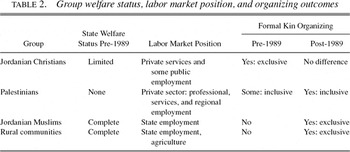
The time line of the family association trend demonstrates the link between state welfare provision, particular definitions of the family, and involvement in the labor market. The group's relation to state welfare determined the time line of family association formation; the precise version of kinship embodied in the association was a consequence of labor market position.59
Labor market position itself was partly a result of political allegiance or estrangement from the regime.


Family associations have adapted and changed in accord with their audiences and markets, their potential kinship bases, and the economic realities they address. They simultaneously draw upon and alter existing ideas of the family. Most differ somewhat from previous concepts of the family but not enough to be viewed as manufacturing identity from scratch. Families combine out of a sense of historical closeness or geographical proximity, such as residence in the same village. Alternatively, new kinship definitions split the previous group into smaller units. Many of the associations contain a few thousand members, smaller than a tribe but usually larger than a single family-name group.
Kinship in the Arab world incorporates numerous levels of familial relations, all of which are potential organizing bases. Ghabra notes that kinship in the Middle East is situational: precise lineages cannot determine who is or is not family; practical social networks determine kinship.60
Ghabra, Palestinians in Kuwait, 18. Similarly, Fandy states that family can be expansive, extending to non-kin. Mamoun Fandy, Saudi Arabia and the Politics of Dissent (New York: St. Martin's Press, 1999), 31.
For analyses of the varying structure of Middle Eastern families and its connection to the local economy, see Doumani, “Endowing Family”; Meriwether, The Kin Who Count.
The term “tribe” is overused and ill-defined. Richard Tapper, “Anthropologists, Historians, and Tribespeople on Tribe and State Formation in the Middle East,” in Tribes and State Formation in the Middle East, ed. Philip S. Khoury and Joseph Kostiner (Berkeley, Calif.: University of California Press, 1990), 48–73. Khoury and Kostiner use a loose definition of tribes as “large kin groups organized and regulated according to ties of blood or family lineage,” Philip S. Khoury and Joseph Kostiner, “Introduction: Tribes and the Complexities of State Formation in the Middle East,” in Tribes and State Formation, 4. Historically in the Middle East tribes moved, lived, and produced together, based on a nomadic and/or agricultural lifestyle. The definition often includes a cultural component, that the group believes it shares a culture distinct from that of other groups.
Village as a form of kinship has been implicitly recognized and used by analysts but not explicitly theorized. See Amatzia Baram, “Neo-Tribalism in Iraq: Saddam Hussein's Tribal Policies 1991–96,” International Journal of Middle East Studies 29 (1997): 1–31; Hanna Batatu, The Old Social Classes and the Revolutionary Movements of Iraq (Princeton, N.J.: Princeton University Press, 1978), chap. 58; Sara Berry, Fathers Work for Their Sons: Accumulation, Mobility, and Class Formation in an Extended Yoruba Community (Berkeley, Calif.: University of California Press, 1985); Guilain Denoeux, Urban Unrest in the Middle East: A Comparative Study of Informal Networks in Egypt, Iran, and Lebanon (Albany, N.Y.: State University of New York Press, 1993), 215; Faleh A. Jabar, “Shaykhs and Ideologues: Detribalization and Retribalization in Iraq, 1968–1988,” Middle East Report (2000): 28–31, 48; Samir Khalaf, “Changing Forms of Political Patronage in Lebanon,” in Patrons and Clients in Mediterranean Societies, ed. Ernest Gellner and John Waterbury (London: Duckworth, 1977), 190; Olivier Roy, “État et recompositions identitaires: L'exemple du Tadjikistan,” in Guerres civiles: Économies de la violence, dimensions de la civilité, ed. Jean Hannoyer (Paris: Karthala, 1999), 221–34; Barnett R. Rubin, “Russian Hegemony and the State Breakdown in the Periphery: Causes and Consequences of the Civil War in Tajikistan,” in Post-Soviet Political Order: Conflict and State Building, ed. Barnett R. Rubin and Jack Snyder (New York: Routledge, 1998), 128–61.
Migration has been shown to cause networks of kinship to widen. Remittances in Yemen fueled the cooperative movement there. Sheila Carapico, Civil Society in Yemen: The Political Economy of Activism in Modern Arabia (New York: Cambridge University Press, 1998). See also Denoeux, Urban Unrest in the Middle East; Leila Tarazi Fawaz, Merchants and Migrants in Nineteenth-Century Beirut (Cambridge, Mass.: Harvard University Press, 1983); Gary Gereffi, Miguel Korzeniewicz, and Roberto P. Korzeniewicz, “Introduction: Global Commodity Chains,” in Commodity Chains and Global Capitalism, ed. Gary Gereffi and Miguel Korzeniewicz (Westport, Conn.: Greenwood Press, 1994), 1–14; Aihwa Ong, Flexible Citizenship: The Cultural Logic of Transnationality (Durham, N.C.: Duke University Press, 1999); Barry Wellman, “Preface,” in Networks in the Global Village, ed. Barry Wellman (Boulder, Colo.: Westview Press, 1999), xi–xxii. This is not the only way migrants organize; they also form community and neighborhood associations or unite on their common characteristic as migrants. For the former, see the Latin American case, Andres A. Thompson and Leilah Landim, “Civil Society and Philanthropy in Latin America: From Religious Charity to the Search for Citizenship,” in Philanthropy in the World's Traditions, ed. Warren F. Ilchman, Stanley N. Katz, and Edward L. Queen II (Bloomington, Ind.: Indiana University Press, 1998), 355–70. In Jordan, the latter occurred with the returnees from Kuwait, but it is the exception. Yann Le Troquer and Rozenn Hommery al-Oudat, “From Kuwait to Jordan: The Palestinians' Third Exodus,” Journal of Palestine Studies 28 (1999) 37–51; John M. Roberts, “The Political Economy of Identity: State and Society in Jordan” (Ph.D., University of Chicago, 1994), 215–16.
Berry, Fathers Work for Their Sons.
David T. Pratten and Suliman Ali Baldo, “‘Return to the Roots:’ Processes of Legitimacy in Sudanese Migrant Associations,” in Beyond the Magic Bullet: NGO Performance and Accountability in the Post-Cold War World, ed. Michael Edwards and David Hulme (West Hartford, Conn.: Kumerian Press, 1996), 142–55.
Roy, “État et recompositions identitaires.”
Kiren Aziz Chaudhry, The Price of Wealth: Oil and Labor Exporters in the International Economy (Ithaca, N.Y.: Cornell University Press, 1997).
The first groups to organize family associations in Jordan were Jordanian Christians and Druze, minorities allied to the state, during the 1950s and 1960s.69
These initial cooperatives registered as mutual benefit, a category reserved for kin organizing. The trend now is to register as a multipurpose association. Interview with Jordan Cooperative Corporation official, 14 April 1998 and various dates, fall 1999.
A significant amount of international migration to the West is present in the Christian groups. The director of one cooperative stated that only a minority of members are employees, which in general refers to government employees. Interview with Jamal al-Naber, Director of Al al-Naber Cooperative, 9 January 2000.
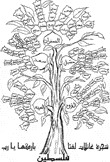
The Palestinians, left out of state-provided social welfare, drew on broad kin networks to obtain social insurance in their precarious economic condition (see Figure 1). These Palestinians found domestic, international, and regional employment primarily in services such as construction, administration, the bureaucracy, and professions. In the 1960s and especially the 1970s, some Palestinian family associations were established. Separated from the land that had formed the basis of their livelihood (most had been farmers), the migrants pursued a professional education that would allow them mobility, the ability to practice anywhere. Unable to count on state largesse for jobs, Palestinians worked in the private sector. Wide-ranging employment contacts were necessary, not only domestically but also within the region and internationally as Palestinians searched for work outside their new residence. Inclusive kinship aided their life chances in statelessness. Coping strategies included the wife's kin, an innovation in family practices, along with additional selected kin. According to one analyst, “family became the means by which the Palestinians were able to respond to the conditions of the diaspora.”71
Ghabra, Palestinians in Kuwait, 17–18. Ghabra implicitly uses village as a form of kinship.

The Lifta Village Family Tree. Source: Lifta Charitable Association, Amman and Zarqa (n.d.). Reprinted with permission.
That family was almost always defined as village of origin. Based on the home village, Palestinian associations cast a wide net and drew in thousands of members.72
Palestinians use the name of that village as the association's name and register about equally as cooperatives and charities.
Signe Gilen et al., “Finding Ways: Palestinian Coping Strategies in Changing Environments,” (Oslo: FAFO, 1994); Aseel Sawalha, “Identity, Self and the Other Among Palestinian Refugees in East Amman,” in Amman, Ville et Société, ed. Jean Hannoyer and Seteney Shami (Beirut, Lebanon: CERMOC, 1996), 345–57.
Ghabra, Palestinians in Kuwait, 109.
Interview with Abu Saעad.
Still, family associations remained a marginal phenomenon in the 1970s and throughout most of the 1980s, despite being one of the only organizing forms permitted by the state. The impetus for such associations was not overwhelming, because the state provided the general population with urban consumer subsidies, and some employment and healthcare. Furthermore, Palestinians had access to plentiful work opportunities in the Gulf. Economic liberalization introduced the main stimulus for family organizing. Previously unorganized Palestinians established family associations, and those who had an organization for the individual family joined with others to form a larger association based on broader kinship. The return of workers due to political liberalization and the 1990–91 Gulf War was indirectly related to the rise of kin associations.76
Labor possibilities in the Gulf states have shrunk considerably, making success in the domestic market critical.
A large portion (41 percent) of previous migrants to the Gulf countries established their own businesses upon return. Charles B. Keely and Bassam Saket, “Jordanian Migrant Workers in the Arab Region: A Case Study of Consequences for Labor Supplying Countries,” Middle East Journal 38 (1984): 692. Returnees from the Gulf war in the 1990s found employment in banking, financial services, commercial, and the health sector, in addition to running retail businesses. Le Troquer and al-Oudat, “From Kuwait to Jordan.” These activities created a new commercial district of the capital, Gardens Street.
Jordanian Muslims, the main regime allies, have restricted the definition of family. In urban and suburban areas, tribes began dividing into smaller units, often the ḥamūla or seven-generation family,78
Gilen et al., “Finding Ways”; Khalid M. Rasheed, “Social Structure, Kinship and Settlement: A Case Study from Southern Jordan” (M.A., Yarmouk University, 1991).
Multiple names for the tribe exist, depending on how descent is traced. The writer's name takes up four lines, tracing ancestry back to the time of the Prophet. The definition he uses of his tribe, however, is more limited than that lineage would imply. Abdullah Ismaעil al-Kaswani, Qabila al-Zaydan Zayadna [The Tribe of Zaydan al-Zayadna] (Amman, Jordan: al-Maktaba al-Wataniyya, 1994), 30, 96.
With unrestricted welfare through public sector jobs, Jordanian Muslims remained unorganized until liberalization began to withdraw those prerogatives. Some organized informally before liberalization. These associations were extremely inclusive, akin to the old style tribal organization. The leader was in control of the organization and members did not own or contribute significantly to its upkeep. Not only is kinship now redefined narrowly, but the new association's form transfers significant control from the leader to the membership.
Last to organize were the rural communities.80
Rural village associations are considered similar in structure and organizing principles. See Hani Hourani and Hussein Abu Rumman, Tatawwur al-mujtamaע al-madani fi al-Urdun wa-waqaעha al-rahin [The Development of Civil Society in Jordan and its Current Situation] (Amman, Jordan: al-Urdun al-Jadid and Dar Sindbad li-l-Nashr, 2004), 119.
Migrant associations in other locations also began as urban, then spread back to the rural areas, serving different purposes in each. In the Sudan, migrant associations function as developmental organizations in the countryside, whereas in the city they offer social security and identity useful in inheritance disputes. Pratten and Baldo, “‘Return to the Roots’,” 143–45. In Yemen, Carapico demonstrates similar functions for rural cooperatives. Carapico, Civil Society in Yemen.
Hanssen-Bauer, Pedersen, and Tiltnes, ed., Jordanian Society, 280.
Interview with Mohammad al-Ardha, Researcher, Directorate of Studies and Research, General Union of Voluntary Societies, 12 October 1999.
CONCLUSION
Family associations do not reflect but have created an identity movement in Jordan. The social importance of the family association to members' daily lives has heightened due to its welfare role. Nonparticipation of kin has been made more difficult due to this role and to the high level of institutionalization and formalization.84
Free-riding is not an overwhelming problem. Family members can refuse to join; however, once a majority of the potential kin group has agreed, individual families find it hard to opt-out or not participate. Some do attempt to avoid paying dues, but this is a temporary and individual escape. Those same individuals recognize the need to eventually become dues-paying members and would need to in the event they requested services from the organization.
The new welfare-providing institutions create enduring lines of social mobilization and identification, channeling individual identity through the family in exchange for access to fundamental economic goods. That the organization through which economic goals are rationally pursued is based on the idiom of identity has important consequences. Claiming to be an alternative and equal form of welfare provision, family associations disguise the shift in state services and the increasing income polarization in Jordan.
The most consequential effect of family associations has been to reinforce the declining significance of the national political arena and facilitate the state's policy of deliberalization.85
Jillian Schwedler, Don't Blink: Jordan's Democratic Opening and Closing, Middle East Report Online; available from www.merip.org/mero/mero070302.html
Formalized family associations are not reactionary responses to a globalized world. They represent an attempt to deal with changes caused by relatively open borders even as they cripple demand-based mobilization for policy changes at the national level. The hope for a meager portion of resources from among fellow kin is sufficient incentive to justify the costs of these organizations, both in terms of the time and money spent by leaders and the sacrifice of autonomy by members. The educated middle class, including academics, doctors, and other professionals who previously eschewed the use of kin, now participate en masse. Their decision solves a key piece to the puzzle of resurgent identity politics.
Author's note: The author thanks Kiren Chaudhry, Beshara Doumani, David Collier, and three anonymous reviewers for their comments and suggestions. Funding was provided by the Fulbright Institute for International Education fellowship and the Simpson Memorial Dissertation Research Fellowship, Institute for International Studies, Berkeley. The Social Science Research Council and the Mellon Foundation provided predissertation and travel grants. The views expressed are mine alone and not those of the U.S. government or any other institutional affiliation.