Disruption of ecosystems is one of the biggest threats posed by invasive species (Mack et al. Reference MACK, SIMBERLOFF, LONSDALE, EVANS, CLOUT and BAZZAZ2000). Thus, one of the most important challenges is to understand the impact of exotic species on native species and habitats (e.g. Jones Reference JONES, Cheke and Hume2008). The probability that entire ‘invasive communities’ will develop increases as more species establish in new areas (Bourgeois et al. Reference BOURGEOIS, SUEHS, VIDAL and MÉDAILM2005). For example, introduced species may act in concert, facilitating one another's invasion, and increasing the likelihood of successful establishment, spread and impact. Simberloff & Von Holle (Reference SIMBERLOFF and VON HOLLE1999) introduced the term ‘invasional meltdown’ for this process, which has received widespread attention since (e.g. O'Dowd Reference O'DOWD2003, Richardson et al. Reference RICHARDSON, ALLSOPP, D'ANTONIO, MILTON and REJMÁNEK2000, Simberloff Reference SIMBERLOFF2006). Positive interactions among introduced species are relatively common, but few have been studied in detail (Traveset & Richardson Reference TRAVESET and RICHARDSON2006). Examples include introduced insects and birds that pollinate and disperse exotic plants, thereby facilitating the spread of these species into non-invaded habitats (Goulson Reference GOULSON2003, Mandon-Dalger et al. Reference MANDON-DALGER, CLERGEAU, TASSIN, RIVIÈRE and GATTI2004, Simberloff & Von Holle Reference SIMBERLOFF and VON HOLLE1999). From a more general ecological perspective, the study of interactions involving introduced and invasive species can contribute to our knowledge of ecological processes – for example, community assembly and indirect interactions.
The red-whiskered bulbul Pycnonotus jocosus L., native to southern Asia, was introduced to the island of Mauritius in the late 1800s (Cheke Reference CHEKE and Diamond1987). Since then, the species has become well established and is now considered to be one of the most invasive species on Mauritius. Pycnonotus jocosus is believed to have contributed to population declines of endemic white-eyes (Zosterops spp.; Cheke Reference CHEKE and Diamond1987, Sørensen Reference SØRENSEN2005) and the disappearance of large native Nephila spiders (Islam & Williams Reference ISLAM and WILLIAMS2000). The bird is also believed to have facilitated the spread of several introduced plant species, including Ligustrum robustum var. walkeri Blume, Clidemia hirta D. Don, Lantana camara L. and Cordia interrupta DC, which, prior to the introduction of the red-whiskered bulbul, were quiescent (Cheke Reference CHEKE and Diamond1987, Linnebjerg et al. Reference LINNEBJERG, HANSEN and OLESEN2009, Vaughan & Wiehé Reference VAUGHAN and WIEHÉ1939). Already in 1916, and again in 1987 and 2008, P. jocosus was recorded as the most abundant bird in Mauritius (Cheke Reference CHEKE and Diamond1987, Cheke & Hume Reference CHEKE and HUME2008). Despite this, and the concerns raised about the effects of P. jocosus on native species, no studies to date have investigated the diet of P. jocosus to assess the ecological impact of the species on the native flora and fauna.
Of particular concern is that P. jocosus can form an invasional meltdown with invasive plants by eating their fruits and dispersing the seeds. Similar concerns about the red-whiskered bulbul have recently been addressed on the neighbouring Mascarene island of Réunion (Mandon-Dalger et al. Reference MANDON-DALGER, CLERGEAU, TASSIN, RIVIÈRE and GATTI2004). That study was restricted to sugar cane plantations and orchards; the main habitats of the red-whiskered bulbul on this island (Mandon-Dalger Reference MANDON-DALGER2002). In Mauritius, most native frugivorous birds (except for the grey white-eye Z. mauritianus) do not move readily between native forest and plantations with exotic species (Jones Reference JONES, Cheke and Hume2008). Thus, in Mauritius it is of great importance to study the red-whiskered bulbul, with a particular emphasis on its potential for creating spill-over effects from exotic to native forests. Here, we investigate the diet of the red-whiskered bulbul in Mauritius, to provide data from which inferences about its impact on Mauritian biodiversity can be drawn. In particular, we focus on the role of the bulbul in the seed dispersal of introduced and invasive plant species in native forest remnants.
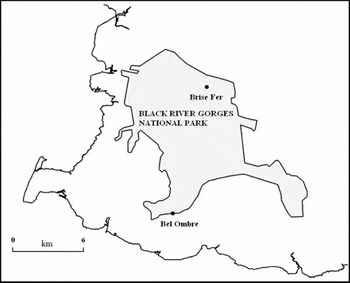
We conducted the study in the Black River Gorges National Park, situated in south-west Mauritius. Within the park, we selected two study sites, the forests at Brise Fer and Bel Ombre (Figure 1). Brise Fer is located on the northernmost spur of the Black River Gorges at 550 m asl and receives 2500 mm y−1 rainfall. The vegetation type is classified as lower montane moist to wet mature forest (Safford Reference SAFFORD1997). Within this forest, two sites were selected: Plaine Lievre (PL; 20°38′S, 57°45′E, ~0.05 km2), an unmanaged forest, and Brise Fer Conservation Management Area (BFCMA; 20°38′S, 57°44′E), a 0.24-km2 fenced area, from which introduced plant species have been mostly removed by manual weeding. Due to high levels of regeneration of native plant species and continuous weeding, BFCMA is generally considered to be the most pristine native forest in Mauritius. Bel Ombre forest is a mid-altitudinal forest containing elements of both lowland forest and upland humid forest, with an average annual rainfall of 1200 mm y−1. At Bel Ombre, observations were made in parts of the lower Bel Ombre forest at 200–400 m asl (BO; 20°28′S, 57°25′E; ~0.05 km2), classified as lower montane to intermediate wet forest (Safford Reference SAFFORD1997).
Map of the Black River Gorges National Park in Mauritius showing the two study sites Brise Fer (which includes both Brise Fer CMA and Plaine Lievre) and Bel Ombre.

The diet of the red-whiskered bulbul was investigated outside its breeding season between late February and June 2005 using faecal analysis, because this method creates minimal disturbance and is directly related to seed dispersal (Mandon-Dalger et al. Reference MANDON-DALGER, CLERGEAU, TASSIN, RIVIÈRE and GATTI2004). Birds were caught alive in fruit- and pellet-baited wire cage traps (100 × 100 × 30 cm), and then placed in a wire holding cage (50 × 50 × 55 cm), covered with cloth to reduce stress to the bird. Birds were kept in the holding cage for 3 h; during this time most individuals defecated, and their faeces were collected. Prior to release, the birds were banded with coloured plastic rings to prevent repeated sampling.
As part of the management plan for the endangered echo parakeet, Psittacula eques, a permanent supplementary feeding station filled with Kaytee® parrot pellets was present at each site. These feeding stations attracted red-whiskered bulbuls, and additional faecal samples were collected from a total of ten plastic sheets (100 × 200 cm) placed randomly underneath trees and shrubs surrounding the stations, as well as below the station itself. Of the 23 trees/shrubs sampled (seven at PL and eight at both BFCMA and BO), four were fruiting (two Psidium cattleianum Sabine and two Ligustrum robustum). In the faeces, any seeds of the same species as the fruiting tree under which the sample was collected were excluded to ensure unbiased results. Theoretically, however, this should not pose a problem since red-whiskered bulbuls are highly mobile and, generally, only spend 2–3 min feeding before they leave the feeding site (J. Linnebjerg, pers. obs.). Mean ± SE gut passage times for seeds of the favoured fruits Clidemia hirta and Ligustrum robustum are 12.7 ± 2.6 min and 15.5 ± 1.1 min, respectively (Linnebjerg et al. Reference LINNEBJERG, HANSEN and OLESEN2009), and seeds would therefore not be defecated before the feeding session ended. At each site, all trees and feeding stations could be observed simultaneously with binoculars (Nikon 8 × 25). More than 25 h of trapping activity were conducted and 125 h were spent observing the trees/stations (50, 45 and 30 h at PL, BO and BFCMA, respectively; observation periods were 1–6 h and represented all times of the day). After a bird had made a visit, the plastic sheet was inspected for faeces. Any faeces found in the cage or on the plastic sheets were collected in separate tubes for subsequent microscopic examination. Fruits from native and introduced plants with ripe fruits in the study areas were sampled and identified, and seeds were extracted and used as a reference collection.
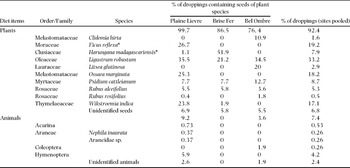
We caught and obtained faecal samples from 20 birds, and an additional 360 faecal samples were obtained from the plastic sheets below trees, shrubs and supplementary feeding stations. The diet of the red-whiskered bulbul consisted primarily of fruits; 98.9% of all faecal samples contained plant material of fleshy fruits, with seeds being present in 92.4% of all faecal pellets (n = 380; Table 1). We identified defecated seeds from ten plant species across all sites. Eight of the ten species were introduced, six of which (Clidemia hirta, Ligustrum robustum, Litsea glutinosa (Lour.) C. B. Rob., Psidium cattleianum, Rubus alceifolius S.Vidal and R. rosifolius Sm) are highly invasive in Mauritius (Strahm Reference STRAHM1993) and occurred in 53% of samples (Table 1).
Dietary composition of the red-whiskered bulbul Pycnonotus jocosus in Mauritius from faecal analysis. Site percentages were calculated from seed frequencies in droppings at each site (Plaine Lievre, n = 273; Bel Ombre, n = 55; Brise Fer, n = 52), and all sites pooled (n = 380 droppings). Asterisks indicate native plant species to Mauritius.

Our study confirms that the red-whiskered bulbul is predominantly frugivorous in Mauritius, at least during our study season. Almost 99% of all droppings analysed contained plant material, with 92.4% containing seeds, and only 7.4% containing invertebrate remains. These results concur with previous studies of red-whiskered bulbuls on Réunion (98.4% contained plant material; Mandon-Dalger et al. Reference MANDON-DALGER, CLERGEAU, TASSIN, RIVIÈRE and GATTI2004) and in common bulbuls P. barbatus in Algeria (94.4% contained plant material in the autumn; Milla et al. Reference MILLA, DOUMANDJI, VOISIN and BAZIZ2005).
The plant material consumed by the red-whiskered bulbul in Mauritius consisted mostly of fruits of invasive species. This indicates that such fruits constitute a major part of the bulbul's diet and suggests that these birds play an important role in dispersing the seeds of introduced plants in Mauritius. Whether the dominance of fleshy-fruited invasive plant species in red-whiskered bulbul diet was due to a genuine preference for exotic over native fruits, or simply was a reflection of plant community composition is unknown but should be tested experimentally. There were numerous other plant species fruiting during the study period. In addition to the plant species already identified in the birds' faeces, 28 species (21 endemic, five native and two introduced) across all of our study sites bore fruits which were potentially edible to the bulbul (P. Gangaram, pers. com.) and, although 6.8% of the seeds were unidentified, it is surprising that we did not find a larger number of seeds from native plant species in the droppings.
The ability to consume a wide range of fruits and the flexible diet of the red-whiskered bulbul (including nectarivory and fly-catching) enables them to survive in areas where fruit abundance varies seasonally, and helps to make them excellent invaders (Corlett Reference CORLETT1998). Furthermore, bulbuls ingest whole fruits and defecate intact seeds of many species. For seeds of two invasive plants, L. robustum and C. hirta, red-whiskered bulbul gut-passage has positive effects on germination, demonstrating that the bulbuls were indeed effective dispersers of these species (Linnebjerg et al. Reference LINNEBJERG, HANSEN and OLESEN2009). It is clear from the seeds found in the samples from BFCMA that the red-whiskered bulbul defecated the seeds of several invasive plant species inside the CMA, even when foraging in this intensely managed area with only native plant species. By virtue of its great abundance, the bulbul was thus capable of dispersing large numbers of seeds from invasive species into managed forest areas, thereby playing a key role in the continued re-invasion of weeded areas. Our results thus also highlight an important mechanism that may facilitate future plant invasions on neighbouring islands in the region, e.g. Réunion, where some native forests are still comparatively free of both the red-whiskered bulbul and invasive plant species. We stress the importance of understanding species interactions when attempting to control invasive plant species, or prevent their establishment.
Due to the small area and relatively lower species richness on oceanic islands (MacArthur & Wilson Reference MACARTHUR and WILSON1967), introduced species can have devastating effects on native island faunal and floral communities. In Mauritius, the red-whiskered bulbul, and the invasive fleshy-fruited plant species that form a great part of its diet, potentially contribute to an invasional meltdown (Simberloff & Von Holle Reference SIMBERLOFF and VON HOLLE1999). Our study emphasizes the need for early-stage monitoring on other islands, where the red-whiskered bulbul or similarly generalised frugivores have been introduced alongside plentiful fleshy-fruited plant species. Our study demonstrates that invasive species – and their interactions – have to be studied and understood at the community level before control measures can be successfully implemented.
ACKNOWLEDGEMENTS
This project was conducted in cooperation with the Mauritian Wildlife Foundation, who we thank for providing work permits and accommodation. We also wish to express our gratitude to the National Parks and Conservation Service of Mauritius for allowing us to live and work in the National Park. Many thanks to K. Jones, S. Sawmy and R. Kennerly for help in the field and F. Rigét for useful discussions. Jens M. Olesen was supported by a grant from the Danish Science Research Council.