Patient safety, and more broadly the quality of care, is typically discussed with reference to the reduction of preventable adverse events (AEs) within hospitals and adherence to practice guidelines on care processes. This approach grows out of human reliability assessment in industry and dominates debates on how to improve safety and care quality. We call it the ‘care-centered approach’ and recognize that the United States is a leader in the field.
Another face of patient safety and care quality may be defined as the ‘system-centered approach’. It focuses on access to a timely and effective continuum of health-care services throughout life – clinical prevention, primary care and appropriate referral to and receipt of specialty care. When a health-care system succeeds in providing timely and effective health-care services to its population, it reduces mortality from conditions amenable to health care, and reduces hospitalization for conditions that need not flare up and result in inpatient admissions (known as avoidable hospital conditions (AHC), for example, congestive heart failure, bacterial pneumonia, diabetes and asthma). The first indicator, mortality amenable to medical interventions (AM), is a summary measure that captures the consequences of poor access to clinical prevention, primary care and specialty services (Nolte and McKee, Reference Nolte and McKee2008). The second indicator, hospital discharges for AHC, otherwise known as ‘ambulatory care sensitive’ conditions, is widely used in the United States and considered a valid measure of access to timely and effective primary care (Institute of Medicine, 1993).
Although these approaches to patient safety and care quality may lead to different interventions for improving value in health care as measured by outcomes achieved, they are not incompatible (Porter, Reference Porter2010). Since both are necessary to assure patient safety and care quality, an important challenge for health policy is how to balance the two. Our purpose here is to highlight differences between these approaches based on experience in the United States and France.
The care-centered approach
The care-centered approach to safety and care quality focuses on measuring variation in performance among health-care professionals. Once outliers are identified, controversy has focused on whether to excise the ‘bad apples’ or improve the system and bring up the average. Since the work of Deming and Berwick, there is an emerging consensus in favor of applying the tools of continuous quality improvement (Berwick, Reference Berwick1989).
US experience
In the United States, the care-centered approach emphasizes the importance of measuring AEs and the effectiveness of care. It is strongly supported by the Institute of Medicine's report, To Err is Human (Kohn et al., Reference Kohn, Corrigan and Donaldson1999) and the Patient Safety and Quality Improvement Act of 2005, which allows for a ‘no blame culture’ of reporting AEs. In addition, recognition of widespread medical practice variations strengthened efforts to encourage physicians to follow practice guidelines, particularly in hospitals. Health-care performance indicators are now so well-established that they have generated a new controversy about the extent to which hospital performance should be publicly reported? (Werner and Asch, Reference Werner and Asch2005).
Some studies reveal the success of local safety campaigns (e.g. those led by the Institute for Healthcare Improvement (IHI)), but results are uneven at the national level (Jha et al., Reference Jha, Li, Orav and Epstein2005), and variation among states is considerable (IHI, 2011). Moreover, there is little evidence of progress despite serious efforts to implement process measures in hospitals (Landrigan et al., Reference Landrigan2010). In comparison to Australia, Canada, Germany, New Zealand and the United Kingdom, the Commonwealth Fund found that the US ranks last with respect to five measures of patient safety (Davis et al., Reference Davis, Schoen and Shoenbaum2007). This finding presents a striking contrast to common perceptions of the US health system's ability to provide state-of-the-art, innovative and safe services.
French experience
In France, use of process measures to improve patient safety and care quality is embryonic compared to United States. Following the contaminated blood scandal of the early 1990s (Steffen, Reference Steffen1999), however, the government established new institutions to conduct disease surveillance (INvS) and protect the population from unsafe foods (AFSSA, now ANSES), unsafe drugs (AFSSAPS) and unsafe blood (EFS). In 2004, the High Authority for Health (HAS) was established as an independent public organization to: (1) advise the government on health technology assessment, (2) develop practice guidelines and (3) promote quality of health services through accreditation and certification. The HAS now leads the EUnetPAS (European Network for Patient Safety) that has developed a common agenda for care-centered safety.
In addition, France's Ministry of Health recently initiated a small number of aggressive safety campaigns with strong patient involvement, for example, one supported by TV spots to improve the use of antibiotics in preventing the appearance of resistant bacteria. Based on the NNIS (National Nosocomial Infections Surveillance System) risk scoring system for surgical wound infections, national prevalence rates of MRSA (Methicillin-Resistant Staphilococcus Aureus) in France declined from 33% in 2001 to 27% in 2006 (Degos et al., Reference Degos, Romaneix, Michel and Bacou2008). These results, based in part on the introduction of care-centered approaches in France, are impressive in comparison to other European countries and to the United States where MRSA infection has increased (Klein et al., Reference Klein, Smith and Laxminarayan2009).
Despite these efforts, in contrast to the United States, France has a weak tradition of targeted safety campaigns, and still lags in following recommendations by international bodies such as the World Health Organization and the Organization for Economic Cooperation and Development (OECD), to set patient safety objectives. Neither the French government nor its new health-related agencies have developed a comprehensive strategy to improve patient safety and other dimensions of health-care quality. Except for nosocomial infections, there is still no national policy to report AEs while providing legal protection for providers. Yet despite France's limited efforts now underway to introduce care-centered approaches for patient safety, there may be some benefits to France's system-centered approach.
France's comparative advantage derives largely from the limitations of the care-centered approach. Although patient safety experts are fond of comparing health care to civil aviation and nuclear power, there are significant challenges to make health care an ultrasafe industry (Amalberti et al., Reference Amalberti, Auroy, Berwick and Barach2005). First, however much one focuses on reducing AEs in hospitals (and we wholeheartedly support such an approach), given the speed of technological innovation in medicine, there will always be new medical technologies and high risk, vulnerable patients with severe pathologies for whom dangerous hospital environments produce unintended effects. Second, most safety campaigns have focused on processes rather than outcomes. Third, reporting systems, information technologies and accreditation processes require significant resources. Even after investments have been made, reducing disparities among hospitals remains a challenge. Fourth, excessive reliance on the care-centered approach reduces physician autonomy, which can weaken ‘resilience’ to exceptional threats and circumstances (Longo et al., Reference Longo, Hewett, G. and Schubert2005).
The system-centered approach
The system-centered approach to patient safety and care quality focuses on how governments can prevent complications from medical interventions and assure access to timely and effective health services throughout the course of life. The French health system is organized around the notion that reducing financial barriers to access is a good investment for society. It provides good access to effective care by general practitioners, including generous pharmaceutical coverage and wide diffusion of neighborhood pharmacies, and at the same time allows direct access to specialty services. In combination, these services facilitate early diagnosis and treatment, which may, in turn, avert the progression of chronic disease and delay exposure to the potentially dangerous hospital milieu.
In comparison to the United States, French NHI provides easy access to general practitioner services through the use of a simple card (carte vitale) for all legal residents (Rodwin, Reference Rodwin2003). French residents may choose among general practitioners, specialists, as well as public and private hospitals. They may go from one to another as often as they want. In 2005, a soft gate-keeper mechanism was introduced to improve care coordination, but the system is still not reputed for its capabilities in coordinating care (Dourgnon and Naiditch, Reference Dourgnon and Naiditch2010). Nonetheless, access to general practitioners is widely available and, in contrast to the United States, a higher share of French respondents report that they were able to see a doctor or nurse on the same or next day the last time they needed care (Schoen, Reference Schoen2010). Likewise, a higher share of French respondents report confidence that they would receive the most effective treatments if seriously ill.
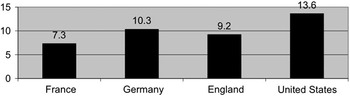
The United States does not have long wait times for non-emergency surgery, but access to primary care is more problematic. In a 2004 survey of five OECD countries, including France and the United States, the United States ranked four out of five with respect to obtaining a same day doctor's appointment when sick, and at the bottom for getting care at night and weekends. US respondents were also the most likely to delay or forego treatment because of cost (Schoen et al., Reference Schoen, Osborn and Trang Huynh2004). In a more recent 2010 survey of eleven OECD countries, French respondents reported more difficulty than those in the United States or the United Kingdom in obtaining appointments with specialists and reported rates as high as US respondents in obtaining care after hours (63%; Schoen et al., Reference Schoen, Osborn and Trang Huynh2004). Although Macinko et al. claim that France had one of the worst systems of primary care among OECD nations between 1970 and 1998 (Macinko et al., Reference Macinko2003), Gusmano et al. found that among France, the United States, Germany and England, France has the lowest rate of hospital discharges for AHC, a measure of access to timely and effective primary care (Figure 1; Gusmano et al., Reference Gusmano, Rodwin and Weisz2010; Gusmano et al., 2004). Likewise, the rate in New York is more than twice as high as in Paris (Gusmano et al., Reference Gusmano, Weisz, Andrews and Rodwin2007). It seems that the 10 dimension ranking of primary care used by Macinko et al. may be less important than the easy access the French population have to their general practioners and the ability these physicians appear to display in managing chronic illness and thereby reducing AHCs.
Hospital discharge rates for avoidable hospital conditions (France, Germany, England and the United States 2004) – Age standardized, United Nations standard population, 2005, for persons 20 years and above.
Sources: Based on analysis by Gusmano et al. (Reference Gusmano, Rodwin and Weisz2010); Gusmano et al. (Reference Gusmano, Weisz, Andrews and Rodwin2007). The hospital discharge data are from France – PMSI, 2004; Germany – Federal Office of Statistics, 2005; England – HES, 2003–2004 and 2004–2005; United States – National Hospital Discharge Survey, 2004 and 2005. Population data are from the national census of each nation. The definition of AHC (based on ICD-10 codes for principal discharge diagnosis) is taken from Weissman et al. (Reference Weissman, Gatsonis and Epstein1992). It includes the following conditions: bacterial pneumonia, congestive heart failure, asthma, cellulitis, perforated or bleeding ulcer, pyelonephritis, diabetes with ketoacidosis or coma, ruptured appendix, malignant hypertension, hypokalemia, immunizable conditions and gangrene.

With respect to amenable mortality (AM), Nolte and McKee have calculated that France has slightly more than half the rate of the United States (Nolte and McKee, Reference Nolte and McKee2008). Their definition is based on mortality for all those below 75 years of age who died from conditions ‘such as bacterial infections, treatable cancers, diabetes, cardiovascular and cerebrovascular disease and complications of common surgical procedures … including half of premature mortality from ischemic heart disease’. Moreover, the percentage decline in amenable mortality in France over the period 1997–1998 to 2002–2003 was twice that of the United States (Nolte and McKee, Reference Nolte and McKee2008) Similar differences were found in amenable mortality between New York and Paris (Weisz et al., Reference Weisz, Gusmano, Rodwin and Neuberg2008).
A more indirect but nevertheless pertinent indicator of overall quality of care, as judged by patients, is consumer satisfaction. Comparisons across Europe place France among those nations with the highest rates of satisfaction. Until recently, there were no surveys using the same instrument in France and the United States, but in 2008 a survey of France, the United States, the United Kingdom, Germany, Italy and Spain placed France at the top, with 55% of respondents ‘satisfied’ in contrast to 28%, 38% and 24%, respectively, in the United States, the United Kingdom and Germany (Harris Interactive, 2008). Likewise, only 43% of French respondents believed that fundamental health system change is necessary in contrast to 50%, 54% and 60%, respectively, in the United States, Germany and the United Kingdom.
Does the French health-care system outperform the US health system with respect to indicators of patient safety and care quality? Ideally, one should compare rates of AEs in French and US hospitals, outcome measures from selected medical interventions and process measures on the extent to which appropriate procedures are followed for patients with specified conditions. Unfortunately, reliable data for most of these indicators are not available for France and the United States (OECD Health Policy Studies, 2010). Although OECD's Health Care Quality Indicators Project has developed some common patient safety indicators, there are not yet standard definitions for different categories of AEs. The OECD notes that France performs better than the United States with regard to mortality from medical errors. However, a footnote reminds us that these differences may be due to ‘differences in reporting methodologies across countries, higher rates of surgeries performed by doctors in some countries, or actual differences in care’ (OECD Health Data 2006, 2007). Clearly, there is, as yet, no robust way to compare AEs across nations and there are no standard definitions of AEs across health care systems. Studies that do measure AEs in the United States and France have relied on different definitions and methods to estimate their magnitude (Michel et al., Reference Michel, Quenon, Djihoud, Tricaud-Vialle and Marie de Sarasqueta2007; Klevens et al., Reference Klevens, Edwards and Richards2007).
Concluding observations
A care-centered approach to patient safety and care quality emphasizes measurement, practice guidelines, transparency and quality controls. This is important, but not necessarily more so than the challenge of assuring collective efficacy by what we have called a system-centered approach. Although France's efforts to pursue a care-centered approach to patient safety are limited, its system-centered approach yields some benefits. Based on the evidence we have reviewed for access to primary care (hospital discharges for avoidable hospital conditions (AHC)), mortality amenable to medical intervention and consumer satisfaction, there appear to be good grounds for bolstering the system-centered approach in the United States.
Acknowledgements
Parts of the research for this paper were funded by a grant to Victor Rodwin from the Commonwealth Fund. We also acknowledge collaboration with Michael Gusmano and Daniel Weisz on the analysis for Figure 2. Finally, we thank Armelle Desplanques, Anthony Kovner and René Amalberti for their comments.