1. Introduction: Recent use of robust
Since its introduction to English, the word robust has undergone semantic evolution from its original meaning describing the strength or health of people or animals. Recent usage suggests that its meaning has expanded considerably over time. A quick review at the recent articles on BBC Online shows diverse uses, from a comment referring to animate beings, such as ‘a quite robust person’, ‘a very robust horse’ and ‘a robust plant’ to inanimate entities such as ‘a robust colour’, ‘robust and perfectly flavoured biscuits’ and ‘she had a very robust voice’. BBC News Magazine (online) nominated robust as one of the top 20 of most overused words in 2013 citing the example of Business Secretary Vince Cable's 2010 statement that he would ‘take robust action on bank bonuses’. The article says that robust has become a buzzword among politicians, and Vanessa Barford asks ‘Is robust robust enough to stick around in 2014?’.Footnote 1 It continues to be a commonly used word. It is often the case that robust is used as a word of nuance, or simply to add some emphasis that the speaker or user of the language wants to convey, which is a problematic feature in sorting out distributions of meaning. The early stages of semantic change may begin with uses that are ‘not necessarily perceived as such by a non-specialist audience’ and may be perceived as a ‘misuse’ or ‘overuse’, such as wicked or awesome (Durkin Reference Durkin2012, 4). Robust has not undergone a process of dramatic semantic change nor has it been accused of being ‘misused’, but it has certainly become a buzzword and has recently been overused. When a word is overused, it appears in a wider range of contexts. The context in which robust is employed seems to have expanded, as have the meanings attached to it.
1.1 Where does robust fit in?
Robust, though not an intensifier, shares a similarity with intensifiers in that it allows very flexible modification of nouns, and its meaning is highly contextual based on the nouns it modifies. In many situations, robust now seems to be used in a very evaluative sense, such as good, and in most usages in the British National Corpus (BNC) in positive semantic prosody.
Degree modifiers or intensifiers are linguistic elements that scale the degree or value conveyed by the item they modify. According to Bolinger (Reference Bolinger1972, 18), degree words are ‘inventories that afford a picture of fevered invention and competition’. Since they are the chief means of emphasis for speakers, they quickly become stale and need to be replaced. They are therefore one of the main areas of grammatical evolution and renewal in English (Brinton and Arnovik Reference Brinton and Arnovik2006, 441). These features have attracted considerable scholarly attention since the beginning of the 20th century, although the definition of an ‘intensifier’ varies among scholars. Perhaps the most widely accepted definition might be that an intensifier is an adjective modifier that scales gradable adjectives such as very, really, completely as in very happy, really interesting or completely absurd (e.g. Sinclair Reference Sinclair, Davies and Ravelli1992; Partington Reference Partington, Baker, Francis and Tognini–Bonelli1993; Lorenz Reference Lorenz, ILse and Gabriele2002). Adverbs can also be intensified if they are gradable (e.g. very/really fast). There are studies that offer broader interpretations of intensifier labels including not only adjectives and adverbs but nouns and verbs. Bolinger (Reference Bolinger1972) examines intensification in terms of gradability and offers a range of lexical items for intensification, suggesting that some adjectives can also perform an intensifying function, as in ‘utter failure’ (Bolinger Reference Bolinger1972, 147). From the outset, the study of intensifiers has been a broad and flexible category, encompassing different semantic and syntactic features, leading to different definitions. In general, intensification involves scaling the quality of the modified entity ‘whether up or down or somewhere between the two’ (Bolinger Reference Bolinger1972, 17), with no specific meaning attached to the intensifier itself.Footnote 2
1.2 The aim of this paper
The primary aim of this paper is to argue that the word robust is currently undergoing a semantic shift, transforming itself into a quasi-intensifier that conveys positive evaluative meanings. Previous studies have tended to focus on intensifiers that modify adjectives, their synchronic or historical aspects of grammaticalisation, variation and recycling (Partington Reference Partington, Baker, Francis and Tognini–Bonelli1993; Tagliamonte Reference Tagliamonte2008). However, there is a noticeable gap in research when it comes to examining the behaviour of specific lexemes in greater detail, within the broader context of intensification – a category previously explored by Bolinger (Reference Bolinger1972).
In the semantic change of a word into an intensifier, the process of semantic development from content to function word has been observed. This process involves subjectification which is the ‘attenuation in the degree of control of the conceptualizer from less to more subjective with less and less motivation for an objective situation’ (Athanasiadou Reference Athanasiadou2007, 561). During this process, the lexical meaning gradually becomes bleached, and degree modifiers are used for intensification. Although there seems to be involvement with the subjectivity of the language users, robust does not show any significant bleaching of its original meaning. In the use of robust, apart from observing the entity objectively, the language users freely assign the nuances of the ‘strength’ or ‘positive evaluative meanings’ to the entity they describe. This makes robust as a useful and versatile word. Robust is not a fully grammaticalised intensifier, however, it is often used metaphorically to reinforce the positive evaluation of ‘soundness’ and ‘strength’ in the attributes of various objects. Robust behaves in a unique way in that despite retaining its propositional meaning, it frequently is used to convey a positive evaluation of the language user, which is detached from objective descriptions of an entity or a situation.
According to Google N-gram, the use of the word robust has remained relatively stable and unchanged from the 18th to the early 20th century but began to rise sharply after 1980. This present study will first trace the etymology of robust using information given by the Oxford English Dictionary Online (OED). In addition, the semantic development of robust will be examined, and examples from the BNC will be analysed. The BNC is a vast collection of over 100 million words of both spoken and written British English spanning from 1960 to 1993. It is crucial for understanding the development of the word robust in its intensifying or evaluative sense. By analysing its usage patterns within the BNC, the aim is to trace the origins of the intensifying or evaluative use of the word robust.
2. A brief summary of the semantic history of robust: Etymology, forms and meanings
Robust has multiple origins, derived from both French and Latin. The etymology given in the OED provides two possible etymons: ‘(i) Middle French, French robuste (of a person) strong, healthy (early 14th cent.), (of thought, emotion, etc.) firm, unshakeable (1481), (of a plant) hardy, vigorous (1604), and its etymon (ii) classical Latin rōbustus made or consisting of oak, physically strong, powerful, firm, solid, capable of resisting change, durable < rōbur strength (see robur n.) + -tus, suffix forming adjectives. Compare robustly adv’.
Despite its use since the late 15th century, there are no quotations of robust from Shakespeare or Milton in the OED. However, both used the variation robustious in their work, which was more popular form in their contemporary usage. Other variations during this period included robustuous and robustous. Each form of the word seemed to have had different shades of meaning along with the core notion of ‘strength’. Interestingly, the meanings of the same form often varied among users. According to the OED, Shakespeare used robustious only in the sense of ‘violent’ and ‘boisterous’, while Milton used the term in the sense of ‘strong’ as well as ‘violent’ and ‘boisterous’. In the etymology section, commentary from the New English Dictionary (1909) indicates that robustious was in common use during the 17th century but became rare in the 18th century, as noted by Johnson, who described it as ‘only used in low language, and in a sense of contempt’. Robust was used to mean ‘coarse’, ‘rough’, ‘rude’, dating back to 1511, however, now considered as ‘rare’ according to the OED. It is fascinating to note that robustious eventually became obsolete in the 18th century, having undergone a unique semantic shift from meaning ‘strong’ to slightly negative connotations such as ‘violent’ or ‘boisterous’. Meanwhile, robust has evolved from its original meaning of ‘strong’ or ‘healthy’ to take on positive connotations.
2.1 Semantic evolution of robust
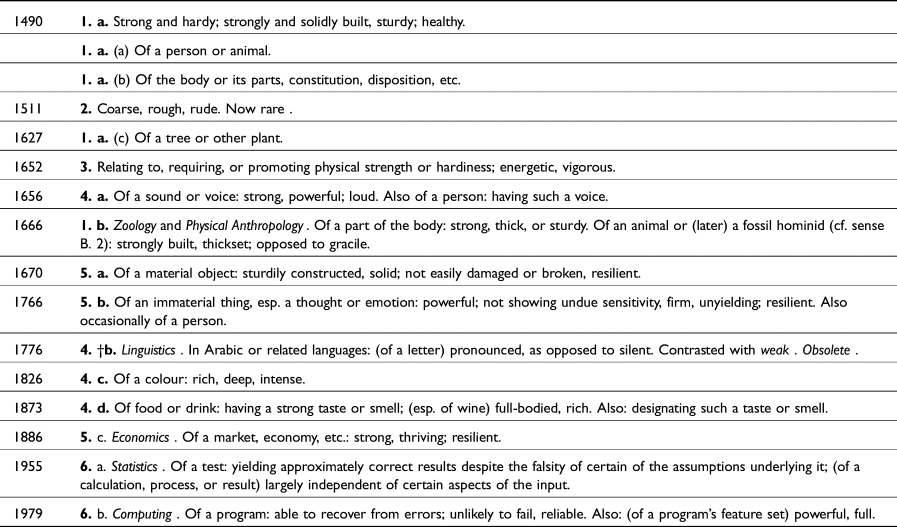
Table 1 shows the development of the meaning of robust in chronological order. All the definitions with the earliest attested dates are from the OED. The earliest documented meaning of robust in the OED refers to people's quality or animal's attributes, describing their body, constitution or disposition as ‘strong, hardy; strongly and solidly built, sturdy; healthy’ (1490). In the same umbrella sense, the meaning applied to a tree or other plant appears from 1627. Senses such as ‘coarse, rough, rude’ first appear in 1511, but are now considered rare.
The chronological first attested meanings of robust

More general senses such as ‘energetic’ and ‘vigorous’ are attested from 1652. This notion of strength was extended to sound or voice, in meanings such as ‘strong, powerful’ or ‘loud’ (1656). Initially related to the strength of living things such as humans, animals and plants, robust eventually broadened to denote physical strength in material objects, signifying ‘sturdily constructed, solid, not easily damaged or broken, resilient’ (1670). Over the course of a hundred years or so, the notion of material strength was extended to include immaterial things, such as thoughts or emotions (1766), as well as the economic or monetary sense of ‘strong’ or ‘resilient’ (1886). Likewise, robust came to express colour and tonal intensity. Originally, it carried the nuance of healthy sun-burnt skin colour, as seen in the contexts like ‘for the sun-burnt, well-baked, robust tone of the flesh-colour’ (1826), it gradually developed into a broader sense of ‘intensity’ in colours, as in ‘(t)he colour is rich, sensuous, robust’ (1892). The figurative application of robust extends to describing taste or smell of food and drink as ‘rich’ or ‘full-bodied’. Finally, robust has been used in statistics of test results (1955) and computer programs (1979) to convey meanings such as ‘reliable’.
3. Corpus evidence
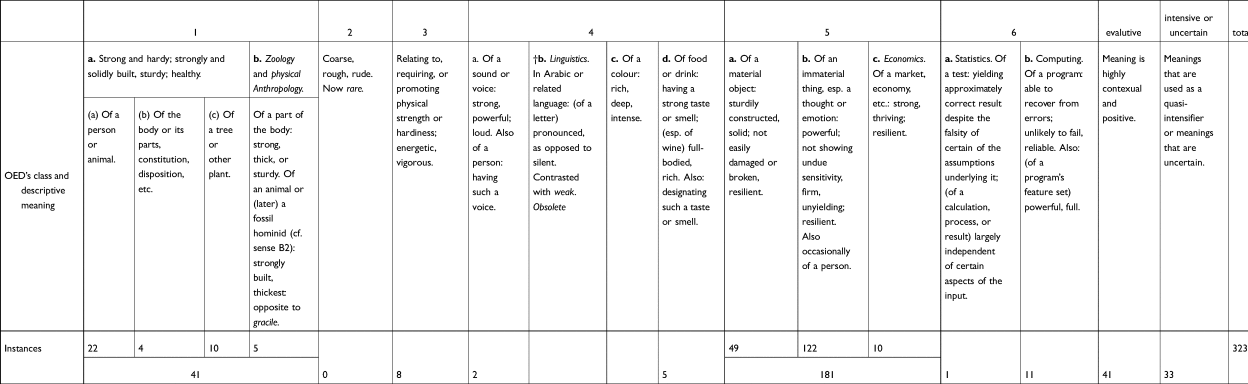
This study uses the BNC to analyse the semantic variation of the adjective robust up to the 1990s. A search for robust in the BNC yielded 686 instances. To investigate collocational variation, this study examines a total of 323 instances where robust modifies nouns as an attributive use. Each instance has been then manually examined to determine its specific meaning and classified according to the definitions provided by the OED.
Table 2 below summarises the results of the usage analysis. The numbers at the top of each column correspond to the OED's word sense classification. Each column provides word sense descriptions from the OED. At the far-right side of the table, the second and third heading to the last, ‘evaluative’ and ‘uncertain’, are sense groups added by the author. Examples that do not fit into any of the sense categories provided by the OED are classified into one of these two categories. The bottom row of each column displays the total number of examples classified in each sense.
Results of usage analysis for robust

Most surprisingly, there are fewer instances of robust being used in its original sense of ‘healthy’ or ‘strong’, with the majority of instances being classified as meaning 5b (emotional sense of ‘powerful’, ‘firm’ or ‘resilient’) in the OED. Many examples present a challenge in terms of classification within the OED's list of meanings from 1 to 6, and are categorised as either ‘evaluative’ or ‘intensive or uncertain’. This section considers examples of usage that easily fit to one of the senses given by the OED and examines their respective meanings.
Examples that are difficult to assign to any of the senses from 1 to 6 are those in which robust has an intensifying or evaluative sense. These examples are discussed in the following section 4 below.
3.1 Robust as ‘strong and healthy’ (sense 1 in the OED)
As mentioned previously, the original meaning of robust, ‘strong’ and ‘healthy’ (sense 1a), was less frequent in the BNC compared to the sense 5. There were 22 examples in the sense 1aa, 4 examples in 1ab, 10 examples in 1ac. There were only 5 examples used in the sense 1b, describing animal body shapes, body parts, bones and fossils. The following example (1) is classified as 1aa (persons or animals as ‘strong’ or ‘healthy’):
(1) Even in rugby, the Afrikaners' passion, the formation of a single non-racial administrative body is imminent; the octogenarian rugby boss, Danie Craven, has long thought it a game for robust men of all races, . . . (BNC, ABK)
In the examples classified in the first sense, two uses of robust, in the collocation such as ‘healthy and robust parents’, and ‘large and robust man’, seem to have intensifying functions. In both cases, the adjectives juxtaposed by and, overlap in meaning with robust: healthy overlaps with the original meaning of robust, and large, meaning ‘of good physique’, is very close to the sense 1ab (the body, its parts, constitution or disposition as ‘strong’ and ‘hardy’) of robust. This type of intensification will be discussed in more detail in section 4.2. For the remaining examples classified in the first sense, there are no particular figurative or quasi intensifying uses.
3.2 Robust as ‘course, rough, rude’ (sense 2 in the OED)
There are no examples in the BNC of the word being used as ‘course’, ‘rough’ and ‘rude’. Overall, robust has more positive than negative connotations.Footnote 3
3.3 Robust as ‘energetic, vigorous’ (sense 3 in the OED)
There are a number of cases where robust was used in conjunctions or collocations in the third sense of the OED as ‘energetic’ and ‘vigorous’. In sport, for example, robust is often seen in collocations such as ‘robust game of rugby’. In example (2) below, robust is used in conjunction with animated, giving the impression that it has an intensifying function:
(2) Soon she was singing with various friends in nearby Crouch End. The new single is a ‘definite fantasy, it's about space’, though with her animated and robust manner, Sonique hopes to bring a ‘more real’ feel to the group. (BNC, ACN)
The remaining examples include a metaphorical use of robust to describe the application of paint, conveying the sense of ‘energetic’ or ‘vigorous’:
(3) The Oilbar medium is firm but mobile in handling and has a buttery smoothness which allows for delicate or robust application directly onto the painting surface. (BNC, CL0)
3.4 Robust as sense 4 in the OED
There are two instances of robust in the sense of 4a, describing voice or sound as ‘strong, loud’, however no instances classified as sense 4b (in linguistics pronounced as opposed to silent) or 4c (colour: ‘rich’, ‘deep’ or ‘intense’). The most common use is for food and drink, describing a ‘strong taste or smell’ (sense 4d), with a total of five instances. The example (4) below, classified as sense 4a, is one in which robust is used to describe the sound (‘melody’):
(4) It's intriguingly titled ‘The Revenge Of The Goldfish’ and it blows your head off. Twelve tracks of lashing, fiery, passionate pop, each of them a little nugget of punky guitaring, robust melody and shrouded, sensitive lyrics. (BNC, CAE)
Out of the five examples classified as sense 4d, one describes the taste of mousse, as shown in (5), and the other four describe the taste of beverages such as wine, coffee, and tea. When robust is used to describe the taste of these beverages, it conveys a positive evaluation by the language user, as they are generally regarded as high-quality when having a strong taste, indicating a satisfying or superior flavour. This will be discussed in detail in section 4.4.
(5) He describes the passion fruit mousse as the perfect dessert to finish a fairly rich and substantial meal. . . . ‘This mousse gives a superb robust flavour, yet is light and very fresh tasting.’ (BNC, A7F)
3.5 Robust as sense 5 in the OED
The usages classified as sense 5 (material, immaterial or economic strength) are the most numerous with 181 instances. This suggests that the figurative use of robust was already becoming established in the examples up to the 1990s. While the 49 usages classified as 5a (‘sturdily constructed’ or ‘resilient’) fit nicely with the OED's definition, many of 122 examples that fall under 5b (emotional sense of ‘powerful’, ‘firm’ or ‘resilient’) present challenges to sort out. Two of these examples will be discussed later in section 4.2. The most common nouns modified by robust as sense 5b were approach (9), view (9), and defense (7). Many instances in sense 5b emphasise the seriousness or determination of attitudes. For instance, in (6), robust is used to signify strong, forceful, and firm judgment, leaving ‘no doubt’ about the necessity to adopt new methods.
(6) . . . The computer revolution may have a significant effect upon the way in which you are able to perform your job. The courts do not encourage Luddism. . . . The judgment in this case, Cresswell and others v Board of Inland Revenue (1984), contained robust comment on the need to move with the times: There really can be no doubt as to the fact than an employee is expected to adapt himself to new methods and techniques introduced in the course of his employment . . . (BNC, B08)
In example (7), which is classified under 5c (economic or market strength), health is used metaphorically to describe the condition of the Japanese economy's manufacturing sector. The term robust emphasises the sector's strength, resilience, and positive state, despite the challenges such as financial market volatility:
(7) # Collapse of equities market While the manufacturing sector showed its usual robust health, 1990 saw considerable volatility in Japan's financial markets, with equities plunging by nearly 15 per cent during the first three months of the year. (BNC, HLD)
3.6 Robust as sense 6 (applied to statistics and computing)
In the OED's word sense classification, the sixth and final sense of robust describes statistics, test results or computer programs as ‘strong’. Within this BNC study, there are 12 examples classified under this sense, with only one falling into the 6a classification (statistics and test results) and 11 into the 6b (computing). In example (8), robust is used to describe a ‘strong’ and ‘reliable’ test:
(8) The reported recurrence risk ratios (R), which are . . . fit a multifactorial model better than a monogenic model for both ulcerative colitis and Crohn's disease . . . This increase in risk is a cardinal feature of a multifactorial trait . . . attempts to map susceptibility loci should be analysed by a robust linkage test (for example, affected pedigree member of ‘sib pair’ test) so as to minimize false positive claims of linkage. (BNC, FT2)
The OED's word sense classification comprises six senses, with the sixth being the latest figurative application. Examining examples individually reveals that robust is often used with positive connotations and in a variety of contexts where it might be highly contextual and not fitting neatly into any specific word sense classification. The following section will examine some specific examples of robust interpreted as having positive evaluative meanings and others as having intensifying meanings.
4. Discussion: Intensive and evaluative use of robust
Sections 3.1 to 3.6 have analysed the actual usages found in the BNC that fall into one of the senses listed in the OED. This section will analyse various uses that either correspond or do not correspond to any of the senses listed in the OED (senses 1 to 6), and that also act as quasi-intensifiers or have positive evaluative meanings. Some of the intensive and evaluative usages include examples that are classified as ‘evaluative’ and ‘intensive or uncertain’ in Table 2.
4.1 Intensive use
This section will begin by looking at examples of robust which seem to play a similar role to that of an intensifier. In the following example (9), robust, which means ‘strong’, can be interpreted as intensifying the degree of freshness.Footnote 4
(9) However, the sound on CD, although vivid and greatly improved, is not quite as memorable as that of the London Symphony. Neither is the performance. The recording was made within a month of the premire, which was conducted by ‘Glorious John’, as Vaughan Williams called Barbirolli. The playing certainly reflects the robust freshness of discovery of new music, but the result, curiously, is not as memorable as the London, which, of course, reflects Sir John's great love for the earlier work. (BNC, ED6)
It seems that robust does not have the original meaning of ‘healthy’ or ‘strong’ here, but rather functions as a quasi-intensifier with a positive connotation. Freshness can be viewed as a gradable noun, with robust acting as a lexeme intensifying the degree of freshness, indicating a higher degree on the freshness scale. When used in this more abstract sense of ‘strong’, robust behaves much like an intensifier.
4.2 Intensification in hendiadys or repetitive use of synonyms
Hendiadys is the linking of two words by the conjunction and to express one idea. In examples (10) and (11), closely related adjectives are juxtaposed with and to modify the noun. In (10), ‘large and robust’ modifies man, nearly synonymous in depicting good physique. This falls under sense 1aa (persons or animals as ‘strong’ or ‘healthy’), but its usage and meaning also carry some intensifying nuances:
(10) . . . the situation had steadily worsened at the Harwell inn. Slatter and his friend, Robert James, had run out of ready cash and had resorted to begging with menaces from the more vulnerable customers. . . . There was more than a hint of imminent violence in every word, and thinly veiled intimidation in every syllable. Isaac Day had had enough. A large and robust man, he strode across the floor and stood firmly in front of Slatter. (BNC, ANK)
Example (11) is classified as sense 5b, interpreted by the OED as ‘(of a thought or emotion) firm, unyielding’. However, this usage can also be seen as an instance of intensification or positive evaluation. Here, robust itself also carries the meaning of ‘vigorous’ defined as sense 3 in the OED. The repetitive use of ‘vigorous and robust’ intensifies the degree of ‘contribution’, with a positive evaluative meaning superimposed on the noun contribution.
(11) Unions continue to make a vigorous and robust contribution to the defence of working-class interests in a hostile society; but, especially since the unsuccessful conclusion to the miners' strike, there is no escaping the problems facing the movement. (BNC, GVX)
The juxtaposition of robust with near synonymous adjectives, as in (10) and (11) above, can be seen as a kind of hendiadys. Similarly, certain word combinations can be used as a means of intensification, as discussed in Bolinger (Reference Bolinger1972):
Intensifiers are not only accumulated but often to a certain extent fused; the following, and others, function as virtual units: all too, only too, all the more, none the less, a little bit, a wee bit, quite a bit, just a little, a whole lot, more or less, more and more, less and less, far and away, out and out, ever so. . . . Among cases of hendiadys, the most familiar are nice and and good and. Nice and still modifies only approvable qualities; good and has been generalised:
The water was nice and hot−just right for tea.
The door is nice and wide. You won't have any trouble getting the furniture through.
He was good and mad (*nice and mad) by that time.
I'll do it when I'm good and ready.
The examples he discusses include ‘nice and’ and ‘good and’, somewhat similar to the usages of (10) and (11), but the main difference is that robust does not come in the position of nice or good. This differs from typical hendiadys in manner of intensification where the combination of two adjectives juxtaposed by and creates a meaning similar to ‘very’, i.e., nice and hot becomes ‘very hot’, good and mad becomes ‘very mad’. The adjective preceding and is limited, and is usually one syllable, when it is to play an intensifying role. In this sense, large and robust, vigorous and robust can only be seen as adjectives with lexical meanings juxtaposed with and, but they are still almost synonymous, intensifying the meaning of the noun.
The next three examples use robust with synonyms, without the conjunction and, but with a comma or nothing in between. These adjectives overlap with the meaning of the word robust itself, suggesting that robust does not add specific meaning but simply intensity. Example (12) illustrates the successive use of the synonymous adjectives lively and robust:
(12) His light, humorous sketches began to appear regularly in London newspapers and in periodicals such as Punch. . . . In 1900 he settled in London, where his lively, robust style of writing caught the eye of the founder of modern popular journalism, Alfred Harmsworth . . . (BNC, GT7)
The meaning of lively is very close to the OED's third definition of robust, ‘energetic and vigorous’. However, the definition of sense 3 is confined to the physical meaning related to people's health, described as ‘relating to, requiring, or prompting physical strength or hardiness’. Therefore, this example, being not directly classified as sense 3 in the OED, is an example of metaphorical extension, where the object of modification is ‘style of writing’.Footnote 5 In (13), the adjectives flexible and robust are used together to describe an extensive manufacturing capability:
(13) What we were trying to do was to give our business a ‘new’ manufacturing tool that has a sharper edge with which to attack competitors and chop off more market share. We believe that without a flexible, robust manufacturing capability, driven by a team with the right attitude, the business is handicapped, will wither and eventually die. (BNC, K9K)
This usage is categorised as sense 5b, the meaning of ‘resilient’, which typically describes immaterial things, such as thoughts or emotions. Although in (13), the modified noun is not related to thoughts or emotions, it can be seen as an extended and metaphorical use of robust, meaning ‘resilient’. This usage can also be classified as evaluative, since flexible and robust do not really intensify the nominal meaning of ‘manufacturing capability’ but rather add a positive evaluation to it. Robust implies strength and durability in manufacturing capability and in facing market pressures, while flexible denotes adaptability to changing circumstances to meet customer needs. The meanings of these two words are quite similar when used to describe manufacturing capability, conveying an assertive attitude and positive evaluation. In (14), healthy and robust are used almost synonymously to convey the idea of ‘strong, supportive’ parents:
(14) We actually split up for a few days because his mother sent a Christmas card to him and not to me. I said, ‘Why can't you tell your mother now we're married she must send her Christmas card to both of us’, but he couldn't tell her. ‘Early in marriage a re-ordering of priorities is necessary, and some couples can run into trouble if their commitment to, or dependence upon, healthy robust parents cannot be allowed to take second place to their commitment to their new partner . . . ’ (BNC, BNF)
The usage of robust is classified in the first sense in the OED, which describes a person as ‘strong and hardy; strongly and solidly built, sturdy; healthy’. However, within this context, parental well-being might not positively impact the couple's relationship, potentially due to their existing commitments to their parents. The phrase ‘healthy robust’ implies the parents’ physical and mental strength, with robust emphasizing their already strong attributes, which can be interpreted as an example of intensification.
4.3 Intensification with nouns that connote ‘strong’ in their meaning
The examples discussed in this section include the collocations of ‘robust grip’ and ‘robust appetite’ where robust modifies nouns with gradable adjectives.Footnote 6 For example, grip is defined in the Collins English Dictionary as ‘a firm, strong hold on something’. In other words, this is a noun that contains the modal adjectival meaning of ‘firm’ and ‘strong’ in its nominative sense. In this case, when robust modifies grip, the meaning of these gradable adjectives is strengthened:
(15) At the end was an opening . . . through which one could see the glimmer of the sea and the northernmost hill of the broch islet. I was looking at this, and not at where I was putting my feet. I stubbed my toe, swore, tripped, and almost fell, to be saved by a robust grip above the elbow. (BNC, CKF)
The following example (16) also shows that robust modifies the noun appetite, which contains the modal meaning of ‘strong’. The Collins English Dictionary defines appetite as ‘someone's strong desire for something’. In combination with robust, the adjectival meaning of ‘strong’ in appetite seems to be strengthened, suggesting that appetite can also be considered a gradable noun:
(16) He thinks that he wants a reconciliation, and up to a point he does; but what he hopes most of all is that Alfred will give his blessing to the new play he has written -- a drama of sibling rivalry called Brother Mine. Alfred will have none of it. . . . Whose side are we supposed to be on? Is Alfred doomed to survive only in the reflected glory of Michael's reputation, or is Michael's writing merely a pale reflection of Alfred's extrovert figure? (Alfred has a robust appetite for life; Michael is mollycoddled and plagued with gastritis.) (BNC, AK4)
4.4 Robust for positive evaluation
This section looks at the use of robust in contexts where language users employ nuances of positive evaluation, resulting in multi-layered meanings. In previous instances, positive evaluative meanings can be read into robust through intensification. Extending the discussion in the previous sections which highlighted the repetitive use of synonyms, this section focuses on cases where the positive evaluative meaning of robust is clearly discernible. In these cases, the intention is not only to highlight specific aspects of the meaning of the modified noun, but rather to convey an overall evaluative stance. As a result, determining the particular sense that language users might wish to convey through the use of robust, becomes a challenging endeavour. For instance, in (17) and (18), robust is used to express a positive evaluative attitude towards the modified entities, adding subtle nuances and an additional layer of meaning.Footnote 7
(17) Health and strength and a certain robust attractiveness had been hers, good marks in the classroom, an ear for music, parental praise, had been hers. (BNC, AD1)
(18) The main course should be a robust dish with a good rich sauce made from the finest ingredients; crisp onions or shallots, a strong stock or glace de viande and, most important of all, good wine. (BNC, ED9)
In example (17), robust describes the physical attractiveness and general well-being of the person, implying a positive evaluation of these qualities. Health and strength, correspond to the original meaning of robust, while ‘robust attractiveness’ contributes an additional positive layer to the person's evaluation. Although it may also seem unusual to use robust to express a person's attractiveness, this usage suggests that robust is becoming a versatile word capable of expressing such positive evaluations. Pairing robust with attractiveness creates a more nuanced and complex portrayal of the person.
In example (18), robust is used to describe a dish as a satisfying main course. It suggests that the user of the language considers a dish served with ‘a good rich sauce made from the finest ingredients’ to be a pleasing and desirable dish, i.e. a ‘robust dish’. The mention of ‘crisp onions or shallots’ implies that they are cooked to a crisp texture, which adds complexity to the flavour and enhances the overall quality of the dish. Similarly, the inclusion of ‘a strong stock or glace de viande’ suggests a rich and complex flavour base, that adds depth to the flavour. In this usage, robust implies that the dish is of a higher standard in every way – the quality of the ingredients, the way it is cooked to achieve a pleasing texture, and the way it is given a complex, rich flavour. In fact, there are many nuances to the use of robust, and if we had to make a simple deduction about the function of the word, we could conclude that it adds a very positive assessment of the dish, highlighting a certain level of complexity and richness in its flavour profile.
Looking beyond culinary contexts, the OED explains another facet of robust. Specifically, when applied to coffee or wine, it lists ‘full-bodied’ as one of the meanings of robust (sense 4d). Although, in example (19), the flavour of the coffee is described as full-bodied and its aroma as robust, the smell and the taste come from inseparable sensory organs.Footnote 8 When a particular coffee or wine is described as full-bodied, it is not just describing a bold or strong taste or smell; it is actually distinguishing a flavour or aroma that scores very highly when judged by cupping or tasting. Using full-bodied and robust to describe the taste and smell of coffee is a definitive way of expressing the speaker's very high opinion of its flavour.
(19) Grown in the Cordillera mountains, Lyons Costa Rica is dark and strong, reflecting the volcanic character of its origins with a full-bodied flavour and robust aroma, the perfect end to a festive dinner party, especially when accompanied by liqueurs. (BNC, C9X)
Finally, the following example (20) illustrates that ‘robust advice’ can be interpreted as being ‘reliable’ advice rather than being just ‘strong’ or ‘effective’ adviceFootnote 9:
(20) Finally, it has to be admitted that we were strengthened in our resolve not only by the robust advice of our own legal team but by the knowledge that the merger of Dearden Farrow and the loss of the practising name meant that we were not susceptible to concerns in regard to our reputation. (BNC, CBV)
In this sentence, robust can be used to mean ‘reliable’ or ‘trustworthy’ because it refers to the advice given by a legal team. By describing the legal team's advice as robust, the speaker may be suggesting that the advice is not only strong and persuasive, but also well-informed and trustworthy. The word robust, when combined with ‘advice’, expands its meaning beyond simply ‘strong’ to include the specific nuances of ‘reliable’ or ‘dependable’ and can be interpreted as reflecting the speaker's positive evaluative attitude.
5. Conclusion: Intensifier with nouns
This study has presented an analysis of robust as an intensifier for nouns, which has not received much attention in previous studies. Analysing examples up to the 1990s reveals its diverse applications and its evolution into a quasi-intensifier.
The word robust has undergone metaphorical expansion and is now used as a quasi-intensifier in various contexts. The evolution of the meaning of robust can be traced back to the late 15th century, when it was used to describe humans or animals as ‘hardy’ or ‘strong’. In the 17th century, it began to be used in a botanical sense, referring to trees or plants. By the late 17th century, the term robust was used to describe sounds, the body parts of humans and animals, as well as material objects. In the 18th century, it was applied to immaterial things and the field of linguistics. During the 19th century, robust was used to describe colours, food and drink, and economics. In the mid-20th century, it began to be used in statistics, and by the late 20th century, it was adopted in computing and for speaker-oriented positive evaluations.
There are several patterns in the usage examples where robust behaves like a quasi-intensifier. The first is when the gradable noun is modified, as in ‘robust freshness’ in example (9), where robust points to an upper level on the scale that the noun has in terms of gradability. The second is by repetition, which occurs in the form of hendiadys and in tautology. The third is the usage where the noun contains ‘strong’ as a modal meaning, which is further intensified by robust. The final means of intensification are evaluative uses, where there is a multi-layered positive nuance that can be read into robust, making robust a useful term.
Robust has metaphorically expanded its meaning and is used as a quasi-intensifier in a wide range of contexts. While the evaluative role of intensifiers has not been a central topic of discussion in previous studies, the present study shows that language users often add positive evaluative meanings to their remarks, which can often be tantamount to an intensification.
Acknowledgements
I would like to thank John Owen (Bunka Gakuen University) for his useful and valuable comments, as well as for our personal discussions on word usage. I am also grateful to the anonymous reviewers for their invaluable comments.
Appendix
This appendix contains examples that are categorised as ‘evaluative’ or ‘intensive or uncertain’ in Table 2, along with their context. Category 7, which is labelled as ‘evaluative’ in the paper, is presented with a more detailed classification ranging from 7a to 7d with the last subcategory being 7e ‘other evaluative meanings’ in the Table 3 below.Footnote 10 Category 8, which is labelled as ‘intensive or uncertain’ in Table 2, is divided into two subcategories, 8a and 8b. The number of examples sorted in each subcategory is displayed in the second-to-last row. The bottom row shows the total number of examples in each sense group, which corresponds to the numbers in Table 2 of the paper.
Subcategories for ‘evaluative’ and ‘intensive or uncertain’ sense group

1. The category 7 (evaluative)
Additional subcategories are made (7a to 7d) under the category of 7 (evaluative). Those that cannot be grouped with a particular usage are categorised as 7e ‘other evaluative meanings’.
The first subcategory in Table 3, 7a identifies evaluative meanings such as ‘solid, definitive, reliable’, meanings indicating a higher level of certainty. A total of eight examples are classified in this category. Nouns that have been modified are analysis, verification, proxies, reality, selection, difference, approach and view. In example (i), robust modifies difference, suggesting that the difference is reliable, dependable and strong enough to distinguish between sentences effectively.
-
(i) . . . even with such limitations the search space was too large to search exhaustively. The algorithm was modified to allow forward pruning. . . . Why was such forward pruning successful in HARPY and not in HWIM? The reason is that the recognition network was arranged in such a way that acoustic similarities were minimized. Woods writes: ‘For example, What are their affiliations is in the grammar, but no other sentences starting with What are their are possible. The only two sentences starting with What are the are What are the titles of the recent ARPA surnotes and What are the key phrases. These three sentences will almost certainly find some robust difference beyond the initial three words that will reliably tell them apart.’ (Woods 1982, 314) (BNC, HX9)
The second subcategory, 7b identifies evaluative meanings such as ‘proper, decent’, and three examples are classified under this meaning. The modified nouns are institutions, story-teller and story-telling. In example (ii), robust modifies institutions:
(ii) Managers long cushioned by state intervention become driven by production targets, not by the test of the market. Their failures can all too readily be excused and even hidden by further infusions of state funds. Few are likely to be enthusiastic about taking up the burdens of having to compete. This problem is especially acute in smaller countries like Kenya and Tanzania, where there are now fears that state capitalism will merely be replaced by ‘crony capitalism'. All too often, newly privatised enterprises remain dependent on political connections for a wide range of monopolistic privileges to cushion the full force of competition. Unless adequate attention is paid to building robust institutions that promote internal competition and offset the lack of commercial experience or knowledge in the political system, privatisation will merely transfer privilege and feather-bedding from one group to another. (BNC, EEF)
In this context, robust is used to describe institutions that are strong and well developed. The phrase ‘promote internal competition’ refers to the healthy competitive environment that successful enterprises maintain. Additionally, ‘offset the lack of commercial experience or knowledge in the political system’ suggests that newly privatised enterprises often do not function effectively as typical enterprises. In addition to conveying strength and resilience, robust can also imply the ideas of being proper and decent as institutions. This suggests that the institutions should not only be strong and effective but also well-established and suited to their purpose.
The third subcategory, 7c identifies evaluative meanings such as ‘firm’, ‘steady’ and ‘reliable’, and three examples are classified under this meaning. One of these (‘robust advice’) is discussed in example (20) of section 4.4 of the paper. Other modified nouns are observations and scheme. An example of robust modifying observations is shown in example (iii):
(iii) . . . The result was that the social pressure had no effect at all. In children between four and eight years of age there was absolutely no difference between the number of realist answers produced by the pairs and by the control, solo children. They knew the realist option but did not take it as a way out of a social impasse, because, I would argue, the phenomenalist tendency of thought is too strong. What dominated their judgements was the salience of the illusion – that was ‘most up front in consciousness’. Many readers who know nothing else about Piaget's work will know of his experiments on ‘conservation’. These simple but extremely robust observations concern children's knowledge that although a substance or display is changed perceptually – in other words, that the appearance of an object may change – properties such as length, area, volume, weight, number do not change. Here is perhaps the simplest and most dramatic example: the non-conservation of length by children below about seven years of age. (BNC, A0T)
In this context, robust is used in the phrase ‘simple but extremely robust observations’ to emphasise that the observations are not just ‘persuasive’, but rather ‘firm’, ‘steady’, and ‘stable’. This indicates that these observations are ‘eliable’ and ‘dependable’ in the area of child development.
The fourth subcategory, 7d identifies evaluative meanings describing excellence, strength, or steadiness of strategy, performance, economic recovery, etc. The qualified nouns are recovery, strategy, evening trade, and performance (of systems and business). In example (iv), robust is used to describe the performance of OCR systems:
(iv) However, the development of the optical scanner has provided the hardware necessary for converting a paper document into an electronic form, albeit as a pixel representation. What is further required is the conversion of the pixel representation to a textual one, which is where optical character recognition (OCR) algorithms take over. A number of commercial OCR systems are currently available, such as ReadWrite and TextPert. Some systems are able to identify characters along with their size, location and other layout information, showing robust performance on high quality machine-printed documents. However, once documents have become degraded (i.e. faxed, or photocopied) the performance rapidly deteriorates. (BNC, EES)
In this context, ‘robust performance’ refers to the ability of OCR systems to perform well and reliably on high quality machine-printed documents, efficiently identifying characters along with their size, location, and other layout information. Robust in this context conveys positive connotations such as ‘excellent’ or ‘good’ in performance.
In the category 7 (evaluative), there are a total of 22 examples of usages under the subcategory of 7e ‘other evaluative meanings’, including two examples, (17) and (18), discussed in this paper. The modified nouns are heroes, strikers, relationship, sense of humour, sense, performance (in theatrical play), response (in the context of the market), management (in business), representation scheme, system, treatment, version (of opera), attractiveness (see example [17] in section 4.4 of the paper), exploration and appraisal programme, drunkards, dispenser of aspirins for headaches (referring to a woman), dish (see example [18] in section 4.4 of the paper), approach (in the context of painting style), and speech (four examples in total). Example (v) is one of the few instances where robust can have a negative connotation:
(v) He's sick,’ said Holly. The tranquillity had gone from his face. He moved forward to close the gap again with the tunic back in front of him and his lips were dented white where the teeth had bitten at them. ‘Sick? Of course he's sick. Sick like everybody. What do you expect, a nice neat psychiatric ward? He's better here, better with us than at the Sebsky . . . ’ ‘I don't know of the Sebsky.’ ‘For one who intends to stay a long time with us, Englishman, you know little of us. In Moscow is Kropotkin Lane. At Number 23 is the Sebsky Institute for Forensic Psychiatry. Ask Feldstein, our little revolutionary. He shits himself each day that they will send him there. Friend Byrkin would get robust treatment at the Sebsky. Even this place is better than some, Englishman.’ (BNC, CJT)
In this context, ‘robust treatment’ suggests that the treatment provided at the Sebsky Institute of Forensic Psychiatry, would be rigorous, intense, and, in some cases, harsh and severe. It seems to imply that the treatment methods at the Sebsky are not gentle or lenient, but rather thorough and might be aggressive. This usage is classified as 7e ‘other evaluative meanings’. However, it is one of the few instances where the negative connotation of robust can also be inferred, whereas in most cases, robust conveys a positive meaning.
2. The category 8 (intensive or uncertain)
This paper identifies 33 examples of usage classified as ‘intensive or uncertain’. Seven of these examples could be interpreted as usages of intensification (subcategory 8a in Table 3), including the examples (9), (12), (15), and (16) in section 4 of the paper. Within the subcategory 8b ‘meanings that are uncertain’, there are three examples that can also be interpreted as having negative evaluative meanings.
The seven modified nouns in the examples categorised as 8a ‘meanings that can be read as intensification’ are as follows: freshness (see example [9] in section 4.1 of the paper), style of writing (example [12] in section 4.2 of the paper), grip (example [15] in section 4.3 of the paper), appetite (example [16] in section 4.3 of the paper), expansion, example, and competition. The 26 modified nouns in the examples categorised as 8b ‘meaning that are uncertain’ are: adventures, variety (referring to Beethoven's music), tail-ender, units, times, strength (referring to a station), pleasures, police action, prediction, residuals, results, control methods, management, representation primitive, adventures, scoundrels (two examples), SunPro, blend of youth and experience, bank account, eloquence, dialogue, view (two examples), and style (two examples).
Among the category 8 (intensive or uncertain), three examples will be discussed here: the first has a negative nuance (categorised as 8b), the second cannot be straightforwardly interpreted, and therefore categorised as 8b ‘meanings that are uncertain’, and the third example that manifests a slightly different type of intensification from those discussed in the paper. Example (vi) shows robust modifying scoundrels and intensifying the negative connotation of the noun:
(vi) . . . Beccaria's reputation for humanity comes from the famous sections that oppose the use of torture and of capital punishment. While his arguments about capital punishment are still of great relevance, it now seems rather odd that it could have been thought necessary to have to argue against the use of torture for extracting confessions. At the time Beccaria was writing, however, it was assumed that God and righteousness would prevent innocents from breaking under torture and falsely confessing. He points to the irrationality of this assumption and makes the seemingly rather obvious point that ‘Torture . . . is an infallible means for absolving robust scoundrels and for condemning innocent persons who happen to be weak’ (p. 32). (BNC, CRX)
In this context, robust reinforces the negative connotation of the noun scoundrels, implying a negative quality of strength or resilience in the face of torture. This emphasis on strength suggests that innocent people, who may be weaker, are less able to withstand torture, while scoundrels possess certain level of resilience.
Example (vii) is categorised as 8b ‘meanings that are uncertain’ because it is difficult to interpret a singular meaning:
(vii) . . . together with the ‘sex in shiny packets’ literature and the cacophony of juke-boxes and ‘nickelodeons’. All this was contrasted uninvitingly against the fondly remembered oral traditions of the working-class neighbourhoods – brass bands, free-and-easy nights at the local pub, and pigeon-fancying – as an essentially ‘hollow’ and ‘faceless’ cultural diminishment. And when Hoggart turned his attention to the ‘juke box boys’ who were a recognisable strain of early Teds – ‘boys between fifteen and twenty, with drape-suits, picture ties, and an American slouch’ – even the slouch was, characteristically, identified as ‘Americanised’ and hence ‘postwar’ and ‘un-British’, as the boys sipped their milk-shakes and tapped their feet to the music in their milk-bar rendezvous: It was a typical mode of response by Hoggart, contrasting the cultural solidity of the English pub and its robust pleasures with the contrived artificiality of the ‘American’ cafe; the fantasy world of admass set unfavourably against the down-to-earth character of working-class tradition. ‘This regular, increasing, and almost unvaried diet of sensation without commitment’ would ‘render its consumers less capable of responding openly and responsibly to life’ and ‘induce an underlying sense of purposelessness’. The associations between this allegedly purposeless irresponsibility and a galloping crime rate have come to be employed regularly in postwar discourses on the decline and fall of the ‘British way of life’. So, too, the feeling that life was becoming ‘Americanised’ has been used unsparingly to describe the process of ‘permissive’ rot and the collapse of traditional authority – most forcibly registered in the adoption of the term ‘mugging’ to disown as ‘un-British’ the old-fashioned crime of street robbery . . . (BNC, EDE)
The challenge of determining the meaning of robust in this context may be attributed to its use as a collective term for the various values associated with English pubs that are discussed throughout the text. These values include steadiness, longevity, and the enduring strength that has historically characterised the working class. Therefore, interpreting the term robust as a single sense is challenging as it encompasses multiple related meanings.
The final example (viii) is categorised as 8a ‘meanings that can be read as intensification’. Although this paper discussed several types of intensification, example (viii) differs slightly from the others because the modified noun competition is not really a graded noun, yet it still retains a certain scale in its lexical meaning:
(viii) . . . American and United get their strength from strong route networks which draw in huge numbers of passengers. Possessing the two biggest computer-reservations systems in the world does no harm either. Delta benefits from a modern fleet of aircraft with low operating costs. But even these giants are having trouble. American Airlines made a $215 m loss in the fourth quarter of 1990, while on January 23rd Delta reported that it went $208 m into the red during the same period, the biggest quarterly loss in its history. If America's airline industry continues its present rate of consolidation, it could soon be dominated by American, United and Delta. This is the opposite of what deregulation set out to accomplish. Sam Skinner, the American transport secretary, believes that even if there are fewer airlines in America ‘robust competition will continue’ . . . (BNC, ABH)
Although competition is not typically considered a graded noun in the same way as freshness (example [9] in the paper), nor does it contain any gradable adjectives as its lexical meaning, such as grip (example [15] in the paper), it often implies a sense of intense comparison or rivalry. In a business context, competition can imply striving to outperform others or achieve a superior position. This may suggest that competition has an element of comparison as part of its lexical meaning. Robust in this context may add a higher level of severity and serve as a quasi-intensifier.
 SAYAKA OGASAWARA is an Assistant Professor at Bunka Gakuen University, Japan, within the Faculty of Intercultural Studies, Department of Intercultural Studies and Tourism. She received her MA in English and American Literature from Rikkyo University, Japan. Her research interests include lexical semantics, historical semantics, and semantic change, with a special focus on the semantic development and change of English intensifiers. She has previously written on the semantic change of adverbs, including an article on “Delexicalization and Relexicalization of Intensifiers: Their Semantic Development from Intensity to Rapidity” (Studies in Pragmatics 15, The Pragmatics Society of Japan, 2013), in which she examined the semantic change of fast from an intensive adverb to an adverb denoting speed. Email: sayaca.423@gmail.com