

INTRODUCTION
St John's Wort (Hypericum perforatum) is a perennial herb native to Europe and West Asia with a wide range of medicinal applications. The products derived from its aerial parts were reported to have anti-inflammatory, antibacterial, antiviral, sedative, analgesic, diuretic and wound-treating properties, and they have also been used to treat depression (Barnes et al., Reference Barnes, Anderson and Phillipson2001; Medina et al., Reference Medina, Martinez-Poveda, Amores-Sanchez and Quesada2006). St John's Wort has been introduced into many temperate regions of the world including the Mediterranean rim, North and South America, South Africa, Australia and New Zealand (Robson, Reference Robson and Ernst2003). It is also a new crop in the sub-tropical region of Taiwan. However, year-round field trials in Taiwan indicated that St John's Wort grows vigorously but fails to bloom (unpublished data). Therefore, plug-grown stem tip cuttings are used currently for large-scale farming of St John's Wort in Taiwan (Lu et al., Reference Lu, Sung and Chen2008). The increased complexity of producing and transplanting plug-grown stem tip cuttings has limited Taiwanese farmers' interest in growing this species. Thus, an alternative and appropriate method to induce flowering and to ensure seed setting is required if St John's Wort is to grow successfully and more extensively in Taiwan.
The transition from vegetative growth to flowering, which is regulated by both plant factors and environmental signals, is the major developmental switch in the life cycle of growing plants (Blázquez, Reference Blázquez2000; Thomas, Reference Thomas2006; Zeevaart, Reference Zeevaart2006). Photoperiod is perhaps the most important environmental signal that regulates flowering (Blázquez, Reference Blázquez2000; Imaizumi and Kay, Reference Imaizumi and Kay2006). To produce St John's Wort seeds successfully in Taiwan, it is essential to know the plant's responses to photoperiod. St. John's Wort is well-adapted to the environment in temperate zones and usually blooms during the summer months (Walker et al., Reference Walker, Sirvent, Gibson and Vance2001), suggesting it is a long-day plant. However, little is known about the effect of photoperiod on its flowering. Both day length extension and night interruption are frequently used to analyse the photoperiodic regulation of flowering in many plant species (Runkle et al., Reference Runkle, Heins, Cameron and Carlson1998; Stirling et al., Reference Stirling, Clark, Brown and Wilson2002; Vaz et al., Reference Vaz, Figueiredo-Ribeiro and Kerbauy2004). The aim of the present study was to examine the effects of day length extension and night interruption on flowering and seed setting of field-grown St. John's Wort.
MATERIALS AND METHODS
Plant materials and growth conditions
Stem tip cuttings of H. perforatum were produced from three-month-old stock plants using the techniques detailed by Lu et al. (Reference Lu, Sung and Chen2008). The cuttings were inserted into 72-cell rock-wool plug trays and rooted in a greenhouse (with mean daily air temperature of 25.1 ± 1.7 °C) for three weeks. They were then transplanted to the field plots (in an 11-h photoperiod, 06:30 to 17:30 hours) on the experimental farm of the Department of Agronomy, National Chung Hsing University on 4 October 2008. Identical regimes of irrigation and fertilization (800 kg ha−1 fertilizer, N-P2O5-K2O: 12–18-12) were applied to all plants.
Photoperiod treatments
Six different photoperiod treatments were imposed on the plants (each with 8–10 side shoots) that had been raised for 70 days after transplanting. All the plants were exposed to 11 h of natural day length and daylight (photosynthetic photon flux density ranged from 1000 to 1400 μmol m−2 s−1). Some of these field-grown plants were subjected to different day length extension treatments (photoperiods of 13 h, 15 h, 17 h and 19 h, respectively) or a night interruption treatment (1 h of night interruption lighting in the dark period of from 23:30 to 00:30 hours). The supplemental lighting was provided using daylight type fluorescent lamps, which delivered 30 μmol m−2 s−1 photosynthetic photon flux density at plant height. Opaque black cloth was used on all the treated plants to block possible lighting interference as necessary. All six photoperiod treatments were applied and lasted for 70 days (26 November 2008–4 February 2009). Time to flowering, the number of flowers produced, the number of capsules produced and the number of seeds produced were recorded.
Germination tests
Three samples each with 100 seeds were incubated on moistened germination paper at 20 °C in an incubation chamber. These seeds were watered when necessary. Germination counts were initiated after 7 days of incubation and were monitored daily for 14 days. Seeds were recorded as germinated when their radicles were protruding and visible (2 mm in length), and mean germination time (MGT) was calculated (Yeh and Sung, Reference Yeh and Sung2008).
Statistical analyses
There were 24 plants in each treatment in a completely randomized design with three replications. Statistical analyses of the data were performed using the SAS system (version 6.21, SAS Institute Inc. Cary, NC, USA). Preliminary studies from March to June 2008 obtained results similar to those from the present study.
RESULTS
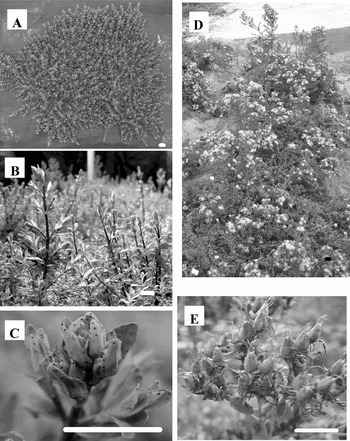
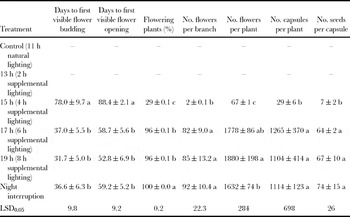
In the present study, notable morphological change was found. Plants that had no flower bud initiation tended to have runner-type stems (Figure 1A), whereas plants that had produced flower buds showed erect-type stems (Figure 1B). As was shown in Table 1, no flower buds were developed for the plants grown under the natural condition of 11-h photoperiod. Plants that had received 13 h of day length treatment (11 h of natural sunlight plus 2 h of supplemental lighting treatment) also failed to initiate flower buds (Table 1). However, 29% of the plants that had received 15 h of day length treatment (11 h of natural sunlight plus 4 h of supplemental lighting) did show flower bud initiation (Figure 1C), even though the appearance of the first flower bud was later (78 days after the start of lighting supplement) than the flowering of the plants that were grown with 17 and 19 h of day length treatment (31.7 and 37.0 days after the start of lighting supplement, respectively) (Table 1). The plants that were grown under 17 and 19 h of day lengths also bloomed earlier (58.7 and 52.8 days, respectively) than the plants that had received 15 h of day length treatment (88.4 days) (Table 1). Additionally, plants that were grown under 17 and 19 h of day length produced more flowers than plants that were grown under 15 h of day length (Table 1).
Hypericum perforatum plants grown under natural day-length (A), the plants subjected to supplemental lighting showed erect stems with developing flora buds (B), open flowers (C), the plants at full-bloom stage (D) and developing capsules (E).

Effects of day-length extension and night interruption treatments on several flowering characteristics of field-grown H. perforatum.

Values followed by the same letter are not significantly different using Fisher's least significant test (p = 0.05).
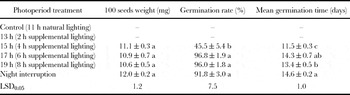
Although different day length extensions (15, 17 and 19 h of photoperiod treatment) did induce the plants to flower (Figure 1D), a considerable level of flower abortion occurred on these plants, particularly for plants that had received 15 h of photoperiod treatment. As a result, the number of capsules produced (Figure 1E) on these plants was significantly lower than the number of flowers (Table 1). Moreover, the capsules on the plants grown under 15 h of day length contained fewer seeds than the plants grown under 17 or 19 h of day length (Table 1). Nevertheless, no significant differences in seed dry weight were obtainable among the plants grown under different day lengths (Table 2).
Effects of day-length extension and night interruption treatments on several seed characteristics of field-grown H. perforatum.

Values followed by the same letter are not significantly different using Fisher's least significant test (p = 0.05).
Flower buds on St John's Wort plants that had received night interruption treatment (1 h of supplemental lighting from 23:30 to 00:30 hours) were visible 36.6 days after night interruption illuminations was initiated (Table 1). Flowers were eventually observed on all the plants subjected to night interruption treatment; however, approximately 32% of these flowers failed to develop capsules (Table 1). Capsules from the plants subjected to night interruption treatment had similar numbers of seeds and seed dry weight as those from the plants receiving 17 and 19 h of photoperiod treatment (Table 2).
Both germination rate and MGT of produced St John's Wort seeds were also affected by day length extension treatments (Table 2). Under 15 h of day length, the seeds produced showed a germination rate of 45.5% and MGT of 11.5 days. However, seeds produced from plants grown under 17 and 19 h of day length showed a germination rate of 96.4% and MGT of 13.9 days (average of the two treatments) (Table 2). The night interruption treatment also affected the quality of seeds produced (Table 2). The germination rate of seeds produced under the night interruption treatment (91.8%) was slightly lower than the germination rate of seeds produced with 17 or 19 h of photoperiod treatment. However, the difference was statistically insignificant at 5% level. Seeds produced with night interruption also had a longer MGT than seeds produced with 19 h of photoperiod treatment.
DISCUSSION
Both temperature and photoperiod are principal factors that synchronize the flowering responses of plants to changing environments (Zeevaart, Reference Zeevaart2006). However, a two-year field trial in Taiwan showed that St John's Wort plants failed to bloom when they were grown in the mountainous region (24°2′51″N, 121°13′30″S) at 1200 m asl with year round temperatures fluctuated from a low of 6–18 °C to a high of 18–28 °C. Therefore, the effects of temperature on flowering induction have been ruled out for St John's Wort plants grown in Taiwan at present.
Long-day plants are generally known to flower when the light period of a photoperiod cycle exceeds a certain length (Adams et al., Reference Adams, Pearson and Hadley1997; Islam et al., Reference Islam, Patil and Gislerød2005; Khokhar et al., Reference Khokhar, Hadley and Pearson2007). The long photoperiod detected by photoreceptors will activate the long-day flowering pathway, resulting in induction and acceleration of flowering (Blázquez, Reference Blázquez2000; Thomas, Reference Thomas2006). In contrast, inactivation of photoreceptor-regulated signals is sufficient to suppress flowering under short-day conditions (Jeong and Clark, Reference Jeong and Clark2005). Our results are consistent with the supposition that St John's Wort is a long-day plant.
In the present study, both day length extension and night interruption were used to analyse the light regulation of flowering of St John's Wort plants. As was shown in Table 1, no flower buds were developed for plants grown under 11 or 13 h of day length condition. Some of the plants (29%) that had received 15 h of day length treatment did show flower bud initiation, but the appearance of the first flower bud was later than that of the plants that were grown with 17 and 19 h of day length treatments. In fact, plants that were grown under 17 and 19 h of day length bloomed earlier and produced more flowers than plants that were grown under 15 h of day length. These results confirmed the existence of photoperiodic flowering response in St. John's Wort. Thus, St John's Wort appears to be a long-day plant with a critical day length of 15 h, and an inadequate day length would extend its vegetative phase and inhibit its flowering. Moreover, a significant level of flower abortion occurred on the plants grown under extended day length conditions (15, 17 and 19 h day lengths). These results seem to suggest that the quantity of light that had provided photo-assimilates to support flower development and subsequent seed setting might have been inadequate (Thomas, Reference Thomas2006). Thus, substantial amounts of seeds competing for rather limited photo-assimilates may have been aborted to make sure that the surviving seeds were well developed and able to germinate. This proposition needs to be further investigated.
Night interruption is also an effective approach to inducing flowering in many long-day plant species (Hamamoto et al., Reference Hamamoto, Shimaji and Higashide2003). The length of uninterrupted dark period is one of the most important factors that control the flowering responses of plants to a succession of light-dark cycles. It is assumed that, during the long dark period, the level of photoreceptor-activated flowering signals is too low to promote flowering in long-day plants. Night interruption lighting would break up the long dark period and promote flowering (Runkle et al., Reference Runkle, Heins, Cameron and Carlson1998). In this study, flower buds were visible on all the plants subjected to night interruption treatment, even though one-third of the flowers failed to develop capsules. Moreover, capsules from plants subjected to night interruption produced the same number of seeds (Table 1) with the same level of seed dry weight (Table 2) as those from plants receiving 17 or 19 h of day length treatment. These results clearly indicate that 1 h of night interruption is effective in inducing flowering and subsequent seed setting in St John's Wort plants grown under the short-day condition (11 h of natural day length).
The environments (e.g. temperature and day length) experienced by the maternal plant during plant development and seed filling are known to influence the germination ability of produced seeds (Munir et al., Reference Munir, Dorn, Donohue and Schmitt2001; Ofir and Kigel, Reference Ofir and Kigel2006). Only limited data on day length effects on seed germination are available for long-day plants. Gutterman (Reference Gutterman1996) reported that the seeds of Schismus arabicus (Poaceae) produced under 18 h of day length condition had better ability to germinate than seeds produced under the 8 or 12 h of day length. In the present study, under 15 h of day length condition the St John's Wort seeds produced were rather poor in seed quality (with germination rate of 45.5% and MGT of 11.5 days) (Table 2). Tetrazolium staining indicated that the non-germinated seeds were physiologically viable (unpublished data). It appears that a substantial amount of St John's Wort seeds produced from plants that had received 15 h of day length treatment might have been in a dormant state. If this is the case, ways to break dormancy of St John's Wort seeds need to be investigated in the future.
In the present study, the supplemental lighting was terminated 18 days before the opening of the first flower. Thus, seeds from plants grown with 15 h of day length treatment had developed under the short-day condition (around 11 h of day length). On the other hand, treatments with 17 and 19 h of day length lasted 12–18 days more during the early phase of seed-fill, which did improve the quality of produced seeds (Table 2). It appears that the longer day length (17 or 19 h of day length) not only induced flowering but also enhanced the germination responses of produced St John's Wort seeds. The light requirement for germination of produced seeds might have been mediated through the action of phytochromes (presumably Pfr). In the present study, daylight type fluorescent lamps that were relatively rich in red light (red:far red ratio = approx. 5.0) were used. The longer day length would favour the accumulation of Pfr (biologically active) that was required for seed germination (Shinomura, Reference Shinomura1997). This phytochrome hypothesis might also explain in part why plants receiving night interruption treatment also produced relatively high quality seeds, although these seeds were slightly lower in germination rate and longer in mean germination time than seeds from plants grown with 19 h of day length treatment.
In conclusion, the St John's Wort appears to be a long-day plant with a critical day length of 15 hd−1 for flowering induction and subsequent seed development. Both day length extension (longer than 15 h) and night interruption with artificial light are effective for flowering induction and seeds setting. Our data further indicated that the photoperiod or night interruption experienced by the maternal plant during flowering also affected the germination responses of produced seeds. It appears that plants receiving 19 h of day length treatment would produce seeds with the highest quality. Night interruption with daylight type fluorescent lamps is also effective in producing high quality St John's Wort seeds, although these seeds are slightly lower in quality than the seeds from plants grown with 19 h of day length treatment. Such a night interruption system could be considered for seed production of St John's Wort on a commercial scale.
Acknowledgements
We gratefully acknowledge financial support from the National Science Council of the ROC.