Since the beginning of the modern social sciences, scholars who write about politics and society have emphasized the importance of print and newspapers in shaping human activity. “Reading the newspaper in early morning,” Hegel wrote in about 1805, “is a kind of realistic morning prayer. One orients one's attitude against the world and toward God [in one case], or toward that which the world is [in the other]. The former gives the same security as the latter, in that one knows where one stands” (Rosenkranz Reference Rosenkranz1844, quoted in Buck-Morss Reference Buck-Morss2000).
In our time, scholars such as Benedict Anderson, Jürgen Habermas, Marshall McLuhan, and Amartya Sen have theorized about the role of printing and newspapers. Often, however, such theorizing has treated printing and newspapers as if they were unchanging and undifferentiated. Such theorizing has often neglected the workings of newspapers—the economics that drive them, the technologies that bind or free them, the personalities that produce them, and the readers to whom they must relate in order to succeed.
This essay takes two scholarly concepts that assign a central place to print and newspapers and applies them to the Indian state of Kerala, where newspapers have been an important part of life for more than 100 years. Out of this testing of the concepts, the essay develops a typology of newspaper development. The concepts are the “print-capitalism” of Anderson (Reference Anderson1983) and the “public sphere” of Habermas (Reference Habermas1991). Printing and newspapers are central to both (Schudson Reference Schudson2003, 64–71). For Habermas, “the press” is “the public sphere's preeminent institution” (1991, 181). Print is essential for the “public sphere” because it enables the rational debate of intelligent citizens, which is at the heart of the concept. For Anderson, following Hegel and McLuhan, print and newspapers produce the common language and constant experience essential for creating the emotions of nationalism that have driven much of human history for 200 years. Anderson suggests that the uniting of printing (technology) with capitalism (economic dynamism) provided the impetus to carry common messages widely and relentlessly, while at the same time homogenizing languages and creating “national” mother tongues (1983, 41–49). For modern nationalism, “print-capitalism” is the vehicle without which the sentiments and practices of “nationhood” cannot grow.
Both Habermas and Anderson, though focused on different aspects of human society, have in common their emphasis on the crucialness of print and newspapers, an emphasis captured by Anderson's beacon, McLuhan: “Print released great psychic and social energies … by breaking the individual out of the traditional group while providing a model of how to add individual to individual in massive agglomeration of power” ([Reference McLuhan1964] 1987, 172).Footnote 1 But how do these concepts play out in an actual place? Are there more subtle ways to think about the role of print and newspapers in social change, ways that appreciate nuance and do justice to the complexity of the past?
The essay has three parts. The first outlines the argument. The second uses the historical experience of Kerala to show how the argument works in practice. The third draws conclusions about the role of newspapers in politics and social change.
Kerala, India's most literate region, situated on its southwestern coast, provides a lively laboratory in which to examine how print arrives, spreads, and affects people's lives. It elected a Communist government in 1957, has shown the best “social statistics” in India for more than thirty years, and often figures in discussions, such as that of Sen, of “public action” (Sen and Drèze Reference Sen and Drèze1995).Footnote 2 The spread of printing and the growth of newspapers in Kerala suggest a three-stage typology for the development of print. Such a typology forces us to look more closely at the political economy of printing and newspapers and highlights inadequacies in the ways in which “public sphere,” “print-capitalism,” and “public action” are deployed for analysis.
Print and Newspapers in Kerala
Throughout the twentieth century, Kerala was India's most literate corner, and for the past fifty years, since useful figures have been available, Kerala has consumed more newspapers per capita than any other part of India. As well as Hindus, Kerala is home to large numbers of Christians and Muslims and to vigorous Communist parties.Footnote 3 In the past twenty-five years, policy makers and scholars have written of the “Kerala model of development,” which is held to have produced enhanced quality of life for its people without revolutions (Sen and Drèze Reference Sen and Drèze1995, 51–56).Footnote 4
The story of print and newspapers in Kerala passes, I argue, through three identifiable stages: rare, scarce, and mass. The role of print and newspapers varies in each stage. “Rarity” (seldom found or occurring) and “scarcity” (insufficient for the demand or need) are distinctions worth making.Footnote 5 In the rare stage, printing presses exist but are exclusive and rare; there are no newspapers. In Western Europe, this stage gave way between the 1620s and 1700 (Starr Reference Starr2004, 20–31).
Print becomes “scarce” when periodicals and newspapers are published regularly and from a number of outlets. This scarce stage generates circulations of up to 30 copies per 1,000 people. (In contrast, Japanese penetration ratios in the twenty-first century are close to 600 dailies per 1,000 people; see Ramonet Reference Ramonet2005, 1). The number of such publications grows because the capital cost to produce them is modest once a few printing shops are engaged in various types of work, particularly the publication of textbooks. A newspaper then becomes an additional product for the press to sell. In the scarce stage, low-circulation newspapers are published as “small handicraft business” (Habermas Reference Habermas1991, 181). They spread widely and are read in coffee shops and public places over days and weeks. Penetration, however, is no more than 20–30 newspapers for every 1,000 people. It is relatively easy to run a press and to print small-circulation newspapers, but such newspapers are expensive to buy and circulations remain limited. Newspapers have the authority of a scarce, desirable, slightly mysterious commodity. There are numerous publications but not large numbers of paying subscribers. This stage began in Britain in the early 1700s and gave way in the 1860s; in the United States, it began to give way with the penny press of the 1830s (Starr Reference Starr2004, 123–39).
The third stage is print as a mass medium—the mass stage in my typology. Daily newspaper circulations push beyond 50 copies for every 1,000 people to reach levels, as in the 1930s, of more than 1,000 papers for every 1,000 people in some industrialized countries (i.e., more than one daily for every person). A majority of households see a daily newspaper. The selling price becomes relatively cheaper because advertising pays the publisher's bills, even though costs rise as larger circulations require more elaborate arrangements for printing and distribution. This stage prevailed in Britain and the United States in the twentieth century.Footnote 6
Anderson does not differentiate between the effect of print in what I refer to as its “scarce” and “mass” stages, though the difference, as the Kerala example shows, is significant. Nor does Sen in his allusions to the role of the press in “public action.” For Habermas, of course, a distinction is vital. The massification of circulation, and the transformation of the press from a craft to an industry, changes the kinetic power of newspapers and print. The evidence from Kerala, as I try to show, lends weight to such a proposition.
Created by India's administrative reorganization of 1956, Kerala is a narrow chord stretching for 350 kilometers along the southwestern coast. Its 30 million people speak Malayalam as their mother tongue. Under the British from about 1800 to 1947, this region was divided into a British-ruled district called Malabar and two princely states, Travancore and Cochin, ruled by Indian princes under British supervision. Since systematic censuses began in the 1870s, Kerala has been recorded as the most literate place in India, and by the end of the twentieth century, literacy rates in Kerala stood at more than 90 percent of the population over seven years of age and outstripped any comparable unit of government in India.
From the 1970s on, Kerala has also been identified as the home of the “Kerala model of development”. The state has India's longest life expectancy, lowest infant mortality, lowest birth rate, and highest literacy rate—and is the only major unit of the Indian Union where women outnumber men. In short, Kerala appears to be a place where quality of life has improved relatively peacefully and without massive disruption. Though the story should not be romanticized, Kerala nevertheless suggests a tantalizing social equation for those who seek to improve the material lives of poor people in agrarian societies.Footnote 7
Two features of Kerala primarily contribute to an explanation of “the model.” First, as Sen and others have noted, Kerala produced remarkable levels of “public action” or “public politics,” often led in the second half of the century by Communist parties. Large sections of the population were mobilized to make demands of their governments. Second, the place of women in Kerala is unusual in that they have had more autonomy (of a kind) than in other parts of India.
It is sometimes thought that Kerala's high levels of literacy produced the remarkable position of its women. In fact, it is the other way round: Kerala's lead in literacy came about because of the unusual position of women. Until the second half of the twentieth century, significant sections of the high-status Hindu population were matrilineal. Children grew up in their mothers' houses, and property descended through the female line. Though women's autonomy was limited in many ways, matrilineal women nevertheless had room to maneuver that was unique in India. There was no stigma to widow remarriage; dowry was not part of the system; girls went to school, even past puberty. A further factor in the equation lay in the fact that 20 percent of Kerala's population was Christian. Though the highest-status Christians did not accord women notable autonomy (they practiced both dowry and child marriage), they exploited their Christian connections with the British rulers and began to send both their boys and their girls to British-style schools beginning in the late nineteenth century. Thus, a competition arose between different religious groups to build schools and educate both boys and girls. The maharajas of Travancore and Cochin invested heavily in local primary education and encouraged the establishment of nongovernment schools with grants (Jeffrey Reference Jeffrey1987). As the education system grew from the 1870s on, so did the demand for books and newspapers in Malayalam. For the purposes of this essay, what is important is that girls went to school in large numbers and increased the demand for textbooks. Literate women looked for things to read. The market for print was enlarged. The owner of a printing press could make a living.
Rare Medium: Print in Kerala, 1600–1870s
Printing as an expanding enterprise on the Kerala coast dates from the nineteenth century, though there were rare Portuguese printing presses from the late 1500s. The first grammar book of Malayalam is said to have been published in Bombay in 1799 (Kesavan Reference Kesavan1988, 597, 615).Footnote 8 The first presses of the nineteenth century were funded by European Christian missionaries and by princely and British governments. Charles Mead, a printer-turned-missionary, established the first press of this generation in 1820 under the auspices of the London Missionary Society and later set up the Travancore government press. Benjamin Bailey, founder of the Church Missionary Society press in Kottayam in 1821, cut the first Malayalam types in Kerala, built a wooden press to supplement the original press imported from Britain, and compiled an English–Malayalam dictionary (Kesavan Reference Kesavan1988, 620–25). The printing equipment available in India in the early nineteenth century had changed little since Gutenberg.Footnote 9 Bailey's self-made press was likened to William Caxton's, and the arrival of an American press in 1857 was considered noteworthy.
The story of printing in Kerala has been told before. What has not been adequately investigated is how the enterprise was financed. Because the aim of the mission presses was to print schoolbooks and biblical literature to convert people to Christianity, they received support from sympathizers in Britain. In northern Kerala (Malabar District), German missionaries from Basel arrived in the 1830s and used their overseas resources to finance a press to print schoolbooks and religious literature. But the missions were always short of money, and print shops had to pay bills. Mead's press took paid work from the Travancore government; Bailey's dictionary got a subvention of 1,000 rupees from the maharaja, to whom it was dedicated. By 1853, a Hindu commercial man had started a private press, and the Church Missionary Society press was printing schoolbooks for the government (Kesavan Reference Kesavan1988, 621, 626, 695). Finance for printing came from overseas missions, British or princely governments, and small sales of textbooks and tracts.
In Travancore in the 1860s, pressure for efficient administration to promote the growing of valuable cash crops created a colonial-style bureaucracy, and one of its symbols, the weekly Travancore Government Gazette, began publishing in 1863. The princely state expanded local-level primary education and created a committee to produce textbooks in Malayalam. As school enrollments grew, so did the audience of potential readers. Though these initiatives happened in Travancore, printed materials traveled throughout the Malayalam area. Textbooks and almanacs were money earners, providing a relatively predictable market and a steady income for a printer. The publications of Herman Gundert of the Basel Mission are said to have been “sold at very cheap rates in the schools of Malabar” (Kawashima Reference Kawashima1998, 94; Kesavan Reference Kesavan1988, 639).
It became possible to make a living from a print shop. The financial rewards lay, first, in the expanding market for textbooks; then in printing for government, religious institutions, and private citizens; and finally in production of newspapers that sold advertisements. A press could augment its income by “selling the printed books” by means of an agent “carrying them from place to place” (Kesavan Reference Kesavan1988, 696). A man whose life exemplified the transition of print from rare to scarce medium wrote that “books were generally available through salesm[e]n who walked from house to house selling books that were carried in bundles on their backs and heads.” Most of what they sold was “Puranic and traditional literature … Not many new books had come out.” This was as late as 1900 in a relatively remote corner of Kerala, though the author noted that “it is doubtful whether there was a good bookshop even at the larger towns like Trichur.”Footnote 10 A young Brahmin of the same generation slept in a print shop when he was sent to a small town for his education. He, too, became a publicist (Wood Reference Wood1985, 68–70, 85). By 1938, the Travancore state claimed 156 different print shops and 318 printing presses (Travancore Directory 1937, 984–1004). But we know little about the finances and technology of such print shops, in contrast to Bengal and north India or to Shanghai (Blackburn Reference Blackburn2003, 77 and passim; Gupta and Chakravorty Reference Gupta and Chakravorty2004; McDonald Reference McDonald1968, 598–99; Reed 2003).
Regular weekly newspapers in Kerala dated from the 1870s, as the railways, international telegraph, steamships, and the Suez Canal made printing equipment more easily available, increased the movement of people, and raised expectations about what “news” was and how quickly it should be available. Presses, for one thing, were heavy. The popular metal Stanhopes, Albions, and Columbians, which were workhorse presses for many years, were notoriously so, and such equipment needed cheap steam transport to carry it around the world and around India.Footnote 11
In this period from the arrival of print until the 1870s, print in Kerala was a “rare medium.” In a time of print as a “rare medium,” printing presses exist, but newspapers are usually unknown; “the prevalent belief” is that books are “unnecessary, even useless”; and “no published calendar” is available in homes (Wood Reference Wood1985, 42, 54, quoting Sankaran Nambudiripad).Footnote 12 A “reading public” is “an infinitesimal fraction of the vast population,” (quoted in Orsini Reference Orsini, Gupta and Chakravorty2004, 109), and newspapers, if any exist, circulate at a ratio of fewer than 1 copy for every 1,000 people.
Scarce Medium: Print in Kerala, 1870s–1970s
By 1863, the government press in Travancore had published ten textbooks in Malayalam, plus another dozen titles in Tamil and English. (TGG, 1864, vol. 2, no. 3). At the same time, the press of the Church Missionary Society in Kottayam, as well as turning out 4 million pages of Bible literature, rejoiced in “an order for 600 rupees worth of school-books. Here is a heathen government teaching Christian school-books! What an importance is thus given to the C. M. press here!” (Reverend John Hawksworth writing in the CMS Annual Report 1859–60, 152; see also McDonald Reference McDonald1968, 600). And with the textbooks came “two tolerably well conduced vernacular periodicals published by the English Missionaries … These are vehicles of useful popular information and promise to grow in importance” (TAR 1860–61, 8).
Such periodicals were useful adjuncts to the textbooks, religious literature, and job printing. A publisher's investment in a periodical could often be recouped from its selling price. With a few advertisements, some publications could turn a profit. For buyers—libraries, clubs, schools, and coffee shops—a weekly newspaper became a reasonable investment because it was kept and read for days. The notion of “as old as yesterday's news” was not yet part of expectations.
A new chapter in the extension of print began in 1864, when Travancore found it necessary to proclaim a copyright regulation because it was “expedient to encourage the publication of useful books” (TGG, January 15, 1864, vol. 2, no. 3). By the 1880s, as print became a “scarce medium,” in my terms, the Travancore school system alone needed 77,000 textbooks each year. One call for tenders alone sought bids for 10,000 copies of the Book 1 and 2 readers in Malayalam (TGG, February 12, 1884, vol. 22, no. 7). In 1889, the government abolished its book depot, which had acted as a bookshop, “as there are now private book shops in Travancore.”Footnote 13 In tiny Cochin State, 119 Malayalam books were registered for copyright in the decade of 1891 to 1901 (Census of India, 1901, vol. XX, Cochin, part 1, Report, 118).
The textbook market became increasingly lucrative and contested. Books were recommended for inclusion in the educational curriculum. An elderly aristocrat wrote to Travancore's dewan (minister) urging him to buy the rights to a translation for 100 rupees and assign it as a school textbook, where it would at once sell 1,000 of the 2,000 copies already printed.Footnote 14 Allegations of favoritism and corruption in the selection of textbooks followed for the next forty years, culminating in a scandal in which members of the Malabar District Board were convicted of corruption in 1941.Footnote 15 This should not be surprising: By the 1950s, the Kerala education system devoured more than 5 million textbooks a year (Hindu, June 22, 1958, 5; Kerala State Administration Report 1960, 95).Footnote 16
Where do newspapers—regular, weekly or daily accounts of “public” matters—fit into this picture? Benjamin Bailey produced and sold a Malayalam monthly, which contained “news” and useful knowledge about natural science, from the 1840s (Kesavan Reference Kesavan1988, 627, 702). The first nongovernment, nonmission press, founded in 1853, survived for nearly forty years; among its activities was a literary magazine. Similar presses followed, each also publishing “a newspaper,” usually a four-page weekly. The Western Star in English from Cochin began in 1863 and generated a Malayalam version, Paschima Tharaka, from 1864 until the 1870s (Kesavan Reference Kesavan1988, 694–95). Keralamitram, a Malayalam weekly published by a Gujarati businessman in Cochin, followed in 1881 (Press in Kerala 1977, 5–6).
It is necessary to establish two things about this expanding press: its scarcity and its apparent potency. This scarce medium was qualitatively different from the rare medium that print was in former times.Footnote 17 As a scarce medium, print reached and influenced people and, in turn, alerted and troubled political authorities. Let me first look at circulations and cost and then at celebrated suppressions of newspapers in Kerala in this scarce-medium period from the 1870s to the 1960s.
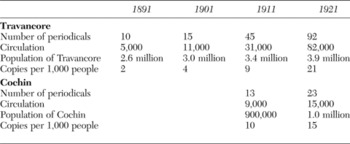
These publications were not cheap. In 1871, the English Western Star, then a weekly, cost 12 rupees a year. Malayalam weeklies were cheaper—about 4 rupees a year. But the cost of the Malayalam weekly represented 2 percent of the annual wage of a print shop manager.Footnote 18 The expense helps to explain the circulations. By the 1890s, when print as a scarce medium was taking hold in Kerala, Travancore had ten recognized periodicals (four monthlies and six weeklies or near-weeklies) with a total circulation of just over 5,000 copies for each print run (TAR 1896–97, 196). By 1903, this had grown to fifteen publications with a total circulation of more than 11,000 copies. Malayala Manorama, which came out twice a week, cost 6 rupees a year and sold 1,300 copies (TAR 1902–3, 58). As table 1 shows, the increasing penetration of newspapers was remarkable between 1911 and 1921, provoked in part by curiosity about the First World War. But even in 1891, a few thousand copies of newspapers wafted around the libraries, schools, tea shops, and reading rooms of Kerala, and authorities imputed to them considerable capacity to reach people and make trouble.
Penetration of newspapers in Travancore and Cochin, 1891–1921.

Sources: For 1911, Census of India, 1911, vol. XXIII, Travancore, part 1, Report, p. 165; for 1921, Census of India, 1921, vol. XXV, Travancore, part 1, Report, p. 84, and vol. XIX, Cochin, part 1, Report, p. 51.
The Vernacular (or Native) Newspaper Reports, which originated in the late 1860s, indicate British concern about print as it moved from being a rare to a scarce medium. Print had power—the power to arouse, inflame, and misinform (as well as to inform, educate, and convert). The Vernacular Newspaper Reports required government translators throughout India to prepare a fortnightly digest of articles in Indian-language newspapers so that India's rulers might “know the native mind”—in part, to nip sedition in the bud. The Vernacular Press Act of 1878 was a further attempt to deal with the inflammatory potential of print, and though the act was short-lived, the Vernacular Newspaper Reports were a staple of British administration until the late 1930s (Jeffrey Reference Jeffrey2003, 185–86).Footnote 19
The Vernacular Newspaper Reports provide a record of an emerging newspaper tradition in Malayalam. By the 1880s, three or four Malayalam newspapers rated the attention of the translators each fortnight. And the founding of Nasrani Deepika in 1887 and Malayala Manorama in 1890 marked the beginning of sustained Malayalam journalism. Both papers still publish in 2009. Malayala Manorama is one of the largest circulating dailies in India and the flagship of one of India's major media families. The two newspapers illustrated essential characteristics of long-lasting newspapers: relentless organization and a sense of economics. Catholic priests provided these qualities to Deepika, which was published by the Romo-Syrian Church. The Syrian Christian family (Jacobites by sect) that published Malayala Manorama were people of commerce who knew the meaning of balanced books. But neither Deepika nor Malayala Manorama was intended as a money maker: Newspapers had ideas to convey—Catholicism in the case of Deepika, the needs of commerce in the case of Manorama.
By the beginning of the twentieth century, Travancore offered an example of print as a scarce medium. Its fifteen Malayalam periodicals and their 11,000 copies came out regularly, published news and opinions, yet were scarce enough to be prized and sought after (TAR 1902–3, 58). The rate of penetration was about 4 newspapers (of all periodicities) for every 1,000 people in the state. (Travancore's population in 1901 was 2.95 million). Partly because of its scarcity, print seemed authoritative. It often carried the word of God or government.
Print in this scarce form shaped Kerala's peculiar sociopolitical environment. By the beginning of the twentieth century, although newspaper circulations were small, they seemed highly significant and troubling to rulers. As early as the 1880s, one youth had to flee Travancore when he was revealed as the author of critical reports about the state in the English-language Madras Standard (Parameswaran Pillai Reference Parameswaran Pillai and Sekhar1964, 179–80). Travancore's dozen or more newspapers were held to excite caste antagonism and to have played a part in the “Nayar-Ezhava riots” of 1905, a landmark in the challenges to high-caste dominance in modern Kerala (Madras Mail, October 14, 1903, 5; October 24, 1903, 6; January 5, 1905, 3; Jeffrey Reference Jeffrey1994, 145–46, 208–10). One writer asserted that “everybody” agreed that the press had caused the riots (Madras Mail, March 25, 1905, 5). Another wrote, “[T]hese interested journals [there were twenty-one, he estimated] are the principal instruments that fan the flame of party-feeling and render it injurious to public welfare and social elevation.” Newspapers were so prevalent and troublesome that he invoked Joseph Pulitzer's call for schools of journalism, like schools of medicine, to improve the quality of journalists. It is indicative of the spread of a news-reading habit that Pulitzer's name was known in Kerala in 1905 (Madras Mail, March 2, 1905, 5).
Authority suspected newspapers. “The Collector [a British official] himself,” the Western Star wrote of British-ruled Malabar District, “exhibits a nervous dislike, if not an actual dread of publicity,” which manifested itself in “an open crusade against the Press” (Western Star, December 23, 1871, 2). Travancore passed a law to regulate the press in 1903 (Madras Mail, December 12, 1903, 5), and in the next fifty years, the press in Malayalam generated three celebrated newspaper suppressions, two by Indian rulers and one by the government of independent India. They illustrate the potency that “the authorities” attributed to the printed word, even though circulations were remarkably small. They also illustrate the creation of a mythology glorifying the press as it struggled to be free.
In September 1910, the Travancore police closed Swadeshabhimani, a Malayalam weekly published in Trivandrum and edited by K. Ramakrishna Pillai (1877–1916), whose modest bust today sits opposite the newspaper's long-gone office in Mahatma Gandhi Road. Ramakrishna Pillai and his family were banished to Madras. One of the newspaper's English-language rivals gloated that “the punishment itself is well deserved and can admit of no doubt.” Swadeshabhimani was “almost wholly filled by violent and malicious abuse of public officers, from the Dewan [the maharaja's chief functionary] downwards” (Western Star, quoted in Madras Mail, September 28, 1910, 5). Swadeshabhimani had accused the dewan of gross immorality and claimed that corruption riddled the Travancore government. But “the most serious thing against the Swadeshabhimani,” wrote the dewan, “has always been the remarkable persistency with which it preached the gospel of government by the people, and the exhortation which it held out to the people of Travancore to unite and demand self-government” (Dewan's Note 1912, 4). The government chose to believe that Ramakrishna Pillai was used by wealthy adversaries of the dewan. He was “a poor man; and though he was the nominal owner of the Press, he must have obtained his funds from the wire pullers who guided his policy” (Dewan's Note 1912, 11). The political economy of newspapers is often opaque.
Ramakrishna Pillai remains a hero of Kerala journalism and part of the legend of a free press in Malayalam. His wife, one of the first women to get a bachelor's degree, edited early magazines for women, and he wrote a Malayalam essay on Karl Marx, published in 1912, often claimed to be the first substantial essay on Marx in an Indian language (Bhaskaran Pillai [Reference Bhaskaran Pillai1956] 1978, 326, 384). The family thus brought together two elements that became cornerstones of the “Kerala model”: the relative autonomy of women and political action. Print contributed to both.
By the 1920s, no government in Kerala ignored newspapers. Touring Travancore in 1925, the dewan noted that because “every schoolmaster in our three thousand and odd schools is the centre of a political group … the demand for Newspapers is great.” Their content led him to fear that “the whole mentality” of the next generation would be “warped.”Footnote 20 In the mid-1930s, Travancore's 150 print shops published ninety periodicals, including seven dailies and more than twenty weeklies (Travancore Directory 1937, 984–1004). One of these dailies was the object of Travancore's second great newspaper closure.
The Travancore government closed Malayala Manorama, by then a daily published from Kottayam, in September 1938 because “it has been the policy of the paper to incite people to disobedience of the law” (Koshy Reference Koshy1976, 632, quoting File no. 302, 1938). The paper did not reopen until after independence. The suppression resulted from the newspaper's support for a civil disobedience movement against the government by the Travancore State Congress, imitating the techniques of the Congress organization in British India. The attempt to destroy the newspaper, and the family that owned it, underlined the widespread influence that authorities attributed to print.Footnote 21
The third suppression was that of Deshabhimani, the newspaper of the Communist Party, published from Kozhikode in the British-ruled district of Malabar. Founded in September 1942 in the midst of the Congress-led Quit India movement against the British and with the Communist Party recently legalized, Deshabhimani opposed Quit India and supported the “antifascist” war being waged by Britain and the Soviet Union against Nazi Germany. Nevertheless, Deshabhimani quickly troubled British and princely authorities. Within a month, the district magistrate of Malabar was keen to get the paper to post a bond, which it would forfeit if it went too far in attacking the British or the maharajas of Cochin or Travancore.Footnote 22 In early 1943, British authorities believed Deshabhimani had a print run of 4,500 copies and was circulating among Malayalam-speaking soldiers in the Indian Army, as well as being widely read in Kerala.Footnote 23 The government took a good-behavior bond of 1,000 rupees from the paper in April 1943, but the Communists replied with a request to turn the weekly into a daily, which was denied. The district magistrate believed that outrageous stories drove up circulation but that the 1,000-rupee deposit had led to a calmer line and a fall in circulation.Footnote 24 When the war ended, Deshabhimani got permission to become a daily, but the district magistrate, now an Indian, wrote that the political situation in Malabar, where the Communists were strong, “has considerably deteriorated due to the open declaration of faith in violence preached by the paper.”Footnote 25
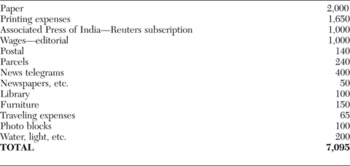
In a fund-raising appeal for 50,000 rupees in August 1946, the Communists disclosed some of the economics of newspapers to their readers. In July, it had costs just over 7,000 rupees to bring out the paper.
The paper claimed it was earning 5,650 rupees from sales and 350 rupees from advertising (Deshabhimani, August 9, 1946).Footnote 26 At the same time, the Madras government, now with an Indian premier, T. Prakasam, declared the original bond forfeited and demanded a new bond of 4,000 rupees. Deshabhimani protested but paid at once.Footnote 27 The ability to raise funds underlined the reach and potency of print in Kerala. The district magistrate wrote, “[Deshabhimani] has a very large circulation and actually reaches a much larger number of people than its circulation would indicate. My information is that it is read out to the public in many village reading rooms and even read out by communist teachers, who are numerous, to children in the schools. It is the most powerful single weapon which the communists possess.”Footnote 28
The contest of deposits and fund-raising went on throughout 1947 and 1948. The deposit of 4,000 rupees was forfeited after further inflammatory writing, and in July 1947, a bond of 10,000 rupees was demanded. It, too, was paid at once. “The Communist Party can collect any security amount without difficulty,” the district magistrate wrote. “When Rs 4,000 was demanded in December last, the amount collected was about Rs 10,000 and so the net result was a gain to the Communist Party funds.” Circulation was now estimated between 7,000 and 8,000 copies.Footnote 29 An evening of selling shares in the newspaper in Cannanore (Kannur) brought in 12 contributions of 100 rupees each and 650 at 5 rupees each.Footnote 30
Deshabhimani was banned by the Madras government in April 1948; it remained banned until 1951.Footnote 31 When Kerala's first Communist government came to power in 1957, Deshabhimani installed a rotary press; in 1968, again with a Communist government in power, it opened an edition in Cochin and in the following year started a weekly. In 2006, it was Kerala's third most popular daily, selling about 227,000 copies a day, a distant third behind Malayala Manorama (1.4 million) and Mathrubhumi (1 million) (ABC 2006).
The suppression of the newspapers underlines the power that governments in Kerala believed print exerted in its scarce form. The “scarcity” is clear: Deshabhimani's circulation never exceeded 8,000 copies in the 1940s, though Malabar District had a population of 4 million. But the paper moved widely, and its very scarcity imparted importance to what it said. The capacity to raise funds, which so frustrated the authorities, testified to the paper's, and the Communist Party's, influence.
Mass circulations are not necessary to make the printed word capable of undermining the authority of governments. The authority of ordered type and the sobriety of the printed page legitimize challenges that would be difficult to articulate or take seriously if merely spoken. In its scarce form, partly by its specialness, print acquires its own authority and a certain magic.Footnote 32 Print underpinned the political activism—the “public action” in a “public sphere”—that became a key attribute of the “Kerala model.”
But print in its mass form exudes far less magic or social electricity. Deshabhimani was a more electrifying publication with a circulation of 8,000 than it is today with a circulation of a quarter of a million.
Mass Medium: Print in Kerala since the 1960s
The seemingly exhilarating story of print becomes compromised at this point. Until the 1960s, one can paint a picture of print as a scarce medium creating conditions that enable people to engage in public action to promote equality and well-being. And if a little print is good thing, a lot of print will surely be that much better. But it is not necessarily so. Print as a mass medium takes on characteristics of Habermas's “refeudalized” public sphere, in which “publicity imitates the kind of aura proper to the personal prestige and supernatural authority” of lordly rulers of the past. “The ‘suppliers’ [of information] display a showy pomp before customers ready to follow” (Habermas Reference Habermas1991, 195).
The force of mass market capitalism came late to Kerala's newspapers. Kerala escaped the attention of the big newspaper owners who ran India's major English-language dailies until the early 1970s, when the Indian Express of Ramnath Goenka started publishing from Cochin. Slow communications until the 1980s left room for local Malayalam dailies, and advertising had not yet dwarfed selling price as the principal source of a newspaper's income. Even big dailies, such as Malayala Manorama and Mathrubhumi, could still be run more like a family restaurant than a large corporation.
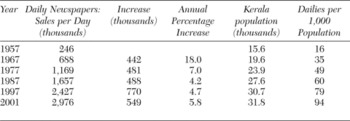
The arrival of true mass media changes the nature and potential of print. This process began in Kerala in the 1960s. In 1957, Kerala's first year as a state of the Indian Union, Malayalam dailies sold 246,000 copies a day, and penetration was in the order of 16 dailies for every 1,000 people. By 1967, they sold 688,000 copies day, a near-trebling of circulation and a doubling of penetration over the decade (see table 3). By 2001, they sold nearly 3 million copies a day, but the rate of annual increase was never greater than the rate of 18 percent a year in the 1957–67 period.
Expenses of Deshabhimani for July 1946 (in rupees).

Source: Deshabhimani 9 August 1946, p.2.
Malayalam daily newspapers, circulation trends since the formation of Kerala.

Source: Press in India and Statistical Outline of India.
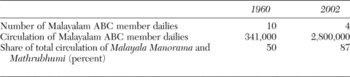
Malayalam dailies, members of the Audit Bureau of Circulations, 1960 and 2004.

Source: Audit Bureau of Circulations.
Mass circulation changes the economy of printing. A slim newspaper selling a few thousand copies—but with those copies widely read (recall Deshabhimani)—can often make ends meet through a combination of careful economy, a few advertisements, self-exploitation by dedicated producers (often men and women with a cause), selling price, and occasional donations from patrons and sponsors. Mass circulation publications cannot do this. They require bigger, faster presses and a larger staff, who have to be paid regularly and may have no ideological commitment to the publication. They require far larger quantities of an internationally price-sensitive commodity—newsprint. And they require distribution—agents and hawkers distribute the publication for reward, not satisfaction. The beginning of the shift in Kerala may be pinpointed to 1962, when Mathrubhumi, based in Kozhikode, opened a second publication center in Cochin. Malayala Manorama countered with a Cochin edition in 1966, and a serious circulation contest began that is still going on in 2009 (Jeffrey Reference Jeffrey1997, 18–21).
What triggered the transformation of print into a mass medium in Kerala? It was not rampant economic development. For the first fifty years of Indian independence, the average annual income in Kerala was lower than the all-India figure. Nor was it the spread of cheap, efficient technology. From the 1950s, controls on the economy made it particularly difficult to import printing equipment, and Indian-manufactured presses and typesetters were old-fashioned and few (Jeffrey Reference Jeffrey2003, 37–38). Rather, I would argue that it was mass politics that began to turn print into a mass medium. Politics came first; mass circulations followed. By the 1950s, Kerala was the most politically mobilized (and literate) region of India, a result of social and political movements extending back to the 1920s. The Kerala state elections of 1957 and 1960 produced the highest voter turnouts in Indian history to that time and seldom surpassed since—78 percent in 1957 and close to 85 percent in 1960. The turnout for the national elections in India in 1957 was 48 percent (Butler, Lahiri, and Roy Reference Butler, Lahiri and Roy1989, 156). And the so-called vimochana samaram (liberation struggle) against the elected Communist government in 1959 was the largest episode of widespread political excitement that independent India had seen. Mathrubhumi opened its second printing center in 1962. Between 1957 and 1967, daily newspaper circulations rose by 18 percent a year, and penetration by 1967 reached 35 dailies for every 1,000 people (see table 3). The Indian rate was about 14 for every 1,000 people (Jeffrey Reference Jeffrey2003, 47–50).
Mass circulations and the dependence on advertising that usually drives mass circulation have affected the survival of newspapers in Kerala. In 1960, ten Malayalam daily newspapers were members of the Audit Bureau of Circulations (ABC) in Mumbai, the organization that scrutinizes the circulation figures of its members so that they can woo advertisers and set advertising rates. The total circulation of the ten member dailies was 341,000 copies a day (ABC 1961).Footnote 33 In 2002, only four Malayalam dailies were ABC members. Those four had a total circulation of 2,800,000 copies, of which 87 percent was represented by Malayala Manorama and Mathrubhumi. In 1960, the share (169,000) of the latter pair was 50 percent.
Any lament for this decline of diversity needs to be carefully thought out. There are seven times more ABC-member newspapers circulating in Kerala today than in 1960, and, more important of course, penetration of ABC dailies is nearly four times greater—from 20 dailies per 1,000 people in 1960 to more than 90 per 1,000 in the first decade of the twenty-first century.Footnote 34 In 2004, Malayala Manorama and Mathrubhumi both published from nine centers in Kerala. These newspapers knew the importance of covering localities and getting close to their readers' lives. Yet few would dispute the contention that the two big dailies were remarkably similar in the way they presented their news and conducted their business. In the slickness of their presentation, and the similarity of the way in which they went about gathering and judging news, they eliminated the idiosyncrasies that were part of the old multinewspaper environment.Footnote 35 And though the large mass media organizations are powerful at one level, they are vulnerable at another: They need the assistance of the state to ply their trade. They need security for their expensive production centers and distribution systems; they need public utilities; and they need advertising, and lots of it. In 2004, Kerala's dailies were capable of alerting and alarming governments, but they were not disposed to trouble governments in the way that Deshabhimani and Malayala Manorama had in pre-independence times. To survive and prosper, mass circulation newspapers must abide by the rules of the system.
Considering the Concepts
Though they attribute great importance to printing and newspapers, scholars tend to overlook subtleties in the development of print habits. In doing so, they may blunt their analysis or draw conclusions that do not hold up to closer inspection. So far, I have used India's most print-hungry region to illustrate the nuances—I have chosen to think of them as “modes” or “stages”—in the development of print and newspapers. I am suggesting that the different modes are capable of doing different things to the societies in which they prevail. Let me try to apply this analysis to the concepts of print-capitalism and public sphere.
Print-Capitalism and Nationalism
In Imagined Communities, Anderson suggests that there is a causal connection between “print-capitalism” and nationalism. The suggestion is worth considering—but its value is severely limited. To be sure, Anderson does not make a specific claim, and he is vague about what the connection between “print-capitalism” and nationalism may be. “Print-language,” we are invited to infer, cannot happen until print-capitalism has come on the scene.
Christopher A. Reed in scrutinizing these problems in Gutenberg in Shanghai, distinguishes between “print culture,” “print commerce,” and “print capitalism” (no hyphen for Reed; 2003, 4–8) and concludes that “print capitalism” as used in Imagined Communities is “historically so imprecise that it could easily apply to the entire long history of late imperial Chinese book production, dating back to at least the Song [960–1279 CE].” Following Marx, Reed suggests that capitalism arrives when print ceases to be “a handicraft” and becomes “a form of ‘industry carried on by machinery’” (Reed Reference Reed2003, 9; the phrase quoted is from Marx).
This distinction, I think, has meaning. Using my terms, one would argue that industrial capitalism comes to print when print becomes a mass medium. Prior to that, in its scarce form, print remains a handicraft, capable of being propagated by scores of writer-handicraft-publisher-technicians.Footnote 36 In its capitalist, mass form, print demands very substantial investment to buy machinery and ensure distribution, as we have seen. Such capital can be raised by family-controlled businesses, but increasingly in the West in the second half of the twentieth century, such investment has come from the stock market—turning family companies into public companies with shares traded daily on stock exchanges (Bagdikian Reference Bagdikian2004, 183–201).
Little of this fits Kerala and the Malayalam language. Print came to Kerala in the nineteenth century as a handicraft and remained so until well into the twentieth. Substantial investment of the kind we could comfortably call “capitalist” arrived only after independence.
Even if one accepts that “capitalism” should be deemed to have spread print in Kerala from the nineteenth century, this process did not lead to an intense nationalist movement based on Malayalam. Speakers of Malayalam already knew about themselves as people distinct from others. They did not need print-language to acquire such a sense. For example, marriages and social relations were conducted throughout the Malayalam-speaking country long before the printing press arrived (Warden Reference Warden1916, 11, reporting adoptions from Travancore to Malabar; Malabar Marriage Commission 1891, appendix III, 11, 14–15, for marriage relationships). With such a base, one might expect the arrival of the printing press to have generated a powerful Kerala nationalism.
But in the twentieth century, the growth of capitalism and print did not lead the people of Kerala to become intense Kerala nationalists, even though they had maharajas as potential figureheads for a Kerala nation and existing state entities (princely states) on which to build a “nation-state.” When an “independent Travancore” was attempted in 1947 by the princely authorities, it was met with derision and quickly collapsed. People's national sentiments extended to an Indian nation.
True, the three units of Travancore, Cochin, and Malabar were united into Kerala State as part of the linguistic reorganization of India in 1956. But this result was by no means universally welcomed. Some Kerala leaders, stalwarts of the pre-1947 struggles against the British and the princes, strongly opposed a united Kerala.Footnote 37 Indeed, when the States Reorganization Committee toured the Malayalam areas in 1954, it was greeted by rival petitioners, some advocating the creation of a united Kerala, others opposing it. Even advocates were lukewarm. “If,” one supporting memorandum ran, “there had been no agitation or demonstration for a Kerala State, unlike in several other parts of India, it was not due to lack of enthusiasm for a State, but only due to the sober and constitutional way the people of this area ever approached this question” (Travancore-Cochin Pradesh Congress Committee 1954). This was a gentle gloss to put on perhaps the most politically tempestuous corner of India, tossed by conflicts between Communists and the Congress Party and the scene of two bitter little insurgencies between 1946 and 1952. If print-capitalism led to nationalism in any universal way, one might expect strong demands for a Malayalam-speaking political entity.
Anderson anticipates such a possibility when he writes, “Print-language is what invents nationalism, not a particular language per se” (1983, 122). The Kerala elites became Indian nationalists (and often Communists, too). It is here that the role of print (but not necessarily capitalism) in modern nationalism is undeniable (though the statement is not particularly acute in what it explains about the past). If “print-language” invents nationalism, it does not, as Anderson writes, necessarily invent a nationalism to match the language. In the case of Kerala, if print-language invented anything, it invented Indian nationalism. Mathrubhumi still displays across its masthead in English, “Mathrubhumi: The National Daily in Malayalam.” Malayalam newspapers performed a role that Indian-language newspapers as a whole have performed for years: they provided a hinge linking various regions with the larger structures and ideas that we call “India.” But the Kerala (and Indian) example suggests that print does not need to be hyphenated to capitalism to foster “nationalism.” And if one is simply saying that wherever printing takes hold, nationalism is likely to pop up, one is not offering a particularly sharp instrument for dissecting the past.
The example of India's most print-oriented, literate region suggests that the print-capitalism concept has little predictive or explanatory value. Print and capitalism may well be ingredients in a mixture that provokes people to conceptualize a “nation” and demand a sovereign state to encompass such a nation. But in such an equation, the links between the potency of print and the arrival of capitalism are tenuous, and in Kerala, at least, provocative ideas, spread by print, had greater power in the scarce mode of print—before the arrival of genuine capitalism. Capitalism—if we mean an industrial process that searches for mass markets—and print appear to produce a combination that pacifies rather than excites.
Public Sphere
Habermas displays a keen interest in newspapers and how they originate, work, and change (1991, 181–96). Perhaps for that reason, his notions of a “public sphere”—how it emerged, changed, and contorted and the role of print and press in the making of a public sphere—often fit with the experience of Kerala. “The bourgeois public sphere,” according to Habermas, was “the sphere of private people come together as a public” to debate “the general rules governing relations … of commodity exchange and social labour” (27). Such a place or space as the public sphere cannot happen without “critical publicity,” which is “the principle of the public sphere” (140). The public sphere becomes a notable feature of some European countries beginning in the eighteenth century. Habermas approvingly quotes Kluxen on the “public opinion” that took shape in this eighteenth-century public sphere: “[T]his public opinion was directed by another factor: by the establishment of an independent journalism that knew how to assert itself against the government and that made critical commentary and public opposition against the government part of the normal state of affairs” (60). In short, the “public sphere” cannot happen without print and regular publications.
In Kerala, the social turbulence of the twentieth century happened in a “public sphere,” which was made possible partly because of the spread of print, publishing, and newspapers. Habermas offers a further element that dovetails with the experience of Kerala. He sees three stages in the evolution of printing, stages similar to the notion of rare, scarce, and mass modes. In the first stage, printing was a handicraft practiced by artisans to make money, as if they were stitching boots or hammering horseshoes. This corresponds to my “rare” mode, when newspapers have not really begun. The second stage is that of “literary journalism,” wherein “‘the newspaper's publisher … changed from being a merchant of news to being a dealer in public opinion’” and “the commercial purpose … receded almost entirely into the background.” Such publications often lost money—a characteristic of the scarce mode of print in Kerala (Habermas Reference Habermas1991, 181). In Habermas's third stage, the “the profitability of the enterprise got the upper hand over its publicist intention” (181, 186). We move into the mass media age, when “the publisher appoints editors in the expectation that they will do as they are told in the private interest of a profit-oriented enterprise.” For Habermas, “the world fashioned by the mass media is a public sphere in appearance only” (171). What I term the loss of the magic of print in its mass media mode, Habermas refers to in terms of “a culture that no longer trusts the power of the printed word” (163).
Habermas's view of the role of newspapers in the evolution of a “public sphere” fits with the Kerala experience. In what I call the scarce mode, which roughly corresponds to Habermas's eighteenth-century public sphere, print enabled the formulation and discussion of social and political issues and the mobilization of significant numbers of people around such issues. The diversity of newspaper publication in this mode—it was relatively cheap and technically feasible to put out a newspaper—promoted variety. The relative scarcity of print gave it interest and authority. Thus arose the fears among governments that led them to close the three Malayalam newspapers in 1910, 1938, and 1948. Similarly, Habermas's argument about mass media resonates in Kerala. The dominance of the two great capitalist newspapers, Malayala Manorama and Mathrubhumi, has coincided with the decline of competitors and an increasing dependence of the survivors on their relationships with the state and with large advertisers. The last great political mobilizations in Kerala were the “liberation struggle” of 1959, in which Christian-owned newspapers played an especially important role, and the land reform protests of 1969–70, propelled by Communist publications.
Conclusion: Print, Newspapers, and Their Effect on Societies
My purpose in laying these ideas about printing and newspapers, which are such important components of the theorizing of Anderson and Habermas, against the experience of India's most print-exposed region is to make a point about the study of print and newspapers. Though they are accorded prominence in theories of social movements and historical change, little attention has been paid to the important stages in the development and impact of these industries. As we have seen, the newspaper is often treated as if it were the same, and had the same effects, no matter the place or time. Habermas, in my view, is the more sensitive to changes and their potential consequences for societies.
On the other hand, one has to draw a long theoretical bow to make print-capitalism ideas fit Kerala or India. Certainly commerce and printing go together, but as the Kerala story shows—in common with the Habermas argument—there are times in the evolution of print when profit making is less significant than publicizing. Moreover, the easy equation between print-capitalism and nationalism, which is implied (though never explicitly stated) in Imagined Communities, has no purchase in Kerala. In spite of a distinctive language and script, long-standing princely state units of government, and a vibrant print culture, Kerala's people showed (and show today) scant inclination to demand their own nation-state. A sense of an Indian nation was born in Kerala long before capitalism and print got married.
This discussion contributes three suggestions to those who use print and newspapers as raw material for interpreting and understanding change. First, it suggests the need for care and questioning if scholars, in using ideas about print-capitalism or the public sphere, choose to emphasize the role of print and newspapers. The role of print in the making of nationalism needs to be closely explored for individual cases, not invoked sweepingly. On the other hand, Habermas's suggestion of three episodes or stages in the role of print in the creation of a public sphere resonates in Kerala, where the experience of mass media in the past thirty years accords with ideas about “refeudalization.” The proliferation of media, and of audiences that consume them, does not signal increased political activity. It may, indeed, signal its decline.Footnote 38
Arising from the caveats about the use of these social science concepts is a more general admonition: the need for fine-grained analysis of what we are talking about when we refer to the effects of print and the role of newspapers in the modern world. One needs to ask questions about finance, technology, circulations, owners, editors, and advertisers. To generalize about a world of “print,” undifferentiated by time or place, is like wearing boxing gloves to make pastry.
Finally, the discussion in this essay raises a more difficult question: What does it mean for politics if much of India is making a transition from print as a rare medium to a mass media age, thereby missing the experience of a rambunctious “scarce medium” era of print and, with it, something approaching a “public sphere”? Is a valuable tradition of politics, which is part of Kerala's twentieth-century history, now embedded in its political culture, lost? The expansion of satellite television, received by close to one-third of Indian households in 2006, offers the possibility that a majority of Indians will move rapidly from having little exposure to print or other media into an electronic mass media age. There, media bring entertainment, sometimes presented as news, but they seldom generate sustained social energy, argue sociopolitical viewpoints relentlessly, or encourage political action. Will the absence of such practices and traditions malnourish politics in much of India in the future?
Acknowledgments
I thank Dr. Barbara Nelson for her help in preparing this essay and a number of colleagues who commented on drafts and seminar presentations.