1. Introduction
The Palaeo-Tethys is widely accepted as an Early Devonian to Triassic ocean that closed as a result of collision between blocks with Gondwanan affinities and Eurasia (Li, Reference Li1987; Li et al. Reference Li, Cheng, Hu and Hong1995, Reference Li, Zhai, Dong and Huang2006). However, the evolutionary history of the Palaeo-Tethys Ocean remains debated. Recent studies have shown that the Longmu Co–Shuanghu suture zone (LSSZ) in the middle of the Qiangtang terrane is the key location for study of the Palaeo-Tethys (Zhai et al. Reference Zhai, Li, Wang, Chen and Zhang2009, Reference Zhai, Zhang, Jahn, Li, Song and Wang2011b; Zhang et al. Reference Zhang, Dong, Wang, Dan, Zhang, Deng, Xu, Xia, Zeng and Liang2016, Reference Zhang, Dong, Wang, Dan, Zhang, Xu and Huang2017), because low-temperature and high-pressure metamorphic rocks (eclogites and blueschists), ophiolites, ocean-island basalt (OIB)-type basalts and arc magmatism have been documented in the LSSZ (Kapp et al. Reference Kapp, Yin, Manning, Murphy, Harrison, Spurlin, Lin, Deng and Wu2000, Reference Kapp, Yin, Manning, Harrison, Taylor and Ding2003; Li et al. Reference Li, Zhai, Dong and Huang2006, Reference Li, Dong, Zhai, Yu and Huang2008; Zhang et al. Reference Zhang, Cai, Zhang and Zhao2006a,b; Zhai et al. Reference Zhai, Jahn, Zhang, Wang and Su2011a,b; Zhang et al. Reference Zhang, Dong, Li, Deng, Zhang and Xu2014). However, it is uncertain whether the LSSZ is an in situ suture zone. Two competing models have been proposed to explain the formation of the LSSZ: (1) the zone formed from southward low-angle subduction of the Songpan–Ganzi accretionary mélange along the Jinsha suture zone (Kapp et al. Reference Kapp, Yin, Manning, Murphy, Harrison, Spurlin, Lin, Deng and Wu2000; Pullen et al. Reference Pullen, Kapp, Gehrels, Ding and Zhang2011); or (2) it represents the in situ suture of the relic of the main Palaeo-Tethys Ocean (Li, Reference Li1987; Li et al. Reference Li, Cheng, Hu and Hong1995, Reference Li, Dong, Zhai, Yu and Huang2008; Zhai et al. Reference Zhai, Jahn, Zhang, Wang and Su2011a,b, Reference Zhai, Jahn, Wang, Su, Mo, Wang, Tang and Lee2013; Metcalfe, Reference Metcalfe2013). According to the former view, Qiangtang is one complete block; the latter model states that the Qiangtang block is divided by the LSSZ into the northern and southern Qiangtang blocks (NQB and SQB) (Li, Reference Li1987; Li & Zheng, Reference Li and Zheng1993; Zhang et al. Reference Zhang, Zhang, Li, Zhu and Wei2006b; Zhai et al. Reference Zhai, Jahn, Zhang, Wang and Su2011a,b, Reference Zhai, Jahn, Wang, Su, Mo, Wang, Tang and Lee2013; Metcalfe, Reference Metcalfe2013), which have different affinities.
Regional geological mapping (1:50<2>000 scale) has revealed the stratigraphy, lithological distribution and tectonic framework of central Qiangtang (Zhang et al. Reference Zhang, Dong and Li2010; Hu et al. Reference Hu, Li, Xie, Wu, Wang and Su2013; Wu, Reference Wu2013). In the NQB, the Riwanchaka Formation (a series of marine Carboniferous rocks) is exposed in the Chabu area and is rich in fossil corals, brachiopods and ammonites (Xie, Reference Xie1983). The fossil assemblages are similar to the Yangtze-type Guizhouphyllum–Yuanophyllum coral communities. Fan (Reference Fan1985, Reference Fan1988) proposed that the Riwanchaka Formation has a close relationship with South China. Conversely, the Carboniferous–Permian strata (Zhanjin Formation) of the SQB are characterized by glaciomarine deposits with cold-water biotas that show a Gondwanan affinity (Li & Zheng, Reference Li and Zheng1993; Metcalfe, Reference Metcalfe1994; Li et al. Reference Li, Cheng, Hu and Hong1995; Fan et al. Reference Fan, Li, Wang, Xie and Xu2015). These palaeontological differences might have resulted from the existence of an ancient ocean between the NQB and SQB. Further systematic studies of the provenance, palaeontological evidence and depositional settings of the Riwanchaka and Zhanjin formations on either side of the LSSZ are urgently needed.
In this contribution, we report new provenance analyses and palaeontological findings from the Riwanchaka Formation of the NQB, central Tibet. The results reveal that the depositional settings of the NQB and SQB were significantly different, at least during Early Carboniferous time, and provide robust evidence for the existence of the Palaeo-Tethys Ocean in the central Qiangtang block.
2. Geological background
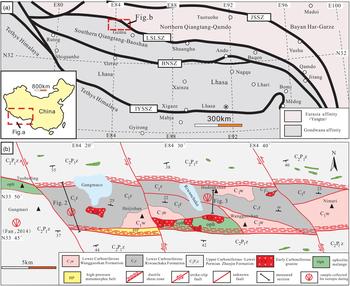
Tibet is composed of several continental blocks. The closure of the Tethys Ocean occurred along four main suture zones on the Tibetan Plateau (from south to north): the Indus–Yarlung Zangbo suture zone, the Bangong–Nujiang suture zone, the Longmu Co–Shuanghu–Lancangjiang suture zone and the Jinshajiang suture zone (Fig. 1a).
(a) Tectonic framework of the Tibetan Plateau and the distribution of glacial-marine diamictite. JSSZ – Jinsha suture zone; LSLSZ – Longmu Co–Shuanghu–Lancangjiang suture zone; BNSZ – Bangong Co–Nujiang suture zone; IYZSZ – Indus–Yarlung Zangbo suture zone. (b) Geological sketch map of the Gangmar Co–Riwanchaka area of central Qiangtang, Tibet.

The Qiangtang block of the northern Tibetan Plateau is located at the junction of Gondwana and Cathaysia. This block is the key to resolving discrepancies regarding the evolution of northern Gondwana, Palaeo-Tethys evolution, the coupling relationship between basin and range, and the uplift of the Tibetan Plateau and subsequent environmental effects. The Qiangtang block is divided into the southern Qiangtang–Baoshan block and the northern Qiangtang–Changdu plate, separated by the Longmu Co–Shuanghu–Lancangjiang suture zone (Fig. 1a). The LSSZ is composed of blueschists, eclogites, ophiolites, OIB-type basalts, metasedimentary rocks and minor chert (Li et al. Reference Li, Cheng, Hu and Hong1995, Reference Li, Zhai, Dong and Huang2006, Reference Li, Dong, Zhai, Yu and Huang2008; Zhai et al. Reference Zhai, Jahn, Zhang, Wang and Su2011a,b; Zhang et al. Reference Zhang, Dong, Li, Deng, Zhang and Xu2014), and is regarded as a relic of the main Palaeo-Tethys Ocean (Zhai et al. Reference Zhai, Jahn, Zhang, Wang and Su2011a,b). The Ordovician–Permian sedimentary rocks in the southern Qiangtang area are dominated by stable platform type deposits. These rocks are typical of those deposited on the northern margin of Gondwana, with increasing amounts of glacial outwash in the Carboniferous–Permian deposits (Dickins, Reference Dickins1996; Winn & Steinmetz, Reference Winn and Steinmetz1998; Holz, Reference Holz1999; Wopfner, Reference Wopfner1999; Jin, Reference Jin2002; Eyles et al. Reference Eyles, Mory and Eyles2003; Meert, Reference Meert2003; Maejima et al. Reference Maejima, Das, Pandya and Hayashi2004; Trosdtorf et al. Reference Trosdtorf, Rocha-Campos, Santos and Tomio2005; Dasgupta, Reference Dasgupta2006; Hota et al. Reference Hota, Maejima and Mishra2006; Fielding et al. Reference Fielding, Frank and Isbell2008; Veevers & Saeed, Reference Veevers and Saeed2009; Gonzalez & Saravia, Reference Gonzalez and Saravia2010; Holz et al. Reference Holz, França, Souza, Iannuzzi and Rohn2010; Fan et al. Reference Fan, Li, Wang, Xie and Wu2014). In the northern Qiangtang area, there are mainly shallow-marine carbonate rocks of Devonian to Permian age. These rocks are fossil-rich and continuous, and have the characteristics of stable continental margin sedimentary deposits (Li, Reference Li1987; Li et al. Reference Li2008). In addition, collisional granites have been linked to the Triassic closure of the Palaeo-Tethys (Hu et al. Reference Hu, Li, Yang, Zhang and Yu2010). An angular unconformity between the Upper Triassic Wanghuling Formation and an ophiolitic mélange in the Guoganjianian Mountain area indicates that Gondwana and Eurasia were amalgamated at c. 214 Ma (Li et al. Reference Li, Zhai, Chen, Dong and Yu2007).
The Qiangtang–Riwanchaka area is located in the Chabu area, 240 km north of Gaize county town. Tectonically, the area lies in the middle-western part of the Longmu Co–Shuanghu–Lancangjiang suture zone, which has an extremely complex geological structure. Fault structures, mainly striking E–W, are well developed in this region, which also contains a series of large ductile shear zones. The rocks are of low metamorphic grade. However, the Lower Carboniferous Riwanchaka Formation is exposed 10 km west of Heijishan, near Tuobeiling. These rocks are largely unaltered. A high-pressure metamorphic belt also crops out, which is part of the central Qiangtang high-pressure metamorphic belt and includes eclogite, marble and garnet–muscovite schist. This belt records the process of subduction–collision and exhumation of the Yangtze Plate and Gondwana (Zhai et al. Reference Zhai, Li, Wang, Chen and Zhang2009, Reference Zhai, Jahn, Zhang, Wang and Su2011a; Wu, Reference Wu2013) (Fig. 1b).
3. Lithology and palaeontology of the Riwanchaka Formation
3.a. Lithology
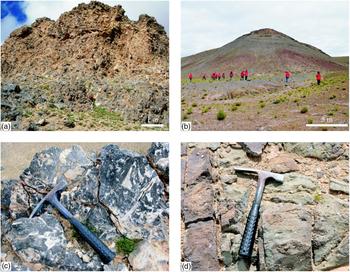
The Riwanchaka Formation is rich in corals and brachiopods (Figs 2–4). The base of the formation consists of volcano-sedimentary rocks; the top is not exposed (Fig. 3) (Liu & Yao, Reference Liu and Yao1988). These rocks exhibit weak metamorphism, weak deformation and some folding.
Measured geological section of the lower Carboniferous Riwanchaka Formation in east Gangmar Co, Chabu Village, Gaize County, Tibet, with the location of sample P611T indicated. Q - Quaternary; C1r - Lower Carboniferous Riwanchaka Formation.

Cross-section through the Riwanchaka Formation at the mountain east of Riwanchaka lake, Chabu area, north Gaize county, Tibetan Plateau (after Liu & Yao, Reference Liu and Yao1988). C1r - Lower Carboniferous Riwanchaka Formation; C1w - Lower Carboniferous Wangguoshan Formation.

(a, b) Petrographic characteristics of the Riwanchaka Formation observed in the field. (c) Limestone. (d) Conglomerate. Hammer for scale is 33 cm long.

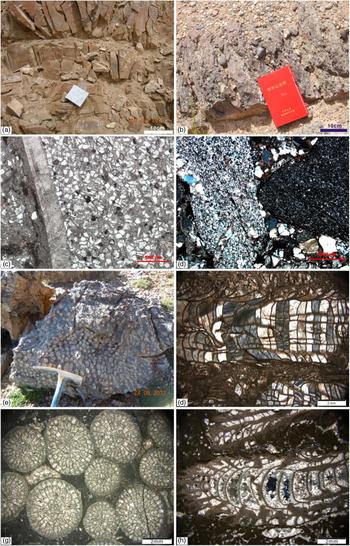
The fine feldspar-quartz sandstone consists mainly of rock fragments, impurities and cement (Fig. 5c). The main clastic components are quartz (~70 %), feldspar (20 %) and rock fragments (10 %). These components are well sorted and have a grain size range of 0.125–0.250 mm.
Petrographic characteristics of the Riwanchaka Formation observed in the field and under the microscope. (a) Sandstone; (b) conglomerate; (c) sandstone under the microscope; (d) conglomerate under the microscope; (e) colonial coral; (f) coral fossil (Antheria sp.) (thick section); (g) coral fossil (Siphonodendron sp.) (thick section); (h) coral fossil (Diphyphyllum sp.) (thick section).

The fine conglomerate is composed mainly of gravel-size clasts and interstitial material (Fig. 5d). The clasts are mainly quartz sandstone, lithic feldspar sandstone and andesite, and they make up ~40 % of the rock. The clasts are 2–10 mm in diameter, poorly sorted and secondarily angular–subangular. The main interstitial materials are rock debris and crystal debris. The crystal debris is composed mainly of quartz, feldspar and calcite, with grains mostly around 0.2 mm in size.
The clastic rocks of the Riwanchaka Formation are mainly composed of calcitic sandstones and conglomerates, which contain many gravel clasts of igneous origin. Carbonate rocks include micrites, bioclastic limestones and biohermal limestones (Fig. 5a–d). Both solitary and colonial corals are well preserved in the bioclastic rocks, with the fine structure visible under the microscope (Fig. 5f–h). The age of these corals was identified as Early Carboniferous by the Nanjing Institute of Geology and Palaeontology, Chinese Academy of Sciences.
3.b. Palaeontology
The Riwanchaka Formation contains abundant fossils such as fusulinids, corals and brachiopods. The corals Kueichouphyllum cf. sinense, K. heishhkuanense, Arachnolasma sinense, A. cylindricum and A. sinense aichiapingense, and the brachiopods Gigantoproductus cf. moderatus, G. cf. giganteus, Crurithyris sp. and Schuchertella sp. were collected from the Riwanchaka profile by the Tibet Regional Geological Survey Party (Fan, Reference Fan1988). During regional investigations at the 1:250<2>000 scale in Dinggu, the Geological Survey Institute of Guizhou Province collected the fusulinid Eostaffella sp.; corals Arachnolasma sp., A. sinense densum Wu, A. aff. sinense, A. cylindricum multiseptatum, Bothrophyllum sp., Diphyphyllum sp., D. platiforme, D. hochangpingense Yu, D. cf. hochangpingense, Dibunophyllum sp., Heterocaninia sp., Kueichouphyllum sinense Yu, Kueichouphyllum sp., Lithostrotionella cf. spiniformis Yu, Lophophyllidium sp., Lophophyllum ashfellensis var. regulare Yu, Lithostrotion sp., L. decipiens, L. cf. mccoyanum, L. cf. portlocki, Lonsdaleia ossipovae, L. cf. ossipovae, Neomultithecopora sp., Opiphyllum sp., Palaeosmilia sp., P. cf. murchisoni, P. cf. fraterna, Thysanothylloides sp., T. cf. irregulare, Yuanophyllum sp., Y. kansuense and Y. cf. kansuense; the brachiopods Athyris sp., Balakhonia cf. yunnanensis, Chonetes sp., Datangia cf. ovatiformis, Echinoconchus sp., E. fasciatus, E. cf. subelegans, E. cf. fasciatus, Eomarginifera sp., Gigantoproductus sp., Linoproductus sp., L. cf. tenuistriatus, Martinia sp., Marginatia cf. fernglenensis, Palaeochoristites sp., P. cf. cinctus and Productus sp.; and the foraminifer Palaeotextularia sp.
The coral fossils collected in the Gangmar Co–Riwanchaka area during this study are Diphyphyllum sp., Palaeosmilia sp., Remisia sp., Yuanophyllum sp., Yabeella sp., Bothrophyllum sp., Crataniophyllum sp., Antheria sp., Neokoninckophyllum sp., Dorlodotia sp., Heterocaninia sp. and Siphonodendron sp.
4. Materials and methods
Terrigenous clastic rocks are widely distributed in the Riwanchaka Formation. In this study, sample P611T was obtained from calcareous siltstone in SW Gangmar Co (N33° 47′ 28″, E84° 16′ 38″) (Figs 1b, 2, 5a). Sample R12T17 was collected from the East Mountain of Riwanchaka lake (N33° 47′ 28″, E84° 16′ 38″) (Figs 1b, 5c). The samples are fresh and contain no mineralization, alteration or fossils. The sampled beds are conformably overlain by limestone beds with abundant fossils.
Zircon grains were separated at the Special Laboratory of the Geological Team of Hebei Province, China. The grains were washed and fragmented to millimetre size. After elutriation and magnetic and electromagnetic separation they were mounted in epoxy resin and polished. Cathodoluminescence (CL) images were obtained using a Quatan 200F scanning electron microscope at the Institute of Physics, Peking University, Beijing, China.
The zircons were analysed using an Agilent 7500a quadrupole (Q) inductively coupled plasma mass spectrometer (ICP-MS) and a 193-nm laser ablation system at the Institute of Geology and Geophysics, Chinese Academy of Sciences. The method of Yuan et al. (Reference Yuan, Gao, Liu, Li, Günther and Wu2004) was used to determine the U–Pb ages. Mass fractionation correction and results were calculated using GLITTER 4.0 (Jackson et al. Reference Jackson, Faul, Fitz Gerald and Tan2004). Corrections to mass fractionation were performed using Harvard zircon 91500 (Wiedenbeck et al. Reference Wiedenbeck, Alle, Corfu, Griffin, Meier, Oberli, Quadt, Roddick and Spiegel1995) as the external standard, and corrections to common Pb followed Andersen (Reference Andersen2002). Weighted mean ages and concordia plots were processed using ISOPLOT 3.0 (Ludwig, Reference Ludwig2003).
5. Analytical results
Some of the detrital zircons from both samples are oval and rounded, showing that these specimens have undergone long-distance transport. Most of the zircons occur as complete crystals, suggesting that a great deal of proximal material was accreted (Figs 6, 7). The crystals also show oscillatory zoning, indicating a magmatic origin (Hoskin & Schaltegger, Reference Hoskin and Schaltegger2003).
Representative cathodoluminescence images of samples P611T, Riwanchaka Formation.

Representative cathodoluminescence images of samples R12T17, Riwanchaka Formation.

A total of 120 zircons from sample P611T and 100 zircons from sample R12T17 were analysed by LA-ICP-MS to obtain U–Pb ages. Measurements for which the age concordance was less than 90 % were excluded, leaving 213 measurements (online Supplementary Material Tables S1 and S2). Most of the Th/U ratios of the zircon crystals are greater than 0.4, suggesting that these are magmatic zircons. Some zircons have a Th/U ratio of less than 0.1, indicating a metamorphic source.
The ages of zircons from sample P611T were separated into three time intervals (Fig. 8d; online Supplementary Material Table S1): 325–400 Ma with a peak at 362 Ma (50 % of the total measurements), 400–500 Ma with a peak at 454 Ma (11.21 % of measurements) and >500 Ma with a scattered distribution (38.79 % of measurements).
(a) U–Pb concordia diagrams and (b) age histograms of zircons from conglomerate (R12T17) in the Riwanchaka Formation, and (c) U–Pb concordia diagrams and (d) age histograms of zircons from sandstone (P611T) in the Riwanchaka Formation.

The ages of zircons from sample R12T17 could be separated into three intervals (Fig. 8b; online Supplementary Material Table S2): 325–400 Ma with a peak at 360 Ma (64.95 % of measurements), 400–500 Ma with a peak at 437 Ma (6.18 % of measurements) and >500 Ma with a scattered distribution (28.87 % of measurements).
6. Discussion
6.a. Provenance of the Riwanchaka Formation
During late Palaeozoic to Triassic times, each side of the Longmu Co–Shuanghu–Lancangjiang plate suture was marked by differences in sedimentary deposits, biological evolution and geographical flora, magmatic activity, metamorphism and stages of tectonic movement. These differences arose because one side was part of Gondwana and the other was part of Eurasia. The Ordovician marine sedimentary sequence in the southern part of the Tibetan Plateau is a stable sedimentary formation that developed on the northern margin of Gondwana. The main ways of recognizing a Gondwanan affinity include similarities in basement rocks, the Palaeozoic sedimentary sequence and the palaeobiogeographical affinities of the faunas (Guo et al. Reference Guo, Liang, Zhang and Zhao1991). In the Yangtze Plate, structures of the Late Caledonian Orogeny are found in strata of the Jinning period, which extensively overlie the Nanhua deposits. The distinctive structures and evolutionary courses of the two continental plates are the main basis for plate unit division (Li, Reference Li1987, Reference Li2008).
Gehrels et al. (Reference Gehrels, Kapp, DeCelles, Pullen, Blakey, Weislogel, Ding, Guynn, Martin, McQuarrie and Yin2011) performed a systematic study on the detrital zircon chronology of the Himalayan Orogen. The authors reported U–Pb ages for 1189 north Qiangtang zircons and 1242 south Qiangtang zircons, revealing differences between the northern and southern parts of the Qiangtang block. Based on analyses of detrital zircons of the Wenquan quartzite in the southern Qiangtang block, Dong et al. (Reference Dong, Li, Wan, Wang, Wu, Xie and Liu2011) concluded that the detrital material was derived from Gondwanan metamorphosed basement. The southern Qiangtang block was part of Gondwana. Xia et al. (Reference Xia, Zhong, Tong and Lu2006, Reference Xia, Wang, Zhong, Tong, Lu and Wang2009) identified a large Silurian sedimentary delta system in the Longmu Co area of the Tibetan Plateau, and found an unconformity between the Ordovician–Silurian and Upper Devonian strata east of Wuzhishan and at other localities in Longmu Co, demonstrating that the north side of the Longmu Co–Shuanghu–Lancangjiang plate suture zone was affected by late Caledonian movements. They considered that the northern Qiangtang massif was part of the Eurasian system. Hu et al. (Reference Hu, Li, Xie, Wu, Wang and Su2013) and Jiang et al. (Reference Jiang, Li, Xie, Wang, Hu, Wu, Peng and Chen2014) reported a series of Early Carboniferous magmatic arc rocks in the Longmu Co–Shuanghu–Lancangjiang suture zone, and concluded that these rocks were part of the southern margin of Eurasia, not the northern margin of Gondwana.
The Riwanchaka Formation, located at the suture between the Qiangnan–Baoshan and Qiangbei–Changdu blocks, show three age peaks of detrital zircons at 360, 437 and 454 Ma, which are significantly younger than the Pan-African orogenic event (500–600 Ma) recorded in Gondwana-type sediments (Meert, Reference Meert2003; Cawood et al. Reference Cawood, Johnson and Nemchin2007; Torsvik & Cocks, Reference Torsvik and Cocks2013), compared with the detrital zircon dating of typical Gondwana-type sedimentary formations (Fig. 9). However, these ages are consistent with the subduction of the Longmu Co–Shuanghu–Lancangjiang ocean-island arc and the age of the Caledonian Orogeny, indicating that the sedimentary material of the Riwanchaka Formation was derived from the periphery of the Yangtze continent.
Age spectra diagrams of detrital zircons from areas south of the Longmu Co–Shuanghu–Lancangjiang suture zone.

The compiled crystallization ages of detrital zircons from the Lower Carboniferous strata (Riwanchaka Formation) and garnet–staurolite–muscovite (Grt–St–Ms) schist samples from the northern Qiangtang block show similar main peaks (360 Ma) and troughs, although the relative amplitudes of subpeaks vary slightly (Zhang et al. Reference Zhang, Dong, Wang, Dan, Zhang, Xu and Huang2017) (Fig. 9). Detrital zircon spectra are considered to indicate the tectonic setting of the basin in which the zircons were deposited (Cawood et al. Reference Cawood, Hawkesworth and Dhuime2012). In general, the majority of zircon ages of samples from the Lower Carboniferous strata of the northern Qiangtang block (Peng et al. Reference Peng, Li, Xie, Wang, Jiang and Chen2014; Zhang et al. Reference Zhang, Dong, Wang, Dan, Zhang, Xu and Huang2017) are close to the timing of sediment deposition (measured crystallization age (CA) − depositional age (DA) <100 Ma at 30 % of the zircon population; Fig. 10), which is consistent with an active continental margin environment (Fig. 10) (Cawood et al. Reference Cawood, Hawkesworth and Dhuime2012). In contrast, the Carboniferous–Permian samples from the southern Qiangtang block (Gehrels et al. Reference Gehrels, Kapp, DeCelles, Pullen, Blakey, Weislogel, Ding, Guynn, Martin, McQuarrie and Yin2011; Fan et al. Reference Fan, Li, Wang, Xie and Wu2014, Reference Fan, Li, Wang, Xie and Xu2015) contain more and older zircons (CA − DA >150 Ma at 5 % of the zircon population; Fig. 10), which are derived mainly from underlying basement, indicating that these rocks formed in a passive continental margin environment (Cawood et al. Reference Cawood, Hawkesworth and Dhuime2012). In addition, Zhang et al. (Reference Zhang, Dong, Wang, Dan, Zhang, Xu and Huang2017) reported that the protoliths of the Grt–St–Ms schists near the Riwanchaka Formation have a northern Qiangtang affinity and were deposited in an active continental margin setting. These characteristics indicate that the Riwanchaka Formation was deposited in an active continental margin environment.
Discrimination diagrams of detrital zircon age patterns for determining their tectonic settings (modified from Cawood et al. Reference Cawood, Hawkesworth and Dhuime2012). (a) Convergent (red field); (b) collisional (blue field); (c) extensional (yellow field).

6.b. Palaeobiogeographic affinities
The Riwanchaka Formation contains many warm-water fossils. The fossil assemblages are similar to those of the Machala Formation in the Changdu area, the Shangsi Formation in Guizhou Province and the Zongchanggou Formation in Sichuan Province. Fan (Reference Fan1988) found that most of the fossils co-occurring with Thysanothylloides in the Riwanchaka section were Yuanophyllum. This is similar to the former Shangsi Formation in Guizhou Province and the Zongchanggou Formation in Sichuan Province. Jiang et al. (Reference Jiang, Yang and Fan1991) found that the Riwanchaka Formation could be compared with the Shangsi Formation in Guizhou, the Zongchanggou Formation and the Zhangbagou Formation in Sichuan, the Zimenqiao Formation in Hunan, the Luocheng Formation in Guangxi, the Lueyang Formation in Gansu and the Simen Formation in Guangdong, and also with upper Westphalian strata of the former Soviet Union and the United Kingdom. The authors proposed that Carboniferous biotas and sedimentary rocks could be classified into Cathaysia and Gondwana types. The Xainza and Himalaya areas are Cathaysia type, while the Gerze and Qando areas are Gondwana type. Therefore, there was a wide ocean basin in this area during Carboniferous time. Li et al. (Reference Li, Cheng, Hu and Hong1995, Reference Li, Dong, Zhai, Yu and Huang2008) studied the northern and southern sedimentary rocks and biological characteristics in the Longmu Co–Shuanghu–Lancangjiang plate suture zone in detail. They observed that the Carboniferous fossils in the Machala, Qingnidong, Gongjue, Jiaka, Xiaobangda and Haitong strata in the Riwanchaka and Changdu areas were consistently of the typical Yangtze Guizhouphyllum–Yuanophyllum coral fossil assemblage. However, the Zhanjin Formation crops out in wide bands on both sides of the Riwanchaka Formation and contains cold-water organisms and conglomerate (Liang et al. Reference Liang, Nie, Guo, Xu, Zhang and Wang1983; Li, Reference Li1987; Li et al. Reference Li, Cheng, Hu and Hong1995, Reference Li, Dong, Zhai, Yu and Huang2008). The cold-water Eurydesma bivalve fauna is a typical palaeocommunity of Gondwana. Tillites are widely exposed to the south of the Longmu Co–Shuanghu–Lancangjiang suture (Winn & Steinmetz, Reference Winn and Steinmetz1998; Holz, Reference Holz1999; Wopfner, Reference Wopfner1999; Maejima et al. Reference Maejima, Das, Pandya and Hayashi2004; Dasgupta, Reference Dasgupta2006; Veevers, Reference Veevers2007; Holz et al. Reference Holz, França, Souza, Iannuzzi and Rohn2010; Gonzalez & Saravia, Reference Gonzalez and Saravia2010), indicating that the area of Gondwana was affected by the Talchir glacial period (Guo et al. Reference Guo, Liang, Zhang and Zhao1991; Li et al. Reference Li, Cheng, Hu and Hong1995). In summary, we propose that the Riwanchaka Formation in the study area can be regarded as being typical Yangtze-type sedimentary strata similar to the Lower Carboniferous Yangtze-type sedimentary strata of South China, and significantly different from the Gondwana sedimentary strata of the coeval Zhanjin Formation in terms of sedimentological characteristics.
The blueschists, eclogites, OIB-type basalts, ophiolites and metasedimentary rocks near the Riwanchaka Formation are considered relics of the Palaeo-Tethys Ocean, recording the evolution of the Tethys Ocean (Kapp et al. Reference Kapp, Yin, Manning, Murphy, Harrison, Spurlin, Lin, Deng and Wu2000, Reference Kapp, Yin, Manning, Harrison, Taylor and Ding2003; Li et al. Reference Li, Zhai, Dong and Huang2006, Reference Li, Dong, Zhai, Yu and Huang2008; Zhang et al. Reference Zhang, Cai, Zhang and Zhao2006a,b; Zhai et al. Reference Zhai, Jahn, Zhang, Wang and Su2011a,b; Zhang et al. Reference Zhang, Dong, Li, Deng, Zhang and Xu2014, Reference Zhang, Dong, Wang, Dan, Zhang, Xu and Huang2017). On the basis of combined petrological, biostratigraphical and detrital zircon data, the Riwanchaka Formation is inferred to have been deposited in warm water at the southern margin of the Eurasia continent, isolated from Gondwana and facing a wide ocean during Early Carboniferous time (Fig. 11). The present tectonic location of the area might be the result of late-stage tectonic movements.
Ancient geographical position graph of the Lower Carboniferous Riwanchaka Formation.

7. Conclusions
(1) Zircon ages of 360, 437 and 454 Ma for the Riwanchaka Formation reflect the tectonic-magmatic events of the initial arc reduction stage in the Longmu Co–Shuanghu–Lancangjiang ocean and the Caledonian Orogeny, implying that the provenance of the clastic rocks was probably the Yangtze continent.
(2) The contrasting provenance, palaeontological biotas and depositional settings of Carboniferous to Permian strata either side of the LSSZ indicates the existence of an ancient ocean between the northern and southern Qiangtang blocks. Combining the results of the present study with those of previous studies on high-pressure metamorphic rocks, arc magmatism and ophiolites, we confirm the LSSZ to be an in situ suture zone that represents the main suture of the Palaeo-Tethys Ocean.
Author ORCIDs
Hu Peng, 0000-0001-7447-3984
Acknowledgements
We thank Ms Xu Feng for drafting the figures, and Mr Yang Hantao, Mr Wang Ming, Mr Hu Peiyuan, Mr Jiang Qingyuan and Mr Xu Wei for their help in the field. This research was funded by the National Science Foundation of China (Grant Nos 41072166, 41272240, and 41273047) and China Geological Survey project (Grant Nos 1212011221093, 1212011121248, and 12120113036700).
Supplementary material
To view supplementary material for this article, please visit https://doi.org/10.1017/S0016756819000359.