The Koh-i-Noor Diamond, at 105.60 metric carats and measuring 36.00 by 31.90 by 13.04 millimeters, is not the largest diamond in the world. It is not the clearest. It is not the brightest.Footnote 1 It remains, however, one of the most famous pieces of royal material culture in Britain today, as visitors to the Tower of London know. This fame owes less to the stone's physical makeup than to its history as an artifact of conquest within geopolitical power struggles pertaining to the South Asian subcontinent and beyond. Confiscated on behalf of the British crown from the property of the Punjabi maharajah Duleep Singh in 1849, it has been housed with the crown jewels ever since. It was shown as the property of Queen Victoria for the first time in public during the Great Exhibition of 1851.
This article examines the mid-nineteenth-century appropriation and display of the Koh-i-Noor to show how the diamond functioned on a number of levels in British imperial culture, often in contradictory ways. Marcia Pointon and Tillman Nechtman have revealed how diamonds were a fraught commodity in the late eighteenth and early nineteenth centuries. Critiques about the consumption habits of Queen Charlotte (1744–1818) fixated on the amount of diamond jewelry she possessed, effectively disciplining where and when the monarch could wear her jewels.Footnote 2 Additionally, nabobs, or well-to-do gentlemen who made their fortunes in India and returned to the metropole, were known for their diamond wealth, often displayed in the jewelry of their wives. Critiques of these “upstarts” painted diamond consumption and the diamond trade in a highly negative light, associating the consumer with the rapacity of a corrupt brand of plunder imperialism.Footnote 3
When the Koh-i-Noor Diamond entered public discourse in Britain, however, the court and the colonial government used the biography of the stone to cast British conquest in India in a progressive light. The dominance of this narrative was severely challenged once the Koh-i-Noor went on display in 1851: the stone's physique did not conform to exhibition-goers’ aesthetic expectations. Easily one of the biggest attractions at the exhibition, the gemstone was nevertheless found by spectators to be dull and disappointing. The satirical magazine Punch referred to it as the “Mountain of Darkness,” making a play on the English translation of Koh-i-Noor as “Mountain of Light.”Footnote 4 Following the exhibition, the prince consort had the diamond, then about 186 carats, recut.
In the context of the rest of the exhibition, the diamond registered more as an emblem of a frivolous, feminized, and orientalized luxury commodity than as a proper mascot for the “Great Exhibition of the Works of Industry of All Nations.” Controversy ensued: gendered arguments about diamond consumption threatened to denigrate Victoria as the recipient of the gem. Spectators and commentators were more apt to read the diamond as an emblem of old-fashioned plunder imperialism than as a progressive acquisition fit for the figurehead of a modern Britain. The language of mid-nineteenth-century imperialism depicted colonial exploitation as ensuring the future of Britain's industrial progress by furthering the “civilizing mission.” The degree to which the Koh-i-Noor—and Victoria's public, gendered appropriation of it—did not seem to fit in with these midcentury “respectable” values set the stage for the stone's recutting. I argue that the Koh-i-Noor's refashioning was an attempt to reconstitute the stone as a gemological component of Britain's civilizing mission, where the weight of British science and machinery was literally brought to bear on the diamond's structure.
Recent studies of material culture have asked us to appreciate the mutually constitutive condition of things and their contexts as they move through both time and space, shifting from being things to being commodities to being things again, all the while performing different cultural, economic, and ideological work for different audiences. Things can oppress, constrain, and literally weigh a person down; they can also enable the performance of identity, inculcate ideology, and effect a sense of individualism, liberty, and empowerment.Footnote 5 Elaine Freedgood has shown that the process of disassociating the product from its conditions of production and distribution, so integral to Marx's explanation of the commodity fetish, was far from complete in the nineteenth century. Indeed, Victorian consumers—of products, spectacles, and ideas—were in many ways hyperaware of where things came from and the networks of exploitation that were in place to deliver these goods. This knowledge inhered in the meanings of things within imperialism and imperial culture.Footnote 6 Other writings, such as Jennie Batchelor and Cora Kaplan's recent edited volume Women and Material Culture, 1660–1830 (2007) and Erin Mackie's now-classic Market à la Mode (1997), have explored how gendered anxieties about things, the market, and consumption have animated the formation of an empire-laden modernity as women have negotiated their way within it.Footnote 7
Taking my cue from the above literature, I show in the remainder of this article how the Koh-i-Noor's past and transmission to England as an artifact inhered in its meanings at the Great Exhibition alongside knowledges about the production and distribution of diamonds in general. This set the stage for the diamond's problematic refashioning as a symbol of Britain's civilizing mission.
In January 1848, James Andrew Broun-Ramsay, the future Lord Dalhousie, arrived in India to take up his dual post as governor-general of India and governor of Bengal. He had fallen out of favor in the House of Lords, was frustrated with the disintegration of the Conservative Party, and was disillusioned with party politics in general. At thirty-five years of age, he was the youngest governor-general ever appointed, and he was determined to make his mark as a superb administrator in India. Three months after his arrival, Dalhousie prepared to back the East India Company's army in its efforts to quash Sikh rebellions in the northwest; one year later, he had officially annexed the Punjab as British territory in India and put the region under his own administration.Footnote 8 With the seizure of Lahore, the British took control of the maharajah's treasury, a vast collection of precious metal and gemstone artifacts. Within this treasury was housed the Koh-i-Noor, and it was Dalhousie who decided to send the diamond to England to become the property of the queen.Footnote 9
This was a controversial move. While the queen rewarded the governor-general for his actions by conferring on him the title “first Marquis of Dalhousie,” he sustained heavy criticism from the Court of Directors of the East India Company (EIC). The EIC directors claimed that they had been robbed of a valuable diamond and the chance to present the piece to Victoria themselves. According to usual practice, the Lahore treasury in its entirety was considered war booty won by the EIC and therefore the Court of Directors could sell or give away pieces as bonuses to its servants as it saw fit.Footnote 10 Instead of following this, the governor-general took extraordinary measures to ensure that the Koh-i-Noor would be reserved from the general category of booty. He staged a durbar, or ceremonial meeting, with the defeated twelve-year-old maharajah, Duleep Singh, compelling Singh to offer the diamond directly to the queen, as a token of his submission. The Court of Directors was informed about this development two weeks after the fact.Footnote 11
The governor-general had no qualms about pressuring the child-ruler. The maharajah did not consent to the appropriation and cataloging of his entire treasury or to the auctioning of most of its pieces, but no consent was necessary in the logic of the EIC's administration—most likely Singh would have lost the diamond regardless of Dalhousie's intervention. In the governor-general's official memory of the ceremony, he characterized the boy as “endued with an intelligence beyond his years, and [he] cannot be supposed to have been ignorant of the purpose for which the Durbar was now convened.”Footnote 12
While the maharajah's part in the exchange is still open to debate, there can be no doubt that he parlayed a career out of that event and his subsequent (mostly) close relationship with Victoria. In 1852, the teenager was painted by George Beechey wearing a miniature of Victoria around his neck. Two years later, Singh traveled to England, met with the queen, and again sat for a portrait, this time by Franz Winterhalter, who also incorporated the diamond-studded miniature of Victoria into the painting. Singh was the first person outside of the royal family (and, presumably, the crown jewelers) to view the Koh-i-Noor after its recutting. In 1854, during one of the sittings for the Winterhalter portrait, Victoria famously showed him the diamond again, and—much to the delight of the queen and the British press—the deposed sovereign reenacted the handover of the gemstone as a token of his submission.Footnote 13
The young maharajah fairly basked in this role of chivalrous subject, charming the British press and court. Just as the recut Koh-i-Noor was a symbol of Britain's civilizing mission in India, Singh was seen, one could argue, as a living complement of the stone: he was baptized in 1853, received a British education, and lived much of his life in Britain. In various ways he exemplified the elite Indian “go-between” for which Thomas Babington Macaulay had called in his infamous “Minute on Education in India” (1835), a text often viewed as the most overt, albeit secular, articulation of the civilizing mission of British imperialism before 1857. Macaulay urged, “We must at present do our best to form a class who may be interpreters between us and the millions whom we govern; a class of persons, Indian in blood and colour, but English in taste, in opinions, in morals, and in intellect. To that class we may leave it to refine the vernacular dialects of the country, to enrich those dialects with terms of science borrowed from the Western nomenclature, and to render them by degrees fit vehicles for conveying knowledge to the great mass of the population.”Footnote 14 As the “redeemed” upper-level Indian, Singh, in tandem with the recut Koh-i-Noor, performed an important symbolic function on an empire-wide scale: the maharajah and the diamond could be seen as “vehicles” for disseminating the promise of imperial intervention. Unlike the diamond, however, Singh was capable of rebellion. In 1858 and 1882 he renewed his claim on the Koh-i-Noor, arguing that it had been unjustly taken without compensation and criticizing British rule in India. And in the 1880s, he made a sustained effort to reinstate himself as ruler of the Punjab.Footnote 15 Although his politics cannot justly be reduced to his claim to ownership of a diamond, this was what the press generally took away from his protests.Footnote 16 The maharajah's indelible association with the Koh-i-Noor both enabled and constrained his public persona.
Meanwhile, Dalhousie by 1854 was privately outraged that of all people it was Duleep Singh who was famous for giving the stone to Victoria. Characterizing the teenager's grandstanding in London as “arrant humbug,” the bitter governor-general wrote, “Had I been within a thousand miles of him he would not have dared to utter such a piece of trickery.”Footnote 17 From the moment Dalhousie reserved the diamond for the crown, he had imagined himself as the hero of the annexation of the Punjab and the appropriation of the Koh-i-Noor, the agent extraordinaire of the material and symbolic conquest of India. A staunch monarchist who had been deeply alarmed by republican uprisings in continental Europe, the governor-general reveled in the idea of aggrandizing his queen as well as furthering his own career. After entering Lahore in 1849, he wrote to an underling, “It is not every day that an officer of their Government adds four millions of subjects to the British Empire, and places the historical jewel of the Mogul Emperors in the Crown of his own Sovereign. This I have done. Do not think I unduly exult.”Footnote 18
It is thus clear that what compelled Dalhousie to reserve the Koh-i-Noor, in particular, was not its physical makeup but, rather, the stone's biography and the way that British conquest in India could be written into it. The Lahore treasury itself, regardless of the Koh-i-Noor, was impressive: it included, for example, Taimur's Ruby and the Darya-i-Noor Diamond (“Sea of Light”), a piece reputed to be the “largest and most beautiful diamond ever in Bengal” and of “superior brilliancy and purity of color to the Koh-i-Noor.” The quantity of the collection was also reputed to be immense; one estimate placed the monetary value of the treasury at “little short of a million pounds” exclusive of the Koh-i-Noor. Officers recording the inventory ran precious rings along strings “dozen by dozen, like so many buttons.”Footnote 19 There were other, more physically impressive pieces Dalhousie could have chosen to send to Victoria; instead, he chose the piece with the most lore attached to it. His personal diary recites a history of the diamond that subtly mixes Dalhousie's role into the narrative, vindicates the annexation of the Punjab as sanctioned by the government (which was doubtful), and showcases Victoria's acquisition of the stone as its redemptive biographical endpoint or “death”:
The Koh-i-Nur [sic] has ever been the symbol of conquest. The Emperor of Delhi had it in his Peacock Throne. Nadir Shah seized it by right of conquest from the Emperor. Thence it passed into the hands of the King of Kabul. While Shah Shuja-ul-Mulk was king, Ranjit Singh exorted [sic] the diamond by gross violence and cruelty. And now when, as the result of unprovoked war, the British Government has conquered the kingdom of the Punjab, and has resolved to add it to the territories of the British Empire in India, I have a right to compel the Maharaja of Lahore, in token of his submission, to surrender the jewel to the Queen, that it may find its final and fitting resting-place in the crown of Britain. And there it shall shine, and shine, too, with purest ray serene. For there is not one of those who have held it since its original possessor, who can boast so just a title to its possession as the Queen of England can claim after two bloody and unprovoked wars.Footnote 20
The governor-general's memorandum to the EIC's Court of Directors reinforced this characterization of the diamond as a symbol of British conquest: “I am confident you will sanction my having thus set apart the Koh-i-noor as a historical memorial of conquest and that the Hon’ble Court of Directors will cordially approve the act which placed the Gem of the Moghuls [sic] in the Crown of Britain.”Footnote 21
Dalhousie invoked the idea that the artifact was to function as an archival piece, a “memorial of conquest” and of just, “proper” imperial expansion. To his mind, it would be the foremost relic featured in all subsequent representations of Victoria, his national-imperial monarch. The stone's quality was secondary; after all, the gem was arguably inferior to the Darya-i-Noor. The crown, literally and figuratively, would acquire an ornament of supposedly startling material value and cultural-historical significance—not only in India but in Britain as well. The relic linked the two, inextricably, in a static arrangement of dominance and submission.
The underlying motif of stasis, evidenced in Dalhousie's characterization of the “crown of Britain” as the Koh-i-Noor's “final … resting-place,” would also have been encoded for audiences in the artifact's identity as a diamond.Footnote 22 For centuries in Western and Arabic discourse, a diamond's principal quality was its hardness, the word “diamond” coming from the ancient Greek adamas, which may in turn have come from the Arabic al Mas or almas, all meaning “indomitable.”Footnote 23 It was not until the fifteenth century that European discourse began to include positive valuations of the diamond based on reflectivity, color, and beauty. By the mid-nineteenth century, the hardness factor was still a diamond's defining feature in British discourse, but this was channeled through aesthetic expectations about beauty. Victorian readers were still shocked by scientific experiments that proved that diamonds, being crystallized carbon and chemically similar to coal, would burn, contrary to classical descriptions of them.Footnote 24 Dominant ideas about diamonds in general thus reinforced Dalhousie's efforts to equate the permanence of British dominance over India with the possession of the Koh-i-Noor Diamond by Victoria.
Along with the gem, Dalhousie sent back to England a complete history of the diamond and the “vicissitudes through which [it] has passed,” assuring the queen of its inestimable value through an anecdote that would become a newspaper favorite: “Runjeet Sing sent a message to Wufa Begum, the wife of Shah Sooja, from whom he had taken the gem, to ask her its value. She replied, ‘If a strong man were to throw four stones, one north, one south, one east, one west, and a fifth stone up into the air, and if the space between them were to be filled with gold, all would not equal the value of the Koh-i-noor.’”Footnote 25 Here, the stone's pricelessness—or imaginary exorbitant price—was highlighted alongside its value as a historical artifact. At this moment, there was little if any tension between these two characterizations, and there is no evidence to suggest that the royal family ever contemplated rejecting the diamond.Footnote 26
From at least the time of George IV's coronation in 1821, the court had sought a large, preferably famous diamond for the monarch to wear, probably to keep pace with the other leaders of Europe, who themselves had large, famous diamonds available to them for public display. For instance, the restored French monarchy had absorbed Napoleon Bonaparte's collection, which included the Pitt Diamond; Catherine II had acquired the Orlov Diamond for Russian use; and the Portuguese royals had access to several large gems. The British parliament, however, was reluctant to finance such a purchase; and despite being offered large stones on occasion, the British royal family chose not to purchase one with its own money.Footnote 27 The Koh-i-Noor Diamond's inclusion in London's Great Exhibition of 1851 was almost automatic. Still bitter over the loss of the Koh-i-Noor, one EIC director could look back in 1854 and grumble that what was still so startling about Victoria's acquisition of the stone was not that Dalhousie had offered it to the queen but that she had accepted it.Footnote 28 In 1850, however, no such recriminations were voiced. Perhaps the gift of the Koh-i-Noor was exactly the kind of exchange for which crown and government were looking; Prince Albert was especially delighted by the timing of the tribute, personally involved as he was in organizing the Great Exhibition.
Albert began publicizing the Koh-i-Noor alongside the publicity for the upcoming exhibition. He asked Dalhousie for more information to feed to the press, and the governor-general provided it by commissioning researchers not only to comb written records of the diamond but also to go out into the “bazaars of India regarding the traditions existing among the people connected with the great diamond.”Footnote 29 These efforts failed to produce the continuous narrative for which the prince and the governor-general were perhaps hoping. Instead, Theophilus Metcalfe, the lieutenant-governor of the northwest provinces in India, delivered two narratives, which he termed the “Traditional” and the “Historical” versions.
The “Traditional” version was based on oral interviews with the “oldest Jewellers in the City of Delhi, as handed down from family to family” and supposed the diamond to have been mined some five thousand years before, “in the time of Krishna.” Found by a zamindar, or land administrator, it had become the property of the “Rajah Kuns.” From there it had changed hands through war and takeover, eventually ending up in the possession of the “Rajah of Oojain in the Malwa Territory, who had become master of the whole of Hindoostan.” Changing hands again during the “Mohamedan invasion,” the diamond eventually became the property of the early Mughal/Mongol emperor Timur (Timoor or Tamerlane), from whence it had passed down through the Mughals to the early eighteenth-century ruler Mohammed Shah, who had worn it in his turban. The “Traditional” version gained in momentum and detail as the characters became more familiar to nineteenth-century listeners: “On Nadir Shah's visit to Delhi the Emperor and he exchanged Turbans, and thus it became the property of the latter. While others again affirm that Mohummud Shah gave the Diamond to effect his restoration to power as Emperor of Hindoostan. On the murder of Nadir Shah [of Persia] by his own tribe, Ahmed Shah Dooranee became possessed of the Kingdom of Khoorasan and of the Koh-i-noor, and at his death it descended successfully to his [four] sons Timoor, Shah-Zuman, Shah [Mahmud] and Shah Shooja-ool-Moolk and from the latter was forcibly taken by Ranjeet Singh.”Footnote 30 From Ranjit Singh, the diamond passed to his youngest son, Duleep Singh, and then to Victoria.
The “Historical” account, coming second in Metcalfe's report, filled in more details of the Mughal emperors who were celebrities of pre-Raj India—namely, Babur and Humayun—based on passages from a written account, the “History of the Reign of the Great Ukber.” In this version the Mughals, instead of inheriting it from Timur, came into contact with the stone through Humayun's administrative turn in Agra. There, a local jeweler, who oversaw the cutting of the stone, valued it at “half the amount of the sum daily expended in the whole land.” Humayun presented it to his father, Babur, who was emperor at that time, but Babur declined the gift. The same source related another anecdote:
When Hoomayoon Badshah [Humayun] was seriously ill his father Babur Shah consulted some physicians regarding his case—Meer Abool Bukker, a learned man, represented that he had ascertained from former Sages that when the Physicians despaired of the recovery of any patient the most valuable thing in the possession of the invalid should be given in charity and a blessing solicited from the Almighty. The Emperor Babur observed that in his opinion he himself was the most precious, and that he would consecrate himself. The standers by however intimated that by God's mercy the Prince would recover and that the meaning of the sages was that the most valuable article of property should be offered up, and consequently, that the Emperor Babur Shah should offer the Diamond which had been taken in the wars with Sooltan Ibraheem. Babur Shah replied that no treasure on Earth could be put in comparison with his beloved son, and that he would offer himself as a Sacrifice to obtain his recovery. Hoomayoon recovered, and the Jewel remained with the descendants of Timoor until the reign of Mohummud Shah.Footnote 31
That Metcalfe did not further resolve the two narratives into a master narrative is significant. The first depicts a violent past, lusty and turbulent; the second offers a picture of relative refinement, religiosity, and peculiar negotiation. In a way, these ambivalent narratives, both of which were taken up by the press, serve as a microcosm for the ambivalent approaches the British had developed to India's past and present. In Ideologies of the Raj, Thomas Metcalf shows that the British respected India's Mughal past in light of impressive cultural works of splendor (such as the Taj Mahal) but also that they derogated it as irrationally violent, opulent, and haphazard.Footnote 32 Contemporary representations of the diamond were constructed to embody this ambivalent ideology; the discourses about it reveal as much about British attitudes toward the Indian past and their intervention into it as about the material culture itself.
Metcalfe's collection of narratives was augmented by other reports, including the tale of how the stone got its name: upon acquiring it in 1739, the Persian leader Nadir Shah was said to have exclaimed “Koh-i-Noor!” or “Mountain of Light!”Footnote 33 A statement taken from the Lahore elder Bhaie Mahoo Singh, who was ten years of age when he served as an attendant to “Shah Shoojo-ool-Moolk in Cabul,” the possessor of the diamond prior to Ranjit Singh, recounted the negotiations that took place between the shah and Ranjit Singh over the stone. His account is rich in details that include references to the shah's harem, how Ranjit Singh had the gem worked into his turban and then paraded on the back of an elephant through Kabul, the incredible security around the diamond during the march back to India, its new setting in an armlet, and how Singh wore the armlet during all official meetings, including those with British officers. Another informant recounted a narrative similar to Metcalfe's “Historical” narrative: on his deathbed, Ranjit Singh and his retinue tried to decide whether or not to send the diamond to the “temple of Juggurnath, as an offering to Krishna.” The stone was not sent, and Singh died, leaving his dynasty in peril, as the narrative went.Footnote 34
These facets of the diamond's biography, at Dalhousie's promptings, infused British print culture, mixing with information that had already been available to the public. The Koh-i-Noor had entered the British imaginary through descriptions of Maharajah Ranjit Singh's attire during a durbar with European officials in 1838
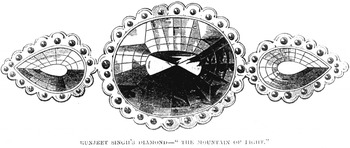
“Runjeet Singh's Diamond—‘The Mountain of Light,’” Illustrated London News, 26 May 1849, 332.

and attendant general allusions to the stone's inclusion in the Peacock Throne of the Mughals, an artifact that had been recorded in Jean-Baptiste Tavernier's seventeenth-century travelogue of India.Footnote 35 Tavernier wrote that he had seen a giant diamond connected with Shah Jahan's Peacock Throne, a 780-carat stone that was mined in “Kollur,” shaped down to 280 carats, and presented to Shah Jahan around 1656.Footnote 36 As this diamond had since been lost, many commentators speculated that it could have been cut in two, one half being made into what became the Orlov Diamond and the other the Koh-i-Noor.Footnote 37 To be sure, however, before the late 1840s the Koh-i-Noor was not a central piece in British imaginings of India but merely one object in a pantheon of Indian artifacts of interest. One of the first visual images of the stone in British print culture was a sketch of it (see fig. 1) that ran alongside those of other jewels in the Lahore treasury in the Illustrated London News as part of the newspaper's in-depth coverage of the Anglo-Sikh war beginning in 1848. The caption of the sketch reads “Runjeet's Singh's Diamond—‘The Mountain of Light,’” and the accompanying text cautions readers that it is “a mistake to suppose this diamond to be the largest and most precious in the world, for it is surpassed by several.”Footnote 38
However, once it became general knowledge that the diamond would become part both of the crown jewels and of the Great Exhibition, set to open on 1 May 1851, interest in the stone increased exponentially. A widespread recitation and codifying of its biography began, fed not only by Dalhousie's “official” research but by storytelling spawned outside of the court's and colonial government's control. A rumor, perhaps started by the Delhi Gazette and quickly taken up by the Illustrated London News, had it that the diamond was cursed: all who possessed it would run into ruin, as evidenced most forcefully by the “tragedy” of Singh's ruling line.Footnote 39 The curse rumor infuriated Dalhousie, particularly after he received a note from Victoria herself saying that she was anxious about the curse. He sprung into action, constructing the diamond as a benevolent talisman and writing, “When Shah Shoojah, from whom it was taken, was afterwards asked … ‘what was the value of the Koh-i-Noor,’ he replied, ‘Its value is Good Fortune; for whoever possesses it has been superior to all his enemies,’ … I sent the Queen a narrative of this.”Footnote 40 But the newspapers did him one better by articulating a different antidote: the queen's status as a female rendered her exempt from a curse ill-disposed only toward “Oriental” male despots. This, discursively, set the diamond in the same context as the feminine body of the British monarch and made this proximal relationship a necessity for counteracting the effects of the “Indian” curse. As the Illustrated London News had it, via the Delhi Gazette, “The mischievous superstition attaching to the possession of this unique and invaluable diamond might be utterly crushed by this retributive consignment.”Footnote 41 Years later, in 1865, C. W. King brought up the curse with regard to the Indian “Mutiny”-Rebellion in his book The Natural History, Ancient and Modern, of Precious Stones and Gems, “attribut[ing] the great mutiny of 1857 to its malignant influence.” King's book was a resounding success despite its many technical fallacies, and his recollection of the curse speaks to the enduring cultural purchase various facets of the invented lore commanded.Footnote 42
The curse (as well as the controversy the stone engendered) informed Wilkie Collins's construction of the fictional monster diamond at the center of his novel The Moonstone (1868). Collins drew on the Koh-i-Noor and the Orlov Diamond, both famously from India, as inspiration for his detective story about a diamond robbery.Footnote 43 The novel grapples with how imperial-colonial events in India created and affected a private household in Britain in unsettling ways, again underlining the diamond's lingering and fraught connection with British colonialism.Footnote 44
Another tale about the Koh-i-Noor's time between the Lahore treasury and the queen's possession upset the governor-general and the East India Company directors alike. As the story went, John Lawrence, a member of the EIC's Court of Directors, took possession of the stone after it was taken from the Lahore treasury. Being preoccupied with matters concerning the takeover of the Punjab, Lawrence dropped the stone into his waistcoat pocket and forgot about it. Six weeks later, the governor-general asked to see the diamond. As the story went with [his] heart in his mouth [Lawrence] sent for his old bearer and said to him: “Have you got a small box which was in my waistcoat pocket some time ago?” “Yes Sahib,” the man replied, “ … I found it and put it in one of your boxes.” “Bring it here,” said the Sahib. Upon this the older bearer went to a broken down tin box and produced the little one from it. “Open it” said John Lawrence, “and see what is inside?” He watched the man anxiously enough as each fold of the small rags was taken off and great was his relief when the precious gem appeared. The bearer seemed unconscious of the treasure which he had in his keeping. “There is nothing here, Sahib!” he said, “but a bit of glass.”Footnote 45
The EIC launched an inquest into the story, which produced sworn statements that the stone-and-pocket incident had never happened and that the diamond had been in perfect safety as it traveled to England.Footnote 46 Nevertheless, the anecdote of the “forgotten treasure” persisted. Periodicals related the “event” as a quirky story that contrasted humorously with the sordid, intense, and exotic details of the diamond's “Indian” past. Such recountings trivialized not only the meaning of the gem in Indian discourse and the violence of the conquest of Lahore on the EIC's behalf; they also trivialized the meaning of the gem in the market economy as priceless and yet entirely forgettable. Just as Victorians could argue that the British Empire had been acquired haphazardly, “in a fit of absence of mind,” so could Victorian reporters portray the Koh-i-Noor as having come to England lightly, almost accidentally.
As much as anecdotes like these worked to move the diamond beyond simple association with markets, money, and the business of empire, explications of the stone's market value were never absent from this Koh-i-Noor discourse. The jewel was never allowed to completely or simply register as a thing. Descriptions of its physical makeup—mostly having to do with its size and beauty or its reflective quality—abounded, eventuating in a “priceless” valuation that was estimated at somewhere between £500,000 and £3,000,000.Footnote 47 While this price range was certainly an exorbitant one for any Briton to imagine, it nevertheless gave the “priceless” diamond a specific value, a place within the political economy of mid-Victorian Britain as well as within the diamond market in general. Descriptions of its prized physicality could be highly exaggerated: not only was the diamond characterized as the largest in existence (hyperbole even the governor-general did not try to advance) but speculation mounted as to whether the “Mountain of Light” could actually emit light of its own accord. All these speculations about what the diamond looked like, what it would cost, how it came to be Victoria’s, and what it meant to India were printed and reprinted so often that curiosity about the diamond had swelled to a fever pitch by the time the Great Exhibition began. Expectations of grandeur for the item could not have been higher, and the “exotic” and “dramatic” history of the Koh-i-Noor was something that “most people [would] know,” as Lady Login, the wife of the EIC director entrusted with carrying the stone to London, recollected.Footnote 48
On the opening day of the Great Exhibition, 1 May 1851, spectators rushed to the east nave of the Crystal Palace for their first glimpse of the Koh-i-Noor, which was being shown “in a large gold bird-cage.”Footnote 49 They had endured the long opening ceremony, complete with Victoria, Albert, and other members of the royal family making a preliminary tour of the fair. Commentators of the day linked the monarch, the gemstone, and the glass building that housed the exhibition: The Times's coverage emphasized the grandeur of the Crystal Palace, how it “was like the Koh-i-Noor itself,” and how Victoria and the loyalty she inspired reflected and enhanced this grandeur.Footnote 50 The Crystal Palace was acknowledged to be a triumph of British architecture and craftsmanship, a fitting envelope for an event meant to celebrate the strengths of British industry. For its part, the Examiner played with the “Mountain of Light” moniker, arguing that it was a “superb description” for both the diamond and the building and that it reflected Victoria's countenance as well.Footnote 51 Palace, diamond, and monarch were thus all seen as magnificent and mutually reinforcing. Enhancing these associations, the queen wore, as The Times reported, “a dress of pink watered silk, brocaded with silver, trimmed with pink ribands and blonde, and ornamented with diamonds. Diamonds and feathers formed the head dress.”Footnote 52
Victoria's tour of the exhibition began with an inspection of the Koh-i-Noor, celebrating her association with the stone and its prominence at the fair. Dalhousie's vision of the diamond as a straightforward symbol of conquest was associated with an eighteenth-century brand of imperialism, one that had been discredited in favor of the rise of moral empire. As Thomas Richards has discussed, Victoria's challenge at the exhibition was to strike a balance between her symbolic status as a facilitator of British industry, “proper” empire, and progress and her identity as a female shopper-consumer involved in the launch of British consumer society. Her consumer choices were under intense scrutiny.Footnote 53
Given this context, the narrative of Singh's submissive durbar and “gift giving” of the jewel was crucial. As Pierre Bourdieu argues, the gift-exchange economy—while still very much an exchange of value—serves to mask the violence inherent in exchange between unequal bodies of power, violence that is usually more apparent in market economy exchange.Footnote 54 As the focal point in a supposedly amicable gift-giving relationship between Duleep Singh and Queen Victoria, the exchange of the Koh-i-Noor could mask on a symbolic level the economic exploitation alive in the East India Company's conquest of Lahore much more effectively than if the diamond had been seized by the EIC or Dalhousie on behalf of the queen. Although the Koh-i-Noor was a diamond of great worth, then, this was constructed as secondary to its value as a symbolic, archival piece. Dalhousie's role in the matter was necessarily eclipsed (much to his outrage) in favor of a narrative more palatable to the British public, one that the young maharajah was willing to support.
As Victoria inspected the newest addition to the crown jewelry, however, this romanticized history of Singh's submission was already subject to debate. By May 1851, the East India Company had renewed its claim to the Koh-i-Noor, arguing that Singh's durbar was a sham and that Dalhousie had no right to reserve the stone for the queen. Indeed, all of Dalhousie's actions were under review because the takeover of Lahore was being investigated by Parliament throughout the time of the exhibition. As The Times reported, it was ironic that with “a hundred thousand eyes staring at the precious jewel with such unsated interest,” the circumstances of how the Koh-i-Noor came into Victoria's possession were, at best, blurred: “Fifty times at least every morning are questions asked as to the capture, sale, purchase, or conveyance of this priceless treasure. Nobody appears to know exactly how it passed from the jewel-room of Lahore to its present resting place—whether it became British property by seizure or forfeit, or whether it fell to the Queen by tribute or right.”Footnote 55
No clear narrative was available for spectators to grasp, and, as Arndt Mersmann has shown, the physical layout of the Koh-i-Noor's place within the Great Exhibition raised even more questions. The cage was close enough to the India exhibit to draw associations between the diamond and the general EIC display in which other jewels from the Lahore treasury were shown, but the Koh-i-Noor was not a part of it. Although technically housed in the British area of the Crystal Palace, the golden cage was also removed from direct associations with those exhibits as well.Footnote 56 If anything, the only visual clue as to where and to whom the exhibit belonged was found on the top of the cage, where the gilded bars met: a golden crown reminded onlookers that the contents were royal property. The stone was undeniably associated first and foremost with the queen.
Victoria and the Koh-i-Noor were linked in the popular imagination in part because of the tremendous security that surrounded both. Before the event opened, rumors abounded about threats made by “Chartists” or by a “French or German Socialist” to murder the queen or to steal the Koh-i-Noor.Footnote 57The Times feared that these threats might cause the queen to withdraw from the opening ceremonies and thereby doom the exhibition.Footnote 58 When the opening ceremony went off without incident, anxieties about the monarch's safety seemed overblown: in jest, Punch included a full-page cartoon of “Her Majesty—as She Appeared on the First of May, Surrounded by ‘Horrible Conspirators and Assassins,’” who included her husband, their small children, and adoring ladies in the audience.Footnote 59
The security measures that were in effect to protect the Koh-i-Noor received almost as much attention as the stone itself did at the beginning of the exhibition. Although put in the same register as the monarch, the diamond still maintained its connection with India as the Daily News reported that “no human hand must touch this wonder of the east.”Footnote 60 While long descriptions of the cage and the stone's overnight protection were typical in newspaper coverage of the exhibition, the Spectator provided perhaps the most lurid account of the Koh-i-Noor's lodging:
While yet in the transept, there is what looks a gigantic brazen parrot cage. It's the iron cage that restrains and protects the famed “Koh-i-Noor” or “Mountain of Light” diamond. The solid bars of iron are gilded. The Diamond is supported in the air by two small golden hands. … It is about the size of a very small egg, hollowed on one side: on each side are two smaller diamonds. At night and on the touching of a spring by the custodian, these precious gems sink into a massive iron box of impregnable strength. … It is understood that ever so slight a touch of the glass shade which covers the Diamonds within the great iron cage would cause the machine to collapse like the leaves of the sensitive plant, and plunge the gems into the cavernous retreat till the authorities should summon them forth again with their privileged key.Footnote 61
The sexual overtones of “impregnable,” a “cavernous retreat,” and the phallic “privileged key” of authority are unmistakable in this passage, feminizing and sexualizing the diamonds and implying that their “virtue” remains intact through the security measures that both “restrain” and “protect” the gems.
Once it became open knowledge that the fabled stone was not living up to expectations, feminizing the Koh-i-Noor, as well as diamonds in general and the appreciation of them, became increasingly common practice. The glaziers had constructed the Crystal Palace so that when the sun was out, the east nave would be illuminated by sunlight. A pleasing concept, this design did nothing to enhance the diamond on the days when the sun did not shine, which turned out to be most of the time in London during the spring and summer of 1851. For the entire opening month of the exhibition, as throngs of people clamored to see the stone, the diamond was unlit, causing many to find it dull. Some thought it might have been a reproduction, because the “authentic” diamond in the public imaginary sparkled on an unparalleled level. As the Great Exhibition historian Yvonne French relates, diamond experts themselves were unsure of the Koh-i-Noor's authenticity; two juries were convinced that the diamond on display was only a paste imitation.Footnote 62 Eventually the display was changed so that gaslights illumined the cage and the stone within, now on a black velvet cushion. As one exhibition reviewer and aesthete, John Tallis, wrote, exhibition-goers were in danger of being duped:
On the right, and nearly at the entrance of the foreign nave, you observe a crowd, curious and eager, flocking about a great parrot-cage with gilded bars. Within that is placed on a cushion the Koh-i-Noor. This diamond supplies, in the history of Central Asia, the place of the golden fleece, and has occasioned more than one bloody war. … To ordinary eyes it is nothing more than an egg-shaped lump of glass. They may show us what they please and call it Koh-i-Noor. On ordinary days, that is, the shilling days, it is exposed in its great cage, ornamented with a policeman, and they rely on the sun to cause it to sparkle; but on the Friday and Saturday it puts on its best dress; it is arrayed in a tent of red cloth, and the interior is supplied with a dozen little jets of gas, which throw their light on the god of the temple. Unhappily, the Koh-i-Noor does not sparkle even then. Thus the most curious thing is not the divinity, but the worshippers.Footnote 63
The Examiner noted that excited fairgoers who had made their way to the east nave “speedily turned away from the Koh-i-Noor in evident disappointment,” and a startlingly similar phrase was used by the Observer.Footnote 64 By July, the Examiner had all but given up on the gem, reporting that, “the poor Koh-i-Noor is literally on its last legs” as the display was changed yet again to better compliment the diamond.Footnote 65Punch quipped that the Koh-i-Noor was “sick” and related that Mr. Punch had heard a “stupid Frenchman” say that the diamond gave “about as much light as the sun in England.” Mr. Punch in turn declared, “The less it is seen, the more it is appreciated.”Footnote 66
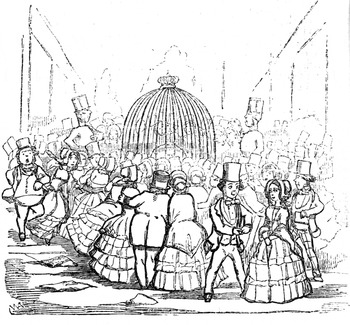
Punch never missed an opportunity to satirize the situation, and through its pages we see the most detailed criticisms not only of the acquisition of the Koh-i-Noor but of diamonds and luxury consumption in general. Picking up on the notion of diamond appreciation as frivolous, silly, and feminized, the magazine published the invective “What I Remarked at the Exhibition,” which dismissed the Koh-i-Noor display as merely the one to which “the ladies would go the first thing.”Footnote 67 A cartoon in another issue of Punch visually reinforced this point, depicting primarily women interested in getting a view of the diamond's cage (see fig. 2). The accompanying text asks, “Do you see what a crowd hems in the monster bird-cage?—which bird-cage many a fine lady would give up her pew in church to be able to hang up in her drawing room. What a number of cats (on two legs) there would be jumping up after it, to be sure!”Footnote 68 Two men occupy a central position in the cartoon, one shown talking to a lady, and another hemmed in by two women, his arm around one of them. Elsewhere, other men are also pictured touching the women near them. It is possible that here the cartoonist encoded a commentary on how women were vulnerable to male advances in the crush of people around the gemstone, the ladies’ attention directed to the diamond, their defenses down. Visually, the arc of the diamond's cage compliments the arc of the ladies’ hoopskirts, allowing for a commentary on the protection of the “diamond within,” recalling the Spectator's sexualized narrative of the Koh-i-Noor's security discussed above.
“The Front Row of the Shilling Gallery,” Punch, 5 July 1851, 10.

Erin Mackie has shown how in the eighteenth century the hoopskirt was a lightning rod for anxieties about female sexuality and desire (e.g., a woman's hoopskirt could conceal her pregnancy) and women's power in the public sphere, especially with respect to commodity consumption. The hoopskirt spawned invectives against the “shamelessly conspicuous” amount of space women took up in public when wearing one: “Ten thousand eyes were fixt on her alone.” For this, the skirt was repeatedly derided as frivolous and vain, the height of improper, feminized consumption.Footnote 69 The parallels between hoopskirt discourse and gendered commentaries on the Koh-i-Noor's gilded cage and female audience are striking: it is entirely possible to read figure 2 as depicting, first, the Koh-i-Noor enabling females to indulge themselves, through the spectacle of the diamond, in gauche luxury consumption; second, the diamond being inappropriately vain and central to the exhibition; and, third, the spectacle facilitating “dangerous” sexualities.
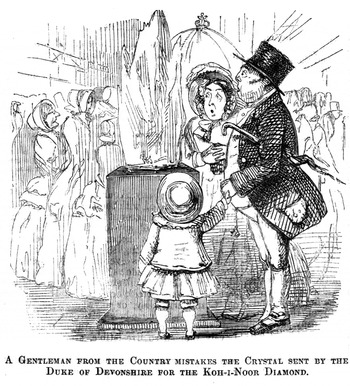
The way the Koh-i-Noor spectacle encouraged females to desire diamonds was belabored in “Diamond Dialogues,” Punch's fictional dialogue between the two policemen stationed next to the Koh-i-Noor. Says Policeman A1, “Behold them here. Women—moths; diamond—candle!” Policeman B2 replies, “I say, did you ever see a cat, all alone, watching a canary, or a bowl of gold-fish? Well, then, just look at that old lady lookin’ at the diamond! If her eyes don’t turn green and yellow, and if she don’t run the tip of her tongue round her mouth as if she was already tastin’ the Mountain!”Footnote 70 Association of women with diamonds and the Koh-i-Noor, either as consumers of spectacle or as literal consumers of diamonds, ran in juxtaposition to articles such as “Ballad for Old-Fashioned Farmers: On the Great Exhibition,” which contained the verse “I hears a vast deal, and I s’pose I shall moor, / About that famous diamond the gurt Koh-i-Noor, / That's wuth nigh a million, as folks do relate; / But what's that with wheat down below thirty-eight?”Footnote 71 This contrasted the Koh-i-Noor as frivolous and feminized and the production of wheat as masculine and rational. Indeed, Punch was not the only publication to underline the absurdity of how the diamond registered simultaneously on symbolic and economic levels: as early as opening day, the Daily News quipped that the stone, “to the uninitiated observer, [is] a very inadequate representation of two millions of money.”Footnote 72 Another Punch cartoon (see fig. 3) pictures this “uninitiated observer” as a “gentleman from the country,” unused to metropolitan diamond fashion: “A Gentleman from the Country mistakes the Crystal sent by the Duke of Devonshire for the Koh-i-Noor Diamond” depicts how the appearance of the diamond did not live up to the hyperbolic descriptions of it at large in the public's imagination and hints at the elitism and whimsicality of diamond fashion in general.Footnote 73
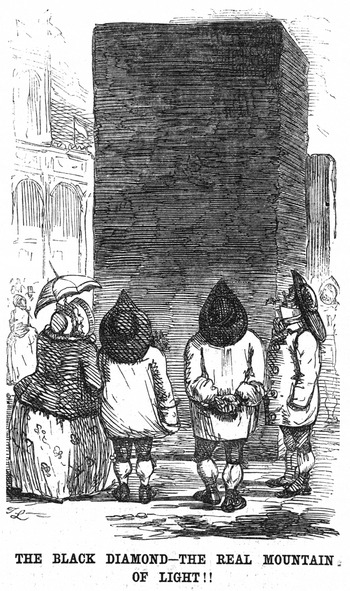
Repeatedly, Punch played with the idea of the diamond trade as feminine, superfluous, and ultimately incongruous with the goals of the exhibition, which were to promote industry and progress. The magazine deployed the ironic motif of comparing diamonds to coal throughout the exhibition. Both substances were acknowledged to be composed of carbon, but in the logic of satirizing, coal stood for masculinized production and diamonds stood for feminized consumption. The irony that the “Mountain of Light” did not emit light but that coal, when put to private and industrial use, did—literally and in terms of driving industrial progress—was too good to pass up for many contemporary commentators, as the motif was taken up by John Tallis as well (see fig. 4). “The Black Diamond—The Real Mountain of Light!!” depicts Punch's take on the matter, namely, that the most important commodity the crowds should be made to appreciate was the industrial potential of coal.Footnote 74 Always interested in lampooning the aristocracy, the magazine noted that when gas (another form of carbon) was used to light the diamond, “The Koh-i-noors of society only shine with the borrowed light of those working beneath them in station!”Footnote 75
“A Gentleman from the Country mistakes the Crystal sent by the Duke of Devonshire for the Koh-i-Noor Diamond,” Punch, 17 May 1851, 200.

The magazine made the contrast between carbon forms again in a fictional encounter, “Coal and Koh-i-Noor,” in which the diamond, in the form of an “Indian maid” converses with a male “Coal Gnome.” As the conversation progresses, the Indian maid, symbolizing not only the famous stone but the diamond trade as well, presents a number of traits typically associated with the feminine: her movement (and power) is localized; she is petulant and makes war easily; she is beautiful and passively accepts praise but eventually withers and retires. In contrast, the Coal Gnome travels the world, forging the “chariot wheel” of peace, and guides looms, builds palaces, and grinds grain. He easily outlasts the diamond and creates while she destroys, an outright negation of the female reproductive
“The Black Diamond—The Real Mountain of Light!!” Punch, 14 June 1851, 252.

capacity and a rehearsal of the stereotype of the voracious, consuming woman.Footnote 76 Mr. Punch took pains to warn his readers that dependency on Indian consumer goods (diamonds, in this case) was not a financially stable course of action and that investment in British industry would power the nation-empire much more effectively. In the logic of gendered colonialism and orientalism, as Lata Mani has shown, the Indian representative's identity as a maid would have immediately signaled to the cartoon's readership that she was an overdetermined symbol of entrenched traditionalism, unprogressive and timeless.Footnote 77 For Mr. Punch, the Koh-i-Noor was the “Mountain of Darkness” on a number of levels.Footnote 78
Through Punch's dismissal of the stone, we can see how in the context of the exhibition the Koh-i-Noor registered not as the next best introduction to British imperial material culture but as a throwback to an eighteenth-century brand of imperial plunder and frivolous diamond consumption. Mr. Punch refused to let his readers forget that the stone was essentially war booty. At the end of “Diamond Dialogues,” Policeman B2 asks with regard to the Koh-i-Noor, “What, did we buy and pay for it?” A1 replies, “Bought it with the brave blood of armies, and the gold of soldiers’ pay! Paid I don’t know how much in blood, and gold, and gunpowder, and bayonet cold iron.”Footnote 79
Punch's critique of diamonds and the diamond trade was also directed toward the realities of British involvement in the trade in the 1850s. By then, Indian raw diamond production was negligible—the Indian diamonds that came to Britain in the nineteenth century were gained only sporadically, through EIC war booty settlements.Footnote 80 The majority of the diamonds that poured into London markets to be distributed throughout Europe and the world came from Brazil. Since 1802, the British government, along with private investors, had been heavily involved in handling diamond extraction in Minas Gerais, the “diamond fields” of Brazil. It was open knowledge that slave labor was still used in the fields; the fact that Britons were still involved in the African slave trade, supplying and managing some of that labor, was known but sublimated in public discourse.Footnote 81 What place did Victoria's performative consumption of a large diamond—arguably an emblem of slave labor, imperial plunder, and dangerous female desires—have at an exhibition devoted to progress, industry, and science?
Perhaps most unsettling for contemporaries was not, then, the failure of the diamond but its success. Tallis's quip comes again to mind: “The most curious thing is not the divinity, but the worshippers.”Footnote 82 While Punch simply dismissed the “worshippers” as women unable to control their consumptive desires, it was the only publication to identify the spectators as solely female. The Observer decided that the public's attraction to the stone was “owing to some talismanic influence it possesses … and this it has continued since the day the Exhibition opened, the central sun, round which a crowd of worshipping satellites revolve.”Footnote 83 For Tallis, the answer lay in the viewers' class: on shilling days, people ran to see the Koh-i-Noor, again and again, because of their low, unrefined taste. Their acceptance of the stone was in keeping with that of the “uncivilized” Indians, who also worshipped idols; indeed, it was the “Oriental” cut of the diamond that was blamed for the its inability to gratify “British” taste. To Tallis, Mr. Punch, and others, the horror of the Koh-i-Noor at the exhibition was that an “Oriental” aesthetic and product, absorbed into Britain via blatant plunder imperialism, was being hypervaluated at a venue designed to celebrate Western industrial achievement and Whiggish progress.
By the close of the exhibition and despite all efforts to improve its display, the Koh-i-Noor, while successful in attracting spectators, had obviously failed to live up to expectations and do the kind of cultural work the royal family had intended it to do—and Victoria had not even had a chance to wear it on her person, within a crown or anything else. The Koh-i-Noor was a decidedly unfashionable ornament, even though it was still inextricably linked with one of the most prominent tastemakers in the country, not to mention the figurehead of the nation-empire. As historians of fashion have made clear, the need for women in power to appear to be in fashion was tremendously high, since for them to appear to be out of fashion was to invite criticism about the legitimacy of their status and their belonging in an elite social echelon.Footnote 84 Fashion was an issue for many in Britain, but for Victoria, whose body and attire were under such intense scrutiny, the performance of her (albeit unique) role in society was integral to her project of becoming a monarch popular with the bourgeoisie and seeing the monarchy through republican challenges.Footnote 85
As for the diamond's role, the discourse of consumption, as Erin Mackie has explored, constructed women as “colonized” by the commodities they consumed; it was a horrifying thought that this unworthy Indian object could make Victoria its subject.Footnote 86 In a similar vein, Marcia Pointon argues that although it was a marker of femininity to receive jewelry as a gift, “at the same time, being a recipient of jewels carried obligations and gave rise to possibilities and to dangers.”Footnote 87 Dalhousie automatically assumed the relationship with India that was being articulated through Victoria's appropriation of the Koh-i-Noor was a simple narrative of British dominance, but the cultural discourses of fashion, jewelry giving (and jewelry wearing), and female consumption created a much more ambiguous reading of the diamond exchange, one that went beyond the context of the exhibition.
Prince Albert responded to the Koh-i-Noor's negative press by having the stone recut. I contend that this refashioning of the gemstone, carefully staged to incorporate British science and technology (though secretly dependent upon Dutch expertise), was an attempt to reposition the artifact in British material culture as a symbol of the British Empire's civilizing mission in India. The diamond would be redeemed, supposedly, by the cutting of regular facets into its face, rendering a symmetrical, highly reflective object of consistent coloring and transparency. Ellen Kennedy Johnson's work on the rage for Chinese wallpaper in Britain shows how the appreciation of authentic Chinese wallpaper in the eighteenth century gave way to a taste for “rational,” neoclassical print designs. Aesthetically, Europeans came to appreciate “orderly” designs just as rationality, order, and progress began to be seen as particularly Western values.Footnote 88
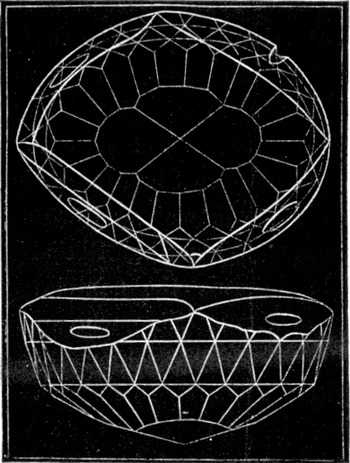
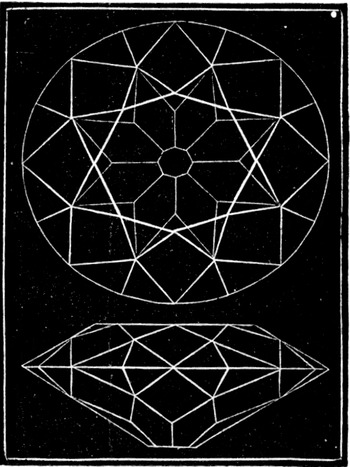
The same was true for diamonds. Early modern Indian lapidaries cut gemstones so as to preserve their size and weight. Between 1750 and 1850, almost all diamonds coming from India to Europe—the famous Pitt (Regent) Diamond, the Hope Diamond, and the Sancy Diamond—were recut to enhance brilliancy, the “brilliant” fashion being a mathematically symmetrical pattern of facets designed to maximize reflectivity at the expense of the stone's size. Many of these recuts received a great deal of attention when they were made;Footnote 89 the Koh-i-Noor was only the latest monster diamond to be restyled. However, the recutting of the Koh-i-Noor became a celebrated part of the diamond's biography in a way that set it apart from other famous diamond “makeovers.” For example, in Louis Dieulafait's 1871 book on diamonds and precious stones—a best seller in England, France, and the United States—the author includes “before” and “after” engravings only for the Koh-i-Noor (see figs. 5 and 6) and not for other famous diamonds.Footnote 90 Dieulafait's engravings not only underscore Johnson's point about the imposition of symmetry and regularity on the diamond; they also, it is important to note, show at first glance in both the “before” and the “after” images a diamond of approximately the same size. In point of fact, the recutting reduced the Koh-i-Noor by about 40 percent. This reduction was seen as the cost of redeeming the stone.
As soon as the Great Exhibition ended, Albert began his quest to refashion the diamond by contacting a handful of British academic scientists. Sir David Brewster, the renowned physicist, sent his six-point report on the Koh-i-Noor to the prince. It began, “As this Diamond is, in its present state, useless as an ornamental Gem, it possesses only a historical value.” The trick to redeeming the stone, in Brewster's reasoning, would be to reduce its size and change its form without losing its “historical character.” While the scientist went back and forth on what cuts would be appropriate and vaguely urged a move toward symmetry, he ultimately recommended that the prince consult a diamond cutter.Footnote 91
Other scientists Albert turned to included Nevil Story-Maskelyne, head of geology and mineralogy at the British Museum, and crystallographers James Tennant and Walter Mitchell. Brewster, Tennant, and Story-Maskelyne, in particular, became Britain's leading authorities on the Koh-i-Noor, its physique, history, and
“The Koh-i-Noor before recutting.” Louis Dieulafait, Diamonds and Precious Stones (New York, 1874), 95.

place within the crown jewelry.Footnote 92 The crown-sponsored effort by academic science to strategize the diamond's recut, though of little use when it came down to the actual act, reveals how the diamond's reputation was to be rehabilitated and reconfigured to symbolize progress, rationality, and British modernity. Still maintaining its Indian heritage and associations, the Koh-i-Noor, in its offensive “Oriental” cut, would be modified, improved upon, and, in a word, civilized. If successful, the “new” gemstone would allow Victoria to be bound up in imperial discourse in positive ways, rehabilitating diamond consumption for a modern monarchy and a modern era, modeling “proper,” Western diamond aesthetics for those Koh-i-Noor “worshippers” who had in themselves exhibited poor taste at the Great Exhibition.
Albert's recourse to British science and to the idea that the diamond could be changed to reflect English taste and still maintain its Indianness recalls Macaulay's overtures to the progressive qualities of Western science and culture. Brewster's
“The Koh-i-Noor after being re-cut.” Louis Dieulafait, Diamonds and Precious Stones (New York, 1874), 98.

insistence that the diamond's Indian history somehow be kept intact illuminates a way the gem registered in British material culture as an article manifesting British imperialism in India. Through “civilizing” it via a complete structural intervention, the stone would no longer be associated with an outdated imperialism of plunder and instead could take its place as a member of Macaulay's enlightened (both figuratively and literally) class. Moreover, the “work” the gem would be doing would be to model a perfect, useful kind of subjecthood for all of India. This could mitigate the charge of frivolity inherent in discourse about diamonds and jewelry at large. As Pointon argues, if jewelry could be shown to be useful, it would not be regarded as an ostentatious display of vanity.Footnote 93 The question remained: could this be done?
After turning to the scientists, Albert consulted the diamond cutters. Several refused to be involved because they felt the gem would be irreparably damaged in the process. The prince was undeterred; he was willing to sacrifice the diamond in the hopes that it could be redeemed. After several weeks, the Coster firm in Amsterdam agreed to produce a recutting strategy, one that they (erroneously) promised would not reduce the weight of the stone in any significant manner.Footnote 94
Beginning on 16 July 1852 and lasting for “thirty-eight days of twelve hours each,” the diamond was recut.Footnote 95 Led by The Times, the London press followed the process intently, spurred on by the flow of scientists and aristocrat-celebrities who visited the crown jewelers, Messrs. Garrard of Panton-street, to observe the cutting. Chief among them, and the person who participated in making the first cut, was the aged Arthur Wellesley, duke of Wellington.Footnote 96 The Garrards agreed that the duke would be a fine mascot for the endeavor—if the diamond were damaged in the first cut, all could be blamed on a very old man who was the vanquisher of Napoleon Bonaparte and beyond reproach. In addition, the duke was associated with military successes in India, having fought Tipu Sultan and orchestrated the British takeover of the Deccan. For his part, Wellesley was fascinated by the process and attended several meetings leading up to the event, becoming a more-than-willing “dook,” or diamond holder, for the initial process. The recut was set up to be a triumph of Western science; the diamond was constructed as raw material, under- or improperly worked by “Oriental” artistry. “Superior,” masculinized Western mathematics, machinery, and aesthetics were deployed to extract, along proper British lines, the spectacular worth from this “Mountain of Light.”Footnote 97
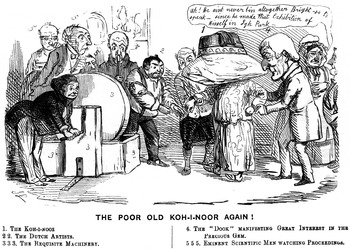
As it had been throughout the Great Exhibition, Punch was on the spot to lampoon the highly staged cutting process. In a cartoon (see fig. 7), a sickly-looking Koh-i-Noor dressed in “Oriental” garb is depicted as being led to “The Requisite Machinery” by the “Dook” of Wellington while “Eminent Scientific Men Watching Proceedings” oversee the Dutch artists who are actually doing the work. A woman in the background notes that the diamond has not looked good since “he made that Exhibition of Hisself ” in Hyde Park. Mr. Punch characterized the process as surgery: “We hardly know how to describe the nature of the operation, unless we compare it to the removal of cataract from the Mountain, so as to bring out the eye of the Koh-i-Noor into a state of brilliancy.” He made fun of the scientists—“savants” who were ultimately useless, having to rely on Dutchmen—and professed to caring more about Mr. Garrard (who broke his leg one day during the recut) than about the progress of the diamond.Footnote 98
The Coster firm's claims that it would be able to cut the diamond without reducing its weight were repeated in the London press throughout the recutting process. By the time the operation was complete, the ridiculousness of these claims was plain: the diamond was significantly smaller than it was when it arrived in England. While this was, in fact, typical of the costs of Western diamond-cutting strategies, the loss of a 186-carat diamond was shocking to many—so shocking that it came to eclipse assurances by journalists who attended the (re)unveiling that the profound restyling had left the Koh-i-Noor “unsurpassed by any other
“The Poor Old Koh-i-Noor Again!” Punch, 7 August 1852, 54.

of above ground, in type, lustre and beauty.”Footnote 99 Questions were raised as to whether or not the recut actually had been such a success, for the diamond still was not as brilliant as might be expected of a “Mountain of Light.” As Mr. Punch related, “After all this fuss had been made, and expense gone to, a discussion arose as to whether the patient really is itself after all—whether the Koh-i-Noor is the Koh-i-Noor?—a query that seems to us a little like taking off a man's leg, and then proceeding to ask whether he is the individual in whose case amputation is required.”Footnote 100
While still intensely interested, the public received the “new” Koh-i-Noor with mixed reactions. It remained a major attraction at any exhibition in which it appeared, beginning with the Dublin Exhibition in 1853 and continuing through the World's Fair in London in 1862. But, as Brewster had warned, some of its symbolic value was lost in the makeover: King wrote in 1865 that the recutting was “a most ill-advised proceeding, which has deprived the stone of all its historical and mineralogical value; for as a specimen of a monster diamond whose native weight and form had been as little as possible diminished by art … , it was unrivalled in Europe; and giving in their stead a bad-shaped, shallow brilliant, of but inferior water, and only 102.5 carats.”Footnote 101 Replicas of the gemstone became attractions, beginning with the glass mock-up on display at the British Museum (courtesy of Story-Maskelyne). The practice of displaying replicas moved beyond museums into the market proper—jewelers such as Bond Street's Edwin Streeter sported replicas of a pantheon of famous diamonds, the Koh-i-Noor among them, as did Harrods department store. Significantly, whether it was on exhibition itself or in replica form, the “new” Koh-i-Noor was displayed alongside replicas of the “original” stone, indicating how the recutting process was part of the attraction.Footnote 102 In this way, the controversy over the diamond and its Indian past was never excluded from public memory; rather, the complexity of the situation in 1851 continued to inhere in the meanings of the stone long after it had been accepted as a part of the crown jewelry.
The unease with which the Koh-i-Noor was greeted after its recutting can again be explained by the diamond's resonance as a symbol of the relationship between Britain and India. By the mid-1850s, British imperialism and culture had moved away from Macaulay's formulation of the civilizing mission—if, indeed, Macaulay's vision, delivered in 1835, had ever been dominant. The rise and success of the abolitionist movement was the crucial context from which a decidedly evangelical brand of “moral empire” emerged, inheriting a missionary discourse infused with racialist thought and hailing Britain's divine duty to Christianize, protect, and elevate non-Anglo-Saxon “others.” In this vein, Robert Moffat and David Livingstone, two missionaries whose work in Africa would be celebrated for the latter half of the nineteenth century, were perhaps more fitting mascots for the midcentury civilizing mission than was the Koh-i-Noor.Footnote 103 The Indian Rebellion, or “Mutiny,” of 1857–58 is typically seen as the watershed moment when British attitudes toward India shifted to entire dismissal of the idea that India and Indians could achieve “proper” modernity and progressive civilization.Footnote 104 We can see in this earlier moment of 1851–52, through the uneasy reactions to the Koh-i-Noor, that this shift was beginning in British ideology before the Indian Rebellion later in the decade. Doubts abounded as to whether the diamond could be completely “civilized” and simultaneously maintain its role in Indian history.
Bound for a central spot in the Crown of State in 1850, the Koh-i-Noor was used at various times by Victoria in a diadem, a brooch, and a bracelet but never became the central piece that Dalhousie had imagined. The queen did not even wear the diamond in public in Britain until the marriage of her daughter to the crown prince of Prussia in 1858—she was careful to display the piece in the context of family milestones as per the dicta of “proper” feminine diamond jewelry display.Footnote 105
Scholars such as Catherine Hall and Philippa Levine have shown how imperial politics, culture, and ideology in the nineteenth century were animated by anxieties about the incompleteness of British hegemony—that the empire, a complex network binding colonies and metropole, was always at risk of imploding, degenerating, and becoming dysfunctional.Footnote 106 Amid this anxiety and the concomitant shifting, multivalent meanings of empire, narratives of the Koh-i-Noor unsuccessfully attempted to fix the meaning of Britain's intervention in India for mid-Victorian audiences. Delivered to England as an artifact of British conquest, the diamond became a symbol of the “civilizing mission,” and a contentious one at that. Contemporaries fought over its resonance as an object of value, as an object of feminine desire, as quintessentially “Oriental,” as a symbol of the monarch, and as a symbol of unprogressive economy. The invocation of Britain's imperial identity to activate the monarchy was not a strategy reserved for the era of high imperialism in the 1870s and 1880s but was used much earlier in the century—to complex and unforeseen effects. Never again did Victoria purchase or accept as a gift a famous large diamond, although many were offered to her, including the 245-carat Jubilee Diamond from South Africa, ostensibly designed for her Diamond Jubilee of 1897. As for the Koh-i-Noor, perhaps the official royal history of the English Regalia puts it best: “No King of England has worn it, and it has never been set in a sovereign's crown.”Footnote 107